Exodus 2:18
And when they came to Reuel their father, he said, How is it that ye are come so soon to day?
Translations
American King James Version, KJV Cambridge Paragraph Bible, Webster Bible
And when they came to Reuel their father, he said, How is it that you are come so soon to day?
And when they came to Reuel their father, he said, How is it that ye are come so soon to day?
And when they came to Reuel their father, he said, How is it that ye are come so soon today?
And when they came to Reuel their father, he said, How is it that ye are come so soon to-day?
And they come in to Reuel their father, and he saith, 'Wherefore have ye hastened to come in to-day?'
And when they came to Reuel their father, he said, Why are ye come so soon to-day?
Then came they in unto Reuel their father,—and he said, Wherefore have ye so early come in to-day?
Berean Standard Bible, Majority Standard Bible
When the daughters returned to their father Reuel, he asked them, “ Why have you returned so early today?”
When they came to Reuel, their father, he said, “ How is it that you have returned so early today?”
And when they came to Reuel their father, he said, How is it that you have come back so quickly today?
And whe they came to Reuel their father, he said, Howe are ye come so soone to day?
Douay-Rheims (Challoner revision)
And when they returned to Raguel their father, he said to them: Why are ye come sooner than usual?
Pictures
Cross-references
- Exodus 3:1
Now Moses kept the flock of Jethro his father in law, the priest of Midian: and he led the flock to the backside of the desert, and came to the mountain of God, even to Horeb.
Both name Moses' father-in-law, Jethro, also called Reuel.
- Acts 7:29
Then fled Moses at this saying, and was a stranger in the land of Madian, where he begat two sons.
Stephen recalls Moses’s stay in Midian after fleeing Egypt.
- Exodus 4:18
And Moses went and returned to Jethro his father in law, and said unto him, Let me go, I pray thee, and return unto my brethren which are in Egypt, and see whether they be yet alive. And Jethro said to Moses, Go in peace.
both name Moses' father-in-law as Jethro and Reuel
- Numbers 10:29
And Moses said unto Hobab, the son of Raguel the Midianite, Moses’ father in law, We are journeying unto the place of which the LORD said, I will give it you: come thou with us, and we will do thee good: for the LORD hath spoken good concerning Israel.
calls Hobab son of Raguel Moses' father-in-law
- Exodus 18:12
And Jethro, Moses’ father in law, took a burnt offering and sacrifices for God: and Aaron came, and all the elders of Israel, to eat bread with Moses’ father in law before God.
both name Moses' father-in-law
- Judges 4:11
Now Heber the Kenite, which was of the children of Hobab the father in law of Moses, had severed himself from the Kenites, and pitched his tent unto the plain of Zaanaim, which is by Kedesh.
calls Hobab Moses' father-in-law
Commentary
Each commentary is drawn from primary sources: the writings of Ellen G. White and Adventist pioneers and periodicals. Each commentary is separate. Its own words are not a quotation; follow the references to read the source passages.
Ellen G. White
6 sources
Reuel was the father of the women Moses had helped at the watering place.ST Feb 19, 18801SP 167.2–168.1 His words record his surprise at their unusually early return that day from watering their father's flock after Moses helped them.ST Feb 19, 1880SG3 185.1–2 His daughters regularly tended and watered their father's flock.1SP 167.1SG3 185.1–2 Reuel is the same person as Jethro.SG3 185.1–2PP 247.2
He was a worshiper of God, a God-fearing priest and prince of Midian, honored by those around him for wise judgment.1SP 167.2–168.1PP 247.2 The verse belongs to the account of Moses' flight from Egypt and his God-guided arrival in Midian.SG3 185.1–2PP 247.2 Moses was received into Reuel's household, married one of his daughters, and remained in Midian forty years as keeper of his father-in-law's flocks.1SP 167.1SG3 185.1–2PP 247.2 Reuel's influence on Moses was great.1SP 167.2–168.1
Moses' change from a mighty statesman and leader of armies in Egypt to a keeper of Jethro's flocks came because he had not yet learned the lessons essential for true greatness.Ms 14, 1896, par. 11 In that humble, lowly station of work his sympathies were drawn out to the sheep and lambs, and he learned to guard these creatures with the tenderest care toward every living thing, recognizing that God cares for all He has made and that sheep show mistreatment by their attitude though they cannot complain aloud.Ms 14, 1896, par. 11 By learning what it means to be a true shepherd of sheep, Moses learned to be a tender shepherd for Israel, a training still needed by anyone with a harsh, overbearing spirit.Ms 14, 1896, par. 11
Sources
Pioneers and periodicals
16 sources
The verse records Reuel asking why his daughters had returned so unusually early that day after Moses helped them water their father's flock.ST Feb 19, 1880ST Nov 27, 1901 It belongs to Moses' flight to Midian after he killed an Egyptian and escaped Pharaoh, before his forty years of wilderness schooling and God's call to deliver Israel.ST Jan 24, 1911 Reuel, also called Jethro, was Moses' father-in-law and the priest of Midian, a worshiper of the true God whose home gave Moses refuge from Egypt.RH Jul 1, 1873ST Apr 2, 1912 Those long years keeping sheep in lonely exile curbed Moses' eager spirit and taught him humility, faith, patience, and tender care, fitting him to lead God's people out of Egypt toward Canaan.RH Feb 4, 1873ST Nov 27, 1901 It stands in the historical opening of Exodus that relates Israel's oppression in Egypt and the birth, rearing, and calling of Moses to deliver his people.ST Jan 20, 1909
Setting and Meaning
Exodus 2:18 stands in the first, mainly historical division of Exodus in chapters 1-18, and specifically in chapters 1-4 which relate the oppression of Israel in Egypt and the birth and upbringing of Moses until he is called to be the deliverer of his people.ST Jan 20, 1909 It belongs to the history in Exodus 1 to 12 of God's call to the kingdoms of earth, when Egypt ruled the world three and one-half millenniums ago as the greatest kingdom of earth, acknowledged for might and power and skill and wisdom in statecraft.ST Nov 14, 1906 Its annually overflowing river fertilized its land and was deified as a god, while the sun joined the river in producing food and was worshiped, with its kings titled as representatives of the sun-god.ST Nov 14, 1906 At that time the few descendants of the nomadic patriarch Abraham sought supplies from Egypt's granaries after the captive slave Joseph had taught Pharaoh to store grain in plenteous years and had instituted an easy rental and tax land-law under which Egypt prospered without oppression while his memory was honored.ST Nov 14, 1906
The verse belongs to the time when the promise sworn to Abraham drew near and Moses, qualified and commissioned by God, began to make Israel know the statutes of God and His laws.ST Feb 28, 1906 Israel had nearly lost the knowledge of God and His laws during the long slavery in Egypt amid polytheism, idolatry and licentiousness, and Sabbath observance had become difficult if not impossible for a people sunken in slavery.ST Feb 28, 1906 Moses' effort to make the people rest from their work brought Pharaoh's rebuke and harsh measures to crush the attempt at Sabbath observance.ST Feb 28, 1906 It is part of the account of Moses' early life and flight to Midian after he killed an Egyptian and escaped Pharaoh, before his forty years of wilderness schooling and God's call to deliver Israel.ST Jan 24, 1911
The verse records that Reuel was the father of the women Moses had helped, that he noticed their unusually early return from watering the flock, and that he asked why they had come back so soon that day.ST Feb 19, 1880ST Nov 27, 1901 His daughters had returned home earlier than their father expected after Moses helped them water their father's flock.ST Nov 27, 1901 The meeting belongs at a fountain in Midian to which Moses had fled, a place where women and girls came to draw water, as they did at Nazareth.ST May 19, 1898
The verse belongs to the early history of Moses told in Exodus 2, which records his being hidden three months by his parents, his adoption by Pharaoh's daughter, and his flight into the land of Midian.ST Apr 13, 1904 That history is true and reliable, not fabulous or mythological, because the same account is largely reproduced in Stephen's recounting in Acts 6 and Acts 7:17-60.ST Apr 13, 1904 It is part of the general series of events related in the first fourteen chapters of Exodus, which would not be expected to obtain any direct mention in the historical records of Egypt, because nothing was ever registered on the public monuments except successes and triumphs.RH Apr 23, 1908
Identity and Training
Reuel is the father of the daughters who came to him, and he is Moses' father-in-law.RH Jul 1, 1873ST May 10, 1910 Reuel is the same Hebrew word as Raguel, and Reuel or Raguel and Jethro and Hobab are all names denoting Moses' father-in-law.RH Jul 1, 1873 The description of Hobab as the son of Raguel does not make him a different man from Raguel or merely Moses' brother-in-law, since Numbers 10:29 and Judges 4:11 both still call Hobab, the son of Raguel the Midianite, Moses' father-in-law, and Judges is as fully inspired and as exact as the earlier texts.RH Jul 1, 1873 As held by others, Reuel and Jethro are two names for the same man, Moses' father-in-law, as Jacob and Israel are two names for one man, yet the word father can also mean grandfather or remote ancestor, making Reuel the grandfather of the daughters and the father of Jethro, Jethro the father-in-law of Moses, and Hobab the brother-in-law of Moses.ST May 10, 1910
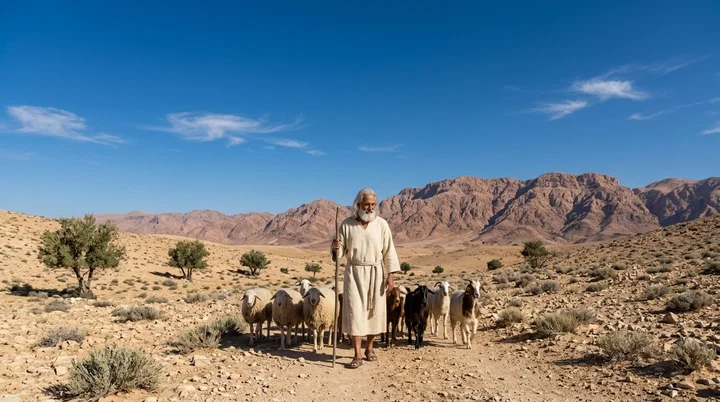
Reuel, or Jethro, the priest of Midian, was a worshiper of the true God and one of God's witnesses scattered through the nations outside Israel, and his home gave Moses a place when Moses fled from Egypt, proving that not all of God's true people were found in the called nation.ST Apr 2, 1912 The years in Midian keeping sheep were a course of preparation that fitted Moses to lead God's people out of Egypt and toward Canaan. That lonely exile followed his premature blow to deliver his brethren, when he fled for his life to escape the wrath of an offended king and found as a lonely exile a home in the desert with the holy priest of Midian.RH Feb 4, 1873
There he took a shepherd's humble garb and led Jethro's flocks forty long years while his suffering people still groaned beneath the oppressor's yoke.RH Feb 4, 1873 Those tardy years of weary waiting were God's training, who sees the end from the beginning, curbing and disappointing his eager spirit to gain just the experience needed to fit that chosen servant for his high and holy mission, to lead God's people as a tender, patient shepherd, teaching unwearied labor, patient waiting, and steady earnest aim until the appointed time comes.RH Feb 4, 1873 Moses patiently endured that exile, and the experience prepared him for his work in the exodus of Israel from Egypt and for his long trial in the wilderness.RH May 2, 1865 The long period of humble labor and hardship taught him humility, faith, patience, self-denial, obedience, and tender care for others, and these experiences prepared him to lead Israel compassionately, showing that human training alone could not replace the character formed through this experience.ST Nov 27, 1901 Through that exile as a period of preparation for his ministry he learned humility and how to walk with God.RH Nov 18, 1873
Sources