Exodus 2:8
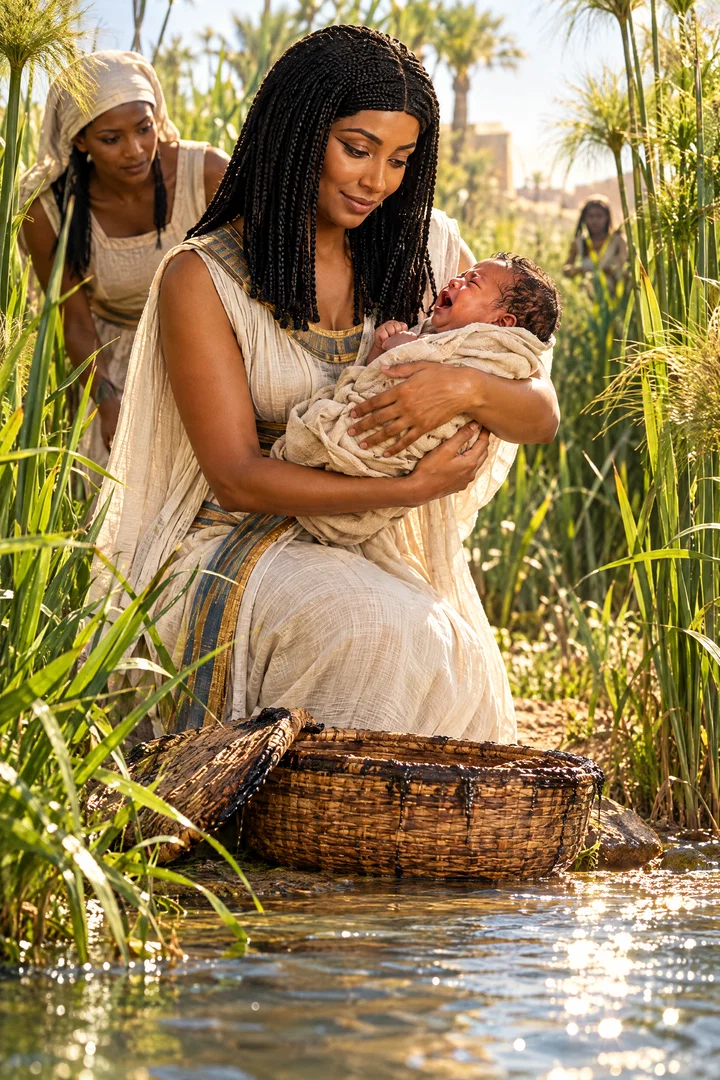
And Pharaoh’s daughter said to her, Go. And the maid went and called the child’s mother.
Translations
American King James Version, King James Version, KJV Cambridge Paragraph Bible, Revised Version
And Pharaoh’s daughter said to her, Go. And the maid went and called the child’s mother.
And Pharaoh's daughter said to her, Go. And the maid went and called the child's mother.
And Pharaoh’s daughter said to her, Go. And the maiden went and called the child’s mother.
and the daughter of Pharaoh saith to her, 'Go;' and the virgin goeth, and calleth the mother of the lad,
And Pharaoh's daughter said to her, Go. And the damsel went and called the child's mother.
And Pharaoh’s daughter said to her—Go. So the maid went, and called the mother of the child.
Berean Standard Bible, Majority Standard Bible
“ Go ahead,” Pharaoh’s daughter told her. And the girl went and called the boy’s mother.
Pharaoh’s daughter said to her, “ Go.”The young woman went and called the child’s mother.
And Pharaoh's daughter said to her, Go. And the girl went and got the child's mother.
And Pharaohs daughter sayde to her, Goe. So the maide went and called the childes mother,
Douay-Rheims (Challoner revision)
She answered: Go. The maid went and called her mother.
Pictures
Cross-references
- Acts 7:22
And Moses was learned in all the wisdom of the Egyptians, and was mighty in words and in deeds.
adoption led to princely Egyptian learning
- Exodus 1:22
And Pharaoh charged all his people, saying, Every son that is born ye shall cast into the river, and every daughter ye shall save alive.
Pharaoh’s decree against Hebrew boys threatened Moses, whose rescue God provided.
- Hebrews 11:23
By faith Moses, when he was born, was hid three months of his parents, because they saw he was a proper child; and they were not afraid of the king’s commandment.
Moses was preserved in infancy through his parents’ faith and courage.
- Hebrews 11:24
By faith Moses, when he was come to years, refused to be called the son of Pharaoh’s daughter;
Moses was the child of Pharaoh’s daughter, whose royal status he later refused.
- Exodus 1:15-17
And the king of Egypt spake to the Hebrew midwives, of which the name of the one was Shiphrah, and the name of the other Puah:
The midwives defied Pharaoh’s order to kill Hebrew boys, preserving Moses and others.
- Exodus 2:2-3
And the woman conceived, and bare a son: and when she saw him that he was a goodly child, she hid him three months.
hiding three months and basket before mother called
- Exodus 1:8
Now there arose up a new king over Egypt, which knew not Joseph.
The new king is the father of the daughter who finds Moses.
- Acts 7:20
In which time Moses was born, and was exceeding fair, and nourished up in his father’s house three months:
beauty of child prompted preservation plan
- Exodus 6:20
And Amram took him Jochebed his father’s sister to wife; and she bare him Aaron and Moses: and the years of the life of Amram were an hundred and thirty and seven years.
Identifies the mother called as Jochebed.
- Exodus 2:15
Now when Pharaoh heard this thing, he sought to slay Moses. But Moses fled from the face of Pharaoh, and dwelt in the land of Midian: and he sat down by a well.
Moses flees from Pharaoh to Midian.
- Micah 6:4
For I brought thee up out of the land of Egypt, and redeemed thee out of the house of servants; and I sent before thee Moses, Aaron, and Miriam.
both show Miriam joined with Moses in deliverance
Commentary
Each commentary is drawn from primary sources: the writings of Ellen G. White and Adventist pioneers and periodicals. Each commentary is separate. Its own words are not a quotation; follow the references to read the source passages.
Ellen G. White
14 sources
Pharaoh's daughter by saying Go agreed to the girl's offer and sent her to find a Hebrew nurse, so Miriam went and brought the child's own mother Jochebed to nurse him.SG3 180.1–182.11SP 162.21SP 163.1–164.1 The Lord guided in all of this, from the placing of the babe in the ark of bulrushes and Miriam's watch to his discovery at the river and his restoration to his mother, overruling Pharaoh's decree of death for the Hebrew boys so Moses was preserved.1SP 163.1–164.11SP 164.2Ms 52, 1903, par. 8 The reunion gave his mother a brief safe opportunity while he was still young, before he passed into the care of those who knew not God, to nurse her own son for pay and lay the foundation of his character.SG3 180.1–182.11SP 163.1–164.1ED 61.3ED 61.2Ms 52, 1903, par. 8 In that home in Goshen she rooted him in love and loyalty to God, teaching him faith, truthfulness and justice through patient instruction that kept him faithful despite later temptation and the prospect of a crown.1SP 163.1–164.1ED 61.3ST Jun 9, 1881FE 95.5–96.1 Though an exile and a slave, strong in faith and unafraid of the king's commandment, her early influence shaped his whole future life and the great mission he fulfilled as deliverer and leader of Israel, showing a mother's work holds to a great extent the destiny of her children for eternity.CE 223.2–224.1ST Jun 9, 1881MH 372.1
River Encounter and Providence
Pharaoh's daughter's word Go was agreement to the girl's offer to find a Hebrew nurse and a sending of her on that errand, so Miriam brought Moses's own mother Jochebed to nurse him.SG3 180.1–182.11SP 162.21SP 163.1–164.1ED 61.3ED 61.2 In receiving that permission Miriam brought his own mother, and his mother was then entrusted with his care and paid to bring up her own son, so that after her anxious effort to save him from the cruel death Pharaoh had decreed for all the male children of the Hebrews she could care for him without fear.1SP 163.1–164.1Ms 52, 1903, par. 8 By this the decree against the Hebrew boys was overruled, for Moses was preserved and brought into Pharaoh's family, where he gained the education and military experience that prepared him to lead Israel out of Egypt.1SP 164.2
The Lord God guided in all these transactions, from placing the babe Moses in the little ark of bulrushes to Miriam's watch, his discovery by Pharaoh's daughter at the river, and his restoration to his mother, while the heavenly host watched with interest.Ms 52, 1903, par. 8 This belongs to the Bible as textbook that deals with the most minute details as well as the greatest affairs, given by the same divine Instructor who gave the prophetic records of Revelation and the history of the life of Christ and of His condemnation and crucifixion, and it is placed on record so that all may realize that all actions are seen by God and by the heavenly angels.Ms 52, 1903, par. 8 Miriam's part in Exodus 2:4-8 displays her early force of character, when as a child she watched beside the Nile the little basket in which the infant was hidden, and her self-control and tact God made instrumental in preserving the deliverer of His people.PP 382.3 After his mother was called, Moses spent his infancy and early training in the lowly cabin home in Goshen.FE 95.5–96.1RH Oct 30, 1900
Mother's Formative Teaching Influence
The call brought Moses back to his own mother to be nursed while he was still young, giving Jochebed a brief opening before he passed into the care of those who did not know God.SG3 180.1–182.1ED 61.3ED 61.2 That reunion gave her time to lay the foundation of his character through his Hebrew upbringing and teaching.SG3 180.1–182.1ED 61.2 In that safe opportunity she rooted him in love and loyalty to God and trained him for God.1SP 163.1–164.1ED 61.3ST Jun 9, 1881 She taught him faith in God, truthfulness, and justice.1SP 163.1–164.1
Her training followed the Hebrew pattern where home and school were one, with loving parents teaching God's requirements, His dealings with His people, His providence and the future life.FE 95.5–96.1 They taught by figures and symbols, by nature and revelation.FE 95.5–96.1 From this education in the lowly cabin home in Goshen he came forth vigorous in body and mind, quick to perceive and strong to act, with a heart prepared like good ground and a mind trained to see God in revelation and nature.FE 95.5–96.1 Through patient and persevering instruction she planted religious principles in him that kept him faithful despite later temptations and the prospect of a crown.ST Jun 9, 1881 Though she was an exile and a slave, her influence in his early years shaped his whole future life and the great mission he fulfilled as leader of Israel and its deliverer.CE 223.2–224.1MH 372.1
Jochebed, the Hebrew mother called to her son, was strong in faith and was not afraid of the king's commandment.MH 372.1 Responsibility rests especially upon the mother, by whose life-blood the child is nourished and its physical frame is built up.MH 372.1 She also imparts the mental and spiritual influences that shape mind and character.MH 372.1 The verse shows a Christian mother's work has no equal, for to a very great extent she holds the destiny of her children in her hands.CE 223.2–224.1 She deals with developing minds and characters not for time only but for eternity, sowing seed that will spring up and bear fruit for good or for evil and impressing the image of the divine upon a human soul.CE 223.2–224.1
Especially during the early years the responsibility of forming character rests upon her, and the impressions then made remain through life.CE 223.2–224.1 A mother's example and spirit can shape even an infant.CE 223.2–224.1ST Nov 10, 1881 Parents should therefore direct the instruction and training of their children while very young to the end that they may be Christians, trained not as heirs to the throne of an earthly empire but as kings unto God to reign through unending ages.CE 223.2–224.1 Mothers have the sacred duty to seek God's wisdom and grace in raising their children.ST Nov 10, 1881 Every mother's moments are priceless because her work will be tested in the solemn day of accounts, when many failures and crimes will be found to have resulted from ignorance and neglect in guiding childish feet, and many who blessed the world with genius and truth and holiness will be found to owe the principles of their influence and success to a praying Christian mother.CE 223.2–224.1
Sources
Pioneers and periodicals
67 sources
Pharaoh's daughter told the girl to go, and the maid went and called the child's own mother, agreeing to her offer to find a Hebrew nurse.ST May 7, 1894ST Nov 13, 1901ST Dec 25, 1901 The maid was Miriam, the watchful little sister waiting by the reeds, and the mother brought was Jochebed.ST Oct 11, 1883ST Apr 15, 1903 God's overruling providence is seen in preserving Moses amid Pharaoh's law ordering Hebrew male babes to be thrown into the river, so that the child marked for death was brought up in Pharaoh's own household at his expense.RH Jan 9, 1913ST Jan 28, 1913ST Jul 21, 1881RH Nov 17, 1910 He was thus restored to his humble enslaved mother, who was even paid to nurse her own son and used those few early years in watching, prayer and teaching to link his soul with heaven and implant love and loyalty to God.ST Feb 12, 1880ST Feb 12, 1880RH Aug 26, 1909 That hidden training laid the foundation of his greatness so firmly that Egyptian wisdom, honor and prospect of a crown could not corrupt him, fitting the man chosen to deliver Israel and lead them out of bondage.ST Jun 9, 1881ST Dec 25, 1901ST Jun 11, 1894RH Jun 6, 1912
Words and Historical Setting
Pharaoh's daughter said Go in answer to the girl's offer to fetch a Hebrew woman to nurse the child, and the maid went and called the child's own mother to care for him.ST Feb 12, 1880ST May 7, 1894ST Nov 13, 1901 Her compassion in sending the girl opened the way for Moses to be nursed and trained by his own mother under the princess's protection, and his life was thus spared in answer to his parents' faith.ST Feb 12, 1880ST May 7, 1894ST Dec 25, 1901 The mother who was brought and entrusted and even paid to nurse her own son and serve as his governess was Jochebed, and through that instruction in boyhood Moses learned that God would deliver Israel through him.ST Feb 12, 1880ST Oct 11, 1883 God can preserve a threatened child through the actions of such unlikely protectors.ST Mar 8, 1910
The maid sent is Miriam, the wise and trusty little sister who waited tired among the reeds without complaining or running away to play because her mother told her to stay by and watch what would happen to the baby left under God's care.ST Apr 15, 1903 She crouched near the river while danger hung over whether the cruel king's daughter, coming down with her two maids, would see the basket and tell her father. The baby had been hidden three months in the cabin home because a cruel sun-worshiping king had ordered all boy babies of families loving the true God to be thrown into the river, and his mother, impressed that God would care for her child and might need him for a great work, had put him wholly under the Lord's care in a little woven basket boat covered outside with pitchy mud and lined inside soft. Jochebed was the daughter of Levi and granddaughter of Jacob, heir through Levi's 137 years, more than half a century with his father Jacob and a like period with his daughter, of the great truths handed down from Enoch through Abraham, Isaac and Jacob concerning the second advent, the Judgment and the resurrection, and she taught Moses so effectually that at forty he left Pharaoh's court to unite with the Hebrews in slavery.ST Oct 11, 1883 The taking part of women in thus preserving Moses shows women's place in God's work, and his preservation and care assure the widow and her daughter that God protects widows and cares for orphans.ST Apr 15, 1903ST Dec 9, 1913
The place was the marshy reed-filled part of the river near the little thatched cabin almost hidden from the river by reeds where the baby lived with his mother, Miriam and Aaron while his father was away making brick. The little basket was carried by the mother and Miriam and placed among the reeds, with Miriam hidden nearby to watch over it after three months hidden at home.RH Feb 3, 1910 Pharaoh's daughter came there to bathe and with a woman's tenderness found the ark of bulrushes instead of its falling to the monsters of the river or Pharaoh's hard-hearted officers.RH Mar 9, 1869RH Feb 3, 1910 She opened it to see the most beautiful babe she had ever beheld, understood at once that he was one of the Hebrews' children, and his beauty, innocence, cruel fate and weeping pleaded so powerfully that she pitied him and determined to adopt him for her own child and confer on him all that the wisdom of Egypt, then the most advanced of any nation, could give.RH Mar 9, 1869RH Feb 3, 1910
The verse belongs to the first, mainly historical division of Exodus covering chapters 1-18, and more particularly to chapters 1-4 which begin with the oppression of Israel in Egypt and relate the birth and upbringing of Moses until he is called to be the deliverer.RH Dec 17, 1861ST Jan 20, 1909 It is part of the account of Moses' early life before he understood that he was to deliver God's people from Egypt, including his being hidden for three months, his adoption by Pharaoh's daughter, and his flight to Midian, an account also given largely in Acts 7.ST Jan 24, 1911ST Apr 13, 1904 It stands with the account in Exodus 1-2 of the oppression of the children of Israel in Egypt, their prosperity despite the oppression, and the birth and rearing of Moses before God breaks the oppressor's power.RH Dec 17, 1861ST Jan 20, 1909
It stands three and one-half millenniums ago when Egypt ruled the world as the greatest of all kingdoms, acknowledged for might and power and skill and wisdom in statecraft, with its annually overflowing river fertilizing the land and deified as one of its gods and the sun joining with the river in producing food and worshiped with its kings receiving title as representatives of the sun-god upon the throne of men.ST Nov 14, 1906 This was after Joseph, a captive slave of the same people as the few descendants of the nomadic patriarch Abraham who sought supplies from her granaries, taught Pharaoh how to store grain in plenteous years to become rich in famine and instituted an easy rental and tax land-law, so that while he was prime minister and as long as his memory was honored and his laws governed, Egypt prospered and the people who lived in Egypt knew no oppression.ST Nov 14, 1906 The series of events related in Exodus 1-14 to which the verse belongs would not be expected to obtain direct mention in the historical records of Egypt, because nothing was ever registered on the public monuments except successes and triumphs, and court historiographers and monarch would refrain from recording failures, plagues and disasters.RH Apr 23, 1908
The princess who rescued the infant from the Nile is identified as the daughter of Setee I, a mighty conqueror who opened a canal between the Red Sea and the Mediterranean and began rebuilding the Great Wall in front of that canal which had fallen into ruins during the sway of the Shepherd kings.ST Nov 25, 1886 Setee I was the father of Rameses II, the chief oppressor of the Hebrews whose host pursued Moses and the Hebrew multitude down into the bared bed of the Red Sea, and the daughter is also identified as Queen Nefertari who found Moses in the bulrushes and adopted him as her son.ST Nov 25, 1886ST Aug 11, 1909 Rameses II is the Pharaoh of the Oppression of the nineteenth dynasty who talked with Moses and from whose presence Moses fled into Midian and who made Israel to serve with rigor.RH Aug 24, 1905RH Jun 25, 1901 He lived to almost his one hundredth birthday still a ruler of men, with high forehead with a lock of pale yellow hair, hawk-like nose and compressed lips showing kingly will, and his identity is certain for his name was written on his mummy case and again upon his burial coverings.RH Aug 24, 1905RH Jun 25, 1901 His mummy with that of Setee I was found in 1881 near Thebes in an artificially constructed rock cave, a deep chamber of rock in the royal cemetery among the dewless limestone hills far back from the Nile across the plain from Thebes among royal mummies of the eighteenth to the twenty-first dynasties, carried across the plain to the river and conveyed to the museum at Cairo and unwrapped June 1, 1886 and photographed, with delicate linen cloths and even frail funeral garlands intact, confirming the historical accuracy of the account.ST Nov 25, 1886RH Aug 24, 1905RH Jun 25, 1901
The child was a goodly son born to Amram and Jochebed of the tribe of Levi under Pharaoh's decree that every Hebrew male child be destroyed at birth, his birth and future greatness foretold to Pharaoh by Egyptian magicians and to Amram in a dream, and his beauty moved his mother to preserve him.RH Feb 3, 1910 This proves Moses and Aaron were of the house from which the Levites descended.ST Nov 12, 1894 Though son of a poor Levite and a slave, rising from obscurity and poverty, through what happens in the verse he becomes the adopted son of the princess and lives in the king's palace with princely rank and a princely education, marking the start of the first forty-year period of his life running from infancy hidden among the Nile rushes to flight to Midian.ST Nov 7, 1878ST Jul 22, 1886ST Oct 22, 1902 Upon opening the water-tight vessel deposited among the tall vegetation at the verge of the Nile, the sight of the weeping child moved her to compassion so she adopted him as her own and gave him the Egyptian name Moses, which signifies in the original Saved from the water.RH Feb 3, 1910
Providence in Preservation
Exodus 2:8 belongs to the account of God preserving Moses amid the effort to destroy the male children and thus the seed, when Pharaoh's daughter sent the maid to bring the child's mother.ST Jan 28, 1913ST Jul 21, 1881 It is part of the story of Moses's birth showing God's overruling care and special providence in his remarkable preservation from Pharaoh's order to kill Hebrew boys by throwing them into the river.ST Jan 28, 1913ST Jul 21, 1881ST Dec 20, 1899 The child was cared for through God's providence in defiance of Pharaoh's law ordering the death of Hebrew boys, and became Israel's leader who delivered them from Egyptian bondage.ST Mar 30, 1904ST Dec 20, 1899 He survived to lead Israel out of Egyptian bondage with a mighty hand into the promised land.ST Mar 30, 1904ST Dec 20, 1899
What looked like a small accidental affair was all providential and God was in it.RH Jan 30, 1872 A pious mother in her last extremity with heart wrung with anguish committed the babe to a little ark of bulrushes in the flags by the river's brink, and just then Pharaoh's daughter came and her heart was touched.RH Jan 30, 1872 The sending of the maid to call the child's mother led to his being saved and adopted and given the education without which he never could have led God's people.RH Jan 30, 1872 This proves that God's hand is in occurrences now passed over without thought and will be recognized when all things are seen as they are, for He that keeps Israel never slumbers or sleeps, His watchcare is never withdrawn, and He will withhold no good thing from them that walk uprightly.RH Jan 30, 1872
Through this sending of the maid to bring the child's mother, Moses's own mother was chosen to nurse him before he was taken into Pharaoh's home.RH Jan 9, 1913 Thus the child Pharaoh sought to destroy was brought up in his own household and educated at his expense, fulfilling God's word that human wrath would serve His purposes.RH Jan 9, 1913RH Nov 17, 1910 When the king who knew not Joseph dealt wisely to stop the increase of Israel and prevent their leaving Egypt, God caused every means devised against them to work for their growth.RH Nov 17, 1910 God led the daughter of that very king to the bulrushes where Moses was laid out, moved her to pity the helpless babe and take him up and adopt him as her own son, so that the future deliverer of Israel was educated and trained at royal expense, revealing Christ's upholding power.RH Nov 17, 1910
God turned Pharaoh's daughter's heart through the sight of the infant weeping, so that she sent for his mother.RH May 24, 1864 God used this response to preserve Moses and advance the interests of His church.RH May 24, 1864 Satan stirred up Pharaoh to decree that every Hebrew male child be thrown into the river and put to death in order to destroy Moses at birth as the coming deliverer and to keep Israel in Egyptian bondage forever and cut off the promised Seed.RH Mar 9, 1869RH Nov 28, 1912 As he afterward tried to destroy the child Jesus, so he tried to destroy Moses, but God caused both attempts to fail.RH Mar 9, 1869 The very edict meant to kill Moses became the means that raised him into Pharaoh's court where he needed to be, securing to him the utmost advantage of earthly wisdom, after he was first hidden three months at home and then placed in a little water-tight basket among the reeds of the Nile until Pharaoh's daughter found him and his mother was called to care for him.RH Mar 9, 1869RH Nov 28, 1912 This proves the impotence of Satan's malice and calls for stronger faith in God, and Moses so preserved lived as the type of Christ who was to lead Israel out of Egypt into the typical land of promise.RH Mar 9, 1869RH Nov 28, 1912
Mother's Training and Influence
The maid's errand restored Moses to his own mother Jochebed, a humble enslaved Hebrew woman in Goshen, who was entrusted and even paid to nurse her own son and who served as his governess.ST Feb 12, 1880ST Feb 12, 1880RH Aug 26, 1909 She had him only for his earliest childhood, for twelve years, until twelve years old, before he was removed to Pharaoh's palace to be raised at court.RH Aug 26, 1909RH Feb 4, 1873RH Feb 27, 1908 That short time in a humble home of poverty among a toil-worn and oppressed people was the only time he was taught the worship of Jehovah before separation from his father's house to face the allurements of an idolatrous court.RH Feb 4, 1873
Knowing he must soon pass beyond her care to guardians who knew not God, she more earnestly used that short time to link his soul with heaven and implant love and loyalty to God by teaching and by life.RH Aug 26, 1909 She used those few years with greatest earnestness, with days and nights of watching, prayer, teaching by word and life, and example, to instill principles that would enable him to be true to God and to his own manhood amid all the vices and alluring temptations of a king's court.RH Aug 28, 1913RH Sep 16, 1902 To mothers is given the most sacred responsibility and greatest privilege ever given to mortals, the privilege of giving little ones their first education and molding the plastic clay before less loving hands touch it, guarding them from evil, training them to live by principle, and praying that the Lord will seal them for His own throughout eternity.ST Nov 10, 1881 A mother's example and spirit can shape even an infant, so mothers have a sacred duty to seek God's wisdom and grace in raising their children.ST Nov 10, 1881
She gave him a safe opportunity to teach him about God, truth, and justice before he was raised at Pharaoh's court.ST Feb 12, 1880 During those twelve years she faithfully and prayerfully taught him the history, traditions, and prophecies relating to his own people and God's providential dealings, character, designs of future mercy, and mighty works.RH Apr 2, 1861 She often recounted God's mighty works in the deliverance of His people and the promises of the Redeemer to come, using figures and symbols to fix the lessons firmly in memory, impressing on his young mind the great truths of God's providence and of the future life. As daughter of Levi and granddaughter of Jacob, heir through Levi's 137 years, more than half a century with his father Jacob and a like period with his daughter, of the great truths handed down from Enoch through Abraham, Isaac, and Jacob concerning the second advent, the Judgment, and the resurrection of the just, Jochebed taught Moses so effectually that he possessed all the treasures of divine truth held by his ancestors, with the highest measure of inspiration ever given to man, and was well instructed concerning the events of the last day.ST Oct 11, 1883
That hidden work in answer to the parents' faith laid the foundation of his greatness so firmly that the principles of truth she taught could never afterward be renounced.RH Aug 26, 1909ST Dec 25, 1901 Through patient and persevering instruction she planted religious principles in him that kept him faithful despite later temptations and the prospect of a crown.ST Jun 9, 1881ST Nov 13, 1901 That faithful prayerful teaching shut his soul forever against the corrupting influences of abominable Egyptian idolatry, pride, unbelief, and vice.ST Nov 13, 1901 Those early lessons stayed with him beneath later worldly ambition and helped him stand firm when his decisive trial came.ST Sep 12, 1916 Through that instruction in boyhood, while she served as his governess, Moses learned that God would deliver Israel through him.
That childhood teaching kept his integrity in worldly prosperity and glory, so with noble form, rare talents, royal advantages, power in word and deed, and honor as leader of Egypt's armies and regarded as future king, he still refused heathen worship and revered the God of his fathers.RH Feb 4, 1873 He remembered his mission and gave up his claim to the throne for that purpose.ST Jun 9, 1881 When he became forty years of age he left the court of Pharaoh to unite himself with the Hebrews in slavery.ST Oct 11, 1883
The brief record's mention of his mother shows she had great shaping influence in forming his admired character, a character admired by God's people from his day down to the present time, illustrating the power of parental affection and influence.RH May 7, 1901ST Sep 2, 1889 Her untiring watchfulness and careful prayerful instruction in his early childhood laid the foundation for his useful life.RH Jul 2, 1908 His after life of service to God was the result of her efforts, making her an example to all mothers because parents cannot always keep children under personal care and children must go out from the home nest to battle with the world alone, so the daily work of parents is to prepare them for that time.RH May 7, 1901 He stands as an example of a great and useful man whose early life was shaped by a good mother, not a fashionable one.ST Apr 3, 1879
Preparation of the Deliverer
Exodus 2:8 belongs to God's overruling care in raising up Moses as the one chosen to deliver Israel, a man of the hour specially called and fitted for the particular occasion in His work and great plan.ST Jun 11, 1894RH Oct 19, 1916 God's call to life's work comes in youth, for as a child Moses was chosen and trained to become the mighty leader who would lead God's people out of Egypt.RH Jun 13, 1912 God was preparing him from childhood for the work of delivering Israel, his early discipline was sharp but beneficial, and his life was devoted to preparation for eighty years before he led Israel out of bondage.RH Aug 22, 1865
The event helped preserve Moses from Pharaoh's order to kill the Hebrew boys and led to his upbringing in Pharaoh's house and court, where he received the education needed for his future role as Israel's deliverer.RH Jun 6, 1912ST Jul 21, 1881 Further detail about that upbringing is given in Acts 7:20-31, including his instruction in all the wisdom of the Egyptians.RH Jun 6, 1912 The very edict meant to kill him became the means that raised him into Pharaoh's court where he needed to be, securing to him the utmost advantage of earthly wisdom.RH Mar 9, 1869
The episode shows the importance of the training God gives His servants, including Moses' early upbringing in Egypt before his later training in the desert.ST Jun 11, 1894 It marks the start of the first forty-year period of his life, which runs from his infancy hidden among the Nile rushes and his being found and adopted by Pharaoh's daughter to his flight to Midian, through which he becomes the adopted son of the princess and lives in the king's palace with princely rank and a princely education.ST Nov 7, 1878 God began preparing the exodus through his birth and preservation as a helpless infant, then trained him for eighty years to lead Israel, so that the great deliverance began with a small and vulnerable beginning.RH Sep 17, 1914RH Aug 22, 1865
Israel had long sojourned enslaved in Egypt, surrounded by polytheism, idolatry and licentiousness, when Israel had well-nigh lost the knowledge of God and His laws and Sabbath observance was difficult if not entirely impossible for a people sunken in slavery.ST Feb 28, 1906 When the time of the promise sworn to Abraham drew nigh, Moses, qualified and commissioned by Jehovah to make the people know the statutes of God and His laws, began his Heaven-appointed work.ST Feb 28, 1906 Pharaoh at once reprimanded him because he made the people rest from their work and enforced stringent measures to crush out this attempt at Sabbath observance.ST Feb 28, 1906 Moses survived Pharaoh's decree to kill Israel's male children to lead Israel out of Egyptian bondage with a mighty hand and into the promised land, and he is a type of Christ, the Deliverer.ST Mar 30, 1904 Hundreds of years of slavery had unfitted Israel to comprehend God's great salvation and the character He required, so God gave them a great, multiple object-lesson by various forms and rites that would comprehend in its teaching the great plan of salvation.
Types Prophecy and Connections
Moses survived Pharaoh's decree to kill Israel's male children in order to lead Israel out of Egyptian bondage and into the promised land, and he is a type of Christ the Deliverer.ST Mar 30, 1904RH Nov 28, 1912 Satan stirred Pharaoh to decree that every Hebrew male child be put to death and thrown into the river, to keep Israel in Egyptian bondage forever and to cut off the promised Seed.RH Nov 28, 1912 The child was first hidden three months at home and then placed in a little water-tight basket among the reeds of the Nile, and when Pharaoh's daughter found him his mother was called to care for him.RH Nov 28, 1912 God preserved him from that decree so he lived and led the people out into the typical land of promise.RH Nov 28, 1912 The babe in the ark of bulrushes together with the Babe of Bethlehem in the manger is being told and sung by nearly all the nations of men, showing the spread, preservation, and final victory of Bible truth in nearly all languages of earth, and pointing forward to the time when the triumphant church of God will sing the song of Moses and the Lamb on the sea of glass.ST Mar 1, 1905
The Nile is the river where the son of Levi was miraculously saved about thirty-six centuries ago to become the conductor of the people of God.ST Nov 28, 1878 That same river is the place where believers are buried in baptism to live no longer to themselves but to Him in whose name they are baptized.ST Nov 28, 1878 The great honor given to a Hebrew foundling taken from a basket in the Nile into the imperial palace of Egypt pictures the far supreme honor of being picked up from the beggarly rags of sin and guilt to be renewed after the image of God and adopted into the royal family of Heaven as sons of God.ST Nov 3, 1881
Pharaoh's daughter directed Moses' sister to go, after which the maid called the child's mother, illustrating that God can preserve a threatened child through the actions of unlikely protectors.ST Mar 8, 1910 The babe in the ark of bulrushes proves that truth and right are not decided by numbers, that divine strength is made perfect in human weakness, and that minorities have power when God is on their side.ST Jul 14, 1887 Therefore when opposed by multitudes God's people should not be intimidated or discouraged but should fear not, little flock, for it is the Father's good pleasure to give them the kingdom.ST Jul 14, 1887 The story of Moses, the son of a poor Levite, shows that God chooses the humblest instruments.ST Jul 22, 1886 Pharaoh's daughter drawing Moses from the Nile and rescuing him is a symbol of a woman's better instincts outwitting male tyranny.ST Mar 30, 1876
Lessons for Home and Church
Moses was given back to his own mother for only the few years of his earliest childhood, for twelve years, before he was taken from her while still a child to be surrounded by all the vices and alluring temptations of a king's court.RH Feb 27, 1908 His mother knew that separation would come and used that short time with the greatest earnestness to instill into his heart principles that would enable him to be true to God and to his own manhood in the midst of those influences, to instill in him the true meaning of life, and his after life of service to God as a mighty man to deliver Israel was the result of her efforts.RH Feb 27, 1908 She is an example to all mothers because parents cannot always keep children under personal care and influence, and children must go out from the home nest to battle with the world alone, so the daily work of parents is to prepare them for that time. To mothers is given the most sacred responsibility and greatest privilege ever given to mortals, the privilege of giving little ones their first education and molding the plastic clay before any less loving hands touch it, guarding them from evil, training them to live by principle, and praying that the Lord will seal them for His own throughout eternity.
A mother holds to a very great extent the destiny of her children, dealing with developing minds and characters, working not for time alone but for eternity, sowing seed that will spring up and bear fruit either for good or for evil, impressing upon a human soul the image of the divine.RH Mar 4, 1915 Especially during the early years the responsibility of forming character rests upon her, and the impressions then made remain through life.RH Mar 4, 1915 The mother's work is to teach and command obedience from the earliest years, because children taught obedience when young are much more likely to hear and heed the voice of the Lord.RH Feb 27, 1908 A mother's example and spirit can shape even an infant, so mothers have a sacred duty to seek God's wisdom and grace in raising their children.ST Nov 10, 1881 Parents should direct the instruction and training of their children while very young to the end that they may be Christians, for children are placed in their care to be trained not as heirs to the throne of an earthly empire but as kings unto God to reign through unending ages, so there is no other work that can equal the work of the Christian mother.RH Mar 4, 1915
Jochebed the mother of Moses brought one of the world's greatest blessings through her influence in the home. God designed the home to educate the human family before the fall, and though the curse of sin brought many changes in the instruction required, the home is still the principal gateway for the entrance of the Gospel. Amram and Jochebed, by their care and training of their child Moses, illustrate how God-fearing parents can lay the foundations of education and Christian character and prepare children for Christian work and leadership.RH Sep 17, 1914 Their faithful care, with prayers and tears, helped prepare the way for the godly life and service that followed and is offered as an encouraging example to parents.RH Jul 28, 1904
Moses was given back to his own mother to nurse and train him in the lowly cabin home in Goshen, and that early home training impressed on his young mind the great truths of God's providence and of the future life, by often recounting God's mighty works in the deliverance of His people and the promises of the Redeemer to come, using figures and symbols to fix the lessons firmly in memory. It belongs to the Lord's own direction of the education of Israel, which was not restricted to religious interests but included whatever affected mental or physical well-being, and which commanded the Hebrews to teach their children God's requirements and to make them acquainted with all His dealings with their fathers. His mother is presented as an example of someone who instilled lasting principles in a child's young mind, and his character is presented as an example of the value of true education and child training.RH Oct 30, 1900ST Nov 19, 1902 Moses was taught by his godly mother in his early formative years and that teaching kept him from ever forgetting the God of his fathers or losing sight of the promised deliverance.RH Aug 17, 1916 The example proves it is doubly essential to teach children in the home school and the church school during those early years, not only to give them spiritual development but to prepare them for future usefulness in giving the message to others in this later day of deliverance.RH Aug 17, 1916
Pharaoh's daughter tells the maid to go, and the maid calls the child's mother, so women took part in preserving Moses and the verse stands as an example of women's place in God's work.ST Apr 15, 1903 Moses' preservation and care through his mother being brought to care for him assure the widow and her daughter that God protects widows and cares for orphans.ST Dec 9, 1913
Sources