Translations
American King James Version, King James Version, KJV Cambridge Paragraph Bible
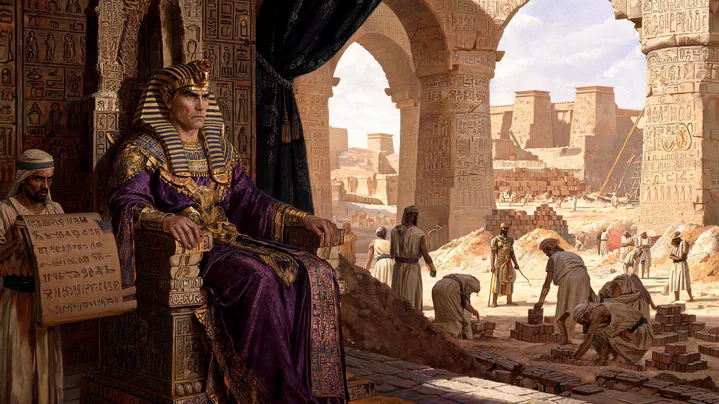
Now there arose up a new king over Egypt, which knew not Joseph.
Webster Bible, American Standard Version
Now there arose a new king over Egypt, who knew not Joseph.
Now there arose a new king over Egypt, which knew not Joseph.
And there riseth a new king over Egypt, who hath not known Joseph,
And there arose a new king over Egypt, who did not know Joseph.
Then arose a new king over Egypt,—who had not known Joseph.
Berean Standard Bible, Majority Standard Bible
Then a new king, who did not know Joseph, came to power in Egypt.
Now there arose a new king over Egypt, who didn’t know Joseph.
Now a new king came to power in Egypt, who had no knowledge of Joseph.
Then there rose vp a newe King in Egypt, who knewe not Ioseph.
Douay-Rheims (Challoner revision)
In the mean time there arose a new king over Egypt, that knew not Joseph:
Pictures
Cross-references 20 of 26
- Genesis 15:13-14
And he said unto Abram, Know of a surety that thy seed shall be a stranger in a land that is not theirs, and shall serve them; and they shall afflict them four hundred years;
God foretold Israel’s affliction in Egypt, judgment on its oppressors, and eventual deliverance.
- Exodus 3:7-10
And the LORD said, I have surely seen the affliction of my people which are in Egypt, and have heard their cry by reason of their taskmasters; for I know their sorrows;
God sees Israel’s oppression in Egypt and sends Moses to deliver them.
- Acts 7:18
Till another king arose, which knew not Joseph.
Also describes a new Egyptian king who did not know Joseph.
- Exodus 12:40-41
Now the sojourning of the children of Israel, who dwelt in Egypt, was four hundred and thirty years.
Israel’s departure from Egypt came at the appointed end of the 430 years.
- Exodus 1:13-14
And the Egyptians made the children of Israel to serve with rigour:
Israel suffers bitter, rigorous bondage under Egypt’s new king.
- Psalms 105:17-22
He sent a man before them, even Joseph, who was sold for a servant:
Joseph’s enslavement and rise in Egypt prepared a refuge for Jacob’s family.
- Genesis 50:24-25
And Joseph said unto his brethren, I die: and God will surely visit you, and bring you out of this land unto the land which he sware to Abraham, to Isaac, and to Jacob.
Joseph assured Israel’s descendants that God would bring them back to Canaan.
- Exodus 1:12
But the more they afflicted them, the more they multiplied and grew. And they were grieved because of the children of Israel.
Oppression made Israel increase.
- Exodus 1:22
And Pharaoh charged all his people, saying, Every son that is born ye shall cast into the river, and every daughter ye shall save alive.
decree to drown sons
- Exodus 5:2
And Pharaoh said, Who is the LORD, that I should obey his voice to let Israel go? I know not the LORD, neither will I let Israel go.
Pharaoh refuses to let Israel go and declares that he does not know the LORD.
- Genesis 45:5-11
Now therefore be not grieved, nor angry with yourselves, that ye sold me hither: for God did send me before you to preserve life.
Joseph went ahead of his family to Egypt, where famine brought them after him.
- Genesis 41:39-45
And Pharaoh said unto Joseph, Forasmuch as God hath shewed thee all this, there is none so discreet and wise as thou art:
Joseph’s service had brought Egypt prosperity and royal favor.
- Genesis 47:11
And Joseph placed his father and his brethren, and gave them a possession in the land of Egypt, in the best of the land, in the land of Rameses, as Pharaoh had commanded.
former favor contrasted with new king
- Genesis 46:26-27
All the souls that came with Jacob into Egypt, which came out of his loins, besides Jacob’s sons’ wives, all the souls were threescore and six;
Israel’s household entered Egypt as seventy people.
- Genesis 47:12
And Joseph nourished his father, and his brethren, and all his father’s household, with bread, according to their families.
former nourishment contrasted with new king
- Matthew 2:13
And when they were departed, behold, the angel of the Lord appeareth to Joseph in a dream, saying, Arise, and take the young child and his mother, and flee into Egypt, and be thou there until I bring thee word: for Herod will seek the young child to destroy him.
Egypt’s attempt to destroy God’s people foreshadows efforts against the promised Deliverer.
- Genesis 47:4
They said moreover unto Pharaoh, For to sojourn in the land are we come; for thy servants have no pasture for their flocks; for the famine is sore in the land of Canaan: now therefore, we pray thee, let thy servants dwell in the land of Goshen.
Israel came only to sojourn for famine
- Deuteronomy 4:20
But the LORD hath taken you, and brought you forth out of the iron furnace, even out of Egypt, to be unto him a people of inheritance, as ye are this day.
Egypt is described as an iron furnace from which God brought Israel.
- Exodus 1:17
But the midwives feared God, and did not as the king of Egypt commanded them, but saved the men children alive.
The midwives feared God and saved the Hebrew sons.
- Exodus 6:6-8
Wherefore say unto the children of Israel, I am the LORD, and I will bring you out from under the burdens of the Egyptians, and I will rid you out of their bondage, and I will redeem you with a stretched out arm, and with great judgments:
God promises to free Israel from Egyptian bondage and bring them to their ancestors’ land.
Commentary
Each commentary is drawn from primary sources: the writings of Ellen G. White and Adventist pioneers and periodicals. Each commentary is separate. Its own words are not a quotation; follow the references to read the source passages.
Ellen G. White
5 sources
After Joseph and his brothers and all that generation died, while the children of Israel were fruitful and increased abundantly and multiplied and grew exceeding mighty until the land was filled with them, a new ruler came to power over Egypt.SG3 178.21SP 160.2–162.1 In one sense, he had no knowledge of Joseph.SG3 178.2 In another sense, he did not honor Joseph and refused to acknowledge his service to Egypt, rather than being merely unaware of it.PP 241.3–41SP 160.2–162.1
With the generation Joseph had helped gone, he treated Israel's growing population as a threat, telling his people that Israel had become more and mightier than they and calling for wise dealing to keep them from multiplying further lest they join enemies in war and fight and leave the land, and this began policies that led to their enslavement.SG3 178.2PP 241.3–41SP 160.2–162.1 Although he moved to hold them, he had learned that Israel were of great service to the kingdom as able and understanding workmen whose labor he was unwilling to lose, so he ranked the free Israelites with the class of slaves who had sold their flocks, herds, lands, and themselves for food.1SP 160.2–162.1 His call for wise dealing to stop their increase led to setting taskmasters over them to afflict them, building the treasure-cities Pithom and Raamses, imposing bitter and rigorous bondage in mortar and brick and field service that put even women to work in the fields, and then enforcing daily quotas to subdue them and crush their independent spirit.1SP 160.2–162.1
The oppression then advanced to commanding the killing of newborn sons at birth and finally to casting sons into the river, moved by Satan to destroy the male children and defeat God's purpose of raising up a Hebrew deliverer.1SP 160.2–162.1 The verse warns those who inherit what earlier workers prepared not to grow self-important and forget Joseph, whose earlier service had benefited them.Ms 54, 1890, par. 8 It applies to men newly placed in positions of responsibility who disregard the service and history of those who came before them, and their resistance to straight testimony and pride over rebukes puts them at risk of following the pattern of Korah, Dathan, and Abiram.Lt 16g, 1892, par. 10–11
Sources
Pioneers and periodicals
71 sources
A new power came to the throne in Egypt that no longer favored Israel, and its not knowing Joseph was not ignorance of his saving work but a willful refusal to honor his memory and acknowledge any debt to his people.ST Feb 12, 1880ST Nov 14, 1906ST Apr 30, 1894ST Nov 6, 1901ST Jan 28, 1913 Seeing Israel grown fruitful and mighty, the king feared they would join his enemies and leave the land, so he set taskmasters over them and dealt shrewdly by affliction to check their increase and make their departure impossible.RH Jan 2, 1913RH Mar 9, 1869RH May 14, 1901RH Nov 19, 1908RH Jan 20, 1916 His policy was wicked and not truly wise, for it fought against God, and God turned every measure against them into growth, so the more they were oppressed the more they multiplied.ST Jun 11, 1894ST Apr 30, 1894ST Jan 23, 1912 The bondage was the beginning of the four-hundred-year servitude in a strange land foretold to Abraham in Genesis 15, also reckoned as 430 years, before Israel would inherit Canaan.RH Jan 2, 1913RH Nov 19, 1908RH Aug 11, 1863GSAM 43.1 Behind the oppression lay an effort to destroy the promised seed and the line of the promised Deliverer, yet God preserved that line and raised up Moses, saved even in infancy under the death decree and trained at royal expense, to lead Israel out at the appointed time.ST Dec 22, 1898ST Apr 30, 1894RH Nov 17, 1910
Sense and Setting of Verse
To know Joseph in this place is not to have heard of his history or of how he saved Egypt from famine, but to honor his memory, to own obligation to Israel for his sake, and to feel gratitude; the new king knew and chose not to acknowledge, seeking to make that service forgotten, caring nothing for Joseph or his people in selfish and cruel vindictiveness.ST Feb 12, 1880ST Nov 14, 1906ST Nov 6, 1901ST Nov 6, 1901 While Joseph's memory had endured his laws had governed and Egypt and its people had prospered, but disregard for him now came to power and preceded oppression.ST Nov 14, 1906ST Nov 14, 1906
The rise marks a decisive change of rule from kings who favored Israel and recognized the good Joseph had done to a new and unfavorable power, a new dynasty that no longer honored Joseph nor recognized Israel in Egypt as Joseph's people.ST Nov 14, 1906ST Apr 30, 1894ST Nov 6, 1901ST Jan 23, 1912ST Nov 14, 1906 Under the former favor Israel had grown fruitful, mighty and numerous and filled the land in peaceful prosperity, and with the change that growth provoked fear and a resolve to oppress, turning prosperity into bondage under taskmasters as despised slaves.ST Apr 30, 1894RH Jan 20, 1916ST Jan 28, 1913ST Jan 20, 1909 The king looked with envy and greed on Israel prospering in Goshen and set out to curb increase by slavery and further oppression, yet human persecution could not stop God from prospering His people so that the more they were oppressed the more they increased.ST Nov 14, 1906ST Jan 23, 1912 The transformation from a favorable dynasty to an unfavorable one is clear and decided, though the exact dynastic change is not certainly agreed.ST Jan 23, 1912ST Jan 23, 1912
The new king was a foreigner of Assyrian stock, effectively the first king of a new dynasty, reckoned among the Shepherd Kings, a foreign usurper and Assyrian oppressor with no gratitude toward Joseph and no obligation to his people.ST Jun 16, 1887ST Jan 28, 1913GSAM 43.1ST Jan 17, 1911ST Oct 30, 1901 As such he viewed the Israelites as a resource for labor for his reign and as possible adversaries if left free, so that a new king who knew not Joseph fits the historical setting directly rather than requiring a figurative explanation.ST Jun 16, 1887 With his coming the period when Joseph's name was honored and his people respected ended.ST Oct 30, 1901 Pharaoh itself is not a personal name but a general title for king, like czar or emperor.ST Jan 23, 1912ST Jan 17, 1911
The verse stands at the beginning of the first, mainly historical division of Exodus, chapters 1-18, which opens with the oppression of Israel in Egypt and continues through the birth and upbringing of Moses until his call to be deliverer.RH Apr 23, 1908RH Jan 20, 1916RH Sep 17, 1914 It introduces Israel in bondage, marking the turn from prosperity when Israel had become numerous and powerful to affliction under a king who knew not Joseph.RH Jan 20, 1916ST Jun 11, 1894RH Jan 20, 1916 The use of forced labor here belongs to the opening period of the events of Exodus and is a matter to be compared with Egyptian historical records.RH Apr 23, 1908 Though Israel then seemed forgotten by God, the Lord's hand was especially shown in increasing their number and preserving their lives under great trial, proving that help is in the name of the Lord.ST Jun 11, 1894
Identity Date and Chronology
The new king is Rameses II, also called Sesostris, of the nineteenth dynasty, the Pharaoh of the oppression who reigned sixty-seven years, built the treasure cities, and ruled until six years before the Exodus.ST Apr 14, 1887ST Aug 9, 1910ST Apr 30, 1894RH Aug 24, 1905ST Jan 28, 1886 Seti I shared in the earlier work of that oppression, and Rameses' son Menephthah I was the Pharaoh of the Exodus.RH Apr 23, 1908ST Apr 30, 1894 Joseph had lived through the reign of Thothmes III and three successors, dying at the beginning of Amenophis IV's reign.ST Aug 9, 1910 Until the death of Khu-n-Aten, also called Khu-en-Aten, the heretic king who favored Asiatics and Canaanites, Semites had greater influence in Egypt than native Egyptians, so the closeness of the rise of the new king to oppression allows a long interval before Rameses II.ST Aug 9, 1910ST Dec 23, 1889 The building of the cities named in the following verse need not have happened immediately after his rise.ST Aug 27, 1885
The new kings came after a national uprising drove out the Semites and after the death of Khu-n-Aten, who had favored Asiatics and Canaanites in religion and government.RH Aug 24, 1905 They represented the triumph of the national faith in Amon and the national cry of Egypt for the Egyptians. Breaking with the former friendly policy toward foreigners, they drove foreigners out or massacred them and reduced those who remained, like the Israelites in the land of Goshen, to the condition of public slaves, and sought further to lessen them by destruction of their male offspring. Israel, as a Semitic people living near Asia, then faced greater hostility.RH Aug 24, 1905
Bondage began only after Joseph and all his generation died, so only part of the two hundred fifteen years from Jacob's entrance into Egypt to the Exodus was spent in slavery.RH Jan 2, 1913 Servitude began about thirty years after Jacob's family entered Egypt, and the departure came four hundred thirty years after entry.RH Feb 17, 1874 In one reckoning slavery began in 1573 B.C., three hundred forty-eight years after Abraham left his father's house in 1921 B.C., with Moses born two years later and the departure in 1491 B.C., leaving Israel in actual bondage only eighty-two years from 1573 to 1491 B.C., the four hundred thirty-year sojourning ending on the selfsame day.RH May 14, 1901 The time of captivity thus begun is also placed around 1400 B.C., when Palestine, long a province of Babylonia and then tributary to Egypt, was greatly disturbed.ST Aug 12, 1913 At that time a people called Khabiri named among the enemies of the Canaanites were part of the Hebrew race, and this disturbed condition made the land far more easily taken under Joshua, while the name Jerusalem was already in use.ST Aug 12, 1913
The oppressed Israelites were employed principally in brick-making and also in mortar work in building the store-cities Pithom and Raamses.RH Apr 23, 1908 Pithom is Pa-Tum at Tel-el-Maskoutah, religiously named Pi Tum meaning devoted to Tum and civilly named Succoth, a square walled town built in part by Rameses II with thick brick walls enclosing solid chambers entered only by trap-door for use as storehouses or magazines.RH Apr 23, 1908ST Apr 30, 1894 Its store-chambers are built almost entirely of brick laid with mortar in regular tiers.RH Apr 23, 1908 Raamses lay near Tanis and was built partly by Seti I but mainly by Rameses II, whose monument and bricks stamped with the name Raamses support the account that Israel built Raamses.ST Oct 21, 1930RH Apr 23, 1908 The Pithom bricks generally contain straw but in some instances are destitute of it, with lower courses of hard unbaked brick containing chopped straw, higher courses of poorer brick with long scanty straw, and last courses with no straw but sedges, rushes and water plants or with neither straw nor rushes, matching the making of brick with straw until straw was withheld yet the full tale was required.RH Apr 23, 1908ST Apr 30, 1894 He is the king whose army included the officer who wrote a surviving account of a soldier's hardships.ST Nov 11, 1886
Historicity and Corroboration
The account is true history rather than fable or myth.ST Apr 13, 1904 Israel's slavery in Egypt was a literal historical event, and the plagues upon Egypt and the deliverance through the Red Sea were literal events as well.ST Jan 3, 1884 Its reliability is corroborated in the New Testament because Stephen recounts the same incident in Acts 7:18, showing the early records of Moses are accurate.ST Apr 13, 1904
Its use of forced labor in Egypt during the opening period in which the events of Exodus took place is a matter that can be compared with Egyptian historical records.RH Apr 23, 1908 Its account of Joseph and the Exodus has its historical reliability corroborated by inscriptions on Egyptian monuments, which supports its value as a record of Egyptian history.ST Jul 30, 1885 That corroboration includes an Egyptian stele that mentions Israel in Egypt.RH May 13, 1909 It includes tablets naming the Hebrews as Habiri and speaking of their gradual encroachment.ST Apr 30, 1894 It includes archaeological evidence of Rameses II's monument and bricks stamped with the name Raamses, supporting the record that the Israelites built the city of Raamses.ST Oct 21, 1930
Its historical truth is shown by the body of Rameses II found in July 1881 with thirty-five other mummies of kings, queens, princes and high priests in the ruins of a temple near Thebes, now in the museum at Bulaq near Cairo.ST Apr 30, 1894 The identification rests on papyri preserved with the mummy and markings on the case and bandages.ST Apr 30, 1894 He was the greatest builder among the Pharaohs whose name is on nearly every ruin in Egypt and Nubia.ST Apr 30, 1894 The body of his son has never been found though memorials of him remain.ST Apr 30, 1894
Oppression and Divine Overruling
Exodus 1:8 marks the turn from Israel's prosperity in Egypt to affliction, when a new king who forgot Joseph and his services arose and Egyptian ingratitude gave way to cruel treatment of Joseph's people.RH Mar 9, 1869RH Jan 20, 1916ST Jul 21, 1881 Before this Israel had grown fruitful and mighty and numerous and filled the land, while the seven-year famine had left the Egyptians themselves in slavery to Pharaoh, and the former Pharaoh had welcomed Israel, nourished them, and given them a possession in the best of the land.RH May 14, 1901RH Nov 19, 1908 That brief time of prosperity was followed by long and terrible oppression under taskmasters, hard service with vigor that made lives bitter with hard bondage, and finally orders against newborn sons.RH May 14, 1901RH Aug 11, 1863RH Dec 17, 1861 It was a dreadful reversal of the former welcome, nourishment and possession, from an honored place under Joseph to enslavement and attempts to destroy male children.RH May 14, 1901RH Mar 9, 1869
The king looked with jealousy, envy and greed on Israel's mighty increase in Goshen and reasoned they were more and mightier than Egypt and must be checked lest they become more powerful than the Egyptians.RH May 14, 1901ST Nov 14, 1906RH Mar 9, 1869 He feared they would multiply and join Egypt's enemies in war and leave the land, and he knew they expected sometime to return to Canaan to their ancestral inheritance.RH Jan 2, 1913RH Nov 19, 1908RH Mar 9, 1869 Because their service had become so valuable he proposed to deal wisely with them by afflicting them with burdens, setting taskmasters over them to check increase and make departure impossible.RH Jan 2, 1913RH May 14, 1901RH Nov 19, 1908 In arraying himself against the word of God that they would return, he rapidly filled the cup of his iniquity and sounded the fall of the nation.RH Jan 2, 1913
Under him slavery in all its horrors began, with taskmasters set to afflict Israel and a cruel daily increase of burdens.RH May 14, 1901RH Aug 11, 1863 They were forced to work without materials and without rest, refused straw yet still required to deliver the full tale of bricks, and compelled even to labor on the Sabbath, while decrees put male children to death.RH Aug 11, 1863ST Apr 29, 1908 At last came the command to all his people to cast every newborn son into the river while saving every daughter alive.RH May 14, 1901 Their treatment as despised slaves under idolatrous rulers, with oppression, forced work and murdered infants, illustrates human ingratitude and wrongdoing despite past benefits.
The king's policy was shrewd and wicked but not wise, because it fought against God.ST Apr 30, 1894 Every measure devised against Israel God caused to work for their growth instead, so the more they were oppressed the more they multiplied and human persecution could not stop God from prospering them.ST Jan 23, 1912RH Nov 17, 1910 The hardships made them stronger physically and the Lord used them as a means of increasing their numbers, and their lowly condition as a nation of slaves became the means God used to preserve His truth in the world.ST Apr 30, 1894ST Feb 20, 1907 Though Israel then seemed forgotten by God, the Lord's hand was especially shown in increasing their number and preserving their lives under great trial, proving that help is in the name of the Lord, and the tribulation worked out salvation for them.ST Jun 11, 1894ST Apr 30, 1894
God used this affliction to keep Israel from becoming attached to Egypt and to stir them to leave for Canaan and undertake the journey to the promised land.RH Mar 9, 1869RH Mar 9, 1869 Continued prosperity might have kept them from going, but their expected return made the king's oppression the means of stirring them.RH Mar 9, 1869 That affliction accomplishes for God's people what cannot otherwise be accomplished.RH Aug 11, 1863
Prophecy Promise and Deliverer
The rise of the new king marks the beginning of the affliction foretold to Abraham in Genesis 15, the four-hundred-year servitude in a strange land, also reckoned as 430 years of affliction and strangerhood in which Israel became strangers in a land not theirs and served with cruel bondage before inheriting Canaan.RH Nov 19, 1908RH Aug 11, 1863GSAM 43.1 After Joseph had been brought down as a slave and Jacob had brought his family down in famine, Joseph and all his brethren and all that generation died, and Israel became fruitful and multiplied and waxed exceeding mighty until the land was filled with them.RH Nov 19, 1908 Then the new power arose that did not regard Joseph, feared that Israel were more and mightier than Egypt and would multiply and join enemies in war and leave the land, and called for dealing wisely by setting taskmasters over them to afflict them with burdens.RH Nov 19, 1908RH Aug 11, 1863 That affliction included cruel taskmasters daily increasing burdens, refusal of straw while still requiring the full tale of bricks, and decrees putting male children to death, until God declared He had surely seen the affliction and heard the cry by reason of the taskmasters.RH Aug 11, 1863
Though Abraham was dead, God had not forgotten His people but made this oppression the occasion for raising up a movement to fulfill prophecy through Moses, to bring them out to a good land flowing with milk and honey and give each tribe a definite and permanent possession, so that every detail of the movement fit every detail of the prophecy with nothing failing.RH Nov 19, 1908 Bondage began only after Joseph and all his generation died, so only part of the 215 years from Jacob's entrance to the Exodus was spent in slavery.RH Jan 2, 1913 The new king knew Israel expected sometime to return to Canaan to their ancestral inheritance, and because their service had become so valuable he set taskmasters over them to afflict them and make departure impossible.RH Jan 2, 1913RH Sep 14, 1916ST Dec 12, 1916 In doing this he arrayed himself against the word of God that they would return, rapidly filled the cup of his iniquity, and sounded the fall of the nation, yet though he opposed their departure and made release appear impossible he could not prevent God from fulfilling the promise to Abraham and bringing Israel out at the appointed time.RH Jan 2, 1913RH Sep 14, 1916ST Dec 12, 1916
The oppression and destruction of the male children were part of an effort to destroy the promised seed, an attack on the line through which God's promise to Abraham, the promised territory, and the promised Deliverer would be fulfilled and made known.ST Dec 22, 1898ST Nov 7, 1906 Egyptian hatred went so far as to destroy all the male children in hope of destroying Israel, which was Satan's plan to destroy the promised seed and so defer the plan of salvation.ST Apr 30, 1894 Egypt thus becomes the first of the nations used in repeated attempts to destroy, enslave and scatter God's distinct people through whom the promised Deliverer would come.ST Nov 7, 1906 God's protecting power preserved that line, and the tribulation worked out salvation for them.ST Dec 22, 1898ST Apr 30, 1894
The oppression became the setting where God proved that He rules in the kingdom of men by taking Moses, who had been reared for the throne, and making him the leader to deliver Israel from bondage.ST Oct 28, 1897 Every measure devised against Israel God caused to work for their growth instead, showing God's providence and Christ's upholding power turning hostile human wisdom into increase and deliverance.RH Nov 17, 1910 When Moses was placed in the bulrushes under the tyrannical king's law demanding his immediate death, the king's own daughter was led there, took up the helpless child and adopted him as her son, so that the future deliverer was educated and trained at royal expense.RH Nov 17, 1910 At once he became the special object of providential care, preserved through loving God-fearing parents who devised a way to save him, through the ark of bulrushes, adoption by the king's daughter, and early instruction by his faithful mother before he was taken into the king's family. Israel's bondage together with the deliverance from Egypt is a type of events to transpire either under the gospel or at the close of this dispensation.RH Sep 17, 1872
Doctrine Connections and Application
The rise of the new king belongs to the account of Israel's oppression in Egypt, when as bondmen they could not keep the Sabbath in their oppressed state.RH May 16, 1854ST Apr 29, 1908 Their taskmasters increased their labor and compelled them to work on the Sabbath, and their deliverance made Sabbath-keeping possible again.RH May 16, 1854ST Apr 29, 1908 This explains why Moses later gave their deliverance as a reason for requiring Sabbath observance, without making deliverance the Sabbath's original purpose or institution.RH May 16, 1854
By the time of enslavement the Sabbath with other divine ordinances had fallen almost or altogether into disuse, and that silence is not evidence that God had repealed the Sabbath or granted a formal dispensation during captivity.RH Dec 11, 1856 Abraham's descendants, having gone to Egypt and become associated with its heathen worship, had largely lost their knowledge of God and Christ and forgotten the significance of the early offerings.ST Mar 3, 1898 Their bondage and later deliverance preceded renewed teaching of the principles of atonement, through which they could know God and be reconciled to Him.ST Mar 3, 1898
As a new king arose over Egypt who did not know Joseph, so kings who succeeded Nebuchadnezzar no longer knew Daniel or remembered his service.RH May 11, 1869 The verse belongs to the early history of the world and of God's people contained in the five books of Moses, which is not done away but remains profitable and interesting to know, study, and learn from.RH Nov 26, 1861 Egypt's Pharaohs with their opposition to God's plans and precepts stand with their names and fates as historical witnesses to the truth of the Bible.ST Jul 15, 1908RH Nov 26, 1861
The bondage in Egypt was part of the Old Testament revelation of God's will that Jesus learned in childhood as part of His education in the whole Old Testament canon.ST Aug 13, 1912 That education began in the home at His mother's knee and was supplemented in the synagogue schools, with the Holy Scriptures made the basis of education up to the age of ten years according to the instruction in Deuteronomy 6, in Hebrew, the Greek of the Septuagint, and Aramaic, and not from the philosophies of India, Greece, Egypt, or Rome.ST Aug 13, 1912 With childish receptivity He grasped the bondage together with Adam in his paradise home, the fall, the Deluge, the confusion of tongues at Babel, and the call of Abraham, and saw in it the great deliverance with the Red Sea and the Jordan opened.ST Aug 13, 1912
Egypt's turning from God came notwithstanding all He had done for the nation and all the evidences He had given that His wisdom and goodness and power were mighty above all else.ST Dec 25, 1901 The new king's oppression of Israel was persecution of God Himself in the persons of His chosen people, for the Egyptians persecuted the Hebrews who worshiped the true God.ST Dec 25, 1901RH Jun 8, 1916 The same spirit of turning from God to persecute Him in His people is in the world today in many who have enjoyed much greater light.ST Dec 25, 1901 God's efforts through Moses and Aaron were intended to teach the new Pharaoh, who did not know Joseph or Joseph's God, and the Egyptians that Jehovah was God, so that willing response could have spread God's glory through the earth rather than through Egypt's humiliation and defeat.ST Oct 27, 1898
Pharaoh stands as a model for the South's defense of slavery: like Pharaoh, slaveholders hardened their hearts and clung to oppression after wartime suffering had eased.RH May 1, 1866 As Pharaoh resisted releasing Israel until severe judgments came, so slaveholders would go to desperate lengths before yielding, warning that God's judgment might still come upon them.RH May 1, 1866 Under the changed rule the Israelites, descendants of the patriarch, were reduced to slavery in Egypt and later escaped with divine aid.RH Oct 13, 1859 Their deliverance under Moses deprived the Egyptians of the people they treated as property, and the Egyptians' attempt to stop and recapture them ended in judgment.RH Oct 13, 1859
Pharaoh's rule beginning a despotism that oppressed Israel illustrates resistance to a ruler who demands obedience contrary to God, and God upheld Moses' cause and delivered him and the people from that oppression. A ruler's authority does not make his religion binding, rulers may be ignorant of God's true religion, and subjects are not bound to follow their rulers' religious beliefs.ST May 28, 1912 The verse is also applied to a new generation that apparently does not know Joseph, having lost sight of the pioneers and the work they began though that work was entrusted to them to continue.RH Nov 12, 1901
The verse shows the beginning of the great affliction in which Israel became strangers in a land not theirs and were made to serve with cruel bondage, fulfilling what God told Abraham that his seed should inherit Canaan only after serving and being afflicted four hundred years.RH Aug 11, 1863 That affliction included cruel taskmasters set over them who daily increased their burdens, refusing them straw yet still requiring the full tale of bricks, and decrees putting their male children to death, until God declared that He had surely seen their affliction and heard their cry by reason of their taskmasters.RH Aug 11, 1863 That affliction accomplishes for God's people what cannot otherwise be accomplished.RH Aug 11, 1863 Yet their long slavery had left them unable to grasp fully the meaning of God's salvation with a mighty hand and the character He required.
The verse shows a new hostile king coming to power who had no regard for Joseph and brought deadly danger to the innocent.ST Sep 27, 1910 It means godless rulers forget past good and use the sword against God's people, so that deliverance requires miraculous saving of life, as Moses was saved from Pharaoh and Matthias was saved from the sword of Herod the Great.ST Sep 27, 1910
Sources