Exodus 23:19
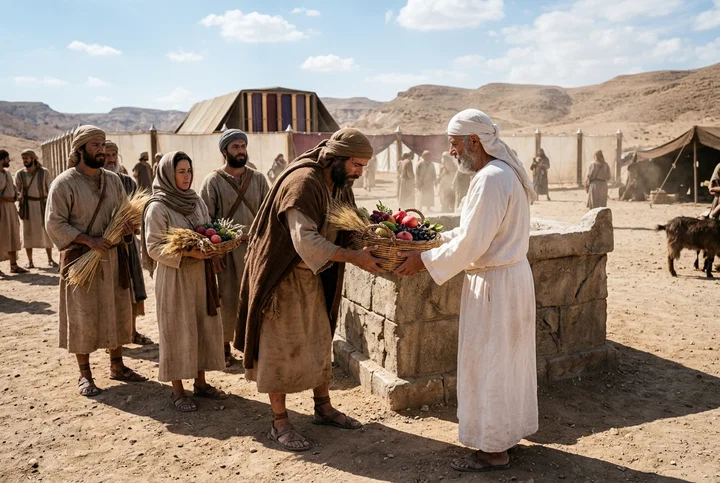
The first of the firstfruits of thy land thou shalt bring into the house of the LORD thy God. Thou shalt not seethe a kid in his mother’s milk.
Translations
The first of the first fruits of your land you shall bring into the house of the LORD your God. You shall not seethe a kid in his mother’s milk.
The first of the firstfruits of thy land thou shalt bring into the house of the LORD thy God. Thou shalt not seethe a kid in his mother’s milk.
The first of the firstfruits of thy land thou shalt bring into the house of the Lord thy God. Thou shalt not seethe a kid in his mother’s milk.
The first of the first-fruits of thy land thou shalt bring into the house of the LORD thy God. Thou shalt not seethe a kid in his mother's milk.
The first of the firstfruits of thy ground thou shalt bring into the house of the LORD thy God. Thou shalt not seethe a kid in its mother’s milk.
The first of the first-fruits of thy ground thou shalt bring into the house of Jehovah thy God. Thou shalt not boil a kid in its mother’s milk.
the beginning of the first-fruits of thy ground thou dost bring into the house of Jehovah thy God; thou dost not boil a kid in its mother's milk.
The first of the first-fruits of thy land thou shalt bring into the house of Jehovah thy God. Thou shalt not boil a kid in its mother's milk.
The beginning of the firstfruits of thy ground, shalt thou bring into the house of Yahweh thy God. Thou shalt not boil a kid in the milk of its dam.
Berean Standard Bible, Majority Standard Bible
Bring the best of the firstfruits of your soil to the house of the LORD your God.You must not cook a young goat in its mother’s milk.
You shall bring the first of the first fruits of your ground into the house of the LORD your God.“ You shall not boil a young goat in its mother’s milk.
The best of the first-fruits of your land are to be taken into the house of the Lord your God. The young goat is not to be cooked in its mother's milk.
The first of the first fruites of thy lande thou shalt bring into the house of the Lord thy God: yet shalt thou not seeth a kid in his mothers milke.
Douay-Rheims (Challoner revision)
Thou shalt carry the firstfruits of the corn of thy ground to the house of the Lord thy God. Thou shalt not boil a kid in the milk of his dam.
Pictures
Cross-references
- Leviticus 23:10-14
Speak unto the children of Israel, and say unto them, When ye be come into the land which I give unto you, and shall reap the harvest thereof, then ye shall bring a sheaf of the firstfruits of your harvest unto the priest:
Israel presented the harvest’s first sheaf before eating the new crop.
- Exodus 22:29
Thou shalt not delay to offer the first of thy ripe fruits, and of thy liquors: the firstborn of thy sons shalt thou give unto me.
Requires the first produce to be offered to God without delay.
- Proverbs 3:9
Honour the LORD with thy substance, and with the firstfruits of all thine increase:
Both command honoring the Lord by bringing the firstfruits of one’s increase.
- Deuteronomy 26:2
That thou shalt take of the first of all the fruit of the earth, which thou shalt bring of thy land that the LORD thy God giveth thee, and shalt put it in a basket, and shalt go unto the place which the LORD thy God shall choose to place his name there.
Directs Israel to bring the first of the land’s produce to God’s sanctuary.
- 2 Chronicles 31:5
And as soon as the commandment came abroad, the children of Israel brought in abundance the firstfruits of corn, wine, and oil, and honey, and of all the increase of the field; and the tithe of all things brought they in abundantly.
The people bring abundant firstfruits, as commanded.
- Numbers 15:20
Ye shall offer up a cake of the first of your dough for an heave offering: as ye do the heave offering of the threshingfloor, so shall ye heave it.
Both require an offering from the first of the produce.
- Exodus 34:26
The first of the firstfruits of thy land thou shalt bring unto the house of the LORD thy God. Thou shalt not seethe a kid in his mother’s milk.
Also commands bringing the firstfruits to God’s house.
- Ezekiel 44:30
And the first of all the firstfruits of all things, and every oblation of all, of every sort of your oblations, shall be the priest’s: ye shall also give unto the priest the first of your dough, that he may cause the blessing to rest in thine house.
Requires the firstfruits of produce and offerings to be given.
- Nehemiah 10:35
And to bring the firstfruits of our ground, and the firstfruits of all fruit of all trees, year by year, unto the house of the LORD:
The people commit to bring the firstfruits of their land to the Lord’s house.
- Deuteronomy 18:4
The firstfruit also of thy corn, of thy wine, and of thine oil, and the first of the fleece of thy sheep, shalt thou give him.
Names produce and wool as firstfruits given to God.
- 1 Corinthians 15:20
But now is Christ risen from the dead, and become the firstfruits of them that slept.
Connects Christ as the first risen one with the hope of resurrection.
- Exodus 13:13
And every firstling of an ass thou shalt redeem with a lamb; and if thou wilt not redeem it, then thou shalt break his neck: and all the firstborn of man among thy children shalt thou redeem.
Both consecrate the first to God.
- Numbers 28:26
Also in the day of the firstfruits, when ye bring a new meat offering unto the LORD, after your weeks be out, ye shall have an holy convocation; ye shall do no servile work:
Both connect firstfruits with an offering to the LORD.
Commentary
Each commentary is drawn from primary sources: the writings of Ellen G. White and Adventist pioneers and periodicals. Each commentary is separate. Its own words are not a quotation; follow the references to read the source passages.
Ellen G. White
5 sources
This command is one of the commandments of God from Sinai that Moses was to gather up and carry out before the people in practice.Ms 185, 1907, par. 13–16 It is part of the statutes and judgments given to Israel, which were to be strictly obeyed and to be studied by all with a heart to obey.Ms 185, 1907, par. 13–16Ms 126, 1901, par. 46–47 These directions were given by Jesus Christ and are not of a lower order than the statutes given in the present age.Ms 126, 1901, par. 46–47 Obedience to His commandments was the condition for being kings and priests unto God and for God communicating with His people and His people communicating with God.Ms 185, 1907, par. 13–16 Israel with lifted voice and hands to heaven agreed to comply with the conditions and be obedient, but when Moses was away temptation came and they broke them by making a calf.Ms 185, 1907, par. 13–16
The first produce and increase of the land were to be given to the Lord before anything else, brought into the house of the Lord as an offering.4T 77.2–3AA 336.3–337.14T 467.1–2 This included the firstfruits of the harvest and vintage, as well as of the wool and grain, which were consecrated to Him.4T 77.2–3 The same system that set apart property for God also required offerings from the firstborn of the flocks and the first gathering of the harvest, requiring people to return part of what they receive from Him.4T 467.1–2 The firstfruits were presented at the sanctuary and then devoted to the priests.AA 336.3–337.1
Alongside this, gleanings and the edges of the fields were reserved for the poor, and the poor, widows, orphans, and strangers were included in the feasts.4T 77.2–3 This practice taught that God must come first, that He owns the fields and flocks and provides the means for their increase, and that people hold their possessions as His stewards.4T 77.2–3AA 336.3–337.14T 467.1–2 At the close of each year, the people were also required to declare whether they had obeyed these commands.4T 77.2–3
Sources
Pioneers and periodicals
36 sources
The command requires bringing the earliest produce of the land to the house of the Lord as an offering, and it forbids boiling a young goat in its mother's milk.RH Feb 4, 1909RH Apr 7, 1903RH Sep 2, 1902ST Jun 3, 1908 The first and best of what the land yields belongs to Him and is to be given without delay before the rest is used, not the last and worst kept back for Him.ST Jan 22, 1880RH Mar 2, 1876RH Apr 16, 1901 Giving the firstfruits in this way acknowledges Him as giver and absolute owner of all that is possessed and puts Him first in farming and in every department of life.ST Mar 20, 1901RH Jun 5, 1900 The offering is a voluntary thank offering distinct from the tithe, expressing gratitude for His provision and applying to all increase and income from daily labor, trade, and skill.ST Jan 8, 1885RH Mar 26, 1861ST Dec 25, 1901 At Passover the waved sheaf of the spring harvest with its lamb pointed to Christ as the first to rise from the dead, through whom His people enter eternal life.ST Aug 7, 1884ST Aug 2, 1883
Place in Covenant Law
Exodus 23:19 belongs to the second and chiefly legislative division of Exodus in chapters 19-40, part of the system of legal ordinances given for the guidance of Israel as a ransomed people bound to Jehovah by solemn covenant. It stands among the statutes given with the Ten Commandments in Exodus 20:1 to 24:8 and ratified over the book of the covenant, serving the fundamental covenant purpose to preserve Israel as a peculiar treasure, a kingdom of priests, and a holy nation. It was spoken by God to Moses alone in private after the Ten Commandments had been declared with an audible voice to all the people.ST May 16, 1878 It is not one of the ten words spoken directly by God but one of the judgments privately communicated to Moses to deliver to the people, dealing for the most part with rights between man and man and with what ought to be enforced judicially to rectify or check evil when the law is violated.ST Apr 15, 1886
It belongs to the civil and religious laws given under the covenant arrangement entered into in Exodus 19, and together with the latter part of Exodus 20 and the whole of Exodus 21 and 22 it forms an epitome of the civil and ceremonial laws given to Israel.ST May 16, 1878 It was given after the people accepted the terms of the agreement and before the old covenant bargain was sealed, as one of the words they covenanted to perform. It is part of the judgments in Exodus 21-23 that Moses wrote in the book of the covenant and that were ratified in Exodus 24.ST Dec 10, 1896ST Dec 16, 1897 These judgments formed the basis of Israel's national law and expressed principles already present in God's law, with later instruction developing those principles without adding or removing any moral principle.ST Dec 10, 1896
The book of the covenant contains moral, civil, and ceremonial laws given to regulate the Jewish theocracy.ST Dec 16, 1897 That book was not itself the covenant; Israel's covenant was their agreement with God concerning the words and laws he gave them.ST Dec 16, 1897 The statutes in Exodus 21-23 made the moral principles of the Ten Commandments clearer and applied them in practical rules for Israel.ST Apr 17, 1907 They rest upon the Ten Commandments in Exodus 20 as statutes rest upon a constitution, so the verse cannot conflict with those commandments and its interpretation and ethics must accord with their ethics, and with Exodus 34:1 it forms part of a code of rules based upon the ten laws.ST Apr 15, 1886
These precepts grew out of the commandments and formed part of the covenant with Israel.ST Aug 5, 1889 They are distinct from the Ten Commandments that God spoke and wrote on the stone tablets.RH Jul 9, 1901 Exodus 23 belongs to a collection of general laws and precepts needed for community life.ST The statutes and judgments in Exodus 21-23, spoken to Moses after the people heard God speak the Ten Commandments, partly define duty to God and chiefly define duty to other people; they include ceremonial precepts, while most set out principles of justice among people.ST Mar 1, 1883
The firstfruits command stands among instructions for Israel's yearly feasts, including the feasts of unleavened bread and harvest.RH Aug 13, 1857 Its presence alongside those ceremonial observances does not make every command in the chapter ceremonial, for the chapter also includes moral commands and the seventh-day Sabbath mentioned separately in verse 12.RH Aug 13, 1857 It is identified as part of the ceremonial precepts given to Moses, which pointed to good things to come.RH Dec 31, 1861 It belongs to the ritual and judicial law given through Moses after Israel's transgression, added to the Ten Commandments because of transgression to preserve Israel's natural life and its place as Abraham's natural seed until Christ came.RH Feb 7, 1854
Exodus 23 is grouped with the laws concerning Israel's annual feasts and sabbaths, which involved going to Jerusalem three times a year with sacrifices and belonged to a ceremonial system designed especially for those dwelling in Canaan.RH Oct 14, 1873 That system was a shadow pointing forward to Christ and was abolished at the cross, in contrast with the seventh-day Sabbath as a creation memorial made for all humanity.RH Oct 14, 1873 The judgments in Exodus 21-23 are decisions of the highest court and the ministration of the law in cases applying peculiarly to Israel while dwelling in Canaan, written in the book of the covenant as part of the conditions on which Israel as a nation could remain in the land.RH Oct 22, 1861 In sequence they follow the giving of the holy law in Exodus 20 with preliminary instruction for building the sanctuary during the wilderness journey of the children of Israel.ST Feb 11, 1913
These laws were given in love to draw the people into close fellowship with God and to write his law on their hearts.ST Jan 27, 1909 The verse belongs to the law of Moses commanded through Moses in Horeb and included under the statutes and judgments to be remembered in Malachi 4:4. It stands together with the Ten Commandments and with all the civil regulations, sacrificial and offering laws, laws of conduct between man and man, health laws, ceremonial laws and moral laws given to Israel, especially as set forth in Exodus 20 to 40 and Leviticus. It is to be remembered in the last days with the great laws that rule conduct and with the laws of offerings, sacrifices and types in which the substance of the new dispensation is traced from the shadows of the old.
It is part of the law of ordinances, which was written out after the moral law in the record of events from Moses' time.ST May 6, 1875 It is part of the other instruction given in Exodus 20, 21, and 23 in addition to the covenant of the Ten Commandments proclaimed from the mount. The word seethe in the prohibition of cooking a kid in its mother's milk means boil, and boil is the clearer English rendering.ST Jun 3, 1908 Exodus 23 is mentioned as part of the Mosaic code, whose essential differences from the Code of Hammurabi show the superiority of the Mosaic law.ST Mar 10, 1909
Firstfruits Offering and Meaning
While receiving practical laws at Sinai for life in the promised land, Israel was instructed to bring the first of the land's produce to the house of God as an offering.RH Feb 4, 1909RH Apr 7, 1903 That offering was drawn from the land's harvest and connected with the firstfruits presented at the appointed ingathering times.RH Apr 7, 1903 It belonged to the Feast of Harvest, or Feast of Weeks, held when the first grain was ready, and was to be brought before the people used the harvest for themselves.RH Sep 2, 1902
The first and best portion of what God gives from the land belongs to Him and must be brought to His house without delay before people use the rest for themselves.ST Jan 22, 1880RH Mar 2, 1876 His claims and cause are to be kept foremost, with the first ripe fruits given to the Lord.RH Apr 16, 1901RH Jul 14, 1868 The first portion was sacred as part of commanded giving, so giving the last and worst gleanings instead reverses the priority set.RH Jul 14, 1868ST Nov 4, 1889 Applied to increase generally, God is to be honored with the first portion before anything is used for personal needs.RH Mar 2, 1876ST Jan 8, 1885
Bringing firstfruits before using the harvest taught Israel to recognize God as the giver and owner of what they possessed and to put Him first.ST Mar 20, 1901 God requires His proprietorship to be recognized in farming and in every department of life.RH Jun 5, 1900 The first fruits of the corn were to be devoted to religious uses, alongside hallowing the seventh day, giving Him the firstborn redeemed by substitution, and giving Him one tenth of all yearly gains.RH Jun 5, 1900 This is because He is absolute proprietor who has put men in possession for a limited time to use His property for Him.RH Jun 5, 1900
At Passover this offering was the spring harvest's first yield, presented with a sheaf waved before the Lord to the priest.ST Aug 7, 1884ST Aug 2, 1883 With it an unblemished year-old lamb was offered as a burnt offering.ST Aug 7, 1884 The offering expressed gratitude for God's provision and trust that Christ would be the first to rise from the dead.ST Aug 7, 1884ST Aug 2, 1883 Through His resurrection His people would enter the blessed realm and eternal life.ST Aug 7, 1884ST Aug 2, 1883
This firstfruits offering is a voluntary thank offering distinct from the tithe, applying the principle of giving God the first and best of all increase and income.ST Jan 8, 1885 The same principle applies to the fruits of daily labor, trade, and human skill, so what people receive or make should be given to God first and spent in His service.ST Dec 25, 1901 Firstfruits were among the gifts and sacrifices Israel was to offer, and giving the best expressed a sincere spirit of giving, while merely formal service made offerings unacceptable to God.ST Feb 8, 1892 The offering of the first produce to the house of the Lord is comparable to the offering of corn and vegetables that North American Indians brought to the Great Spirit.RH Mar 26, 1861
Sources