Leviticus 23:10
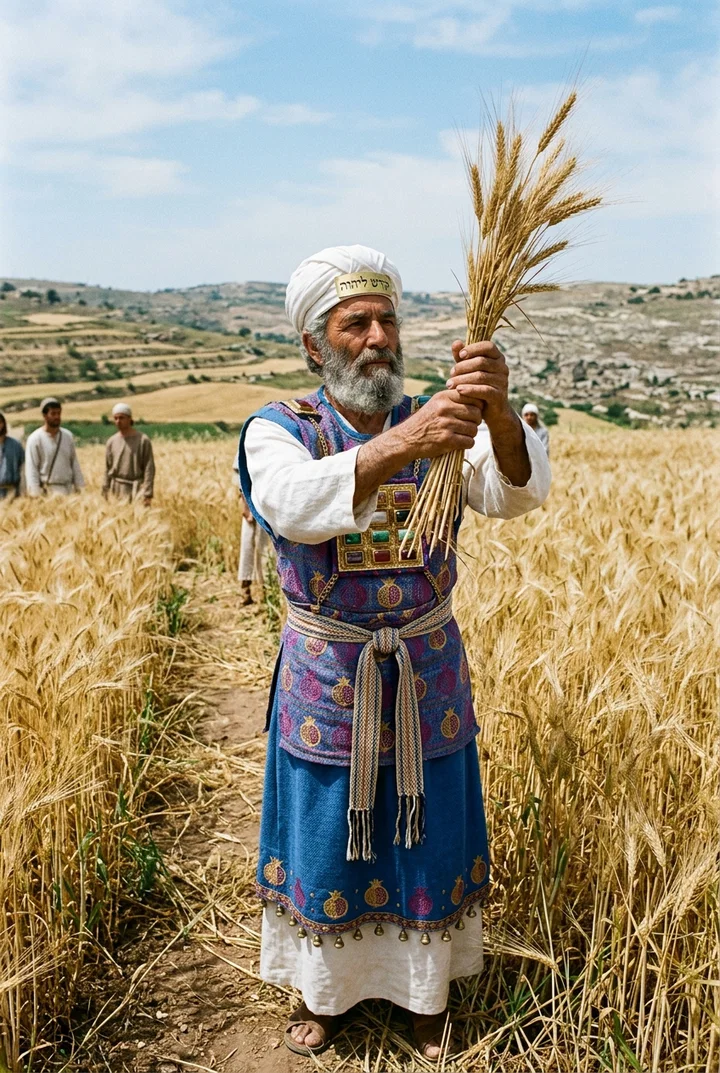
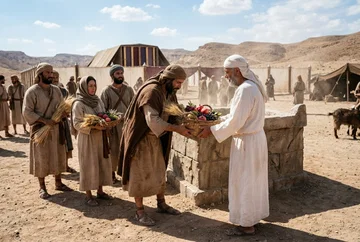
Speak unto the children of Israel, and say unto them, When ye be come into the land which I give unto you, and shall reap the harvest thereof, then ye shall bring a sheaf of the firstfruits of your harvest unto the priest:
Translations
Speak to the children of Israel, and say to them, When you be come into the land which I give to you, and shall reap the harvest thereof, then you shall bring a sheaf of the first fruits of your harvest to the priest:
King James Version, KJV Cambridge Paragraph Bible
Speak unto the children of Israel, and say unto them, When ye be come into the land which I give unto you, and shall reap the harvest thereof, then ye shall bring a sheaf of the firstfruits of your harvest unto the priest:
Speak to the children of Israel, and say to them, When ye shall have come into the land which I give to you, and shall reap the harvest thereof, then ye shall bring a sheaf of the first-fruits of your harvest to the priest:
Speak unto the children of Israel, and say unto them, When ye be come into the land which I give unto you, and shall reap the harvest thereof, then ye shall bring the sheaf of the firstfruits of your harvest unto the priest:
Speak unto the children of Israel, and say unto them, When ye are come into the land which I give unto you, and shall reap the harvest thereof, then ye shall bring the sheaf of the first-fruits of your harvest unto the priest:
'Speak unto the sons of Israel, and thou hast said unto them, When ye come in unto the land which I am giving to you, and have reaped its harvest, and have brought in the sheaf, the beginning of your harvest unto the priest,
Speak unto the children of Israel and say unto them, When ye come into the land that I give unto you, and ye reap the harvest thereof, then ye shall bring a sheaf of the first-fruits of your harvest unto the priest.
Speak unto the sons of Israel, and thou shalt say unto them:—When ye enter into the land which, I, am giving you, and ye reap the harvest thereof, then shall ye bring in a sheaf of the first-ripe corn of your harvest, unto the priest;
Berean Standard Bible, Majority Standard Bible
“ Speak to the Israelites and say, ‘ When you enter the land that I am giving you and you reap its harvest, you are to bring to the priest a sheaf of the firstfruits of your harvest.
“ Speak to the children of Israel, and tell them, ‘ When you have come into the land which I give to you, and shall reap its harvest, then you shall bring the sheaf of the first fruits of your harvest to the priest.
Say to the children of Israel, When you have come to the land which I will give you, and have got in the grain from its fields, take some of the first-fruits of the grain to the priest;
Speake vnto the children of Israel, and say vnto them, When ye be come into ye land which I giue vnto you, and reape the haruest thereof, then ye shall bring a sheafe of the first fruites of your haruest vnto the Priest,
Douay-Rheims (Challoner revision)
Speak to the children of Israel, and thou shalt say to them: When you shall have entered into the land which I will give you, and shall reap your corn, you shall bring sheaves of ears, the firstfruits of your harvest to the priest:
Pictures
Cross-references 20 of 33
- 1 Corinthians 15:20
But now is Christ risen from the dead, and become the firstfruits of them that slept.
Christ’s resurrection fulfills the firstfruits offering.
- Leviticus 23:15-16
And ye shall count unto you from the morrow after the sabbath, from the day that ye brought the sheaf of the wave offering; seven sabbaths shall be complete:
Counts fifty days from the wave-sheaf offering to the feast of Pentecost.
- Acts 2:1-4
And when the day of Pentecost was fully come, they were all with one accord in one place.
The Spirit’s outpouring fulfills Pentecost on its appointed day.
- Colossians 2:16-17
Let no man therefore judge you in meat, or in drink, or in respect of an holyday, or of the new moon, or of the sabbath days:
Paul’s reference to holy days and shadows is linked to the feasts in Leviticus 23.
- 1 Corinthians 15:23
But every man in his own order: Christ the firstfruits; afterward they that are Christ’s at his coming.
Christ’s resurrection fulfills the firstfruits offering, followed by the resurrection of those who belong to him.
- Exodus 23:16
And the feast of harvest, the firstfruits of thy labours, which thou hast sown in the field: and the feast of ingathering, which is in the end of the year, when thou hast gathered in thy labours out of the field.
Names the harvest feast as the feast of the firstfruits of labor.
- Deuteronomy 16:9
Seven weeks shalt thou number unto thee: begin to number the seven weeks from such time as thou beginnest to put the sickle to the corn.
The count of seven weeks begins when reaping starts.
- Leviticus 23:14
And ye shall eat neither bread, nor parched corn, nor green ears, until the selfsame day that ye have brought an offering unto your God: it shall be a statute for ever throughout your generations in all your dwellings.
Israel must offer the harvest’s firstfruits before eating its new grain.
- Exodus 22:29
Thou shalt not delay to offer the first of thy ripe fruits, and of thy liquors: the firstborn of thy sons shalt thou give unto me.
Commands Israel not to delay offering the first of its produce.
- Exodus 23:19
The first of the firstfruits of thy land thou shalt bring into the house of the LORD thy God. Thou shalt not seethe a kid in his mother’s milk.
Commands bringing the firstfruits of the land to God.
- James 1:18
Of his own will begat he us with the word of truth, that we should be a kind of firstfruits of his creatures.
Both describe God’s people as firstfruits.
- Revelation 14:4
These are they which were not defiled with women; for they are virgins. These are they which follow the Lamb whithersoever he goeth. These were redeemed from among men, being the firstfruits unto God and to the Lamb.
Both texts use firstfruits language, though the title need not mean first in time.
- Leviticus 23:5
In the fourteenth day of the first month at even is the LORD’s passover.
Passover is dated at the start of the harvest-linked feast calendar.
- Matthew 27:52-53
And the graves were opened; and many bodies of the saints which slept arose,
The risen saints are presented as the wave-sheaf firstfruits at Christ’s resurrection.
- Proverbs 3:9
Honour the LORD with thy substance, and with the firstfruits of all thine increase:
Both call for honoring God with the firstfruits of one’s increase.
- Exodus 34:22
And thou shalt observe the feast of weeks, of the firstfruits of wheat harvest, and the feast of ingathering at the year’s end.
Names the Feast of Weeks, counted from the firstfruits offering.
- Numbers 28:26
Also in the day of the firstfruits, when ye bring a new meat offering unto the LORD, after your weeks be out, ye shall have an holy convocation; ye shall do no servile work:
Names the day of firstfruits in the appointed feast.
- Matthew 28:1
In the end of the sabbath, as it began to dawn toward the first day of the week, came Mary Magdalene and the other Mary to see the sepulchre.
Christ’s resurrection fulfills the firstfruits offering typified by the wave sheaf.
- Joshua 5:11
And they did eat of the old corn of the land on the morrow after the passover, unleavened cakes, and parched corn in the selfsame day.
Israel ate the land’s old corn after Passover, not a firstfruits offering.
- 1 Corinthians 5:7
Purge out therefore the old leaven, that ye may be a new lump, as ye are unleavened. For even Christ our passover is sacrificed for us:
Christ is the Passover sacrifice, paired with the firstfruits sheaf.
Commentary
Each commentary is drawn from primary sources: the writings of Ellen G. White and Adventist pioneers and periodicals. Each commentary is separate. Its own words are not a quotation; follow the references to read the source passages.
Ellen G. White
7 sources
The command was given to Israel for when they should come into the land given to them, that at the beginning of the harvest a sheaf should be brought to the priest.PP 539.4 The grain was barley, the earliest grain, just beginning to ripen, and the first ripe heads were gathered from the harvest field.DA 785.4PP 539.4ST Feb 3, 1914 The priest waved the sheaf before God's altar before the Lord as a thank-offering acknowledging that the harvest belonged to God.DA 785.4PP 539.4ST Feb 3, 1914
The presentation took place at Passover, on the second day of the seven days' feast of unleavened bread following the Passover, when the people went up to Jerusalem.DA 785.4DA 77.1ST Feb 3, 1914 This symbolic ceremony had been performed for more than a thousand years.ST Feb 3, 1914 The harvest could not be reaped and gathered until the ceremony had taken place, for the sickle could not be put to the grain to gather it into sheaves beforehand.DA 785.4PP 539.4ST Feb 3, 1914
The sheaf represented the harvest, and together with the slain lamb and the unleavened bread it was a type of the work of Christ, standing as one of the springtime types alongside the Passover and the meat-offering.DA 785.4DA 77.1LS 110.2 Christ is the antitype of the wave-sheaf, fulfilling it by coming forth from the dead and from the grave.DA 785.4ST Feb 3, 1914LS 110.2Ms 113, 1897, par. 15–16Ms 113a, 1897, par. 14 His resurrection occurred on the very day the sheaf was to be presented, in its order and time.DA 785.4ST Feb 3, 1914LS 110.2
As the firstfruits Christ represents the great spiritual harvest to be gathered for the kingdom of God.DA 785.4ST Feb 3, 1914 His resurrection is the type and pledge of the resurrection of all the righteous dead.DA 785.4ST Feb 3, 1914Ms 113a, 1897, par. 14 Just as the spring types were fulfilled as to time — the Passover in the crucifixion, the wave-sheaf in the resurrection, and the meat-offering in the descent of the Holy Spirit on the day of Pentecost — so the autumnal types connected with the second advent would be fulfilled as to time.LS 110.2 The work of the high priest coming out of the sanctuary on the tenth day of the seventh month to bless the people points to Christ coming out of heaven on that day to bless His waiting people.LS 110.2
Sources
Pioneers and periodicals
90 sources
When Israel entered the land God gave them and reaped its harvest, they were to bring a sheaf of its firstfruits to the priest to be waved before the Lord for acceptance.ST Apr 30, 1912ST Apr 30, 1912ST Jul 3, 1879 The sheaf was waved on the morrow after the Sabbath, on the sixteenth of Abib or Nisan, beginning the count of seven complete weeks or fifty days to the Feast of Weeks or Pentecost.ST Apr 30, 1912ST Apr 30, 1912RH Feb 12, 1914 The wave sheaf of new grain typifies Christ rising very early on the first day as the firstfruits of those who sleep, the sample and pledge of the resurrection harvest to be gathered at His coming.ST Apr 30, 1912RH Aug 21, 1856RH Mar 31, 1868RH Jul 4, 1854 The rite belongs to the yearly feasts and sabbaths of the ceremonial law of types and shadows, fulfilled in Christ and taken away at the cross, standing apart from the weekly seventh-day Sabbath made at creation and ever binding.ST May 27, 1908RH May 13, 1862ST Jun 4, 1902RH Aug 31, 1905RH Dec 29, 1859 Before using the crop Israel was to give God first of the best as a thank offering acknowledging Him as giver of temporal provision and of His first-born Son.ST Aug 7, 1884ST Aug 14, 1879ST Jun 17, 1897RH Mar 2, 1876RH Feb 17, 1874
Harvest Command and Ritual
After coming into the land God gives them and reaping its harvest, Israel must bring a sheaf of the firstfruits of that harvest to the priest to be waved before the Lord for acceptance.ST Apr 30, 1912ST Apr 30, 1912ST Jul 3, 1879RH Feb 12, 1914RH Mar 1, 1906 The sheaf is waved on the morrow after the Sabbath, identified as Abib or Nisan 16, the day after the fifteenth and the second day of the unleavened bread or Passover feast.ST Apr 30, 1912ST Apr 30, 1912RH Feb 12, 1914RH Mar 1, 1906 That day begins the count of seven complete Sabbaths or perfected weeks, fifty days, to the Feast of Weeks or Pentecost, also called feast of firstfruits, feast of the fiftieth day, feast of the conclusion, and season of giving the law.ST Apr 30, 1912ST Apr 30, 1912RH Mar 1, 1906 Its week is chosen by the forwardness or backwardness of the barley ripening rather than by a fixed month date, and on one reckoning its timing is tied to the regular weekly Sabbath rather than to a fixed date of the month.ST Apr 30, 1912ST Apr 30, 1912ST Jul 3, 1879 These observances were yearly ceremonial rites that ceased when their type met fulfillment in Christ, and in A.D. 31 the sixteenth fell on the weekly Sabbath.ST Apr 30, 1912ST Apr 30, 1912
The rite includes a burnt offering of an unblemished first-year lamb offered with the waved sheaf.ST Apr 30, 1912RH Mar 1, 1906ST Aug 7, 1884 It was to be offered early in the morning before breakfast, before any bread or parched corn or green ears were eaten, and the people were to eat no bread, parched grain, or green ears from the new harvest until the offering was made.RH Aug 21, 1856ST Jan 22, 1880ST Aug 7, 1884RH Sep 3, 1857 The first loaf made from the first grain threshed and ground was also given to the Lord.ST Aug 7, 1884RH Feb 17, 1874 The firstfruits were brought from the Kidron valley on the third day of the feast, and for more than a thousand years the first heads were gathered at the Passover pilgrimage before the sickle was put to the grain.ST Apr 30, 1912RH Aug 21, 1856RH Sep 3, 1857
The offering is a thank offering acknowledging God as giver of temporal provision and abundance, honoring His authority, goodness, and prospering hand for temporal wants.ST Aug 7, 1884ST Aug 14, 1879ST Jun 17, 1897RH Mar 2, 1876RH Feb 17, 1874 It is given before putting sickle to gather grain or using the crop, giving to God first of the best received with the heart's supreme affection.ST Aug 14, 1879RH Mar 2, 1876RH Feb 17, 1874ST Aug 2, 1883 It is presented with produce, work of hands, pledges, vows, and freewill offerings at the appointed gatherings at Passover, about fifty days later at weeks, and at the harvest ingathering at tabernacles.ST Aug 14, 1879ST Jun 17, 1897ST Aug 2, 1883 This balances labor with worship in an ordered system where even small departure brings blame, and its harvest imagery is fulfilled when the Holy Spirit is poured out with three thousand converts as a firstfruits harvest.ST Aug 14, 1879ST Jun 17, 1897
The command is conditional on entering Canaan, so the whole typical system of sanctuary patterns, sacrifices, atonement, feasts, new moons, and convocations is deferred until then and does not come into full force in the wilderness.ST Apr 1, 1889RH Sep 3, 1857RH Oct 7, 1851 Its barley-harvest timing regulates the sacred year and Passover calendar, reckoned by actual ripening in Judea, with the Caraite April new moon presented as consistent and the Rabbinical calendar as unready.RH Sep 3, 1857RH Feb 6, 1879 The omer of new corn is counted from Nisan 16 for forty-nine days to Weeks on Sivan 6-7, somewhat paralleled by Deuteronomy 16, and Pentecost was kept only after entering Canaan as a harvest thanksgiving, not fifty days after leaving Egypt or in the wilderness and not as a memorial of giving the law.ST Apr 1, 1889RH Sep 3, 1857RH Feb 6, 1879 It belongs to the priests' recurring earthly sanctuary service in the holy place as pattern-shadow lesson of Christ's ministry in the heavenly tabernacle, profitable for doctrine and hope, with males appearing three times yearly.ST Apr 23, 1912RH Oct 7, 1851ST Jun 19, 1907
The verse confirms that the day commences at evening at sunset.ST Mar 8, 1883 It is an example of enumeration explaining the absence of the Hebrew definite article, which does not disprove the rule about the article when an institution is first instituted, enacted, or mentioned.RH Nov 12, 1872 It records Jews offering firstfruits of corn and vegetables, resembled by North American Indians offering corn and scanty vegetables to the Great Spirit.RH Mar 26, 1861
Offering Day and Pentecost Count
The sheaf was to be waved before the Lord on the morrow after the Sabbath, identified as Abib or Nisan 16, the day after the fifteenth and the second day of the unleavened bread or Passover feast.ST Apr 30, 1912ST Apr 30, 1912RH Feb 12, 1914ST Jul 3, 1879RH Feb 12, 1914 From that day of bringing the wave sheaf with its burnt offering of a lamb was to be counted seven complete sabbaths, literally seven perfected or completed weeks, to the morrow after the seventh Sabbath, numbering fifty days.ST Apr 30, 1912ST Apr 30, 1912RH Mar 1, 1906 That fiftieth-day feast is the Feast of Weeks or Pentecost, also called the feast of firstfruits, the feast of the fiftieth day, the feast of the conclusion, the season of the giving of the law, and the time of the new grain offering of the wheat harvest.ST Apr 30, 1912RH Mar 1, 1906 These observances were yearly ceremonial rites that ceased when their type met fulfillment in Christ.ST Apr 30, 1912
On one reckoning the Sabbath after which the sheaf is waved is the regular weekly Sabbath, not the fifteenth, so the offering is stationary as to weekday on the first day while the paschal lamb is stationary as to moon date on the fourteenth.ST Jul 3, 1879RH Aug 21, 1856RH Feb 6, 1879 Its week is chosen by the forwardness or backwardness of the barley ripening rather than by a fixed month date, so the verse does not set a fixed date in the first month and Pentecost has no fixed calendar date but floats with the harvest.ST Jul 3, 1879RH Aug 21, 1856ST Jul 3, 1879 The fifteenth day of the first month, the day after the Passover on the fourteenth, and another such day five days later are annual Sabbaths only five days apart coming without regard to the day of the week, not weekly Sabbaths.RH Feb 6, 1879 The day of the firstfruits offering itself was not given a Sabbatic character and did not replace the weekly seventh-day Sabbath, coming only once each year.RH Jul 21, 1874
On the other reckoning the Sabbath is the ceremonial Passover Sabbath on the fifteenth, so the offering falls on the fixed date of the sixteenth and floats as to weekday, coming only once a year.ST Nov 15, 1883ST Apr 12, 1883ST Nov 15, 1883RH Mar 1, 1906 The waving on the second day of the Feast of Unleavened Bread, the day after its opening holy convocation, began the count of fifty days to Pentecost, falling on the same day of the week as Pentecost.ST Apr 12, 1883RH Jun 16, 1863 Pentecost was therefore counted from the Passover feast's annual Sabbath, not from the weekly Sabbath, as seven complete weeks making forty-nine days with Pentecost on the following fiftieth day, being seven periods of forty-nine days beginning on any weekday rather than always Sunday.RH Nov 1850RH Jun 16, 1863 For this reason the offering does not prove holy convocations or offerings on the first day of every week, does not appoint Sunday as a weekly holy day, and does not keep the creation Sabbath in memory on the first day.ST Nov 15, 1883ST Nov 15, 1883 The Spirit's descent at Pentecost fulfilled the promise of baptism with the Holy Spirit but gave no special weekly honor to the day on which the feast fell, since type must meet antitype whether Pentecost fell on Sunday or another day of the week.RH Nov 1850ST Apr 15, 1889
At the crucifixion the Passover Sabbath and the weekly Sabbath fell together, which explains why that Sabbath day was called a high day.RH Feb 12, 1914RH Feb 12, 1914RH Jun 16, 1863 In that year the sixteenth, the wave-sheaf day after the first Passover Sabbath on the fifteenth, fell on the weekly seventh-day Sabbath, making that Sabbath both weekly Sabbath and second paschal day, equally or more sacred because the wave sheaf was then offered.RH Feb 12, 1914RH Feb 12, 1914ST Mar 11, 1886RH Feb 5, 1914 The sheaf was to be waved at its appointed time even when that day fell on the seventh-day Sabbath, because Sabbath rest did not postpone ceremonial observances.RH Jun 4, 1901 On one account the sheaf was cut at sunset at the close of the fifteenth, about the time Christ was taken down from the cross at the beginning of the Lord's Sabbath, then offered in the temple on the Lord's Sabbath, with the next day, the sixteenth, beginning the counting of the Omer for seven weeks to Pentecost.RH Mar 1, 1906 On another reckoning the ceremony fell on the first day of the week, pointing to the day of Christ's resurrection as antitype of the wave sheaf as firstfruits of those who slept, while one account places presentation and rising on the seventeenth.RH Feb 12, 1914
Pentecost was to be observed only after Israel entered Canaan and harvested its crops, as a thanksgiving feast for the harvest, not a memorial of the giving of the law.ST Apr 1, 1889ST Jun 17, 1897 Thus it was not celebrated fifty days after the departure from Egypt or during the forty years in the wilderness.ST Apr 1, 1889 The feast's harvest imagery was fulfilled at Pentecost when the Holy Spirit was poured out on the fiftieth day after the resurrection and three thousand people accepted Jesus, a firstfruits harvest from His earthly work, with the waving of the barley sheaf starting the count to the single-day offering of wheat firstfruits.ST Jun 17, 1897RH Jan 14, 1862RH Oct 30, 1855 The firstfruits feast prefigures the Spirit's descent at Pentecost, and the later feast of ingathering, alike as types though the latter brings greater rejoicing, prefigures a later work of the Holy Spirit near the end of the gospel age before the harvest.RH Sep 2, 1851
Christ the Antitypical Sheaf
The wave sheaf of new grain sprung from the old kernel that had perished typifies Christ rising very early on the first day of the week as the firstfruits of those who sleep.RH Aug 21, 1856RH Mar 31, 1868ST Feb 23, 1882 It was to be brought to the priest and waved on the morrow after the Sabbath, on Abib or Nisan 16, the day after the Passover Sabbath and the second day of unleavened bread, early in the morning before breakfast and before any bread or parched corn or green ears were eaten.ST Apr 30, 1912RH Aug 21, 1856RH Aug 5, 1852 In A.D. 31 that sixteenth day fell on the weekly Sabbath, and from it the count of seven complete Sabbaths, fifty days, ran to Pentecost.ST Apr 30, 1912RH Dec 15, 1868RH Oct 30, 1855 The fulfillment came with exactness both as to day and hour, as the Passover on the fourteenth was met by Christ's sacrifice, and it signified the beginning of the fulfillment of the promise.ST Apr 30, 1912RH Aug 21, 1856RH Oct 30, 1855 Other offerings appointed for that day did not postpone its central event, proving preliminary offerings do not delay the grand work of a typical day.RH Dec 15, 1868RH Oct 30, 1855
As the sheaf is a specimen and sample of the whole crop, so Christ is the true sample, model, pledge, proof and promise of the resurrection harvest.RH Mar 31, 1868RH Jul 4, 1854ST Jan 4, 1877 His resurrected body is the model for the bodies of His people, and the grain still in the field is those who belong to Christ and will be raised at His coming with glorious bodies like His.RH Mar 31, 1868RH Jul 4, 1854ST Jan 4, 1877 He is called firstfruits not as the first person ever raised in time, but as the pre-eminent source on whom even earlier raisings depended as demonstration of life and immortality.RH Jul 4, 1854ST Jan 4, 1877 His resurrection together with the saints who rose after Him was the antitype and a sample of the full harvest of saints to be gathered from all the earth in every age.RH Oct 26, 1905
Those saints raised at His resurrection are the antitype of the sheaf, brought as a chosen multitude from the grave on the very day the sheaf was presented.RH Oct 26, 1905ST Jan 28, 1889 They accompanied Him to heaven and were presented by Him as priest before God and the Father in the heavenly sanctuary.ST Jul 2, 1902RH Oct 26, 1905RH Sep 30, 1915RH May 14, 1914 The sheaf from each field represented them, a sample of the great harvest to be gathered when Jesus comes again and of the multitude who will rise at His second coming.ST Jul 2, 1902RH Sep 30, 1915RH May 14, 1914 Their acceptance was a pledge of God's acceptance and blessing for the rest of the harvest, for faithful laborers and the souls gathered through their work.ST Jul 2, 1902
The sheaf need not have been the first sheaf reaped nor the only sheaf already reaped when presented. Waved before the Lord for acceptance with an unblemished first-year lamb as burnt offering, while the people ate nothing of the new grain until it was made, it was a thank offering acknowledging God's temporal provision and expressing belief that Christ would be first to rise and through Him people would enter blessed eternal life.ST Aug 7, 1884ST Aug 2, 1883 Its antitype commences on the day of the type but extends forward a great distance afterward, as feeding on Christ the Passover and the abiding Spirit show.RH Dec 15, 1868RH Oct 30, 1855 Because the vernal types were fulfilled in order and time — Passover in the crucifixion, wave sheaf in the resurrection, meat offering in the descent of the Spirit at Pentecost — the autumnal types of the second advent will also be fulfilled as to time, with the tenth day of the seventh month marking the commencement of a prolonged work as the high priest coming out to bless the people points to Christ coming out to bless His waiting people.LS 110.2RH Oct 30, 1855
The wave sheaf was a type fulfilled entirely in Christ alone as the firstfruits, not in the one hundred and forty-four thousand, so their being called firstfruits does not make them fulfill this type nor make them infants raised with Christ.RH Jul 3, 1856 On one reckoning its last earthly fulfillment came in Christ's work on the day of the crucifixion, when He presented to the Father the first souls rescued by His death amid Calvary — Simon who bore the cross, the penitent thief, and the Roman centurion — drawn from Ham, Shem, and Japheth and thus from each of the tribes of men.ST Dec 5, 1916 On another reckoning Jesus on the Sabbath deliberately plucked ears of new corn and gave them to His disciples before presentation to the priest, not from absolute necessity since He could have supplied their wants otherwise, but to show He had abolished the Jewish priesthood and transferred it to His disciples as His future priests, which enraged the scribes and Pharisees; and with the disannulling of that priesthood the Jewish Sabbath went away also, for a change of priesthood requires of necessity a change of law.RH Sep 30, 1858
Crucifixion Year Fulfillment Dates
In the crucifixion year the wave-sheaf day, the sixteenth of Abib or Nisan, the day after the first Passover Sabbath on the fifteenth and the second day of the Passover feast, fell on the weekly seventh-day Sabbath.RH Feb 12, 1914RH Feb 12, 1914RH Feb 5, 1914RH Jun 16, 1863ST Mar 11, 1886 That Sabbath was therefore both the weekly Sabbath and the second paschal day, equally or more sacred, and this is why the Sabbath following the crucifixion was called a high day.RH Feb 12, 1914RH Feb 5, 1914RH Jun 16, 1863 This fixes the crucifixion to Friday the fifteenth, the first Sabbath of the Passover feast, and rules out a Wednesday or Thursday crucifixion.RH Feb 5, 1914ST Mar 11, 1886 Counting fifty days from that sixteenth as the first of the count places Pentecost that year also on the seventh-day Sabbath.RH Feb 12, 1914ST Mar 11, 1886RH Feb 12, 1914
Christ rose on the sixteenth day of the first month as the antitype of the firstfruits, answering to His crucifixion on the fourteenth as the antitype of the paschal lamb.RH Aug 5, 1852RH Nov 8, 1906RH Jun 2, 1851RH Feb 3, 1853 It was on the anniversary of the feast and on the very day the sheaf had been presented after more than a thousand years of ceremony, fulfilled exactly as to time just as Passover was met by His sacrifice and Pentecost by the outpouring of the Holy Spirit.RH Aug 5, 1852RH Oct 30, 1855 Its timing follows that ceremonial date rather than a special choice of Sunday.RH Aug 5, 1852RH Oct 30, 1855 The burnt offerings and other work appointed for the day of firstfruits and the feast of weeks did not prevent the grand event of each day from meeting its antitype on the pointed day, proving preliminary offerings do not delay the grand work of a typical day, and the antitype commences on the day of the type but may extend forward a great distance.RH Oct 30, 1855
The connection of the resurrection to the Sabbath is only incidental, because the wave sheaf is a yearly institution, not a weekly one, and does not depend on the Sabbath or the week.RH Nov 1850ST Mar 3, 1890 The Sabbath stands wholly independent of it on God's unchangeable appointment.ST Mar 3, 1890 Pentecost was counted from the Passover feast's annual Sabbath, not from the weekly Sabbath, and therefore could fall on any day of the week.RH Nov 1850 The Spirit's descent at Pentecost fulfilled the promise of baptism with the Holy Spirit but did not give a special weekly honor to the day on which the feast fell.RH Nov 1850
On one reckoning the sheaf was waved on the morrow after the Sabbath of Passover week always stationary as to weekday on the first day, unlike the paschal lamb stationary as to moon date on the fourteenth of the first month.RH Aug 21, 1856 It was to be offered early in the morning before breakfast, before any bread or parched corn or green ears were eaten.RH Aug 21, 1856 The wave sheaf, new grain from the old kernel that had perished, was an emblem of the resurrection, and Christ the bread of life fulfilled the type with exactness both as to weekday and hour by rising very early on the first day, which made it necessary for Him to rise on that day and no other.RH Aug 21, 1856RH Jul 8, 1873 The day of its offering thus foreshadowed a change of weekly rest from the seventh to the first day, with the resurrection of new grain carrying in embryo the sacred observance of the first day in this dispensation.RH Aug 21, 1856RH Jul 8, 1873
The annual offering of the first barley harvest on the day after the Sabbath was not a weekly Sabbath and was given no Sabbatic character by the law, though it typifies Christ the firstfruits rising on the day after the Sabbath.ST Feb 23, 1882ST Nov 15, 1883 It does not fix the sixteenth of Nisan to the first day every year, since that date falls on different weekdays year by year, and it came only once a year, not every week.ST Nov 15, 1883ST Nov 15, 1883 Therefore it does not appoint Sunday as a weekly holy day, does not keep the creation Sabbath in memory on the first day, and does not prove holy convocations or offerings on the first day of every week.ST Nov 15, 1883ST Nov 15, 1883 That holy convocations were held on days besides the seventh-day Sabbath shows a religious gathering on another day does not by itself make that day a Sabbath, and the eighth day of feasts falling on varying weekdays like New Year or July Fourth likewise proves nothing for a weekly first day.RH Mar 18, 1862RH Jul 29, 1873 The feast-day instructions do not establish that Pentecost was Sunday, for Pentecost means the fiftieth day, and honoring that annual day would not establish weekly observance of the first day, since the outpouring was required to meet the antitype whether Pentecost fell on Sunday or not.RH Nov 1850RH Jul 29, 1873
Ceremonial System and Sabbaths
Leviticus 23:10 belongs to the instructions for the annual feasts, fasts, holy convocations and yearly sabbaths of the Levitical Mosaic ceremonial law of types and shadows, celebrated from year to year when Israel lived as it should before God.ST May 27, 1908ST Jun 4, 1902ST Jun 17, 1903 It requires Israel after entering the promised land and beginning harvest to bring a sheaf of firstfruits to the priest as part of a series of feasts and ceremonies that together foreshadowed the good things of the gospel, including Christ's sacrifice, death, resurrection, ascension and the outpouring of the Holy Spirit at Pentecost, understood as a collective system and not as complete separate predictions each extending into a later event.ST May 27, 1908RH May 13, 1862 The chapter embraces Passover, unleavened bread, firstfruits, weeks, tabernacles, new moons, meats, drinks and offerings, all of the nature of type and prophecy pointing forward to Christ and finding fulfillment and substance in Him and His work as priest.ST May 27, 1908RH May 13, 1862ST Jun 17, 1903 As shadow it expired by limitation when reached, was abolished, blotted out and taken out of the way at the cross, with Galatian observance linked to circumcision and justification by law.RH Aug 31, 1905ST Dec 13, 1905ST Jun 17, 1903 The first and eighth days of the feasts are Jewish ceremonial sabbaths deriving authority from the laws governing the feasts and ceasing when that law was abolished, distinct from the Lord's seventh-day Sabbath, with the plural sabbath days referring to the different ceremonial sabbaths including those on the first and tenth days of the seventh month.RH Aug 31, 1905ST Dec 13, 1905 The yearly feast days and Sabbaths came in in consequence of sin and met fulfilment in Christ Jesus, distinguished from the weekly Sabbath which is always the seventh day in constant succession while yearly sabbaths could fall on any weekday, a distinction made by the expression besides the Sabbaths of Jehovah and by the very nature of the institutions.ST Jun 17, 1903ST Oct 31, 1900
These yearly sabbaths, numbered as four or seven on the first, seventh, eighth, tenth, fifteenth and other feast days with two connected with Passover ceasing with the Lamb, stand beside and apart from the Sabbaths of the Lord.ST Jun 4, 1902RH Aug 31, 1905 The first day, seventh day, eighth day and sabbaths named in the chapter are not the first, seventh and eighth days of the week but the pre-eminent days of the feast concerned, coming only once a year like New Year's Day or Thanksgiving, while the Sabbaths of the Lord are weekly.ST Jun 4, 1902ST Jul 17, 1879 They are not called the Sabbaths of the Lord but your sabbaths or her sabbaths or Jewish sabbaths or Jewish ceremonial sabbaths, local and ceremonial, connected with Israel's three annual feasts, tied to specific days of the month and distinct from the Lord's weekly Sabbath though sometimes falling on it without regularly coinciding with it.RH Aug 31, 1905RH Dec 29, 1859ST Jul 17, 1879 They fall on fixed month dates on any weekday, allow food preparation unlike the seventh day, pertain to Canaan pilgrimage to Jerusalem for the circumcised, originate after sin from human rebellion rather than creation, are written by men on parchment beside the ark rather than spoken from heaven and written twice by God's finger in stone in the ark, and are temporary for one nation.ST Jun 4, 1902RH Dec 29, 1859ST Jun 17, 1903 Unlike them the weekly seventh-day Sabbath was made at creation before sin and types, blessed and sanctified as God's rest, a memorial of creation and redemption, moral, unchangeable and ever binding.ST Dec 13, 1905ST Jun 17, 1903ST Oct 31, 1900
The sabbath-days of Colossians 2 with meat, drink, holydays and new moons are these annual sabbaths of the Jews with their meat offerings and drink offerings besides the Sabbath of the Lord, seven sabbaths belonging to the typical law and different from the seventh-day Sabbath made for man, against us and taken out of the way, with the festival holy day referring to the passover, and they have no reference to the Sabbath of the Lord our God.RH Dec 20, 1853 The esteemed days of Romans 14, where keeping or esteeming all alike is liberty without judging and without seeking justification, are these old ceremonial festival sabbaths such as Passover, Pentecost and Tabernacles done away at the cross, so that ceremonially every day is alike, with no reference whatever to the regular weekly recurring seventh-day Sabbath of the fourth commandment which is immutable and ever required of Christians.ST Nov 11, 1930 The eighth day spoken of is the eighth day of the feast, not Sunday as a day of the week, since the chapter stands in a reckoning of days of the feast not days of the week, and using it to argue for Sunday-keeping assumes without right the very point to be proved.RH Apr 19, 1870 Holy convocations were held on days besides the seventh-day Sabbath, so a religious gathering on another day does not by itself make that day a Sabbath, and sacred observance is fittingly located on a memorable day.RH Jun 24, 1873RH Mar 18, 1862 Leviticus gives specific feast times unlike the Lord's Supper, so institution time does not fix observance time, and feast reckoning is of feast days not weekdays.RH Jun 24, 1873RH Apr 19, 1870
Those who held otherwise taught that the seventh-day Sabbath is classed first among the feasts and holy convocations in the chapter and the whole group was abolished together.RH Mar 8, 1864 They taught that the chapter lists feasts having Sabbaths connected with them covering both yearly sabbaths and weekly Sabbaths, so holy day includes those feasts and sabbath days includes the weekly Sabbaths, and that the Sabbath is a type which puts it in the category of positive institutions and destroys every vestige of moral basis for it because moral institutions are not typical and typical institutions are not moral, with pointing back to a past event not preventing pointing forward as the passover also pointed back yet was a type.RH Oct 29, 1872 They used the annual sabbaths listed in the chapter as proof that God could make any day of the week a Sabbath if He chose.RH Apr 24, 1879
The annual round of sanctuary ceremonies typified the full service of Christ's priesthood, with the Day of Atonement as the year's final day and day of judgment in which sins symbolically borne into the holy place during the year were brought into final review, leaving those who confessed and put away sins clear before God while those who did not were cut off from the congregation. The service belonged to the earthly sanctuary as pattern and shadow or type of the heavenly sanctuary, given as an impressive object-lesson to teach concerning the temple of God in heaven and Christ's priestly service therein as High Priest and Minister, profitable for doctrine, reproof, correction and instruction in righteousness to make the man of God perfect, written for learning so that through patience and comfort of the Scriptures hope may be had.ST Jun 19, 1907 Its festivals required Israel's males to appear before the Lord at the sanctuary three times each year and are fulfilled in Christ's antitypical priestly service, with ceremonial feast days requiring offerings including drink-offerings distinguished from the Ten Commandments and treated as among the ceremonies Christ's death blotted out.ST Apr 23, 1912ST Jan 20, 1881 Its ceremonial observances could be withheld from the wicked just as people may now be excluded from the Lord's Supper, its appointed holy days and ceremonial sabbaths distinguished from the Lord's weekly Sabbaths were later misused as a means of earning salvation though originally given as expressions of faith, its pilgrimages with sacrifices were burdensome for Gentiles and displeasing to God amid sin as Isaiah says, yet underlying principles remain though not binding as national worship law, with the weekly Sabbath placed first so other festivals are dated from it.ST Nov 16, 1876ST Jun 8, 1915
Giving Principle and Disputed Uses
When Israel came into the promised land and reaped its harvest, the first sheaf of firstfruits was to be brought to the priest before the sickle was put in to gather the grain and before any of the crop was used, giving God first of the best that was received.ST Aug 14, 1879RH Mar 2, 1876RH Feb 17, 1874RH Mar 18, 1873 It was a thank offering and sweet savor acknowledging Him as giver of all temporal blessings and honoring His authority, goodness, and prospering hand in supplying temporal wants, accepted only when given with the heart's supreme affection.ST Aug 14, 1879RH Mar 2, 1876RH Feb 17, 1874RH Mar 18, 1873 The first handful of grain and the first loaf made from the first ripe grain threshed and ground were given to the Lord, and nothing of the new harvest was to be eaten until the offering was brought.RH Feb 17, 1874RH Mar 18, 1873 Giving the firstfruits was also a token of appreciation that Heaven had given its choicest and best gift, God's first-born, God's only begotten Son, to die for men, and it belonged to a system in which pledges based on the prosperity of the previous year were paid or laid by at certain set times during the year.RH Mar 18, 1873
The verse belongs to the presentation of all the yearly sabbaths and feast days, and the first sheaf marks the beginning of the harvest feast.ST Feb 25, 1913ST Jul 2, 1902 That harvest feast follows the Passover, whose outward sign recalls deliverance from Egypt, while spiritual benefit also requires God's sign of a new heart.ST Jul 2, 1902 Spiritually, sharing in that feast means bringing the first sheaf and then gathering the sheaves from the field where it was taken, and faithfulness and good experience in the earlier feasts enrich participation in the final feast that follows the harvest feast.ST Jul 2, 1902
The day called the morrow after the Sabbath is claimed to fall on the 16th of Abib, after the 15th, the first day of unleavened bread, with the accompanying claim that the 15th was always both an annual and a weekly Sabbath so that the regular weekly sequence was interrupted each year. That claim about the 14th of Nisan always falling on Friday is rejected, and the date is said to have no bearing on the Sabbath question. The Sabbath after which the sheaf is waved is the regular weekly Sabbath, not the fifteenth day of the first month, which, coming the day after the Passover on the fourteenth, is a day of no servile work with another such day five days later.RH Feb 6, 1879 These are annual Sabbaths only five days apart coming without regard to the day of the week, not weekly Sabbaths, and the verse has no certain reference to the fifteenth day, so to identify it with that day requires making its Sabbath not a weekly Sabbath.RH Feb 6, 1879 To make the weekly Sabbath governed by the lunar months or changed every year on that ground therefore has no basis, since yearly Sabbaths could fall on different dates and days of the week while the seventh-day Sabbath was not thereby made movable, and changes in feast dates do not change which day is the seventh day.RH Feb 6, 1879ST Apr 3, 1907
Those who held the movable view used Abib 10, 14, and 16 as secular work days that never fall on the Sabbath.ST Feb 4, 1897 They placed Israel's freedom from Egypt on Abib 15 and made the week including Pentecost contain eight days.ST Feb 4, 1897 They made the weekly Sabbath fall on fixed month dates like a birthday coming on a different weekday every year, so that the Sabbath changed each year and began with the first of the year.ST Feb 4, 1897
Sources