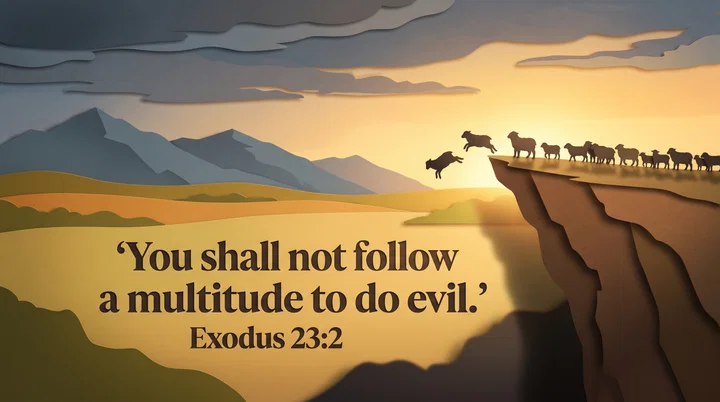
Exodus 23:2
Thou shalt not follow a multitude to do evil; neither shalt thou speak in a cause to decline after many to wrest judgment:
Translations
You shall not follow a multitude to do evil; neither shall you speak in a cause to decline after many to wrest judgment:
King James Version, KJV Cambridge Paragraph Bible, Webster Bible
Thou shalt not follow a multitude to do evil; neither shalt thou speak in a cause to decline after many to wrest judgment:
Thou shalt not follow a multitude to do evil; neither shalt thou speak in a cause to turn aside after a multitude to wrest judgment:
Thou shalt not follow a multitude to do evil; neither shalt thou speak in a cause to turn aside after a multitude to wrest justice:
'Thou art not after many to evil, nor dost thou testify concerning a strife, to turn aside after many to cause [others] to turn aside;
Thou shalt not follow the multitude for evil; neither shalt thou answer in a cause, to go after the multitude to pervert [ judgment].
Thou shalt not follow multitudes to commit wickedness,—neither shalt thou answer in a quarrel, so as to turn away after multitudes to mislead,
Berean Standard Bible, Majority Standard Bible
You shall not follow the crowd in wrongdoing. When you testify in a lawsuit, do not pervert justice by siding with the crowd.
“ You shall not follow a crowd to do evil. You shall not testify in court to side with a multitude to pervert justice.
Do not be moved to do wrong by the general opinion, or give the support of your words to a wrong decision:
Thou shalt not follow a multitude to do euil, neither agree in a controuersie to decline after many and ouerthrowe the trueth.
Douay-Rheims (Challoner revision)
Thou shalt not follow the multitude to do evil: neither shalt thou yield in judgment, to the opinion of the most part, to stray from the truth.
Pictures
Cross-references
- Matthew 7:13-14
Enter ye in at the strait gate: for wide is the gate, and broad is the way, that leadeth to destruction, and many there be which go in thereat:
The broad way followed by many contrasts with the narrow way leading to life.
- Hosea 10:13
Ye have plowed wickedness, ye have reaped iniquity; ye have eaten the fruit of lies: because thou didst trust in thy way, in the multitude of thy mighty men.
Both rebuke trusting in the multitude.
- Acts 5:29
Then Peter and the other apostles answered and said, We ought to obey God rather than men.
Obedience to God takes priority over human demands.
- John 12:42-43
Nevertheless among the chief rulers also many believed on him; but because of the Pharisees they did not confess him, lest they should be put out of the synagogue:
Fear of exclusion and love of human praise led rulers to hide their belief.
- Exodus 32:1-4
And when the people saw that Moses delayed to come down out of the mount, the people gathered themselves together unto Aaron, and said unto him, Up, make us gods, which shall go before us; for as for this Moses, the man that brought us up out of the land of Egypt, we wot not what is become of him.
Aaron and the people follow the multitude into idolatry.
- Matthew 27:22-23
Pilate saith unto them, What shall I do then with Jesus which is called Christ? They all say unto him, Let him be crucified.
The crowd cries out together for Jesus’ death.
- Joshua 24:15
And if it seem evil unto you to serve the LORD, choose you this day whom ye will serve; whether the gods which your fathers served that were on the other side of the flood, or the gods of the Amorites, in whose land ye dwell: but as for me and my house, we will serve the LORD.
Choosing to serve the Lord means refusing to follow the crowd into evil.
- Matthew 27:24-26
When Pilate saw that he could prevail nothing, but that rather a tumult was made, he took water, and washed his hands before the multitude, saying, I am innocent of the blood of this just person: see ye to it.
Pilate yields to the multitude and condemns Jesus despite recognizing his innocence.
- Exodus 23:6
Thou shalt not wrest the judgment of thy poor in his cause.
Commands against denying justice to the poor.
- 1 Thessalonians 5:21
Prove all things; hold fast that which is good.
paired as the alternative to following the multitude
- Matthew 23:30
And say, If we had been in the days of our fathers, we would not have been partakers with them in the blood of the prophets.
The Pharisees denied their fathers’ error yet repeated their persecution of the prophets.
- John 19:7
The Jews answered him, We have a law, and by our law he ought to die, because he made himself the Son of God.
Jesus’ accusers invoked their law to justify his death.
- Psalms 49:13
This their way is their folly: yet their posterity approve their sayings. Selah.
Both warn against following a mistaken way approved by many.
- Proverbs 11:21
Though hand join in hand, the wicked shall not be unpunished: but the seed of the righteous shall be delivered.
The wicked will not escape punishment, even when many join together.
Commentary
Each commentary is drawn from primary sources: the writings of Ellen G. White and Adventist pioneers and periodicals. Each commentary is separate. Its own words are not a quotation; follow the references to read the source passages.
Ellen G. White
17 sources
Thou shalt not follow a multitude to do evil forbids both joining a crowd in doing wrong and bending justice to agree with the majority, requiring judges and all people to refuse false causes, bribery, and partial decisions.Lt 160, 1906, par. 3–9PP 311.1 The choice of the many never makes wrong right, so widespread custom, worldliness, pride, and popularity can never excuse disobedience or make it virtuous.Lt 38, 1896, par. 94T 647.117MR 81.1–2 Faithfulness therefore means standing singular and apart on the Lord's side, with each person and household serving the Lord no matter what others do.Lt 38, 1896, par. 9SPBC 137.517MR 79.2–4 This requires keeping the seventh-day Sabbath specified in the fourth commandment rather than yielding to pressure to keep Sunday or follow the world, even when obedience brings opposition, loss of profit, reproach, and inconvenience.17MR 81.1–2Lt 108, 1886, par. 13–17Lt 108, 1886, par. 5–1217MR 79.2–49T 229.3–230.2 For the young it warns especially against joining lawless companions and copying careless conduct, since going with the many places influence on the side of evil and leads others astray, while refusing to follow keeps influence on Christ's side.MYP 411.2CT 221.18MR 282.2–283.1Ms 20, 1895, par. 9–10
Setting and Meaning
The command belongs to the instruction given to Moses on the mount in Exodus 19-24, given by Christ Himself who spoke the directions on Sinai and afterward spoke in human flesh.Lt 160, 1906, par. 3–9 It is needed now just as verily as it was needed by Israel in the days of Moses, and is to be studied and presented before the people.Lt 160, 1906, par. 3–9 It guards against doing injustice and guides how to deal with one another, requiring all contention to cease and hearts to be softened and subdued so that brethren love one another.Lt 160, 1906, par. 3–9
It presents the truth and light and grace given from Sinai, to be studied, obeyed wholly, and carried out in practice and character.Ms 185, 1907, par. 13–16 Obedience to all the commandments is the condition for being as kings and priests unto God, for communion with God, and for strength of character under every temptation so as not to lose hold upon God.Ms 185, 1907, par. 13–16 It forbids joining a crowd in doing wrong, and it forbids speaking in a cause so as to turn aside after many to wrest judgment.PP 311.1 Judges therefore must not distort justice, support a false cause, let bribery sway decisions, or bend judgment to agree with the majority.PP 311.1
Israel broke this word when Moses was absent by following the multitude to do evil in making the calf and worshiping idols, though with lifted voice and hands to heaven they had professed to comply, and by this they proved disloyal and untrue.Ms 185, 1907, par. 13–16 In mercy a chance was given to redeem themselves by separating from the apostasy and taking a firm decided stand on Moses's side.Ms 185, 1907, par. 13–16 The three thousand who would not come perished.Ms 185, 1907, par. 13–16
Numbers Never Excuse Sin
The choice of the many never makes evil right, and joining in sin is never excused by the number who choose it.Lt 38, 1896, par. 917MR 81.1–2Lt 108, 1886, par. 13–17SPBC 137.54SP 501.1–2 Widespread practice of worldliness and pride does not excuse imitating it.Lt 38, 1896, par. 94T 647.1 Popularity, custom, and the world's disregard of God's law do not make disobedience right or virtuous, so duty must be chosen rather than conforming to avoid seeming different.17MR 81.1–2Lt 108, 1886, par. 13–17SPBC 137.5 This applies when many oppose obedience, as in pressure to keep Sunday instead of the seventh-day Sabbath.17MR 81.1–2Lt 108, 1886, par. 13–17
When duty requires avoiding sin, faithfulness may require being singular and standing apart from the majority.Lt 38, 1896, par. 9SPBC 137.5 Being different in that case is simply the distinction between purity and impurity and between righteousness and unrighteousness.Lt 38, 1896, par. 9SPBC 137.5 The command means placing oneself on the Lord's side and refusing to join the multitude in doing evil wherever one lives, with each person and household called to serve the Lord no matter what others do or serve and worship.17MR 79.2–4
Choosing the crowd's path of transgression over obedience, after rejecting clear warnings, leaves people responsible for their choice.Ms 185, 1907, par. 13–164SP 501.1–2 The same testing by God's Word comes in the present day.Ms 185, 1907, par. 13–16 It requires young and old to be braced Bible students, led step by step to do righteously, refusing insinuations of evil, praying, and holding to God through temptation and sickness.Ms 185, 1907, par. 13–16 The verse is a single text to stand upon and to meet Satan with It is written in order to effectually resist him.17MR 79.2–4
Standing Firm in Obedience
The command requires keeping the very day the fourth commandment specifies, the seventh-day Sabbath, rather than yielding to pressure to keep Sunday. 17MR 81.1–2Lt 108, 1886, par. 13–1717MR 79.2–4 God's people must not follow the world's customs to avoid seeming different, and must not abandon His commandments for an easier time or to avoid persecution, opposition, reproach, and inconvenience, even when many oppose those who obey. 17MR 81.1–2Lt 108, 1886, par. 13–179T 229.3–230.2Ms 9, 1900, par. 8–9 Popularity does not make disobedience right, and the world's disregard of the law does not make transgression virtuous, so Christians must choose duty and stand apart rather than join the majority in doing wrong. 17MR 81.1–2Lt 108, 1886, par. 13–17Lt 108, 1886, par. 5–12
Obedience holds even when keeping the Sabbath means closing business on Saturday though it is the busiest and most profitable day, giving up that gain, losing income, and standing apart from the crowd. Lt 108, 1886, par. 5–1217MR 79.2–4 Popularity, profit, and worldly favor do not justify disobeying God's law. Lt 108, 1886, par. 5–1217MR 79.2–4 Hesitating for profit and riches, or to gain favor with transgressors of God's law to escape inconvenience, opposition, and reproach, breaks this command and bows the knee to Satan as in Christ's temptation, choosing Satan's way and will over God's claims and becoming liable to suffer the penalty for transgression of His holy law against all disobedience. 17MR 79.2–4 Nor are those under such opposition to condemn faithful believers who remain steadfast. Ms 9, 1900, par. 8–9
For the young, the command warns against joining lawless companions and copying careless conduct when unholy examples are on every side. MYP 411.2CT 221.18MR 282.2–283.1Ms 20, 1895, par. 9–10 Going with the many puts personal influence on the side of evil and of Satan, and can mislead others who have held firmly to right principles or have no firm loyalty to God, while refusing keeps influence on Christ's side and keeps others from being led astray. MYP 411.2CT 221.18MR 282.2–283.1Ms 20, 1895, par. 9–10 Those who follow the crowd disregard warnings, claim in self-confidence that they know enough not to be corrupted, fail to seek safe footing, become unguarded, and are charmed by the careless recklessness of those who boast of knowing evil. 8MR 282.2–283.1 In this way they abandon right principles and take deadly steps on the road to death and destruction, because influence is power; the command therefore calls the young to guard their choices, hold firmly to God, and follow what is right even when many choose otherwise. 8MR 282.2–283.1Ms 20, 1895, par. 9–10
Sources
Pioneers and periodicals
107 sources
The verse gives two commands: not to join a crowd in doing wrong, and not to let the number on one side of a case sway testimony or judgment away from what is just.RH Aug 21, 1855ST Jan 27, 1909ST Apr 15, 1886 No number of people doing evil makes it right, and neither majority nor minority decides what is right before God.RH Nov 7, 1912ST Mar 12, 1894ST Oct 23, 1893ST Nov 11, 1889 In religion the multitude has always been on the side of falsehood while only the minority has held the truth, so popular opinion and widespread custom can never settle moral and religious duty.ST Mar 12, 1894RH Apr 14, 1874RH Jul 18, 1912ST Nov 7, 1892 Keeping Sunday because most people keep it does not make it right or satisfy the command to keep the seventh day holy, and agreement by many to substitute another day cannot cancel God's commandment.ST Apr 5, 1883ST Nov 11, 1889ST Mar 24, 1898ST Jul 18, 1878 Truth and duty must therefore be obeyed even when it means standing alone and losing friends, fortune, or life, for one person on God's side stands against the world.RH Apr 10, 1900ST Jan 25, 1899ST Apr 2, 1912ST May 24, 1905
Place in Law and Covenant
The verse stands among practical instructions for different areas of life that grow out of the law, belonging to the legal ordinances given to guide Israel under its covenant with Jehovah.ST Jan 25, 1910 It is part of the law of Moses commanded in Horeb, with the statutes and judgments that include the Ten Commandments and all other precepts given through Moses covering moral law, civil regulations, conduct between man and man, health laws, and ceremonial laws of sacrifices, offerings and types revealing the substance of the new dispensation from the shadows of the old. Malachi 4:4 calls attention to this whole law, not to the Ten-Commandment law alone, and in the last days God calls His people to remember it especially as set forth in Exodus 20 to 40 and Leviticus.
It belongs to the statutes and judgments that follow the ten words spoken by God's voice with an awful display of divine majesty, after which the people removed and stood afar off.ST Feb 6, 1879ST May 16, 1878 It was spoken to Moses only while he was in the immediate presence of God in the thick darkness, in a private interview after the people heard that voice for the first time.ST Feb 6, 1879ST May 16, 1878ST Mar 1, 1883 Like the rest of the latter part of Exodus 20 and all of Exodus 21, 22 and 23, it partly defines duty toward God but principally defines duty toward fellow man, stating principles of justice among men alongside precepts of a ceremonial character.ST Feb 6, 1879ST May 16, 1878ST Mar 1, 1883 Together those chapters form an epitome of the civil and ceremonial laws to be followed in civil and religious matters.ST May 16, 1878ST Mar 1, 1883
The statutes in Exodus 21 to 23 reveal and apply the principles of the Ten Commandments, which were spoken from Sinai with terrible solemnity but could not be comprehended by minds blinded and corrupted through slavery and heathenism, so God gave these statutes to make the moral connections clearer to apprehend.ST Apr 17, 1907 They grew out of the commandments and formed part of the covenant with Israel.ST Apr 17, 1907ST Aug 5, 1889 The judgments in chapters 21-23 formed the basis of Israel's national law and expressed principles of God's law, with later instructions developing those principles without adding or removing any moral principle.ST Dec 10, 1896 Those regulations are to be interpreted according to the Ten Commandments as the moral constitution of Israel, with which no regulation can conflict, and Israel's covenant agreement did not change the law's nature or make it less binding or enduring.ST Dec 10, 1896ST Apr 15, 1886
God spoke this statute from the thick darkness to Moses only, Moses told all these words to the people and they answered the second time that they would do all the words the Lord had said, and then Moses wrote it in the book of the covenant.ST Apr 17, 1907 With the Ten Commandments it was included in the book ratified at Sinai, while remaining distinct in rank as the judgments rather than the words of the Lord, privately communicated to Moses and delivered through him rather than spoken immediately by the voice of God.ST Apr 15, 1886 The chapter's judgments and statutes are instructions God gave Moses to teach the people, distinct from the Ten Commandments that God spoke aloud and wrote on stone.RH Jul 9, 1901 Delivered through Moses and recorded in a book, they are part of the moral, civil, ceremonial and ecclesiastical laws in the book of the covenant which Israel agreed to obey, which regulated the Jewish theocracy.ST Dec 16, 1897RH Jul 9, 1901
They informed the people of many points relating to the covenant so they would fully understand before they promised obedience and the old covenant was sealed in Exodus 24, alongside the additional instruction God gave Israel at Sinai with the Ten Commandments as part of the words they agreed to obey. Exodus 23 belongs to the ritual and judicial law spoken to Moses on the mount, which Moses was to write in a book to accord with the law written on the tables of stone.RH Feb 7, 1854 It was communicated during the forty days and forty nights in which Moses fasted because of Israel's transgression in worshiping a molten image, made when Moses delayed longer than expected after the six days following the speaking of the Ten Commandments, and the tables were given to Moses only when he had made an end of communing concerning this law.RH Feb 7, 1854
The verse belongs to the laws section of Exodus, chapters 20-24, forming part of the complete code of laws given as Israel became a nation, with its judicial precepts intended for the nation's civil government.RH Dec 31, 1861RH Jan 20, 1916 It is part of the holy law and other laws God gave Israel through Moses at Sinai in love, to write them on the people's hearts and bring them into close relationship with Him.ST Jan 27, 1909 Exodus 23 belongs to the Mosaic code, which is superior to the Code of Hammurabi.ST Mar 10, 1909
Meaning of Words and Justice
The verse gives two commands: not to join a crowd in wrongdoing, and not to distort justice by siding with the many or letting the number on one side of a case sway judgment.RH Aug 21, 1855ST Jan 27, 1909 Moral right and wrong are not determined by the number or influence of those who do something.ST Sep 26, 1895 A person must not join a majority or follow powerful people when they are doing wrong, but must resist their influence and judge rightly.ST Sep 26, 1895
The verse is not set apart from the moral law merely because it is outside the Ten Commandments, but belongs with God's obligations regulating life and conduct alongside the command not to kill.RH Aug 21, 1855 It belongs to a perfect moral code whose commands forbid the greatest harms and by including them the lesser harms of the same kind, and whose precepts are to be kept from love for God and neighbor.RH Aug 21, 1855 By itself the prohibition of following a multitude into evil is incomplete, because it depends on Scripture to define what evil is.RH Aug 21, 1855
The verse states a right or judgment respecting duty from man to man, prescribing what ought to be enforced judicially to rectify or check evil when the law is violated.ST Apr 15, 1886 It gives guidance for public justice by cautioning witnesses, requiring juries to give impartial verdicts, and providing judges with direction for sentencing. It calls for following the wise few rather than the many, and states a rule of moral independence not to join a majority in doing wrong even when many others go that way.ST Sep 26, 1895ST Aug 20, 1902
Numbers Never Make Wrong Right
The command forbids joining a crowd in doing wrong, for the number of people committing evil does not make it right and a majority does not make an evil course right.RH Nov 7, 1912ST Mar 12, 1894ST Oct 23, 1893 It warns against following a multitude into wrongdoing and against letting the many sway judgment away from what is right.ST Mar 12, 1894ST Oct 23, 1893 Right and wrong are not determined by how many follow a course, and neither majority nor minority decides what is right before God.ST Oct 23, 1893ST Nov 11, 1889 Neither right conduct nor true opinion is decided by the greater number, and popularity and numbers are no test of truth, so agreement or influence of many is no proof that a belief or action is right, whether done with others or alone.ST Nov 11, 1889RH Jul 21, 1874
The warning governs religious and moral decisions, which cannot be settled by majority opinion, human influence, or custom.ST Mar 12, 1894ST Nov 11, 1889 In deciding between Sunday and the seventh day, duty must be judged by Scripture rather than numbers, customs, or human influence.ST Nov 11, 1889 Agreement with others is right only when God's word leads to it, and when it leads elsewhere a person should walk alone with Christ rather than follow the multitude.ST Nov 7, 1892 Even widespread acceptance of error excuses no one from choosing the right, for moral principle requires doing right at any cost and relying on God for support.ST Apr 17, 1893RH Jul 18, 1912 The command remains as timely amid spiritual decline as when first spoken.ST Apr 17, 1893RH Jul 18, 1912
Its counsel applies for all time and to every majority, whether professed servants of God or ordinary Gentiles, since loyalty to the Lord matters more than agreement with the human majority.ST Sep 5, 1895ST Jan 29, 1885 Gradual abandonment and popular custom cannot make disregard of the seventh-day command lawful, for a practice does not become right merely because many follow it.ST Jan 29, 1885 The truth borne to the world does not depend on whether its bearers number 10,000 or 10,000,000, for truth and right judgment are not determined by what most believe or do.ST Jan 23, 1893 In religion the multitude has always been on the wrong side, on the side of falsehood, rejecting God's truth and persecuting God's little flock while only the minority has stood for truth.RH Apr 7, 1863 The greatest errors have been the most widely received, majorities are seldom right, and the majority has as a rule been wrong on every question of moral reform.RH Jul 18, 1912
Popular agreement is no infallible guide to religious truth, as shown when the crowd demanded the death of Jesus and the release of Barabbas, and widespread observance of a religious day does not prove divine approval.RH Apr 14, 1874 People must follow God rather than custom, precedent, or pressure of the crowd, refusing fear of man as Aaron failed to do when he made the golden calf from fear of the people.RH Apr 14, 1874 Instead they must take the stand of Shadrach, Meshach, and Abednego in refusing to worship the golden image even at the cost of the fiery furnace, for the many go through the wide gate and broad way to destruction and everyday Christian living must show the same refusal to compromise between truth and error. Every age has its error and every person his bias, so present churches are not free from error and prejudice, and each reader must consider that he may now be condemning God's truth by going with the multitude just as past ages did.RH Apr 7, 1863
Not following a multitude to do evil includes not following a multitude to believe evil, for universal or majority belief does not make a doctrine true.ST Dec 20, 1899 False beliefs such as the natural immortality of the soul and endless torment must not be accepted on the ground of universal or majority belief, since the majority has always been in the wrong.ST Dec 20, 1899 Every teaching must be proved from the Word of God and only what is good held fast.ST Dec 20, 1899 A sin does not become acceptable to God because many commit it, and common practice cannot excuse breaking the Sabbath or any other commandment.ST Oct 5, 1882ST Nov 25, 1889 Sin remains sin whether committed by few or many, and its multiplication and spread make it more offensive to God, not less.ST Oct 5, 1882ST Nov 25, 1889
A crowd's approval does not make wrongdoing right, for moral right and wrong do not change with the opinions or customs of different times and peoples.ST Nov 18, 1903 A person must not join the many in evil but remain faithful to integrity even when standing alone.ST Nov 18, 1903 Human agreement and law must not take God's place or justify disobedience to His commands, so truth must not be compromised and the majority must not be followed into evil.ST Apr 28, 1898 The majority's example is no authority for conduct even when following it would bring worldly convenience or favor.ST Apr 28, 1898ST Mar 4, 1886 A church, lodge, or nation cannot make wrongdoing right or cancel the moral law, and each person is responsible for doing right individually rather than joining wrongdoing because others do it or bending justice to follow the majority.ST Jan 8, 1885
Sabbath Sunday and Worship Customs
National or local custom never excuses disobedience to God, so the fact that Sabbath-keeping is not the custom in a country does not justify breaking the Sabbath and following the majority in evil, and God's command must be obeyed rather than the multitude. The command reaches those who know Scripture requires observance of the seventh day yet avoid it because few keep it and others disapprove, for convenience, worldly interests and human approval do not justify disobedience, and the multitude's example must not replace Scripture as guide.ST May 20, 1889ST Jan 18, 1905RH Feb 17, 1852 Fear of persecution or loss of reputation and friendship, and loving the praise of men more than the praise of God, are condemned as reasons for neglecting plain duty, since the popular way leads to destruction while the way to life is narrow and found by few.ST May 20, 1889ST Sep 30, 1880ST Jan 18, 1905RH Feb 17, 1852 Obedience to God must stand above worldly convenience and favor, and the course of the multitude and the opinions and verdict of the majority must not be made the criterion of right judgment and the rule of action.ST May 20, 1889ST Jan 18, 1905
No matter how many agree to substitute another day for the day God commands, their agreement does not cancel the commandment or make the substitute lawful.ST Apr 5, 1883 Widespread agreement, practice, or custom does not justify disobeying God's command to keep the seventh day holy.RH Aug 15, 1854ST Sep 9, 1886ST Jun 26, 1884 This includes customary business or pleasure travel on the Sabbath and widespread labor on the seventh day God sanctified, whose popularity does not excuse disregard of the law, for God's law and not personal feelings or popular custom is the standard of right and wrong.RH Aug 15, 1854ST Sep 9, 1886ST Jun 26, 1884 The more common such a transgression is, and the more it is treated like law, the greater the warning it gives, and though judgment may be delayed it will come according to righteousness and God's law.RH Aug 15, 1854ST Jun 26, 1884
The fact that most people keep the first day is no reason to follow them rather than keep the seventh day, and willingness to obey only if the people do so is still conformity to the multitude in wrongdoing.ST Mar 24, 1898ST Jul 18, 1878RH Feb 7, 1916 Following the multitude into first-day observance does not make that practice right or satisfy the fourth commandment, and going along with the crowd when the crowd is wrong gives no excuse for breaking the seventh-day Sabbath.ST Mar 24, 1898ST Jul 18, 1878 One must not follow the majority into wrongdoing or bend judgment to agree with many, for number does not make a course right.ST Sep 30, 1880RH Feb 7, 1916 In deciding whether Sunday or the seventh day is the Sabbath, Christians are to judge by Scripture rather than numbers, customs, or human influence, since moral duty is not decided by how many support a course and neither majority nor minority determines what is right before God.ST Nov 11, 1889RH Oct 14, 1915 The fact that many keep Sunday does not make Sunday the Sabbath and gives no reason to keep Sunday as the Sabbath.ST Nov 11, 1889RH Oct 14, 1915
Faithfulness requires following Christ rather than men and not joining the majority of Christendom in rejecting the seventh-day Sabbath even though many will never return to keeping it, instead of acting like the Jews of old who went with the crowd, for God still calls to His true Sabbath.ST Nov 15, 1905 Joining the majority in keeping a day God has not sanctified rather than keeping His holy Sabbath is following the multitude to do evil.RH Mar 3, 1863ST Mar 31, 1898 Each person must decide for obedience to God, respect His commandments, keep the Sabbath holy, and walk in faith in Christ and obedience as the only way into the heavenly city, which brings well-being in the end under accountability to a holy God, with His unchanging law as the basis of judgment.RH Mar 3, 1863ST Mar 31, 1898
Honoring Sunday as a religious institution or substitute for the seventh-day Sabbath must not be followed even when many promote it and civil laws and many Christians support it, for God's authority and commandments must be respected rather than a popular human institution that conflicts with them, and a majority's practice does not make it right.ST Aug 30, 1883RH Aug 5, 1852 Long use by a majority for many hundred years does not make a practice right, so keeping the first day as the Sabbath because the church has done so, and bowing to images and saints because a majority has done so, are evils that must not be followed.RH May 26, 1853 Popularity does not make a practice right even when nine-tenths of professing Christians observe Lent, and joining such Catholic and heathen innovations corrupts the simplicity of truth and leads to excusing careless living the rest of the year.ST May 6, 1889 Such observance is will-worship displeasing to God because the importance, time and expense given to human inventions hide the institutions God appointed.ST May 6, 1889 Christians should obey God's commandments and walk in His ways rather than follow popular religious customs with heathen origins such as Christmas and Easter.ST Jan 5, 1915
Each person must settle not to imbibe the prevailing spirit and not to go with the multitude in the way of the world wholly or in part.RH Jun 18, 1908 This forbids using means lent by the Lord to purchase giant fire-crackers, toy pistols and sight-seeing for children in keeping the Fourth of July, especially when it falls on the Sabbath, God's memorial of creation.RH Jun 18, 1908 Instead the day is to be used as a religious liberty day for studying civil and religious liberty and considering omens that the republic's foundations are undermined, the structure tottering, the torch of liberty extinguished, and an image to the beast formed, in light of the coming time of trouble, the end of sin, and the reign of righteousness.RH Jun 18, 1908 Widespread Sunday diversions and pursuit of recreation must not draw church members away from worship and spiritual interests, for the fact that many do so does not make following them right.RH Nov 9, 1911
The multitude's apparent approval of Fijian burial traditions does not make them right, showing tradition can cruelly shape affections.RH Dec 7, 1905 Custom, the multitude, and tradition of men must not be followed in baptism, nor conformity to what fathers did because they did it, but Christ must be followed with the Bible as the only guide rested upon as upon a rock.RH Mar 28, 1871 There is no life in following a multitude to do evil even to keep peace and end controversy over the Sabbath, but life is found only in connection with Jesus Christ and walking in His way of righteousness.ST Jul 3, 1907RH Aug 20, 1872ST Dec 23, 1886 The warning therefore stands against adopting a popular change to the Sabbath despite absence of divine authority for it, and against yielding to pressure for Sunday observance and abandoning truth about the Lord's Sabbath to go along with the movement to transfer the Sabbath to the first day.ST Jul 3, 1907RH Aug 20, 1872ST Dec 23, 1886
Courage to Stand Alone
One on God's side stands against the world, for numbers and power are no measure of right, and truth and duty must be obeyed even when obedience means standing alone and losing friends, fortune, or life.RH Apr 10, 1900ST Jan 25, 1899 It is better to be right than popular, better to be alone with God than to follow or lead a multitude to do evil, and better to be in a prison cell with the enduring principles of Christ in the heart than on the throne of a universal world kingdom with the taint of sin in the soul.ST Apr 2, 1912ST May 24, 1905 What serves God's glory serves the good of His creatures, but to resist His will in oneself to the end perverts His mighty saving power to destruction, so His work is too sacred, solemn, and important for self-service or worldly pleasure.ST May 24, 1905
Joining the crowd brings evil, for Aaron did so and a nation went into idolatry, and Pilate did so and crucified the Lord of glory.ST Dec 7, 1904 By contrast Abraham, Moses, Elijah, Jesus, Paul, and the good of all ages did not do so, but set their faces Godward though obeying God's glad tidings was unpopular in the days of Noah, Lot, Moses, Elijah, Jesus, Paul, and Luther.ST Dec 7, 1904 The command forbids fearing man and going with the multitude into evil as Aaron did in making the golden calf because he feared the people. It requires instead the stand of Shadrach, Meshach, and Abednego in refusing to worship the golden image even at the cost of the fiery furnace, and everyday Christian living must show the same refusal to compromise in the relation of truth to error, since the many go through the wide gate and broad way to destruction.
The greatest errors have been the most widely received and the majority have as a rule been on the wrong side of every question of moral reform, for human regard for a doctrine does not decide its standing before God.RH Jul 18, 1912 The fact that the majority opposes the right releases no individual from doing the right, and the command not to follow the crowd to do wrong is as timely in days of spiritual declension as when first spoken to the children of Israel.RH Jul 18, 1912 It calls the man of God to be a man of principle to do right at whatever cost, relying alone upon the God of right for sympathy and support and standing in God's strength for the truth and righteousness of Christ the Saviour, as Moses, Joshua, Caleb, Samuel, Elijah, Elisha, Paul, and Silas did.RH Jul 18, 1912 The Reformers likewise followed the Bible as far as its truths had been revealed to them rather than seeking popularity, enduring hardship and social rejection, for ancestry or popularity cannot secure a place in Christ's kingdom.ST Jul 7, 1887
Unswerving loyalty is the grandest quality in the Christian, meaning staying loyal to God as King and Redeemer and to His law even when standing alone.RH Jul 2, 1914ST Oct 10, 1895ST May 1, 1907 It means refusing to go with the crowd into wrongdoing when others fail, desert the ranks, prove false when a great leader falls, or join many in evil, but holding more firmly to duty with constant vigilance.RH Jul 2, 1914ST Oct 10, 1895ST May 1, 1907 Such loyalty is possible even when character is imperfect, knowledge not extensive, education defective, and experience limited, and it makes zealous soldiers of God in days of lukewarmness and treachery.RH Jul 2, 1914 Moral courage is required to follow principle rather than join a multitude in doing wrong.RH Nov 20, 1866ST Nov 21, 1892 When moral principle is involved, personal responsibility to God takes precedence over following a society or organization, and though acting before God may leave a person seemingly alone, that person is to endure in faith.ST Nov 21, 1892
People of principle do not follow a crowd into wrongdoing but resist pressure from opposing circumstances and remain steadfast in doing what is right.RH Apr 5, 1906 God's people must not follow the majority into wrongdoing or conform to a corrupt society when doing so abandons what is right, but must follow truth wherever it leads and practice what God requires even at the cost of popularity or social influence, otherwise their example helps keep others in error.RH Sep 19, 1871 Refusing to follow the crowd marks a God-fearing soul with an enlightened conscience and a work of grace in the heart, living a pious, pure, godly, and steadfast life.ST Oct 20, 1887 Because human moral sight is disorganized by sin and its views of life and character are distorted, the natural man does not see the beauty, blessedness, glory, and usefulness of such a life, so one who obeys is often a most aggravating spectacle to society, unattractive to the world, enduring contempt, neglect, grievous suffering, and hard treatment like the prophets, Jesus Christ in His perfect holiness, the apostles, and many of the purest and noblest believers since.ST Oct 20, 1887
A Christian must not join a crowd in doing evil even when wrongdoing is widespread or fashionable, and the abundance of sin instead calls for greater watchfulness, faithfulness, and resistance to sin while remaining true to God.ST Apr 14, 1887 God's people must not join the majority in doing evil but must resist the worldliness of the larger church and remain faithful even when many have abandoned true religion, for those who follow the multitude face judgment when Christ comes.ST Aug 14, 1884 The seeker of truth must not go with the multitude or look to the crowd for light and knowledge to make the path clear.RH Apr 25, 1865 He must refuse to be satisfied to go with the multitude pressing down the broad highway toward ruin, turn aside to release himself from the current, tumult, confusion, and darkness, press out to a place of rest and reflection, and climb upward toward the morning light where others are found who have likewise become wearied with the jargon and tumult of the multitude left behind.RH Apr 25, 1865
Truth remains God's voice calling people to listen and obey even when it leads through hardship rather than worldly approval, though the multitude may praise truth one day and reject it the next.RH Jul 3, 1879 Refusing to consent with majorities and sing their song when it is wrong is a noble discontent that spurs a man to rise and unite with the few who heed no taunting throng, to raise what is right and battle down what is wrong.ST Feb 20, 1907 Though such a contest may take years, truth never ceases to call until an answer wakes and manhood's ranks increase, showing that powers that slumbered can animate the soul with highest purpose and with the will that turns things to control.ST Feb 20, 1907 The command calls for following principle rather than drifting with the crowd, and for giving up gain or pleasure rather than compromising conscience, truth, and duty, even when faithfulness means standing alone against accepted social and religious views, and it forbids letting many people's opinion distort justice.ST Jan 25, 1899
Serving God means obeying His commandments rather than following the crowd, and that obedience must be freely given in love, not compelled by fear or force.ST Dec 25, 1901 Following the crowd is popular but not right, while walking with God is right both now and forever.ST May 5, 1898 The pressure of many going together can make it hard to stand apart, but the command calls for a right decision even when others urge the opposite, and resisting that pressure can strengthen self-control and shape later choices.RH Jun 30, 1874 It is natural for the carnal heart to follow the multitude to do evil and to follow a bad example rather than a good one, and the devil uses the mighty power of social influence and example to lead people away through many kinds of gatherings for wicked designs.RH Mar 8, 1870 Christians must not leave this weapon to him but must meet together in divine worship to exert good social influence, strengthen and encourage each other in overcoming, and provoke one another to love and good works by godly example.RH Mar 8, 1870
Young Christians must resist bad examples and not follow the crowd into evil, and applied to boys this calls for standing apart from harmful ways and choosing honesty and right conduct rather than copying others.RH Aug 4, 1868RH Aug 3, 1916RH Aug 4, 1868 Participation in sin weakens moral, mental, and spiritual strength.RH Aug 4, 1868 The command means never doing what everybody does because everybody does it and never judging oneself by one's neighbor or one's neighbor by oneself, and applied to social life and amusements this refusal settles most perplexing questions to one's own final satisfaction though not to mankind's satisfaction.ST Jan 4, 1905 It applies to resisting harmful social customs and choosing the right way even when standing alone, to refusing to join those who have let love give way to selfishness, and to refusing to follow the multitude into reckless drinking, for waiting for everyone else to reform is no excuse for going along with evil.ST Sep 6, 1883RH Aug 23, 1870
Justice Liberty and Public Duty
The verse forbids bending judgment to agree with the many, and this holds even when warnings about Rome are rejected by nearly everyone, for such rejection does not make them untrue and the duty remains to stand with God's word rather than follow the crowd. A majority does not make a wrong action right, including the use of force or compulsion in matters of worship and conscience, for one person on God's side stands against the world and numbers or power are no measure of what is right.RH Apr 10, 1900 Numbers will not make wrong right and a bad principle cannot be made good by the many who follow it.ST Jun 11, 1912
Applied to religion this condemns inquisitorial, political and coercive methods for winning souls even when used by sincere, earnest, zealous men with purpose to do something, since such coercion never truly wins souls or comes to full Gospel fruition though it may appear successful for a time.ST Jun 11, 1912 It upholds religious liberty that no soul is truly God's unless willingly so, following Jesus Christ who taught broadly but never used political or coercive methods and appealed always to heart and conscience.ST Jun 11, 1912 A majority cannot make an action right merely by numbers, and civil or religious power must not use majority rule to compel others or distort justice.ST Jan 29, 1894 The majority's religious beliefs do not give it the right to force seventh-day observers to stop lawful work in Sunday-law prosecutions, just as a minority has no right to impose its observance on everyone.ST Jan 29, 1894
The verse forbids the moral tyranny of the multitude over the individual and requires independent judgment and life.ST Dec 23, 1903 It means not surrendering questions of thought, morals or policy to neighbors' views, speaking independent conviction even when it differs from the majority, and living one's own life in one's own way rather than holding back for fear of being thought radical or queer.ST Dec 23, 1903 The mob spirit culminating in lynching is its extreme violation, but the violation begins whenever a person hesitates to express differing judgment or live according to conscience.ST Dec 23, 1903 Joining the majority in doing wrong is forbidden even when the wrong is officially ordered by one's own country in time of war, and virtue must not be put aside for patriotism.ST Apr 27, 1904 The watchword my country, right or wrong violates it, whether the war is an inhuman war of conquest or a war to quell a rebellion.ST Apr 27, 1904
Following the big crowd to do wrong by giving up definite conviction is forbidden, so God's people must refuse a church union or federation that breaks down definite conviction and replaces it with following the majority, since such proposed union is an ecclesiastical political combination Christ never commissioned His people to enter.ST Apr 29, 1913 The many must not be allowed to sway from just judgment, but God's word and truth must be chosen over popular error in a time of crisis.ST Mar 5, 1894 Each person and family must resist joining the majority in worldly conduct and its consequences, and must not follow the crowd blindly into evil.ST Apr 20, 1888ST Oct 18, 1883 Bending a judgment to follow the crowd is also forbidden in the decline of Protestant Christianity.ST Oct 18, 1883
Sources