John 19:7
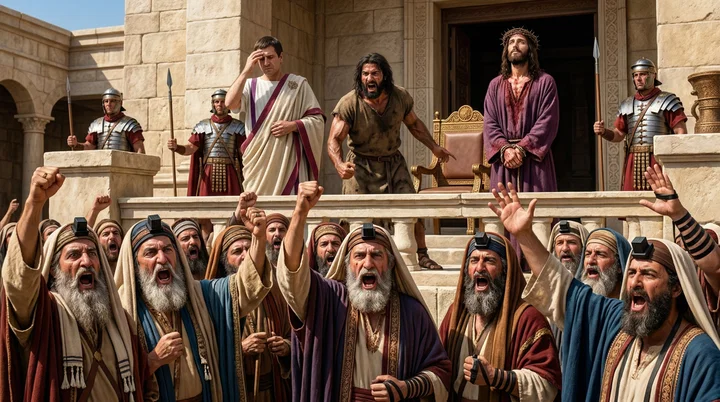
The Jews answered him, We have a law, and by our law he ought to die, because he made himself the Son of God.
Translations
American King James Version, King James Version, KJV Cambridge Paragraph Bible, Webster Bible
The Jews answered him, We have a law, and by our law he ought to die, because he made himself the Son of God.
Revised Version, American Standard Version
The Jews answered him, We have a law, and by that law he ought to die, because he made himself the Son of God.
the Jews answered him, 'We have a law, and according to our law he ought to die, for he made himself Son of God.'
The Jews answered him, We have a law, and according to [ our] law he ought to die, because he made himself Son of God.
The Jews answered him—We, have, a law, and, according to the law, he ought to die, because, Son of God, himself, he made.
“ We have a law,” answered the Jews, “ and according to that law He must die, because He declared Himself to be the Son of God.”
“ We have a law,” answered the Jews, “ and according to our law He must die, because He declared Himself to be the Son of God.”
The Jews answered him, “ We have a law, and by our law he ought to die, because he made himself the Son of God.”
And the Jews made answer, We have a law, and by that law it is right for him to be put to death because he said he was the Son of God.
The Iewes answered him, We haue a lawe, and by our law he ought to die, because he made himselfe the Sonne of God.
Douay-Rheims (Challoner revision)
The Jews answered him: We have a law; and according to the law he ought to die, because he made himself the Son of God.
Pictures
Cross-references 20 of 28
- John 18:36-37
Jesus answered, My kingdom is not of this world: if my kingdom were of this world, then would my servants fight, that I should not be delivered to the Jews: but now is my kingdom not from hence.
Jesus tells Pilate his kingdom is not of this world and that he came to bear witness to truth.
- Luke 23:22
And he said unto them the third time, Why, what evil hath he done? I have found no cause of death in him: I will therefore chastise him, and let him go.
Pilate finds no cause for death but proposes to chastise Jesus and release him.
- John 19:12-16
And from thenceforth Pilate sought to release him: but the Jews cried out, saying, If thou let this man go, thou art not Cæsar’s friend: whosoever maketh himself a king speaketh against Cæsar.
The leaders pressure Pilate to condemn Jesus, and he hands him over to be crucified.
- Matthew 26:64-66
Jesus saith unto him, Thou hast said: nevertheless I say unto you, Hereafter shall ye see the Son of man sitting on the right hand of power, and coming in the clouds of heaven.
Jesus’ divine claim provokes the council to condemn him to death.
- Matthew 27:11-31
And Jesus stood before the governor: and the governor asked him, saying, Art thou the King of the Jews? And Jesus said unto him, Thou sayest.
Jesus is tried before Pilate and condemned to crucifixion.
- John 18:38
Pilate saith unto him, What is truth? And when he had said this, he went out again unto the Jews, and saith unto them, I find in him no fault at all.
Pilate declared Jesus faultless before the leaders accused him.
- Leviticus 24:16
And he that blasphemeth the name of the LORD, he shall surely be put to death, and all the congregation shall certainly stone him: as well the stranger, as he that is born in the land, when he blasphemeth the name of the LORD, shall be put to death.
The priests invoke the law prescribing death for blasphemy.
- John 5:18
Therefore the Jews sought the more to kill him, because he not only had broken the sabbath, but said also that God was his Father, making himself equal with God.
His opponents treat his claim to be God’s Son as making him equal with God and worthy of death.
- Matthew 26:65-66
Then the high priest rent his clothes, saying, He hath spoken blasphemy; what further need have we of witnesses? behold, now ye have heard his blasphemy.
Both describe Jesus being condemned for claiming divine sonship.
- John 18:31
Then said Pilate unto them, Take ye him, and judge him according to your law. The Jews therefore said unto him, It is not lawful for us to put any man to death:
The Jewish leaders say Roman authority prevents them from carrying out a death sentence.
- Mark 15:13-14
And they cried out again, Crucify him.
The crowd demands Jesus’ crucifixion despite Pilate asking what evil he has done.
- John 10:33-36
The Jews answered him, saying, For a good work we stone thee not; but for blasphemy; and because that thou, being a man, makest thyself God.
His opponents accuse Him of blasphemy for claiming divine sonship.
- Isaiah 53:3
He is despised and rejected of men; a man of sorrows, and acquainted with grief: and we hid as it were our faces from him; he was despised, and we esteemed him not.
The suffering Messiah is despised and rejected.
- Luke 22:70
Then said they all, Art thou then the Son of God? And he said unto them, Ye say that I am.
Jesus answers the rulers that he is the Son of God.
- Luke 23:4
Then said Pilate to the chief priests and to the people, I find no fault in this man.
Pilate declares that he finds no fault in Jesus.
- Luke 23:14
Said unto them, Ye have brought this man unto me, as one that perverteth the people: and, behold, I, having examined him before you, have found no fault in this man touching those things whereof ye accuse him:
Pilate finds no basis for the accusations against Jesus.
- Acts 3:13-15
The God of Abraham, and of Isaac, and of Jacob, the God of our fathers, hath glorified his Son Jesus; whom ye delivered up, and denied him in the presence of Pilate, when he was determined to let him go.
Jewish leaders delivered Jesus to Pilate, denied him, and chose his death.
- Colossians 1:15
Who is the image of the invisible God, the firstborn of every creature:
Jesus is the image of God whom they persecuted.
- Matthew 27:2
And when they had bound him, they led him away, and delivered him to Pontius Pilate the governor.
Jesus is brought to Pilate for judgment.
- Acts 2:23
Him, being delivered by the determinate counsel and foreknowledge of God, ye have taken, and by wicked hands have crucified and slain:
Jewish leaders are guilty though Romans crucified Him.
Commentary
Each commentary is drawn from primary sources: the writings of Ellen G. White and Adventist pioneers and periodicals. Each commentary is separate. Its own words are not a quotation; follow the references to read the source passages.
Ellen G. White
28 sources
In the judgment hall of the Roman trial, after Pilate repeatedly declared he found no fault in Jesus, the Jewish leaders answered by invoking their own law to demand His death because He made Himself the Son of God, a blasphemy charge distinct from the rebellion charge they pressed to secure condemnation by Rome.RH Jan 23, 1900Ms 112, 1897, par. 26–3012MR 218.2–220.1DA 723.1–724.14RED 102.2–103.1 The claim startled Pilate and made him more afraid, so he withdrew into the hall to question Jesus about His origin, wondering if He was divine while still ignorant of His mission.RH Jan 23, 1900ST Nov 2, 18825RED 64.2–65.1 The claim was true, for He openly asserted His divine character as the Son of the living God clothed in humanity, with His divinity attested by prophecies, teachings, and miracles whose light exposed their error.ST Nov 2, 18825RED 64.2–65.1ST Jul 11, 1878Ms 111, 1897, par. 5–10Ms 104, 1897, par. 8–9 Yet they rejected that light from hatred, envy, and malice, exalting human customs and traditions above God's commandments while keeping ceremonial strictness, so their guilt in condemning the innocent was greater than that of Pilate, Herod, or the soldiers who acted in comparative ignorance.Ms 112, 1897, par. 26–30DA 736.1–737.112MR 400.2–401.4Ms 104, 1897, par. 8–919MR 163.2–3 In using their law to press the civil power to kill an innocent man they set human law above God's law, a union of church and state that will be repeated in the last days when courts declare by human law that commandment-keepers ought to die for refusing the Sunday idol in place of the Sabbath of the fourth commandment.Ms 90, 1897, par. 11Ms 104, 1897, par. 4–712MR 218.2–220.119MR 162.2–163.1ST May 26, 1898
Trial Setting and Charge
The setting is the Roman trial in the judgment hall, where Jewish officials brought Jesus to Pilate to have the Sanhedrin's sentence confirmed and executed.DA 723.1–724.1 There He was condemned and humiliated before the crowd that called for His crucifixion, an ordeal for which the disciples had been prepared so that the rejection and the fickleness of those who had once followed Him would not take them wholly by surprise.4RED 102.2–103.1
After Pilate repeatedly declared that he found no fault in Jesus and recognized Him as innocent, the Jews answered by invoking their law to demand His death because He made Himself the Son of God.RH Jan 23, 1900Ms 112, 1897, par. 26–3012MR 218.2–220.1Ms 51, 1897, par. 31–32ST Jun 3, 1889 This blasphemy charge under their law was distinct from the separate charge of leading a rebellion intended to secure condemnation by the Romans.RH Jan 23, 1900Ms 112, 1897, par. 26–30Lt 90, 1897, par. 13–18Ms 51, 1897, par. 31–32ST Jun 3, 1889 Their appeal to law and religious zeal was pressed even after Pilate had pronounced Him innocent, and it masked envious hatred.Ms 112, 1897, par. 26–30Lt 90, 1897, par. 13–18ST Jun 3, 1889
The charge startled Pilate and made him more afraid, driving him back into the judgment hall to question Jesus about where He came from.RH Jan 23, 1900ST Nov 2, 18825RED 64.2–65.1ST Jul 11, 18783SP 144.2–3 He wondered whether Jesus was a divine person, though he had no clear understanding of Christ or His mission.ST Nov 2, 18825RED 64.2–65.1ST Jul 11, 18783SP 144.2–3 He was moved by Jesus' noble bearing despite suffering, and he tried to wash his hands of the blood of a just person.RH Jan 23, 1900ST Nov 2, 1882 Pilate's wife heard this accusation in her dream and recognized Jesus as the Prince of God, also seeing the events of His trial, crucifixion, and return in glory.DA 731.6–732.3
Though declaring before the scornful accusers that He was without fault, Pilate for his office's sake gave Him up to have spikes driven through His hands and through His feet and to be hanged upon the cruel cross while He was derided.Ms 74, 1911, par. 17 As He was delivered to the people to be crucified the chief priests and elders ridiculed His claim to be the Son of God.3SP 148.1
Rejecting the Divine Son
Those who pressed the demand for death had unmistakable evidence of divinity in fulfilled prophecies, in teaching, and in miracles.ST Nov 2, 18825RED 64.2–65.1ST Jul 11, 1878DA 736.1–737.1 That light exposed their darkness and error, yet their hearts were hardened against Him even while He suffered at their hands.ST Nov 2, 18825RED 64.2–65.1ST Jul 11, 1878ST Jun 3, 1889
The charge grew out of hatred, envy, and malice.Ms 112, 1897, par. 26–30Ms 112, 1897, par. 31–32ST Jun 3, 1889 Religious zeal exalted customs, traditions, and human commandments above God's true commandments.Ms 112, 1897, par. 31–32 Appeal to law and strict concern to avoid ceremonial defilement masked envious hatred and deliberate rejection of received light.Ms 112, 1897, par. 26–30Ms 104, 1897, par. 8–919MR 163.2–3Ms 112, 1897, par. 31–32 It served Satan's purpose to destroy the image of God, and shows how human rules can be used as a pretext for opposing God while traditions are carefully observed.Ms 112, 1897, par. 26–3019MR 163.2–3
His claim was true, for He openly asserted His divine character and the prerogatives of the Son of God before His judges.Ms 111, 1897, par. 5–10 He is the Son of the living God whose divinity was clothed in humanity, the One who founded their religious system.Ms 104, 1897, par. 8–9Ms 74, 1911, par. 17 Though condemned as a blasphemer, He bore abuse without retaliation and looked forward to coming in glory when they would face His judgment.Ms 111, 1897, par. 5–10
In rejecting that light they acted directly against God's Word with no real evidence, treating the pure and innocent Christ as a criminal and willingly condemning the innocent.Ms 104, 1897, par. 8–919MR 163.2–319MR 162.2–163.1 Their guilt and responsibility were therefore greater than Pilate's, Herod's, or the Roman soldiers', who were comparatively ignorant.DA 736.1–737.1
Their appeal to law stands condemned by their own law-breaking, for Caiaphas in rending his priestly robe in pretended passionate zeal transgressed the law of heaven.12MR 400.2–401.412MR 393.3–394.2 No priest might remove his turban or rend his robe under penalty of death, because only perfection in dress and attitude and spirit could represent the holiness and perfection of the heavenly service.12MR 400.2–401.4 Christ, who made the laws governing the Temple service, could have turned the legal charge back upon Caiaphas as the true lawbreaker.12MR 400.2–401.4 The death sentence pronounced on Christ applied truthfully to Caiaphas himself, who by law deserved to die for his own sinful guilt and hypocrisy.12MR 393.3–394.2 Christ knew the hypocrisy dwelling in his soul while the robe was torn, and mourned over his transgression as over every human transgression and bore even his guilt.12MR 393.3–394.2
In Him the Passover type met its antitype when He was killed.Ms 104, 1897, par. 8–9 He remained sinless and faithful to His Father through the cross, proving false Satan's claim that God's law could not be kept.Lt 12, 1911, par. 8–11 His death also disproved Satan's charges against God and vindicated God's willingness to make the greatest sacrifice for humanity.Lt 12, 1911, par. 8–11 The shame and suffering He endured cancel the debt of every sinner who relies on His merits and virtue.Ms 56, 1894, par. 8–9
Pattern for Final Persecution
The cry for death by law shows religious leaders pressing civil power to kill an innocent man after the Roman judge had found no fault in Him.12MR 218.2–220.119MR 162.2–163.1Lt 90, 1897, par. 13–18 They set their own law above the law of Jehovah and trampled God's holy law underfoot while God's law was despised.Ms 104, 1897, par. 4–712MR 218.2–220.1ST May 26, 1898 It is union of church and state producing religious bigotry and oppression, the same pattern as Nebuchadnezzar making a golden image for all to worship.12MR 218.2–220.1 In this way human authority and human laws shaped by evil can be raised against God's law to oppose God and to punish those loyal to Him.Ms 104, 1897, par. 4–719MR 162.2–163.1Lt 90, 1897, par. 13–18
The same words and charge will be repeated over and over in the last days of earth's history against God's commandment-keeping people for the truth's sake.Ms 90, 1897, par. 11ST May 26, 1898 Then human laws will be exalted above God's law, with human law held supreme and God's law counted as nothing.Ms 90, 1897, par. 11ST May 26, 1898 Courts will favor those who obey human law and will declare by their law that the faithful ought to die.Ms 90, 1897, par. 11ST May 26, 1898 They will demand sacred observance of the Sunday idol and idol sabbath in place of God's holy Sabbath of the fourth commandment.Ms 90, 1897, par. 1112MR 218.2–220.1ST May 26, 1898 In the courts injustice will prevail against those loyal to the commandments, judges will refuse to listen to their reasons because arguments in favor of the fourth commandment are unanswerable yet condemn them by human law, those who respect human law will be favored, and those who will not bow will have no favors shown them.ST May 26, 1898
Christ's followers must therefore be prepared for similar persecution under laws framed as serving good.Ms 104, 1897, par. 4–719MR 162.2–163.1 Their appeal to human rules as a pretext for opposing God while carefully observing traditions shows how deliberate rejection of light can condemn the innocent.19MR 163.2–3 Those who live then will know tribulation in the world with peace in Christ.ST May 26, 1898
Sources
Pioneers and periodicals
41 sources
The Jews demanded Jesus die by their law because He made Himself the Son of God, after Pilate had repeatedly declared he found no fault and no crime worthy of death in Him and was determined to release Him.RH Jan 23, 1900ST Jan 23, 1901ST Nov 9, 1882STST Oct 28, 1875 They understood that claim in its unique and proper sense to mean making Himself equal with God, and on that ground treated it as blasphemy deserving death, though they had no power to carry out a death sentence and had first charged Him before Pilate with sedition for making Himself a king.ST Nov 1, 1877ST Mar 28, 1911ST Jun 7, 1899ST Feb 20, 1901 Hearing the Son of God charge for the first time startled Pilate and made him more afraid, wondering whether Jesus was divine, deepening his resolve to release Him and driving him back to question where He came from, yet he yielded to pressure and fear of being accused to Caesar and ordered the execution to proceed.RH Jan 23, 1900ST Nov 2, 1882ST Jul 11, 1878ST Jul 14, 1881 Their appeal to law concealed envy and hatred and made law supreme over right and justice and over God Himself, showing how persecutors profess respect for law and use civil power to accomplish religious ends.ST Jun 24, 1913RH Jul 3, 1900ST Sep 4, 1901RH May 30, 1912 The same words will be repeated against God's people in the last days when human laws are exalted above God's law, while the very Sonship and divinity for which He was condemned remains the foundation of hope.ST May 26, 1898ST Feb 20, 1901
Trial Before Pilate
John 19:7 belongs to Pilate's examination of Jesus after Pilate had repeatedly declared that he found no fault in Him, no crime in Him, and nothing worthy of death in Him, and had become determined to release Him.RH Jan 23, 1900ST Nov 9, 1882STRH Jun 15, 1911 The demand that by their law He ought to die because He made Himself the Son of God was pressed after Pilate had already pronounced Jesus innocent and just and had tried to wash his hands of the blood of a just person.RH Jan 23, 1900RH Jun 15, 1911 The Jewish rulers returned to the charge of blasphemy after Pilate refused to condemn Jesus for sedition.ST Nov 9, 1882 The mob's outcry at last prevailed and Jesus was led away to be crucified.RH Jun 15, 1911
Pilate had no doubt Jesus was innocent yet gave way to Jewish pressure and worldly interest.ST Jul 14, 1881RH Dec 9, 1858 When a further talk with Jesus made Pilate determined to let Him go, the Jews threatened his standing as Caesar's friend.RH Dec 9, 1858 Fear of the suspicious and jealous Tiberius Caesar, who readily heard charges of treason against rulers, and concern for worldly interest overcame conscience, lest Pilate be accused to Caesar and deposed or slain.ST Jul 14, 1881RH Dec 9, 1858ST So he yielded, consented to the crucifixion, ordered the execution to proceed, and Jesus was led away bearing His cross, though presented as innocent and as incarnate truth while the mob pressed Pilate to decide whether He would live or die.RH Dec 9, 1858ST
As preparation for execution Pilate ordered Jesus scourged.RH Dec 9, 1858 Roman soldiers stripped Him, put an old royal-colored robe on Him, crowned Him with platted thorns, put a reed in His right hand for a scepter, bowed before Him in mockery as King of the Jews, spit on Him and struck Him on the head with the reed to drive the thorns in.RH Dec 9, 1858 Torn by scourging and bloody from the temples and back, He was brought out before the people in hope pity would gain His release, but priests and people demanded crucifixion.RH Dec 9, 1858ST Oct 7, 1886 After being declared innocent He received unmerited torture and mockery from the soldiers of Herod and Pilate, then a compromise scourging to appease unreasoning wrath, and after all was handed over to His persecutors to be crucified.ST Mar 13, 1901
The Jews at that time did not have power to carry out a death sentence themselves.ST Mar 28, 1911ST Although they had condemned Jesus on the blasphemy charge for claiming to be the Son of God, with the stated reasons that He called Himself the Son of God, the Messiah, and King of the Jews, they knew it would carry no weight in a Roman court and avoided it as a formal charge.ST Mar 28, 1911ST Jun 7, 1899RH Jul 16, 1861 They took Him to Pilate instead on a charge of sedition, claiming He made Himself a king and an enemy of Caesar, so that His crucifixion was presented as a crime against the Roman state.ST Mar 28, 1911ST Jan 17, 1911ST Oct 1, 1896 Pilate knew the charge that Jesus had made Himself a king in sedition against Caesar was not true, and regarded these accusations as religious offenses that Roman justice did not punish with death.STRH Jul 16, 1861
The claim that Jesus made Himself the Son of God came after Pilate tried to wash his hands of a just person.RH Jan 23, 1900 Hearing it for the first time startled Pilate and made Him more afraid.RH Jan 23, 1900ST Nov 2, 1882ST Jul 11, 1878ST Nov 9, 1882 It made him wonder whether Jesus was a divine person or being, because Jesus was unlike any man he had known.ST Nov 2, 1882ST Jul 11, 1878ST Nov 9, 1882RH Jun 15, 1911 It deepened his resolve to release Him and drove him back into the judgment hall to question Jesus about where He came from, though he had no clear understanding of Christ or His mission.RH Jan 23, 1900ST Jul 11, 1878ST Nov 9, 1882
Even despised and scourged, with bleeding brow and torn back, Jesus still carried Himself with noble bearing more like a king on His throne than a condemned criminal.ST Nov 2, 1882ST Oct 7, 1886 This was in contrast with His own people, who had hardened their hearts against Him despite clear evidence of His divinity.ST Nov 2, 1882ST Oct 7, 1886 Pilate, a governor used to cruel scenes and battle, felt sympathy for the suffering prisoner, recognized His innocence, and saw His noble bearing despite His suffering, while the priests' charge arose from hatred because His light exposed their darkness and error.ST Nov 2, 1882ST Jun 3, 1889ST Oct 7, 1886
The guilt for Christ's death belongs to the leaders of the Jews, with the Romans acting by their hand.ST By this demand and by the pressure they brought to bear on Pilate they constrained him to deliver Jesus to be crucified.ST Though the Jews believed He was a blasphemer, their sincere conviction did not make their judgment right, and by prompting and approving His execution they were responsible for crucifying Him. Pilate acted inconsistently by persistently appealing to the people for consent to do his plain duty and by offering to cruelly scourge an innocent man to appease their wrath.ST Mar 13, 1901 He demanded Jesus' death on a charge practically the same as Barabbas's crime yet the cry was for Barabbas to be released while Barabbas stood convicted at his trial and Jesus had been declared innocent.ST Mar 13, 1901
Meaning of Sonship Claim
The Jews understood the claim to be the Son of God in a unique and proper sense, not in the general sense in which God's people are called His children, and they correctly and logically reasoned it to mean making Himself equal with God.ST Nov 1, 1877ST Feb 20, 1901 On that understanding they treated the claim as blasphemy deserving death and invoked their law to demand that by their law He ought to die.ST Jan 23, 1901ST Mar 28, 1911 This was presented with the stated reasons for sentencing Him that He called Himself the Son of God, the Messiah, and King of the Jews.ST Oct 28, 1875RH Jul 16, 1861 Their law called for His death, but they lacked the authority to carry out the sentence, so they took Him to Pilate and presented a charge of sedition instead, since Pilate would not act on the blasphemy charge.ST Mar 28, 1911ST Oct 1, 1896 Pilate regarded these accusations as religious offenses that Roman justice did not punish with death, yet His crucifixion was presented as a crime against the Roman state, with Jesus accused of being an enemy of Caesar.ST Oct 1, 1896RH Jul 16, 1861
They had clear evidence of His divinity in the prophecies, teachings, and miracles, but their hearts were hardened against Him.ST Nov 2, 1882ST Jul 11, 1878 Their charge arose from hatred of Christ, whose light exposed their darkness and error.ST Jun 3, 1889 They persecuted Jesus, who is the image of the invisible God, because He would not conform to their ideas of religion, for their ideas of the character of God and of religion in both form and spirit had become distorted, yet they remained full of zeal for their creed.ST Dec 10, 1896 Their charge startled Pilate and made him wonder whether Jesus was a divine person or being, increasing his fear as he saw Jesus' noble bearing despite His suffering, though Pilate had no clear understanding of Christ or His mission.ST Nov 2, 1882ST Jul 11, 1878 While the priests invoked their law to demand His death, Pilate recognized Jesus' innocence.ST Jun 3, 1889
The accusations of false witnesses could furnish no ground for condemnation, confirming the perfection of His character in charity, piety, purity, fortitude, self-possession, self-denial and self-government.ST Feb 20, 1901 At last He was condemned for asserting His divinity because He declared Himself to be the Son of God.ST Feb 20, 1901 In judging what was derogatory to the power and reverence of God, the Sanhedrin ignorantly condemned to death the very God who gives breath to the people and gave them life.ST Jan 23, 1901 That condemnation proves the everlasting inability of sinful man to interpret the law of God and the inability of the State to decide questions of religion or punish alleged infidelity.ST Jan 23, 1901 Making claim to be sons of God is not blasphemy but the privilege of all believers.ST Jan 23, 1901
Passover Sacrifice Fulfilled
John 19:7 belongs to the account of the condemnation and death of Jesus, where the Jews invoked their law to demand His death because He had made Himself the Son of God.RH Oct 30, 1855ST Aug 13, 1874 That death was the death of Jesus as the Lamb of God and Passover sacrifice, killed on the fourteenth day of the first month, on the very day the paschal lamb was slain.RH Oct 30, 1855ST Aug 13, 1874 In this He fulfilled the type of the Passover lamb at its appointed time.RH Oct 30, 1855ST Aug 13, 1874
Law Misused to Persecute
The demand for death rested on an appeal to their own law, with assumed righteousness used to make the demand appear just and with their law presented as proof that the accusation deserved acceptance.RH May 30, 1912ST Sep 5, 1895 They knew a charge of blasphemy would carry no weight in a Roman court, so they framed their hostility as civil procedure.RH May 30, 1912 That appeal to enforcing law concealed envy and served as a cloak and pretext for wickedness, disguising persecution of One condemned for loyalty to God's law and the truths of Scripture.ST Jun 24, 1913RH May 30, 1912ST Sep 5, 1895 In this the religious majority was joined by the world and the government against Him.ST Sep 5, 1895
Citing a law does not make its enforcement righteous, for a law may be evil and enforcing an unrighteous law is not virtuous.ST Sep 12, 1895 Their claim that the law required His death because He had made Himself the Son of God did not make the demand just, and it stands as an example of law invoked to justify an unjust charge and punishment.ST Mar 19, 1912 The governor yielded to their pressure and consented to the crucifixion.
Human law was here treated as sacred and supreme over right and justice and over God Himself, put above everything to bring Christ under it to crucifixion.ST Sep 4, 1901 But right is above law and a just God is above everything else, so the Jews afterward found there was something greater than their law, and all who make law supreme will find the same.ST Sep 4, 1901 To deify law is to deify fallen humanity, and it sets up human despotism and human slavery.ST Sep 4, 1901
It is an example of persecutors professing great respect for law and insisting that the law must be enforced in order to use governmental power to accomplish their own ends against one man.RH Jul 3, 1900 It belongs to the same repeated pattern as the accusers of Daniel trapping Darius with an unchangeable decree, the Roman emperors under whom Christians suffered most by faithful enforcement of imperial laws, and the Dark Ages when hundreds of thousands were tortured in strict accordance with the laws of the state.RH Jul 3, 1900 Their appeal to civil authority made the death of the Son of God possible and exemplifies religious persecution carried out by people claiming to defend God's honor.RH Jul 3, 1900ST Oct 2, 1893
The episode illustrates what follows when church authority is backed by civil law and when laws invading freedom of conscience are used to justify injustice.ST Jun 24, 1913RH Jan 23, 1908 Christ is crucified afresh in His followers wherever religious decrees are enforced with civil penalties.RH Jan 23, 1908 This is the same issue behind attempts to establish Christ's rule through religious and political force, showing law used as a weapon of religious persecution rather than to protect people's rights.ST Dec 20, 1899
That same appeal to law is repeated when Sunday laws are enforced against Sabbathkeepers, exposing such prosecutions as religious persecution.ST Sep 19, 1911RH Sep 7, 1911 It serves as a text for setting forth the principles of religious liberty before citizens and neighbors whose attention is stirred by the trial.ST Sep 19, 1911RH Sep 7, 1911 Loyalty to the higher command of God brings conflict with earthly authority, as when a military officer punishes Sabbath obedience while insisting the law must be enforced, so that the faithful Adventist soldier stands under the same kind of legal condemnation Christ stood under for faithfulness to God.RH Sep 26, 1907 Along with the complaint that He did not observe the Sabbath according to their customs, the charge that He made Himself the Son of God and ought to die by their law led to His sentence under Pilate and His execution at Calvary as a victim of religious legislation.ST May 19, 1914
Invoking their own law to justify demanding death is comparable to claiming that a secret society's rules could justify killing a member.ST Nov 11, 1875
Warning and Comfort Today
John 19:7 shows the Jews setting their own law above the law of Jehovah and trampling God's holy law underfoot to demand the death of Christ for loyalty to God's law and Scripture truth.ST May 26, 1898 The same words will be repeated over and over in the last days of earth's history against God's people for the truth's sake.ST May 26, 1898 Then human laws will be exalted above God's law, with human law held supreme and God's law counted as nothing.ST May 26, 1898 In the courts injustice will prevail against those loyal to the commandments of God.ST May 26, 1898 Judges will refuse to listen to their reasons because arguments in favor of the fourth commandment are unanswerable, yet will condemn them by human law.ST May 26, 1898 Those who respect human law will be favored, but those who will not bow to the idol sabbath will have no favors shown them.ST May 26, 1898 Those who live then will know persecution, while having tribulation in the world and peace in Christ.ST May 26, 1898
The account of condemnation and death to which John 19:7 belongs can subdue pride and cast out discontent when read by a fretful or gloomy Christian.ST Apr 17, 1879RH Apr 8, 1902ST Mar 13, 1901 It presents Jesus going forth to die amid the crowd's cries, crowned with thorns and carrying the cross, with His suffering and death for the reader to prompt surrender to God.ST Apr 17, 1879RH Apr 8, 1902ST Mar 13, 1901 The demand for His death by law because He made Himself the Son of God was on a charge practically the same as Barabbas's crime, yet the crowd cried for Barabbas to be released while Barabbas stood convicted at his trial and Jesus had been declared innocent.ST Mar 13, 1901 Pilate acted inconsistently by persistently appealing to the people for consent to do his plain duty and by offering to cruelly scourge an innocent man to appease unreasoning wrath.ST Mar 13, 1901 So after being declared innocent Jesus received unmerited torture and mockery from soldiers, then the compromise scourging, and after all was handed over to His persecutors to be crucified, sacrificing His life in this cruel manner that our lives might be saved.RH Apr 8, 1902ST Mar 13, 1901
He was condemned for asserting His divinity because He declared Himself to be the Son of God, which correctly and logically means making Himself equal with God.ST Feb 20, 1901 The accusations of false witnesses could furnish no ground for condemnation, confirming the perfection of His character in charity, piety, purity, fortitude, self-possession, self-denial and self-government.ST Feb 20, 1901 That very fact of His Sonship and divinity for which He was condemned is the foundation of hope.ST Feb 20, 1901
Sources