Exodus 34:28
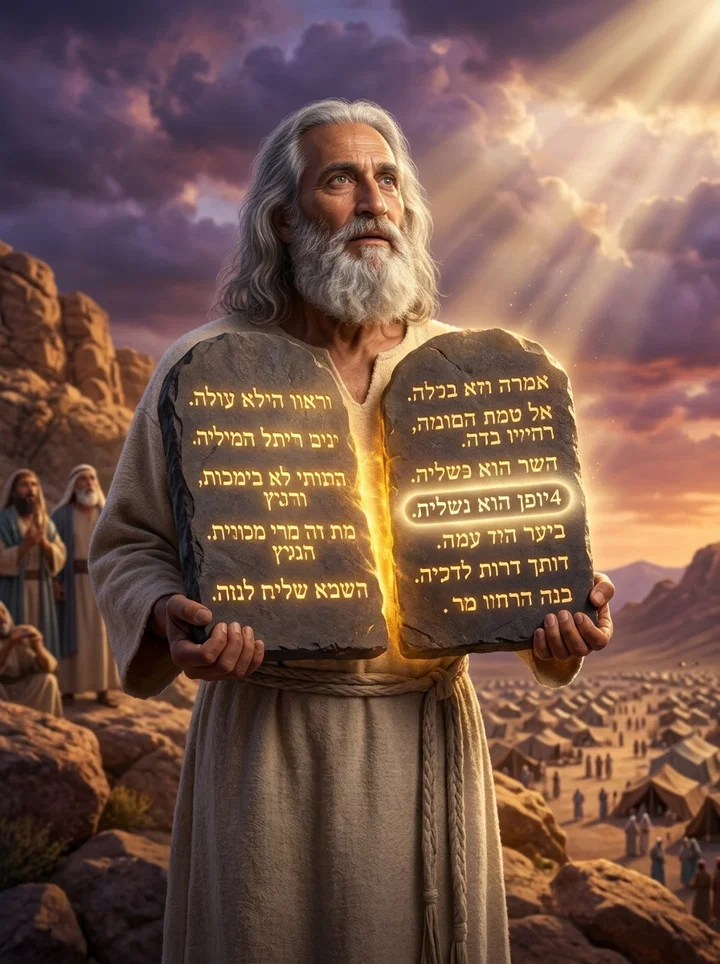
And he was there with the LORD forty days and forty nights; he did neither eat bread, nor drink water. And he wrote upon the tables the words of the covenant, the ten commandments.
Translations
And he was there with the LORD forty days and forty nights; he did neither eat bread, nor drink water. And he wrote on the tables the words of the covenant, the ten commandments.
King James Version, Revised Version
And he was there with the LORD forty days and forty nights; he did neither eat bread, nor drink water. And he wrote upon the tables the words of the covenant, the ten commandments.
And he was there with the Lord forty days and forty nights; he did neither eat bread, nor drink water. And he wrote upon the tables the words of the covenant, the ten commandments.
And he was there with the LORD forty days and forty nights; he neither ate bread nor drank water: and he wrote upon the tables the words of the covenant, the ten commandments.
And he was there with Jehovah forty days and forty nights; he did neither eat bread, nor drink water. And he wrote upon the tables the words of the covenant, the ten commandments.
And he is there with Jehovah forty days and forty nights; bread he hath not eaten, and water he hath not drunk; and he writeth on the tables the matters of the covenant — the ten matters.
— And he was there with Jehovah forty days and forty nights; he ate no bread, and drank no water. — And he wrote on the tables the words of the covenant, the ten words.
So then he was there, with Yahweh, forty days and forty nights, bread, did he not eat and, water, did he not drink, and he wrote upon the tables, the words of the covenant, the ten words.
Berean Standard Bible, Majority Standard Bible
So Moses was there with the LORD forty days and forty nights without eating bread or drinking water. He wrote on the tablets the words of the covenant— the Ten Commandments.
He was there with the LORD forty days and forty nights; he neither ate bread, nor drank water. He wrote on the tablets the words of the covenant, the ten commandments.
And for forty days and forty nights Moses was there with the Lord, and in that time he had no food or drink. And he put in writing on the stones the words of the agreement, the ten rules of the law.
So hee was there with the Lord fourtie dayes and fourtie nights, and did neither eat bread nor drinke water: and hee wrote in the Tables the wordes of the couenant, euen the tenne commandements.
Douay-Rheims (Challoner revision)
And he was there with the Lord forty days and forty nights: he neither ate bread nor drank water, and he wrote upon the tables the ten words of the covenant.
Pictures
Cross-references 20 of 95
- Deuteronomy 4:13
And he declared unto you his covenant, which he commanded you to perform, even ten commandments; and he wrote them upon two tables of stone.
Identifies the covenant God wrote on stone tablets as the Ten Commandments.
- Exodus 20:1-17
And God spake all these words, saying,
The commandments proclaimed at Sinai are the covenant code written on the tablets.
- Exodus 31:18
And he gave unto Moses, when he had made an end of communing with him upon mount Sinai, two tables of testimony, tables of stone, written with the finger of God.
God gives Moses the stone tablets written with his finger.
- Deuteronomy 10:4
And he wrote on the tables, according to the first writing, the ten commandments, which the LORD spake unto you in the mount out of the midst of the fire in the day of the assembly: and the LORD gave them unto me.
The Lord wrote the Ten Commandments on the second tablets.
- Deuteronomy 9:9-11
When I was gone up into the mount to receive the tables of stone, even the tables of the covenant which the LORD made with you, then I abode in the mount forty days and forty nights, I neither did eat bread nor drink water:
Moses fasts forty days and receives the stone tablets of the covenant.
- Deuteronomy 5:22
These words the LORD spake unto all your assembly in the mount out of the midst of the fire, of the cloud, and of the thick darkness, with a great voice: and he added no more. And he wrote them in two tables of stone, and delivered them unto me.
God spoke the commandments aloud, added no more, and wrote them on stone tablets.
- Exodus 32:15-16
And Moses turned, and went down from the mount, and the two tables of the testimony were in his hand: the tables were written on both their sides; on the one side and on the other were they written.
Describes the written covenant tablets.
- Exodus 24:12
And the LORD said unto Moses, Come up to me into the mount, and be there: and I will give thee tables of stone, and a law, and commandments which I have written; that thou mayest teach them.
God promises Moses stone tablets bearing the law and commandments.
- Exodus 34:1
And the LORD said unto Moses, Hew thee two tables of stone like unto the first: and I will write upon these tables the words that were in the first tables, which thou brakest.
God promises to write the words on the replacement tablets.
- 2 Corinthians 3:7
But if the ministration of death, written and engraven in stones, was glorious, so that the children of Israel could not stedfastly behold the face of Moses for the glory of his countenance; which glory was to be done away:
Moses’ shining face reflects the glory of the law engraved on stone.
- Matthew 4:2
And when he had fasted forty days and forty nights, he was afterward an hungred.
Jesus fasted forty days in the wilderness, as Moses did.
- Exodus 19:5-8
Now therefore, if ye will obey my voice indeed, and keep my covenant, then ye shall be a peculiar treasure unto me above all people: for all the earth is mine:
God offers Israel covenant terms, and the people accept them.
- Exodus 24:18
And Moses went into the midst of the cloud, and gat him up into the mount: and Moses was in the mount forty days and forty nights.
Moses stays with God on the mountain forty days and nights while receiving the covenant tablets.
- 1 Kings 19:8
And he arose, and did eat and drink, and went in the strength of that meat forty days and forty nights unto Horeb the mount of God.
Elijah likewise spent forty days and nights at Horeb in the strength of food God provided.
- Exodus 24:3-8
And Moses came and told the people all the words of the LORD, and all the judgments: and all the people answered with one voice, and said, All the words which the LORD hath said will we do.
Moses writes the covenant words, and Israel accepts the covenant ratified with blood.
- Deuteronomy 9:10
And the LORD delivered unto me two tables of stone written with the finger of God; and on them was written according to all the words, which the LORD spake with you in the mount out of the midst of the fire in the day of the assembly.
Both describe God writing the covenant words on the stone tablets.
- 2 Corinthians 3:13
And not as Moses, which put a vail over his face, that the children of Israel could not stedfastly look to the end of that which is abolished:
Moses’ veil covered the glory of his ministry, which was passing away.
- Deuteronomy 10:2
And I will write on the tables the words that were in the first tables which thou brakest, and thou shalt put them in the ark.
God writes the commandments on the replacement tables.
- Hebrews 9:4
Which had the golden censer, and the ark of the covenant overlaid round about with gold, where in was the golden pot that had manna, and Aaron’s rod that budded, and the tables of the covenant;
The covenant tables are kept in the ark of the covenant.
- 1 Kings 8:21
And I have set there a place for the ark, wherein is the covenant of the LORD, which he made with our fathers, when he brought them out of the land of Egypt.
Identifies the covenant kept in the ark as the covenant God made with Israel.
Commentary
Each commentary is drawn from primary sources: the writings of Ellen G. White and Adventist pioneers and periodicals. Each commentary is separate. Its own words are not a quotation; follow the references to read the source passages.
Ellen G. White
14 sources
After Israel's sin with the calf, Moses spent a second forty days and forty nights alone with the Lord on the mount in worship and intercession, with no other man permitted to go up.PP 329.1–3PP 329.4–330.1 For the whole time he neither ate bread nor drank water, miraculously upheld as at the first.Ms 12b, 1896, par. 29PP 329.4–330.1Ms 125, 1909, par. 40–41 The tables he had hewn at God's command were written upon by the Lord himself with the words of the covenant, the ten commandments, while Moses was also commanded to write the covenant words and received direct instruction to teach Israel as a repository of truth for the world.Ms 12b, 1896, par. 29PP 329.4–330.1ST Jun 11, 1874Ms 12b, 1896, par. 30–31Ms 125, 1909, par. 40–41 That long communion caused his face to shine with the reflected glory of the divine presence, so that Aaron and the people in guilt were afraid to come near and he put a veil upon his face when returning to the camp.PP 329.4–330.1GW 143.1ST Nov 21, 1892 Unlike Christ, who in human nature hungered through forty days while facing Satan's fierce temptations in the wilderness, Moses was specially enshrouded by God's glory and felt no pangs of hunger nor the assault of a powerful tempter.LC1 136.32RED 32.3LC1 47.1–2
Time on the Mountain
Exodus 34 stands in the setting of worship and intercession for Israel after their sin, with the promise to renew favor to them and do great wonders on their behalf.PP 329.1–3 It was a second forty days and forty nights alone in communion with God, with no man permitted to go up with him and none permitted to approach during his absence.PP 329.4–330.1 For the whole forty days and nights there with the Lord he neither ate bread nor drank water, miraculously sustained as at the first.Ms 12b, 1896, par. 29PP 329.4–330.1Ms 125, 1909, par. 40–41RH Jul 28, 1874
On the mount he listened to God's words and received instruction directly from God to teach and give to Israel, an essential preparation of the highest value.Ms 12b, 1896, par. 29Ms 12b, 1896, par. 30–31Ms 125, 1909, par. 40–41 That instruction taught that Israel was to be a repository of truth for the whole world.Ms 12b, 1896, par. 30–31 Covered so he could see and live, he was shown heavenly things as the ideal for the sanctuary.ST Nov 21, 1892 During that time he was shown the pattern for every bell, pomegranate, tassel, fringe, curtain, and vessel, with nothing to be made except according to that pattern, so that when he came down he was ready to direct the skilled workers.ST Nov 21, 1892
At God's command he had prepared two tables of stone and taken them to the summit, and the Lord himself wrote upon the tables the words of the covenant, the ten commandments.PP 329.4–330.1 God commanded Moses to write the covenant words, and the ten commandments were written upon the stone tables while he was with the Lord.Ms 12b, 1896, par. 29ST Jun 11, 1874 That long communion caused his face to reflect the glory of the divine presence with dazzling, shining light, which he himself did not know.PP 329.4–330.1GW 143.1ST Nov 21, 1892 In conscious guilt Aaron, the rulers, and the people were afraid to come near, and in compassion for their fear he put a veil upon his face and continued to do so thereafter when returning to the camp from communion.PP 329.4–330.1Ms 12b, 1896, par. 30–31
While he was on the mount listening to the words of God, Israel below made a golden calf and worshiped it.Ms 125, 1909, par. 40–41 When he came down and found this he called for everyone on the Lord's side to take position with the Lord.Ms 125, 1909, par. 40–41 Those who yielded were preserved alive while those who refused lost their lives, showing that the Lord tests His people.Ms 125, 1909, par. 40–41
Contrast with Christ's Fast
Moses went without food for forty days on special occasions when he was lifted and elevated above ordinary human weakness and above the human condition, specially sustained by God and surrounded, enshrouded, and enclosed by God's glory and excellent glory.2RED 32.3LC1 47.1–21RED 47.1–2ST Feb 22, 1883ST Jun 11, 1874 Because he was so sustained and enclosed, he did not feel hunger and did not suffer its pangs during the forty days.LC1 136.32RED 32.3LC1 47.1–21RED 47.1–2ST Feb 22, 1883
Nor was he facing a powerful tempter during that time, nor harassed and tormented by Satan and his fierce temptation as Christ was.LC1 136.32RED 32.31RED 47.1–2ST Jun 11, 1874RH Jul 28, 1874 By contrast, Christ in human nature, without the same visible sustaining glory, went forty days without food in the wilderness and endured hunger while facing Satan's temptations.LC1 136.32RED 32.3LC1 47.1–2RH Jul 28, 1874
Sources
Pioneers and periodicals
134 sources
He remained with the LORD forty days and forty nights a second time, eating no bread and drinking no water.ST Jan 26, 1915ST Nov 11, 1897ST Aug 21, 1879 The stay renewed the covenant after Israel broke it by worship of the golden calf and the first tables were broken, with intercession made for the people and the covenant words written again to bind them as His peculiar treasure and holy nation.ST Jan 27, 1909ST Jan 31, 1911 The One who wrote upon the tables was the LORD Himself, not Moses who did the fasting, fulfilling His promise to write again what was on the first tables, while those who held otherwise taught that Moses himself transcribed them because he was commanded to write.ST Aug 21, 1879ST Oct 19, 1888RH Dec 9, 1852RH Dec 23, 1852RH Dec 23, 1852 What was written was the words of the covenant, the ten commandments, the moral law alone engraven in stone by God's own finger and placed in the ark, distinct from the civil, ceremonial and judicial laws Moses wrote in a book beside the ark.ST Apr 25, 1906RH Aug 21, 1855RH Mar 23, 1852ST Mar 31, 1881RH Oct 21, 1851 That moral law is permanently binding as the transcript of God's character and the basis of His government, kept in the heart under the new covenant with the Sabbath as its seal, and Moses descending in vigor with shining face showed that communion with God sustains and transforms.ST Nov 11, 1897ST Mar 31, 1881RH Apr 21, 1851ST Feb 4, 1886PGGC 27.1–2
Wording and Historical Setting
The stay was a second forty days and forty nights with the LORD in which neither bread was eaten nor water drunk.ST Jan 26, 1915ST Nov 11, 1897ST Aug 21, 1879RH Dec 9, 1852RH Dec 31, 1861 The second period lasted as long as the first and was spent beholding God's glory, bowing in worship, and interceding that God would not destroy Israel for sin.RH Dec 31, 1861RH Nov 17, 1863 It was one of two prolonged personal interviews in Horeb in which the tables were twice received, an eminent direct communion like that later granted to Paul.RH Dec 31, 1861RH Nov 17, 1863
The stay was a renewal after Israel broke the covenant by worshipping the golden calf within forty days of God speaking at Sinai.ST Jan 27, 1909ST Jan 31, 1911 Moses broke the first tables in just indignation as a symbol of that transgression, then made a heart-breaking plea with punishment following, interceded that God would not cast off Israel, and returned to close communion.ST May 6, 1886ST Jan 31, 1911ST Jan 2, 1893 God revealed Himself as the merciful and righteous One, and the covenant words were written again to bind the ransomed people to Jehovah as a peculiar treasure, a kingdom of priests, and a holy nation under His legal ordinances.ST Jan 31, 1911ST Jan 2, 1893 Fear or compulsion could not secure faithful service, so the law had to be received into the heart through love as well as written on stone.ST Jan 27, 1909ST Jan 2, 1893 During that long communion Moses' face reflected the glory of the divine presence with dazzling unearthly light, unknown to himself, so that Aaron and the people shrank and were afraid and he covered his face with a veil.ST Jun 10, 1880ST May 6, 1886
The second tables contained exactly what was on the first tables that Moses broke, namely the words the LORD spoke in the mount out of the midst of the fire in the day of the assembly.RH Jan 7, 1862RH Dec 31, 1861ST Jul 22, 1908 They were an exact copy of the original code itself and not an incomplete copy.RH Jan 7, 1862RH Dec 31, 1861 Moses hewed the second stones like the first and carried them up and brought them down, whereas the preparation of the first tables was God's own work.ST Jan 26, 1915RH Jul 9, 1901ST Jul 22, 1908ST Apr 9, 1902RH Dec 31, 1861 Preparing the second taught Moses valuable lessons.ST Apr 9, 1902
The verse belongs to the Sinai narrative from Exodus 19 to the setting up of the tabernacle.RH Dec 24, 1861RH Jan 20, 1916ST Dec 10, 1896 After deliverance from Egypt and the Red Sea crossing into the mountain fastnesses of the wilderness, God descended in person upon Mount Sinai with His angels.RH Dec 24, 1861ST Jun 26, 1907 Exodus 16 is marked by giving Israel the Sabbath, Exodus 19 by espousing Israel as a holy nation, Exodus 20 by giving Israel the law, and Exodus 24-34 continues that same narrative through the sanctuary instruction in chapters 25-31 to the building and setting up immediately afterward in chapters 33-40.RH Dec 24, 1861ST Dec 10, 1896ST Jun 26, 1907 Moses was in the mount in the midst of the cloud where the glory abode like devouring fire in sight of Israel, having gone up with his minister Joshua after telling the elders to tarry with Aaron and Hur, the cloud covering the mount six days and God calling him out on the seventh.RH Dec 9, 1852 There he was shown the pattern for every bell, pomegranate, tassel, fringe, curtain, and vessel on the glowing height, with nothing to be made except according to that pattern, and the movable dwelling was afterward wrought exactly to those directions for the Divine Deliverer to dwell among them.ST Nov 21, 1892ST Jun 26, 1907
The forty days were for giving the national, ceremonial, judicial, and sanctuary laws, with their dimensions, material, and furnishings, which Moses wrote in a book called the book of the law and the book of the covenant.RH Dec 9, 1852RH Feb 7, 1854 Only at the close of the forty days were the two tables of testimony given to bring down from the mount.RH Dec 9, 1852 The written commandments therefore came at least eighty days after the covenant was ratified, after the people had already made and ratified their covenant, as its basis and not the covenant itself.RH Jun 26, 1900RH Feb 7, 1854
The writing is called the ten commandments, literally the ten words, from which comes the name decalogue, so that name is strictly Biblical.ST Mar 4, 1886RH Dec 24, 1861RH Dec 28, 1905 Words here has the special sense of commandments, not ten ordinary words.RH Oct 25, 1870RH Oct 29, 1872 The same Hebrew word appears for commandment and for word in Psalm 119:89, showing God's law originated in heaven, was made known to angels, remains there forever, and cannot be altered or fail.ST Apr 25, 1906 The Sabbath commandment is the fourth of these precepts.RH Dec 24, 1861
What was written was the ten commandments and those alone, the same ten God spoke, excluding all else.RH Jan 7, 1862ST Mar 4, 1886RH Mar 31, 1863 That excludes the preface to the decalogue and Moses' later rehearsal with omissions, citations back to the original, added appeals to gratitude, and verbal deviations.RH Jan 7, 1862RH Mar 31, 1863 Against the claim that Exodus contains one different from Exodus 20, it is difficult to find a second, different decalogue in Exodus 34.ST
Writer of the Tables
The one who fasted forty days and forty nights without bread or water was Moses, but the one who wrote upon the tables the words of the covenant, the ten commandments, was the LORD Himself, not Moses.ST Aug 21, 1879RH Dec 9, 1852RH Dec 23, 1852ST Oct 19, 1888RH May 26, 1853 The first he is Moses with the LORD, and the second he is the LORD doing the writing, for two persons are spoken of in the text and the pronoun refers to the LORD.ST Aug 21, 1879ST Oct 19, 1888RH May 26, 1853ST Jun 2, 1881ST Sep 2, 1913 Such a change of referent without repeating the noun is allowed by the brevity of Hebrew, which leaves much to be gathered from connection and requires many supplied words to make full sentences.ST Jan 26, 1915ST Aug 21, 1879ST Sep 2, 1875ST Aug 21, 1879 Taken alone the wording does not by itself prove who wrote, since the repeated pronoun may refer to different persons and must be decided by context and by other texts on the same point.ST Jan 26, 1915ST Aug 21, 1879ST Sep 2, 1875ST Oct 19, 1888RH Aug 21, 1855
The same chapter proves it, for there the LORD told Moses to hew two tables like the first and said I will write upon them the words that were in the first tables which were broken.ST Aug 21, 1879ST Oct 19, 1888RH May 26, 1853ST Jul 22, 1908ST Sep 2, 1913 Since it is impossible for God to lie He kept that promise and did the writing, putting on the second tables the same words that were in the first.ST Aug 21, 1879ST Oct 19, 1888RH May 26, 1853ST Jul 22, 1908 Moses’ own account in Deuteronomy 10:1-5 settles it beyond doubt, where he was told to hew tables and make an ark and was promised I will write on the tables.ST Sep 23, 1875ST Aug 21, 1879ST Aug 21, 1879ST Jun 4, 1902 He then records that He wrote on the tables according to the first writing the ten commandments which the LORD spoke in the mount out of the fire, and the LORD gave them to Moses, who put them in the ark.ST Sep 23, 1875ST Aug 21, 1879ST Aug 21, 1879ST Jun 4, 1902
The command Write thou these words refers to other words, namely the preceding ceremonial and judicial requirements and covenant words given at that time.ST Jan 26, 1915RH Apr 22, 1862ST Mar 31, 1881RH May 26, 1853ST May 10, 1910 Those Moses recorded in a book, distinct from the moral law on stone, for Moses wrote other words that served as basis for a covenant while God alone wrote the commandments on the hewn stones in fulfillment of His promise.ST Jan 26, 1915RH Apr 22, 1862RH May 26, 1853ST May 10, 1910RH May 13, 1862 The sacred utterances were inscribed by God’s own finger with no human scribe taking them down and no angel hand engraving them, attesting their special sanctity and high authority.ST Oct 19, 1888ST Feb 4, 1886RH Aug 2, 1870RH Nov 25, 1852RH Sep 15, 1874 They were written twice and are the only part of the Bible so written directly by God, and the fact that Moses also wrote the commandments in a book gives no reason to deny that God also wrote them upon stone.ST Oct 19, 1888ST Feb 4, 1886RH Aug 2, 1870RH Nov 25, 1852RH Sep 15, 1874
On the other reading, held by fewer, the he who wrote is Moses himself, who was there with the LORD forty days and forty nights without eating bread or drinking water and wrote upon the tables the words of the covenant, the ten commandments.ST Oct 19, 1888RH Dec 23, 1852RH Apr 30, 1857ST Apr 9, 1902ST Oct 4, 1883 This is because the LORD had just commanded, Write thou these words, so that all the LORD spoke to Moses in the mount was written by Moses.ST Oct 19, 1888RH Dec 23, 1852ST Jan 24, 1900ST Oct 4, 1883 The second tablets were hewn by Moses, unlike the first whose preparation was God’s own work, and preparing them taught Moses lessons.ST Oct 19, 1888ST Jul 22, 1908ST Feb 4, 1886ST Apr 9, 1902 On this reading Moses transcribed upon the tables a divine original miraculously set before him, while the phrase written with the finger of God refers only to that miraculously made inscription set before him like the handwriting on the wall before Daniel.ST Oct 19, 1888RH Dec 23, 1852ST Apr 9, 1902
Covenant and Commandments
The words written upon the tables were expressly the words of the covenant, the Ten Commandments, written by God on two stone tablets distinct from the many other laws and expressions given in Scripture.ST Apr 25, 1906RH Aug 21, 1855RH Mar 23, 1852RH Apr 12, 1860RH Jun 2, 1859 The stone tablets were therefore the tables of the covenant, holding the literal Decalogue given at Sinai and placed in the ark of the testimony, which is the ark of the covenant in the Most Holy Place of the earthly sanctuary.RH Aug 21, 1855RH Mar 23, 1852RH Apr 12, 1860RH Jun 2, 1859ST Nov 1, 1877 The covenant, or testament, is the Ten Commandments as the written condition of the Sinaitic covenant.RH Apr 12, 1860ST Nov 1, 1877
The commandments are the covenant's terms, conditions, or moral conditions, not the contract or mutual agreement itself, for obedience to them was the condition of the agreement between God and Israel.ST Nov 11, 1897ST Feb 13, 1879ST Mar 8, 1883RH Jul 18, 1854RH Dec 9, 1851 To obey His voice and to keep His covenant meant to keep the Ten Commandments, which were given as the law-condition of the covenant-agreement made in Exodus 19:5-8 and contain its terms.RH May 3, 1860ST Feb 13, 1879ST Mar 8, 1883RH Jul 18, 1854RH Dec 9, 1851 Israel's promise could be broken without abolishing or changing God's law, which expresses the principles of His moral government and existed before the Horeb covenant.ST Nov 11, 1897RH Dec 9, 1851
The weight of testimony holds that the Ten Commandments constituted the covenant in full, not merely a part of it, and are therefore presented as God's covenant, not merely a small part of a larger law.RH Aug 21, 1855RH Aug 5, 1851RH Oct 21, 1851RH Apr 21, 1851RH Apr 29, 1862 They alone are called God's covenant, engraved by God and distinct from the ordinances Moses wrote in a book, with enduring obligations arising from human nature and relations to God and one another unlike temporary outward observances.RH Oct 21, 1851RH Apr 21, 1851RH May 26, 1853 Whether the law itself constituted the first covenant or was the subject of the agreement depends on whether covenant means its terms or the agreement between the parties, since covenant in Scripture has different meanings, and calling the Decalogue a covenant does not make it the old covenant nor is it called either the old or the new covenant.ST Apr 3, 1928ST Mar 1, 1883
The tables are never called tables of the law but always tables of the testimony or tables of the covenant to mark their covenant nature.ST Apr 15, 1886 Other commands were coupled with the ten in covenant making and ratification, yet a marked distinction remains between the ten as the words of the Lord and the additional judgments given through Moses concerning duties between men and judicial enforcement.ST Apr 15, 1886 The covenant's terms were that the people obey God's voice and keep the commandments while God would make them His special possession above all peoples, and breaking the commandments therefore broke the covenant.RH May 3, 1860 Since that covenant provided no forgiveness or restoration for the transgressor, a new covenant providing forgiveness was necessary, with the law remaining the basis of both covenants, and the written commandments coming after the people had already made and ratified their covenant show they were its basis, not the covenant itself.RH May 3, 1860RH Jun 26, 1900
The old covenant agreement was Israel's promise to obey the law under penalty of death together with God's pledge to make them a holy nation if they obeyed perfectly, with the law proclaimed from Sinai as its basis, not the agreement itself, later written on stone by God's own hand.RH May 13, 1862ST Jun 16, 1914ST Dec 10, 1896 That first covenant Moses spoke and wrote was written by Moses in the book of the covenant with the ten words and the judgments of Exodus 21-23 and ratified with blood, distinct from what God wrote on stone and not itself the covenant dedicated with sacrificial blood.RH May 13, 1862ST Dec 10, 1896 The old covenant could be abolished without abolishing the Ten Commandments, which are that concerning which a covenant was made, His voice speaking the ten and adding no more, existing before the old covenant and continuing after the new has done its work.RH Apr 29, 1862RH Apr 12, 1860RH Apr 30, 1872 The verse does not call the ten the old covenant; they are distinct from the conditional agreement formed by the people's promise to obey and from the first covenant Moses spoke and wrote that was dedicated with blood.RH May 13, 1862ST Jan 4, 1905ST Jun 16, 1914
The covenant described in Hebrews 8:7 was faulty because sinful, weak Israel could not keep the law, and in the new covenant God puts that same law in the heart so people can keep it.ST Nov 11, 1897 That law remains obligatory, perpetual, just and good, summed in the new covenant as God's law in its relation to the sinner and as manifest in Christ Jesus in the gospel.ST Dec 10, 1896 The new covenant, or gospel dispensation, is based on all ten commandments as the foundation God laid, and Christ builds upon that foundation, finding ten and building upon ten, not nine.RH Feb 14, 1854 The covenant's confirmatory seal, or sign of its authority, is the seventh-day Sabbath, belonging to the Decalogue as part of God's enduring moral law and not a temporary ceremonial ordinance, continuing for God's people, the true Israel, under the new covenant, with restoring that Sabbath sign part of preparation for final deliverance.PGGC 27.1–2RH Dec 21, 1869
Moral Law Distinct and Enduring
The verse marks off the Ten Commandments, the moral and spiritual law written and engraved on stone by God Himself, from the civil, ceremonial, judicial and ritual laws which Moses wrote in a book and which were placed beside the ark.ST Mar 31, 1881RH Oct 21, 1851RH Apr 21, 1851ST Feb 4, 1886RH Oct 7, 1851 The tables belong to the law of God and alone are called His covenant, while the ordinances in Moses' book were given for a limited time; the Ten Words were written twice and are the only part of Scripture written directly by God rather than through Moses as amanuensis.RH Oct 21, 1851RH Apr 21, 1851RH Oct 7, 1851RH Aug 2, 1870 They are the ten words, the Hebrew equivalent of decalogue, and also the words of the covenant, Jehovah's covenant, the word of God in a distinctive sense and an essential part of the word which abides.ST Feb 4, 1886RH Aug 2, 1870
What God wrote on the two tables was the ten commandments and those alone, the same ten that He spoke, and decalogue as their name is strictly Biblical.ST Feb 24, 1887ST Mar 4, 1886 The teaching of those who held the other position is that the verse by itself identifies what was written but does not settle whether anything else was included.RH Aug 21, 1855 This difference marks the moral law as permanently and perpetually binding as the divine will, while ceremonial institutions, judicial law except where it agrees with the moral law, and outward observances were temporary, local, limited to Israel and not grounded like the ten in obligations growing out of human nature and relations to God and one another.ST Mar 31, 1881RH Apr 21, 1851ST Feb 4, 1886RH Nov 25, 1852 The figure of blotting out and nailing to the cross fits the ordinances written by Moses' hand in the book of the law, which could be blotted out and nailed to the cross, but is out of place for the law engraved in the tables of the covenant, which even if the tables were nailed after drilling could never have what was engraven in them blotted out.RH Nov 25, 1852
The ten words are a transcript of the name or character of God as summed in Exodus 34:4-7, expressing His nature and His view of right and wrong and showing humanity's relation to Him.ST Apr 20, 1904ST Nov 25, 1880 As God is so is Christ His Son who is the Word, and this written Word is the Sword of the Spirit discerning thoughts and intents; they are fatherly counsels, a summary of religion and morality, true, righteous, broad, perfect, holy, just and good.ST Apr 20, 1904ST Nov 25, 1880ST Feb 28, 1884 The Decalogue is the fundamental central law summing human duty, prescribing duties toward God first and toward others, a universal unchanging rule for all people and ages which Christianity presupposes and incorporates, while civil and ritual laws guarded Israel and trained in obedience and purity.ST Apr 22, 1880ST Feb 28, 1884 It is a rule for Gentiles before faith and after faith, and keeping the ten words is keeping God's commandments in gospel times.ST Jan 29, 1880ST Jan 29, 1880 The law existed before its Sinai publication, since sin and death existed before Moses and Abraham and his household knew and kept God's law, the same law afterward declared on Sinai whose principles were already known in ancient times.RH Apr 30, 1908RH Oct 18, 1853
The moral duties in the commandments did not first come into existence with the covenant made at Horeb, for the Sabbath already existed before that covenant was made.RH May 27, 1852 The Sabbath's essential requirement was established at creation, blessed and hallowed, and continues to the end of time, belonging to the Decalogue as part of God's enduring moral law and not a temporary ceremonial ordinance.RH Aug 2, 1870RH Dec 21, 1869 The fourth commandment guards the sanctity of the Sabbath, commanding remembrance, six days of labor, and rest for household, servants, cattle and stranger because God made all in six days and rested the seventh, requiring consecration of the seventh day and laying unrelaxed obligation on all mankind with no exception.RH Nov 8, 1853RH Nov 25, 1858ST Feb 4, 1886 Each of the ten is holy because spoken by the one God, the Sabbath precept uttered by Jehovah's voice as surely as any other and sharing their perpetuity, confirmed by Jesus requiring commandment-keeping to enter life and summing law as love to God and man and by James teaching that to offend in one point is guilty of all.ST Feb 4, 1886
God's law originated in heaven, was made known to angels and created beings, and remains there forever, for the word translated word in Psalm 119:89 is the same Hebrew word used for commandment here and in Deuteronomy 4:13, and it cannot be altered or fail.ST Apr 25, 1906 It is His covenant which He commanded to be performed, confirmed to Jacob for a law and to Israel for an everlasting covenant, kept by Abraham to secure the promises, containing only ten precepts, spoken by God with nothing added, which He says He will not break or alter, including the fourth commandment and the seventh day.RH Nov 8, 1853RH Aug 20, 1857 What was done away was the ministration with its glory, replaced by a more glorious ministration, not the law itself, for the ministration of the ten commandments is not the commandments themselves any more than the ministration of the Spirit is the Spirit itself.RH Jun 25, 1861RH Nov 2, 1911 The veil hid only the shining of the skin of Moses' face brought down in open view with the tables in hand, not the commandments engraved in stone, and that glory of countenance, the ministration of death so called because death is the penalty for violation, was what passed away in contrast to the ministration of the Spirit under Christ which gives life.RH Jun 25, 1861ST Jul 14, 1914
The ten include as the second a positive prohibition of bowing down to images and doing them homage, and as the tenth a single commandment that cannot be divided into two without making the ninth identical with the seventh and making God use tautology, God's holy law written by His own finger as the most emphatic synopsis of all religion and morality.RH Sep 15, 1874 Law and commandments may be used interchangeably to refer to the stone code, but they do not refer to it exclusively or almost invariably.RH Aug 21, 1855 This law is the basis of God's government and the code of Christ's kingdom whose convicting work reaches hearts and consciences. They are the moral law governing human conduct, and Christian liberty does not mean freedom to break the ten words.RH Nov 17, 1859
Sanctuary Glory and Veil
Exodus 34:28 belongs to the minute description of the worldly sanctuary built in the days of Moses in Exodus 25 to 40, made exactly according to the pattern shown him in the mount where he was with the LORD after He had brought Israel out from under Pharaoh across the Red Sea into the mountain fastnesses of the wilderness.ST Oct 29, 1894ST Jun 26, 1907 There in forty days of direct communion God covered Moses so he could see God and live and behold heavenly things as the ideal, and showed him the pattern for every bell, pomegranate, tassel, fringe, curtain, vessel, dimension, material and furnishing, with nothing to be made except according to that pattern.ST Nov 21, 1892ST Jun 26, 1907 The tabernacle so wrought and fashioned by the people exactly according to those directions, far from their enemies in the heart of the wilderness so their Divine Deliverer might dwell among them, had two apartments separated by a veil, the holy place twenty cubits long, ten cubits wide and ten cubits high and the most holy place ten cubits in each dimension and half as large.ST Oct 29, 1894ST Jun 26, 1907 Its sides and west end were acacia boards overlaid with gold set by tenons in silver sockets weighing a talent and held at the top by bars through rings.ST Oct 29, 1894 Its divinely given pattern and furnishings served as an object lesson of God's plan of salvation, with the law as its central standard, for the words written on the stone tablets by God's finger are identified as the words of the covenant, the Ten Commandments, the moral conditions of the covenant made at Horeb, a complete code of moral law deposited in the ark of the covenant in the Most Holy Place of the earthly sanctuary, with a distinction belonging to the Sabbath commandment that the other commandments do not share.RH Mar 23, 1852RH Mar 17, 1863
Moses remained a second forty days and nights in the mount in communion with God, miraculously sustained without eating or drinking as at the first, while the Lord wrote again upon the tables the words of the covenant, the ten commandments.ST Jun 10, 1880 During that long communion his face reflected the glory of the divine presence, and he came down with the two tables of stone in his hands with his face shining with dazzling unearthly light brought from the presence of the Lord.ST Jun 10, 1880ST Oct 16, 1884ST Jun 5, 1879 Unknown to himself the shining did not cease when he descended, shining with such intense brightness and great glory that Aaron and all the people shrank from him, were afraid of him, and could not look upon him while he talked with them.ST Jun 10, 1880ST Oct 16, 1884ST Jan 17, 1884ST Aug 13, 1874 On learning the cause he covered his face with a veil and continued to do so when coming from such heavenly communings and while he talked with them.ST Jun 10, 1880ST Oct 16, 1884ST Jun 5, 1879 This marked the beginning of his service in presenting the law, whose words brought condemnation and the sentence of death to sinners.RH Jul 8, 1852
The tables of testimony were brought down with the ten commandments written and engraven in stones in his hand in open view.RH Jun 25, 1861 The vail Moses put over his face did not hide the ten commandments but hid only the shining of the skin of his face, the glory of his countenance that made his ministration glorious.RH Jun 25, 1861 That glory is the ministration of death that was to be done away, meaning the service performed by Moses as minister, called death because death is the penalty for violation of God's law.RH Jun 25, 1861 The ministration of the ten commandments is not the ten commandments themselves, any more than the ministration of the Spirit is the Spirit itself, so what was abolished was the glorious ministration in contrast to the ministration of the Spirit under Christ which gives life, while the ten commandments themselves, including the fourth commandment, remain and are not done away.RH Jun 25, 1861
Moses stands as representative of the old covenant because he was the first priest under that covenant, and his coming down glorified sets the comparison between the priesthood of Moses and the priesthood of Christ that Paul addresses in 2 Corinthians 3.ST Oct 16, 1884 This coming down with shining face is the event referred to in 2 Corinthians 3, not the writing commanded in Deuteronomy 27 or done by Joshua on an altar after crossing Jordan.ST Jun 5, 1879
The law on stone demanded death for transgression, and the serving out of that death-penalty is the ministration of death, bringing condemnation in contrast to the ministration under Christ which gives life and righteousness.RH Jun 25, 1861RH Jul 8, 1852AUST May 31, 1920 The glory that flooded Moses' person and face when he came from the mountain after talking with God and returned to speak with men was so bright that Israel could not gaze upon him with uncovered eyes.AUST May 31, 1920 Moses received the law from God in the Spirit, and the law given on stone was life to him through his forty days and nights without food or water in God's presence.ST Jun 19, 1907 The law ministered death to the Israelites when they received it only as outward words, but through the Spirit it becomes a law of righteousness, and the glory of condemnation is meant to fade before the greater glory of righteousness.ST Jun 19, 1907
Moses' time in God's presence was life and salvation to him, so that he could remain forty days and nights without eating.ST Jan 16, 1907 The glory he received from God contrasted with the glory of condemnation that the Israelites experienced through the law in their sinful condition.ST Jan 16, 1907 That outward glory could not keep them from idolatry while Moses was away.ST Jan 16, 1907
Sustenance Communion and Application
Moses remained forty days and forty nights without bread or water while engaged in active work, and came down in usual strength and vigor.RH Sep 25, 1913RH Mar 25, 1902 He did not feel hunger because he was lifted above ordinary human weakness and sustained by means beyond physical food.ST Feb 22, 1883ST Feb 18, 1913RH Sep 25, 1913 That sustaining was the glory of God surrounding him on special occasions in the mount.ST Feb 22, 1883ST Jun 11, 1874ST Feb 18, 1913
His stay parallels the forty-day fast Jesus later underwent in the wilderness.ST Jul 30, 1894ST Feb 17, 1890 Unlike Christ, Moses was not harassed and tempted by Satan nor suffered the fierceness of hunger.ST Jun 11, 1874RH Jul 28, 1874 Denying appetite in such fasting belongs to the conflict with sin, entered in an unusually spiritual frame in which eating mattered less.ST Feb 17, 1890
Fasting in this way accompanies devotion to God and times of spiritual need.ST May 19, 1881 It is the example of a devoted servant of God with the Lord.ST May 19, 1881ST May 12, 1881
Extended communion shut in with God for forty days and then another forty days left His likeness impressed upon Moses until his face shone.RH Nov 17, 1863RH Nov 17, 1863 Meditation and fellowship with God likewise impress His likeness upon the soul.RH Nov 17, 1863 That time in communion preceded his bold request to see God's glory, showing that constant fellowship builds confidence and faith.RH Jan 13, 1859 Communion lifts above the world and enables endurance, overcoming, and victory.ST Mar 12, 1885 In the midst of that glory Moses lived and received the revelation of God and His law, in contrast to the danger the same presence posed to those who feared being consumed.ST Mar 12, 1896ST Aug 27, 1896
Israel turned to the golden calf within forty days of God speaking at Sinai, showing that fear or compulsion cannot secure faithful service.ST Jan 27, 1909 The law must be received into the heart through love as well as written on stone.ST Jan 27, 1909 Hearts must be yielded so the divine finger may engrave the holy law there, a lesson taught also by Moses hewing the second tables unlike the first which God prepared.ST Apr 9, 1902
Moses as God's human messenger in the forty days' fast was visited by God's angels in harmony with God's moral law.ST Dec 8, 1909 The angelic touch restores strength and takes away disease and makes the messenger strong, so he came down with face shining with the glory and power of God and with renewed strength.ST Dec 8, 1909 This renewed strength and glory mark true angelic ministry, opposite to spiritist mediums who come from seances utterly exhausted, powerless, and sometimes in hopeless insanity.ST Dec 8, 1909
The words of the covenant written on the tables are the ten words, which are God's commandments.ST Jan 29, 1880ST May 17, 1905 Keeping the ten words is keeping God's commandments, including the seventh day.ST Jan 29, 1880ST Jan 29, 1880 To turn from them is to stumble and leave Christ, and the question remains whether they are a rule in gospel times and whether they were ever written in any Gentile's heart.ST Jan 29, 1880ST Jan 29, 1880 Obedience to God's law can bring suffering while leaving the obedient spiritually free, in contrast to imprisonment behind ten iron bars.ST May 17, 1905
Sources