Exodus 27:1
And thou shalt make an altar of shittim wood, five cubits long, and five cubits broad; the altar shall be foursquare: and the height thereof shall be three cubits.
Translations
And you shall make an altar of shittim wood, five cubits long, and five cubits broad; the altar shall be foursquare: and the height thereof shall be three cubits.
King James Version, KJV Cambridge Paragraph Bible
And thou shalt make an altar of shittim wood, five cubits long, and five cubits broad; the altar shall be foursquare: and the height thereof shall be three cubits.
And thou shalt make an altar of shittim wood, five cubits long, and five cubits broad; the altar shall be foursquare: and its hight shall be three cubits.
Revised Version, American Standard Version
And thou shalt make the altar of acacia wood, five cubits long, and five cubits broad; the altar shall be foursquare: and the height thereof shall be three cubits.
'And thou hast made the altar of shittim wood, five cubits the length, and five cubits the breadth — the altar is square — and three cubits its height.
And thou shalt make the altar of acacia-wood, five cubits the length, and five cubits the breadth; the altar shall be square; and the height thereof three cubits.
And thou shalt make the altar of acacia wood,—of five cubits length and five cubits breadth four square, shall the altar be, and three cubits the height thereof.
Berean Standard Bible, Majority Standard Bible
“ You are to build an altar of acacia wood. The altar must be square, five cubits long, five cubits wide, and three cubits high.
“ You shall make the altar of acacia wood, five cubits long, and five cubits wide. The altar shall be square. Its height shall be three cubits.
And make an altar of hard wood, a square altar, five cubits long, five cubits wide and three cubits high.
Moreouer thou shalt make the altar of Shittim wood, fiue cubites long and fiue cubites broade (the altar shall be foure square) and the height thereof three cubites.
Douay-Rheims (Challoner revision)
Thou shalt make also an altar of setim wood, which shall be five cubits long and as many broad, that is, foursquare, and three cubits high.
Pictures
Cross-references 20 of 29
- Hebrews 8:5
Who serve unto the example and shadow of heavenly things, as Moses was admonished of God when he was about to make the tabernacle: for, See, saith he, that thou make all things according to the pattern shewed to thee in the mount.
The earthly sanctuary was made according to the pattern shown on the mount.
- Exodus 25:9
According to all that I shew thee, after the pattern of the tabernacle, and the pattern of all the instruments thereof, even so shall ye make it.
The altar is made according to the pattern God showed Moses.
- Acts 7:44
Our fathers had the tabernacle of witness in the wilderness, as he had appointed, speaking unto Moses, that he should make it according to the fashion that he had seen.
The wilderness tabernacle was made according to the pattern shown to Moses.
- Hebrews 9:1-5
Then verily the first covenant had also ordinances of divine service, and a worldly sanctuary.
Describes the first covenant’s sanctuary and its furnishings, including the altar’s sacrificial setting.
- Hebrews 9:23-24
It was therefore necessary that the patterns of things in the heavens should be purified with these; but the heavenly things themselves with better sacrifices than these.
The earthly altar belongs to a sanctuary patterned after the true holy places in heaven.
- Exodus 25:40
And look that thou make them after their pattern, which was shewed thee in the mount.
The altar was made according to the pattern shown to Moses on the mountain.
- Exodus 38:1
And he made the altar of burnt offering of shittim wood: five cubits was the length thereof, and five cubits the breadth thereof; it was foursquare; and three cubits the height thereof.
Gives the altar’s construction and materials.
- Exodus 40:6
And thou shalt set the altar of the burnt offering before the door of the tabernacle of the tent of the congregation.
Places the altar of burnt offering before the tabernacle door.
- Exodus 30
And thou shalt make an altar to burn incense upon: of shittim wood shalt thou make it.
Both describe furnishings and practices of the sanctuary.
- Exodus 29:38-42
Now this is that which thou shalt offer upon the altar; two lambs of the first year day by day continually.
Prescribes the daily lamb offerings on the altar as part of sanctuary service.
- Hebrews 7:27
Who needeth not daily, as those high priests, to offer up sacrifice, first for his own sins, and then for the people’s: for this he did once, when he offered up himself.
Christ’s once-for-all self-offering fulfills what the altar sacrifices symbolized.
- John 1:29
The next day John seeth Jesus coming unto him, and saith, Behold the Lamb of God, which taketh away the sin of the world.
The altar’s victims represented Christ, the Lamb who takes away sin.
- Exodus 29:37
Seven days thou shalt make an atonement for the altar, and sanctify it; and it shall be an altar most holy: whatsoever toucheth the altar shall be holy.
The altar is declared holy, and whatever touches it holy.
- Exodus 40:29
And he put the altar of burnt offering by the door of the tabernacle of the tent of the congregation, and offered upon it the burnt offering and the meat offering; as the LORD commanded Moses.
Places the altar at the tabernacle entrance and describes its use for offerings.
- 2 Chronicles 4:1
Moreover he made an altar of brass, twenty cubits the length thereof, and twenty cubits the breadth thereof, and ten cubits the height thereof.
Contrasts the temple altar’s size with the tabernacle altar.
- Exodus 27:8
Hollow with boards shalt thou make it: as it was shewed thee in the mount, so shall they make it.
The altar follows the pattern shown on the mount for the sanctuary.
- Leviticus 7:2
In the place where they kill the burnt offering shall they kill the trespass offering: and the blood thereof shall he sprinkle round about upon the altar.
The altar is where the trespass offering is killed and its blood sprinkled.
- Leviticus 4:18
And he shall put some of the blood upon the horns of the altar which is before the LORD, that is in the tabernacle of the congregation, and shall pour out all the blood at the bottom of the altar of the burnt offering, which is at the door of the tabernacle of the congregation.
Blood is applied to the horns of the altar of burnt offering.
- Leviticus 4:30
And the priest shall take of the blood thereof with his finger, and put it upon the horns of the altar of burnt offering, and shall pour out all the blood thereof at the bottom of the altar.
Blood from the sin offering is applied to the horns of the altar.
- Leviticus 4:7
And the priest shall put some of the blood upon the horns of the altar of sweet incense before the LORD, which is in the tabernacle of the congregation; and shall pour all the blood of the bullock at the bottom of the altar of the burnt offering, which is at the door of the tabernacle of the congregation.
Blood is applied to the altar of burnt offering.
Commentary
Each commentary is drawn from primary sources: the writings of Ellen G. White and Adventist pioneers and periodicals. Each commentary is separate. Its own words are not a quotation; follow the references to read the source passages.
Ellen G. White
2 sources
The instruction concerns the altar of burnt offering standing in the outer court of the tabernacle.RH Nov 8, 1915 It was to be constructed of shittim wood, five cubits in length and five cubits in breadth, thus made foursquare, with its height three cubits.Ms 97, 1899, par. 3–4RH Nov 8, 1915 Those specifications of material, shape, and size formed part of God's directions for building the tabernacle.Ms 97, 1899, par. 3–4 The skill and wisdom exercised in carrying out that tabernacle-building work were gifts from God, to be used for His glory.Ms 97, 1899, par. 3–4
Sources
Pioneers and periodicals
32 sources
God commanded Moses to build a foursquare altar of acacia wood five cubits long and broad and three cubits high, about nine feet square and nearly five and a half feet high.ST Jan 24, 1911RH Jan 6, 1853 It was the altar of burnt offering overlaid with brass with its horns and grate, standing in the open court nearest the entrance before the tabernacle where offerings were burned year round.ST May 20, 1880RH Jan 6, 1853ST May 1, 1901RH Mar 28, 1854 It was part of the minute instructions given to Moses in forty days on Mount Sinai, to be made exactly after the heavenly pattern shown him with nothing left to human fancy.ST Oct 29, 1894ST Mar 25, 1889RH Jan 6, 1853RH Dec 31, 1861 There the sinner brought a victim, confessed sin upon its head and shed its blood, and the fire consumed it as the forfeited life given in place of his own.ST Jan 24, 1911RH Jan 6, 1853ST Apr 1, 1897 The animal pointed to Christ the spotless Lamb offered on God's altar, pouring out His life for humanity and made sin for sinners that they may be made the righteousness of God in Him.ST Jan 24, 1911ST Apr 1, 1897 The earthly sanctuary and its altar were a shadow and type of the heavenly temple and Christ's priestly ministry, and its service of sacrifices passed away when He offered Himself once for all.ST Jan 24, 1911ST Jun 26, 1907ST May 27, 1889ST
Sanctuary Pattern and Setting
Exodus 27:1 belongs to the very minute description of the sanctuary built in the days of Moses in Exodus 25 to 40, to the detailed description of the tabernacle and its sacred furnishings with the altar of burnt offering standing before the tabernacle entrance, and to the minute description in Exodus 25-31 of the tabernacle as erected by Moses.ST Oct 29, 1894ST May 20, 1880RH Feb 11, 1858 It is part of the explicit instructions God gave to Moses in Exodus 25-31 for building the sanctuary and preparing its services, contained principally in Exodus 25-30 with the record of compliance in Exodus 35-40.ST Feb 17, 1890 It stands in the instruction for the court around the tabernacle, continued through Exodus 25-40, with the building and setting up in Exodus 33-40.ST Oct 29, 1894ST Feb 17, 1890ST Nov 14, 1892
The detailed instructions for the construction of the tabernacle and its furniture were given to Moses during his forty days' stay in the mountain on Sinai, during his forty days and nights on the mount, given together with the tables of stone.ST Mar 25, 1889 They were part of the pattern God gave when He ordained the sanctuary and its furnishings, the ark that would hold the law, the mercy seat, and the priesthood that would minister before the ark.RH Dec 31, 1861 These instructions show how particular God was about what pertained to His worship.ST Mar 25, 1889
Moses was instructed to make everything exactly according to the pattern shown him in the mount, with the altar of burnt offering made after the pattern the Lord showed to Moses.ST Oct 29, 1894RH Jan 6, 1853 Nothing was left to man's fancy as to how it should be built or how large, but God showed the pattern after which it was to be made and endowed chosen men with wisdom to carry it out, and the instructions were not to be disregarded under penalty of death.ST Feb 17, 1890 That pattern for the altar and its fittings as part of the typical tabernacle was shown to Moses on the mount by Jesus Christ, minister of the true tabernacle, for Christ gave Moses the instructions for the altar and the other parts of the sanctuary as part of the pattern for the earthly sanctuary shown to him on Mount Sinai.ST May 27, 1889ST Sep 17, 1874 The altar was about nine feet square and nearly five and a half feet high, overlaid with brass, and used for offering up sacrifices to God.RH Jan 6, 1853
The explicit instructions were given in the first year after Israel came out of Egypt, that those who would give willingly with the heart bringing gold, silver, brass, precious stones, blue, purple and fine linen, skins, spices and oil should make God a sanctuary, for sanctuary means a sacred or holy place, that He might dwell among them, where His glory would remain and their worship would center.ST Feb 17, 1890 The command to build shows that God's people are so intimately related to the sanctuary work that the divine and the human cooperate at every step, God making known His purpose that they make Him a sanctuary that He may dwell among them. The sanctuary was made as God's dwelling place among His people and as part of the unfolding plan of redemption, where God would dwell among His people and manifest His presence, with the building and its particulars set out in Exodus 25 to 31 and 36 to 40 and the altar made according to the fashion God showed to Moses in the mount.ST Jun 4, 1885ST Jul 8, 1930ST Jun 19, 1907ST Oct 25, 1905
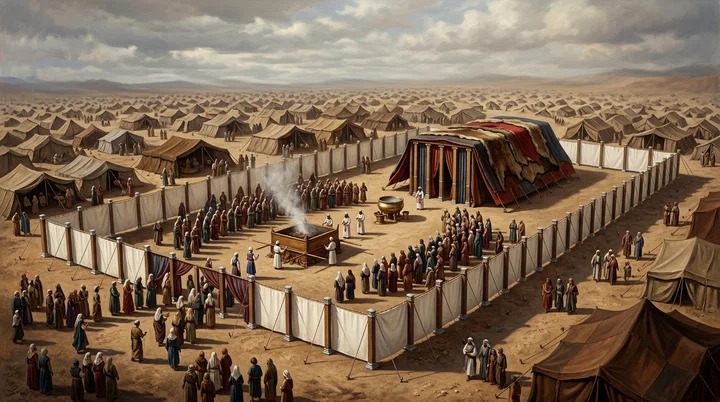
The tabernacle with its court was adapted to journeying to the promised land, to be taken down and set up again where the pillar of cloud halted, with the hosts of Israel pitching their tents around it.ST Nov 14, 1892 Like the tabernacle itself, everything was made with strict regard to proportion and beauty from materials that impress purity and sacredness, with all important dimensions being five cubits or some multiple of five cubits.ST Nov 14, 1892 The court around the tabernacle was a larger space forming a double square fifty by one hundred cubits, enclosed by hangings of fine-twined linen on pillars of brass five cubits high set five cubits apart, with a twenty-cubit entrance on the east.ST Nov 14, 1892 The wilderness tabernacle was the building God commanded Israel to erect whose worship and service centered on the holy of holies, where God's law rested beneath the mercy seat, whose central place was the holy of holies containing the ark of the covenant and God's law, with the ark that would hold the law, the mercy seat, and the priesthood that would minister before the ark.ST Jun 19, 1907ST Jan 27, 1909RH Dec 31, 1861
Altar Form and Placement
The command is to make an altar of shittim wood, also called acacia wood, five cubits long and five cubits broad so that it is foursquare, and three cubits high.ST Jan 24, 1911ST Jun 26, 1907ST May 1, 1901 That is about nine feet square and nearly five and a half feet high.RH Jan 6, 1853RH Mar 28, 1854 The prescribed size of the wilderness altar of burnt offerings was four times smaller in length and breadth than the altar of burnt offerings in Solomon's temple.RH Mar 17, 1910
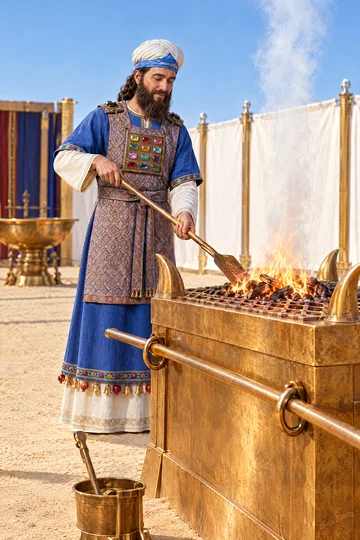
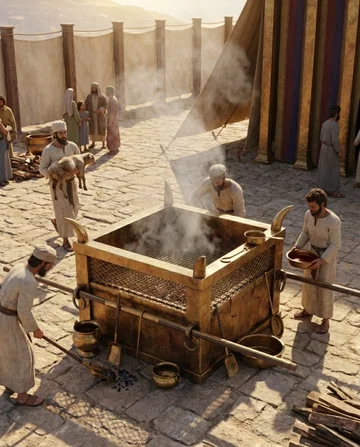
The altar is the altar of burnt offering, also called the brazen or brass altar.RH Jan 6, 1853ST May 1, 1901RH Mar 28, 1854ST Apr 1, 1897RH Mar 1, 1870 It was overlaid with brass, including its corner horns, and was square on top with horns at each corner.ST Apr 1, 1897RH Mar 1, 1870RH Aug 12, 1873 It was a hollow box with an openwork brass grate or network that let air circulate and allowed ashes to fall into pans beneath, and it had prescribed fittings and equipment made according to the pattern.ST May 1, 1901RH Aug 12, 1873
It stood in the open court before the tabernacle, nearest the east entrance, first inside the court gate between the court entrance and the tabernacle door.ST May 20, 1880ST May 1, 1901RH Mar 28, 1854ST Apr 1, 1897RH Mar 1, 1870 The laver stood between it and the tabernacle.RH Mar 1, 1870 It stood in the court where sacrificial victims were slain and their blood was shed, and it was in use the year round.ST Aug 19, 1913STST Apr 1, 1897
Solomon's temple otherwise kept the same shapes, dimensions and divisions as the wilderness tabernacle in the same proportion, showing God's original plan still regulated provision for His worship, while the temple altar was disproportionately large.RH Mar 17, 1910 This disproportion is accounted for by the supposition that it was the undisturbed altar built by David on the spot when he bought the hill from Ornan the Jebusite.RH Mar 17, 1910 One teaching holds that the text does not explain this altar's particular dimensions or materials.RH Jun 21, 1864
Sacrificial Service and Meaning
The altar was for offering sacrifices to God, where victims were slain and all burnt offerings were burned with fire.ST Jan 24, 1911RH Jan 6, 1853ST May 1, 1901ST Aug 19, 1913ST Whole burnt offerings, peace offerings, meat offerings and the rest were brought there, with burnt offerings and portions of other offerings consumed upon it.ST Jan 24, 1911ST Apr 1, 1897RH Sep 19, 1912 Blood, which represents life, was shed there, poured on the ground all around the altar and poured out at its base, never eaten but poured out freely and covered with dust.ST Apr 1, 1897 That ministration of sacrifices and offerings belonged to the ancient sanctuary, and its worship and services were object-lessons of God's mercy.ST Jan 24, 1911ST Aug 19, 1913ST
The first step for a sinner to find peace and joy and forgiveness was to bring an offering to the altar.ST Apr 1, 1897 The sinner confessed sins upon the head of the animal to transfer sin to it, then shed its blood representing its life.ST Apr 1, 1897 The priest laid the offering on the altar, and fire from God out of heaven consumed it to show acceptance.ST Apr 1, 1897
The offering represented the sinner and pointed to Christ as the Lamb of God who takes away sin.ST Apr 1, 1897 The animal had a double meaning of the man's own forfeited life and the life of the spotless Lamb.ST Apr 1, 1897 It teaches Christ giving His life freely and being offered on God's altar as the sacrifice for man, pouring out His blood or life for humanity and not for Himself.ST Apr 1, 1897 He was made sin for sinners though He knew no sin, so they may be cleansed and made the righteousness of God through Him.ST Apr 1, 1897
Burnt offerings and portions consumed on the altar represent sin being consumed.RH Sep 19, 1912 Its continually burning fire makes the altar a symbol of the final destruction of sin.RH Sep 19, 1912 That destruction is necessary before the redeemed can be at one with God and behold His holiness.RH Sep 19, 1912
The sinner's sacrifice at the altar before the entrance was a contribution toward complete atonement.RH Jul 27, 1916 It came before the final disposition of sin at the mercy seat.RH Jul 27, 1916
Heavenly Type and Fulfillment
The earthly sanctuary with its altar and its ministration of sacrifices and offerings was a pattern, shadow, figure and type of the heavenly temple and of Christ's priestly service there as High Priest and Minister of the sanctuary.ST Jan 24, 1911ST Jun 26, 1907ST Jun 19, 1907ST May 16, 1878RH Jun 21, 1864 The pattern for the altar and its fittings, five cubits long and broad so as to be foursquare and three cubits high, was shown to Moses in the mount by Jesus Christ, the Son of God and Minister of the true tabernacle, and Moses was charged to make everything exactly according to it.ST Jun 26, 1907ST May 27, 1889ST May 16, 1878RH Aug 12, 1873 Study of the earthly sanctuary therefore gives clearer views of the heavenly, of the Saviour, and of His work in behalf of men, for its rites pointed to Christ and His power to forgive sin and transform character.ST Jun 26, 1907ST Jun 19, 1907 The sanctuary thus let down upon earth sets forth God's plan of government and how He deals with those who sought to dethrone Him by sin. It sets forth the plan devised from eternity for salvation from sin, in which He remains King while executing the office of Priest upon the throne in dealing with sinners, and its worship and services were object-lessons of God's mercy.ST Aug 19, 1913
The instruction for the altar is part of Scripture profitable for doctrine, reproof, correction and instruction in righteousness to make the man of God perfect, written for learning to give patience, comfort and hope.ST Jun 19, 1907 Its directions for offerings and sacrifices point from the shadows of the old dispensation to the substance of the new.ST Jun 26, 1907 The sanctuary sacrifices and services were object-lessons pointing to Christ, who offered Himself once as the sacrifice for sin.ST Jan 24, 1911ST That service of sacrifices and offerings passed away when Christ died once for all, while the heavenly temple where Jesus now ministers remains.ST Jan 24, 1911
The sanctuary and its altar belong to the typical system through which the plan of salvation was revealed.ST Apr 15, 1886RH Aug 12, 1873 Its ceremonies and ordinances in Exodus 25-30 included burdensome ritual requirements, distinguished from the Ten Commandments spoken by God at Sinai and written on stone.ST Apr 15, 1886 They are part of the laws given through Moses that Malachi calls God's law. Together with Exodus 27-30, the directions for the sanctuary altar reserved priestly rites to Aaron and his sons, so Saul was not authorized to offer sacrifices himself.ST Mar 3, 1914
Sources