Leviticus 4:7
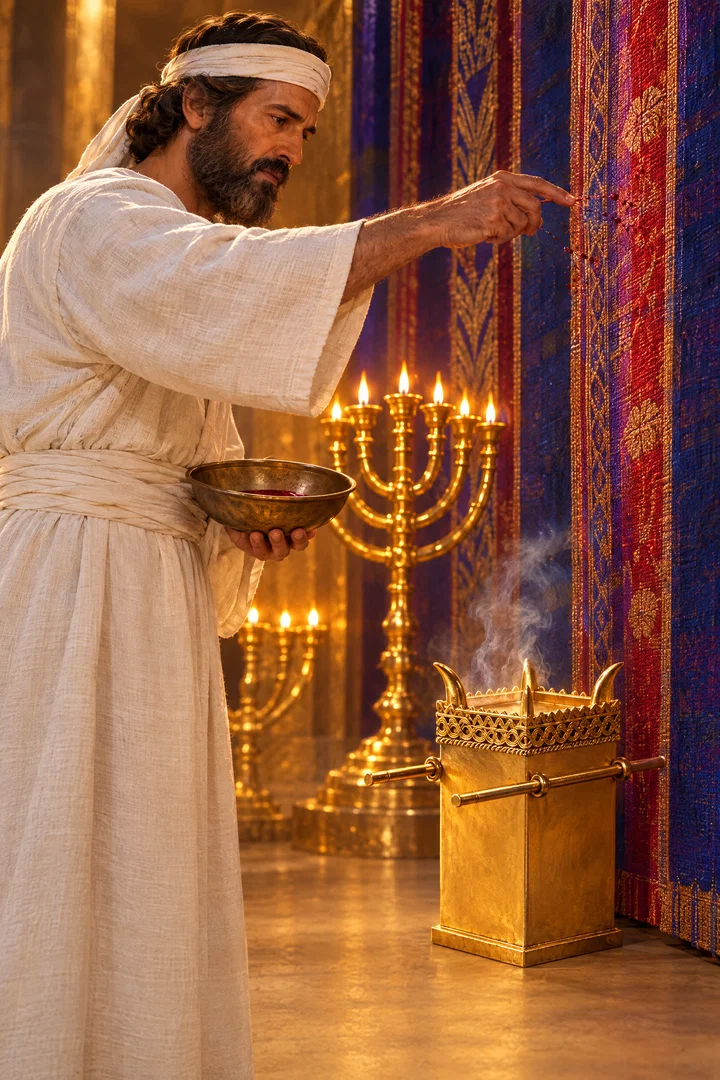
And the priest shall put some of the blood upon the horns of the altar of sweet incense before the LORD, which is in the tabernacle of the congregation; and shall pour all the blood of the bullock at the bottom of the altar of the burnt offering, which is at the door of the tabernacle of the congregation.
Translations
And the priest shall put some of the blood on the horns of the altar of sweet incense before the LORD, which is in the tabernacle of the congregation; and shall pour all the blood of the bullock at the bottom of the altar of the burnt offering, which is at the door of the tabernacle of the congregation.
And the priest shall put some of the blood upon the horns of the altar of sweet incense before the LORD, which is in the tabernacle of the congregation; and shall pour all the blood of the bullock at the bottom of the altar of the burnt offering, which is at the door of the tabernacle of the congregation.
And the priest shall put some of the blood upon the horns of the altar of sweet incense before the Lord, which is in the tabernacle of the congregation; and shall pour all the blood of the bullock at the bottom of the altar of the burnt offering, which is at the door of the tabernacle of the congregation.
And the priest shall put some of the blood upon the horns of the altar of sweet incense before the LORD, which is in the tabernacle of the congregation; and shall pour all the blood of the bullock at the bottom of the altar of the burnt-offering, which is at the door of the tabernacle of the congregation.
And the priest shall put of the blood upon the horns of the altar of sweet incense before the LORD, which is in the tent of meeting; and all the blood of the bullock shall he pour out at the base of the altar of burnt offering, which is at the door of the tent of meeting.
And the priest shall put of the blood upon the horns of the altar of sweet incense before Jehovah, which is in the tent of meeting; and all the blood of the bullock shall he pour out at the base of the altar of burnt-offering, which is at the door of the tent of meeting.
and the priest hath put of the blood on the horns of the altar of spice-perfume before Jehovah, which [is] in the tent of meeting, and all the blood of the bullock he doth pour out at the foundation of the altar of the burnt-offering, which [is] at the opening of the tent of meeting.
and the priest shall put of the blood on the horns of the altar of fragrant incense, which is in the tent of meeting, before Jehovah; and he shall pour all the blood of the bullock at the bottom of the altar of burnt-offering, which is at the entrance of the tent of meeting.
Then shall the priest put of the blood upon the horns of the altar of fragrant incense before Yahweh, which is in the tent of meeting,—and, all the [remainder of the] blood of the bullock, shall he pour out at the base of the altar of ascending-sacrifice, which is at the entrance of the tent of meeting,
Berean Standard Bible, Majority Standard Bible
The priest must then put some of the blood on the horns of the altar of fragrant incense that is before the LORD in the Tent of Meeting. And he is to pour out the rest of the bull’s blood at the base of the altar of burnt offering at the entrance to the Tent of Meeting.
The priest shall put some of the blood on the horns of the altar of sweet incense before the LORD, which is in the Tent of Meeting; and he shall pour out the rest of the blood of the bull at the base of the altar of burnt offering, which is at the door of the Tent of Meeting.
And the priest is to put some of the blood on the horns of the altar on which perfume is burned before the Lord in the Tent of meeting, draining out all the rest of the blood of the ox at the base of the altar of burned offering which is at the door of the Tent of meeting.
The Priest also shall put some of the blood before the Lord, vpon the hornes of the altar of sweete incense, which is in the Tabernacle of the Congregation, then shall hee powre all the rest of the blood of the bullocke at the foote of the altar of burnt offring, which is at the doore of the Tabernacle of the Congregation.
Douay-Rheims (Challoner revision)
And he shall put some of the same blood upon the horns of the altar of the sweet incense most acceptable to the Lord, which is in the tabernacle of the testimony. And he shall pour all the rest of the blood at the foot of the altar of holocaust in the entry of the tabernacle.
Pictures
Cross-references 20 of 63
- Leviticus 16:15-16
Then shall he kill the goat of the sin offering, that is for the people, and bring his blood within the vail, and do with that blood as he did with the blood of the bullock, and sprinkle it upon the mercy seat, and before the mercy seat:
The high priest uses sacrificial blood to atone for and cleanse the sanctuary of Israel’s sins.
- Hebrews 8:5
Who serve unto the example and shadow of heavenly things, as Moses was admonished of God when he was about to make the tabernacle: for, See, saith he, that thou make all things according to the pattern shewed to thee in the mount.
Earthly sanctuary service is a pattern of Christ’s heavenly ministry.
- Hebrews 10:4
For it is not possible that the blood of bulls and of goats should take away sins.
Animal blood could not actually take away sins.
- Hebrews 9:7
But into the second went the high priest alone once every year, not without blood, which he offered for himself, and for the errors of the people:
Both describe the high priest’s blood ministry in the sanctuary.
- Hebrews 10:1
For the law having a shadow of good things to come, and not the very image of the things, can never with those sacrifices which they offered year by year continually make the comers thereunto perfect.
The sanctuary sacrifices were a shadow of Christ’s work and could not perfect worshipers.
- Leviticus 17:11
For the life of the flesh is in the blood: and I have given it to you upon the altar to make an atonement for your souls: for it is the blood that maketh an atonement for the soul.
Explains the blood’s representation of life.
- Leviticus 6:30
And no sin offering, whereof any of the blood is brought into the tabernacle of the congregation to reconcile withal in the holy place, shall be eaten: it shall be burnt in the fire.
A sin offering whose blood enters the sanctuary is burned rather than eaten.
- Leviticus 10:17-18
Wherefore have ye not eaten the sin offering in the holy place, seeing it is most holy, and God hath given it you to bear the iniquity of the congregation, to make atonement for them before the LORD?
The offering bears the congregation’s iniquity, while its blood is handled in relation to the sanctuary.
- Hebrews 13:11-12
For the bodies of those beasts, whose blood is brought into the sanctuary by the high priest for sin, are burned without the camp.
The sanctuary sin offering is burned outside the camp, as Jesus suffers outside the gate.
- Hebrews 9:12
Neither by the blood of goats and calves, but by his own blood he entered in once into the holy place, having obtained eternal redemption for us.
Christ enters the heavenly sanctuary as high priest by his own blood, fulfilling the earthly rites.
- Hebrews 9:24
For Christ is not entered into the holy places made with hands, which are the figures of the true; but into heaven itself, now to appear in the presence of God for us:
Christ enters heaven’s true sanctuary to appear before God for us.
- Leviticus 4:17
And the priest shall dip his finger in some of the blood, and sprinkle it seven times before the LORD, even before the vail.
It describes the same sprinkling for the congregation’s offering.
- Exodus 30:7-8
And Aaron shall burn thereon sweet incense every morning: when he dresseth the lamps, he shall burn incense upon it.
Describes the daily incense service at the golden altar.
- Leviticus 4:25
And the priest shall take of the blood of the sin offering with his finger, and put it upon the horns of the altar of burnt offering, and shall pour out his blood at the bottom of the altar of burnt offering.
The ruler’s sin offering places blood on the burnt-offering altar and pours it at its base.
- John 1:29
The next day John seeth Jesus coming unto him, and saith, Behold the Lamb of God, which taketh away the sin of the world.
Jesus is the Lamb who takes away the world’s sin.
- Numbers 15:27-28
And if any soul sin through ignorance, then he shall bring a she goat of the first year for a sin offering.
Both describe atonement and forgiveness for sins committed unintentionally.
- Colossians 2:17
Which are a shadow of things to come; but the body is of Christ.
Earthly ordinances and rites are shadows pointing to Christ.
- Exodus 40:6
And thou shalt set the altar of the burnt offering before the door of the tabernacle of the tent of the congregation.
Locates the altar where the blood was poured.
- Leviticus 6:25
Speak unto Aaron and to his sons, saying, This is the law of the sin offering: In the place where the burnt offering is killed shall the sin offering be killed before the LORD: it is most holy.
It names the sin offering whose blood was handled at the altar.
- Numbers 35:33
So ye shall not pollute the land wherein ye are: for blood it defileth the land: and the land cannot be cleansed of the blood that is shed therein, but by the blood of him that shed it.
Shed blood defiles the land, and cleansing requires blood.
Commentary
Each commentary is drawn from primary sources: the writings of Ellen G. White and Adventist pioneers and periodicals. Each commentary is separate. Its own words are not a quotation; follow the references to read the source passages.
Ellen G. White
4 sources
Leviticus 4:7 lays out the ritual for a sin offering made for a priest or for the whole congregation, in which some of the blood was put upon the horns of the golden altar of sweet incense in the holy place, and all the rest of the blood of the bullock was poured out at the bottom or base of the altar of burnt offering in the court at the door of the tabernacle of the congregation.PP 761.5 In that same ritual the fat was burned upon the court altar, while the body of the victim was burned outside the camp.PP 761.5 The verse also shows how the blood of the individual sin offering was dealt with, being carried into the holy place and sprinkled before the veil.PP 354.2–355.1
That carrying and sprinkling pictured the transfer of the repentant sinner's confessed sin, borne through the blood, to the sanctuary itself.PP 354.2–355.1 Sin offerings of this kind were required in addition to the tenth of a person's increase.ST May 6, 18754T 467.1–2 The sin offering was one of the returns imperatively required in proportion to the capital entrusted, standing alongside the tithe and with thank offerings, trespass offerings, sacrificial offerings, and other dues.4T 467.1–2
The tithe alone was not the standard of giving, for property was sanctified by keeping God's claims paramount in almost every article.4T 467.1–2 Besides the tithe there were the ransom for the firstborn, the firstfruits of flocks and harvest, the corners and gleanings left for the poor, the spontaneous produce of the seventh year for the needy, the remission of debts every seventh year, the expenses for hospitality and gifts to the poor, assessments upon property, and special freewill offerings such as those given for the wilderness tabernacle and for the Jerusalem temple.4T 467.1–2 By these means conscientious givers returned about one-third of all their income for religious interests and for the poor.4T 467.1–2 The lesson for today is that a Christian entrusted with ten or twenty thousand dollars must likewise present sin offerings and thank offerings to God, with the larger the capital entrusted requiring the more valuable gift returned.4T 467.1–2
Sources
Pioneers and periodicals
75 sources
The verse directs that in the sin offering for a priest or the whole congregation some of the bullock's blood be put on the horns of the incense altar inside the tabernacle and all the rest poured at the base of the burnt-offering altar at its door, with the blood also sprinkled seven times before the veil.RH Sep 16, 1852ST Jun 4, 1885RH Aug 3, 1876ST Jun 27, 1911ST Jun 27, 1911 The blood stands for the forfeited life of the sinner, and by confession, laying the hand on the victim's head, slaying it, and the priest carrying its blood inside, guilt is transferred from the sinner to the victim and then into the sanctuary, leaving sin recorded there while the sinner goes free pardoned.ST Nov 20, 1879ST Jan 18, 1883RH Mar 10, 1874ST Jun 27, 1911ST Jun 27, 1911 The slain animal and the priest's work together foreshadow Christ as the Lamb bearing the iniquity of all in his body and as the Mediator ministering his own blood in the heavenly sanctuary, whose body burned outside the camp points to Jesus suffering outside the gate.RH Aug 3, 1876ST Jul 8, 1930ST Nov 23, 1904ST Apr 15, 1886 Atonement is made not by the killing in the court but by the priest's ministry of the blood in the sanctuary, so Christ's death on Calvary where no priest officiated did not finish the atonement, which he began as High Priest after his ascension and completes by cleansing the sanctuary and removing sin forever.ST Aug 8, 1916ST Jul 2, 1885RH Sep 30, 1852RH Jul 6, 1869 The offering is for sin done unwittingly, teaching that ignorance does not make wrong right or remove guilt, but when the sin becomes known atonement must be made through faith in the promised sacrifice.ST Jun 27, 1911ST Apr 20, 1904ST Feb 20, 1893ST Aug 24, 1888ST Apr 15, 1889
Blood Rite Described
The rite divides the bullock's blood into two placements, with some put upon the horns of the altar of sweet incense before the Lord inside the tabernacle of the congregation and all the rest poured out at the bottom of the altar of burnt offering at the door of the tabernacle.ST Jun 4, 1885RH Aug 3, 1876ST Jun 27, 1911ST Jan 14, 1886ST Apr 1, 1886 For the sin offering of the anointed priest or of the whole congregation the priest brings the blood into the sanctuary, and the same service also requires sprinkling the blood seven times before the veil of the sanctuary, before the inner veil in front of the ark.RH Sep 16, 1852ST Jun 27, 1911ST Jan 14, 1886ST Sep 5, 1900 The sprinkling is before the Lord behind which is the law transgressed, and the blood so placed represents life given in atonement.RH Dec 8, 1915ST Jun 27, 1911ST Nov 19, 1894
The order begins with confession and laying the hand upon the victim's head, by which guilt passes to the substitute, followed by slaying of the victim by the offerer himself, or by the elders for the congregation, on the north side of the burnt-offering altar at the door of the tabernacle.RH Dec 8, 1915RH Sep 16, 1852RH Jun 27, 1912RH Nov 17, 1863 The anointed priest then takes the blood into the Holy, carries it within the tabernacle, applies it upon the horns and before the veil, and pours out the remainder in a vessel at the base of the altar.RH Sep 16, 1852RH Jun 27, 1912RH Jun 21, 1864 Only the fat is burned upon the altar, while the rest of the bull, where the whole is not burned on the altar, is carried outside the camp and burned in a clean place as unclean.RH Sep 16, 1852ST Apr 15, 1889ST Sep 5, 1900
This handling belongs to the sin offering for an anointed priest or for the whole congregation collectively guilty, and it differs from that appointed for a ruler or for one of the common people for the same sin of ignorance.ST Jun 27, 1911ST Jun 27, 1911ST Mar 11, 1886ST May 22, 1901 Where the priest is concerned in the sin he is not permitted to eat of the offering, but in cases where the blood is not taken into the sanctuary the priest eats part of the flesh to bear the iniquity of the congregation, and both the blood brought in and the flesh eaten bring sin in figure into the sanctuary.ST Mar 11, 1886ST May 22, 1901RH Jun 27, 1912ST Nov 19, 1894 The altar where the remaining blood is poured is the altar of burnt offering standing just inside the entrance to the court directly between the entrance and the door of the tabernacle, before the door of the tent of meeting.ST May 1, 1901ST May 1, 1901 It was seven and one-half feet square and four and one-half feet high, made of acacia wood overlaid with heavy brass plate, with an open grate top like network through which ashes were sifted into pans beneath; animals for sin offerings, burnt offerings, and trespass or guilt offerings were killed in the court just north of it, the blood received in a suitable vessel, the priest dipping his finger in it to put some upon the horns before pouring the rest at the base.ST May 1, 1901ST May 1, 1901
The acts are distinguished by distinct words, for the priest dips his finger into the blood and then sprinkles, and dipping is not sprinkling.ST Oct 6, 1881ST Sep 2, 1913 In Hebrew tabal means to dip or immerse while nazah means to sprinkle, and in Greek the dipping is bapsei from bapto meaning to dip, to plunge, to immerse, from which baptizo comes with the same meaning, while the sprinkling is prosranei from rantizo meaning to sprinkle around, and the pouring is ekkeo meaning to pour.ST Oct 6, 1881ST Sep 2, 1913 The three words are never used interchangeably for the three acts, so to baptize is to dip, plunge, and immerse, not to sprinkle or pour, with the same meaning carried into the New Testament where baptism is dipping and immersing.ST Sep 2, 1913
The service is the daily ministration in the holy place performed through the year for individuals when they presented their particular offerings, after confession and restitution, by which the priest made atonement in the court and the Holy so the sin was forgiven.RH Sep 16, 1852RH Mar 8, 1870ST Nov 19, 1894 It is distinct from the yearly national atonement for blotting out sins made in the Holy of Holies, yet the day-by-day transfer of sin into the sanctuary defiles the holy places and makes necessary the special cleansing work.RH Sep 16, 1852RH Jun 21, 1864ST Nov 19, 1894 It is part of the complete yearly round performed in the sanctuary built by Moses in the wilderness and afterward in the temple, which in building, appointments, priesthood, and service was the example and shadow of Christ's more excellent ministry in the true tabernacle in heaven, begun when He ascended on high and typified once for all in each year's service.RH Dec 8, 1915RH Mar 8, 1870ST Nov 28, 1895ST Nov 1, 1877
Guilt Carried Into Sanctuary
The blood carried into the sanctuary represented life, the innocent victim's life given in place of the sinner's life forfeited under the law.ST Nov 20, 1879ST Jan 18, 1883RH Mar 10, 1874ST Jun 4, 1885ST Aug 15, 1878 The repentant sinner laid the hand on the victim's head and confessed the sin, and by that act guilt passed in figure from the sinner to the offering.ST Jan 18, 1883RH Mar 10, 1874RH Dec 8, 1915ST Jun 4, 1885ST Jul 8, 1930 The victim was then slain in the sinner's stead, slain by the sinner's own hand in acknowledgment that death was deserved but that the substitute was accepted to die instead.ST Nov 20, 1879ST Jan 18, 1883RH Mar 10, 1874RH Dec 8, 1915 Its blood, as its life, was taken by the priest into the holy place and sprinkled before the veil behind which stood the ark containing the ten commandments covered by the mercy seat, put upon the horns of the altar of sweet incense, with the remainder poured at the base of the altar of burnt offering.ST Jan 18, 1883RH Mar 10, 1874RH Dec 8, 1915ST Jun 4, 1885 By that carrying of blood, or by the priest's eating of the flesh to bear iniquity where blood was not brought in, the sin was conveyed from the victim into the sanctuary while the sinner went free pardoned.ST Nov 20, 1879ST Jan 18, 1883RH Mar 10, 1874RH Dec 8, 1915ST Jul 8, 1930
That transfer continued day by day through the year in the daily ministration, which typifies the ministry of the great High Priest in the temple above.ST Nov 20, 1879ST Jan 18, 1883RH Dec 8, 1915 Its presence in the sanctuary testified that sin had defiled God's dwelling and figuratively polluted it.ST Jun 27, 1911ST Jun 27, 1911ST Apr 1, 1886 It left marks of sin upon the altar, a record of sin and its remedy marked before God and accumulated there, making necessary the cleansing of the sanctuary by the ceremonies of Leviticus 16 on the Day of Atonement.ST Jun 27, 1911ST Apr 1, 1886RH Sep 26, 1912ST Sep 20, 1910 The same blood that witnessed to defilement spoke pardon to the sinner whose guilt the offering bore.ST Jun 27, 1911ST Jun 27, 1911 For life is in the blood and blood was given for atonement, and the offerings represented Christ's death and showed the offerer's faith that Christ bears sin and that his blood cleanses from it.ST Apr 15, 1889ST Jan 27, 1890RH Apr 10, 1900ST Aug 8, 1878
Pardon was secured through the offerings only as expressing faith in the promised sacrifice and Mediator of the new covenant, not because the offerings themselves took away sin.ST Apr 15, 1889ST Jan 27, 1890RH Apr 10, 1900 Through priestly ministry with blood before God for those who come to God through him, mercy reaches lawbreakers whose response includes repentance and faith, their sins being borne into the sanctuary and later removed in its cleansing.ST Jun 27, 1911ST Jun 27, 1911ST Jan 27, 1890ST Aug 8, 1878 The blood representing the sinner's sinful life and sins was covered by the morning and evening incense continually rising before God on the incense altar.RH Feb 19, 1901 This typified sins being covered so the sinner could be accepted.RH Feb 19, 1901
Ignorant Sin Still Sin
Leviticus 4 deals with sins done unwittingly, unwillingly, through simple unacquaintance with duty or misunderstanding of circumstances, as when a person is misled into thinking wrong is right.ST Apr 20, 1904ST Aug 24, 1888RH Apr 28, 1910 Such a sin of ignorance was not passed by as of no consequence, and lack of awareness does not prove a person free from sin or completely saved from it.ST Feb 20, 1893ST Mar 22, 1883ST Nov 25, 1886 Wrongdoing is not made right by ignorance or sincerity or good intentions, and sin remains sin even when the doer does not recognize it.RH Apr 28, 1910ST Mar 22, 1883ST Nov 25, 1886 When the sin is brought to mind and becomes known it must be confessed, repented of, put away, and forgiven through faith in Christ.ST Apr 20, 1904RH Apr 28, 1910ST Mar 22, 1883
Ignorance may lessen blame and make the sin less heinous than sins of weakness and sins of presumption, but it cannot justify sin or strip it of wickedness.ST Aug 24, 1888ST Nov 25, 1886RH Mar 3, 1874ST Oct 30, 1884 Sins of ignorance do not tear apart the new robe of righteousness, yet they sully it, they cast shadows on the heavenly pictures put in the soul, and they can lie with terrible weight of vengeance on the head.ST Aug 24, 1888 They still require forgiveness and complete purification and cleansing, and the different offerings appointed for them prove they were among the things that made the death of Christ necessary.ST Aug 24, 1888RH Mar 3, 1874ST Oct 30, 1884
A person can sin without knowing it, but when the sin becomes known he is counted guilty and must bring the required offering in order to be forgiven.ST Apr 20, 1904ST Feb 20, 1893ST Apr 26, 1883 In olden times atonement had to be made for a sin of ignorance or the sin remained, which proves lack of knowledge does not excuse a fault but is sin that causes destruction unless remedied.ST Feb 20, 1893ST Apr 26, 1883RH Nov 10, 1863 Those who sinned through ignorance were required to repent and reform as soon as their ignorance was removed, and that duty continues in this dispensation.RH Mar 3, 1874ST May 31, 1905 When light comes and is refused, past sins of ignorance are imputed as if committed with clear knowledge of duty, as when Christ came as light and was refused.RH Mar 3, 1874 This includes breaking God's commandments unwillingly or through ignorance, and breaking God's law by keeping Sunday as many of past generations did ignorantly, for which atonement is provided and repentance is required upon discovery.RH Nov 10, 1863ST May 31, 1905
Christ Foreshadowed in Offering
The sin offering portrays both the victim and the priest's work, for an innocent bullock is substituted for the sinner, the sin is confessed over it and laid upon the substitute as a whole, it dies in his place, and its blood is presented to God so that confession brings atonement and transfer of confessed sin to the sanctuary.ST Jul 8, 1930ST Apr 15, 1886RH Apr 10, 1900 In this the animal foreshadows the Lamb of God, upon whom the iniquity of all is laid and who bears sins in his own body on the tree, while the blood itself figures the sinner's life forfeited under the law.ST Nov 23, 1904ST Apr 15, 1886ST Jul 8, 1886 The rite teaches that sin brings death and must be confessed and renounced, that the law and its penalty remain in force, and that although atonement was made for the whole world it avails only for those who humble themselves before God and confess.ST Nov 23, 1904ST Feb 3, 1909RH Apr 10, 1900 The offerings with all their ritual details are thus shadows of Jesus Christ, the great substance to which they point.ST Feb 3, 1909
The offering whose blood is brought inside the sanctuary and whose body is burned outside the camp especially prefigures Jesus, for as some of the blood is put on the horns of the incense altar within while the rest is poured at the base of the burnt-offering altar, so the body is consumed without the camp as Jesus suffered outside the gate.RH Aug 3, 1876 As the blood of these offerings carried the people's sins into the earthly sanctuary, so Christ's blood is ministered in the heavenly sanctuary where sins are transferred.RH Aug 3, 1876
The blood poured on the ground at the base is no waste but a deliberate part of the offering, typifying Christ's blood removing sin's defilement and curse from the earth as well as from the sinner.RH Jun 27, 1912RH Jun 27, 1912 Through that poured blood the land is redeemed from sin and the curse, for Christ's death purchased the earth as well as its inhabitants.RH Jun 27, 1912RH Jun 27, 1912 That same act pictures the taint of sin taken from the defiled earth and the earth restored to Eden beauty.RH Jun 27, 1912
The blood placed before God points to Christ's blood given as an atoning sacrifice for human redemption, foreshadowed from the first bleeding lamb that pointed to Christ's death, and it is presented before God in connection with the prayer of every truly penitent person.RH Nov 13, 1900 Yet the blood of bulls and goats in these first-covenant ordinances of divine service could not really take away sins or make perfect, and the service did not atone for a single sin.ST Apr 15, 1886ST Jul 8, 1886ST Aug 5, 1889 Fulfillment came only in the body of Christ, who takes away the sin of the world by putting away sin through the sacrifice of himself, so that after his once-for-all sacrifice the typical sacrifices were abolished in his flesh and are no longer to be continued, and eternal life now requires eating the flesh of the Son of man and drinking his blood.ST Apr 15, 1886RH Jan 10, 1916ST Jul 8, 1886
Atonement by Priestly Ministry
Atonement is made by the priest with the blood in the sanctuary after the victim has already been slain by the sinner.ST Aug 8, 1916ST Jul 2, 1885RH Sep 30, 1852ST Mar 29, 1883RH Jul 6, 1869 The priest did not slay the sacrifice and was not himself the offering, but took its blood and with it made the atonement in the sanctuary.ST Aug 8, 1916ST Jul 2, 1885RH Sep 30, 1852 The killing in the court was preparatory and not itself the atonement, for the sacrifice was not slain in the sanctuary but its blood was presented there by the priest.ST Jul 2, 1885RH Sep 30, 1852ST Mar 29, 1883 The verse therefore means that atonement is priestly mediatorial work with blood in the sanctuary, not the death of the victim.ST Aug 8, 1916ST Jul 2, 1885RH Jul 6, 1869
Since slaying is not atonement and no priest officiated on Calvary, Christ's death did not complete the atonement there.RH Sep 30, 1852RH Jul 6, 1869 He began priestly atonement after the resurrection and ascension, when as appointed High Priest He entered the heavenly sanctuary by His own blood to minister.RH Sep 30, 1852RH Jul 6, 1869
The blood ministry in the first apartment makes reconciliation and begins the work of atonement by transferring the people's sins to the sanctuary.ST Jun 6, 1878RH Jan 11, 1870RH Apr 6, 1869STST Aug 15, 1878 Guilt is removed from the sinner to the victim by laying on of hands and slaying, and carried in its blood put on the horns of the altar and poured out at its base into the sanctuary, where it leaves a record of sin and its remedy accumulated through the year.ST Sep 20, 1910RH Apr 6, 1869STST Aug 15, 1878 This work remains unfinished until completed on the Day of Atonement on the tenth day of the seventh month, when the high priest cleanses the sanctuary, blots out sins, confesses them out and lays them on the scapegoat so that Israel stands free from sin.ST Jun 6, 1878RH Jan 11, 1870STST Aug 15, 1878 The later work in the second apartment thus cleanses the sanctuary of what the daily service placed there, and the earthly service is the pattern of the work in the heavenly sanctuary.ST Jun 6, 1878ST Sep 20, 1910ST Aug 15, 1878
The sin-offering ritual shows the law that was violated and that demands an atonement for sin.ST Nov 23, 1904RH May 19, 1863 Sinners were represented by slain animals, showing that sin brings death, and the blood symbolizes the sinner's life forfeited under the law.ST Nov 23, 1904ST Apr 19, 1905RH Aug 3, 1876 The shedding of blood signifies that the sinner deserves death, while the victim's death is accepted in the sinner's place by God's mercy, witnessing to human sin and to God's provision of atonement through an appointed substitute.ST Nov 23, 1904RH Aug 3, 1876 Christ is the true sin offering whose blood was shed for the whole world, showing that the law and its penalty remain in force, and the atonement made for all avails for those who humble themselves before God and confess and renounce their sins.ST Nov 23, 1904
Life Offered to God
Because blood represents life, the placing of some blood on the horns of the incense altar and the pouring of the rest at the base of the burnt-offering altar teaches the sinner's life presented to God through Christ's merit, renewed by Christ and given in service according to God's direction.ST Sep 5, 1900ST Sep 5, 1900 The horns of the incense altar represent Christ's renewing power, the incense itself represents Christ's merit, and the burnt-offering altar represents complete consecration.ST Sep 5, 1900ST Sep 5, 1900 God directs how the surrendered life is used, even if it is dishonored or forgotten.ST Sep 5, 1900
The ritual pictures willing surrender without self-righteousness, with the carnal nature willingly surrendered to crucifixion and the life offered in reliance on Christ's merit.ST Sep 5, 1900 It is a picture of coming to God with one's sinful nature and yielding one's life to His keeping.ST Sep 5, 1900 A trusting person who follows known light yet sins unknowingly may still offer that life in confidence, because Christ's merit covers unknown sin and God does not count that sin against the person.ST Sep 5, 1900
The law belongs to the special offerings, such as sin offerings, peace offerings, and thank offerings, which were given in addition to tithes and on which much was spent.ST Aug 16, 1883 These sacrifices cost the one making them something, with the cost varying with the wealth or position of the offerer, and sin offerings were required in addition to the tenth of a person's increase.ST May 6, 1875ST Aug 16, 1883 A profession of religion therefore requires contributing to the cause, and worship that costs nothing and merely occupies a place is disreputable.ST Aug 16, 1883 The instruction regarding worship, sacrifices, and how to obtain forgiveness of sin was given together with definite instruction concerning physical well-being, so that as God's chosen and holy people they might reflect the glory of God both in holiness of character and in physical development.RH Sep 24, 1914
Sources