Exodus 28:30
And thou shalt put in the breastplate of judgment the Urim and the Thummim; and they shall be upon Aaron’s heart, when he goeth in before the LORD: and Aaron shall bear the judgment of the children of Israel upon his heart before the LORD continually.
Translations
And you shall put in the breastplate of judgment the Urim and the Thummim; and they shall be on Aaron’s heart, when he goes in before the LORD: and Aaron shall bear the judgment of the children of Israel on his heart before the LORD continually.
King James Version, Revised Version
And thou shalt put in the breastplate of judgment the Urim and the Thummim; and they shall be upon Aaron’s heart, when he goeth in before the LORD: and Aaron shall bear the judgment of the children of Israel upon his heart before the LORD continually.
And thou shalt put in the breastplate of judgment the Urim and the Thummim; and they shall be upon Aaron’s heart, when he goeth in before the Lord: and Aaron shall bear the judgment of the children of Israel upon his heart before the Lord continually.
And thou shalt put in the breast-plate of judgment the Urim and the Thummim; and they shall be upon Aaron's heart, when he goeth in before the LORD: and Aaron shall bear the judgment of the children of Israel upon his heart before the LORD continually.
And thou shalt put in the breastplate of judgment the Urim and the Thummim; and they shall be upon Aaron’s heart, when he goeth in before Jehovah: and Aaron shall bear the judgment of the children of Israel upon his heart before Jehovah continually.
'And thou hast put unto the breastplate of judgment the Lights and the Perfections, and they have been on the heart of Aaron, in his going in before Jehovah, and Aaron hath borne the judgment of the sons of Israel on his heart before Jehovah continually.
And thou shalt put into the breastplate of judgment the Urim and the Thummim, that they may be upon Aaron's heart when he goeth in before Jehovah; and Aaron shall bear the judgment of the children of Israel upon his heart before Jehovah continually.
Thus shalt thou place, in the breastpiece for giving sentence, the lights and the perfections, so shall they be upon the heart of Aaron when he goeth in before Yahweh,—so shall Aaron bear the sentence of the sons of Israel, upon his heart before Yahweh continually.
Berean Standard Bible, Majority Standard Bible
And place the Urim and Thummim in the breastpiece of judgment, so that they will also be over Aaron’s heart whenever he comes before the LORD. Aaron will continually carry the judgment of the sons of Israel over his heart before the LORD.
You shall put in the breastplate of judgment the Urim and the Thummim; and they shall be on Aaron’s heart, when he goes in before the LORD. Aaron shall bear the judgment of the children of Israel on his heart before the LORD continually.
And in the bag you are to put the Urim and Thummim, so that they may be on Aaron's heart whenever he goes in before the Lord; and Aaron may have the power of making decisions for the children of Israel before the Lord at all times.
Also thou shalt put in the brest plate of iudgement the Vrim and the Thummim, which shalbe vpon Aarons heart, when he goeth in before the Lord: and Aaron shall beare the iudgement of the children of Israel vpon his heart before the Lord continually.
Douay-Rheims (Challoner revision)
And thou shalt put in the rational of judgment doctrine and truth, which shall be on Aaron’s breast, when he shall go in before the Lord: and he shall bear the judgment of the children of Israel on his breast, in the sight of the Lord always.
Pictures

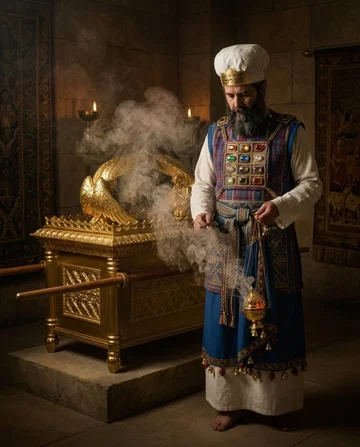
Cross-references 20 of 25
- Hebrews 8:1-2
Now of the things which we have spoken this is the sum: We have such an high priest, who is set on the right hand of the throne of the Majesty in the heavens;
Christ ministers as High Priest in the true heavenly sanctuary.
- Hebrews 9:7
But into the second went the high priest alone once every year, not without blood, which he offered for himself, and for the errors of the people:
The high priest entered the inner sanctuary once a year.
- Hebrews 7:25
Wherefore he is able also to save them to the uttermost that come unto God by him, seeing he ever liveth to make intercession for them.
Jesus ever lives to intercede for his people.
- Hebrews 8:5
Who serve unto the example and shadow of heavenly things, as Moses was admonished of God when he was about to make the tabernacle: for, See, saith he, that thou make all things according to the pattern shewed to thee in the mount.
The earthly priestly service is a shadow of heavenly things.
- Hebrews 9:24
For Christ is not entered into the holy places made with hands, which are the figures of the true; but into heaven itself, now to appear in the presence of God for us:
Christ appears before God for humanity in heaven, the true sanctuary foreshadowed by the earthly holy place.
- Numbers 27:21
And he shall stand before Eleazar the priest, who shall ask counsel for him after the judgment of Urim before the LORD: at his word shall they go out, and at his word they shall come in, both he, and all the children of Israel with him, even all the congregation.
The priest consults the Urim to seek God’s guidance.
- Hebrews 9:11-12
But Christ being come an high priest of good things to come, by a greater and more perfect tabernacle, not made with hands, that is to say, not of this building;
Christ fulfills the earthly high-priestly service in the heavenly sanctuary.
- Leviticus 16:2
And the LORD said unto Moses, Speak unto Aaron thy brother, that he come not at all times into the holy place within the vail before the mercy seat, which is upon the ark; that he die not: for I will appear in the cloud upon the mercy seat.
Aaron bears Israel’s judgment before the LORD, whose presence the high priest enters under restriction.
- 1 Samuel 23:9-12
And David knew that Saul secretly practised mischief against him; and he said to Abiathar the priest, Bring hither the ephod.
David receives answers to his inquiries through the ephod.
- Exodus 29:1-9
And this is the thing that thou shalt do unto them to hallow them, to minister unto me in the priest’s office: Take one young bullock, and two rams without blemish,
Both texts describe setting apart priests for service before the LORD.
- Ezra 2:63
And the Tirshatha said unto them, that they should not eat of the most holy things, till there stood up a priest with Urim and with Thummim.
Eligibility awaits a priest who can consult the Urim and Thummim.
- Exodus 28:21
And the stones shall be with the names of the children of Israel, twelve, according to their names, like the engravings of a signet; every one with his name shall they be according to the twelve tribes.
The breastplate stones bear the names of Israel’s twelve tribes.
- Leviticus 8:1-13
And the LORD spake unto Moses, saying,
The passage describes the consecration of Aaron and his sons for priestly ministry.
- Leviticus 16:4
He shall put on the holy linen coat, and he shall have the linen breeches upon his flesh, and shall be girded with a linen girdle, and with the linen mitre shall he be attired: these are holy garments; therefore shall he wash his flesh in water, and so put them on.
Both describe the high priest’s attire for sacred service.
- Hebrews 9:1-5
Then verily the first covenant had also ordinances of divine service, and a worldly sanctuary.
Describes the first covenant’s sanctuary and its furnishings.
- 1 Samuel 30:7-8
And David said to Abiathar the priest, Ahimelech’s son, I pray thee, bring me hither the ephod. And Abiathar brought thither the ephod to David.
David uses the ephod to inquire of the LORD and receive guidance.
- Exodus 28:2-4
And thou shalt make holy garments for Aaron thy brother for glory and for beauty.
God gives detailed instructions for Aaron’s symbolic garments.
- Nehemiah 7:65
And the Tirshatha said unto them, that they should not eat of the most holy things, till there stood up a priest with Urim and Thummim.
Both describe the Urim and Thummim in connection with the priesthood.
- 1 Samuel 28:6
And when Saul enquired of the LORD, the LORD answered him not, neither by dreams, nor by Urim, nor by prophets.
Names the Urim among the means of seeking God’s answer.
- Exodus 28:12
And thou shalt put the two stones upon the shoulders of the ephod for stones of memorial unto the children of Israel: and Aaron shall bear their names before the LORD upon his two shoulders for a memorial.
The high priest bears Israel’s names before the LORD as a memorial.
Commentary
Each commentary is drawn from primary sources: the writings of Ellen G. White and Adventist pioneers and periodicals. Each commentary is separate. Its own words are not a quotation; follow the references to read the source passages.
Ellen G. White
15 sources
God placed the Urim and Thummim in the breastplate of judgment so the high priest, bearing Israel upon his heart, could seek and receive decisions and messages from God when he went in before the Lord.1SP 398.2–399.1ST Feb 21, 1911ST Jul 28, 1881 Approval was shown by light flashing upon the precious stones on the right, permitting action and promising success, while refusal and displeasure were shown by a cloud shadowing the stones on the left, a sign also given at times upon the cherubim above the ark in the Most Holy Place.1SP 398.2–399.1SG4 102.1COS 165.2–3ST Oct 7, 18865RED 86.2 Aaron's bearing the judgment of Israel continually foreshadows Jesus as the great High Priest, who bears the names of all His people, remembers them and His covenant, and ministers their burdens in the heavenly sanctuary without any human bearer of the breastplate.EW 213.14MR 245.25MR 10.1 That manifestation by light and shadow ended at the death of Christ, when the veil was torn, God's protecting presence left the temple and no longer overshadowed the mercy seat and breastplate, and the temple sacrifices lost their value because the Lamb of God had become the sacrifice for the world.COS 165.2–3ST Oct 7, 18865RED 86.2 The exact directions for the breastplate and priestly garments show that those who minister before a holy God must come with reverence, order and cleanliness, with dress and service that honor Him and teach the people His holiness.GW92 161.1GW92 162.22T 610.3–612.1Ms 56, 1900, par. 11–12
Guidance Through the Breastplate
The Urim and Thummim placed in the breastplate of judgment were the appointed means by which the high priest sought and received decisions and messages from Jehovah.1SP 398.2–399.1ST Feb 21, 1911 When inquiry was made, the answer was signaled by the two stones: light resting on the right stone meant approval, success, and permission to act, whether to go to battle or to decide difficult cases, while a cloud resting on the left stone meant refusal and failure.1SP 398.2–399.1SG4 102.1 The answer was also sought when ministering before the ark in the Most Holy Place, where God could reply audibly or signify approval or refusal by light or cloud upon the cherubim.1SP 398.2–399.1
God thus made known His acceptance or displeasure through the precious stones of the breastplate, with the light of His glory flashing upon them and the cloud of His disapproval shadowing them.COS 165.2–3ST Oct 7, 18865RED 86.2 The breastplate of judgment belonged to the high priest and was worn when he went in before the Lord, and its sacredness came from its use in the service God had directed rather than from the object itself, so Gideon's imitation of it to establish worship elsewhere was unauthorized.ST Jul 28, 1881 This manifestation by light and shadow rested on God's presence overshadowing the earthly mercy seat in the Most Holy Place.ST Oct 7, 18865RED 86.2
Christ the True High Priest
Aaron's bearing the judgment of the children of Israel upon his heart before the Lord continually is a symbol of Jesus as the great High Priest, who bears the names of all His people in the holy place.4MR 245.2 He remembers His people and the words He has given them to encourage their trust, and He remains mindful of His covenant.4MR 245.2 The priestly breastplate is reflected in His heavenly ministry, where the breastplate bears magnified names showing His relation to Israel as He enters the second apartment of the heavenly sanctuary after the prophetic periods ended in 1844.EW 213.1 As High Priest He is able to bear this responsibility and the burdens of His people, and human agents are not required to carry the official breastplate.5MR 10.1 The costly breastplate that once bore the light of God's glory displays the sacred splendor of the high-priestly office in contrast to His humble appearance when He stood on trial.5RED 35.3–36.2
That manifestation of acceptance or displeasure by light and shadow in the precious stones ended at the death of Christ.COS 165.2–3ST Oct 7, 18865RED 86.2 When He died the veil of the temple was torn in two from top to bottom, the Most Holy Place and its sacred objects were exposed to common gaze, and God's protecting presence left the temple.COS 165.2–3ST Oct 7, 18865RED 86.2 The earthly Most Holy Place was no longer sacred, and His presence would never again overshadow the earthly mercy seat or the breastplate, so the light no longer flashed upon the stones nor did the cloud shadow them.COS 165.2–3ST Oct 7, 18865RED 86.2 The blood of the temple offerings was henceforth of no value, because the Lamb of God in dying had become the sacrifice for the sins of the world.COS 165.2–3
Reverence in Priestly Service
Exodus 28:30 belongs to God's specific, detailed and symbolic directions about priestly garments, including what was to be placed in the breastplate.GW92 161.1GW92 162.22T 610.3–612.1Ms 56, 1900, par. 11–12 God distinctly specified what garments the priests were to wear, requiring them to be made in a particular style in accordance with their work of doing service in the holy place and ministering in the priest's office.GW92 161.1GW92 162.22T 610.3–612.1 The care given to those garments shows a divine preference concerning the dress of those who serve Him.GW92 161.1Ms 56, 1900, par. 11–12
Before coming into God's presence, every particle of dust had to be put away by washing hands and feet at the laver placed between the altar and the congregation, because God is so high and holy that death would follow unless these conditions were met.GW92 162.2 Those who minister before God must therefore approach Him with care, reverence, order, and especially cleanliness.GW92 161.12T 610.3–612.1 Their ordered, clean appearance teaches the people that God is holy and His service is sacred, and that impurity and defilement must be put away.GW92 161.12T 610.3–612.1 God requires order in everything connected with His service, and the apparel of those who officiate before Him can honor or dishonor Him.GW92 161.1 So too the dress of Christ's followers should be symbolic, representing Him in all things.Ms 56, 1900, par. 11–12
Sources
Pioneers and periodicals
63 sources
God commanded that the Urim and Thummim be put in the breastplate of judgment, worn over Aaron's heart when he went in before the Lord, so that he bore the judgment of the children of Israel upon his heart continually, with the names of the twelve tribes borne on its engraved stones.RH Aug 15, 1865ST Sep 6, 1910 Urim and Thummim mean light and perfection, manifestation and truth, and they were the divine means for making God's will known with clearness and certainty, light or a halo upon the stone signifying approval and a cloud or darkness signifying denial.ST Jan 14, 1897ST Dec 5, 1895RH Sep 16, 1852ST Nov 12, 1894ST Dec 17, 1912 Aaron bearing Israel in type points to Jesus Christ as the great High Priest in heaven, bearing the sins and names of every repentant believing soul upon His heart before the Lord continually and never forgetting them.RH Dec 1, 1863ST Sep 6, 1910RH Aug 19, 1851 The earthly cleansing of the sanctuary with the breastplate was a work of judgment prefiguring the closing work in the heavenly sanctuary, where each name borne on the breastplate is examined and retained or erased before pleading ends.RH Apr 8, 1858ST Aug 12, 1880RH Jan 1851RH Dec 1850 God still guides His true Israel on life's journey as truly as Israel of old, so that every Christian may know in prayer whether light encircles the request or a cloud rests upon it, accepting God's leading as right and best.RH Apr 26, 1906RH Nov 25, 1902ST Apr 11, 1906ST Feb 6, 1901
Breastplate and Its Stones
The Urim and Thummim were put in the breastplate of judgment, which Aaron wore over his heart when he went in before the Lord, and Aaron was thereby to bear the judgment of the children of Israel upon his heart before the Lord continually.RH Aug 15, 1865ST Sep 6, 1910ST Jun 26, 1907RH Sep 16, 1852 That breastplate also bore the names of the twelve tribes of Israel on twelve engraved stones, twelve stones representing the twelve tribes for whom the high priest ministered.RH Aug 15, 1865ST Sep 6, 1910RH Aug 19, 1851RH Sep 16, 1852 It belonged only to the high priest as a portion of his holy garments, and in the heavenly sanctuary the great High Priest likewise bears the names of God's true Israel and presents them before the Father and the angels.RH Aug 15, 1865ST Sep 6, 1910ST Jun 26, 1907RH Aug 19, 1851 In the prescribed furnishings and service this arrangement was part of the earthly system serving as a type of the heavenly sanctuary and its service, with its meaning and efficacy pointing to Christ.ST Sep 6, 1910ST Jun 26, 1907 The priestly garments signified the high priest's calling and purpose.
The names Urim and Thummim denote the clearness and perfection of the answers obtained, meaning manifestation and truth, because the answers were always clear and manifest and never fell short of perfection in fullness or certainty of truth, unlike heathen oracles which were enigmatical and ambiguous.ST Dec 5, 1895RH Sep 16, 1852RH Dec 15, 1910RH Sep 18, 1856ST Feb 25, 1913 They are rendered as light and perfection, manifestation and truth, light and truth for Israel's tribes, and Light and Right.ST Jan 14, 1897ST Dec 5, 1895RH Sep 16, 1852RH Dec 15, 1910RH Sep 18, 1856 Through them God made His will known, possibly by a supernatural sign.RH Sep 18, 1856ST Feb 25, 1913 This priestly disclosure of manifestation and truth points to Christ, the great High Priest through whom truth is manifested, the antitypical Urim and Thummim.ST Dec 5, 1895 Their earlier prophetic use meaning Light and Right had long been extinguished except that it lit once more in Caiaphas as high priest of that year, who from Moses' seat set forth Jesus as the one true offering while condemning Him beyond his own awareness.ST Jan 14, 1897
The form of the Urim and Thummim is not specified. They are described as two brilliant stones placed in the breastplate over the high priest's heart for learning the mind of the Lord through the high priest.ST Nov 12, 1894ST Dec 17, 1912ST Feb 6, 1901 They were two large precious stones of great brilliancy at the right and left of the breastplate, placed at the sides of the breastplate, with light around the stone on the right signifying divine consent or approval and a cloud over the stone on the left signifying denial or disapproval.ST Nov 12, 1894ST Dec 17, 1912ST Feb 6, 1901 When a question was asked, light encircling the precious stone at the right meant yes and light encircling the stone at the left meant no, and the breastplate was attached to the ephod, which is why David called for the priest to bring the ephod when undecided what course to pursue.ST Nov 12, 1894ST Dec 17, 1912ST Feb 6, 1901 At one place the breastplate is described as holding a white diamond through which God's will was revealed, white being the emblem of purity and righteousness.ST Dec 3, 1902
The breastplate with its jewels was part of the splendid dress prescribed for the high priest to wear on other occasions, distinct from the plainest humblest dress he put on when entering the most holy place on the great Day of Atonement.ST Nov 12, 1894RH Aug 15, 1865RH Jan 11, 1870ST Jun 6, 1878 The robe of the common priest was of white linen woven in one piece, extending nearly to the feet and confined about the waist by a white linen girdle embroidered in blue, purple, and red, with a linen turban or miter completing the outward costume.ST Nov 12, 1894 The common priests were not to enter the sanctuary with shoes, leaving them in the court lest dust desecrate the holy place, as Moses at the burning bush was directed to put off his sandals because the ground was holy.ST Nov 12, 1894 They were to wash both hands and feet before ministering in the tabernacle or at the altar of burnt offering, constantly teaching that all defilement must be put away from those who approach into the presence of God.ST Nov 12, 1894 After God committed the priesthood to Aaron and his sons, no one else was to perform the rites of a priest unless especially directed by the Lord.ST Mar 3, 1914
Given on the Mount
The command belongs to the explicit detailed instructions for the sanctuary, its furnishings, priesthood and service in Exodus 25 to 31.ST Mar 25, 1889ST Jan 27, 1909ST Jan 31, 1911ST Dec 10, 1896 Those instructions were given to Moses during his forty days and nights on the mount after the covenant was ratified and before the sanctuary was built and set up.ST Mar 25, 1889ST Jan 31, 1911ST Dec 10, 1896 They were made according to the pattern shown to Moses in the mount, and the vessels and arrangement, including the breastplate with its Urim and Thummim, belong to that pattern which represents the heavenly temple.ST May 16, 1878
It describes the wilderness tabernacle and later the temple as God's dwelling among Israel and the center of their worship.ST Jun 19, 1907ST Nov 14, 1892 Worship centered on the holy of holies, where the law of God rested beneath the mercy seat, and the priesthood ministered before the ark containing the law written on stone.ST Jun 19, 1907RH Dec 31, 1861 The ancient tabernacle, sanctuary and priests so described are unlike modern churches, being constructed for ministration in sacrifices and offerings, all of which passed away when Christ came and suffered and died once for all.ST Jan 24, 1911 The sanctuary was a God-given object lesson in the plan of salvation whose pattern was given by God, and the great temple which that ancient sanctuary typified is on high with two holy places where Jesus the Lord now ministers.ST Jan 24, 1911ST May 16, 1878
The tabernacle let down upon earth is the object-lesson that sets forth God's plan of government and how He deals with those who have sought to dethrone Him by sin. It sets forth the plan devised from eternity for salvation from sin, executed by Him as priest upon the throne, still King while executing the office of priest in dealing with sinners. It was made known to God's people because they are so intimately related to the sanctuary that they co-operate with God in His work through Christ in the sanctuary, with the divine and the human co-operating at every step, that He may dwell among them. These instructions concerned worship, whose purpose is to bring people into harmony with God's holy law.ST Mar 25, 1889
It belongs to what was commanded by the hand of Moses, not to what God spoke directly to the people from Sinai and wrote on the two tables of stone.ST Mar 22, 1883ST Apr 15, 1886ST Jul 8, 1886 After God spoke the Ten Commandments and added no more, the people stood afar off while Moses drew near into the thick darkness where God was and remained forty days receiving instruction for them, recorded chiefly in Exodus 25-30 and in Leviticus as precepts, statutes and laws commanded by the hand of Moses.ST Apr 15, 1886 It belongs to the Levitical priesthood established after the Ten Commandments had already been given in Exodus 20, and the command to place the Urim and Thummim in the high priest's breastplate illustrates that later priestly system distinct from the moral law.ST Mar 22, 1883ST Mar 22, 1883ST Feb 20, 1879 That instruction included many burdensome ceremonies, diverse washings and carnal ordinances imposed until the time of reformation, a yoke which neither the fathers nor their children were able to bear, which could exhibit guilt but could only point forward to the great Sacrifice.ST Apr 15, 1886 It stands together with the Ten Commandments and with the civil, sacrificial, moral, health and ceremonial laws given through Moses in Horeb with statutes and judgments, belonging to the laws in Exodus 20 to 40 and Leviticus that reveal offerings, sacrifices and types, to be remembered in the last days so the substance of the new dispensation is traced from the shadows of the old.
Bearing Israel's Judgment
Aaron as high priest represented Israel before the Lord and bore the judgment of the children of Israel upon his heart before the Lord continually.RH Aug 15, 1865RH Dec 1, 1863ST Sep 6, 1910ST Jun 26, 1907ST Jan 17, 1884 The Urim and the Thummim were put in the breastplate of judgment worn over his heart when he went in before the Lord, and the breastplate bore the twelve tribes of Israel as twelve names for a continual memorial.RH Aug 15, 1865ST Sep 6, 1910ST Jun 26, 1907RH Aug 19, 1851ST Jan 17, 1884 That breastplate belonged only to the high priest as part of his holy garments and was worn by him every day in the year while engaged in his service, superintending the daily offerings in the holy place and before the door of the tabernacle as well as going once a year into the most holy place, bearing the same twelve names with no more meaning on one day than on another.RH Aug 15, 1865 As Aaron bore Israel in type, so the great High Priest ascended into heaven to appear in God's presence for His people bears their sins and the names of every repentant believing soul and of God's true Israel upon His heart before the Lord continually, presenting them before the Father and angels, never forgetting them but holding them as graven on His hands.RH Dec 1, 1863ST Sep 6, 1910ST Jun 26, 1907RH Aug 19, 1851 The earthly furnishings and service were thus a type and figure whose meaning and efficacy point to Christ and the heavenly sanctuary.ST Jun 26, 1907
The people's sins reached the sanctuary only through this representative, since they could not enter its holy places, and this bearing of their judgment explains how the sanctuary was defiled and why it needed cleansing through the atoning blood handled by the priest.ST Jan 17, 1884RH May 19, 1874RH Nov 24, 1863 Their sins affected the sanctuary through the priest as their representative and were dealt with and cleansed by his ministry with the blood.RH May 19, 1874RH Nov 24, 1863 The breastplate of judgment borne continually was a continual memorial standing together with the continual burnt offering, the continual incense, the perpetual showbread kept ever before the Lord, and the continual lamp-light as part of a continual service.ST Nov 19, 1902RH Nov 25, 1902 That continual service reveals the continual intercession of Christ, the continual One, and by it the abiding union between God and His people is maintained, pointing to continual service to God through Christ dwelling in the believer's heart by faith.ST Nov 19, 1902RH Nov 25, 1902
The breastplate signified that the sanctuary work was a work of judgment, put on by the high priest as he prepared to make atonement for the sanctuary and congregation and to cleanse the sanctuary.RH Aug 15, 1865RH Feb 14, 1854 It was worn every day while superintending the daily offerings and not only on the Day of Atonement, bearing the same twelve names with no more names and representing no more on that day than on other days.RH Aug 15, 1865 On the great Day of Atonement, when entering the most holy place, he laid that splendid dress prescribed for other occasions aside and put on the plainest and humblest dress.RH Jan 11, 1870ST Jun 6, 1878 This laying aside solemnly admonished that he was high priest only in a typical sense and not in reality, and with his sin-offering for himself was expressly designed to impress his infirmity and sinfulness.RH Jan 11, 1870ST Jun 6, 1878
Asking Counsel of God
In the Jewish age all revealings of God to His people and everything relating to His worship was closely connected with the sanctuary, first with the tabernacle in the wilderness and afterward with the temple.ST Jun 3, 1886 The high priest's breastplate set with precious stones belonged there, and messages from Jehovah were received from it.ST Jun 3, 1886ST Feb 21, 1911 The Urim and Thummim placed at the sides of the breastplate over the heart were the divine virtue and power given in its consecration for obtaining an oracular answer from God whenever counsel was asked in the directed manner.ST Nov 12, 1894RH Sep 18, 1856 Through them God's will was made known and the right way made plain, likely by precious stones associated with light and perfection and possibly by a supernatural sign.ST Dec 17, 1912RH Apr 26, 1906ST Feb 25, 1913
Light or a halo encircling the stone on the right signified divine consent, approval, pleasure and yes, while a cloud, shadow or darkness over the stone on the left signified denial, displeasure and no.ST Nov 12, 1894ST Dec 17, 1912RH Apr 26, 1906RH Feb 2, 1911ST Apr 11, 1906 God's glory flashed approval upon the stones and shadowed disapproval upon them, so that a halo about the Urim evidenced pleasure with the request and a cloud at the Thummim showed displeasure.RH Apr 26, 1906RH Feb 2, 1911ST Apr 11, 1906 The brief answers were conveyed through the vestments and repeated by the priest.RH Dec 29, 1910 They were used to ask counsel of God in difficult and momentous cases relating to the whole state and the common interest of Israel.RH Sep 18, 1856RH Jul 16, 1872ST Jun 12, 1884RH Dec 29, 1910
They gave decisions, aid and direction in seasons of difficulty and danger, to deliver His people and encourage the faithful while intimidating or winning enemies.RH Jul 16, 1872 The breastplate was attached to the ephod, which is why David when undecided what course to pursue called for the priest to bring the ephod, that he might know the mind of the Lord.ST Dec 17, 1912 Those answers were clear and complete, and their truth was certain. The names denote the clearness and perfection of the answers, meaning manifestation and truth, light and truth, because the answers were always clear and manifest and never fell short of perfection in fullness or certainty of truth.RH Sep 18, 1856RH Dec 29, 1910
This was unlike heathen oracles, which were enigmatical and ambiguous.RH Sep 18, 1856 The oracular answers to urgent inquiries did not depend on the moral standing of the priest who repeated what was made known.RH Dec 29, 1910
Christ the Antitype
As Aaron bore Israel in type, Christ in antitype bears the sins of all God's people upon His heart before the Lord continually as the great High Priest ascended into heaven to appear in the presence of God for His people.RH Dec 1, 1863ST Sep 6, 1910ST Feb 17, 1890ST Feb 7, 1884RH Jun 2, 1874 The high priest represented Israel before the Lord and bore the people's judgment on his heart continually, with the Urim and Thummim placed in the breastplate of judgment and the twelve tribes borne on twelve stones over his heart when going in before the Lord.RH Dec 1, 1863ST Sep 6, 1910ST Feb 17, 1890ST Feb 7, 1884RH Jun 2, 1874 By that comparison Christ bears His people's sins as their representative and substitute in His priestly work in the heavenly sanctuary, so that their sins are brought and taken there.RH Dec 1, 1863ST Feb 17, 1890ST Feb 7, 1884RH Jun 2, 1874 He never forgets them but holds continually before Him the names of every repentant believing soul and of God's true Israel, presenting them before the Father and the angels as graven upon the palms of His hands and pleading very near His heart.ST Sep 6, 1910RH Aug 19, 1851
The Urim and Thummim in the breastplate are manifestation and truth, signifying the explanation and disclosure of God's truth to His people through the priest who represents them.ST Dec 5, 1895 That priestly role points to Christ, the great High Priest through whom truth is manifested, for He is the antitypical Urim and Thummim.ST Dec 5, 1895 The prescribed furnishings and service to which the breastplate belonged were part of the continual service of the earthly sanctuary, which served as a type and figure of the heavenly sanctuary and its service.ST Jun 26, 1907ST Oct 13, 1909 Its meaning and efficacy point to Christ.ST Jun 26, 1907
The garments and jewels make Aaron splendid, with the breastpiece over his heart as he comes before the Lord bearing Israel's judgment before God continually, but his priestly role points beyond him to Christ, the sinless High Priest who lives forever.RH Jul 5, 1864 A sinful priest dies and cannot be the lasting ground of confidence in prayer, while Christ's enduring priesthood does not end.RH Jul 5, 1864
Judgment Prophecy and History
The high priest went in bearing the breastplate of judgment with the names of the twelve tribes to make atonement for the holy sanctuary and for all the people of the congregation.RH Apr 8, 1858ST Aug 12, 1880 That cleansing of the earthly sanctuary was a work of judgment.RH Apr 8, 1858ST Aug 12, 1880 It prefigures the great time of judgment and decision upon the human race in the closing work of the heavenly sanctuary, where in the antitype sins are blotted out.RH Apr 8, 1858ST Aug 12, 1880 As the high priest carried Israel's names on the breastplate into the Most Holy Place on the Day of Atonement so those represented could benefit from the atonement, so Christ entered the heavenly Most Holy Place on October 22, 1844, bearing those who had not rejected sufficient light and truth to be cut off from Israel, as branches are borne with the vine.RH Jun 9, 1851 In that heavenly judgment each name presented on the breastplate is examined, and the names of those who keep God's commandments and submit to Christ's will are retained, while the names of those who do not are erased before Jesus leaves the Most Holy Place.RH Jan 1851RH Dec 1850 When His pleading ends the last plagues and judgments fall and commandment-breakers are destroyed.RH Dec 1850
The names of children too young to understand or reject truth and children not yet accountable are borne on the breastplate and included in Jesus' mediation.RH Jan 1851RH Apr 7, 1851 They remained subjects of conversion from sin to holiness after His mediation in the Holy Place closed at the end of the 2300 days, for God would give each intelligent being a chance to be saved.RH Apr 7, 1851 The high priest bore the names of all twelve tribes on his breast when he entered the sanctuary, representing their shared interest before God in matters concerning the common interest of all Israel, and the continued use of the breastplate in sanctuary services after the captivity shows that all twelve tribes still had a recognized place among Israel.ST Jun 12, 1884 The Urim and Thummim in the jeweled breastplate, meaning light and truth and manifestation and truth, gave clear, manifest, perfect and certain oracular answers to difficult and momentous inquiries for the whole state of Israel, unlike enigmatic heathen oracles, the brief answers being conveyed through the vestments and repeated by the priest without depending on his moral standing.RH Sep 18, 1856RH Dec 29, 1910 That gift was wanting in the second temple so no oracles were given from its ark.RH Sep 18, 1856
After the return from Babylon a decision about priestly eligibility was deferred until a priest could consult Urim and Thummim, although no high priest is recorded as possessing them after the captivity.RH Dec 29, 1910 Their earlier prophetic use, meaning Light and Right, had long been extinguished, but it lit once more in Caiaphas as high priest of that year, so that from Moses' seat he set forth Jesus as the one true offering for sin even while condemning Him with words whose full meaning went far beyond his own awareness.ST Jan 14, 1897 The precious stones were a means by which God made known approval and disapproval, the light of His glory flashing approval upon them and the cloud of His disapproval shadowing them.ST Oct 7, 1886 This rested on God's presence overshadowing the earthly mercy-seat in the most holy place.ST Oct 7, 1886 When Christ died the veil of the temple was rent in twain from top to bottom, the most holy place was exposed to common gaze and God's protecting presence left the temple, so the light no longer flashed upon nor the cloud shadowed the breastplate stones.ST Oct 7, 1886
Present Guidance and Reverence
Exodus 28:30 shows the Urim and the Thummim were oracles by which the Lord spoke to His people in ancient times and made the right way plain.RH Apr 26, 1906ST Apr 11, 1906 A halo of light seen about the Urim was evidence the Lord was pleased with the request, while a cloud at the Thummim showed His displeasure and denial.RH Apr 26, 1906ST Apr 11, 1906 Every Christian is to have this Urim and Thummim in prayer experience, knowing whether the light encircles the Urim or the cloud is at the Thummim.RH Apr 26, 1906ST Apr 11, 1906 When the Lord grants requests, even while asking, light and joy and wonderful and blessed peace come into the soul.RH Apr 26, 1906 When answering according to His will brings a cloud over life's experience, it is to be known that He does what is right and good and best, with joy in living in that assurance of His leading.RH Apr 26, 1906ST Apr 11, 1906
The record is a lesson in divine guidance, showing God guides His true Israel in the pilgrim journey of life now just as truly as He guided Israel of old in the Wilderness of Sin.ST Feb 6, 1901 Though He no longer manifests Himself in sparkling gems, when difficult ways open, doubtful questions arise, and the right course is uncertain, asked He indicates the right way and illuminates the path with rays of divine light, while the wrong path is obscured to show disapproval.ST Feb 6, 1901 The high priest bore Israel's judgment on his heart before the Lord continually as a memorial, and this breastplate service was part of the sanctuary's continual service, which points to continual service to God through Christ dwelling in the believer's heart by faith.RH Nov 25, 1902 The breastplate of judgment with the Urim and Thummim was God's means of giving decisions, aid and direction in seasons of difficulty and danger, to deliver His people and encourage the faithful while intimidating or winning enemies.RH Jul 16, 1872 It was a type with an antitype that did not pass away with the Mosaic age but continues in the Christian dispensation as divine discernment, special revelations, and miraculous proofs and power attending the work of God, endorsing truth from the advent of Christianity through every age, because God has never changed but is still near to deliver His people.RH Jul 16, 1872
The priests' garments were specified by God in detail for service in the holy place, and the prescribed clothing and careful, reverent conduct of those serving before Him taught that God is holy and that His work and everything connected with it must be treated as sacred.RH Oct 30, 1913ST Mar 15, 1883 Nothing in that sacred service was too small to escape His notice, showing God's work is sacred and important and must not be done carelessly.ST Mar 15, 1883 Its sacredness came from its use in the service God had directed, not from the object itself, and the breastplate of judgment belonged to the high priest and was worn when he went before the Lord, so Gideon's imitation of it to establish worship elsewhere was unauthorized.ST Jul 28, 1881 The Urim and Thummim were two brilliant stones placed in the breastplate over the high priest's heart for learning the mind of the Lord through the high priest, light encircling the precious stone at the right meaning yes and light encircling the stone at the left meaning no, which is why David called for the priest to bring the ephod to which the breastplate was attached when undecided what course to pursue.ST Dec 17, 1912 Seen by faith with delight, Jesus as High Priest pleading before the ark bears the names of His people upon the breastplate of His priestly garment very near His heart, and this nearness means He loves them and through Him they are reconciled to the Father.RH Feb 20, 1866 The stones of the breastplate are the same stones that form the foundation of the New Jerusalem.ST Dec 17, 1912
Sources