Exodus 28:32
And there shall be an hole in the top of it, in the midst thereof: it shall have a binding of woven work round about the hole of it, as it were the hole of an habergeon, that it be not rent.
Translations
And there shall be an hole in the top of it, in the middle thereof: it shall have a binding of woven work round about the hole of it, as it were the hole of an habergeon, that it be not rent.
And there shall be an hole in the top of it, in the midst thereof: it shall have a binding of woven work round about the hole of it, as it were the hole of an habergeon, that it be not rent.
And there shall be a hole in the top of it, in the midst thereof: it shall have a binding of woven work round about the hole of it, as it were the hole of an habergeon, that it be not rent.
And there shall be a hole in the top of it, in the midst of it: it shall have a binding of woven work round about the hole of it, as the hole of an habergeon, that it be not rent.
Revised Version, American Standard Version
And it shall have a hole for the head in the midst thereof: it shall have a binding of woven work round about the hole of it, as it were the hole of a coat of mail, that it be not rent.
and the opening for its head hath been in its midst, a border is to its opening round about, work of a weaver, as the opening of a habergeon there is to it; it is not rent.
And its opening for the head shall be in the midst thereof; there shall be a binding of woven work at its opening round about; as the opening of a coat of mail, it shall be in it — it shall not rend.
and the opening for his head shall be in the midst thereof,—a border, shall there be to the opening thereof round about the work of a weaver, like the opening of a coat of mail, shall there be to it, it must not be rent.
Berean Standard Bible, Majority Standard Bible
with an opening at its top in the center. Around the opening shall be a woven collar with an opening like that of a garment, so that it will not tear.
It shall have a hole for the head in the middle of it. It shall have a binding of woven work around its hole, as it were the hole of a coat of mail, that it not be torn.
With a hole at the top, in the middle of it; the hole is to be edged with a band to make it strong like the hole in the coat of a fighting-man, so that it may not be broken open.
And the hole for his head shalbe in the middes of it, hauing an edge of wouen woorke rounde about the coller of it: so it shalbe as the coller of an habergeon that it rent not.
Douay-Rheims (Challoner revision)
In the midst whereof above shall be a hole for the head, and a border round about it woven, as is wont to be made in the outmost parts of garments, that it may not easily be broken.
Pictures
Cross-references
- Hebrews 8:5
Who serve unto the example and shadow of heavenly things, as Moses was admonished of God when he was about to make the tabernacle: for, See, saith he, that thou make all things according to the pattern shewed to thee in the mount.
The earthly tabernacle was made according to the heavenly pattern.
- John 19:23
Then the soldiers, when they had crucified Jesus, took his garments, and made four parts, to every soldier a part; and also his coat: now the coat was without seam, woven from the top throughout.
seamless garment as type and fulfillment
- Exodus 28:6-8
And they shall make the ephod of gold, of blue, and of purple, of scarlet, and fine twined linen, with cunning work.
ephod worn outside the blue robe
- Matthew 27:51
And, behold, the veil of the temple was rent in twain from the top to the bottom; and the earth did quake, and the rocks rent;
The temple veil was torn at Christ’s death.
- Leviticus 16:4
He shall put on the holy linen coat, and he shall have the linen breeches upon his flesh, and shall be girded with a linen girdle, and with the linen mitre shall he be attired: these are holy garments; therefore shall he wash his flesh in water, and so put them on.
Identifies the holy garments worn for the annual atonement.
- Exodus 25:9
According to all that I shew thee, after the pattern of the tabernacle, and the pattern of all the instruments thereof, even so shall ye make it.
The earthly sanctuary and its furnishings are made according to the pattern shown by God.
Commentary
Each commentary is drawn from primary sources: the writings of Ellen G. White and Adventist pioneers and periodicals. Each commentary is separate. Its own words are not a quotation; follow the references to read the source passages.
Ellen G. White
6 sources
This direction was part of God's detailed and specific instructions for the clothing of those who ministered before Him in the tabernacle and in the holy place.GW92 161.1GW92 162.22T 610.3–612.1Ms 56, 1900, par. 11–12 It was among His special instructions for the dress of those who ministered in His service.GW92 161.1GW92 162.22T 610.3–612.1 Those instructions required that the priests' garments be made with care and in a particular style.GW92 161.1GW92 162.2 That carefulness in dress expressed the order, cleanliness, and reverence required in worship and sacred service.GW92 161.12T 610.3–612.1
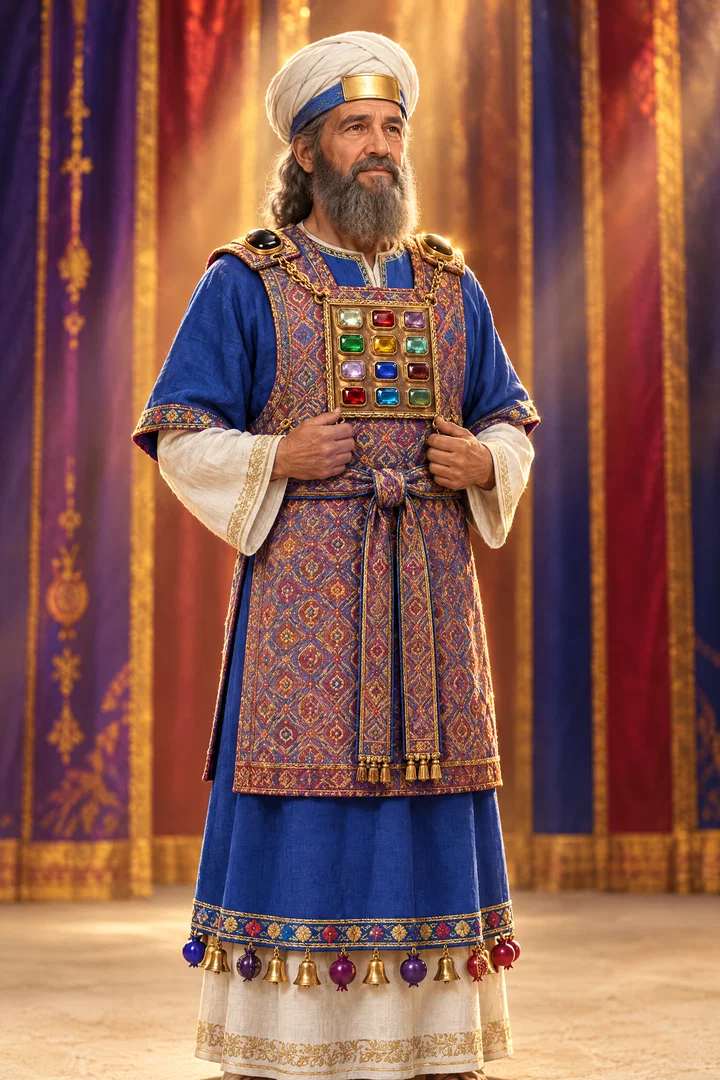
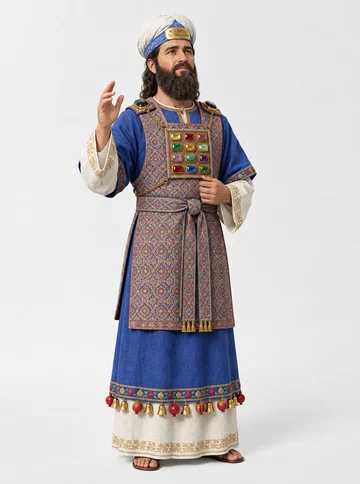
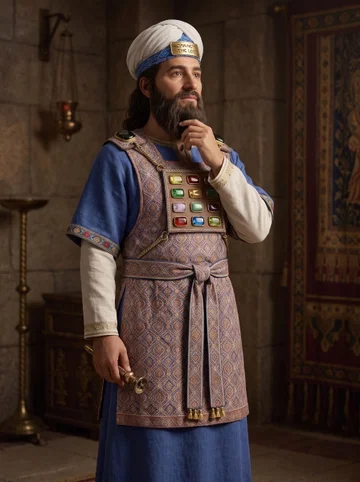
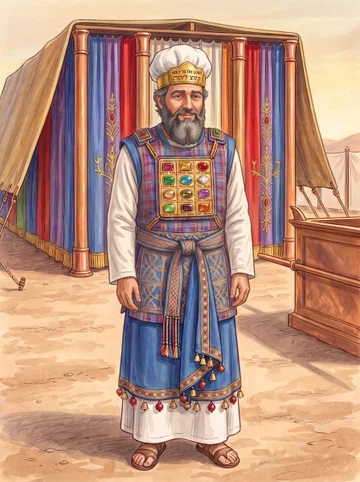
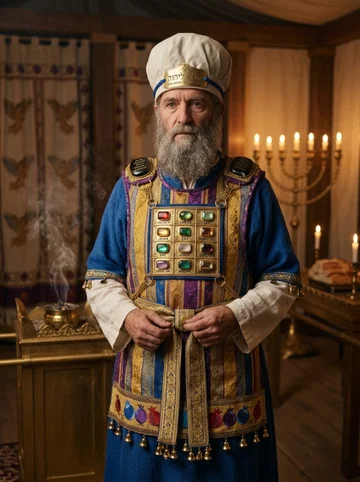
The priestly robes were symbolic, showing that dress can represent the one who wears it and that God cares about the clothing of those who serve Him.Ms 56, 1900, par. 11–12 The verse describes the blue robe of the high priest, made of costly material with beautiful workmanship befitting his exalted station.PP 350.3 It was worn in addition to the linen dress of the common priest and was woven in one piece.PP 350.3 Around its skirt it was ornamented with golden bells and pomegranates of blue, purple, and scarlet, and outside of it was worn the ephod.PP 350.3
The verse requires a reinforced, woven binding around the neck opening, like the opening of a coat of armor, so that the robe would not tear.12MR 400.2–401.4 This preservation of the perfection of the dress represented the sacredness of the heavenly service.12MR 400.2–401.4 A high priest tearing his robe therefore violated the law and marred that representation.12MR 400.2–401.4
Sources
Pioneers and periodicals
22 sources
The opening in the middle of the top of the blue robe of the high priest was to be finished with a strong woven binding around it like the neck of a coat of mail, so that it would not tear.ST Oct 29, 1894ST Feb 17, 1890RH Dec 31, 1861 It belongs to the pattern for the sanctuary and priesthood given to Moses on the mount in Exodus 25 to 31 and afterward wrought by Bezalel and Oholiab and others enabled by God's Spirit, that God might dwell among Israel.ST Jan 27, 1909 It is part of the ceremonial ordinances of the law of Moses concerning the Levitical priesthood, distinct from the Ten Commandments which God spoke to the people and wrote on stone, and the splendid dress of Exodus 28 was laid aside on the Day of Atonement for the plainest dress to show that the earthly high priest was priest only in type.RH Jan 11, 1870ST Apr 15, 1886ST Mar 22, 1883ST Jun 6, 1878 The tabernacle and its priestly garments were an object-lesson of salvation from sin by Christ as priest upon the throne, with the robe woven in one piece foreshadowing His earthly garment and the high priest bearing the names of Israel representing Christ confessing the names of His people before the Judge of all the earth.ST Nov 12, 1894ST Dec 17, 1912ST Jan 24, 1911 Even this binding teaches care and reverence in service before a holy God, that all defilement must be put away by those who approach Him and that small details in sacred work matter.ST Nov 12, 1894ST Jan 27, 1909RH Oct 30, 1913
Robe and Its Setting
The opening was to be in the middle of the top of the robe, with a binding of woven work round about the hole like the neck opening of a coat of mail or armor, so that it would not tear.ST Oct 29, 1894ST Feb 17, 1890ST Jan 27, 1909RH Jan 20, 1916ST May 16, 1878 The opening at the top of the priestly garment was thus centered and reinforced, and the woven-work binding kept it from tearing.ST Oct 29, 1894ST Feb 17, 1890ST Jan 27, 1909 It was the neck opening of the high priest's robe, strengthened like armor at the neck so the fabric would not rend.ST Feb 17, 1890RH Jan 20, 1916ST May 16, 1878
The direction belongs to the detailed instructions for the sanctuary and priesthood ordained during Moses' forty days on the mount, part of the pattern in Exodus 25 to 31 and continued through Exodus 40.ST Jan 27, 1909RH Dec 31, 1861ST Dec 10, 1896ST May 16, 1878 It is one of the explicit directions for the sanctuary God desired Israel to build, every part ordered in detail, with the holy of holies at the center where the ark of the covenant was placed containing God's holy law written on tables of stone.ST Jan 27, 1909 The purpose was a sanctuary that God might dwell among Israel after deliverance from Egyptian bondage, a great multiple object-lesson setting forth God's plan of government and the plan devised from eternity for salvation from sin, built from free-will offerings to teach a people unfitted by slavery to comprehend it. The work was afterward carried out by Bezalel and Oholiab together with other devoted men and women, whom God enabled by placing His Spirit upon them, showing His willingness to bless workers consecrated to Him in material things as well as in spiritual things.ST Jan 27, 1909 It was made known because God's people are so intimately related to the sanctuary question that they cooperate with God in His work through Christ in the sanctuary, so that the divine and the human cooperate at every step.
The verse is part of the description of garments appointed in accordance with priestly office, to be studied carefully together with the consecration services of the next chapter.ST Nov 12, 1894 The common priest's robe was of white linen woven in one piece, extending nearly to the feet, confined about the waist by a white linen girdle embroidered in blue, purple and red, with a linen turban completing the outward costume.ST Nov 12, 1894 Priests entered the sanctuary without shoes, leaving them in the court after the manner of putting off sandals on holy ground, because dust cleaving to shoes would desecrate the holy place, and they washed both hands and feet before ministering in the tabernacle or at the altar of burnt offering, constantly teaching that all defilement must be put away from those who approach into the presence of God.ST Nov 12, 1894 Over his long white coat the high priest wore a blue robe woven in one piece, beautifully ornamented around its hem with golden bells and pomegranates of blue, purple and scarlet.ST Nov 12, 1894ST Nov 12, 1894ST Dec 17, 1912 Over that was the ephod curiously wrought with gold, blue, purple and scarlet, with a beautiful stone in a setting of gold on each shoulder, with chains fastening before the breast a golden plate inscribed Holiness to the Lord accompanied by the names of the twelve tribes in four rows with three names in each row, and with the mysterious Urim and Thummim also given place there in a form that is not known. These were holy garments worn for glory and beauty as he served in the sanctuary, and even that clothing was significant of calling and purpose.RH Sep 16, 1852
The splendid dress prescribed in Exodus 28 was worn in ordinary ministry but was laid aside on the great Day of Atonement for the plainest and humblest dress.RH Jan 11, 1870ST Jun 6, 1878 The change solemnly showed that the earthly high priest was priest only in a typical sense and not in reality, and was expressly designed to impress his infirmity and sinfulness.RH Jan 11, 1870ST Jun 6, 1878
The priestly garment law belongs to the law of Moses commanded in Horeb with statutes and judgments in connection with the Levitical priesthood, recorded chiefly in Exodus 25 to 30 and Leviticus and set forth in Exodus 20 to 40 and Leviticus.ST Apr 15, 1886ST Mar 22, 1883ST Feb 20, 1879 It is distinct from the Ten Commandments, which God spoke directly to the people from heaven and wrote on stone with nothing added before that priesthood was appointed, after the people stood afar off and asked Moses to speak for God, whereas this was commanded by the hand of Moses alone in the mount during forty days.ST Apr 15, 1886ST Mar 22, 1883ST Feb 20, 1879 It is part of the ceremonial ordinances, burdensome ceremonies and carnal ordinances imposed until the time of reformation, a yoke which neither the fathers nor their children were able to bear, consisting of offerings, sacrifices and types whose shadows point to the substance of the new dispensation.ST Apr 15, 1886 Those who hold the wider reckoning include it with the Ten Commandments together with civil regulations, laws of conduct between man and man, health laws, ceremonial laws and moral laws, and call God's people in the last days to remember it.
Type and Reverence
The instructions for the sanctuary and its services in Exodus 25 to 31 let down upon earth an object-lesson setting forth God's plan of government and how He deals with those who have sought to dethrone Him. They set forth the plan devised from eternity for salvation from sin by Christ as priest upon the throne, still King while executing the office of priest in dealing with sinners. They were made known to God's people because His people are so intimately related to the sanctuary question that they cooperate with God in His work through Christ in the sanctuary, so that the divine and the human cooperate at every step. The ancient tabernacle so described was constructed for ministration in sacrifices and offerings, and there is no likeness between that ancient sanctuary and modern churches.ST Jan 24, 1911
All those sacrifices and offerings passed away when Christ came and suffered and died once for all.ST Jan 24, 1911 The ancient sanctuary typified the great temple on high where Jesus the Lord now ministers.ST Jan 24, 1911 The directions for building and the marvelously beautiful sanctuary structure in Exodus 25 through 40 were given to Moses after Israel's deliverance from Egyptian bondage as a great, multiple object-lesson to teach the great plan of salvation to a people unfitted by slavery to comprehend it, built from free-will offerings so God could dwell among them. The full description through the end of Exodus sets forth the sanctuary and its furnishings and gives the exact pattern of the service of God, with its two kinds of ceremonies conducted by different persons at different times in separate apartments because of the errors of the people, pointing to the remedy for sin.ST Mar 10, 1898
The high priest's garment was woven all of one piece, and this foreshadows Christ's earthly garment which was woven in one piece.ST Dec 17, 1912 A special dress was appointed in accordance with priestly office, and even that clothing was significant of calling and purpose.ST Nov 12, 1894 The common priest's robe was of white linen woven in one piece, extending nearly to the feet, confined about the waist by a white linen girdle embroidered in blue, purple, and red, with a linen turban completing the outward costume.ST Nov 12, 1894 Over his long white coat the high priest wore the blue robe woven in one piece, and over that the linen ephod curiously wrought with gold, blue, purple, and scarlet, with a beautiful stone in a setting of gold on each shoulder, with chains fastening before the breast a golden plate inscribed Holiness to the Lord accompanied by the names of the twelve tribes in four rows with three names in each row, and with the mysterious Urim and Thummim also given place there.ST Dec 17, 1912 The skirt of the blue robe was beautifully ornamented with golden bells and pomegranates of blue, purple, and scarlet.ST Dec 17, 1912
Those were the gorgeous robes worn when he entered the most holy place to make atonement for the people, which represent Christ as High Priest confessing the names of His people before the judgment-seat of the Judge of the whole earth.ST Dec 17, 1912 The opening in the middle of the top of the robe was given a reinforced binding of woven work round about it, like the neck opening of a coat of mail, so that it would not tear.RH Oct 30, 1913 The minute and explicit directions for the sanctuary He wanted Israel to build, every part ordered in detail with the holy of holies at the center where the ark of the covenant was placed containing God's holy law written on tables of stone, belong to the work God enabled Bezalel and Oholiab together with other devoted men and women to erect properly by placing His Spirit upon them, showing that God is just as willing to bless workers in material things who are consecrated to Him as workers in spiritual things.ST Jan 27, 1909 The detailed requirements for priestly clothing, down to that binding, taught care and reverence in service before God and showed the people that God is holy and His work sacred, and even small details in sacred work mattered.RH Oct 30, 1913ST Mar 15, 1883
Priests entered the sanctuary without shoes, leaving them in the court, following the direction given to Moses at the burning bush to put off sandals on holy ground, because dust cleaving to shoes would desecrate the holy place, and they washed both hands and feet before ministering in the tabernacle or at the altar of burnt offering.ST Nov 12, 1894 This constantly taught that all defilement must be put away from those who approach into the presence of God.ST Nov 12, 1894
Sources