John 19:23
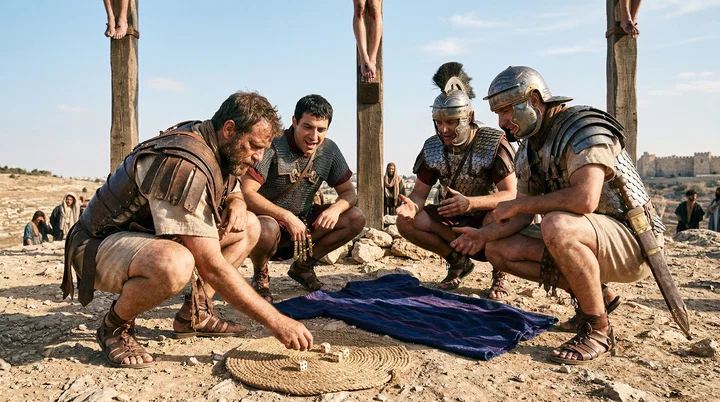
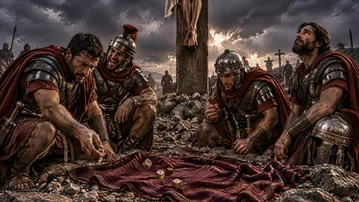
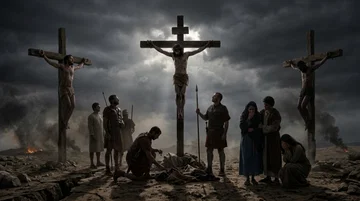
Then the soldiers, when they had crucified Jesus, took his garments, and made four parts, to every soldier a part; and also his coat: now the coat was without seam, woven from the top throughout.
Translations
American King James Version, King James Version, KJV Cambridge Paragraph Bible, Webster Bible
Then the soldiers, when they had crucified Jesus, took his garments, and made four parts, to every soldier a part; and also his coat: now the coat was without seam, woven from the top throughout.
The soldiers therefore, when they had crucified Jesus, took his garments, and made four parts, to every soldier a part; and also the coat: now the coat was without seam, woven from the top throughout.
The soldiers therefore, when they had crucified Jesus, took his garments and made four parts, to every soldier a part; and also the coat: now the coat was without seam, woven from the top throughout.
The soldiers, therefore, when they did crucify Jesus, took his garments, and made four parts, to each soldier a part, also the coat, and the coat was seamless, from the top woven throughout,
The soldiers therefore, when they had crucified Jesus, took his clothes, and made four parts, to each soldier a part, and the body-coat; but the body-coat was seamless, woven through the whole from the top.
The soldiers, therefore, when they had crucified Jesus, took his garments and made four parts, unto each soldier, a part; also the tunic. Howbeit, the tunic was without seam, from above, woven throughout.
Berean Standard Bible, Majority Standard Bible
When the soldiers had crucified Jesus, they divided His garments into four parts, one for each soldier, with the tunic remaining. It was seamless, woven in one piece from top to bottom.
Then the soldiers, when they had crucified Jesus, took his garments and made four parts, to every soldier a part; and also the tunic. Now the tunic was without seam, woven from the top throughout.
And when Jesus was nailed to the cross, the men of the army took his clothing, and made a division of it into four parts, to every man a part, and they took his coat: now the coat was without a join, made out of one bit of cloth.
Then the souldiers, when they had crucified Iesus, tooke his garments (and made foure partes, to euery souldier a part) and his coat: and the coat was without seame wouen from the toppe throughout.
Douay-Rheims (Challoner revision)
The soldiers therefore, when they had crucified him, took his garments, ( and they made four parts, to every soldier a part,) and also his coat. Now the coat was without seam, woven from the top throughout.
Pictures
Cross-references
- Psalms 22:18
They part my garments among them, and cast lots upon my vesture.
It foretells the division of Jesus’ garments and casting lots for his clothing.
- Matthew 27:35
And they crucified him, and parted his garments, casting lots: that it might be fulfilled which was spoken by the prophet, They parted my garments among them, and upon my vesture did they cast lots.
The soldiers divide Jesus’ garments and cast lots for his vesture.
- Mark 15:24
And when they had crucified him, they parted his garments, casting lots upon them, what every man should take.
The soldiers divide Jesus’ garments at the cross.
- Luke 23:34
Then said Jesus, Father, forgive them; for they know not what they do. And they parted his raiment, and cast lots.
Jesus prays for those crucifying him as they divide his garments.
- John 19:2
And the soldiers platted a crown of thorns, and put it on his head, and they put on him a purple robe,
The purple robe and crown of thorns recall Jesus’ mockery before the crucifixion.
- John 19:18
Where they crucified him, and two other with him, on either side one, and Jesus in the midst.
Jesus is crucified between two thieves.
- Luke 23:33
And when they were come to the place, which is called Calvary, there they crucified him, and the malefactors, one on the right hand, and the other on the left.
Describes Jesus’ crucifixion at Calvary between two criminals.
- Genesis 37:23
And it came to pass, when Joseph was come unto his brethren, that they stript Joseph out of his coat, his coat of many colours that was on him;
Joseph’s brothers strip him of his coat before selling him.
- Luke 23:52-56
This man went unto Pilate, and begged the body of Jesus.
Records Jesus’ burial and the preparation day before the Sabbath.
- Exodus 28:32
And there shall be an hole in the top of it, in the midst thereof: it shall have a binding of woven work round about the hole of it, as it were the hole of an habergeon, that it be not rent.
The high priest’s garment was woven in one piece, corresponding to Christ’s garment.
- Psalms 22:16
For dogs have compassed me: the assembly of the wicked have inclosed me: they pierced my hands and my feet.
Both describe the crucifixion, including the piercing of Jesus’ hands and feet.
- John 19:19
And Pilate wrote a title, and put it on the cross. And the writing was, JESUS OF NAZARETH THE KING OF THE JEWS.
inscription above Jesus at same scene
- John 19:30
When Jesus therefore had received the vinegar, he said, It is finished: and he bowed his head, and gave up the ghost.
The hymn recalls Jesus’ final words from the crucifixion account.
- John 19:28
After this, Jesus knowing that all things were now accomplished, that the scripture might be fulfilled, saith, I thirst.
Jesus’ thirst is noted as fulfilling Scripture during the crucifixion.
Commentary
Each commentary is drawn from primary sources: the writings of Ellen G. White and Adventist pioneers and periodicals. Each commentary is separate. Its own words are not a quotation; follow the references to read the source passages.
Ellen G. White
26 sources
After He was crucified at Calvary outside Jerusalem, the soldiers took His garments and divided them into four parts, but kept His coat whole because it was woven without seam from the top throughout and cast lots to decide who would receive it.DA 741.1–2COS 159.3–160.11SP 157.2–158.2DA 745.5–746.1 In this dividing of His clothing and casting of lots for it, prophecy was fulfilled.COS 159.3–160.1DA 745.5–746.13SP 160.1 His plain seamless garment belonged to His meek and lowly life without a home and stands as a pattern of self-denial and simplicity against pride, devotion to clothing, and needless expense for personal display.3T 379.2STSE 58.1RH Jun 10, 1852EW 88.2–3RH Jun 12, 1855 The robe left whole and unrent represents the unity that should exist among His followers, which must not be torn by division, coldness, and controversy.Lt 107, 1898, par. 4Ms 89, 1898, par. 345MR 371.3 The cruelty He endured when stripped and hung as a bleeding victim in deepest humiliation assures that He fully understands every human experience and has provided grace and power at the believer's side.Ms 9, 1911, par. 22Ms 8, 1886, par. 8
Scene at Calvary
Jesus was led from the judgment-hall to Calvary for crucifixion before a vast multitude, for news of His condemnation had spread throughout Jerusalem and people of all classes and all ranks flocked toward the place of crucifixion.DA 741.3 The priests and rulers had promised not to molest His followers if He Himself were delivered to them, so the disciples and believers from the city and the surrounding region joined the throng that followed the Saviour.DA 741.3 The dividing of His garments took place at Calvary outside the boundaries of Jerusalem, where felons and murderers were executed.DA 741.1–2 There He suffered without the gate as substitute, sanctifying the people with His own blood and redeeming them from the curse of the law for the transgression by which Adam and Eve were banished from Eden.DA 741.1–2
After He was crucified the soldiers took His garments and divided them among themselves, making four parts, to every soldier a part.COS 159.3–160.1DA 745.5–746.13SP 160.1SG3 174.2–176.1ST Jul 25, 1878 His coat was without seam, woven from the top throughout, and it was kept intact rather than divided.COS 159.3–160.1DA 745.5–746.13SP 160.1SG3 174.2–176.1ST Jul 25, 1878 Over that seamless woven coat the executioners disputed and contended, and they settled who would receive it by casting lots for it.COS 159.3–160.11SP 157.2–158.2DA 745.5–746.13SP 160.1ST Jul 25, 1878 This dividing of His clothing and casting of lots for His garment fulfilled the prophecy that His clothing would be divided and lots cast for it.COS 159.3–160.1DA 745.5–746.13SP 160.1ST Jul 25, 1878 The stripping of Jesus of His garments parallels the stripping of Joseph of his coat of many colors by his brothers, linking the two innocent sufferers.1SP 157.2–158.2SG3 174.2–176.1
While the world's Redeemer hung suffering on the cross, the soldiers were concerned with His clothing and quarreled over His garment.ST Nov 25, 1889 Their concern for His vesture in that hour shows how hardened their hearts were and how completely they seemed controlled by the powers of darkness.ST Nov 25, 1889 Those quarreling over His garments and casting lots for His clothing at the foot of the cross stopped when they heard the repentant thief call Jesus Lord.DA 750.4 The detail of the seamless robe identifies Him in His suffering and death, alongside the crown of thorns and His crucifixion between two thieves.Ms 34, 1897, par. 46
Prophecy and Redemptive Suffering
The dividing of His clothing and the casting of lots for His garment fulfilled prophecy that His clothing would be divided and lots cast for it.COS 159.3–160.1DA 745.5–746.13SP 160.1ST Jul 25, 1878 After He was crucified the soldiers divided His garments among themselves, while His seamless woven coat became the subject of dispute that they settled by casting lots to decide who would receive it and keep it intact.COS 159.3–160.1DA 745.5–746.13SP 160.1ST Jul 25, 1878 The executioners stripping Him of His garments parallels Joseph's brothers stripping him of his coat of many colors, linking the two innocent sufferers and presenting Joseph's suffering at his brothers' hands as a pattern of His rejection and suffering.1SP 157.2–158.2SG3 174.2–176.1 His plain seamless coat contrasts with Joseph's coat of many colors.1SP 157.2–158.2SG3 174.2–176.1
The dividing of His garments by His enemies as He hung on the cross was part of the cruelty He endured, and that suffering assures that He fully understands every experience that may come to people.Ms 9, 1911, par. 22 On the cross He hung as a bleeding victim in the depths of humiliation, dying as a malefactor in the hands of wicked men.ST Jul 7, 1898Ms 8, 1886, par. 8 His death provides grace and power, with the cross as evidence that He is at the believer's side to help.Ms 8, 1886, par. 8 His humiliation on the cross cut off the hopes of eternal life the disciples had centered in Him and marks the taking away of the Bridegroom, when days of trial and temptation come and the presence of the Comforter is not clearly discerned.ST Jul 7, 1898 At that sight the disciples have cause to mourn and fast as their faith is tried and their hope and courage fail.ST Jul 7, 1898
His dying on the cross as the Son of God was a terrible, trying hour of gloom that fulfilled His predictions and brought the disciples over the ground of test and trial.Ms 126, 1907, par. 9–10 Their faith failed in that proving because through sleep and failure to watch and pray they had not received knowledge of the sufferings of Christ and the glory that should follow and had not shared His self-sacrifice.Ms 126, 1907, par. 9–10 Had they remained watching they would not have lost faith while beholding Him dying, and amid darkness some rays of hope would have lighted the gloom and sustained them.Ms 126, 1907, par. 9–10 The crucifixion is the sacrifice whose blood is the price by which people are bought for God, calling people to surrender themselves to His keeping power and bring their lives into conformity with His will.Lt 122, 1901, par. 15 The sacrifice on the cross at Calvary was so great that it sets the measure against which the church's work is compared, and despite some progress the church remains far behind the work entrusted to it.Ms 56, 1901, par. 8
Pattern for Dress and Unity
His coat was plain and seamless, woven in one piece from the top throughout, and that simplicity suited the meek and lowly life He lived without a home.3T 379.2RH Jun 10, 1852EW 88.2–3SCEV 26.5–27.3 That simple clothing makes Him a pattern of self-denial.EW 88.2–3 It belongs to the picture of His meek and lowly life and stands in contrast to those who decorate themselves to win the world's approval.SCEV 26.5–27.3 It is set against devotion to clothing and personal display.3T 379.2 It is an example of simplicity in dress, set against spending time and effort on personal decoration and display.STSE 58.1
It belongs to the true Pattern of a life marked by sacrifice, doing good to others and making them happy, and His plain garment stands in contrast to pride and needless expense.RH Jun 12, 1855 His seamless robe represents the unity that should exist in His church, and the seamless robe must not be rent or torn by divisions.Lt 107, 1898, par. 4Ms 89, 1898, par. 345MR 371.3 Divisions, coldness, and controversy are like rents and tears in the robe and dishonor Him.Lt 107, 1898, par. 4Ms 89, 1898, par. 34 Believers are to cultivate love, tenderness, and the unity of the Spirit in the bond of peace.Lt 107, 1898, par. 4
His example is one of coming to save and uplift humanity, and people are called to follow Him and serve as His co-workers.Ms 34, 1897, par. 46
Sources
Pioneers and periodicals
73 sources
After he was nailed to the cross the four soldiers shared his outer clothing in four equal parts, one for each man, but because his inner tunic was woven in one piece from top to bottom without a seam they left it whole and cast lots to decide who would have it.ST May 17, 1899ST May 17, 1905ST Jul 14, 1881ST May 26, 1898 What they did carried out to the letter what had been foretold in Psalm 22:18, though as heathen executioners they did not know they were fulfilling prophecy and cared more for his clothes than for him.ST Jun 7, 1899RH Jun 24, 1858ST May 26, 1898RH Jan 24, 1871 This exact fulfillment marks him as the true Messiah and witnesses to the truthfulness of Scripture.ST Oct 21, 1930ST May 17, 1899 In it is seen the Son of God, the Word who was God and by whom all things were made, giving himself and all he had as the atoning sacrifice for the sins of the whole world.ST Jun 14, 1905RH Aug 20, 1908RH Nov 10, 1863RH Apr 14, 1874ST Jun 18, 1885 His plain seamless dress shows his meek and lowly life without outward splendor, and stands for his righteousness as one whole gift to be received entire and for a complete Christian character.RH Jun 10, 1852RH Sep 9, 1902RH Jul 10, 1856ST Jan 13, 1881RH Dec 1, 1859
Garments Divided Among Soldiers
After he had been crucified, the soldiers took his garments and made four parts, one part for every soldier, while the seamless coat was kept undivided and assigned by casting lots rather than tearing it.ST Jul 25, 1878ST May 17, 1899ST May 17, 1905RH Jun 24, 1858 The dividing of the clothing with contention over the woven garment fulfilled the prophecy that his garments would be divided and lots cast for his clothing, showing agreement between the prophetic record and the Gospel record.ST Jul 25, 1878RH Jun 24, 1858RH Aug 21, 1866
The coat was without seam, woven in one piece from the top throughout, from top to bottom.ST May 17, 1899ST May 17, 1905ST May 26, 1898RH Jul 16, 1861 It was an outer robe with braid and hem, worn as he walked among eager multitudes to heal and bless.ST Oct 22, 1894
The four executioners treated the clothing as their rightful spoil and perquisite for the cruel work, and divided it while he hung suffering in their presence.ST Jul 14, 1881ST May 26, 1898ST Jul 14, 1881 He was crucified by four soldiers, each driving one of four spikes through his hands and feet.ST Jul 14, 1881
At the execution his garments were taken from him for the third time, first his cloak, then his coat, then even his under-dress, leaving him dying naked on the criminal's gibbet before a great multitude with arms extended and nailed to the wood.RH Oct 25, 1870 After a night of fatigue and anguish, being led through Jerusalem from tribunal to tribunal, buffeted, veiled, struck, bound and taken to Pilate, scourged and bathed in blood, clothed in scarlet and mocked, then clothed again for the way to Calvary, the clothing was divided among the soldiers with lots cast for the cloak.RH Oct 25, 1870 This reveals love that having lived poorer than the birds of the air and foxes of the field was willing to die still poorer, deprived of all, and its touching, sublime simplicity marks the death as that of God and proves such lowly facts worthy of divine inspiration, sung a thousand years in advance.RH Oct 25, 1870 At his death he owned nothing except his seamless garment and his dust-covered travel vesture gathered from travel on his mission of love, leaving soldiers nothing else to quarrel over and divide.RH Oct 25, 1870RH Nov 4, 1873 Though rich with the glory he had with the Father before the world, he lived as a carpenter boy dependent on ministering women, with no money for tax until a fish furnished it and nowhere to lay his head, riding into Jerusalem on a borrowed colt, keeping the Passover in a borrowed room, and with no grave of his own until Joseph begged his body and gave it room in his own new tomb for three days and three nights.RH Nov 4, 1873
Crucifixion Time and Setting
The scene belongs at Golgotha, where death chilled the heart of the Nazarene, yet death did not keep the victory because he rose and the dead shall hear his voice.ST Jul 30, 1912 It was the day before the Sabbath, commonly called Friday.ST Apr 21, 1914 Jewish testimony places the crucifixion at three o'clock in the afternoon on Passover.RH Sep 5, 1865
Christ our Passover was sacrificed on the fourteenth day of the first month, meeting the Passover type exactly as to time.RH Oct 30, 1855RH Dec 15, 1868 The paschal lamb slain on that day foreshadowed Christ, the Lamb of God, who died on that same day.ST Aug 13, 1874 The grand event of the day met its antitype on the very day of the type.RH Oct 30, 1855
That exact-day meeting establishes that the antitype commences on the day of the type but may then extend forward a great distance.RH Oct 30, 1855 Believers still feed on Christ the Passover, and the Spirit given at Pentecost still abides.RH Oct 30, 1855 Mere preliminary and circumstantial offerings did not prevent that exact-time fulfillment.RH Oct 30, 1855
John's record of Jesus crucified and buried stands parallel to Luke 23:35-53 and to Matthew 27:31-66 and Mark 15:21-47, showing that Christ died for sins according to the Scriptures.ST Mar 20, 1901 The events of the crucifixion lead to his burial and to the later report that he had risen, as he had foretold.RH Jul 16, 1861
The crucifixion marks the culmination of his life of sacrifice for fallen humanity. On the mountain his sorrow for lost sinners was revealed and his sacrificial love for the world reached its climax.ST Sep 10, 1902 Hanging on the cross at Calvary is the central scene through which the history of redemption is viewed.ST Apr 3, 1884 His death at Calvary teaches that sacrifice means complete consecration, for the slain offering represents the one who offers it and the shedding of blood signifies the giving of life, so that lesser suffering could express willingness to follow to Gethsemane or the judgment hall but only death represents willingness through his strength to go with him to Calvary.ST Sep 12, 1900 Calvary with Gethsemane best shows his unutterable compassion and affection, the sleepless vigilance that watched over human welfare, which the watching few shall behold face to face when the long-absent Beloved comes in glorious majesty and beauty and grasps their unseen leading hand with immortal love.RH Dec 23, 1873
The cross shows Jesus in the depths of humiliation, dying as a malefactor in the hands of wicked men, with the hopes of eternal life the disciples had centered in him cut off.ST Jul 7, 1898 It marks the taking away of the Bridegroom, when days of trial and temptation come and the presence of the Comforter is not clearly discerned, when faith is tried and hope and courage fail and mourning and fasting are fitting.ST Jul 7, 1898 That suffering and death are past when he comes again in glory, and the cross will never again bring him anguish.ST Dec 7, 1904
The seamless vesture was taken by Rufus, a guardsman of Herod Antipas and son of Varro, the same man who had beheaded John the Baptist despite his father's pleading.ST Jan 24, 1911
Prophecy Literally Fulfilled
The dividing of the garments and the casting of lots for the vesture fulfills David's prophecy in Psalm 22:18 literally and precisely, showing agreement between the prophetic and Gospel records.ST Jun 7, 1899RH Jun 24, 1858ST Jan 2, 1879ST May 17, 1899 After crucifying Jesus the soldiers divided his garments into four portions, one share for each soldier, and cast lots for his seamless coat rather than tearing it.RH Jun 24, 1858ST Jan 2, 1879ST May 26, 1898ST Oct 21, 1930 This came to pass to the letter, and it was one of many prophecies fulfilled during the day of his crucifixion.ST May 26, 1898ST Oct 21, 1930
The fulfillment was accomplished by men who did not know they were fulfilling Scripture.ST May 26, 1898RH Jan 24, 1871 They were ignorant pagans who did not know and did not care who the sufferer was, with no thought that he was any better than they, caring more for his garments than for him who lately wore them.ST Nov 25, 1889RH Jan 24, 1871 While the world's Redeemer hung suffering between two thieves they divided his clothing among them and disposed of his vesture by lottery and quarreled over his garment, showing how hardened their hearts were and how completely they seemed controlled by the powers of darkness.ST Nov 25, 1889ST May 26, 1898RH Jan 24, 1871 Their gambling for the Master's vesture therefore calls for pity rather than indignation.RH Jan 24, 1871
This precise fulfillment helps identify Jesus as the true Messiah and testifies to the truthfulness of Scripture.ST May 17, 1899 It stands among the signs of the first advent connected with Christ, fulfilled literally and precisely as the words of prophecy said.ST Oct 21, 1930 Its touching, sublime simplicity marks the death as that of God and proves such lowly facts worthy of divine inspiration, sung a thousand years in advance.ST May 17, 1899RH Oct 25, 1870 Because the prophecies of the first advent were fulfilled literally, including the soldiers dividing his garments and casting lots for his seamless coat, the prophecies of his second coming and reign are likewise to be read literally.ST Oct 21, 1930RH Dec 26, 1865
Christ Seen in Garments
The one crucified in the dividing of the garments is the Son of God, not merely a human being, giving himself to death as the sin-atoning sacrifice.RH Nov 10, 1863 His death displays both the enormity of sin and the value of the sacrifice.RH Nov 10, 1863 He is no other than the Word who was in the beginning, who was God with God and by whom all things were made.RH Apr 14, 1874 Made flesh to dwell among men, he came from the Father and returned to him, taught and worked miracles, was falsely accused by the Jews, was put to death on the cross with his blood shed, was buried and rose again, and prayed that the Father would restore to him the glory he had with him before the world was.RH Apr 14, 1874
His crucifixion is the sacrifice made for the sins of the whole world.ST Jun 14, 1905 Its benefit is received only by those who believe in him and obey the gospel.ST Jun 14, 1905 His death on the cross reveals God's suffering for human sin.RH Aug 20, 1908
The plain seamless coat shows he was plain in appearance, without outward splendor to make him desirable to look at.RH Sep 9, 1902 He wore a plain seamless coat woven as one piece, simple clothing suited to a servant rather than royal apparel.RH Jun 10, 1852RH Jul 10, 1856RH Jun 23, 1863 That simple dress fits the meek and lowly life he lived without a home, taking no pride in outward appearance.RH Jun 10, 1852RH Jun 23, 1863 There was no pride in him but humility, and those who look for him at his coming look for that humble man, with life and character showing it by putting away pride of appearance and dress and becoming meek and humble and holy in all conduct.RH Jul 10, 1856 His earthly garment woven in one piece corresponds to the high priest's one-piece garment.ST Dec 17, 1912
His utter poverty at death is the greatest example against covetousness.RH Nov 4, 1873 Though rich with the glory he had with the Father before the world, he became poor, living as a carpenter boy and depending on women who ministered to him.RH Nov 4, 1873 He had no money to pay tax until a fish furnished it, and had nowhere to lay his head while foxes have holes and birds have nests.RH Nov 4, 1873 When he rode in triumph into Jerusalem it was on a borrowed colt, and when he kept the Passover it was in a borrowed room.RH Nov 4, 1873 When he hung on the cross he owned nothing except his seamless garment and his dust-covered travel vesture gathered on his mission of love, leaving the soldiers nothing else to quarrel over and divide, and he had not even a grave of his own until Joseph begged his body and gave it room in his own new tomb for three days and three nights.RH Nov 4, 1873 That lowly garb belonged to his humiliation, together with the manger of his birth and the thorns put upon him, and it has now been exchanged for a robe of light worn by him as a Prince and King enthroned in might.
While he hung on the cross suffering in their presence, the four soldiers treated his clothing as spoil and divided it among themselves, dividing his clothing and quarreling over his garment.ST Nov 25, 1889ST Jul 14, 1881 He prayed for the people who mocked him below.ST Jun 7, 1899 Their concern for his vesture while the world's Redeemer suffered shows how hardened their hearts were and how completely they seemed controlled by the powers of darkness.ST Nov 25, 1889 His ignominious death upon the cross under gloomy and most foreboding circumstances at the founding of the glorious kingdom stands in dark contrast to the luminous martyrdom of Stephen that vindicated the divine power of his religion.
Scripture Images and Parallels
The seamless coat taken from him pictures the fourth commandment torn away from the Lord's rest-day and fastened to Sunday as a stolen claim to be God's Sabbath.ST Nov 30, 1882RH May 20, 1862 The transfer separates what belongs together, leaving the rest-day stripped while another day wears its authority.ST Nov 30, 1882RH May 20, 1862
The seamless coat pictures God's doctrine as one undivided whole reaching from Paradise lost to Paradise restored.ST Nov 4, 1897ST May 19, 1909 It is not split between Old and New Testaments nor between law and Gospel dispensations.ST May 19, 1909 The whole coat without seam is Christ's righteousness as God's gift, received wholly and renewing through and through rather than patched with worldly attachment.ST Jan 27, 1898 To put on Christ is to receive him wholly and not in fragments, and Christian life and character must likewise be complete and consistent in every part.ST Jan 13, 1881 Divisions caused by sin rend that seamless robe in the church.RH Dec 1, 1859 The seamless robe also pictures how life's accomplishments and character blend into a whole, so that strengthening one part strengthens the whole.ST Jul 4, 1911
The seamless dress still brings healing, for to touch him in life's throng and press, even by beds of pain, is to be made whole again.RH Feb 8, 1915RH Jul 21, 1903 He wore it as a seamless outer robe woven from the top throughout, with braid and hem, walking among eager multitudes to heal and bless with it fanned by passing breezes.ST Oct 22, 1894 The long-suffering woman who had spent all without relief believed that touching even its hem or braid would give life and health.RH Jun 17, 1915ST Oct 22, 1894 She pressed unnoticed and unknown through the jostling crowd in great need and humble faith, and a single touch as he sped by took away all her pain and illness, thrilling new life through her body with color returned to her cheek, light to her eye, and strength to her limbs, so she knew she was well.RH Jun 17, 1915ST Oct 22, 1894 Though she shrank back as impure and tried to hide her cure in the crowd, he knew what had happened and stopped her flight, and she fell at his feet in gratitude and fear and told her story.RH Jun 17, 1915 Sin-sick souls crowded by cares, doubts, and fears may still reach its hem in faith, and the garment near him pictures his manifest love and saving power.ST Oct 22, 1894 That same trust is called for when life's ills and heaviest burdens press, that faith may touch it and live, and that healing is reached through deeds of pain.RH Feb 8, 1915RH Jun 17, 1915
The seamless robe remains a comfort in sorrow and despair, for its rustle turns the heart to Christ and his suffering through God's Word bringing hope and joy.RH Nov 5, 1908 It is the robe of faith that brings cheer to the sin-burdened, and turning to this source lifts despair.ST May 4, 1915 The redeemed are imagined touching it when they see his glorious face, as the sign of the hoped-for meeting with the crucified Jesus in the life to come.ST Mar 11, 1875 Still his when the believer meets him alone in evening prayer on the mount where he prays, touching it with the hand while kneeling and crying for forgiveness for sin and sorrow brings his answering blessing.RH Mar 7, 1912 His answer gives assurance of strength forever from the boundless stores above, with the Father waiting only for prayer to crown with love, and in infinite mercy helping and forgiving, covering with his wings, teaching how to live, and giving peace.RH Mar 7, 1912
The seamless vesture is a material thing left from his cruel death with no life, power, or merit in itself, no more than the cross, the nails, the sepulcher, or the napkin wound about his head. Seeking it as a souvenir or honoring it with fear and reverence as a sacred relic is empty, because there is no merit in a dead past and he is not in these things, for he is risen. The true history of his clothing is not essential to knowing him.ST May 14, 1902 The dividing of the garments and the lots cast for the seamless coat becomes an image for the Pope's temporal dignity and possession of Rome, portrayed as gambled over and transferred among political rivals.RH Jul 23, 1861
Practical Lessons for Believers
The gambling of the soldiers for the vesture was done from purely selfish purpose without any clear conception of his divine character and mission.ST Apr 1, 1880 It was coarse chance-taking decided by lot with the lucky man taking the garment, done in his hour of agony with garments just stripped from the Redeemer and perhaps agreed upon while the clothes were still upon him, heartless to the last degree and indescribably revolting as the first raffle on record.ST Apr 1, 1880ST Apr 1, 1880 That same principle condemns gambling in the name of religion by his followers with the light of almost nineteen Christian centuries who ought to know better than to gamble to support preaching, adorn a church, or buy a communion set through selling drawing-tickets for grab-bags, cakes with rings hidden in them, bed-quilts, arm-chairs and other goods.ST Apr 1, 1880ST Apr 1, 1880 Those who enliven such scenes are connected to the scene at the cross, raising which of the two is worse and whether Christ could say to such a church, Many have done virtuously, but thou excellest them all.ST Apr 1, 1880
Casting lots for his garments at the foot of the cross while onlookers looked on without feeling was poor treatment of Christ on earth, and a church putting up at lottery the image of her divine Master is no better treatment of him now.RH Jan 24, 1871 Gambling for things of a sacred character is worse than gambling for earthly treasures, and doing it with Christ's image shows how terribly the moral sensibilities of professed Christians have become blunted.RH Jan 24, 1871 The soldiers were ignorant pagans who did not know and did not care who the sufferer was, with no thought that he was any better than they, caring more for his garments than for him who lately wore them, so their gambling for the Master's vesture calls for pity rather than indignation.RH Jan 24, 1871
His plain seamless coat and simple life are the pattern of simplicity rebuking pride, needless expense, trimming apparel, ornamenting the person with dress and display such as feathers upon hats, and devotion of precious time to display.RH Jun 12, 1855RH Feb 19, 1867RH Aug 7, 1900 Remembering that garment alongside his crown of thorns, wounds, agony in the garden and death for every person calls Christians to consider his suffering and their sins, to seek Christian graces rather than outward adornment, to weep over sins, to resist harmful habits and worldly fashions, and to submit from the heart to God's will.RH Oct 5, 1869RH Apr 8, 1873RH May 19, 1859 Thinking of the coat together with the thorns cures pride and selfishness and teaches taste, order and cleanliness in dress with plainness, without gold or other superfluous ornaments such as rings and bracelets worn to look pretty.RH Apr 8, 1873 His example calls the youth to withdraw affections from dress and display and to dress plainly in faithfulness to baptismal vows, since concern for others' salvation mattered more to him than protecting his influence by following worldly expectations of dress.RH Feb 19, 1867RH Aug 7, 1900 His life marked by sacrifice, doing good to others and making them happy stands in contrast to pride and needless expense.RH Jun 12, 1855
Reading his sufferings at the crucifixion can help subdue pride and cast out discontent in fretful or gloomy Christians.ST Apr 17, 1879 He is the man of sorrows who in pitying love shared human woe, toil, burden and care through days of toil and nights of prayer, and his suffering stands with the heavy cross he bore, the piercing crown of thorns he wore, the nails, the spear and the gore. Remembering these sufferings leaves no room to murmur or complain in grief and pain, to ask for a life of ease, or to live one hour to please self, and because he suffered pain becomes sweet, bringing the sufferer lower at his feet to meet him in closer sympathy. His suffering and death at Calvary is an example for Christians facing affliction, sorrow or burdens, and his death is described as fulfilling the law.ST Jan 13, 1881 The awful experiences of Gethsemane and Calvary must be seen as part of the picture with the glory of the ascending Lord and a seat with him on his throne, for Calvary means hands and feet pierced and brow scarred with a crown of thorns, and he reached the throne for a redeemed world in that wounded condition, so the only way to the throne of God is by the way of Calvary through self-denial and taking up the cross daily and following him.RH Feb 4, 1904
After he was crucified the soldiers divided his garments among themselves and left him with only his coat, illustrating that he gave everything he had to the work of saving humanity.ST Jun 18, 1885
Sources