Exodus 28:33
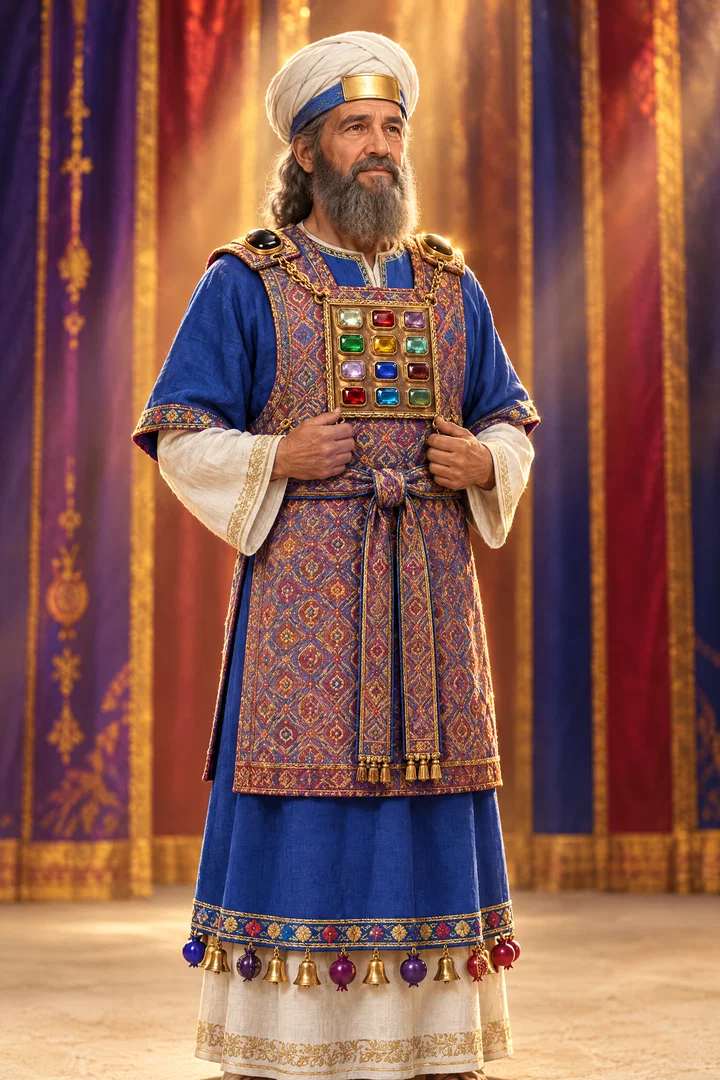
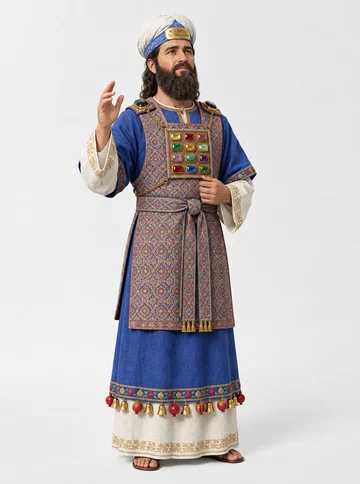
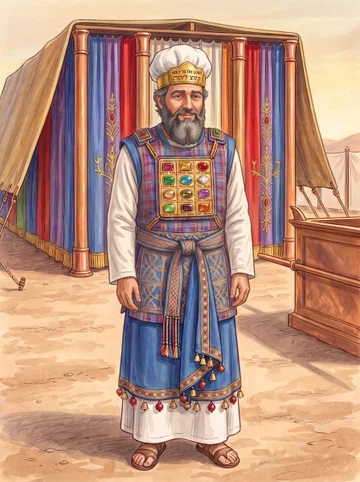
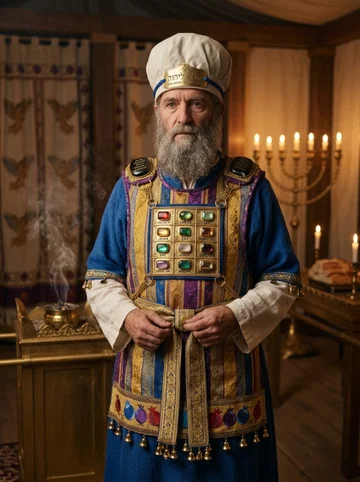
And beneath upon the hem of it thou shalt make pomegranates of blue, and of purple, and of scarlet, round about the hem thereof; and bells of gold between them round about:
Translations
And beneath on the hem of it you shall make pomegranates of blue, and of purple, and of scarlet, round about the hem thereof; and bells of gold between them round about:
King James Version, KJV Cambridge Paragraph Bible
And beneath upon the hem of it thou shalt make pomegranates of blue, and of purple, and of scarlet, round about the hem thereof; and bells of gold between them round about:
And beneath, upon the hem of it thou shalt make pomegranates of blue, and of purple, and of scarlet, round about its hem; and bells of gold between them around it.
Revised Version, American Standard Version
And upon the skirts of it thou shalt make pomegranates of blue, and of purple, and of scarlet, round about the skirts thereof; and bells of gold between them round about:
'And thou hast made on its hem pomegranates of blue, and purple, and scarlet, on its hem round about, and bells of gold in their midst round about;
And on the skirts thereof thou shalt make pomegranates of blue, and purple, and scarlet, round about the skirts thereof; and bells of gold between them round about:
And thou shalt make upon the skirts thereof pomegranates of blue and purple and crimson, upon the skirts thereof round about—and bells of gold in the midst of them round about:
Berean Standard Bible, Majority Standard Bible
Make pomegranates of blue, purple, and scarlet yarn all the way around the lower hem, with gold bells between them,
On its hem you shall make pomegranates of blue, and of purple, and of scarlet, all around its hem; with bells of gold between and around them:
And round the skirts of it put fruits in blue and purple and red, with bells of gold between;
And beneath vpon the skirtes thereof thou shalt make pomegranates of blew silke, and purple, and skarlet, round about the skirts thereof, and belles of gold betweene them round about:
Douay-Rheims (Challoner revision)
And beneath at the feet of the same tunick round about, thou shalt make as it were pomegranates, of violet, and purple, and scarlet twice dyed, with little bells set between:
Pictures
Cross-references
- Hebrews 8:5
Who serve unto the example and shadow of heavenly things, as Moses was admonished of God when he was about to make the tabernacle: for, See, saith he, that thou make all things according to the pattern shewed to thee in the mount.
The priestly garments belong to the earthly sanctuary made according to the heavenly pattern.
- Exodus 28:2-4
And thou shalt make holy garments for Aaron thy brother for glory and for beauty.
God specifies the priestly garments, including the robe’s ornaments.
- Exodus 25:4-9
And blue, and purple, and scarlet, and fine linen, and goats’ hair,
The sanctuary’s construction uses the same colored materials and follows God’s pattern.
- Exodus 28:6-8
And they shall make the ephod of gold, of blue, and of purple, of scarlet, and fine twined linen, with cunning work.
describes the ephod worn outside the robe
- Exodus 25:40
And look that thou make them after their pattern, which was shewed thee in the mount.
Both describe God’s commanded work following the pattern shown on the mount.
- Exodus 39:24-26
And they made upon the hems of the robe pomegranates of blue, and purple, and scarlet, and twined linen.
The robe’s hem and its alternating pomegranates and bells carry out the directions given.
- Leviticus 16:4
He shall put on the holy linen coat, and he shall have the linen breeches upon his flesh, and shall be girded with a linen girdle, and with the linen mitre shall he be attired: these are holy garments; therefore shall he wash his flesh in water, and so put them on.
The high priest wears holy garments when entering the sanctuary.
- Acts 7:44
Our fathers had the tabernacle of witness in the wilderness, as he had appointed, speaking unto Moses, that he should make it according to the fashion that he had seen.
The wilderness tabernacle was made according to the pattern Moses saw.
- Matthew 27:51
And, behold, the veil of the temple was rent in twain from the top to the bottom; and the earth did quake, and the rocks rent;
The temple veil was torn at Christ’s death.
- Hebrews 9:24
For Christ is not entered into the holy places made with hands, which are the figures of the true; but into heaven itself, now to appear in the presence of God for us:
The earthly sanctuary is a figure of the true sanctuary in heaven.
- Exodus 36:8
And every wise hearted man among them that wrought the work of the tabernacle made ten curtains of fine twined linen, and blue, and purple, and scarlet: with cherubims of cunning work made he them.
Both describe skilled work using blue, purple, and scarlet materials for the tabernacle.
- Hebrews 9:1-5
Then verily the first covenant had also ordinances of divine service, and a worldly sanctuary.
Describes the Mosaic tabernacle as the sanctuary of the first covenant.
- Exodus 26:31-35
And thou shalt make a vail of blue, and purple, and scarlet, and fine twined linen of cunning work: with cherubims shall it be made:
Gives further instructions for the sanctuary.
- Leviticus 16:2
And the LORD said unto Moses, Speak unto Aaron thy brother, that he come not at all times into the holy place within the vail before the mercy seat, which is upon the ark; that he die not: for I will appear in the cloud upon the mercy seat.
The high priest enters the innermost sanctuary before God.
Commentary
Each commentary is drawn from primary sources: the writings of Ellen G. White and Adventist pioneers and periodicals. Each commentary is separate. Its own words are not a quotation; follow the references to read the source passages.
Ellen G. White
21 sources
The verse describes the hem of the high priest's blue robe, woven in one piece and worn over the common linen dress, made of costly material with beautiful workmanship for his exalted station and trimmed all around with golden bells and pomegranates of blue and purple and scarlet set alternately, bell and pomegranate.EW 213.1PP 350.3SG1 158.1 The bells sounded while he ministered alone in the inner apartment before the mercy seat, which he could enter only once a year after most careful and solemn preparation, while the people waited outside in solemn silence and earnest prayer, fearing him slain if he lingered and rejoicing when the tinkling was heard as he came out alive to bless them.1SP 274.2ST Mar 4, 1903SG4 9.2 The bell and pomegranate identify Jesus as the great High Priest, fulfilled in His entering the Most Holy Place in heaven when the Holy Place ministration ended in 1844 at the close of the 2300 days, whom believers follow by faith and prayer to receive the Holy Ghost with light and power and love and joy and peace.ExVEGW 43.1EW 213.1SG1 158.1 While He intercedes for Israel the alternating bell and pomegranate on His garment mean His priestly work is still going on and not finished, and He will not leave the Most Holy until every case is decided for salvation or destruction, only then laying aside His priestly attire for garments of vengeance and stepping out from between the Father and man.SLGB 1.1ExVEGW 19.1LSEGW 116.1 The tinkling heard as He moves out marks the finishing of His intercession, when restraint is removed and wrath is poured out in plagues upon the shelterless guilty while the saints live without an intercessor.EW 239.4SG1 198.1 The special specification of these garments shows God has a preference concerning the dress of those who minister for Him, requiring clean, orderly, reverent apparel in accordance with their sacred work that honors Him and represents Him to the people.GW92 161.1GW92 162.22T 610.3–612.1Ms 56, 1900, par. 11–12
The Robe's Hem Described
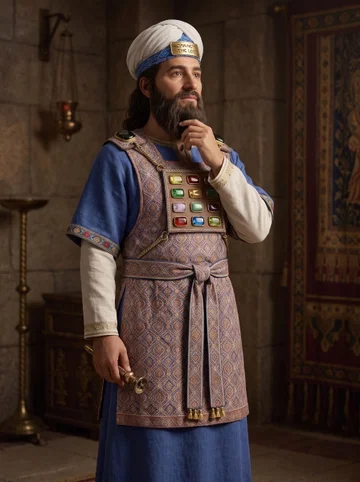
The skirt described is the hem of the high priest's blue robe, woven in one piece and worn over the linen dress of the common priest.PP 350.3 It was made of costly material with beautiful workmanship befitting his exalted station.PP 350.3 Around its hem were golden bells and pomegranates of blue and purple and scarlet, placed alternately, a bell and a pomegranate, round about the bottom of the garment.EW 213.1PP 350.3SG1 158.1SG4 9.2EW 29.1–30.1
The chapter belongs to instruction given by Christ as the great I AM enshrouded in the pillar of cloud, as the greatest of all teachers educating His church in the wilderness.Ms 92, 1899, par. 10–12 It gives the outline of God's expressed will and the higher education after the divine similitude, for the mental, physical, and moral improvement of the whole being, for the formation of right sentiments, and for the development of practical usefulness.Ms 92, 1899, par. 10–12 It tells God's covenant with the people He is seeking to save, the terms of salvation, and the education of most value for present and eternal good as citizens of heaven, giving correct knowledge as its lessons are practically worked out, habituating the mind to dwell upon and observe God's teaching, strengthening the mental powers, and working upon the highest principles.Ms 92, 1899, par. 10–12
The bells sounded while the high priest ministered alone in the inner apartment, the dwelling-place of God's visible glory.ST Mar 4, 1903 That apartment he could enter only once a year, and only after the most careful and solemn preparation, to converse with God before the mercy-seat.ST Mar 4, 1903 While he went in with trembling, the people waited outside in solemn silence with hearts uplifted in earnest prayer for the divine blessing.ST Mar 4, 1903 If he remained an unusual time in the most holy they were terrified, fearing that because of their sins or some sin of the priest the glory of the Lord had slain him.ST Mar 4, 1903 When the tinkling of the bells upon his garments was heard as he came out from before God's presence they were greatly relieved that he lived, and he then came forth and returned to bless them.1SP 274.2ST Mar 4, 1903SG4 9.2
Christ's Heavenly High Priesthood
The bell and pomegranate around the hem mark Jesus as the great High Priest, and the pattern is fulfilled in what He wears as He passes from the first apartment into the second in heaven.ExVEGW 43.1EW 213.1EW 46.1 After the ministration in the holy place ends in 1844 at the close of the 2300 days, He leaves the throne and goes to the Father to receive the kingdom, entering the Most Holy Place in a robe with bell and pomegranate alternating around its bottom.ExVEGW 43.1EW 213.1SG1 158.1 Believers on earth follow Him there by faith and prayer, and receive from Him the Holy Ghost with light, power, love, joy, and peace.ExVEGW 43.1
While He intercedes for Israel in the heavenly most holy place, the alternating bell and pomegranate on the hem of His garment show that His priestly work is still going on and is not finished.ExVEGW 19.1LSEGW 116.1Ms 2, 1849, par. 1–2EW 29.1–30.1CET 100.1–3 He will not leave the Most Holy Place until every case is decided either for salvation or for destruction.SLGB 1.1ExVEGW 19.1LSEGW 116.1Ms 2, 1849, par. 1–2CET 100.1–3 Only when that work is finished does He lay aside His priestly attire and clothe Himself with the garments of vengeance and step out from between the Father and man.SLGB 1.1ExVEGW 19.1LSEGW 116.1Ms 2, 1849, par. 1–2CET 100.1–3 Then God no longer keeps silent but pours out His wrath, which cannot come while Jesus still wears the priestly robe.SLGB 1.1ExVEGW 19.1LSEGW 116.1Ms 2, 1849, par. 1–2CET 100.1–3
The tinkling of the bells heard as He moves out of the most holy place marks the finishing of His work there and the closing of His intercession between guilty man and God, after every case is decided.EW 239.4SG1 198.1 Restraint is then removed, Satan gains entire control of the finally impenitent, and darkness covers the earth.EW 239.4SG1 198.1 The plagues break upon the shelterless guilty who rejected salvation, while the saints live in the sight of a holy God without an intercessor.EW 239.4SG1 198.1
Ordered Ministry and Dress
The hem with its bells and pomegranates belongs to God's special, distinct specification of what the garments of those who ministered in His service should be.GW92 161.1GW92 162.2 He required a particular style for doing service in the holy place and for ministering in the priest's office.GW92 162.2 Those garments were to be in accordance with their work.GW92 162.2
Their apparel was part of an ordered, clean, and reverent ministry.GW92 161.12T 610.3–612.1 What they wore could honor or dishonor God.GW92 161.1 Their orderly appearance and service helped the people recognize God's holiness and the sacredness of His work.2T 610.3–612.1 The detailed, symbolic directions for Aaron's garments and the care given to them show that God has a preference concerning the dress of those who serve Him, and Christ's followers too should dress in a way that represents Him.Ms 56, 1900, par. 11–12
Sources
Pioneers and periodicals
51 sources
The hem of the high priest's blue robe was to be ringed all around with woven pomegranates of blue and purple and scarlet, with bells of pure gold hung alternately between them so that they sounded as he moved.RH Mar 11, 1909ST Oct 25, 1905RH Dec 31, 1861 The costly and beautiful workmanship befitted his exalted office and taught reverence for a holy God and a sacred service, with the pomegranates standing for fruit and the bells for sound.ST Nov 12, 1894RH Oct 30, 1913 While he ministered alone before God in the inner dwelling place of glory, the people waited outside in solemn prayer and listened for the tinkling, and as long as it was heard they were assured he was alive and interceding, their obligations fulfilled and God pleased with them.ST Jun 24, 1880ST Mar 21, 1911ST Mar 4, 1903ST Oct 25, 1905 The border is applied to Jesus as the great High Priest ministering in the holiest place of the heavenly sanctuary, alive though unseen and interceding for His people while the congregation watches for His return.RH Dec 28, 1911RH Feb 20, 1913 The sound marks Him as the living and compassionate Priest who will soon come forth to bless His waiting church, heralding His arrival in glory as Priest, Saviour, and King.RH Nov 21, 1865RH Nov 5, 1903STRH Nov 4, 1858RH Jan 4, 1906
Text and Setting
The verse belongs to the wonderfully itemized directions of Exodus 25 to 31, carried out in Exodus 35 to 40, marked by extreme exactness and minute detail for the tabernacle and for the priestly attire for Aaron and his sons, with profuse use of gold, silver, costly gems, and fine linen and with beautiful workmanship.ST Jun 10, 1908ST Oct 29, 1894 The depths of its meaning, the reasons for its exactness and detail, and the complete motive for its costly materials cannot be fully seen, fathomed, or appreciated, but hold a multitude of invigorating and instructive ideas, suggestions, and lessons that come to the surface under slow, careful, very thoughtful study with close attention, giving vitalizing food to strengthen famishing hearts and water of life to refresh worn spirits.ST Jun 10, 1908 It is part of the very minute description of the sanctuary built in the days of Moses given in Exodus 25 to 40, which Moses was instructed to make exactly according to the pattern shown him in the mount, and the full description from Exodus 25 to the end of the book must be studied in detail to learn the exact pattern of the two kinds of service performed for the errors of the people pointing to the remedy for sin.ST Oct 29, 1894ST Mar 10, 1898ST Oct 25, 1905
The instructions were given to Moses during the forty days on Sinai, on the mount, exactly according to the pattern shown him there for God's dwelling place among His people, so that He might dwell among Israel.ST Oct 29, 1894ST Jun 4, 1885RH Dec 31, 1861ST May 16, 1878ST Oct 25, 1905 They belong to the instructions for making the sanctuary and its priestly garments given during Moses' time on the mount, within God's careful direction of worship whose purpose is to bring people into harmony with His holy law.ST Mar 25, 1889 They are part of what was commanded by the hand of Moses, recorded chiefly in Exodus 25 to 30 and Leviticus, distinct from the Ten Commandments He spoke directly to the people from Sinai and wrote on the two tables of stone with nothing added.ST Apr 15, 1886
The sanctuary and its service were prescribed by God rather than left to human choice, as an earthly object lesson of His government and plan of salvation showing how He deals with those who have rebelled against Him, brings people into harmony with His holy law, and calls them to cooperate with Him through Christ.ST Mar 25, 1889ST Feb 17, 1890ST Jun 26, 1907 The tabernacle was made for ministration involving sacrifices and offerings that passed away when Christ died once for all, and the ancient sanctuary with its rites typified the heavenly temple where Jesus now ministers, pointing to Christ the coming Messiah and showing His power to forgive sin, transform character, and deliver from burdens.ST Jan 24, 1911ST Jun 26, 1907 The tabernacle consisted of two holy places with sacred vessels made according to the pattern shown in the mount as a pattern of the heavenly temple, centering on the most holy place where God's law rested beneath the mercy seat and where priests ministered in His presence, and the worship and service of the wilderness tabernacle where Israel's worship centered revolved around that most holy place.ST Jun 19, 1907RH Jan 4, 1870
God placed His Spirit upon Bezalel and Oholiab with other devoted men and women so the building might be properly erected and the work properly done, and they carried out the divine pattern given to Moses in the mount describing its marvelously beautiful structure.ST Jan 27, 1909 When the ark with all its furniture and equipment was made just as God directed, with the ark of the covenant containing God's holy law written on tables of stone placed at the center in the holy of holies, blessing and glory came down upon the congregation and the completed building.ST Jan 27, 1909 The verse commands pomegranates of blue, purple, and scarlet made round about the hem of the priestly garment, with bells of gold placed between them alternately all around, so that they made a sound as the priest moved.RH Mar 11, 1909ST Oct 25, 1905RH Dec 31, 1861ST May 16, 1878RH Sep 16, 1852 The image is of pomegranates and gold bells arranged alternately around the hem of the high priest's garment as he ministers, with his sound heard when he enters before the Lord.RH Sep 16, 1852RH Dec 28, 1911
The high priest wore over the long white linen robe of the common priest a blue robe woven in one piece, ornamented around the skirt with golden bells and pomegranates of blue, purple, and scarlet, contributing to his splendid appearance.ST Nov 12, 1894ST Dec 17, 1912RH Jul 5, 1864 Over the long white coat he wore a linen ephod curiously wrought with gold, blue, purple, and scarlet, with beautiful stones in settings of gold on each shoulder, a golden breast ornament inscribed Holiness to the Lord bearing the names of the twelve tribes in four rows of three, and the mysterious Urim and Thummim whose exact form is not known. Even the clothing was significant of calling and purpose, and the costly material and beautiful workmanship of these garments befitted his exalted station.ST Nov 12, 1894
Garments and Meaning
A special dress was appointed for the priests in accordance with their office, and the garments of the high priest were of costly material and beautiful workmanship befitting his exalted station.ST Nov 12, 1894ST Nov 12, 1894 In addition to the linen dress of the common priest he wore a robe of blue woven in one piece, ornamented around the skirt with golden bells and pomegranates of blue, purple, and scarlet.ST Nov 12, 1894ST Dec 17, 1912 Over a long white coat he wore a linen ephod curiously wrought with gold, blue, purple, and scarlet, with beautiful stones in settings of gold on each shoulder, a golden breast ornament inscribed Holiness to the Lord bearing the names of the twelve tribes in four rows of three, and the mysterious Urim and Thummim whose exact form is not known.
Even the clothing was significant of calling and purpose, and its careful regulation according to detailed requirements for service in God's presence taught reverence by showing that God is holy and His service sacred.RH Oct 30, 1913 Sanctification in this setting consists in setting apart or consecrating to a sacred religious use.RH Jul 26, 1864 No detail of the sacred service, even the hem of a garment, was too small to receive God's attention.ST Mar 15, 1883
The verse belongs to the wonderfully itemized directions of Exodus 25 to 31 for the tabernacle and for the priestly attire, marked by extreme exactness and minute detail and by profuse use of gold, silver, costly gems, and fine linen.ST Jun 10, 1908 The depths of its meaning, the reasons for its exactness and detail, and the complete motive for its costly materials cannot be fully seen, fathomed, or appreciated without slow, careful, very thoughtful study with close attention.ST Jun 10, 1908 Such study holds a multitude of invigorating and instructive ideas, suggestions, and lessons that come to the surface to give vitalizing food to strengthen famishing hearts and water of life to refresh worn spirits, and the full description from Exodus 25 to the end of the book must be studied in detail to learn the exact pattern of the two kinds of service performed for the errors of the people pointing to the remedy for sin.ST Jun 10, 1908ST Mar 10, 1898
The golden bells and pomegranates bordering the vest express the need of holiness and call for fruit as well as sound, the pomegranates standing for fruit and the bells for sound. The splendid dress prescribed, with its ornamented hem, was worn on other occasions but had to be laid aside on the Day of Atonement when the high priest entered the most holy place to make atonement in the plainest and humblest dress, showing that he was high priest only in a typical sense and not in reality.RH Jan 11, 1870ST Jun 6, 1878 That laying aside, with his sin offering for himself, was expressly designed to impress his infirmity and sinfulness and has no counterpart in the work of Christ.ST Jun 6, 1878 By contrast Aaron's splendid appearance with blue, purple, and scarlet pomegranates along the hem and gold bells placed between them all around highlights Christ as the sinless Priest who lives forever in heaven.RH Jul 5, 1864
These gorgeous robes, with the blue robe worn over the long white linen robe of the common priest, fitly represent Christ as High Priest as He confesses the names of His people before the judgment seat of the Judge of the whole earth.ST Dec 17, 1912
Atonement Day Hearing
On the Day of Atonement the people waited outside in solemn silence with hearts uplifted in earnest prayer for the divine blessing while the high priest ministered alone in the inner apartment.ST Jun 24, 1880ST Mar 4, 1903 That inner apartment was the especial dwelling-place of God's visible glory, where no mortal eye but the high priest's could look.ST Jun 24, 1880ST Mar 4, 1903 He could enter there only once a year after the most careful and solemn preparation, to converse with God before the mercy-seat.ST Jun 24, 1880ST Mar 4, 1903 With trembling he went in before God and before the Lord, and his sound was heard by means of the bells of gold on the hem of his robe among the pomegranates.ST Oct 25, 1905RH Sep 16, 1852 The people waiting outside listened closely for his movements to know whether he was still alive and ministering.ST Oct 25, 1905
As long as the sound of the bell and the pomegranate could be heard they were assured that there was yet hope for them and that the priest was interceding for them.ST Oct 25, 1905 By that continuing sound they knew whether every Israelite had fulfilled every obligation and whether God was pleased with the priest and the people.ST Oct 25, 1905 If he remained an unusual time in the most holy place they were terrified, fearing that because of their sins or some sin of the priest the glory of the Lord had slain him.ST Jun 24, 1880ST Mar 4, 1903 But when the sound of the tinkling of the bells upon his garments was heard they were greatly relieved to know that he lived and had not been slain.ST Jun 24, 1880ST Mar 21, 1911ST Mar 4, 1903
By that tinkling the congregation in the court could follow the high priest's work in his service before God.ST Mar 21, 1911RH Oct 17, 1912 When they heard the bells they knew he was coming out of the most holy place.ST Mar 21, 1911 He then came forth and blessed the people, and they received his blessing as he came out.ST Jun 24, 1880ST Mar 21, 1911ST Mar 4, 1903
Christ's Heavenly Ministry
The hem with its bell and pomegranate alternating all around belongs to Jesus as the great High Priest ministering in the holiest place of the heavenly sanctuary.RH Dec 28, 1911 As the sound of the bells gave evidence that the high priest was alive within the holiest, so Christ has entered heaven and remains alive and interceding for His people though unseen, while the congregation listens for the sound and watches for His return.RH Feb 20, 1913 The Spirit's audible manifestation at Pentecost was that sound, testifying that the great High Priest had entered within the veil and was living for His people in the Father's presence.RH Feb 20, 1913
Their ringing assured the waiting worshippers that their representative was living and faithful and kept them expecting his reappearance, picturing the promises of Christ sustaining the church's hope for His return.ST Jun 28, 1877 The true High Priest is still living and pleading in the holiest of all, emitting sweet sounds to His spiritual Israel, and soon He will come forth to pour His blessing on His waiting church.RH Nov 4, 1858 The words of Jesus meditated upon serve as those bells.RH Nov 4, 1858
The sound marks Jesus as compassionate High Priest coming forth out of the Holy of Holies to bless the people when His ministration is finished for a little season and the saints are sealed.RH Nov 21, 1865 Only those in a watching position with lamps trimmed and loins girt will discern that tinkling, while those immersed in the cares of this life will not.RH Nov 21, 1865 Those who discern it are the blessed people who know the joyful sound at the time of heaven's latter rain ripening the harvest for the covenant of peace and the marriage table of the Lamb.RH Nov 21, 1865
The golden bells sounding beforehand herald His arrival and give cause for rejoicing and singing, for they are the approach of Christ as glorious Priest, Saviour, and King coming in resplendent beauty and transcendent glory from the opening east.RH Nov 5, 1903STRH Jan 4, 1906ST Oct 31, 1895ST Mar 25, 1913 The bells will be heard when the last message of mercy goes with a loud cry that calls all God's children from their lurking places and makes a people ready for the Lord's coming, and then all His sanctified ones from Abel to the last one sealed will be blessed, made perfect, and receive the promise.RH Apr 9, 1857 Those who direct their faith to Him pray for the Father to give them the Holy Spirit, and Jesus breathes the Spirit upon them, bringing light, power, love, joy, and peace.RH Dec 28, 1911
Law Worship and Application
The hem ordered with pomegranates of blue and purple and scarlet and bells of gold between them round about proves that the second commandment does not forbid the mere making of pictures, figures, or ornaments resembling created things.RH Mar 11, 1909ST Jul 1, 1897RH Mar 9, 1916STST Jun 3, 1908 God Himself commanded these bells and pomegranates to be made on the priestly robe to ornament and beautify the sanctuary service, just as He commanded angels and also lions and cattle and other likenesses, and Israel's skill in the fine arts was thus used in sanctuary furnishings.RH Mar 11, 1909RH Mar 9, 1916ST Jun 3, 1908 They were made to adorn and beautify, to aid worship and to teach in a legitimate way, and to glorify God in His appointed service, not to be worshiped.RH Mar 9, 1916STST Jun 3, 1908 What the commandment forbids is making any likeness of anything in heaven above or earth beneath or water under the earth in order to bow before it and worship it.ST Jul 1, 1897RH Mar 9, 1916STST Jun 3, 1908 None of the sanctuary figures were made to be worshiped, so making and carrying them was not transgression.ST Jul 1, 1897RH Mar 9, 1916
Keeping simple remembrances of friends or using pictures and illustrations to make truth plainer is therefore not a violation, for worship belongs to God alone.ST Drawing or making birds, fish, animals, clothing, houses, furniture, food, or other images for such proper use does not break the commandment, since the pomegranate as a fruit was used over and over as an adornment and the bell as another adornment to make beautiful the house of the Lord.STST Jun 3, 1908 The verse belongs to the law of Moses commanded in Horeb, with statutes and judgments alongside the Ten Commandments. It stands among the laws revealing offerings, sacrifices, and types as a shadow of the old dispensation from which the substance of the new dispensation is traced, which God in the last days calls His people to remember and give special attention to as set forth in Exodus 20 to 40 and Leviticus.
It was not part of the Ten Commandments spoken directly to the people from Sinai and written on the two tables of stone with nothing added.ST Apr 15, 1886 It was part of what was commanded by the hand of Moses during the forty days on the mount, recorded chiefly in Exodus 25 to 30 and Leviticus, consisting of burdensome ceremonies and carnal ordinances imposed until the time of reformation, a yoke which neither the fathers nor the apostles were able to bear.ST Apr 15, 1886 Exodus 28 concerns the Levitical priesthood appointed after the Ten Commandments were given in Exodus 20, so the Ten Commandments were not received under that priesthood and the law received under it is distinct from them.ST Mar 22, 1883ST Mar 22, 1883ST Feb 20, 1879 The faulty law is therefore the Levitical law of priesthood, tithes, and offerings, not the perfect moral law of the Ten Commandments.ST Feb 20, 1879
That Levitical order was set apart to carry forward the ministration begun when the tables were placed in the ark in the Most Holy Place of the typical sanctuary, ministering before that ark while the typical sanctuary continued.RH Dec 12, 1854 That ministration could only exhibit guilt and condemnation and death, offering no sacrifice that could take away sin but only directing penitent sinners forward to the great Sacrifice to be offered for the sins of men.RH Dec 12, 1854 The tabernacle was made for ministration involving sacrifices and offerings that passed away when Christ died once for all, for the ancient sanctuary with its rites was a type of the heavenly temple where Jesus now ministers.ST Jan 24, 1911ST Jun 26, 1907 Given to Moses as a pattern for the wilderness sanctuary, its furnishings and rites were object lessons pointing to Christ the coming Messiah and showing His power to forgive sin, transform character, and deliver people from their burdens.ST Jan 24, 1911ST Jun 26, 1907 The priesthood was committed to Aaron and his sons as a service no one else was to perform unless specially directed by God.ST Mar 3, 1914 The full description from Exodus 25 to the end of the book must be studied to learn the exact pattern of the two kinds of service performed for the errors of the people pointing to the remedy for sin.ST Mar 3, 1914ST Mar 10, 1898 The explicit directions of Exodus 25 to 31, carried out in Exodus 35 to 40 when the ark with all its furniture was made just as directed and blessing and glory came down on the congregation and the completed building, with the Spirit placed on Bezalel and Oholiab and other devoted men and women so the work might be properly done around the holy of holies where the ark of the covenant containing God's holy law was placed, teach that God is just as willing to bless workers in material things who are consecrated to Him as workers in spiritual things.ST Jan 27, 1909
Sources