Exodus 30:20
When they go into the tabernacle of the congregation, they shall wash with water, that they die not; or when they come near to the altar to minister, to burn offering made by fire unto the LORD:
Translations
When they go into the tabernacle of the congregation, they shall wash with water, that they die not; or when they come near to the altar to minister, to burn offering made by fire to the LORD:
When they go into the tabernacle of the congregation, they shall wash with water, that they die not; or when they come near to the altar to minister, to burn offering made by fire unto the LORD:
when they go into the tabernacle of the congregation, they shall wash with water, that they die not; or when they come near to the altar to minister, to burn offering made by fire unto the Lord:
When they go into the tabernacle of the congregation, they shall wash with water, that they die not: or when they come near to the altar to minister, to burn offering made by fire to the LORD.
when they go into the tent of meeting, they shall wash with water, that they die not; or when they come near to the altar to minister, to burn an offering made by fire unto the LORD:
when they go into the tent of meeting, they shall wash with water, that they die not; or when they come near to the altar to minister, to burn an offering made by fire unto Jehovah.
in their going in unto the tent of meeting they wash [with] water, and die not; or in their drawing nigh unto the altar to minister, to perfume a fire-offering to Jehovah,
When they go into the tent of meeting, they shall wash with water, that they may not die; or when they come near to the altar to serve, to burn an offering by fire to Jehovah.
When they enter the tent of meeting, they shall bathe with water so shall they not die,—or when they approach unto the altar to minister, to burn as incense an altar-flame to Yahweh:
Whenever they enter the Tent of Meeting or approach the altar to minister by presenting an offering made by fire to the LORD, they must wash with water so that they will not die.
Whenever they enter the Tent of Meeting or approach the altar to minister by presenting a food offering to the LORD, they must wash with water so that they will not die.
When they go into the Tent of Meeting, they shall wash with water, that they don’t die; or when they come near to the altar to minister, to burn an offering made by fire to the LORD.
Whenever they go into the Tent of meeting they are to be washed with water, to keep them from death; and whenever they come near to do the work of the altar, or to make an offering by fire to the Lord,
When they go into the Tabernacle of the Congregation, or when they goe vnto the Altar to minister and to make the perfume of ye burnt offring to the Lord, they shall wash themselues with water, lest they die.
Douay-Rheims (Challoner revision)
When they are going into the tabernacle of the testimony, and when they are to come to the altar, to offer on it incense to the Lord,
Pictures
Cross-references 20 of 24
- Hebrews 9:1-5
Then verily the first covenant had also ordinances of divine service, and a worldly sanctuary.
Describes the tabernacle sanctuary and its ordinances of worship.
- Exodus 38:8
And he made the laver of brass, and the foot of it of brass, of the lookingglasses of the women assembling, which assembled at the door of the tabernacle of the congregation.
Describes the making of the laver used for priestly washing.
- Hebrews 10:22
Let us draw near with a true heart in full assurance of faith, having our hearts sprinkled from an evil conscience, and our bodies washed with pure water.
Bodily washing accompanies drawing near to God.
- Hebrews 9:10
Which stood only in meats and drinks, and divers washings, and carnal ordinances, imposed on them until the time of reformation.
The required washings were carnal ordinances imposed until the time of reformation.
- Ephesians 5:26
That he might sanctify and cleanse it with the washing of water by the word,
Both texts use washing with water as an image of cleansing.
- John 13:8-10
Peter saith unto him, Thou shalt never wash my feet. Jesus answered him, If I wash thee not, thou hast no part with me.
Jesus connects washing with cleansing and having a part with him.
- Exodus 19:10
And the LORD said unto Moses, Go unto the people, and sanctify them to day and to morrow, and let them wash their clothes,
Both command washing and readiness before meeting God.
- Leviticus 10:1-2
And Nadab and Abihu, the sons of Aaron, took either of them his censer, and put fire therein, and put incense thereon, and offered strange fire before the LORD, which he commanded them not.
Nadab and Abihu died after dishonoring sacred service.
- Isaiah 52:11
Depart ye, depart ye, go ye out from thence, touch no unclean thing; go ye out of the midst of her; be ye clean, that bear the vessels of the LORD.
Both call those serving the LORD to be clean.
- Acts 7:44
Our fathers had the tabernacle of witness in the wilderness, as he had appointed, speaking unto Moses, that he should make it according to the fashion that he had seen.
The wilderness tabernacle was made according to the pattern shown to Moses.
- Hebrews 9:13-14
For if the blood of bulls and of goats, and the ashes of an heifer sprinkling the unclean, sanctifieth to the purifying of the flesh:
Contrasts ritual purification with Christ’s sacrifice, which purges the conscience for service.
- Titus 3:5
Not by works of righteousness which we have done, but according to his mercy he saved us, by the washing of regeneration, and renewing of the Holy Ghost;
Both describe washing as cleansing associated with service to God.
- Exodus 29
And this is the thing that thou shalt do unto them to hallow them, to minister unto me in the priest’s office: Take one young bullock, and two rams without blemish,
same mount instruction containing the verse
- John 15:3
Now ye are clean through the word which I have spoken unto you.
The laver’s cleansing is linked with cleansing through Christ’s word.
- Hebrews 9:11
But Christ being come an high priest of good things to come, by a greater and more perfect tabernacle, not made with hands, that is to say, not of this building;
The earthly sanctuary typified the greater sanctuary where Christ ministers.
- Numbers 18:3-7
And they shall keep thy charge, and the charge of all the tabernacle: only they shall not come nigh the vessels of the sanctuary and the altar, that neither they, nor ye also, die.
Defines who may perform sanctuary and altar duties.
- Hebrews 8:1-2
Now of the things which we have spoken this is the sum: We have such an high priest, who is set on the right hand of the throne of the Majesty in the heavens;
The earthly sanctuary typified the heavenly sanctuary where Jesus ministers.
- Hebrews 9:24
For Christ is not entered into the holy places made with hands, which are the figures of the true; but into heaven itself, now to appear in the presence of God for us:
The earthly sanctuary serves as a figure of the true sanctuary in heaven.
- Exodus 28
And take thou unto thee Aaron thy brother, and his sons with him, from among the children of Israel, that he may minister unto me in the priest’s office, even Aaron, Nadab and Abihu, Eleazar and Ithamar, Aaron’s sons.
same mount instruction containing the verse
- Exodus 31:7-11
The tabernacle of the congregation, and the ark of the testimony, and the mercy seat that is thereupon, and all the furniture of the tabernacle,
Both describe the tabernacle and its furnishings used in worship according to God’s instructions.
Commentary
Each commentary is drawn from primary sources: the writings of Ellen G. White and Adventist pioneers and periodicals. Each commentary is separate. Its own words are not a quotation; follow the references to read the source passages.
Ellen G. White
17 sources
A laver of water stood in the court between the altar and the tent where all could see it, and Moses and Aaron and his sons had to wash their hands and feet there whenever they entered the tent or came near the altar to minister, under penalty of death.1SP 348.3GW92 162.22T 610.3–612.1RH May 30, 1871CH 81.3 The penalty was because God's glory hallowed the sanctuary, so all impurity had to be removed before officiating where He was revealed, even leaving dusty shoes behind and washing before putting on the pure linen garments appointed for the work.1SP 348.3GW92 162.22T 613.2RH May 30, 1871CTBH 184.4 The washing taught that all defilement must be put away by those who come into God's presence, for He is so high and holy that cleanliness and order belong to acceptable worship, and to appear before Him without that preparation dishonors Him.1SP 348.3GW92 162.22T 613.2RH May 30, 18712T 610.3–612.1 Its object was not merely to gain His favor for the priests, but to impress the people with an exalted sense of His holiness and the sacredness of His work.RH May 30, 18712T 610.3–612.1RH May 30, 1871 The outward rite ended when Christ's death fulfilled the ceremonies, and it does not now require worshipers to remove their shoes in church, yet it still proves that God requires purity of heart and personal cleanliness no less than in the wilderness.RH May 30, 18712T 610.3–612.1Lt 29, 1901, par. 2–73MR 55.1–56.1GW 313.1–2 Ministers of sacred things today must therefore be pure and orderly in body, dress, and deportment to keep reverence and commend the truth, and those who pray or preach with breath polluted by tobacco are unfit for His holy service.RH May 30, 18712T 610.3–612.1RH May 30, 1871CH 81.3SG4 126.2–128.1
The Washing Required
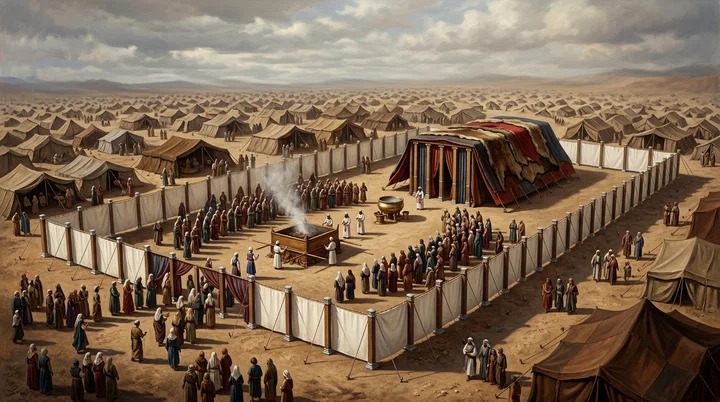
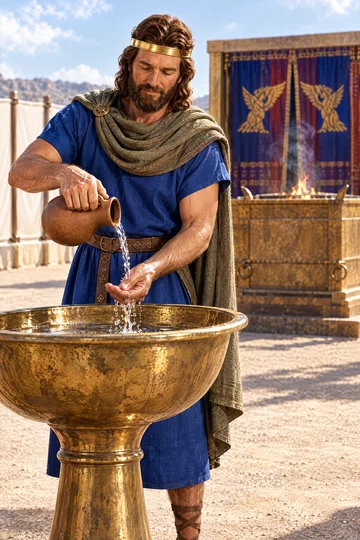
The laver held water and stood in the court beside the door of the tabernacle, between the altar of burnt offering and the tent of the congregation, where the congregation could see it.1SP 348.3GW92 162.22T 613.22T 610.3–612.1CTBH 184.4 Moses and Aaron and Aaron's sons were to wash their hands and their feet there whenever they went into the tent of the congregation and whenever they came near to the altar to minister and burn offering made by fire to the Lord.2T 610.3–612.1RH May 30, 1871ST Apr 14, 1881GW 173.2–3 They washed before entering into the presence of God to plead for Israel, that they die not and do not desecrate the sanctuary.RH May 30, 1871CH 81.3ST Apr 14, 1881SG4 126.2–128.1
The washing was laid under penalty of death, for the sanctuary was hallowed by God's glory and presence.1SP 348.3CTBH 184.4SG4 61.5–62.1 All who officiated where His glory was revealed had to make special preparation and remove all impurity before entering the place made holy by Him.1SP 348.3SG4 61.5–62.1ST Apr 14, 18814T 159.1–2 He is so high, holy, and pure that death would follow unless they complied with these conditions.GW92 162.22T 613.2RH May 30, 1871
That preparation included leaving in the court the shoes to which dust clung, for even dust carried in on shoes could desecrate the holy place.1SP 348.3SG4 61.5–62.14T 159.1–2 Those who ministered in sacred office removed their sandals and washed their feet upon entering the sanctuary.1SP 348.3SG4 61.5–62.1GW 313.1–2 They washed before putting on pure linen garments, with the garments distinctly specified in accordance with the work in the holy place and the priest's office.1SP 348.3RH May 30, 1871CTBH 184.4
What the Washing Taught
The washing taught that every particle of dust and all defilement and impurity must be put away by those who come into God's presence, because the glory of God hallowed the sanctuary and all who officiated where His glory was revealed had to make special preparation and cleanse themselves.1SP 348.3GW92 162.22T 613.2SG4 61.5–62.1 The laver stood in the court between the altar and the congregation where the people could see it, and there Moses and Aaron and Aaron's sons washed their hands and their feet whenever they went into the tent and whenever they came near to minister before the Lord, leaving shoes with clinging dust in the court lest even dust desecrate the holy place.1SP 348.3GW92 162.2RH May 30, 1871RH May 30, 1871SG4 61.5–62.1 It was done in the sight of the congregation with garments distinctly specified in accordance with the work in the holy place and the priest's office, including washing before putting on pure linen garments.RH May 30, 1871CTBH 184.4 The requirement was under penalty of death, for God is so high and holy that death would follow unless they complied with these conditions.GW92 162.22T 613.2RH May 30, 1871
It showed that cleanliness and order are closely connected with acceptable worship, with nothing slack, untidy, or unclean about those who appeared before Him in His holy presence, but order in everything and especially cleanliness.2T 610.3–612.1CTBH 184.4RH May 30, 1871 God is so high, holy, and pure that He commanded this care, and disobedience to the requirement brought death.GW92 162.22T 613.2RH May 30, 1871 Those who officiate before Him may honor or dishonor Him by apparel and deportment, and when ministers show care and reverence the people keep their awe and reverence for God and His sacred service, while when they fail the people lose it.2T 610.3–612.1RH May 30, 1871 To come before His sacred holiness without that special preparation dishonors Him and brings death by consumption, as in the case of Nadab and Abihu.SG4 126.2–128.1CH 82.1–2
Its object was not merely to recommend the priests to God or gain His approbation, but to make a right impression upon the people, giving them an exalted idea of God and His requirements.RH May 30, 18712T 610.3–612.1RH May 30, 1871 It was to show them that God is holy and His work is sacred and must be free from everything like impurity and uncleanness, and that all defilement must be put away from those that approach nigh to God.2T 610.3–612.1RH May 30, 1871 By that same rule all who preach holy truth must have person, actions, and apparel right and perfectly proper, neat and tasteful and orderly, so that every item will recommend the religion and rightly represent the sacred and elevated character of the work before the people.RH May 30, 1871RH May 30, 1871
Ceremony Ended, Principle Remains
The washing at the laver belonged to the ancient ceremonial requirements for ritual cleanliness laid upon those entering the sanctuary or approaching the altar, which illustrated by outward practice the need for care to avoid impurity.Lt 29, 1901, par. 2–73MR 55.1–56.1 Its outward observance is not required of God's people now, for Christ's death brought those ceremonies to their end when type met antitype.Lt 29, 1901, par. 2–73MR 55.1–56.1 Outward washing cannot replace cleansing the heart from sin, nor can outward rites gain God's favor.Lt 29, 1901, par. 2–73MR 55.1–56.1 Those who ministered anciently in sacred office were required upon entering the sanctuary to remove their sandals and wash their feet, but the verse does not require believers now to remove their shoes when entering the house of worship.GW 313.1–2 To make it require that is a non-essential, fanciful theory from minds unlearned in the first principles of the gospel, by which the enemy strives to eclipse the great truths for this time.GW 313.1–2
The command still proves that God is a God of cleanliness, requiring purity of heart and personal cleanliness now no less than He required of Israel journeying in the wilderness.SG4 126.2–128.1CH 82.1–2 As nothing slack, untidy, or unclean was to appear before Him in His holy presence, but order in everything and especially cleanliness, so ministers of sacred things today must be pure and holy, clean and neat in body and dress.RH May 30, 18712T 610.3–612.1 God distinctly specified the garments for service in the holy place and the priest's office in accordance with the work, to show that He may be honored or dishonored by the apparel and deportment of those who officiate before Him.RH May 30, 18712T 610.3–612.1RH May 30, 1871 Its object was not merely to recommend them to God or gain His approbation, but to make a right impression upon the people, giving them an exalted idea of God and His requirements and showing that God is holy and His work is sacred and must be free from everything like impurity and uncleanness.2T 610.3–612.1RH May 30, 1871 When ministers show care and reverence in apparel and deportment the people keep their awe and reverence for God and His sacred service, and when they fail the people lose it, so all who preach holy truth must have person, actions, and apparel right and perfectly proper, neat and tasteful and orderly, to rightly represent the sacred and elevated character of the work.RH May 30, 18712T 610.3–612.1RH May 30, 1871 By that rule every item will recommend the religion, and the dress itself will be a sermon to unbelievers.RH May 30, 1871
By the same requirement, coming before His sacred holiness without special preparation dishonors Him and brings death by consumption, as in the case of Nadab and Abihu, and entering with mouths polluted with tobacco would have shared their fate.SG4 126.2–128.1CH 82.1–2 Priests had to wash before entering the tabernacle or approaching the altar to minister, so they would not desecrate the sanctuary and die, and this cleanliness before coming into God's presence leaves mouths polluted by tobacco unfit for sacred service.CH 81.3SG4 126.2–128.1 Men set apart to speak to the people in Christ's stead cannot offer acceptable service to a holy God with mouths polluted, lips stained, and breath tainted by tobacco, so praying or preaching thus defiled cannot be acceptable.CH 81.3SG4 126.2–128.1CH 82.1–2
Sources
Pioneers and periodicals
37 sources
Priests of Aaron's line were required to wash their hands and feet with water at the laver every time they entered the tent of meeting or came near the altar to minister in burnt offerings, on pain of death for neglect.ST May 20, 1880RH Dec 31, 1861ST Mar 11, 1886 The laver stood in the court between the altar of burnt offering and the sanctuary door, where blood, dirt and dust were cleansed away so no defilement would be carried into the holy place.ST May 1, 1901ST May 1, 1901ST Jun 20, 1911 The earthly sanctuary and its rites were a type and object-lesson of the heavenly sanctuary where Jesus now ministers, pointing to Christ and his power to forgive sin and transform character until the typical service passed away at his once-for-all death.ST Jan 24, 1911ST Jun 26, 1907RH Mar 28, 1854 As one of the diverse washings and carnal ordinances of the law of Moses it was distinct from the Ten Commandments God spoke directly to the people, belonging to the burdensome yoke of commandments contained in ordinances that was abolished in Christ.ST Apr 15, 1886RH Jun 10, 1862 Its constant lesson is that all defilement must be put away by those who approach into God's presence, cleansed as a royal priesthood through the Word by God's grace and power, and therefore ministers of sacred things today must be pure, clean and orderly in body, dress and action in reverent worship of a holy God.RH May 30, 1871RH May 30, 1871ST Jan 24, 1911ST Nov 12, 1894
Setting in Exodus
Exodus 30:20 belongs to the detailed instructions for the construction of the tabernacle and its furniture and for the instruments of its service, given by God to Moses during his forty days and forty nights stay in the mount.ST Mar 25, 1889ST Jan 31, 1911 It stands within the second, chiefly legislative division of Exodus in chapters 19-40, which binds the ransomed people to Jehovah by solemn covenant and provides a system of legal ordinances for their guidance, more particularly within chapters 25-31, also described as Exodus 25-30 and Exodus 25-40.ST Jan 31, 1911ST Jul 8, 1886 It was added instruction given by the hand of Moses after God himself spoke the Ten Commandments to the assembled people from Sinai, with the forty days closed by the Ten Words on tables of stone, and it is grouped with Exodus 30-32.ST Jan 31, 1911ST Jul 8, 1886 In chronological order it comes after the events of Exodus 19-32 and before the building and setting up of the sanctuary in Exodus 33-40.ST Dec 10, 1896 Those sanctuary instructions show how particular God was about worship, which was meant to bring the people into harmony with his holy law.ST Mar 25, 1889
The sanctuary was to be made exactly according to the pattern shown in the mount, as set forth in the very minute description in Exodus 25-40 of the sanctuary built in the days of Moses.ST Oct 29, 1894 It was a portable tabernacle, the inner tabernacle erected by Israel at the command of God in the wilderness, composed of two apartments separated by a veil, the holy place and the most holy place.ST Oct 29, 1894ST Jun 19, 1907 The word sanctuary generally means that building, and afterward Solomon's temple which took the place of the portable tabernacle.ST Jun 19, 1907 In both buildings the worship of God upon earth centered, and all earthly worship and service revolved around the holy of holies where the law of God rested with the mercy-seat over it.ST Jun 19, 1907
The sanctuary was God's dwelling place among his people, which he asked them to make so that he might dwell among them, serving as the center of their worship in the wilderness and through later periods of Israel's history.ST Jun 4, 1885ST Jul 8, 1930 It was given after deliverance from Egyptian bondage, when slavery had unfitted Israel to comprehend God's salvation and required character, as a great multiple object-lesson by various forms and rites comprehending the great plan of salvation. It was built from the free-will offerings of the children of Israel by workmen specially endowed by God to build it, according to a divine pattern given to Moses in the mount, and it was marvelously beautiful. It has no likeness to modern churches, for it was constructed for ministration in sacrifices and offerings.ST Jan 24, 1911
Washing Command Explained
Moses, Aaron and Aaron's sons as priests were required to wash with water at the laver whenever they went into the tent of meeting or came near the altar to minister and burn offerings made by fire unto the Lord.ST May 20, 1880RH Dec 31, 1861ST Mar 11, 1886RH Jan 6, 1853ST Nov 14, 1892 The washing was specifically of hands and feet, and was required preparation before entering the tabernacle or approaching the altar to serve, so that they would not die.ST May 20, 1880ST Mar 11, 1886ST Apr 8, 1897ST May 1, 1901ST Nov 12, 1894 The laver held water for the priests' use and stood before the tabernacle entrance alongside the altar of burnt offering, as part of the sanctuary regulations for the priesthood ordained to minister before the ark and of the sacred service of the tabernacle as God's dwelling place among Israel and the center of their worship.ST May 20, 1880RH Dec 31, 1861RH Jan 6, 1853ST Nov 14, 1892RH Mar 28, 1854 Failure to wash meant death, and appearing before God on behalf of others without this cleansing meant immediate death.ST Mar 11, 1886RH Jan 6, 1853ST Nov 14, 1892ST Apr 8, 1897ST May 1, 1901
The laver holding water stood in the court between the altar of burnt offering near the entrance at the east end and the sanctuary door, between the altar and the sanctuary entrance.ST May 1, 1901ST May 1, 1901ST Jun 20, 1911ST Apr 1, 1913 It stood between the brazen altar of burnt offerings near the entrance and the door of the tabernacle, where the priests washed their hands and their feet before going into the sanctuary or approaching the altar to minister in daily service.ST May 1, 1901ST May 1, 1901ST Jun 20, 1911ST Apr 1, 1913ST Nov 12, 1894 Its purpose was so they could cleanse away blood and other dirt before entering the holy place and not carry dust into the holy place.ST May 1, 1901ST Nov 12, 1894 They also left their shoes in the court and did not enter the sanctuary with shoes on, because particles of dust clinging to shoes would desecrate the holy place.ST Nov 12, 1894
The washing was part of the law of the daily ministration in the first apartment, or holy place, which went forward through the entire year as part of the earthly sanctuary's priestly ministration.RH Mar 28, 1854 It belonged with the burning of sweet incense on the golden altar of incense every morning when the high priest dressed the lamps and every evening when he lighted them, together with the regular morning and evening burnt-offering. There was additional work for the Sabbaths, annual sabbaths, new moons, feasts, and individual offerings. The priestly rites belonged to Aaron and his sons under the directions establishing the priesthood, and were not to be performed by others unless the Lord specially directed them.ST Mar 3, 1914
Type of Heavenly Sanctuary
The directions in Exodus 25 to 31 describe an ancient tabernacle constructed for ministration in sacrifices and offerings, with no likeness to modern churches.ST Jan 24, 1911ST Jun 26, 1907 That earthly sanctuary with its rites and ceremonies was a type of the heavenly sanctuary, the great temple on high where Jesus now ministers.ST Jan 24, 1911ST Jun 26, 1907RH Mar 28, 1854 Its services were object lessons pointing to Christ and His power to forgive sin and transform character, and its priestly ministration, including the washing with water before entering the tent of meeting or coming near the altar to minister lest the priests die, was a pattern of Christ's ministration in the heavenly sanctuary.ST Jun 26, 1907RH Mar 28, 1854 That typical earthly service passed away with Christ's death, when He suffered and died once for all.ST Jan 24, 1911ST Jun 26, 1907
The instructions for the sanctuary and its services set forth on earth God's plan for dealing with sinners and saving them from sin, with detailed provision for those services, to which the washing belongs. The ordinances of divine service given for the earthly sanctuary belonged to the first covenant, and they help explain why its ministration was called a ministration of death.ST Aug 5, 1889
Temporary Ceremonial Ordinance
The washing at the laver belongs to the law of Moses, which included ceremonial laws as well as moral laws and regulations concerning offerings and sacrifices.ST Apr 15, 1886 It stands among the precepts, statutes and laws recorded chiefly in Exodus 25-30 and Leviticus, given through Moses during the forty days on the mount.ST Apr 15, 1886 It is one of the diverse washings and carnal ordinances imposed until the time of reformation, whose types and shadows point to the substance of the new dispensation.ST Apr 15, 1886
It is not part of the Ten Commandments which God spoke directly to the people from heaven on the day of assembly and to which He added no more, but is distinct from God's holy law and holy Sabbath.ST Apr 15, 1886 It was a burdensome ceremony, part of the yoke which neither the fathers nor later generations were able to bear.ST Apr 15, 1886 It belongs to the law of commandments contained in ordinances that was enmity and was abolished in Christ.ST Apr 15, 1886 The washing and other sanctuary services belong to Israel's types and shadows whose purpose was fulfilled in Christ, in contrast with the seventh-day Sabbath, which is not a type and does not end with those temporary ordinances.ST Apr 15, 1886RH Jun 10, 1862
The Levitical practice of washing before priestly service, reflected in pouring water on a priest's hands, continued in modified form in Jewish synagogue practice.RH Jan 12, 1911 After it failed to point people to the better, heavenly way, it had become mechanical.RH Jan 12, 1911 Exodus 30 is also an example of sanctification in the sense of setting apart or consecrating for sacred use, in which sense the sanctuary and its utensils were sanctified.RH Jul 26, 1864
Spiritual Cleansing Signified
Priests were required to wash hands and feet with water at the laver before going into the tent of meeting to serve or coming near the altar to make an offering by fire, on pain of death.RH Sep 19, 1912ST Jan 24, 1911ST Nov 12, 1894 The laver with its basin stood in the court together with the altar of burnt offering, where this washing was to be done before entering the sanctuary.ST Nov 12, 1894 That washing of hands and feet taught the need for cleansing before entering God's presence, linked to being born of water and the Spirit.RH Sep 19, 1912 It constantly taught that all defilement must be put away from those who would approach into God's presence, signifying that those who serve the Lord must be clean.ST Nov 12, 1894
They also left their shoes in the court and did not enter with shoes on, because particles of dust clinging to shoes would desecrate the holy place.ST Nov 12, 1894 The laver's cleansing is connected with the sea of glass as a picture of spiritual cleansing.ST Jan 24, 1911 By it God's children, as a royal priesthood, are cleansed through the Word and by God's grace and power.ST Jan 24, 1911
Cleanliness and Reverent Ministry
God distinctly specified that the priests wash their hands and their feet in the laver placed between the altar and the congregation before coming into His presence in the sight of the congregation, with garments in accordance with their work for service in the holy place and ministry in the priest's office.RH May 30, 1871 The washing at the laver before entering the sanctuary or ministering at the altar, lest they die, was part of the special preparation required before entering the place made holy by God's presence.RH May 30, 1871ST Apr 14, 1881 Every particle of dust had to be put away before going into the presence of God, because He is so high and holy that death would follow unless these conditions were complied with.RH May 30, 1871 God required purity of body and clothes before coming before Him, even to make an offering, which shows the seriousness of reverence and purity in worship.ST Aug 28, 1898 He commanded cleanliness and order with nothing slack and untidy about those who appeared in His holy presence.RH May 30, 1871
The object was not merely to recommend them to God or gain His approbation, but to make a right impression upon the people, to give them an exalted idea of God and His requirements.RH May 30, 1871 It was to show them that God is holy and His work is sacred and must be free from everything like impurity and uncleanness, and that all defilement must be put away from those that approach nigh to God.RH May 30, 1871 Bodily cleanliness was closely connected with acceptable worship and God's purity, as shown by the required washing at the laver before putting on pure linen garments, reflecting His unchanging concern for cleanliness across dispensations.RH Oct 10, 1871 Even dust on the feet was to be removed before entering the ancient sanctuary so they would not pollute it, showing that the sanctuary must be kept clean and that the gospel does not excuse bodily uncleanness.RH Apr 9, 1867
The same requirement means ministers of sacred things today must be pure and holy, clean and neat in body and dress, and rightly represent the sacred and elevated character of their work before the people.RH May 30, 1871 All who preach holy truth must have person, actions, and apparel right and perfectly proper, neat and tasteful and orderly, so that every item will recommend the religion and the dress itself will be a sermon to unbelievers.RH May 30, 1871 He can be honored or dishonored by the apparel and deportment of those who officiate before Him.RH May 30, 1871 The careful cleansing lest dust be carried into the holy place stands in contrast to tobacco spittle and its foul odor in a modern place of worship.RH Feb 26, 1867
Sources