Exodus 35:23
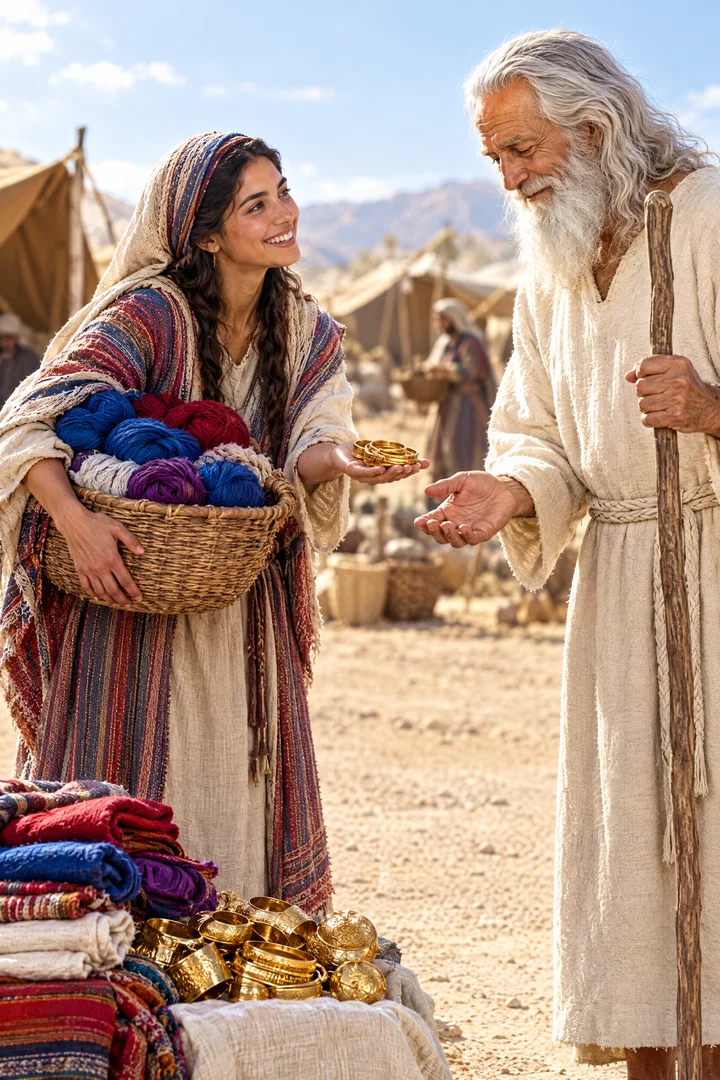
And every man, with whom was found blue, and purple, and scarlet, and fine linen, and goats’ hair, and red skins of rams, and badgers’ skins, brought them.
Translations
American King James Version, King James Version, KJV Cambridge Paragraph Bible
And every man, with whom was found blue, and purple, and scarlet, and fine linen, and goats’ hair, and red skins of rams, and badgers’ skins, brought them.
And every man, with whom was found blue, and purple, and scarlet, and fine linen, and goats' hair, and red skins of rams, and badgers' skins, brought them.
Revised Version, American Standard Version
And every man, with whom was found blue, and purple, and scarlet, and fine linen, and goats’ hair, and rams’ skins dyed red, and sealskins, brought them.
And every man with whom hath been found blue, and purple, and scarlet, and linen, and goats' [hair], and rams' skins made red, and badgers' skins, have brought [them] in;
And every man with whom was found blue, and purple, and scarlet, and byssus, and goats' [hair], and rams' skins dyed red, and badgers' skins, brought [ them].
And, every man with whom was found blue and purple and crimson and fine linen and goat’s-hair,—and rams’ skins dyed red and badgers’ skins brought them in.
Berean Standard Bible, Majority Standard Bible
Everyone who had blue, purple, or scarlet yarn, or fine linen, goat hair, ram skins dyed red, or articles of fine leather, brought them.
Everyone with whom was found blue, purple, scarlet, fine linen, goats’ hair, rams’ skins dyed red, and sea cow hides, brought them.
And everyone who had blue and purple and red and the best linen and goats' hair and sheepskins coloured red and leather, gave them.
Euery man also, which had blewe silke, and purple, and skarlet, and fine linen, and goates heare, and rammes skinnes died red, and badgers skins, brought them.
Douay-Rheims (Challoner revision)
If any man had violet, and purple, and scarlet twice dyed, fine linen and goats’ hair, rams’ skins dyed red, and violet coloured skins,
Pictures
Cross-references
- Exodus 25:1-9
And the LORD spake unto Moses, saying,
God asks Israel to give materials for the sanctuary and provides its pattern.
- Exodus 36:5-7
And they spake unto Moses, saying, The people bring much more than enough for the service of the work, which the LORD commanded to make.
The people bring more than enough materials, so Moses stops further offerings.
- 1 Chronicles 29:6-9
Then the chief of the fathers and princes of the tribes of Israel, and the captains of thousands and of hundreds, with the rulers of the king’s work, offered willingly,
The people give willingly toward the temple.
- Exodus 25:2
Speak unto the children of Israel, that they bring me an offering: of every man that giveth it willingly with his heart ye shall take my offering.
The sanctuary materials are given by willing hearts.
- Exodus 36:6
And Moses gave commandment, and they caused it to be proclaimed throughout the camp, saying, Let neither man nor woman make any more work for the offering of the sanctuary. So the people were restrained from bringing.
The people bring so abundantly that Moses tells them to stop bringing offerings.
- Hebrews 8:5
Who serve unto the example and shadow of heavenly things, as Moses was admonished of God when he was about to make the tabernacle: for, See, saith he, that thou make all things according to the pattern shewed to thee in the mount.
The earthly sanctuary was made from the pattern God showed Moses.
- Exodus 31:1-6
And the LORD spake unto Moses, saying,
God appoints and equips skilled workers to make the tabernacle and its furnishings.
- Exodus 25:4-5
And blue, and purple, and scarlet, and fine linen, and goats’ hair,
Both list materials brought for the sanctuary.
- Exodus 35:4-9
And Moses spake unto all the congregation of the children of Israel, saying, This is the thing which the LORD commanded, saying,
God calls for willing gifts of materials for the sanctuary.
- Exodus 26:1-14
Moreover thou shalt make the tabernacle with ten curtains of fine twined linen, and blue, and purple, and scarlet: with cherubims of cunning work shalt thou make them.
Describes the linen curtains and outer coverings made from these materials.
- Exodus 36:7
For the stuff they had was sufficient for all the work to make it, and too much.
The offerings were sufficient for the sanctuary’s work, with more than enough.
- Exodus 36:8-19
And every wise hearted man among them that wrought the work of the tabernacle made ten curtains of fine twined linen, and blue, and purple, and scarlet: with cherubims of cunning work made he them.
Records the construction of the tabernacle curtains and coverings.
- Exodus 26:31-33
And thou shalt make a vail of blue, and purple, and scarlet, and fine twined linen of cunning work: with cherubims shall it be made:
Both describe the blue, purple, and scarlet materials used for the sanctuary curtain.
- Exodus 12:35-36
And the children of Israel did according to the word of Moses; and they borrowed of the Egyptians jewels of silver, and jewels of gold, and raiment:
The Egyptians supplied valuables later used for the sanctuary.
- Exodus 35:27-28
And the rulers brought onyx stones, and stones to be set, for the ephod, and for the breastplate;
The rulers’ gifts joined the people’s giving for the sanctuary.
- Hebrews 9:1-5
Then verily the first covenant had also ordinances of divine service, and a worldly sanctuary.
Summarizes the sanctuary whose construction used these offerings.
Commentary
Each commentary is drawn from primary sources: the writings of Ellen G. White and Adventist pioneers and periodicals. Each commentary is separate. Its own words are not a quotation; follow the references to read the source passages.
Ellen G. White
16 sources
Everyone who possessed blue, purple and scarlet cloth, fine linen, goats' hair, red-dyed ram skins and badgers' skins brought them as the Lord's offering for building the wilderness sanctuary and its service according to God's design.RH Apr 22, 1902ST Mar 4, 1903 The gifts were free and willing-hearted and not compelled, given by every man and woman whose heart stirred him to give.RH Apr 22, 1902ST Mar 4, 19036T 468.1–2 They gave gladly and eagerly without urging, bringing offerings every morning until they supplied much more than enough and had to be restrained from bringing more.RH Apr 22, 1902ST Sep 11, 1884ST Aug 5, 1875 This generous willing service pleased God, who showed His acceptance when His glory filled the completed tabernacle, reflecting the value they placed on His presence.RH Apr 22, 19021SP 270.1ST Mar 4, 1903 His work is to be advanced now in the same way by hearts as free, willing and anxious, with the same perfection in every line of work done for Him.Ms 109, 1899, par. 1–4ST Aug 5, 1875
Materials Brought for Tabernacle
Every person who possessed blue and purple and scarlet cloth, fine linen, goats' hair, red skins of rams, and badgers' skins brought what was found with them as the Lord's offering for the work of building the tabernacle of the congregation in the wilderness.RH Apr 22, 1902ST Mar 4, 19036T 468.1–2Ms 97, 1899, par. 3–4 These materials were given for the sanctuary and its service, for the construction of the tabernacle and everything commanded to be made for it, according to God's instructions and design.RH Apr 22, 1902ST Mar 4, 1903Ms 97, 1899, par. 3–4ST Aug 5, 1875 It was part of a hearty response to the Lord's invitation, given by every one whose heart stirred him and whom his spirit made willing, both men and women, as many as were willing-hearted.RH Apr 22, 1902ST Mar 4, 19036T 468.1–2
This giving took place after the departure from Egypt, when the people stood only a step from freedom back to slavery and possessed only scanty means, dwelling themselves in small tents.ST Aug 5, 1875 They did not first seek to enlarge and enrich their own dwellings, but put God's house first and followed the design He gave for the tabernacle.ST Aug 5, 1875
The very materials brought, and the skill employed in using them, were themselves gifts from God, entrusted to be used for His glory.Ms 97, 1899, par. 3–4 The construction of the tabernacle was a work the Lord directed with great care, in which He required exactitude, skill, tact, wisdom, and perfection in work done for Him.Ms 109, 1899, par. 1–4Ms 100, 1899, par. 9–11
Willing Abundant Free Offering
The offerings for the tabernacle were free and willing-hearted, not compelled, given by every one whose heart stirred him and whom his spirit made willing, both men and women, as many as were willing-hearted.RH Apr 22, 1902ST Mar 4, 19036T 468.1–2ST Sep 11, 1884LC1 175.3 Whoever had blue and purple and scarlet material, fine linen, goats' hair, red skins of rams, and badgers' skins brought them as the Lord's offering for the sanctuary and its service in the wilderness.RH Apr 22, 1902ST Mar 4, 19036T 468.1–2PP 344.1–4 These were free-will offerings, given willingly and abundantly without needing to be urged.ST Mar 4, 1903ST Sep 11, 1884LC1 175.3
They gave gladly and anxiously, bringing free offerings every morning with cheerful, willing labor until they brought much more than enough for the service of the work commanded to be made.RH Apr 22, 1902ST Aug 5, 1875LC1 175.3 They took ornaments and jewelry from their persons and gave gold, silver, brass, ornamental work and other materials to beautify and enrich God's house, because each soul wanted an interest in it.ST Aug 5, 1875 More than a million dollars was expended, and the gifts came in such abundance that Moses and the leaders had to proclaim that it was enough and they must cease bringing more, because all that had been brought could not be used.RH Apr 22, 1902ST Aug 5, 1875PP 529.11MR 337.2–338.2
This giving was a special call beyond the regular and systematic tithes and donations, with the amount required proportioned to the amount each person possessed.4T 467.1–2 Though the gold and the silver are His, and all that people possess, even their own souls and bodies, are His, and He could have furnished the means without asking any sacrifice, He never works that way.1MR 337.2–338.2 He requires such gifts to sustain His service, to let people have a part in the blessing of returning to the Lord what is His own, and for the good of the givers themselves.4T 467.1–21MR 337.2–338.2
This generous-hearted, willing service was pleasing to God, and when the tabernacle was completed He signified His acceptance when a cloud covered the tent of the congregation and the glory of the Lord filled the tabernacle.RH Apr 22, 1902 Their cheerful generosity in preparing a place for God's presence showed devotion and zeal in supporting the worship of God.1SP 270.1 Their willing and generous gifts reflected the value they placed on God's presence and sacred things.ST Mar 4, 1903
Example for God's Work
Their cheerful generosity in freely bringing the colored cloth, fine linen, goats' hair, and animal skins needed for the tabernacle, in preparing a place for God's presence, is an example of devotion and zeal in supporting the worship of God.1SP 270.1ST Mar 4, 1903 Their gifts were to be willingly and generously offered, reflecting the value they placed on God's presence and sacred things.ST Mar 4, 1903 It stands as an example of devotion, zeal, and liberality in supporting a place for the worship of God.1SP 270.1ST Mar 4, 1903
The varied materials needed for its construction gave everyone an opportunity to take part, and their giving and labor taught them to cooperate with God and with one another.ST Nov 2, 1915 This cooperation also served as a lesson in preparing God's temple in the soul.ST Nov 2, 1915
God required exactitude, skill, tact, wisdom and perfection in the work done for Him on the earthly tabernacle, and He requires that same perfection in every line of work done in His service now.Ms 109, 1899, par. 1–4 Workers are to train their minds to do the very highest service and seek mental strength to do everything according to the pattern shown to Moses in the mount.Ms 109, 1899, par. 1–4 God's work is to be advanced now in the same way, by hearts as free, willing and anxious as Israel's, who when assured there is a work to be done and God calls for their means and hearty cooperation will need no urging.ST Aug 5, 1875 After Israel left Egypt, when they were only a step from freedom back to slavery and had only scanty means with small tents of their own, they did not seek to enlarge their own dwellings first but put God's house first, following the design God gave them for the tabernacle.ST Aug 5, 1875 They needed no urging, but gladly and anxiously brought gifts in abundance, taking ornaments and jewelry from their persons and giving gold, silver, brass, ornamental work and other materials to beautify and enrich God's house because each soul wanted an interest in it.ST Aug 5, 1875 More than a million dollars was expended, and their cheerful, willing labors and offerings were so abundant that Moses had to proclaim they had enough and must cease because all they had brought could not be used.ST Aug 5, 1875
Though the gold and the silver are His and all that people possess, even their own souls and bodies, are His, and He could have furnished the means without asking any sacrifice, He never works that way but called on all the people to bring free-will offerings of blue, purple, scarlet, fine linen, goats' hair, red skins of rams, and badgers' skins.1MR 337.2–338.2 They all wanted a part in the blessing of returning to the Lord what is His own, and they gave until the leaders could say it is enough and to bring no more offerings.1MR 337.2–338.2 The same blessing is for every soul now who takes an interest and makes a free-will offering to help purchase property for a school where youth shall be educated to go forth as missionaries.1MR 337.2–338.2 Heart and purse are to be opened so that when the deed is offered the money is ready.1MR 337.2–338.2
Sources
Pioneers and periodicals
37 sources
Every person who possessed blue and purple and scarlet material, fine linen, goats' hair, red-dyed ram skins, and durable outer skins brought them to supply the fabrics and coverings for the sanctuary built according to God's directions.ST Mar 4, 1903ST Mar 25, 1889 The work was the wilderness tabernacle with two apartments, made exactly after the pattern shown to Moses in the mount, with walls of upright gold-overlaid boards set in silver sockets and curtains forming the roof and entrance.ST Oct 29, 1894ST Mar 10, 1898 The gifts were freewill offerings of willing hearts, given by men and women alike without compulsion until they brought much more than enough, so that Moses had to command them to cease bringing because there was sufficient and too much.RH Apr 22, 1902ST Mar 4, 1903ST Sep 11, 1884RH May 27, 1902RH Aug 21, 1856 The building was a dwelling place made so God could dwell among His people, a divinely given object lesson of His plan of salvation and a type of the heavenly sanctuary pointing to Christ and His work.ST Oct 29, 1894RH May 27, 1902ST Jun 4, 1885ST Jun 26, 1907 The same free, willing, and generous spirit is required now, testing sincerity and love by readiness to put God's house first and advance His work without urging.ST Aug 5, 1875RH May 27, 1902RH Mar 4, 1873ST Dec 31, 1874RH Nov 15, 1870
Setting and Materials Listed
Exodus 35:23 belongs to the very minute description in Exodus 25 to 40 of the sanctuary built in the days of Moses exactly according to the pattern shown to Moses in the mount.ST Oct 29, 1894 That sanctuary had two apartments, and its walls were closely joined upright acacia boards overlaid with gold set in silver sockets and held by bars through rings, while its curtains formed the roof and closed the east entrance.ST Oct 29, 1894ST Mar 10, 1898
The work stands in the wilderness near Sinai after the law was proclaimed from the mount and Moses returned telling of the heavenly sanctuary and the tabernacle God wanted built.RH May 27, 1902 In chronological order it comes after the events of Exodus 19-32 and immediately after the instruction concerning the sanctuary in Exodus 25-31, belonging to the preparing and fitting of the tabernacle and to the building and setting up of the sanctuary in Exodus 33-40.ST Dec 10, 1896 Israel in the third month after release from Pharaoh came from the wilderness of Sin between Elim and Sinai in Western Arabia to make its fourth encampment at Sinai, no longer a destitute, urgent body just emerging from slavery with unbaked bread on their shoulders, and the tabernacle was set up on the first day of the first month of the second year after the Exodus.ST Jun 10, 1908 That building of the wonderful tabernacle at Sinai was a conspicuous deed among the striking deeds and events down to the days of Samuel, and Sinai is the most celebrated of mountains because of the majestic scenes it witnessed and the words of power it heard, becoming to Israel a schoolhouse of flame from whose burning doorway the Teacher of the universe gave momentous lessons of life if received and obeyed and of death if disobeyed.ST Jun 10, 1908
The verse falls within the laws given through Moses, which include more than the Ten Commandments, including statutes and judgments, civil and health regulations, rules for conduct, and ceremonial laws concerning offerings and sacrifices. It belongs to the account where the Lord's directions for building the sanctuary and its furnishings, including the ark, were explicitly carried out, and when the work was complete blessing and glory came upon the congregation and the building.ST Jan 27, 1909ST Feb 13, 1912
The verse means that every man with whom was found blue and purple and scarlet cloth, fine linen, goats' hair, red-dyed ram skins, and durable outer badger skins brought them.ST Mar 4, 1903ST Mar 25, 1889ST Feb 17, 1890 People who possessed the needed fabrics, yarns, hair, and skins thus supplied the fabrics and coverings used in building the sanctuary according to God's instructions, the willing-hearted bringing materials they had available for the sanctuary work and its service without compulsion.ST Mar 4, 1903ST Mar 25, 1889ST Feb 17, 1890 The materials had been brought from Egypt and were used in building the sanctuary by those who possessed fine fabrics, goats' hair, and animal skins.RH Jul 4, 1907 Israel was then only a step from freedom back to slavery with scanty means and small tents of their own and little prospect of gaining more, yet they were able to comply to the uttermost because God knew the state in which they had come out of Egypt and had fulfilled the pledge to Abraham that his descendants would come out with great substance, and though they had few possessions they gave generously from their principal goods, not merely from their increase.ST Aug 5, 1875ST Jun 10, 1908ST Aug 23, 1883
Willing Generous Offerings Given
The offerings for the sanctuary and its service were freewill and willing-hearted, given by every one whose heart stirred him and whom his spirit made willing, both men and women alike, as many as were willing-hearted.RH Apr 22, 1902ST Mar 4, 1903RH May 27, 1902 They were not compelled and needed no urging, asking no pay for what they brought, and there were enough willing Israelite workers that no help had to be hired from the heathen.ST Mar 4, 1903ST Sep 11, 1884ST Aug 5, 1875RH May 27, 1902RH Mar 4, 1873 These offerings supported a work appointed by God and tested the sincerity and love of His people.RH Mar 4, 1873
The gifts were free offerings brought every morning until the people brought much more than enough for the service of the work which the Lord commanded to make.RH Apr 22, 1902ST Sep 11, 1884ST Mar 21, 1911ST Jun 10, 1908 They came in such abundance, with zeal and readiness in sacrificing treasures, that Moses had to give commandment and proclaim that they had enough and must cease bringing presents.RH Apr 22, 1902ST Aug 5, 1875ST Mar 21, 1911ST Sep 17, 1874RH Aug 21, 1856 The stuff was sufficient for all the work and too much, so that all they had brought could not be used and the supply exceeded what the work could use.ST Aug 5, 1875ST Mar 21, 1911ST Sep 17, 1874RH Aug 21, 1856ST Jun 10, 1908
This generous-hearted, willing service was pleasing to God and returned to Him what was already His, for though they had few possessions and little prospect of gaining more, they gave generously from their principal goods and not merely from their increase.RH Apr 22, 1902ST Aug 23, 1883 When the tabernacle was completed He signified His acceptance when a cloud covered the tent of the congregation and the glory of the Lord filled the tabernacle.RH Apr 22, 1902 In this way blessing and glory came upon the congregation and the building when the sanctuary and its furnishings, including the ark, had been made as God had directed.RH Apr 22, 1902ST Jan 27, 1909
The sanctuary's construction was supported by gifts rather than by the tithe, in great liberality in providing for the sacred building. The materials were brought by the people before construction as part of providing everything needed in advance, and the tabernacle was therefore completed without debt.RH Jul 17, 1913
No compulsion was necessary, for Moses was to accept gifts of every man that gave willingly from his heart.ST Sep 17, 1874 No profane methods were used to raise the means: Moses made no grand feast, invited the people to no scenes of gaiety, dancing, and general amusement, and instituted no lotteries or anything of this profane order.ST Sep 17, 1874
Coming into real heart communion with God leads to freely bringing what one has for His sanctuary, so that being a willing giver belongs to such communion.RH Jan 27, 1916 Such willing giving, when each person brings what is found with him, even jewelry kept at home and jewelry still being worn taken off and given as an offering to the Lord and gathered and turned into money put in the treasury, is evidence of the working of the Spirit of God.RH Jan 27, 1916RH Jun 30, 1904
The varied materials needed for its construction gave everyone an opportunity to take part, and their giving and labor taught them to cooperate with God and with one another.ST Nov 2, 1915
Sanctuary Dwelling and Type
The sanctuary was made as the dwelling place God asked Israel to make so He could dwell among them.ST Jun 4, 1885ST Jul 8, 1930ST Jun 26, 1907 The materials used for it were brought by the people who had them, namely blue and purple and scarlet cloth, fine linen, goats' hair, and red-dyed and durable outer animal skins, supplied according to the detailed instructions and directions God gave for its construction.ST Jun 24, 1880ST Jun 4, 1885ST Jul 8, 1930ST Jun 26, 1907 Their willing gifts and devoted effort in freely bringing what they possessed supplied a place for worship, setting an example of devotion, zeal, generosity, and liberality in supporting the worship of God that reflected how highly they valued His sacred presence and sacred things.ST Jun 24, 1880ST Mar 4, 1903
The sanctuary's materials and design formed part of a divinely given object lesson about God's plan of salvation and His desire to dwell among His people, built from the Israelites' freewill offerings. The earthly wilderness sanctuary belongs to the very minute description in Exodus 25 to 40 of the sanctuary built in the days of Moses exactly according to the pattern shown to Moses in the mount, with two apartments and walls of closely joined acacia boards overlaid with gold set in silver sockets and held by bars through rings.ST Oct 29, 1894 Its materials and construction followed the directions God gave Moses, and its earthly service served as a type of the heavenly sanctuary shown to Moses in the mount and pointed to Christ and His work of forgiveness and deliverance.ST Jun 26, 1907
Present Application and Appeal
The verse tests present willingness, for whoever would have brought goods and labor to the wilderness tabernacle will give himself to God's building work today.RH May 27, 1902 God's work is to be advanced now in the same way, by hearts as free, willing and anxious as Israel's, who when assured there is a work to be done and God calls for their means and hearty cooperation need no urging.ST Aug 5, 1875 The offerings supplied a work appointed by God and tested the sincerity and love of His people, being an example of provision for a cause God had appointed through freewill gifts of what each had, including colored cloth, fine linen, goats' hair and animal skins.RH Mar 4, 1873ST Dec 31, 1874RH Nov 15, 1870 The zeal with which Israel engaged in the building and the readiness with which they sacrificed their treasures in free-will offerings, so abundant that Moses had to command them to desist because the stuff was sufficient and too much, is a spirit of sacrifice that should remain in the church of God now no less than the gifts of the Holy Ghost, while its present lack stands far from Israel's liberality.RH Aug 21, 1856
The account gives the plan for providing a place for God's work, in which interested people bring voluntary offerings and donations sufficient to purchase a building set apart for holding services, and following that plan brings the Lord's blessing so the work goes forward as He directs.RH Feb 16, 1905 It stands as precedent for asking people to contribute to building a house for God in obedience to command, illustrating that when God directs His people to build they should first seek the needed funds trusting God will move hearts to provide them from what people have and bring willingly.RH May 16, 1871RH Dec 30, 1915 The willing contribution of the listed fabrics, hair and skins for the sacred work is the model for building college buildings as sacred service, not work undertaken for wages as an inducement, where those who help are moved by desire to serve God and support a worthy project.RH May 27, 1902 Such contributions exemplify generous giving for God's work, as the people's gifts for missions do, in bringing blue, purple and scarlet materials, fine linen, goats' hair and animal skins for the tabernacle.RH Jan 29, 1914
Israel did not seek to enlarge their own dwellings first but put God's house first, following the design God gave them, though only a step from freedom back to slavery with scanty means and small tents of their own.ST Aug 5, 1875 They gladly and anxiously brought gifts in abundance, taking ornaments and jewelry from their persons and giving gold, silver, brass, ornamental work and other materials to beautify and enrich God's house because each soul wanted an interest in it, with more than a million dollars expended in cheerful, willing labors and offerings so abundant that Moses had to proclaim they had enough and must cease because all they had brought could not be used.ST Aug 5, 1875 The giving was varied and bountiful of treasured things, including gold, silver, fine brass, cut and uncut jewels, fine twined linen, costly animal skins, principal spices for anointing oil and sweet spices for fragrant perfume, with willing-hearted men and women bringing gold jewelry, wise-hearted women spinning with their hands and bringing what they had spun, and rulers bringing onyx stones and stones to be set with oil for light and anointing and sweet incense.ST Jun 10, 1908 Each person brought what was found with him, including jewelry kept at home and jewelry still being worn, taken off and given as an offering for the cause, gathered together and turned into money put in the treasury, and such willing giving is evidence of the working of the Spirit of God.ST Jun 10, 1908RH Jun 30, 1904
Those today who call themselves His people are to give in the same way, not by building a material temple or tabernacle of costly wood and rare and gorgeous workmanship, but by dedicating to God a temple in the heart adorned with the beauty of holiness.RH Jun 2, 1859 That heart temple is beautified by most acceptable service to God and humanity, by standing firm in temptation, by sympathy supporting the falling, and by the prayer of faith with a broken and contrite spirit.RH Jun 2, 1859 The varied materials needed for the construction gave everyone an opportunity to take part, and their giving and labor taught them to cooperate with God and with one another, and this cooperation serves as a lesson in preparing God's temple in the soul.ST Nov 2, 1915
Sources