Ezra 1:2
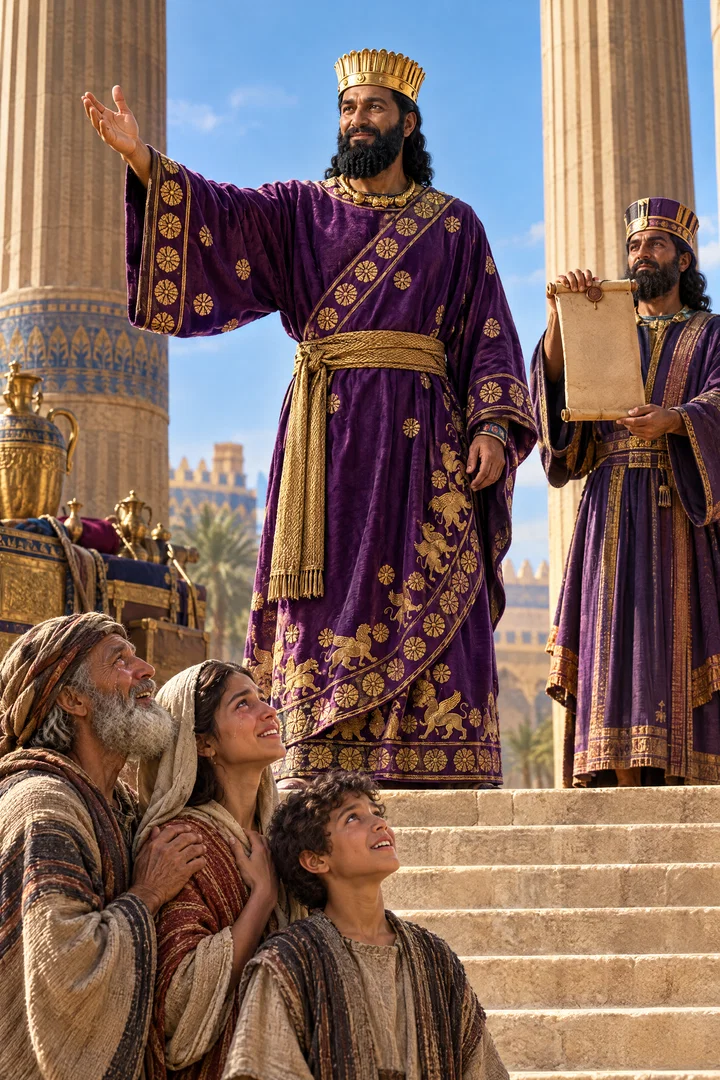
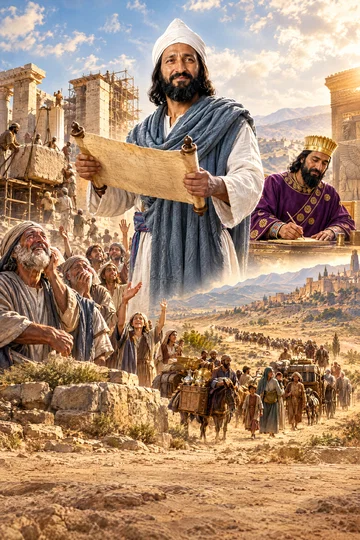
Thus saith Cyrus king of Persia, The LORD God of heaven hath given me all the kingdoms of the earth; and he hath charged me to build him an house at Jerusalem, which is in Judah.
Translations
Thus says Cyrus king of Persia, The LORD God of heaven has given me all the kingdoms of the earth; and he has charged me to build him an house at Jerusalem, which is in Judah.
Thus saith Cyrus king of Persia, The LORD God of heaven hath given me all the kingdoms of the earth; and he hath charged me to build him an house at Jerusalem, which is in Judah.
Thus saith Cyrus king of Persia, The Lord God of heaven hath given me all the kingdoms of the earth; and he hath charged me to build him a house at Jerusalem, which is in Judah.
Thus saith Cyrus king of Persia, The LORD God of heaven hath given me all the kingdoms of the earth; and he hath charged me to build him a house at Jerusalem, which is in Judah.
Thus saith Cyrus king of Persia, All the kingdoms of the earth hath the LORD, the God of heaven, given me; and he hath charged me to build him an house in Jerusalem, which is in Judah.
Thus saith Cyrus king of Persia, All the kingdoms of the earth hath Jehovah, the God of heaven, given me; and he hath charged me to build him a house in Jerusalem, which is in Judah.
'Thus said Cyrus king of Persia, All kingdoms of the earth hath Jehovah, God of the heavens, given to me, and He hath laid a charge on me to build to Him a house in Jerusalem, that [is] in Judah;
Thus says Cyrus king of Persia: All the kingdoms of the earth has Jehovah the God of the heavens given to me, and he has charged me to build him a house at Jerusalem, which is in Judah.
Thus, saith Cyrus, king of Persia, All the kingdoms of the earth, hath Yahweh God of the heavens, given to me,—and, he himself, hath laid charge upon me, to build for him a house, in Jerusalem, which is in Judah.
Berean Standard Bible, Majority Standard Bible
“ This is what Cyrus king of Persia says:‘ The LORD, the God of heaven, who has given me all the kingdoms of the earth, has appointed me to build a house for Him at Jerusalem in Judah.
“ Cyrus king of Persia says, ‘ The LORD, the God of heaven, has given me all the kingdoms of the earth; and he has commanded me to build him a house in Jerusalem, which is in Judah.
These are the words of Cyrus, king of Persia: The Lord God of heaven has given me all the kingdoms of the earth; and he has made me responsible for building a house for him in Jerusalem, which is in Judah.
Thus saith Cyrus King of Persia, The Lord God of heauen hath giuen me all the kingdomes of the earth, and he hath commanded me to builde him an house in Ierusalem, which is in Iudah.
Douay-Rheims (Challoner revision)
Thus saith Cyrus king of the Persians: The Lord the God of heaven hath given to me all the kingdoms of the earth, and he hath charged me to build him a house in Jerusalem, which is in Judea.
Pictures
Cross-references 20 of 78
- Isaiah 44:28
That saith of Cyrus, He is my shepherd, and shall perform all my pleasure: even saying to Jerusalem, Thou shalt be built; and to the temple, Thy foundation shall be laid.
Names Cyrus as God’s instrument to rebuild Jerusalem and the temple.
- Jeremiah 29:10
For thus saith the LORD, That after seventy years be accomplished at Babylon I will visit you, and perform my good word toward you, in causing you to return to this place.
Jeremiah foretold the return from captivity after seventy years, fulfilled through Cyrus’s decree.
- Daniel 9:25
Know therefore and understand, that from the going forth of the commandment to restore and to build Jerusalem unto the Messiah the Prince shall be seven weeks, and threescore and two weeks: the street shall be built again, and the wall, even in troublous times.
Its command to restore and rebuild Jerusalem is distinguished from Cyrus’s temple-only decree.
- Isaiah 45:1-4
Thus saith the LORD to his anointed, to Cyrus, whose right hand I have holden, to subdue nations before him; and I will loose the loins of kings, to open before him the two leaved gates; and the gates shall not be shut;
Isaiah names Cyrus and describes God’s purpose for him in Israel’s deliverance.
- Ezra 7:11-26
Now this is the copy of the letter that the king Artaxerxes gave unto Ezra the priest, the scribe, even a scribe of the words of the commandments of the LORD, and of his statutes to Israel.
Artaxerxes’ decree extends Cyrus’s authorization to restore Jerusalem and its law.
- Ezra 6:1-12
Then Darius the king made a decree, and search was made in the house of the rolls, where the treasures were laid up in Babylon.
Darius later confirms the temple-building decree.
- Jeremiah 25:11-12
And this whole land shall be a desolation, and an astonishment; and these nations shall serve the king of Babylon seventy years.
Foretells the captivity’s seventy-year duration and its end.
- 2 Chronicles 36:22-23
Now in the first year of Cyrus king of Persia, that the word of the LORD spoken by the mouth of Jeremiah might be accomplished, the LORD stirred up the spirit of Cyrus king of Persia, that he made a proclamation throughout all his kingdom, and put it also in writing, saying,
Cyrus proclaims the return of the exiles and the rebuilding of the temple.
- Ezra 6:14
And the elders of the Jews builded, and they prospered through the prophesying of Haggai the prophet and Zechariah the son of Iddo. And they builded, and finished it, according to the commandment of the God of Israel, and according to the commandment of Cyrus, and Darius, and Artaxerxes king of Persia.
Successive Persian decrees carry out God’s command to rebuild the temple.
- Isaiah 45:13
I have raised him up in righteousness, and I will direct all his ways: he shall build my city, and he shall let go my captives, not for price nor reward, saith the LORD of hosts.
Isaiah foretells Cyrus releasing the captives and rebuilding Jerusalem.
- Daniel 9:2
In the first year of his reign I Daniel understood by books the number of the years, whereof the word of the LORD came to Jeremiah the prophet, that he would accomplish seventy years in the desolations of Jerusalem.
Daniel recognizes Jeremiah’s seventy-year prophecy as the desolation nears its end.
- Ezra 5:1-2
Then the prophets, Haggai the prophet, and Zechariah the son of Iddo, prophesied unto the Jews that were in Judah and Jerusalem in the name of the God of Israel, even unto them.
Haggai and Zechariah encouraged the Jews to resume rebuilding the temple.
- Ezra 4:21-24
Give ye now commandment to cause these men to cease, and that this city be not builded, until another commandment shall be given from me.
Artaxerxes’ order halted the rebuilding Cyrus had authorized.
- Ezra 3:10-13
And when the builders laid the foundation of the temple of the LORD, they set the priests in their apparel with trumpets, and the Levites the sons of Asaph with cymbals, to praise the LORD, after the ordinance of David king of Israel.
The temple foundation is laid amid praise, weeping, and shouts of joy.
- Ezra 9:9
For we were bondmen; yet our God hath not forsaken us in our bondage, but hath extended mercy unto us in the sight of the kings of Persia, to give us a reviving, to set up the house of our God, and to repair the desolations thereof, and to give us a wall in Judah and in Jerusalem.
God’s favor through Persian kings restores Jerusalem and its community.
- Haggai 1:1-8
In the second year of Darius the king, in the sixth month, in the first day of the month, came the word of the LORD by Haggai the prophet unto Zerubbabel the son of Shealtiel, governor of Judah, and to Joshua the son of Josedech, the high priest, saying,
The prophet urges the returned people to rebuild the LORD’s house.
- Ezra 2:64
The whole congregation together was forty and two thousand three hundred and threescore,
It records the number of those who returned in response to Cyrus’s call.
- Daniel 5:30-31
In that night was Belshazzar the king of the Chaldeans slain.
Babylon falls, and power passes to the Medes and Persians under Cyrus.
- Ezra 7:7
And there went up some of the children of Israel, and of the priests, and the Levites, and the singers, and the porters, and the Nethinims, unto Jerusalem, in the seventh year of Artaxerxes the king.
Artaxerxes’ seventh year dates a later Persian decree and the return with Ezra.
- Ezra 4:24
Then ceased the work of the house of God which is at Jerusalem. So it ceased unto the second year of the reign of Darius king of Persia.
Opposition halted the temple work until Darius’s reign.
Commentary
Each commentary is drawn from primary sources: the writings of Ellen G. White and Adventist pioneers and periodicals. Each commentary is separate. Its own words are not a quotation; follow the references to read the source passages.
Ellen G. White
13 sources
Cyrus, king of Persia of Medo-Persia, declares that the Lord God of heaven has given him all the kingdoms of the earth and has charged him to build Him a house at Jerusalem in Judah.PK 558.1–2RH Mar 28, 190716MR 169.2–3 His decree is God's appointment of Cyrus and the fulfillment of prophecy, by which God moved him as His agent to free the Jews from Babylonian captivity, proclaim the true God, and supply what was needed to rebuild the temple.PK 558.1–2RH Mar 28, 1907PK 8.3–4Ms 116, 1897, par. 2–5 It gave the exiles the opportunity to return to their Judean homes and restore the temple and its services, and they were to act energetically to carry it out.PK 572.1–2 Nearly fifty thousand took advantage of it to return under Zerubbabel and Joshua as a small remnant, while most remained scattered through the empire rather than face the hardships of the journey and the work of rebuilding.RH Jan 23, 1908PK 598.1 The decree shows that God moves the hearts of pagan kings and men in high places to support His people and advance His cause, so such help is not to be refused merely because it comes from the world, and His forbearance and providence in it call for profound gratitude and rejoicing.16MR 169.2–3Lt 11, 1895, par. 34–38Ms 41, 1895, par. 7–8Lt 98, 1907, par. 2RH Apr 11, 1907
Decree and Historical Setting
Cyrus, king of Persia, of Medo-Persia, proclaimed that the LORD God of heaven had given him all the kingdoms of the earth and had charged him to build Him a house at Jerusalem, which is in Judah.PK 558.1–2RH Mar 28, 1907Lt 11, 1895, par. 34–38Ms 41, 1895, par. 7–8RH Jan 23, 1908 His decree acknowledged God as the source of his authority over the kingdoms and presented the rebuilding of the temple as his assigned work by divine appointment.PK 558.1–2RH Mar 28, 190716MR 169.2–3Lt 11, 1895, par. 34–38Ms 41, 1895, par. 7–8 About two years after the Medo-Persian kingdom arose, he issued the decree allowing the Israelites to return to Canaan and restore the temple.RH Jan 23, 1908
The verse belongs to the beginning of the return from exile, when the first company returned under Zerubbabel and Joshua about seventy years before Artaxerxes came to the throne.RH Jan 23, 1908RH Jan 30, 1908 Artaxerxes later issued the third and final decree for Jerusalem's restoration in 457 B.C.RH Jan 30, 1908 The rebuilding work began under Cyrus and was continued by his successor, and his support made it possible for the Jews to return after seventy years of captivity and serve God in their own country.Ms 116, 1897, par. 2–5Lt 98, 1907, par. 2
God's Purpose Through Cyrus
The decree is God's appointment of Cyrus, and the rebuilding of the temple is the work assigned to him.PK 558.1–2RH Mar 28, 1907Ms 116, 1897, par. 2–5 Cyrus acknowledged that the God of heaven had given him authority over all the kingdoms of the earth and had charged him to build Him a house at Jerusalem, which is in Judah.PK 558.1–2RH Mar 28, 1907 In fulfillment of prophecy God moved upon him to free the Jewish people, to grant them liberty, and to provide what was needed to reconstruct the temple.PK 558.1–2RH Mar 28, 1907Ms 116, 1897, par. 2–5 Cyrus thus acted as God's agent in the prophetic work of restoration, under whom the rebuilding began and which his successor continued.RH Mar 28, 1907Ms 116, 1897, par. 2–5
Through Cyrus God proclaimed the true God and announced deliverance from Babylonian captivity.PK 8.3–4 The power of Cyrus and the resources of empires were made to serve the divine purpose of rebuilding the temple in Jerusalem.PK 8.3–4 That provision for return after seventy years of captivity made it possible for the Jews to go back to their own country and serve God there.Lt 98, 1907, par. 2 Such forbearance toward His wayward people shows the Lord's long patience with them.Lt 98, 1907, par. 2
God's providence in moving the king to help the returned exiles rebuild the temple at Jerusalem is a reason for profound gratitude and rejoicing.RH Apr 11, 1907
Human Response and Application
Cyrus's proclamation opened God's appointed opportunity for the Jews to return to their Judean homes and to restore the temple and its services, and they were to take hold of that opening and press the work forward with energy.PK 572.1–2 The call demanded prompt, vigorous action to carry the permission into effect rather than passive acceptance.PK 572.1–2
Nearly fifty thousand accepted the permission and went up under Zerubbabel and Joshua, yet they were only a small remnant of the Israelites scattered throughout the empire.RH Jan 23, 1908PK 598.1 The decree came about two years after the Medo-Persian kingdom arose, authorizing the Israelites to return to Canaan and rebuild the temple at Jerusalem.RH Jan 23, 1908 Most of the exiles chose to remain in captivity in the provinces rather than endure the hardships of the journey, the rebuilding of their homes, and the labor of restoring the temple services.RH Jan 23, 1908PK 598.1
The king's acknowledgment that the God of heaven had given him his kingdoms and charged him to build the house at Jerusalem in Judah stands as an instance of God moving the hearts of pagan kings and rulers and men in high places to help His people and advance His cause.16MR 169.2–3Lt 11, 1895, par. 34–38Ms 41, 1895, par. 7–8 Because such support is divinely prompted, help and gifts offered for the work are not to be refused merely because they come from the world or from those who do not share the faith.16MR 169.2–3Lt 11, 1895, par. 34–38Ms 41, 1895, par. 7–8
Sources
Pioneers and periodicals
98 sources
In his first year in 536 B.C. after the fall of Babylon, Cyrus king of Persia proclaimed that the Lord God of heaven had given him all the kingdoms of the earth and had charged him to build Him a house at Jerusalem in Judah.ST Feb 11, 1886ST Oct 4, 1905ST Dec 19, 1892ST Feb 25, 1886RH Jul 9, 1908 He invited all of God's people to go up to Jerusalem to build it, and directed their neighbors to help those who remained with silver, gold, goods, beasts, and freewill offerings.RH Jan 20, 1853ST Feb 22, 1883ST Feb 25, 1886 The Lord stirred his spirit to issue the decree in fulfillment of His word through Jeremiah that the captivity would last seventy years, and through Isaiah who had named Cyrus long beforehand as the one to release the captives and build the city and temple.ST Feb 11, 1886RH Jan 28, 1902RH Mar 14, 1912RH Apr 25, 1912 The decree authorized only the rebuilding of the temple with provision for its workers, not the restoration of Jerusalem as a city and polity, and it stands as the first portion of the threefold commandment through Cyrus, Darius, and Artaxerxes that was completed in 457 B.C. from which the seventy weeks are reckoned.ST Feb 25, 1886ST Mar 11, 1889ST Mar 26, 1912RH Feb 7, 1907 It shows God giving civil rule and moving even a heathen king to acknowledge Him, protect His people, and advance His work, with Cyrus yielding where Pharaoh had rebelled and prefiguring the greater Deliverer from the bondage of sin.ST Sep 17, 1885RH Oct 28, 1862ST Aug 17, 1904ST Nov 6, 1901
Decree's Words and Setting
The proclamation of Cyrus king of Persia went forth in his first year, dated to 536 B.C., at the expiration of the seventy years of captivity predicted by Jeremiah.ST Dec 19, 1892ST Feb 25, 1886ST Apr 12, 1883 It came after the fall of Babylon and at the close of the rule of Darius the Mede, two years after the prayer of Daniel 9, when Daniel stood as a prominent man at the Persian court and Cyrus ruled the Persian Empire and the civilized world.ST Dec 19, 1892ST Feb 25, 1886RH Jul 9, 1908 That first year was the first year of his sole government of Medo-Persia, and the seventy years it ended had commenced in 606 B.C. when Nebuchadnezzar made his first successful expedition against Jerusalem.RH Jul 9, 1908RH Apr 28, 1853 Medo-Persia was the silver kingdom that followed Babylon after the army of Cyrus captured Babylon in 538 B.C., called inferior though conqueror of Babylon, indicating deterioration of character as silver is less valuable than gold.RH Jul 9, 1908 About two years after Babylon's king was punished, God moved Cyrus to send the Jews back to their own land, and his order stands as the first partial decree concerning restoration and rebuilding, beginning a sequence of three Persian decrees together forming the commandment of the God of Israel, not complete until Artaxerxes's decree in 457 B.C.RH Apr 28, 1853ST Jan 14, 1897
In the decree Cyrus declared that the LORD God of heaven had given him all the kingdoms of the earth and had charged him to build Him a house at Jerusalem, which is in Judah.ST Feb 11, 1886ST Oct 4, 1905RH Jan 20, 1853ST Aug 9, 1899 He recognized that the God of heaven had given him his empire and dominion and had laid upon him the commission to build the temple in Jerusalem.ST Feb 11, 1886ST Aug 9, 1899RH Jan 28, 1902 The charge made the rebuilding of the temple a commission from God carried out through the Persian king, authorizing the rebuilding of God's house and sanctuary at Jerusalem.ST Oct 4, 1905RH Jan 20, 1853 It belonged to the restoration of the Jews to their land, released the Israelites to return and rebuild the temple, and provided help and necessary provision for those who needed it and for the workers.RH Jan 20, 1853RH Jan 28, 1902 The sanctuary had lain in ruins, and the returning exiles were to rebuild it when Jeremiah's seventy years of desolation had ended.RH Jan 20, 1853RH Jan 28, 1902
The proclamation invited all of His people who were willing to go up to Jerusalem to build the house of the Lord God of Israel.ST Feb 22, 1883ST Feb 25, 1886ST Feb 2, 1882 It was very liberal, giving full, voluntary permission to go rather than compelling everyone to return, and no prophecy contemplates more than such full permission and voluntary acceptance.ST Feb 22, 1883ST Feb 2, 1882RH Jun 23, 1874RH Jan 19, 1860 Those who remained in any place where they sojourned were to be helped by their neighbors where they sojourned, with silver and gold and goods and beasts besides freewill offerings for the house of God.ST Feb 22, 1883ST Feb 25, 1886ST Feb 2, 1882 Through that means God's promise to restore Jerusalem and its temple began to be fulfilled, with provision for the returnees allowed by those who stayed behind.RH Jun 23, 1874RH Jan 19, 1860
The return under the decree is reckoned at 42,360 people, in contrast with the more than 601,000 who came out of Egypt.ST Apr 19, 1883 The full company is reckoned at 49,897 in all, besides 7,337 servants and maids and 200 singing men and singing women.ST Feb 11, 1886 They went up under Zerubbabel, appointed governor and a direct descendant of King David, with Joshua the son of Jozadak as high priest, the first group returning from Babylon to Jerusalem in the first year of Cyrus.ST Apr 19, 1883ST Feb 11, 1886RH Sep 14, 1916 When they reached Jerusalem they immediately set up the altar of the God of Israel to offer burnt offerings thereon, beginning from the first day of the seventh month even though the foundation of the temple of the Lord was not yet laid.ST Feb 11, 1886 In the first year after the return the altar of burnt offering was set up, and two years later work on the temple foundations began but was stopped by bitter opposition from the surrounding peoples, leaving the work at a standstill for fourteen years until Haggai and Zechariah in 520 B.C. called the people to arise and rebuild, with the temple finished and dedicated four years later in 516 B.C., Zerubbabel having then been living in Jerusalem for sixteen years.RH Sep 14, 1916
The opening of Ezra, in Ezra 1:1-3, repeats the closing passage of Second Chronicles word for word, and this identity points to Ezra as the writer of the books of Chronicles.RH May 11, 1916 The verse belongs to the historical account of the return from Babylonian captivity in the days of Ezra and Nehemiah, whose Babylonian life and surroundings give its background.ST Apr 20, 1904ST Mar 10, 1909 The return was real, and Ezra was not an imaginary person.ST Apr 20, 1904 Cyrus left his own account of how he captured Babylon on a cylinder written in cuneiform writing, and Nabonidus, father of Belshazzar, left another cuneiform account of the same capture.RH Sep 7, 1905 The reading of Babylonian writing makes these records readable, and the uncovering of Babylon and Nineveh after lying long forgotten reveals their history and their rulers' own accounts of contact with God's chosen people, illustrating Bible times.RH Sep 7, 1905
Cyrus's Knowledge of God
Cyrus publicly acknowledged the living God before the nations, declaring that the God of heaven had given him dominion over the kingdoms of the earth and had charged him to build Him a house at Jerusalem in Judah.RH Mar 14, 1912ST Jun 25, 1902 His decree began the restoration of the temple and the return from captivity when the seventy years were fulfilled, carrying out the prophecy that Jerusalem and its temple would be rebuilt.RH Mar 14, 1912 In this he identified himself with Israel's God and proclaimed Him as the true God to the nations, and his influence in promoting God and His worship continued to shape the policies of later Persian kings.RH Mar 14, 1912ST Jun 25, 1902
His use of Jehovah, the God of heaven and of Israel, shows that he accepted personal revelation and identified himself closely with Israel's God.ST Apr 26, 1910ST Apr 26, 1910 That name for God had been used by the Israelites and not by other nations or the patriarchs, so his employing it marks his close identification with Israel's God.ST Apr 26, 1910 The rebuilding of the temple is thus presented as a charge laid by God Himself upon Cyrus.ST Apr 26, 1910ST Apr 26, 1910
He learned of that charge because Daniel, who had stayed in the court of Babylon through the whole captivity, understood from the books of Jeremiah in the first year of Darius that God would accomplish seventy years in the desolations of Jerusalem.ST Feb 11, 1886 When Cyrus came to the throne in 536 at the expiration of the seventy years, Daniel showed him God's word about himself in Isaiah, naming Cyrus as the one whose right hand God holds to subdue nations before him and declaring that he shall build God's city and let go His captives, and by this Cyrus learned that God had charged him to build the house.ST Feb 11, 1886 After reading Isaiah's prophecy that Jerusalem and the temple would be rebuilt, he recognized his commission and authorized Jehovah's worshipers in his realm to go to Jerusalem and build the temple, requiring others to support those who went with goods and animals as well as freewill offerings for the temple.ST Apr 26, 1910 Contrary to Oriental custom he issued the decree releasing the Jews and providing from his own revenues for rebuilding because he believed in the true God after learning that Isaiah had called him by name and foretold his acts one hundred fifty years before his birth.RH Apr 25, 1912 That prophecy had named Cyrus 176 years before the release and 113 years before Cyrus was born, foretelling the release after the seventy-year captivity when Persia did not yet exist and his ancestors were wandering tribes.ST Jan 13, 1888
The proclamation was issued in his first year, 536 B.C., at the expiration of the seventy years of captivity predicted by Jeremiah, when Daniel was a prominent man at the Persian court and Cyrus ruled the Persian Empire and the civilized world.ST Dec 19, 1892 It shows that Cyrus recognized the LORD God of heaven as a great God over all others because of his association with Daniel and because of what God had done for His people in overthrowing Babylon.ST Dec 19, 1892 This recognition is understood as acknowledging Him as great over all others, though not necessarily as God alone.ST Dec 19, 1892
Cyrus recognized the God of heaven as the source of his rule and understood that God had commissioned him to have a house built at Jerusalem.ST Mar 6, 1893 His support for the Jews' return and for rebuilding acknowledged that they were God's people and that the temple was being built at God's command.ST Mar 6, 1893 The Persians are described as monotheists, not polytheists.ST Mar 6, 1893
Fulfilment of Earlier Prophecy
The Lord stirred up the spirit of Cyrus to issue the decree in order to fulfill His word spoken through Jeremiah that the desolation of Jerusalem and the captivity would last seventy years.ST Feb 11, 1886RH Jan 28, 1902RH Mar 14, 1912ST Feb 22, 1883 It was proclaimed in his first year, in 536 B.C., at the expiration of those seventy years, releasing the captives to return to their own land and rebuild the house of God at Jerusalem in Judah.ST Dec 19, 1892RH Jul 9, 1908ST Jan 22, 1880ST Jan 20, 1914 In it Cyrus declared that the God of heaven had given him dominion over all the kingdoms of the earth and had charged him to build Him a house at Jerusalem.ST Feb 11, 1886RH Jan 28, 1902RH Mar 14, 1912ST Feb 22, 1883 The decree thus began the restoration of the temple and the return from captivity, carrying out the promise that Jerusalem would be inhabited, the cities of Judah built, and the temple foundation laid.RH Jan 28, 1902RH Mar 14, 1912ST Feb 22, 1883 It also fulfills what Isaiah foretold concerning Cyrus as the shepherd who would say that Jerusalem shall be built and the foundation of the temple shall be laid.ST Feb 11, 1886RH Mar 14, 1912ST Feb 22, 1883ST Feb 2, 1882
Named about a century and a half beforehand, Cyrus was to let the captives go without price, build the city, and order the temple rebuilt.ST Feb 11, 1886ST Jan 17, 1906ST Jan 20, 1914 The naming came 176 years before the release and 113 years before Cyrus was born, when Persia did not yet exist and his ancestors were wandering tribes, while another reckoning puts it 150 years before his birth.RH Apr 25, 1912ST Jan 13, 1888 The seventy years are reckoned from 606 B.C., when Nebuchadnezzar first came successfully against Jerusalem and took it, to 536 B.C., in the first year of Cyrus's sole government over Medo-Persia after his army captured Babylon in 538 B.C.RH Jul 9, 1908ST Jan 22, 1880ST Jan 20, 1914 After Medo-Persia overthrew Babylon God moved Cyrus without delay to carry out what had been foretold for Jerusalem and the temple, showing that the prophetic word stands and bears witness to His existence and cannot be broken even when events seem to threaten its fulfillment.ST Feb 13, 1912ST Jan 20, 1914
Relation to Seventy Weeks
Cyrus's proclamation in his first year in 536 B.C., after Darius the Mede and two years after the prayer of Daniel 9, invited all of God's people to go up to Jerusalem to build the house of the Lord God of Israel and directed those who remained to be helped by neighbors with silver and gold and goods and beasts besides freewill offerings for the house of God, fulfilling Jeremiah's word and ending the seventy-year captivity with nearly fifty thousand returning, yet it authorized only rebuilding of the temple with necessary provision for the workers, not restoration of Jerusalem as a city and polity with its civil, political, judicial, and governmental life, so its date is not the going forth of the commandment to restore and to build Jerusalem that begins the prophetic period of Daniel 9.ST Feb 25, 1886ST Mar 11, 1889RH Mar 2, 1876ST Jan 23, 1893RH Apr 30, 1901 It was an important, God-given first step in Jerusalem's restoration whose provisions were too limited to fulfill the prophecy, since rebuilding the temple and permitting buildings around it favored the city's restoration only in a limited sense.ST Mar 26, 1912RH Mar 2, 1876 It began but did not by itself fulfill the command, and the seventy weeks and the 2,300 days are not reckoned from it alone.ST Mar 11, 1889ST Mar 26, 1912RH Apr 30, 1901
It is the first part of the threefold commandment to restore and to build Jerusalem given through Cyrus, Darius, and Artaxerxes, beginning a history that Ezra traces through its later portions under Darius and Artaxerxes spanning seventy-nine years from 536 to 457 B.C.ST Mar 11, 1889RH Feb 7, 1907ST Jun 26, 1907ST Jan 14, 1897ST Jul 18, 1911 Cyrus's decree concerned rebuilding the temple and was later renewed by Darius, while it was completed and enlarged by Artaxerxes, and together with the decree of Darius the three form one commandment according to Ezra 6:14.ST Mar 26, 1912ST Jun 26, 1907ST Aug 14, 1901 That combined commandment of the God of Israel was not complete until Artaxerxes's decree in 457 B.C., and the prophetic period of the seventy weeks and 2,300 days is reckoned not from Cyrus alone but from its completion in Artaxerxes's seventh year in 457 B.C.ST Jun 26, 1907ST Jan 14, 1897ST Jul 18, 1911RH Oct 11, 1915 All the features of Cyrus's portion are embraced in the decree of Artaxerxes recorded in Ezra 7, which supplies the only starting-point for the twenty-three hundred days.
What Cyrus lacked, Artaxerxes alone supplied: restoration of civil policy and administration, tax, toll, tribute and custom, judges, and punishment of evildoers even unto death, covering also the reconstructive work of Ezra and the later authority given to Nehemiah on streets, walls, and national organization.ST Aug 14, 1901RH Apr 25, 1854RH Mar 12, 1901RH Feb 27, 1908 The temple was completed in the sixth year of Darius, so the confirming decree of Darius like that of Cyrus had reference only to the house of God and was in no sense a decree to restore and to build Jerusalem, whereas the decree given to Ezra in the seventh year of Artaxerxes in B.C. 457 provided both for the temple and for the political organization and government of the nation, and it alone is the going forth of the commandment from which the seventy weeks, or four hundred and ninety years, are counted.RH Apr 25, 1854RH Mar 12, 1901RH Feb 27, 1908 This is proved by reckoning, for 490 years reckoned from Cyrus's edict end before even the birth of Christ, and counting 483 years from it ends too early to reach the Messiah's public ministry, showing that restoring Jerusalem meant more than rebuilding structures.
Against the weight of this teaching, one exposition identifies Ezra 1:1-4 as the decree to restore and rebuild Jerusalem that begins the seventy weeks and the 2,300-year period and dates it to 457 B.C., the seventh year of Artaxerxes, though the verse itself names Cyrus.ST May 7, 1912 Another exposition identifies Cyrus's decree to rebuild Jerusalem as the commandment that could mark the beginning of the seventy weeks, since Daniel received the prophecy dividing that period into seven weeks, sixty-two weeks, and one week before Cyrus issued the decree, and Cyrus's later edict also brought the end of the captivity that had troubled Daniel.RH Feb 27, 1908
Return and Rebuilding Accomplished
The decree belongs to the restoration from Babylon to Jerusalem and Canaan, releasing the captives at the close of bondage that the temple and its worship might be rebuilt.RH Mar 28, 1907RH Jan 20, 1853ST Aug 9, 1899RH Jun 23, 1874 The charge to build the house at Jerusalem in Judah came after Judea had lain desolate and the land had kept the sabbaths denied under wicked kings, when the sanctuary lay in ruins.RH Jan 20, 1853ST Aug 9, 1899RH Sep 18, 1856 The first two chapters of the account list the people and materials that went up, numbering 42,360, in contrast with the more than 601,000 who came out of Egypt. The earthly ministrations of that sanctuary were not yet complete, the first covenant had not yet ended, and the heavenly ministrations it represented had not yet begun.RH Sep 18, 1856
The permission was full, liberal, voluntary and universal to all His people who were willing to go up to build the house of the Lord God of Israel, not a compulsion for all to return.ST Feb 22, 1883ST Feb 2, 1882RH Jun 23, 1874RH Jan 19, 1860RH Aug 26, 1902 Those who remained where they sojourned were directed to have their neighbors help them with silver and gold and goods and beasts besides the freewill offering for the house of God.ST Feb 22, 1883ST Feb 25, 1886ST Feb 2, 1882 No prophecy contemplates more than such full permission and voluntary acceptance.ST Feb 22, 1883ST Feb 2, 1882
The proclamation was made throughout all the kingdom and put in writing, so it reached all Israel wherever they were scattered.ST Jun 12, 1884RH Sep 4, 1856RH Aug 26, 1902ST Sep 27, 1883 It extended through Media where the ten tribes were in captivity as well as through Chaldea and Assyria where Judah was in captivity, for Chaldea had swallowed Assyria and Persia had swallowed Chaldea.ST Jun 12, 1884ST Sep 27, 1883 It was therefore broad enough to cover both the ten tribes and the two tribes, calling them from Babylonian captivity to return to their native land.ST May 7, 1912RH Sep 4, 1856
Many belonging to the ten tribes availed themselves of the decree, so that Ephraim and Manasseh as well as Judah, Benjamin and Levi dwelt again in Jerusalem and all Israel dwelt in their cities.ST Jun 12, 1884 The majority of all the tribes had been taken away and all the tribes were represented, with remnants of all the tribes returning to form one nation and one kingdom subsequently known as Judea.RH Aug 26, 1902ST Sep 27, 1883 The twelve tribes were represented in the rebuilding of the temple, proving that the ten tribes were no more lost after the Babylonian captivity than Judah and Benjamin were.RH Aug 26, 1902
Yet only a small remnant responded, nearly fifty thousand returning under Zerubbabel and Joshua about seventy years before Artaxerxes came to the throne.RH Jan 23, 1908RH Jan 30, 1908ST Feb 25, 1886 Only a few trusted the promise and were sustained as they rebuilt amid trouble, while many others remained in captivity and did not help restore the temple services.RH Jan 23, 1908RH Feb 17, 1874RH May 25, 1876 Only a few accepted the privilege when all were made free to go at the end of the seventy years.ST Feb 25, 1886RH May 25, 1876
Because only Judah, Benjamin, Levi and a few others returned, the sanctuary promised through Ezekiel was never built.RH Jan 20, 1853RH May 25, 1876 Though the decree allowed return and rebuilding, few returned and the new temple fell far short of the glory God had intended.ST Sep 24, 1902
After opposition stopped the work the decree was found in the Persian records, confirmed and renewed, though a later Persian king ordered discontinuance on misrepresentation of the Jews as rebellious.RH Jul 15, 1873ST Feb 20, 1893 In the first year after the return the altar of burnt offering was set up, and two years later work on the temple foundations began but was stopped by bitter opposition from surrounding peoples.RH Sep 14, 1916 Fifteen years after the return begun under Cyrus the temple was still in much the same condition as at the joyous laying of the foundation stones, the work having languished in discouragement until Haggai and Zechariah called the people to arise about 520 B.C.ST Aug 23, 1899RH Sep 14, 1916ST Feb 20, 1893 The standstill lasted fourteen years until Haggai and Zechariah spoke, with over forty-two thousand exiles led by Zerubbabel, a direct descendant of David, having lived in Jerusalem sixteen years by 520 B.C., and the temple finished and dedicated four years later in 516 B.C.RH Sep 14, 1916
Daniel lived in Babylon with the captives through the whole sojourn in constant communion with God and jealous for His law, which proves the Sabbath was not lost there. He continued even unto the first year of Cyrus and lived to witness the promulgation of the proclamation for rebuilding the temple at Jerusalem, an event of surpassing interest that answered his immediate concern about the end of the captivity.RH Jun 18, 1908RH Feb 27, 1908ST Aug 29, 1895 During the whole captivity while the temple lay in ruins he was the living representation of the true meaning of the temple and its services, himself the temple of the living God in whom true worship was preserved, a type of those who will survive the final overthrow of antitypical Babylon.RH Jun 18, 1908 He perhaps assisted in bringing the return about, yet apparently remained behind and did not return because advanced age likely kept him from traveling.RH Aug 24, 1916ST Aug 29, 1895ST Jan 18, 1877
God permitted Jerusalem and the temple to be destroyed, yet later commanded and directed that the house of God at Jerusalem be rebuilt.ST Sep 26, 1906
God's Rule Through Rulers
Civil rule originates with God, who gives kingdoms to whom He will and gives men the abilities needed to govern, and the confession of Cyrus king of Persia that the God of heaven had given him all the kingdoms of the earth is evidence that even the rule of a heathen king comes from Him.ST Sep 17, 1885RH Oct 28, 1862ST Mar 13, 1893 The Persian monarchy under Cyrus had succeeded Babylon as the dominant world power and ruled the kingdoms of the earth.ST Sep 17, 1885ST Mar 13, 1893ST Oct 29, 1885 Like Babylon before it, Medo-Persia was a universal dominion, the second of the four universal monarchies reaching from Daniel's time till the end of the world.ST Sep 17, 1885ST Oct 29, 1885 After Babylon's power ended God ruled over earthly kingdoms and used a foreign ruler to carry out His purpose as the seventy years of captivity neared their close.ST Mar 13, 1893RH Mar 14, 1865
The Lord stirred the spirit of Cyrus to fulfill the word spoken by Jeremiah and to fulfill the promise that Jerusalem would be inhabited, the cities of Judah built, and the temple foundation laid, with Cyrus as shepherd to perform it.ST Feb 22, 1883ST Feb 13, 1912 God stirred Cyrus after Medo-Persia overthrew Babylon to issue the rebuilding decree without delay so that the prophecy concerning Jerusalem and the temple would be fulfilled, demonstrating that God's prophetic word stands and bears witness to His existence.ST Feb 22, 1883ST Feb 13, 1912 Though the decree to rebuild God's house at Jerusalem and end Israel's captivity and restore worship there looked politically foolish, the Lord moved Cyrus to cooperate with the divine promise.ST Feb 22, 1883ST Feb 13, 1912RH Nov 14, 1912 The Lord stirred him to authorize the return and the rebuilding even though this ran against his own interests, and the decree gave full, liberal and voluntary permission for all of His people who were willing to go up to Jerusalem to build the house of the Lord God of Israel, directing those who remained to help them with silver, gold, goods, beasts, and freewill offerings, since no prophecy contemplates more than full permission and voluntary acceptance.ST Feb 22, 1883RH Nov 14, 1912RH Jan 28, 1902 The decree is an act done with divine approval in which a foreign ruler used the state's authority to support the temple and the interests of the church.ST Nov 11, 1889
God works through rulers, including unbelievers, moving them by His authority and resources to advance His work, and His people may receive their help and gifts rather than rejecting them because of the giver's beliefs.ST Nov 11, 1889RH Dec 1, 1874 He compelled the proud despots of Persia — Cyrus and Artaxerxes and Xerxes — to recognize His supremacy, to protect His people, and to send back the captives from Babylon to rebuild the city and the temple at Jerusalem when the kings and prophets and priests of Judah and Israel had completely failed, letting human instruments utterly fail and the kingdom pass away and the temple become ashes under Nebuchadnezzar so that He might vindicate His own glory and all-sufficiency more gloriously.ST Mar 11, 1897RH Dec 1, 1874 The personal character of a foreign ruler did not prevent him from serving God's purpose to restore the Jews after they had been punished for idolatry.ST Mar 11, 1897RH Dec 1, 1874 Daniel explained to Cyrus that the time had come for the prophesied restoration and that he had been chosen to provide for it, and God impressed this message on the king's heart.RH Jan 28, 1902
Deliverance was set free from captivity in heathen Persia by prayer and not by politics, for Daniel sought deliverance by prayer to the throne of grace for power from on high, and in answer Michael the Archangel and Gabriel who stands in the presence of God were sent to move upon the heart of Cyrus, proving God still fashions things according to His own will and moves the hand that moves the world without His people entering the political field, attending primaries, electing officials, or mixing with politics and politicians to suppress evil.ST Aug 19, 1897RH Nov 12, 1914 The decree for deliverance was issued because Daniel's prayer of faith moved the king, proving that the greatest victories for the church or the individual are not gained by talent or education, by wealth or the favor of men, but in the audience chamber with God when earnest, agonizing prayer lays hold upon the mighty arm of power, standing with God's overthrow of the king of Assyria in answer to prayer as assurance of victories in the more troublous times of the closing work when no human help is nigh and they must walk by faith.ST Aug 19, 1897RH Nov 12, 1914 God also worked among earthly powers so the decree could be carried out, quelling rebellions in Babylon and Media and war in Egypt to deliver His people and help Jerusalem.ST Mar 14, 1911
Cyrus was raised up as a chosen instrument in God's hands to bring deliverance from captivity and restoration to their own land, that God might show His power in him, with the like task assigned to Pharaoh nearly a thousand years before to release captive subjects that they might return to the land of their fathers.ST Aug 17, 1904 Unlike Pharaoh's stubborn opposition to the divine command to let Israel go, Cyrus yielded himself to God to accomplish His pleasure, making the most liberal provision for the return of the exiles and every possible provision for their assistance, accelerating their exodus from a foreign country.ST Aug 17, 1904 Thus the honor and power of God was manifested in his rulership, and his name is handed down as a man through whom God worked in a special manner, favorably renowned in all ages, leaving the choice to imitate Cyrus in willing submission rather than Pharaoh in rebellion.ST Aug 17, 1904 No law of the Medes and Persians could be changed, so the original decree to build the house of God at Jerusalem could not lawfully be reversed by any later Medo-Persian decree, and the later decree stopping the work was illegal in itself and had been secured by false representations.ST Apr 9, 1902 After the usurper died the people in Jerusalem and Judea still held the original decree in their hands yet did not resume the work for lack of faith, thinking the work depended on kings and their decrees first with the Lord cooperating afterward, instead of the Lord and His work coming first with kings cooperating afterward.ST Apr 9, 1902
Gospel Types and Lessons
Cyrus's rise and decree released the Judean captives and set in motion the rebuilding of Jerusalem, fulfilling a prediction made about a century and a half earlier concerning Babylon's fall and Jerusalem's restoration.ST Nov 6, 1901 The return closed the seventy years foretold by Jeremiah and served as an object lesson of the gospel.ST Nov 6, 1901 In that deliverance Cyrus became a type of the greater Deliverer, for as he freed God's people from captivity so the greater Deliverer rescues from the greater captivity of sin.ST Nov 6, 1901 The return displays God's faithfulness and mercy, since He desired to free His people from bondage just as He desires to save people from the captivity of sin.ST Sep 6, 1899 His providence in moving the king to aid the returned exiles in rebuilding the temple was reason for profound gratitude and rejoicing.RH Apr 11, 1907
The coming of Cyrus brings the end of Babylon as the first event in the endings of the times, and points to the coming of the Lord.RH Apr 1, 1873 Until he comes God's people must remain in Babylon without being of Babylon.RH Apr 1, 1873 In Greek his name is Kuros, distinct from Kurios, which means Lord.RH Apr 1, 1873 The account of the restoration after the Babylonian captivity is a model for cultivating patriotism.ST May 11, 1876 That return to the promised land was accomplished by a minority who triumphed gloriously, showing that a small company can re-establish the nation in the home of its glory, an example for modern seekers of a safe home for their persecuted brethren as descendants of those men.ST Oct 6, 1898
The command to arise and build the city and the house of God came after a judgment designed for a lesson.ST Apr 15, 1903 It came in a time of great financial distress and, because of lack of faith, the work was done under the most trying circumstances.ST Apr 15, 1903 The Lord did not want His people to lie longer under the reproach of their humiliation in the presence of their enemies.ST Apr 15, 1903 It was no time to fall back and lay blame on the men who brought about the trouble, because the mistake was Israel's mistake, the loss of the city and house of worship was Israel's loss, and the duty to arise and build was Israel's duty.ST Apr 15, 1903 The original decree for the return was issued in 536 B.C. and was later given efficiency and complemented by the decree of Artaxerxes in 457 B.C.ST Feb 2, 1882 Because all the prophets except Malachi wrote before this return, their prophecies of gathering agree with this history and do not sustain a future return of the Jews in the Age to Come.ST Feb 2, 1882
The transfer of power from Babylon to the Medes and Persians opened the way for God's chosen people to return to liberty and enjoy their religious privileges.ST Apr 23, 1912 The account belongs to the return from Babylonian captivity to rebuild Jerusalem and the temple, from which the mountain Jews in Caucasia traced their ancestry yet did not return for the rebuilding.RH Apr 4, 1912
Sources