Ezra 1:7
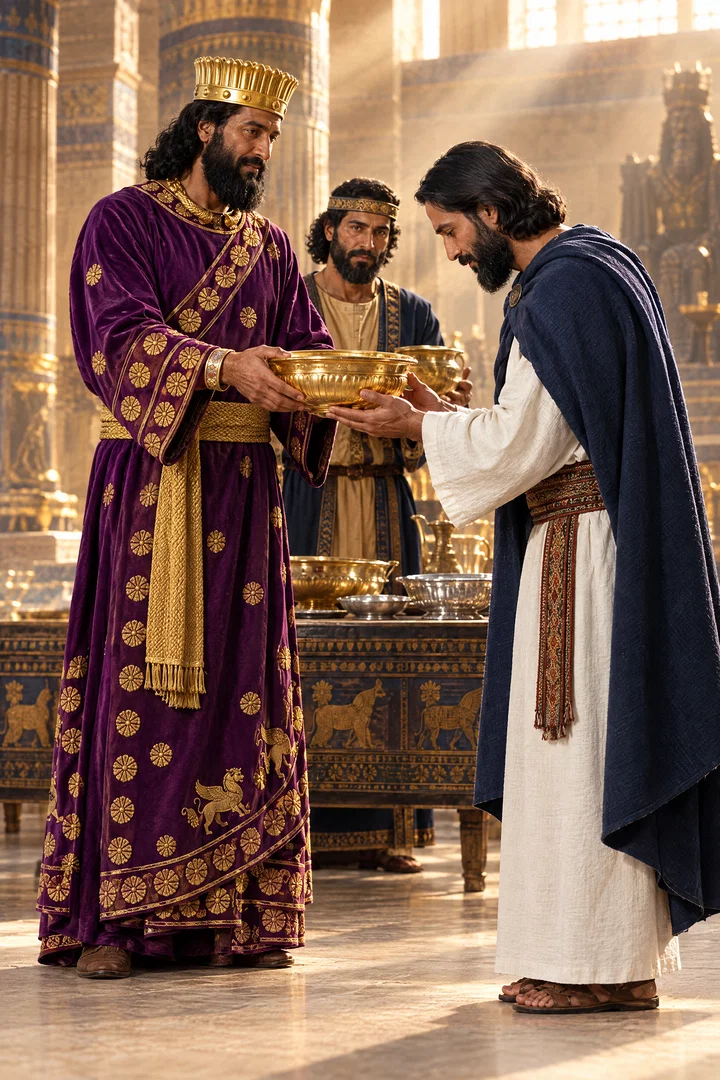
Also Cyrus the king brought forth the vessels of the house of the LORD, which Nebuchadnezzar had brought forth out of Jerusalem, and had put them in the house of his gods;
Translations
American King James Version, King James Version, Revised Version
Also Cyrus the king brought forth the vessels of the house of the LORD, which Nebuchadnezzar had brought forth out of Jerusalem, and had put them in the house of his gods;
Also Cyrus the king brought forth the vessels of the house of the Lord, which Nebuchadnezzar had brought forth out of Jerusalem, and had put them in the house of his gods;
Also Cyrus the king brought forth the vessels of the house of the LORD, which Nebuchadnezzar had brought from Jerusalem, and had put them in the house of his gods;
Also Cyrus the king brought forth the vessels of the house of Jehovah, which Nebuchadnezzar had brought forth out of Jerusalem, and had put in the house of his gods;
And the king Cyrus hath brought out the vessels of the house of Jehovah that Nebuchadnezzar hath brought out of Jerusalem, and putteth them in the house of his gods;
And king Cyrus brought forth the vessels of the house of Jehovah, which Nebuchadnezzar had brought forth out of Jerusalem and had put in the house of his god.
And, King Cyrus, brought forth the utensils of the house of Yahweh,—which Nebuchadnezzar had brought forth from Jerusalem, and put in the house of his gods:—
Berean Standard Bible, Majority Standard Bible
King Cyrus also brought out the articles belonging to the house of the LORD that Nebuchadnezzar had carried away from Jerusalem and placed in the temple of his gods.
Also Cyrus the king brought out the vessels of the LORD’s house, which Nebuchadnezzar had brought out of Jerusalem, and had put in the house of his gods;
And Cyrus the king got out the vessels of the house of the Lord which Nebuchadnezzar had taken from Jerusalem and put in the house of his gods;
Also the King Cyrus brought forth the vessels of the house of the Lord, which Nebuchadnezzar had taken out of Ierusalem, and had put them in the house of his god.
Douay-Rheims (Challoner revision)
And king Cyrus brought forth the vessels of the temple of the Lord, which Nabuchodonosor had taken from Jerusalem, and had put them in the temple of his god.
Pictures
Cross-references 20 of 25
- Ezra 6:14
And the elders of the Jews builded, and they prospered through the prophesying of Haggai the prophet and Zechariah the son of Iddo. And they builded, and finished it, according to the commandment of the God of Israel, and according to the commandment of Cyrus, and Darius, and Artaxerxes king of Persia.
Successive Persian decrees are treated as one commandment for rebuilding the temple.
- Isaiah 44:28
That saith of Cyrus, He is my shepherd, and shall perform all my pleasure: even saying to Jerusalem, Thou shalt be built; and to the temple, Thy foundation shall be laid.
Cyrus carries out God’s purpose to restore Jerusalem and rebuild the temple.
- Isaiah 45:13
I have raised him up in righteousness, and I will direct all his ways: he shall build my city, and he shall let go my captives, not for price nor reward, saith the LORD of hosts.
Cyrus carries out God’s purpose to rebuild Jerusalem and release the captives.
- Ezra 6:1-12
Then Darius the king made a decree, and search was made in the house of the rolls, where the treasures were laid up in Babylon.
Darius renewed Cyrus’s decree and funded completion of the temple.
- Jeremiah 29:10
For thus saith the LORD, That after seventy years be accomplished at Babylon I will visit you, and perform my good word toward you, in causing you to return to this place.
Promises the exiles’ return after seventy years.
- 2 Chronicles 36:7
Nebuchadnezzar also carried of the vessels of the house of the LORD to Babylon, and put them in his temple at Babylon.
Nebuchadnezzar carried the temple vessels to Babylon and placed them in his temple.
- Ezra 5:14
And the vessels also of gold and silver of the house of God, which Nebuchadnezzar took out of the temple that was in Jerusalem, and brought them into the temple of Babylon, those did Cyrus the king take out of the temple of Babylon, and they were delivered unto one, whose name was Sheshbazzar, whom he had made governor;
Records the vessels taken from Jerusalem’s temple and returned from Babylon.
- Ezra 9:9
For we were bondmen; yet our God hath not forsaken us in our bondage, but hath extended mercy unto us in the sight of the kings of Persia, to give us a reviving, to set up the house of our God, and to repair the desolations thereof, and to give us a wall in Judah and in Jerusalem.
It recalls Persian permission to restore Jerusalem and rebuild its walls.
- 2 Kings 24:13
And he carried out thence all the treasures of the house of the LORD, and the treasures of the king’s house, and cut in pieces all the vessels of gold which Solomon king of Israel had made in the temple of the LORD, as the LORD had said.
Nebuchadnezzar carried the temple vessels away, and Cyrus later returned them.
- Isaiah 45:1-4
Thus saith the LORD to his anointed, to Cyrus, whose right hand I have holden, to subdue nations before him; and I will loose the loins of kings, to open before him the two leaved gates; and the gates shall not be shut;
Cyrus’s role in restoring the vessels belongs to the mission God gave him.
- 2 Chronicles 36:22-23
Now in the first year of Cyrus king of Persia, that the word of the LORD spoken by the mouth of Jeremiah might be accomplished, the LORD stirred up the spirit of Cyrus king of Persia, that he made a proclamation throughout all his kingdom, and put it also in writing, saying,
Records Cyrus’s decree at the end of the captivity.
- Daniel 1:2
And the Lord gave Jehoiakim king of Judah into his hand, with part of the vessels of the house of God: which he carried into the land of Shinar to the house of his god; and he brought the vessels into the treasure house of his god.
Both texts describe the Lord’s vessels taken from Jerusalem to a Babylonian temple.
- Jeremiah 25:11-12
And this whole land shall be a desolation, and an astonishment; and these nations shall serve the king of Babylon seventy years.
Babylon’s seventy-year rule and captivity end with Cyrus’s decree.
- 2 Chronicles 36:18
And all the vessels of the house of God, great and small, and the treasures of the house of the LORD, and the treasures of the king, and of his princes; all these he brought to Babylon.
It records the removal of the Temple vessels to Babylon.
- Daniel 5:2-3
Belshazzar, whiles he tasted the wine, commanded to bring the golden and silver vessels which his father Nebuchadnezzar had taken out of the temple which was in Jerusalem; that the king, and his princes, his wives, and his concubines, might drink therein.
Belshazzar used Jerusalem’s vessels at a feast.
- Ezra 5:13
But in the first year of Cyrus the king of Babylon the same king Cyrus made a decree to build this house of God.
Identifies Cyrus as the king who decreed the temple’s rebuilding.
- Ezra 5:17
Now therefore, if it seem good to the king, let there be search made in the king’s treasure house, which is there at Babylon, whether it be so, that a decree was made of Cyrus the king to build this house of God at Jerusalem, and let the king send his pleasure to us concerning this matter.
The search seeks Cyrus’s decree authorizing the rebuilding of God’s house in Jerusalem.
- Isaiah 45:4
For Jacob my servant’s sake, and Israel mine elect, I have even called thee by thy name: I have surnamed thee, though thou hast not known me.
Cyrus is named for Israel’s sake and called to free them.
- Jeremiah 25:12
And it shall come to pass, when seventy years are accomplished, that I will punish the king of Babylon, and that nation, saith the LORD, for their iniquity, and the land of the Chaldeans, and will make it perpetual desolations.
It foretells judgment on Babylon after the appointed period.
- Ezra 5:16
Then came the same Sheshbazzar, and laid the foundation of the house of God which is in Jerusalem: and since that time even until now hath it been in building, and yet it is not finished.
The returned temple vessels accompany the rebuilding of the temple in Jerusalem.
Commentary
Each commentary is drawn from primary sources: the writings of Ellen G. White and Adventist pioneers and periodicals. Each commentary is separate. Its own words are not a quotation; follow the references to read the source passages.
Ellen G. White
2 sources
Nebuchadnezzar had taken the vessels of the house of the Lord out of Jerusalem and put them in the house of his gods, in the temple of his gods in Babylon.PK 559.1RH Mar 28, 1907 Cyrus the king brought those same sacred vessels forth out of Babylon, returning what had been taken.PK 559.1RH Mar 28, 1907 He had them brought out and counted and entrusted to Sheshbazzar, the prince of Judah, for the return journey from Babylon.RH Mar 28, 1907 They were given back so they could be used again in the rebuilt temple, in the restoration of the Lord's house.PK 559.1RH Mar 28, 1907
Sources
Pioneers and periodicals
35 sources
Cyrus brought out the vessels of the house of the Lord that Nebuchadnezzar had taken from Jerusalem and put in the house of his gods, restoring them for the returning exiles to carry back and rebuild the Lord's house.ST Oct 4, 1905ST Dec 19, 1892ST May 7, 1912 They were brought out through Mithredath the treasurer and counted over to Sheshbazzar the prince of Judah, numbering 5,400 vessels of gold and silver, which the exiles carried from Babylon to Jerusalem as treasure for restoring the temple and its worship.RH Mar 28, 1907ST May 3, 1910 This was done in the very first year of Cyrus king of Persia after the Medes and Persians took Babylon, when he proclaimed throughout his kingdom that the Lord God of heaven had given him all kingdoms and charged him to build Him a house at Jerusalem, having been shown by Daniel Isaiah's prophecy naming him as God's anointed to release the captives.ST May 24, 1883ST Jan 13, 1888ST Jan 22, 1880 His decree permitted the return and provided for the temple, its vessels and worship, but it pertained especially to the temple and not to restoring Jerusalem as a city and state, and stands as the first part of the threefold commandment completed by Darius and by Artaxerxes in B.C. 457, from which are reckoned the seventy weeks of 490 years and the 2,300 days.ST Mar 11, 1889RH Mar 10, 1874ST May 17, 1877ST Jan 11, 1883 The return shows God's compassion and faithfulness to His people and His rule over earthly kingdoms in bringing them out of bondage, and the bringing of the vessels out of a pagan temple back to God's temple pictures those made fit by grace being transferred to Christ's spiritual temple to serve Him.ST Sep 6, 1899ST Mar 13, 1893ST Apr 30, 1896
Return of the Vessels
Cyrus the king brought out the vessels of the house of the LORD which Nebuchadnezzar had brought forth out of Jerusalem and had put in the house of his gods.ST Oct 4, 1905ST Dec 19, 1892ST May 7, 1912RH Feb 7, 1907RH Jan 20, 1853 They were the sacred vessels taken from the Jerusalem temple and placed in the temple of his gods at Babylon, now restored for the returning exiles to carry back to Jerusalem.ST Dec 19, 1892ST May 7, 1912RH Feb 7, 1907RH Jan 20, 1853ST May 17, 1877 The restoration belonged to the decree to return and rebuild the Lord's house, though that decree provided for the Jews' return and the rebuilding of the temple and did not yet provide the complete restoration of Jerusalem and the Jewish state.RH Feb 7, 1907RH Jan 20, 1853ST May 17, 1877
He had them brought out through Mithredath the treasurer and counted over to Sheshbazzar the prince of Judah.RH Mar 28, 1907ST May 3, 1910 The gold and silver vessels so numbered and entrusted numbered 5,400. The returning exiles carried them from Babylon to Jerusalem as a valuable treasure and an encouragement to those returning to restore the temple and its worship.RH Mar 28, 1907ST May 3, 1910
The returning was an act of liberality and justice by Cyrus as the exiles prepared to return and rebuild the house of the Lord.ST Dec 19, 1892 God's Spirit was at work upon his heart in this restoration.ST May 3, 1910 The Persian aid provided resources for the work in acknowledgment of the command of the God of heaven, whom the Persians acknowledged as monotheists, not polytheists.ST Mar 6, 1893
The event belongs to Cyrus king of Persia in his very first year as ruler after the Medes and Persians took Babylon.ST May 24, 1883ST Jan 13, 1888ST Jan 22, 1880 Then he made proclamation throughout all his kingdom and put it also in writing that the Lord God of heaven had given him all the kingdoms of the earth and had charged him to build Him a house at Jerusalem in Judah, inviting any of His people to go up.ST Jan 13, 1888 Daniel, made prime minister of the empire, showed Cyrus Isaiah's prophecy naming Cyrus as God's anointed whose right hand God holds to subdue nations, called for Jacob's sake to build God's city and let go God's captives without price or reward, and in response Cyrus issued the proclamation.ST Jan 13, 1888 In this way the return from Babylon after seventy years of captivity was brought about by the power of the king who then ruled Babylon, with restoration of the Jews to their own land.ST May 24, 1883ST Jan 22, 1880
In chronology Cyrus issued the proclamation in B.C. 536 in the first year of his sole government over Medo-Persia after its army captured Babylon in B.C. 538.RH Jul 9, 1908ST Mar 13, 1893ST Jan 20, 1904ST Jan 20, 1904 Thereby he brought to an end the seventy years of captivity that commenced in B.C. 606 when Nebuchadnezzar made his first successful expedition against Jerusalem.RH Jul 9, 1908 This was part of the fulfillment of Jeremiah's prophecy and shows God's compassion and faithfulness to His people and His rule over earthly kingdoms.ST Mar 13, 1893ST Jan 22, 1880 It belongs to the same period as Haggai's encouragement to rebuild and to the account of the temple's restoration after the exile.ST Aug 23, 1899
The decree went out throughout his realm and reached the ten tribes in Assyria as well as the Jews in Babylon, so the gathering after the captivity was not limited to Judah and Benjamin.RH Sep 4, 1856 It was broad enough to include all Israel, though only a small number returned.ST May 7, 1912 Only 42,360 returned under Zerubbabel in the first year of Cyrus, while many Jews remained in Babylon and were later invited to return.ST May 7, 1912ST Apr 19, 1883
The narrative belongs to Babylonian life in the days of Ezra and Nehemiah that is confirmed by discoveries in ancient lands having dealings with Israel, including Babylonian and Assyrian inscriptions and other archaeological information.ST Mar 10, 1909 The return restored sacred objects removed during the conquest.ST Aug 9, 1899 Some of those vessels may also have been used at Belshazzar's feast, and their recovery shows that when God acted, even objects held in a pagan temple were brought back for His people.ST Aug 9, 1899
Decree and Prophetic Time
Cyrus permitted the Jews to return and rebuild the temple, with provision for its vessels and worship, but his decree pertained especially to the temple and did not address restoring Jerusalem itself as a city and Jewish state with its secular government, which then lay in ruins.RH Mar 10, 1874ST May 17, 1877ST Jan 11, 1883ST Nov 13, 1879ST Oct 22, 1874 That distinction matters because the command to restore and to build the city unto Messiah the Prince marks the beginning of the prophetic period, so Cyrus alone is not its going forth.RH Mar 10, 1874ST Jan 11, 1883ST Aug 8, 1878 His decree is the first part of the prophetic commandment of the God of heaven, carried into effect successively by Cyrus, Darius, and Artaxerxes and legally established by their united action as the authority of the Persian Empire.ST Jan 11, 1883ST Oct 22, 1874ST Aug 8, 1878
Cyrus's decree recorded in Ezra 1, dated to 536 B.C., gave the Jews permission to rebuild the temple and was confirmed by Darius and completed by Artaxerxes's charter for the full restoration of Jerusalem.ST Mar 11, 1889ST Jan 20, 1904ST Jan 20, 1904 It contains part of the commandment to restore and to build Jerusalem foretold in Daniel 9 as the beginning of the seventy weeks, but it does not by itself bear all the specifications of that prophecy.ST Feb 17, 1898 Its features are embraced and completed in the decree of Darius in Ezra 6 and finally in the decree of Artaxerxes in Ezra 7, which alone bears all the specifications, so that the temple was built and finished according to the commandment of the God of Israel and according to the commandment of Cyrus, Darius, and Artaxerxes.ST Jan 11, 1883ST Feb 17, 1898 The temple's restoration began under Cyrus's decree recorded in the first two chapters of Ezra, distinct from the later commandment to restore and build Jerusalem which reached its fullness under Artaxerxes.ST Nov 24, 1909ST Feb 17, 1898
Because the commandment was not complete until Artaxerxes issued his final decree in B.C. 457, the going forth of the commandment to restore and build Jerusalem is reckoned from 457 B.C., not from Cyrus alone.ST Mar 11, 1889ST Nov 24, 1909ST Feb 17, 1898ST Jan 20, 1904ST Jan 20, 1904 From that completed commandment are counted the seventy weeks of 490 years allotted to the Jewish people and the 2,300 days.ST Mar 11, 1889ST Feb 17, 1898 The act in Cyrus's very first year of sole government over Medo-Persia after its army captured Babylon marks Medo-Persia as the silver kingdom that succeeded Babylon in world sovereignty, called inferior because silver is less valuable than gold, showing a deterioration of character.RH Jul 9, 1908 Nebuchadnezzar's taking of the vessels from Jerusalem and placing them in the temple of his god at Babylon made that temple a rival to God's sanctuary, and their removal to a pagan temple illustrates that rival sanctuary's profaning of the Lord's sanctuary.RH Feb 3, 1853RH Feb 15, 1870
Spiritual Lessons and Application
Ezra 1:7 belongs to the account of Israel's return from captivity in 536 B.C. under the decree of Cyrus in fulfillment of Jeremiah's prophecy, and it records that the king brought out the sacred vessels of the Lord's house that Nebuchadnezzar had taken from Jerusalem and placed in the temple of his gods.ST Sep 6, 1899ST Mar 13, 1893 That return shows God's compassion and faithfulness to His people and His rule over earthly kingdoms.ST Mar 13, 1893 It shows His mercy in bringing His people out of the bondage of sin.ST Sep 6, 1899
The vessels had been removed as sacred objects during the conquest, and some may also have been used at Belshazzar's feast, yet their recovery shows that when God acted even objects held in a pagan temple were brought back for His people.ST Aug 9, 1899 The sacred vessels and rich treasures taken to Babylon as spoil represent the loss and desolation of Jerusalem.RH Apr 2, 1857 That loss is applied to the disappearance of the church's spiritual life, including its praying parents, zealous young people, and heartfelt praise.RH Apr 2, 1857
Their release from a pagan temple and restoration to God's temple pictures people made fit by God's grace being transferred to Christ's spiritual temple to serve Him.ST Apr 30, 1896
Sources