Genesis 22:2
And he said, Take now thy son, thine only son Isaac, whom thou lovest, and get thee into the land of Moriah; and offer him there for a burnt offering upon one of the mountains which I will tell thee of.
Translations
And he said, Take now your son, your only son Isaac, whom you love, and get you into the land of Moriah; and offer him there for a burnt offering on one of the mountains which I will tell you of.
King James Version, KJV Cambridge Paragraph Bible
And he said, Take now thy son, thine only son Isaac, whom thou lovest, and get thee into the land of Moriah; and offer him there for a burnt offering upon one of the mountains which I will tell thee of.
And he said, Take now thy son, thy only son Isaac, whom thou lovest, and go into the land of Moriah; and offer him there for a burnt-offering upon one of the mountains which I will name to thee.
And he said, Take now thy son, thine only son, whom thou lovest, even Isaac, and get thee into the land of Moriah; and offer him there for a burnt offering upon one of the mountains which I will tell thee of.
And he said, Take now thy son, thine only son, whom thou lovest, even Isaac, and get thee into the land of Moriah; and offer him there for a burnt-offering upon one of the mountains which I will tell thee of.
And He saith, 'Take, I pray thee, thy son, thine only one, whom thou hast loved, even Isaac, and go for thyself unto the land of Moriah, and cause him to ascend there for a burnt-offering on one of the mountains of which I speak unto thee.'
And he said, Take now thy son, thine only [ son], whom thou lovest, Isaac, and get thee into the land of Moriah, and there offer him up for a burnt-offering on one of the mountains which I will tell thee of.
And he said—Take, I pray thee, thy son, thine only one, whom thou lovest, even, Isaac, and get thee into the land of Moriah and cause him to ascend there as an ascending-sacrifice, on one of the mountains which I shall name unto thee.
Berean Standard Bible, Majority Standard Bible
“ Take your son,” God said, “ your only son Isaac, whom you love, and go to the land of Moriah. Offer him there as a burnt offering on one of the mountains, which I will show you.”
He said, “ Now take your son, your only son, Isaac, whom you love, and go into the land of Moriah. Offer him there as a burnt offering on one of the mountains which I will tell you of.”
And he said to him, Take your son, your dearly loved only son Isaac, and go to the land of Moriah and give him as a burned offering on one of the mountains of which I will give you knowledge.
And he said, Take nowe thine onely sonne Izhak whom thou louest, and get thee vnto the land of Moriah, and offer him there for a burnt offering vpon one of the mountaines, which I will shewe thee.
Douay-Rheims (Challoner revision)
He said to him: Take thy only begotten son Isaac, whom thou lovest, and go into the land of vision: and there thou shalt offer him for an holocaust upon one of the mountains which I will show thee.
Pictures
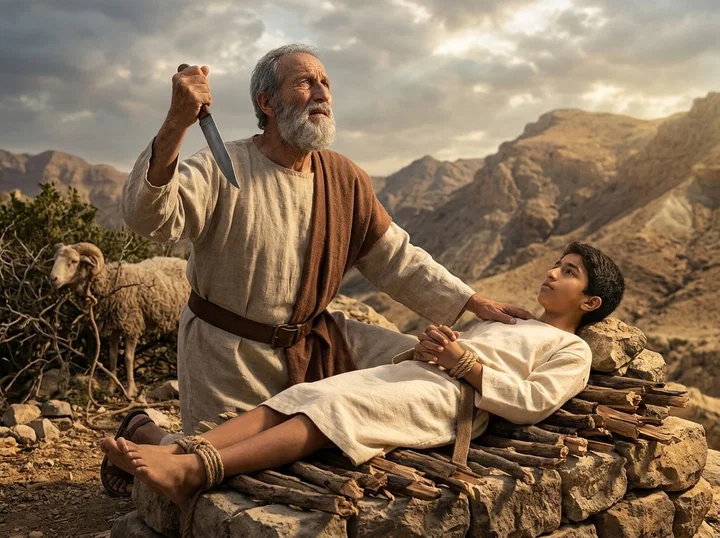
Cross-references 20 of 59
- Hebrews 11:17-19
By faith Abraham, when he was tried, offered up Isaac: and he that had received the promises offered up his only begotten son,
Recounts Abraham offering Isaac as an act of faith.
- Genesis 22:11-13
And the angel of the LORD called unto him out of heaven, and said, Abraham, Abraham: and he said, Here am I.
God stops Abraham, recognizes his obedience, and provides a ram in Isaac’s place.
- Genesis 21:12
And God said unto Abraham, Let it not be grievous in thy sight because of the lad, and because of thy bondwoman; in all that Sarah hath said unto thee, hearken unto her voice; for in Isaac shall thy seed be called.
God identifies Isaac as the line through which Abraham’s promised seed would be called.
- John 3:16
For God so loved the world, that he gave his only begotten Son, that whosoever believeth in him should not perish, but have everlasting life.
Isaac’s near-sacrifice illustrates God giving his Son to save the world.
- Romans 8:32
He that spared not his own Son, but delivered him up for us all, how shall he not with him also freely give us all things?
God gives his Son without sparing him, whereas Abraham’s hand was stopped.
- James 2:21-23
Was not Abraham our father justified by works, when he had offered Isaac his son upon the altar?
Abraham’s willingness to offer Isaac demonstrates faith expressed through obedience.
- Genesis 15:5
And he brought him forth abroad, and said, Look now toward heaven, and tell the stars, if thou be able to number them: and he said unto him, So shall thy seed be.
The promise of descendants like the stars seemed to depend on Isaac.
- 2 Chronicles 3:1
Then Solomon began to build the house of the LORD at Jerusalem in mount Moriah, where the Lord appeared unto David his father, in the place that David had prepared in the threshingfloor of Ornan the Jebusite.
Mount Moriah, associated with Isaac’s offering, became the site of Solomon’s temple.
- Genesis 22:13
And Abraham lifted up his eyes, and looked, and behold behind him a ram caught in a thicket by his horns: and Abraham went and took the ram, and offered him up for a burnt offering in the stead of his son.
A ram is offered in Isaac’s place.
- Genesis 22:16-18
And said, By myself have I sworn, saith the LORD, for because thou hast done this thing, and hast not withheld thy son, thine only son:
God renews the promises and swears to bless the nations through Abraham’s seed because he obeyed.
- Genesis 22:8
And Abraham said, My son, God will provide himself a lamb for a burnt offering: so they went both of them together.
Abraham says God will provide the sacrificial lamb.
- Romans 4:20-21
He staggered not at the promise of God through unbelief; but was strong in faith, giving glory to God;
Abraham trusted God’s promise without wavering, believing God could fulfill it.
- John 8:56
Your father Abraham rejoiced to see my day: and he saw it, and was glad.
Abraham saw Christ’s day by faith and rejoiced.
- Genesis 12:1
Now the LORD had said unto Abram, Get thee out of thy country, and from thy kindred, and from thy father’s house, unto a land that I will shew thee:
Abraham’s earlier obedience to God’s call echoes his obedience in the later command.
- Genesis 15:6
And he believed in the LORD; and he counted it to him for righteousness.
Abraham’s belief in God was counted to him for righteousness.
- Galatians 3:29
And if ye be Christ’s, then are ye Abraham’s seed, and heirs according to the promise.
Those who belong to Christ are Abraham’s seed and heirs of the promise.
- Galatians 3:16
Now to Abraham and his seed were the promises made. He saith not, And to seeds, as of many; but as of one, And to thy seed, which is Christ.
Identifies Abraham’s promised Seed with Christ, through Isaac’s line.
- Genesis 15:2-4
And Abram said, Lord GOD, what wilt thou give me, seeing I go childless, and the steward of my house is this Eliezer of Damascus?
The promised heir makes Isaac’s threatened loss especially weighty.
- John 1:29
The next day John seeth Jesus coming unto him, and saith, Behold the Lamb of God, which taketh away the sin of the world.
The ram offered instead of Isaac foreshadows Christ as the Lamb who takes away sin.
- Hebrews 11:8
By faith Abraham, when he was called to go out into a place which he should after receive for an inheritance, obeyed; and he went out, not knowing whither he went.
Abraham obeyed God’s call and left without knowing where he was going.
Commentary
Each commentary is drawn from primary sources: the writings of Ellen G. White and Adventist pioneers and periodicals. Each commentary is separate. Its own words are not a quotation; follow the references to read the source passages.
Ellen G. White
53 sources
God commanded Abraham alone to take Isaac, his only son of promise through Sarah and the beloved heir in whom his hopes were centered, to the land of Moriah and offer him there as a burnt offering, a three-day journey from his home.ST Mar 27, 1879Lt 110, 1897, par. 1–810MR 118.2–119.1DA 468.3–469.2PP 148.2 It was his last and most severe test, seeming terrible and impossible because it appeared to leave him childless and to contradict God's promise that his seed through Isaac would be as the sand of the sea.GW92 214.1ST Mar 27, 1879Lt 110, 1897, par. 1–8PP 148.3ST Mar 27, 1879 Abraham obeyed promptly without delay, murmur, or reasoning, trusting God's goodness and power to fulfill the promise through Isaac, even believing He could raise him from the dead.GW92 214.1SG3 105.1–106.2Lt 110, 1897, par. 1–8Ms 19, 1886, par. 15–16Ms 96, 1900, par. 18–19 The offering was designed to prefigure the sacrifice of God's Son, with the ram offered in Isaac's place representing the Son of God sacrificed in man's stead, yet unlike Isaac Christ was not spared but suffered crucifixion and death for a guilty race.DA 468.3–469.2STSE 41.2–42.13T 368.1–369.1ST Feb 22, 1899Ms 41, 1898, par. 4–6 It therefore teaches that nothing possessed is too precious to withhold from God, calling for entire surrender of the will and prompt obedient faith that trusts Him irrespective of consequences.Lt 110, 1897, par. 1–8Ms 96, 1900, par. 18–19ST Apr 3, 18793T 368.1–369.1ST May 11, 1876
Words and Historical Setting
“Thine only son” does not deny that Abraham had another son, but identifies Isaac as the only son of promise through Sarah, the one through whom God had said the promise would be fulfilled, with Ishmael left out of account.SG3 105.1–106.2Lt 110, 1897, par. 1–81SP 98.3–99.3ST Apr 3, 1879
Isaac was the tenderly loved, beloved son in whom Abraham’s hopes were centered, the heir of the promised blessing, the light of the home and comfort of his old age, and the joy of his life.ST Mar 27, 1879DA 468.3–469.2PP 148.24T 253.1ST Oct 25, 1910 To lose him even by accident or disease would have brought deep grief, so the loss was felt with special force because of Abraham’s affectionate attachment.Lt 110, 1897, par. 1–8PP 148.2
The startling command was spoken to and heard by Abraham alone, coming in a vision of the night in his home in Beer-sheba when he was about one hundred and twenty years old.ST Mar 27, 1879Lt 110, 1897, par. 1–8STSE 39.2 He was old and longing for rest, and the call came after he had been made to send Ishmael away, which made the demand to slay the one through whom his name was to be perpetuated deeply felt.ST Mar 27, 1879Lt 110, 1897, par. 1–8ST May 11, 1876PP 147.2–148.1
God told him to get to the land of Moriah and offer Isaac there for a burnt offering upon one of the mountains which God would tell him of, the mountain God would identify, near Salem later chosen as Jerusalem.ST Mar 27, 1879STSE 39.2PP 147.2–148.1PP 151.3 The obedience involved a three-day journey and walk with Isaac that gave time to reflect, to look away at every step from things seen to things unseen while temptations pressed upon him, hoping each day that God would revoke the command.ST Mar 27, 187910MR 118.2–119.1Ms 19, 1886, par. 15–16PP 151.3
What was required was dreadfully specific, that Abraham should shed his son’s blood with his own hand, which seemed impossibly dreadful.PP 148.2 He understood the command and that it must be obeyed, yet in his anguish he feared to tell Sarah because her love for Isaac might lead her to hinder the sacrifice.PP 148.4
Nature and Purpose of Test
The command to take Isaac to Moriah and offer him as a burnt offering was Abraham's last and most severe and fearful test of faith, obedience, fear of God, and loyalty.GW92 214.1ST Mar 27, 1879ST May 11, 1876PP 147.2–148.1PP 154.3–155.2 It demanded his beloved and only son of promise, and it came to him alone in a night vision at home when he was about one hundred and twenty years old, old and longing for rest, after he had been made to send Ishmael away, followed by a three-day journey that gave time to reflect.GW92 214.1ST Mar 27, 1879ST May 11, 1876PP 147.2–148.1 More severe than any other, it could not be reasoned out, yet Abraham believed, delighted to obey, stopped reasoning, and came off conqueror, obeying despite anguish without letting feeling or will rebel, until an angel stayed his hand before he harmed Isaac.GW92 214.1Ms 19, 1886, par. 15–16Ms 147, 1899, par. 9 The trial was intended not only for Abraham but to teach heavenly beings about the plan of salvation, for his obedience showed loyalty and disproved Satan's accusations, and when God stopped him and provided a ram in Isaac's place the substitution shed light on how God provides salvation.PP 154.3–155.2 God gave the command to teach Abraham a lesson for his present and eternal good, showing how His people will be tested with the Lord putting His purposes in place of their own devising even when contrary to human desire and the dictates of the flesh.Ms 147, 1899, par. 9
The command seemed terrible, uncalled for, and impossible, appearing to leave Abraham childless and to make the promised descendants impossible.ST Mar 27, 1879ST Mar 27, 1879ST Nov 17, 1881ST Oct 25, 1910 It stood against God's former word heard when called out of Chaldea fifty years before, that his seed through Isaac should be as the sand of the sea for multitude and as the dust of the earth, raising whether the same voice now spoke, whether it was a stranger's voice, whether he was deceived, whether God could contradict Himself, and whether he must cut off the only hope of fulfillment.Lt 110, 1897, par. 1–8PP 148.3 It also seemed to conflict with God's law which forbids killing, and Abraham struggled with doubt, grieved, prayed for confirmation and further light, recalled that the same God had promised Isaac, yet received none and set out to obey without delay.PP 148.3ST Mar 27, 1879 He could have argued that he was too old and weak or that sacrificing Isaac conflicted with the promises concerning him, holding instead to God's stated promise that it would be fulfilled through Isaac and not concluding it must come through Ishmael.ST Mar 27, 1879ST Nov 17, 1881 Age and feebleness gave no excuse, and personal feeling, convenience, and apparent contradiction with promise gave no right to question the command's justice, hesitate, delay, murmur, or reproach; he obeyed without complaint in complete trust.ST Nov 17, 1881ST Oct 25, 1910
God knew how painful the test would be, for the words naming his only beloved son in the promise make that clear.Ms 19, 1886, par. 15–16ST Apr 3, 1879 He has full right to require such experience of His children to give them what they need, and it must not be questioned or excused, for those with perfect confidence never question His dealings.Ms 19, 1886, par. 15–16 The command required Abraham at every step of the three-day walk to look away from things seen to things unseen while temptations pressed upon him.Ms 19, 1886, par. 15–16 He trusted God's goodness and power, believing God meant what He said, sees the end from the beginning, and could raise Isaac from the dead to fulfill the promise of descendants through Isaac.Ms 19, 1886, par. 15–16ST Apr 3, 1879
The trial was given to immortalize through all ages the lesson that the Lord who gave can also take away, that all is His, and that nothing is too precious to give to God.Lt 110, 1897, par. 1–8 Its history was recorded to give strength, courage, and faith to others, teaching that God is the very best friend to be trusted irrespective of consequences.Ms 19, 1886, par. 15–16 It was meant to show loyalty, disprove Satan's accusations, and help angels understand redemption more clearly through the provided ram.PP 154.3–155.2
Abraham's Faith and Obedience
The command tore his soul and filled him with anguish and grief, yet he did not hesitate, delay, murmur, complain, question, or give up, but obeyed promptly and immediately and exactly as commanded, starting at once on the long painful journey.GW92 214.1Ms 96, 1900, par. 18–19Ms 82, 1900, par. 16–17ST May 11, 18764T 144.1–145.1 He refused to let feeling or will rebel, and he carried the work through until heaven interposed to stop him before he harmed his son.GW92 214.1Ms 81, 1898, par. 15ST May 11, 18764T 144.1–145.1 Age and feebleness, deep affection and love, hardship and difficulty gave no excuse for disobedience, and neither personal feeling nor convenience nor the apparent contradiction with the promise gave any right to question, delay, murmur, or reproach.4T 144.1–145.1ST May 11, 18764T 145.2ST Nov 17, 1881ST Oct 25, 1910 Genuine faith requires the whole person surrendered to God and produces good works, and age does not excuse anyone from duty.ST May 11, 18764T 145.2ST Oct 25, 1910
He did not stop to reason the matter out or to question its justice, but obeyed at once without waiting until he could understand it, looking away at every step from things seen to things unseen while temptations and doubts pressed upon him through the three-day walk.Ms 19, 1886, par. 15–16PP 153.3Ms 147, 1899, par. 9Ms 149, 1898, par. 18 He prayed for confirmation and further light and received none, yet he trusted that God was just and righteous and followed the requirement exactly without using the journey to doubt or to excuse himself.PP 148.3ST Mar 27, 1879PP 153.3 On the third day a cloud of glory resting over Moriah confirmed that the command had come from heaven.Ms 19, 1886, par. 15–16PP 148.3ST Mar 27, 1879
He trusted the goodness, power, justice, and righteousness of God, believing that God meant what He said, sees the end from the beginning, and could raise Isaac from the dead.SG3 105.1–106.2Lt 110, 1897, par. 1–8Ms 19, 1886, par. 15–161SP 98.3–99.3ST Apr 3, 1879 Though the demand to slay the one through whom his name was to be perpetuated seemed to leave him childless and to cut off the only hope of fulfillment, he held to the former word that his seed should be as the sand of the sea and as the dust of the earth and that the promise would be fulfilled through Isaac and not through Ishmael, for Isaac was the only son of promise through whom God had said it would come.SG3 105.1–106.2Lt 110, 1897, par. 1–81SP 98.3–99.3ST Mar 27, 1879 This confidence he taught to Isaac as they walked together.Lt 110, 1897, par. 1–8Ms 19, 1886, par. 15–16
In his heart he had made the sacrifice as fully as if he had taken his son's life, thereby showing that he feared God and withheld nothing from Him.Ms 19, 1886, par. 15–16Ms 81, 1898, par. 1510MR 119.21SP 101.2 That faith was counted to him for righteousness, and because he obeyed God renewed the promise to bless and multiply him and to bless all nations in his seed.Ms 19, 1886, par. 15–1610MR 119.2Ms 149, 1898, par. 181SP 101.2 He is registered as the father of the faithful and called the friend of God, and doing such works of obedience is what makes a person a true child of Abraham.Lt 110, 1897, par. 1–8ST Apr 3, 1879Ms 149, 1898, par. 18
When he reached the appointed place he told Isaac what was required, and Isaac consented and submitted because he trusted his father's integrity and believed God had commanded it.10MR 118.2–119.13T 368.1–369.1STSE 39.2 He felt it a privilege and an honor to yield his life as an offering if God would accept him.ST Apr 3, 18793T 368.1–369.1 Then with the knife raised God stopped Abraham before he harmed Isaac, his hand stayed by an angel, and a ram was offered in Isaac's place.GW92 214.1Ms 81, 1898, par. 153T 368.1–369.1
Foreshadowing of Christ's Sacrifice
The command to offer Isaac was given both to test faith and to impress the mind with the reality of the gospel, being designed to prefigure the sacrifice of God's Son for the sins of the world.ST Apr 3, 1879PP 154.1–2 Isaac laid upon the altar in near-sacrifice was a figure of that Son offered for the world, while the ram provided and offered in Isaac's place represented the Son of God to be sacrificed in man's stead.DA 468.3–469.2STSE 41.2–42.13T 368.1–369.1PP 154.1–2 That substitution shows no person can make expiation for himself, for the Son of God alone can bear the world's guilt.DA 468.3–469.2PP 154.1–2
Through anguish and obedience Abraham was permitted to grasp the promise and have the plan of redemption and the self-denial involved in giving a Son to save humanity impressed upon him.STSE 41.2–42.13T 368.1–369.1ST Apr 3, 1879 From his own experience of torture of soul through the dark days of that fearful trial he understood something of the greatness of the sacrifice made by the infinite God for man's redemption and of the greatness of God's love.DA 468.3–469.2PP 154.1–2 He saw in advance the coming Just One, Christ the incarnate Saviour, the Lamb slain for humanity's sins, and rejoiced in the vision of Christ.DA 468.3–469.2 Through the test he was permitted to understand that God accepted the death of His Son to save a rebellious race, and that the Father suffered with His Son.ST Feb 22, 1899
Unlike Isaac, Christ was not spared but endured humiliation, suffering, crucifixion, and a death of agony and shame to save the fallen race doomed to death by transgression of the law.STSE 41.2–42.1PP 154.1–2 The Father's real sacrifice lay in accepting the death of His beloved Son to save a guilty, rebellious race, saying to the sinner, Live, for a ransom is found.ST Feb 22, 1899Ms 41, 1898, par. 4–6PP 154.1–2 The angels who witnessed His humiliation and soul-anguish were not permitted to interpose as in Isaac's case, and there was no voice to cry that it was enough.PP 154.1–2 That giving proves the infinite compassion and love of God and gives assurance that He who delivered up His Son for all will with Him also freely give all things.PP 154.1–2
Abraham had set his feet in the blood-stained path without having to travel it, for when his knife was raised his hand was stayed by an angel.ST Jun 25, 1874 Satan invoked that test to tempt Christ in the wilderness after His long fast, suggesting He need only begin that path and not endure its suffering in self-denial, painful hunger, and death.RH Aug 4, 1874ST Jun 25, 1874 Appearing in light as an angel from the throne, the tempter claimed to be the same angel who had stayed Abraham's hand and to have come now to save Christ's life and help bear part of the work in the plan of salvation.RH Aug 4, 1874ST Jun 25, 1874 Christ rejected that temptation and remained committed to carrying out the plan of redemption fully.RH Aug 4, 1874
Call to Complete Surrender
Nothing held is too precious to give to God, for the dearest treasure belongs to Him and the Lord who gave can also take away.Lt 110, 1897, par. 1–8ST Apr 3, 18793T 368.1–369.1STSE 41.1ST Apr 3, 1879 Isaac stands for anything as dear to the heart as he was to Abraham, so possessions, worldly treasure and wealth, talents, lives, and cherished interests and darling treasures must be laid upon the altar and yielded back for His work when He calls.Lt 110, 1897, par. 1–8ST Apr 3, 1879ST Apr 3, 1879Lt 136a, 1898, par. 18–20 Such surrender gives them true value for saving souls, secures the heavenly benediction, and brings more entrusted to the faithful steward, while holding back nothing decides whether one is rejected or welcomed to inherit the kingdom.Lt 110, 1897, par. 1–8GW92 68.2Lt 136a, 1898, par. 18–20 Complete surrender of the whole human will to God places a person by faith under the protection of Jehovah when obeying His whole will, voice, and law.Ms 96, 1900, par. 18–19Lt 136a, 1898, par. 18–2020MR 26.3–5
The command calls for prompt, immediate, unquestioning, cheerful obedience to every requirement even when startling, terrible, painful, and apparently contradicting promise, without hesitating, delaying, murmuring, questioning, or giving up.Ms 96, 1900, par. 18–19ST May 11, 1876ST Oct 25, 191020MR 26.3–5 Age and feebleness give no excuse from duty, and personal feeling, convenience, affection, and inability to see fulfillment give no right to question, delay, or reproach.ST May 11, 1876ST Oct 25, 1910 True faith is not faith alone but faith joined with trust in God and producing fruits and good works, requiring the whole person surrendered to God.ST May 11, 1876Ms 46, 1891, par. 5 Abraham's experience is the enduring example and measure of extraordinary faith given to give strength and courage and faith, teaching trust in God as the very best friend irrespective of consequences through difficult trials.Ms 19, 1886, par. 15–16ST May 11, 187610MR 119.2LS 97.2–100.2 Believers are to believe His promises and rely on Him regardless of consequences, with assurance that God will provide for His faithful obedient ones even when action brings cost and ridicule.ST Oct 25, 191010MR 119.2LS 97.2–100.2
Solemn duty rests on Christian parents to educate and mould children to have high respect and exalted reverence for God and everything sacred and holy, to regard His claims first, to sacrifice anything for Him, and to exemplify faith by works.ST Apr 3, 1879 Children are taught by Isaac's willing submission to submit to parents and to God, trusting integrity and believing God's command even when the requirement is painful.ST Apr 3, 18793T 368.1–369.1STSE 41.1 The same voice that told Abraham to leave his country for a land God would show commanded the offering, and Abraham believed, delighted to obey, obeyed at once without reasoning it out, and came off conqueror.Ms 149, 1898, par. 18Ms 46, 1891, par. 58MR 356.2 That faith was imputed to him for righteousness, obedience to God's voice and law being essential to favor and blessing, and he was saved by faith in Christ just as the sinner is saved by faith in Christ today.Ms 46, 1891, par. 5Lt 82, 1895, par. 258MR 356.2 Doing such works of obedience is what makes a person a true child of Abraham, commended with the promise that in his seed all nations of the earth would be blessed.Ms 149, 1898, par. 18Lt 82, 1895, par. 25 His going up to Mount Moriah to offer his only son at God's command is held up as the example brethren and sisters are to follow in sowing beside all waters.GW92 68.2RH Dec 15, 1874 They are to meet opposition from selfish motives, bigotry, and prejudice with courage and living faith, not confining labor to their own country or hovering about the churches but going out to the unbelieving world to convert souls to the truth.RH Dec 15, 1874
Sources
Pioneers and periodicals
137 sources
God commanded Abraham to take Isaac, the beloved son who alone bore the promise after Ishmael was set aside, into the land of Moriah to offer him as a burnt offering on a mountain God would show him after a three-day journey.ST Mar 27, 1879ST Nov 22, 1899ST Jun 2, 1881ST Nov 5, 1912ST Sep 8, 1898 It was the severest, supreme and final test of his life, given to prove and perfect faith already formed rather than to allure to evil.ST Dec 28, 1888ST Jun 2, 1881ST Feb 12, 1894 Abraham obeyed at once without questioning or delay, trusting that God would still fulfill the promise through Isaac by raising him even from the dead.ST Nov 5, 1912ST Aug 21, 1901RH Mar 26, 1901ST Feb 26, 1894 Isaac willingly submitted to his father, and together they foreshadowed the Father giving His only-begotten beloved Son to die for guilty humanity.ST May 3, 1899ST Apr 3, 1879ST Nov 5, 1912ST Mar 26, 1894RH Feb 6, 1913 God stopped Abraham and provided a ram in Isaac's place, typifying Christ sacrificed in man's stead, leaving a lasting example that nothing possessed is too precious to surrender to God.ST Apr 3, 1879ST Apr 1, 1875ST Feb 1, 1905ST Nov 22, 1899ST Nov 5, 1912
Words and Historical Setting
The words thine only son mean Isaac was the sole heir of the promise, because Ishmael had been rejected and was not recognized as heir, so that no other offspring could take Isaac's place in the promised seed.ST Jun 2, 1881ST Nov 5, 1912ST Aug 21, 1901ST Sep 8, 1898 Isaac was the son through whom the promise was to be fulfilled, the alone heir to the great promises, the only legitimate son in the line of promise, with no earthly hope of another son to fall back upon.ST Jun 2, 1881ST Nov 5, 1912ST Aug 21, 1901ST Mar 23, 1888 His death seemed to leave no prospect for the promise made nearly fifty years earlier, raising how the promise of possession and posterity would be fulfilled, how Abraham's name and house would be perpetuated, and who would be his heir.ST Aug 21, 1901
The added words whom thou lovest emphasize Abraham's deep affection and make the command especially painful and thorough.ST Jun 2, 1881ST Mar 23, 1888ST Jun 2, 1881RH Feb 5, 1861 Isaac was long looked for and divinely promised, loved above lands and flocks and gold and health, even above his own life, and the repeated naming of him as beloved and only son with Abraham's tender replies shows their close bond.ST Nov 22, 1899ST Feb 26, 1894 The test was thereby made complete, trying whether love for family had become idolatry above God.ST Feb 26, 1894
The command required a burnt offering, a form of worship taught by God in early times.ST Mar 23, 1888RH Aug 17, 1876 Abraham as head of his family offered sacrifices under the patriarchal practice before Moses built the sanctuary, when there was no temple or organized priesthood among men.RH Aug 31, 1911 God Himself chose the place in the land of Moriah, and faithful sacrifice requires obedience to His directions about what to offer, how, and where, not a substitute or way of one's own choosing.ST Nov 5, 1912ST Jun 13, 1900
Abraham was told to go to the land of Moriah and offer Isaac upon one of the mountains which God would tell him of, leaving the exact mountain unnamed until God would show it so he must follow into uncertainty trusting the voice he knew.ST Nov 5, 1912ST Sep 8, 1898ST Sep 8, 1898 The command came in a night vision when Abraham was about one hundred and twenty years old, much older than the nearly one hundred years he was when Isaac was born.ST Mar 27, 1879ST Feb 26, 1894 Then followed a three days' journey that gave time to reflect and to ponder the terribleness of a sacrifice that would leave him childless.ST Mar 27, 1879ST Mar 26, 1894ST Feb 12, 1894
Moriah is the mountain adjoining Jerusalem where Solomon later built the temple, on Ornan's threshingfloor where the angel appeared to David and David erected an altar, built without sound of hammer.ST Nov 5, 1912ST Jan 28, 1886RH Jul 21, 1868RH Sep 12, 1912 It is identified as Mount Zion and linked with Mount Calvary.ST Nov 5, 1912ST Sep 8, 1898 In Abraham's day that place was destitute of inhabitants with no city of Salem yet standing there, proving Jerusalem as a city did not yet exist, in the portion of Canaan later allotted to Judah where Melchizedek ruled.ST Aug 30, 1905RH Jul 21, 1868
The name Moriah is explained as provided by Jehovah.ST Sep 22, 1909 There God revealed Himself as Jehovah-jireh, meaning the Lord will provide, the great eternal Provider and present provider of His creatures' needs.ST Mar 26, 1894ST Jul 26, 1905ST Sep 10, 1902ST Aug 27, 1896 God gave Abraham a sign by which he knew the place when he saw it afar off, a cloud of glory, the presence of holy angels hovering over Mount Moriah, the very spot where the temple was afterward built.ST Feb 12, 1894
Isaac had been given by miraculous power in Abraham's old age and had grown to a comely youth and young man, the pride of his heart.ST Jul 26, 1905ST Feb 12, 1894ST Sep 4, 1901 He was likely a young adult about twenty years old, with the safe range given as twenty to twenty-five years old and the historical estimate as about twenty-three.ST Jul 15, 1913 The command came late in Abraham's old age, when he was old and longing for rest, at the closing of his pilgrimage before his glorification.ST May 11, 1876ST Feb 26, 1894 It came after Abraham left the land of the Philistines and after he had been made to send Ishmael away.ST Mar 27, 1879ST Feb 12, 1894 It followed earlier distrust and failure in seeking the heir, when Abraham had first expected the promised seed through his trusted servant and then through his maidservant Hagar instead of patiently waiting for Sarah's promised son.ST Apr 1, 1875RH Mar 16, 1869ST Feb 12, 1894
Nature and Purpose of Test
The command to take the beloved only son to Moriah for a burnt offering was the severest, supreme, final and most painful test of Abraham's life.ST Jun 2, 1881ST Feb 12, 1894AUST Jun 14, 1920RH Mar 26, 1901ST Feb 26, 1894 It was the real crisis that placed the long-awaited promise of multitudinous seed, anxiously awaited for nearly fifty years, in the balance, and it tried the faith of both father and young son with victory of faith as the outcome.ST Jun 2, 1881ST Feb 12, 1894ST Sep 25, 1901 Coming late in old age at the close of the pilgrimage, when rest of spirit might have been expected, it tested whether love for family had become idolatry above God, for Isaac was the sole heir after Ishmael's rejection, the son through whom the promise must be fulfilled, loved above lands and flocks and gold and health, even above life itself.ST Jun 2, 1881ST Feb 12, 1894ST Feb 26, 1894 No one knows what he can carry until the weight is laid upon him, so the test could only be learned by experience, calling not for boasting or lamenting but for prayerful desire for strength to stand the storm of sorrow.ST Feb 26, 1894 Though the command appeared to conflict with the law against killing, Abraham's faith had grown by believing and obeying so that he could pass without wavering, trusting God could raise Isaac from the dead and still fulfill the promises through him, showing faith perfected through trial and bringing out more fully the promise of the Messiah from his descendants.AUST Jun 14, 1920RH Mar 26, 1901
God tempted Abraham in the Bible sense of testing and proving him, not of alluring him to evil. The dreadful direction to offer Isaac was only the means applying the test, and whatever was attractive or dreadful in it was never the main issue. The test was everything, for Abraham was proved to fear God and to be unreservedly on God's side by not withholding his son, his only son, so that the dread ending was suspended.ST Failure in it would have unfitted Abraham to be the factor God wanted him to be in His plan. To fight for Christ in the sight of the heavenly universe is to look calmly upon every foe by faith under an omnipotent command rather than following human wisdom or the wisdom of the archdeceiver, obeying when God speaks no matter how the enemy tempts to disobey, for the path of obedience is the only safe path.ST Mar 12, 1912
The trial did not expose a defect in character but found character already formed.ST Dec 28, 1888ST Jul 22, 1908 Abraham recognized the voice as coming from God and his actions showed no doubt, though the command to offer the beloved son of promise brought profound human anguish.ST Dec 28, 1888 His obedience, culminating in binding Isaac on the altar and raising the knife, grew out of years of walking with God and becoming stronger in faith through a life of trust and obedience.ST Jul 22, 1908 God gave him strength to endure and obey, and faith triumphed.ST Dec 28, 1888
God used the test to teach Abraham to trust Him and to trust Him fully through progressive dealings and repeated lessons.ST Feb 1, 1905ST Dec 20, 1910 It belongs to a chapter that presents a culminating lesson of faith, confirmed by God's unchanging promise and oath.ST Jan 9, 1912 Faithful sacrifice requires obedience to God's directions about what to offer, how, and where — not a substitute or a way of one's own choosing — and in submitting completely to the One who had given all, Abraham's faith was perfected.ST Jun 13, 1900 The lesson of faith was rehearsed by an object lesson stronger than words, disciplining through suffering and obedience.ST Dec 28, 1888ST Jul 22, 1908 Its great purpose was the blessing it would bring to others, becoming a lasting encouragement to God's people in their own severe trials.ST Dec 28, 1888
The command and its later reversal made a case of apparent contradiction and disappointment, but did not mean God was absent from the work.RH The command seemed to contradict the promise that descendants would come through Isaac, bringing grief and seeking for confirmation and further light that was not given, yet Abraham set out to obey.ST Mar 27, 1879RH Aug 7, 1866 Release came from the same divine authority that gave the command.ST Dec 7, 1882 The express divine command gave warrant for the act and changed its nature, unlike an act undertaken without such a command, so that obedience leading to death would have glorified God and would not have been murder or self-murder.RH Oct 30, 1855RH Oct 29, 1861
God required complete consecration, not Isaac's death, and the sacrifice was withheld when obedience was shown.ST Feb 26, 1894 The command to offer the only son grown to young manhood, through whom promises of extensive possessions and innumerable seed were to continue, was a trial meant to prove an example to all succeeding generations, a seeming end to all hopes and to all prospect of fulfilling the promises, equivalent to human logic to giving up the divine purpose altogether.ST Sep 4, 1901 In it God hung the whole plan of salvation on the thread of Abraham's faith, yet He risked nothing because He knew Abraham would prove faithful and had placed the power of the Holy Spirit underneath his frail humanity.ST Sep 4, 1901 Though the command appeared to contradict the promise and to be unjust, Abraham obeyed without wavering, and God resolved the apparent conflict and showed how His word would be fulfilled.RH Aug 7, 1866
God would never require parents to take their children's lives as offerings to Him.ST May 3, 1899 The true command to offer Isaac as a burnt offering was not recorded to teach sacrifice of children as the Ammonites sacrificed to Moloch.RH Mar 11, 1873 It was recorded as history to teach a lesson in faith, confidence, and obedience, with confidence that all would be right in the end because the command came from the highest authority, and with Isaac willingly obedient.RH Mar 11, 1873 At Moriah Abraham gained a clearer and broader view of God's love, sacrifice, and care.ST Oct 31, 1906 There God proves professed surrender and unworldliness by laying death on the choicest ideal and sweetest expectation, bringing crushing darkness and woe of riven hopes that inexperience has not yet felt, under which rod Abraham was brave.ST Feb 26, 1894
Abraham's Obedient Faith
Abraham knew the command was the voice of God and met it with prompt, unquestioning obedience, without murmuring, delay, excuse, or human reasoning, rising early in the morning, cleaving the wood, journeying with Isaac to the place, building the altar, binding his son, and raising the knife until God stopped him.ST May 11, 1876ST Nov 17, 1881ST Oct 25, 1910ST Feb 26, 1894ST Feb 12, 1894 He did not hesitate over whether Satan had come as an angel of light to deceive him, and he did not confer with flesh and blood, for to do so would have been to fail God.RH Mar 26, 1901ST Feb 12, 1894 His rising early and obeying at once showed perfected, simple faith that acts promptly on a plain command because trust in God's wisdom is stronger than even fatherly love.ST Oct 25, 1910ST Feb 12, 1894 The command called for childlike simplicity of trust in mighty supernatural faith.RH Mar 26, 1901
Neither age nor feebleness nor affection nor difficulty gave excuse or any right to question, delay, murmur, or reproach, even though the command seemed terrible and uncalled for and seemed to conflict with the promises concerning Isaac.ST May 11, 1876ST Jan 20, 1887ST May 11, 1876ST Nov 17, 1881ST Oct 25, 1910 Abraham could have argued that he was too old and weak or that he longed for rest, but age does not excuse anyone from duty.ST May 11, 1876ST May 11, 1876ST Nov 17, 1881 He did not conclude the promise must come through Ishmael, nor did he consult Sarah or go to the minister.RH Mar 26, 1901 Personal feeling, convenience, and apparent contradiction with promise gave no warrant to hesitate or complain, but required implicit trust and immediate, unquestioning, cheerful obedience.ST Oct 25, 1910
He knew the Lord's voice by living with Him in daily secret communion as a most real intimate friend, as a father or mother or dearest friend is known, and by yielding all without reservation to know the leadings of the Holy Spirit.ST Apr 1, 1875ST Apr 3, 1879RH Mar 26, 1901 After a lifetime of learning to trust God's wisdom above human wisdom and works, having first expected the promised seed through his trusted servant and then through his maidservant and having been corrected, he now left no room for evasion.ST Apr 3, 1879ST Feb 12, 1894 The command was an actual divine message, not an overpowering impulse arising within him, and the rule remains to follow God's revealed word rather than feelings and impressions.RH Mar 26, 1901ST Jul 7, 1887 Treating it as a passing inner impulse would make the later call not to harm Isaac seem like an impulse suddenly passing away, undermining the sense and consistency of the account.ST Jul 7, 1887
He trusted that God could still fulfill the promise that descendants would come through Isaac by raising him even from the dead and restoring him from the ashes.ST Aug 21, 1901RH Jul 3, 1900AUST Jun 14, 1920RH Mar 16, 1869 Since Isaac was the only child promised and the alone heir to the great promises, with Ishmael decidedly rejected from being heir, the command appeared to take away everything pledged and to cut off Abraham's own hope of salvation and the world's hope through the promised Messiah to come through Isaac's posterity.ST Nov 5, 1912RH Jul 3, 1900 The greatness of the promised possession and posterity added to his anguish, raising how the promise would be fulfilled, how his name and house would be perpetuated, and who would be his heir if Isaac were slain. Yet he did not waver, believing the same God who had miraculously given Isaac in old age could bring him back from the dead to fulfill the promise made nearly fifty years earlier.ST Nov 5, 1912ST Aug 21, 1901 So fully did he resign his son that Isaac was to him as one already slain, and being saved to him was as receiving him in a figure from the dead.
Those who hold that no substitute was expected teach that Abraham faced a real test and trusted God to raise Isaac from the dead rather than expecting God to provide a substitute.ST Jul 7, 1890 His obedience showed faith perfected through trial and brought out more fully the promise of the Messiah from his descendants.AUST Jun 14, 1920 By preparing for the sacrifice and going up the mountain he showed faith through works and demonstrated trust in God, establishing him as a faithful servant and father of the faithful.AUST Jun 14, 1920ST Aug 30, 1877 His action made his faith evident and complete; the work did not replace faith but grew out of it and showed that it was living.ST Mar 23, 1888RH Mar 20, 1855 The test calls for visible proof of faith, not merely inward consent, and he performed it as a privilege rather than as a way to earn merit, depending on God's grace and recognizing his own unworthiness, leaving consequences to God while faith worked with obedience unto maturity.RH Mar 19, 1861RH Mar 20, 1855ST Oct 31, 1878
In that supreme trial he strengthened himself by recalling the evidence of God's goodness and faithfulness, rather than letting appearances contrary to God's character overwhelm him.RH Jun 7, 1906 By standing the test he redeemed the stain of earlier distrust and weakness over wanting his servant Eliezer to be his heir and over taking Hagar instead of patiently waiting for God's promise.ST Apr 1, 1875RH Mar 16, 1869RH Apr 8, 1875 Through that obedience, by the grace of God, his earlier weakness and unbelief were canceled and he attained truly wonderful, absolutely trustful faith.RH Apr 8, 1875ST Sep 8, 1898 His willingness to obey vindicated his character, restored it, brought Heaven's approval, and obtained for him the titles Father of the faithful and Friend of God.RH Mar 16, 1869RH Mar 16, 1869ST Sep 8, 1898ST Sep 17, 1896
When his obedience was shown God stopped him in the direst hour of his life, commanding him to stay his hand when he raised the knife.ST Jun 3, 1908RH Dec 2, 1915ST Mar 26, 1894 The Angel of Jehovah watching over him and calling from heaven declared that he feared God, thereby making his love and faith known to the universe.ST Jun 3, 1908RH Dec 2, 1915 God affirmed his faithfulness and then promised blessing through his seed to all nations.RH Dec 2, 1915 A sacrifice was still offered, for God provided a ram caught in the thicket as a substitute in Isaac's place, and there He revealed Himself as Jehovah-jireh, meaning the Lord will provide.ST Mar 26, 1894ST Jul 26, 1905RH Jun 8, 1916 He was willing to own his faith even before a scoffing multitude, and the trial of his true character stands proved.RH Nov 26, 1861
Isaac in the Trial
Isaac willingly submitted to being laid on the altar and cheerfully obeyed his father, though as a strong youth he could have resisted or escaped if he had chosen.RH Feb 6, 1913AUST Jun 14, 1920ST Dec 22, 1914 He felt it a privilege and an honor to yield his life as an offering if God would accept him.ST Apr 3, 1879 His willing surrender was sustained by love and reverence for God and by love for his father, reflecting the reverence and respect taught him at home.RH Feb 6, 1913ST Dec 22, 1914 His willing participation also helped reveal the voluntary offering of God's Son to save humanity, making Isaac a type of Him who freely gave Himself.AUST Jun 14, 1920ST Aug 2, 1910 Laid upon the altar at God's command, he was then restored as though alive from the dead when the angel stopped Abraham and God provided a ram caught in the thicket as a substitute offering in his place.RH Jun 8, 1916
The repeated naming of Isaac as the beloved and only son makes the command especially wrenching and presses deeply upon a parent's love.ST Nov 22, 1899ST Nov 5, 1894 Abraham's tender replies to Isaac show their close bond of affection.ST Nov 22, 1899 The story thus brings a parent's anguish into view, and brings also the depth of a mother's love and the sorrow such a sacrifice would cause into view.ST Nov 5, 1894ST Sep 21, 1882 Yet the trial affirms that God is good and will not try anyone beyond strength.ST Nov 5, 1894ST Sep 21, 1882 Abraham's confidence that God would provide a lamb is fulfilled when the Lord provides.ST Nov 22, 1899
Isaac's carrying the wood for the burnt offering is linked with Christ, the beloved Son who carried the wood for His own sacrifice.ST Sep 8, 1898 Abraham and Isaac's experience together parallels the Father and the Son before and at Calvary, with the promises bound up in the beloved only son.ST Sep 8, 1898ST Sep 8, 1898 The command was the real crisis of Abraham's life, placing the long-awaited promise of multitudinous seed in the balance, and it tried not only Abraham's faith but also the faith of his young son Isaac, ending in the victory of faith that overcomes the world.ST Sep 25, 1901 The journey to Moriah gave Abraham opportunity to teach Isaac lessons of faith and love, while trusting that God would keep His promise even if He had to raise Isaac from the dead.ST Sep 22, 1909
Foreshadowing of Christ
Of all the sacrifices in Genesis this offering comes nearest to the great antitypical offering of Christ, prefiguring the Father's self-denial in giving His beloved only-begotten Son to die for guilty humanity.ST Apr 3, 1879ST Nov 5, 1912ST Mar 26, 1894ST Jul 26, 1905RH Feb 6, 1913 The test was not only the giving up of an only son but the giving up of the promised Messiah who was to come through Isaac's posterity, thus seeming to cut off Abraham's own hope of salvation and the world's hope.ST May 3, 1899ST Nov 5, 1912 Abraham's grief and obedience on the three days' journey to Moriah, building the altar, laying the wood, binding his son and raising the knife until God stayed his hand in the direst hour of his life, help show the reality of the Father's suffering and sacrifice.ST May 3, 1899ST Apr 3, 1879ST Mar 26, 1894RH Feb 6, 1913 The command and provision demonstrate God's love and foreshadow Heaven's best Gift, sustained by Abraham's love and reverence for God while Isaac willingly submitted rather than escape, giving only a faint picture of God's greater sacrifice.ST Jul 26, 1905RH Feb 6, 1913 The description of Isaac as an only and beloved son points to Christ as the antitype who is an only Son and the Son of God's love, whose unique sacrifice and life and blood redeem the world.ST Oct 25, 1905ST Jul 26, 1905
God provided a lamb and a ram caught in the thicket as a substitute to offer in Isaac's place, graciously saving Isaac from death.ST Feb 1, 1905ST Nov 22, 1899ST Sep 20, 1883ST Mar 26, 1894 That substitute typified the only-begotten Son of God sacrificed in humanity's place, the great sacrifice who died for the sin of the world and shows the Lord provides a sure refuge and salvation.ST Nov 5, 1912ST Sep 20, 1883ST Mar 26, 1894 In the light of the cross, the climax of sacrifice, all common blessings of light, air, water, bread and life itself are blood-bought gifts from His hand.ST Jul 26, 1905 Through the ordeal Abraham saw the day of Christ in advance and grasped the promise, seeing the coming Just One, the incarnate Saviour and Lamb slain for sins, and rejoiced, coming to understand that God gave His only-begotten Son to save sinners in a greater sacrifice than any human could make.ST May 3, 1899 The Angel of Jehovah who watched over Abraham on the way from Hebron to Mount Moriah and called from heaven when the knife was raised, declaring that he feared God, is the Son of God, thereby making Abraham's love and faith known to the universe, while pointing to Christ who would later die as mankind's ransom without the stroke of wrath being turned away.ST Jun 3, 1908
Abraham's faith to obey was enabled and sustained by faith in God's gift of His only-begotten Son and by covenant relationship with God.ST Jun 3, 1908 The promised Seed and salvation come by God's power through Sarah, not by human schemes, for Isaac the promised son and heir through whom the seed would come was born by God's power after human weakness had tried in its own way what God had promised to do.AUST Jun 14, 1920ST Apr 11, 1900STST Mar 1, 1905ST Jan 14, 1913 In figure Abraham received his son back from the dead, demonstrating that the promised inheritance depended on God's power, and bringing out more fully the promise of the Messiah from his descendants through Abraham's Seed, Christ, in whom the promise concerning a restored earth comprehending the whole world was to be realized.AUST Jun 14, 1920ST Apr 11, 1900ST Mar 1, 1905ST Jan 28, 1903 The promised Redeemer was still held in the promise, not yet present in the flesh, so Abraham left fulfillment wholly to God, trusting God's word even though the command appeared to conflict with the law against killing.AUST Jun 14, 1920ST Apr 11, 1900 By offering and receiving back Isaac Abraham was taught that death and a resurrection were to take place before his seed received the inheritance, just as affliction and oppression were to befall his posterity before they possessed the land.ST Jun 2, 1881RH Aug 28, 1900 Isaac's sacrifice foreshadowed Christ, Abraham's seed and the true heir, who had to suffer before entering His glory, and the saints likewise suffer and await the resurrection before they can inherit their holy and eternal inheritance, proving the faith of the patriarchs looked beyond temporal blessings to the realities of the life to come.ST Jun 2, 1881RH Aug 28, 1900ST Jun 30, 1881
Doctrinal and Prophetic Teachings
The very mountain in the land of Moriah where Abraham was to offer Isaac later held Ornan's threshingfloor where the angel appeared to David and David erected an altar, where Solomon built the temple without sound of hammer, identified as Mount Zion where God's glorious everlasting city and sanctuary will stand forever and never again fall to the enemy.ST Nov 5, 1912 This same spot later selected for God's temple was promised to be covered by the heavenly Jerusalem.RH Sep 12, 1912
The offering up of Isaac marks the starting point for the four-hundred-year period during which Abraham's descendants would be strangers and subject to others, distinguished from the four-hundred-thirty years which began with God's first call to Abraham.ST Sep 26, 1911 Abraham's trust that God would fulfill His word even at the cost of Isaac, through whom the great blessing to mankind, the Messiah, was promised, is reckoned for righteousness.RH Oct 23, 1866RH Jan 14, 1904RH Apr 9, 1908 That inward trust, counted righteous when he believed, was then made visible by outward obedience when he walked forward without refusing because he could not see the reason.RH Oct 23, 1866 Isaac's birth by God's power had taught that human flesh could not bring about the promise, so Abraham's faith rested on God's word rather than on Isaac's visible physical life, believing God could restore life to the dead and receiving Isaac back from death, while the promised Seed, the Redeemer, was still held in the promise and not yet present in the flesh, with fulfillment left wholly to God.RH Jan 14, 1904RH Apr 9, 1908 Abraham's raising the knife shows his conviction that sin requires blood to be shed for its expiation. Abraham's experience illustrates the old and the new covenants, because through human weakness and temporary lack of faith he first tried in his own way with Hagar what God had promised to do for him, then learned the promised seed comes by God's power.ST Sep 23, 1913
God's moral law tested Abraham's faith and confidence, even to the extremity of offering Isaac, in contrast to merely claiming belief.RH Dec 15, 1868 Those who held the distinction taught that the command to offer Isaac was a personal requirement given to Abraham, contrasted with the general law that governs human conduct.RH Dec 25, 1856 Satan invoked Abraham's test to tempt Christ in the wilderness, claiming he had stopped Abraham from killing Isaac and had come as an angel from the throne to save Christ from hunger and death, so Christ need only begin the blood-stained path and not endure its suffering.RH Aug 4, 1874ST Jun 25, 1874ST Jul 12, 1910 The tempter argued that God only designed to prove Christ's willingness to endure and did not require Him to pass through self-denial, painful hunger and death from starvation, and urged Him to turn a stone into bread after His long fast, claiming to be the same angel who stayed Abraham's hand when his knife was raised and Abraham's feet were set in the blood-stained path without having to travel it.RH Aug 4, 1874ST Jun 25, 1874ST Jul 12, 1910 Christ rejected this temptation and remained committed to carrying out the plan of redemption fully.RH Aug 4, 1874
Claims by a father to sacrifice his son in obedience to a divine command like Abraham's are fanatical and do not justify murder, as seen when a California father claimed God had ordered him to sacrifice the son he loved on Moriah's pattern.ST Nov 16, 1882ST May 20, 1897 Some interpreters explain the verse away by claiming Abraham only dreamed he had been commanded to offer his son as a burnt offering.ST Feb 15, 1877 The ordeal of God's people when a death decree is issued will be as severe as Abraham's test when God called him to offer Isaac, his only son whom he loved, whether or not the decree is carried out, for God may deliver them as He delivered Isaac.RH Mar 28, 1854RH Jul 9, 1857 Abraham's offering of his beloved son Isaac is one of the trials that typified the travels and trials of the church, of which Abraham was in a sense the father.RH May 14, 1867
Example for Believers
The command to yield up beloved Isaac stands recorded in sacred history for the benefit of believing children as the test and proof of faith, teaching implicit confidence in God, perfect obedience to His requirements, and complete surrender to the divine will.ST Apr 3, 1879ST Oct 25, 1910ST Apr 1, 1875 It was given in old age and seemed terrible and uncalled for and contrary to promise, yet age and feebleness gave no excuse and feeling, convenience, and apparent contradiction gave no right to question, delay, murmur, or reproach, so the required obedience is immediate, unquestioning, and cheerful.ST Oct 25, 1910RH Feb 21, 1856 For this obedience approval was given with the name Father of the faithful, and those who profess faith are called to follow in denying self and yielding up darling treasures, proving that nothing possessed is too precious to give to God because the dearest treasure belongs to Him.ST Apr 3, 1879ST Apr 1, 1875 Isaac's willing readiness shows genuine faith, obedience, and surrender, for he knew God's voice, trusted the promises, and would have returned to God whatever belonged to Him.ST Apr 1, 1875ST Apr 3, 1879
Isaac represents whatever is dearest to a person, including possessions and worldly wealth, treasured interests and dearest friends, and Abraham's willingness to offer him tests whether love and faith are genuine in yielding to God what is loved most.ST Apr 1, 1875ST Apr 3, 1879RH Sep 11, 1856ST Oct 31, 1878 Believers must therefore be willing to surrender possessions and worldly treasure to God, doing the work He gives and investing means in His cause for human good as proof of love that trusts His guiding hand, which is the faith that prepares for translation.ST Apr 3, 1879ST Oct 31, 1878 Complete surrender is illustrated when the dependent gives up even the support leaned upon with the blind faith of Abraham, and such a gift is accepted and returned.ST Jan 10, 1900 What is thus surrendered gains its true value, for the far greater sacrifice of God's Son for sinful humanity makes self-denial and service in saving others an honor to those who value the atonement.ST Apr 1, 1875
Abraham's trial did not expose a defect of character, for he recognized the command as from God and acted without doubt, though offering Isaac the beloved son of promise brought profound human anguish.ST Dec 28, 1888 God gave him strength to endure and obey so that faith triumphed, and his example became a lasting encouragement to God's people in their own severe trials.ST Dec 28, 1888RH Apr 28, 1868 God is good and will not try anyone beyond strength, a truth that brings a mother's love and sorrow into view while upholding trust under a parent's deepest pressure.ST Nov 5, 1894ST Sep 21, 1882 Victory comes when God is prized above every earthly tie or treasure, and communion with Him brings daily victory culminating in glorious rest, which encourages aged Christians to trust because Abraham's heart-piercing test that allowed no substitute ended well.ST Apr 20, 1915ST Apr 7, 1914 His unfaltering stand under the severest test required of a mortal calls God's people to faith and self-sacrifice.RH Apr 28, 1868
Solemn duty rests on Christian parents to educate and mould children to have high respect and exalted reverence for God and everything sacred, to regard His claims first, to sacrifice anything for Him, and to exemplify faith by works.ST Apr 3, 1879 Abraham's steady instruction at home and throughout daily life prepared his son for submission, so that Isaac, who could have objected, loved his father and cheerfully obeyed and felt it a privilege and honor to yield his life if God would accept him.ST Apr 3, 1879ST Dec 22, 1914RH Apr 17, 1900 Parents may even be called to sacrifice an only child for God, and they must not withhold from God what belongs to Him.RH Dec 2, 1915
Those who have sinned through love of the world are to follow Abraham's extreme stand of obedience, by which he trusted God, redeemed the stain of the past, vindicated character, and stood as an especially excellent example of faith.RH Mar 16, 1869 They should decisively oppose former weakness, answering covetousness with great liberality and neglect with active care for orphans.RH Mar 16, 1869 They are to sow beside all waters and go out to the unbelieving world to convert souls to the truth, not confining labor to their own country or hovering about the churches, but meeting opposition from selfish motives, bigotry, and prejudice with courage and living faith as in going up to Moriah to offer an only son.RH Dec 15, 1874 This willing sacrifice gives depth to Christian life through cross-bearing and scrupulous obedience rather than breadth and pursuit of worldly pleasure, in opposite contrast to the dubious godliness of Lot in the plains of Sodom.
Abraham's willingness to offer Isaac, the son he loved, at great personal cost is the measure of the faith required to obey God when obedience appears foolish to others and demands giving up what is most precious.RH Apr 21, 1868ST Mar 7, 1878RH Oct 6, 1904 That same faith was required to act on the solemn proclaimed truth of the 1844 message of Christ's near coming, venturing everything rather than holding back from fear or doubt despite risk of mockery and loss of life.LS 97.2–100.2ST Mar 7, 1878RH Aug 10, 1905 Those who truly trusted the message would risk ridicule, loss, and life, giving themselves wholly to God, being dead to the world, and making individual preparation to meet the Lord in complete consecration.LS 97.2–100.2ST Mar 7, 1878RH Aug 27, 1914
Moriah teaches daily discipleship in which natural affection is brought into submission to God's higher law in faithfulness to His glory, amid the struggle with sin and the bearing of the cross permitted in each life.ST Aug 22, 1878RH Apr 30, 1914 Setting worldly concerns aside to draw near to God, as in going up the mountain to offer sacrifice and meet Him, and yielding fully, brings to a place of communion and blessing and spiritual privilege.ST Nov 9, 1882RH Aug 5, 1909 By giving up Isaac, Abraham reached his final victory and learned to lean wholly upon God when left without human support, and such sacrifice can awaken a sense of the love shown at Calvary.RH Apr 30, 1914ST Feb 7, 1911 Yet no special mountain must be ascended, for access to God is open everywhere by prayer.ST Nov 9, 1882 The reading of this test applies directly to personal obedience by asking how one meets God's tests.
The giving up of Isaac, in whom Abraham's hopes rested both for this life and as ancestor of the coming Saviour, was his hardest separation and final victory.RH Aug 5, 1909ST Feb 7, 1911 God called him to stand alone once more, perhaps because he was looking more to Isaac than to the God who had given him.RH Aug 5, 1909
Sources