Genesis 21:5
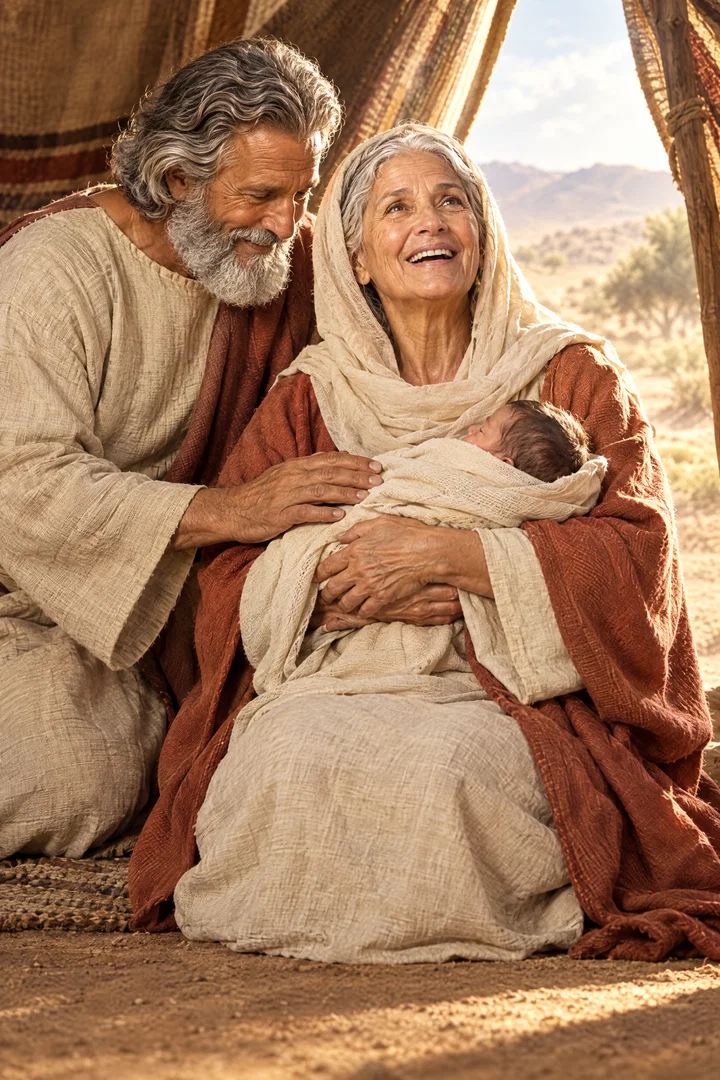
And Abraham was an hundred years old, when his son Isaac was born unto him.
Translations
And Abraham was an hundred years old, when his son Isaac was born to him.
King James Version, KJV Cambridge Paragraph Bible, Revised Version
And Abraham was an hundred years old, when his son Isaac was born unto him.
And Abraham was a hundred years old, when his son Isaac was born to him.
And Abraham was a hundred years old, when his son Isaac was born unto him.
And Abraham [is] a son of a hundred years in Isaac his son being born to him,
And Abraham was a hundred years old when his son Isaac was born to him.
Now Abraham was a hundred years old,—when Isaac his son was born to him.
Berean Standard Bible, Majority Standard Bible
Abraham was a hundred years old when his son Isaac was born to him.
Abraham was one hundred years old when his son, Isaac, was born to him.
Now Abraham was a hundred years old when the birth of Isaac took place.
So Abraham was an hundreth yeere olde, when his sonne Izhak was borne vnto him.
Douay-Rheims (Challoner revision)
When he was a hundred years old: for at this age of his father was Isaac born.
Pictures
Cross-references 20 of 28
- Galatians 4:22-31
For it is written, that Abraham had two sons, the one by a bondmaid, the other by a freewoman.
Isaac’s birth illustrates believers as children of promise and the contrast between bondage and freedom.
- Genesis 12:2
And I will make of thee a great nation, and I will bless thee, and make thy name great; and thou shalt be a blessing:
God promises Abraham a great nation, beginning the twenty-five-year wait for Isaac’s birth.
- Genesis 17:17-19
Then Abraham fell upon his face, and laughed, and said in his heart, Shall a child be born unto him that is an hundred years old? and shall Sarah, that is ninety years old, bear?
Abraham’s age underscores the impossibility of Isaac’s promised birth.
- Genesis 16:1-4
Now Sarai Abram’s wife bare him no children: and she had an handmaid, an Egyptian, whose name was Hagar.
Abraham and Sarah seek the promised heir through Hagar before Isaac’s birth.
- Genesis 22:1-14
And it came to pass after these things, that God did tempt Abraham, and said unto him, Abraham: and he said, Behold, here I am.
Isaac, the promised son, is the focus of Abraham’s severe test of faith.
- Genesis 18:10-14
And he said, I will certainly return unto thee according to the time of life; and, lo, Sarah thy wife shall have a son. And Sarah heard it in the tent door, which was behind him.
God promises Sarah a son at an appointed time despite the couple’s age.
- Genesis 15:4-6
And, behold, the word of the LORD came unto him, saying, This shall not be thine heir; but he that shall come forth out of thine own bowels shall be thine heir.
God promised Abraham an heir from his own body, and Abraham believed.
- Hebrews 11:11
Through faith also Sara herself received strength to conceive seed, and was delivered of a child when she was past age, because she judged him faithful who had promised.
Sarah received strength to conceive through faith.
- Hebrews 11:17-19
By faith Abraham, when he was tried, offered up Isaac: and he that had received the promises offered up his only begotten son,
Abraham’s faith is shown in his willingness to offer Isaac, trusting God with the promises.
- Genesis 12:4
So Abram departed, as the LORD had spoken unto him; and Lot went with him: and Abram was seventy and five years old when he departed out of Haran.
Abraham left Haran at seventy-five, twenty-five years before Isaac was born.
- Genesis 21:9-10
And Sarah saw the son of Hagar the Egyptian, which she had born unto Abraham, mocking.
Ishmael’s mocking of Isaac marks the beginning of Isaac’s affliction.
- Genesis 25:26
And after that came his brother out, and his hand took hold on Esau’s heel; and his name was called Jacob: and Isaac was threescore years old when she bare them.
Gives Jacob’s birth sixty years after Isaac’s.
- Genesis 17:21
But my covenant will I establish with Isaac, which Sarah shall bear unto thee at this set time in the next year.
Foretells Isaac’s birth to Sarah at the appointed time.
- Romans 9:9
For this is the word of promise, At this time will I come, and Sara shall have a son.
Quotes the promise that Sarah would have a son.
- Matthew 1:1-2
The book of the generation of Jesus Christ, the son of David, the son of Abraham.
Jesus’ genealogy traces his descent from Abraham through Isaac.
- Genesis 15:5
And he brought him forth abroad, and said, Look now toward heaven, and tell the stars, if thou be able to number them: and he said unto him, So shall thy seed be.
God promises Abraham a numerous seed.
- Galatians 4:23
But he who was of the bondwoman was born after the flesh; but he of the freewoman was by promise.
Contrasts Abraham’s son born after the flesh with the son born through promise.
- Genesis 22:17-18
That in blessing I will bless thee, and in multiplying I will multiply thy seed as the stars of the heaven, and as the sand which is upon the sea shore; and thy seed shall possess the gate of his enemies;
The oath confirms blessing through Abraham’s seed.
- Genesis 15:13-14
And he said unto Abram, Know of a surety that thy seed shall be a stranger in a land that is not theirs, and shall serve them; and they shall afflict them four hundred years;
The predicted four hundred years of affliction are reckoned from Isaac’s birth.
- Romans 9:8
That is, They which are the children of the flesh, these are not the children of God: but the children of the promise are counted for the seed.
Distinguishes the children of promise from the children of the flesh.
Commentary
Each commentary is drawn from primary sources: the writings of Ellen G. White and Adventist pioneers and periodicals. Each commentary is separate. Its own words are not a quotation; follow the references to read the source passages.
Ellen G. White
1 source
Abraham was one hundred years old when his son Isaac was born to him.PP 757.2 His age at Isaac's birth anchors chronology, showing that Shem lived fifty years after Isaac's birth.PP 757.2 By that overlapping of lives, knowledge was passed through the generations from Adam to Isaac and onward to Jacob.PP 757.2
Sources
Pioneers and periodicals
27 sources
Abraham was one hundred years old, and Sarah ninety, when Isaac was born to them at the set time God had declared.ST Apr 11, 1900ST Mar 1, 1905 His birth came twenty-five years after God's promise and call, reckoned from Genesis 12:1-4 when Abraham was seventy-five years old and left Haran.ST Jun 4, 1885ST Aug 9, 1910ST Feb 4, 1889 It was miraculous and contrary to human nature, to elderly and barren parents past age by God's power, fulfilling the repeated promise through Sarah the lawful free wife after the fleshly scheme through Hagar had produced Ishmael but had not fulfilled the promise.ST Apr 11, 1900ST Mar 1, 1905RH Jul 5, 1915ST Sep 28, 1915 Sarah received strength to conceive through faith, and Abraham's trust despite natural impossibility through long waiting and testing is the faith by which he was counted righteous and the model of standing firmly on God's word.RH Mar 16, 1869ST Mar 5, 1912 His two sons represent the children of the two covenants, Ishmael born after the flesh through human effort and Isaac born of promise and of the Spirit through faith, and Isaac is the miraculous child through whom the promised Seed was to come, for in Isaac shall the seed be called.ST Apr 11, 1900RH May 29, 1900ST Mar 1, 1905RH Nov 18, 1862ST Mar 22, 1899
Birth and Chronology
Abraham was one hundred years old and Sarah ninety when their son Isaac was born to them at the set time God had declared.ST Apr 11, 1900ST Mar 1, 1905RH Mar 16, 1869 The birth was the fulfillment of God's repeated promise that Sarah, the lawful free wife, would bear Abraham a son, accomplished by divine power at an advanced age despite earlier failure and perplexity.ST Apr 11, 1900ST Mar 1, 1905RH Mar 16, 1869 It proved that the promised seed and its blessing come in God's way and by God's power through the free wife according to God's law, not by human unbelief, planning, or fleshly schemes.ST Apr 11, 1900ST Mar 1, 1905
Isaac's birth belongs within God's progressive and providential dealings with Abraham's family as the chosen progenitors of the Seed, from the call through the growth of Abraham's trust to the arrangements for Isaac's marriage.ST Dec 20, 1910ST It came shortly after the destruction of Sodom, which occurred just before he was born.ST Oct 4, 1883
Twenty-five years elapsed between God's promise and call to Abraham and Isaac's birth, reckoned from Genesis 12:1-4 when Abraham was seventy-five years old and left Haran.ST Jun 4, 1885ST Aug 9, 1910ST Feb 4, 1889RH Feb 12, 1861ST Jun 4, 1885 That long wait between the promise that Abraham would become a great nation and its fulfillment is marked by Abraham's age of one hundred at Isaac's birth.ST Aug 9, 1910ST Feb 4, 1889RH Feb 12, 1861ST Apr 20, 1888 This twenty-five-year interval is part of the calculation of the 430 years from the promise to the giving of the law at Sinai and to Israel's departure from Egypt.ST Jun 4, 1885ST Apr 20, 1888
In anno mundi reckoning Abraham was born in A.M. 1948 and Isaac in A.M. 2048, fixed by Abraham's age of one hundred at Isaac's birth.RH Dec 8, 1868 That age and family chronology also show that Shem was able to converse with Isaac for fifty years.ST Oct 4, 1883
Isaac was weaned at about five years old, when Ishmael mocked him, and that mocking was the beginning of the affliction described in Genesis 15:13.ST Jun 4, 1885ST Feb 4, 1889 The affliction thus began thirty years after the promise, starting the 400 years of affliction.ST Jun 4, 1885ST Feb 4, 1889 The twenty-five years in Canaan before the Egyptian sojourn count toward the 430 years from the promise to the law at Sinai and to Israel's departure from Egypt.ST Aug 9, 1910ST Jun 4, 1885ST Apr 20, 1888
By the time Abraham faced his severe test over Isaac he was much older than nearly one hundred and near the end of his life.ST Feb 26, 1894
Promise Through Faith
Abraham was one hundred years old and Sarah ninety when Isaac was born to them, and his birth at that advanced age marked the fulfillment of God's promise to them.RH Mar 16, 1869ST Mar 5, 1912 He was the miraculous child of promise through whom the promised Seed was to come, born contrary to human expectation and nature to elderly and barren parents past age, by God's power and promise rather than by ordinary human expectation.RH Jul 5, 1915ST Sep 28, 1915RH Mar 16, 1869ST Apr 29, 1908ST Mar 5, 1912 His birth could not be explained by nature and came through God's creative power rather than human planning, and Sarah received strength to conceive him through faith.ST Apr 29, 1908ST Mar 5, 1912ST Mar 22, 1899
The birth fulfilled God's repeated promise at the declared set time that Sarah, the lawful free wife, would bear Abraham a son through his own offspring when Abraham was one hundred years old.ST Apr 11, 1900ST Mar 1, 1905ST Jun 15, 1904 It came after Abraham and Sarah's unbelief and fleshly scheme to secure an heir through Hagar had produced Ishmael, and after Abraham had tried to find another way and had known earlier failure and perplexity, yet that effort had not fulfilled the promise.ST Apr 11, 1900ST Jan 24, 1900RH Mar 16, 1869ST Jun 15, 1904 The promised seed and its blessing come through God's promise by God's power, not by fleshly effort, for God declared that Abraham's seed would be called through Isaac, not Ishmael.ST Apr 11, 1900ST Mar 1, 1905
The promised son was named Isaac and circumcised, Sarah rejoiced greatly in God at his birth, and when Isaac was weaned Ishmael mocked him.ST Apr 11, 1900 Abraham still felt the son of the bondwoman should share the heirship, but Sarah saw this would break up the home and pervert God's blessing.ST Apr 11, 1900 God confirmed her word that the son of the bondwoman shall not be heir with Isaac, for in Isaac shall the seed be called.ST Apr 11, 1900
Sarah received power to conceive by faith when she was past age, and Isaac was born of the promise and of the Spirit in contrast to Ishmael, who was born after the flesh.ST Mar 5, 1912ST Mar 22, 1899 Abraham's trust in the promise despite natural impossibility, through a long wait and testing, is the faith by which he was counted righteous and a model of standing firmly on God's word.RH Mar 16, 1869ST Jun 15, 1904ST Jul 1, 1908 His birth is a historical example of what faith makes possible, without which that faith would be as mythical as the event itself.RH Mar 16, 1869
The event was given to demonstrate that the seed which means salvation and the blessing of the promise must come in God's way and by God's power through the free wife according to God's law, depending on faith in God and not on human unbelief, planning, or schemes.ST Apr 11, 1900ST Jun 15, 1904 It was given to perfect Abraham's faith for the trial in which in figure he received his son from the dead.ST Apr 11, 1900ST Jul 1, 1908
Covenants and Christ
Abraham was one hundred years old when Isaac was born, and that birth was not a child produced by human effort but the birth of the promised son.RH May 29, 1900ST Mar 22, 1899 Sarah received power to conceive by faith when she was past age, so Isaac was born of the promise and of the Spirit, in contrast to Ishmael who was born after the flesh.ST Mar 22, 1899 The two sons by Sarah and Hagar thus represent the children of the two covenants.RH May 29, 1900
With Ishmael born to Hagar the maidservant and Isaac born to Sarah the freewoman, the history supplies the illustration used in Galatians 4 for the two covenants.ST Jan 24, 1900 They are also called the two testaments or dispensations, the two systems typical and antitypical.ST Jan 24, 1900 They stand for the two peoples, literal Israel and true Israel, or Jews and Gentiles, as representatives of the Lord and His work in two special periods of its development in the earth.ST Jan 24, 1900
Isaac was the miraculous child of promise through whom the promised Seed was to come.ST Apr 11, 1900ST Mar 1, 1905RH Jul 5, 1915 The fulfillment came at the declared set time of God's repeated promise that Sarah, the lawful free wife, would bear Abraham a son when Abraham was one hundred years old.ST Apr 11, 1900ST Mar 1, 1905 That birth by God's power rather than human planning proves that the seed which means salvation must come in God's way and by God's power through the free wife according to God's law, not by human unbelief and fleshly schemes as with Hagar and Ishmael.ST Apr 11, 1900ST Mar 1, 1905 God declared that in Isaac shall the seed be called, not in Ishmael, so Messiah as son of Abraham came in direct line from that illustrious patriarch, the father of the faithful and friend of God.ST Apr 11, 1900ST Mar 1, 1905RH Nov 18, 1862 The promised son was named Isaac and circumcised, Sarah rejoiced greatly in God, and when Isaac was weaned Ishmael mocked him.ST Apr 11, 1900 Abraham still felt the son of the bondwoman should share the heirship, but Sarah saw this would break up the home and pervert God's blessing, and God confirmed her word that the son of the bondwoman shall not be heir with Isaac.ST Apr 11, 1900 The event was given to demonstrate God's way and to perfect Abraham's faith for the trial in which in figure he received his son from the dead.ST Apr 11, 1900
Isaac's birth came contrary to human expectation and could not be explained by nature, marking it as miraculous and through God's power rather than human planning.ST Sep 28, 1915ST Apr 29, 1908 He therefore represents the child of promise and the new covenant, whose new birth comes through God's creative power.ST Apr 29, 1908 He represents the children of freedom who are saved through Christ under the new covenant, rather than through human schemes or reliance on their own works.ST Sep 28, 1915 His birth at Abraham's advanced age marks him as the promised child born through faith rather than ordinary human expectation, for Sarah received strength to conceive through faith, and Isaac became an example of those who are children of promise.ST Mar 5, 1912
Isaac's name means laughter or rejoicing, and his birth is presented as an illustration of Christ's birth.ST Sep 8, 1898 It stands within the line of fulfillment of God's promise to Abraham, yet like Christ's birth it was not the promise's ultimate fulfillment, which will come at Christ's return and the resurrection.
Sources