Genesis 14:10
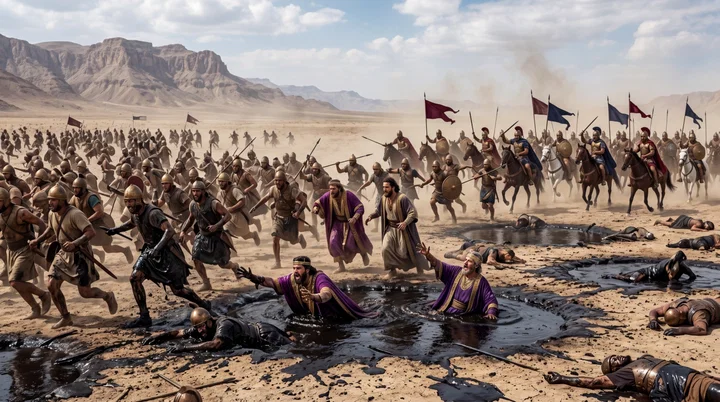
And the vale of Siddim was full of slimepits; and the kings of Sodom and Gomorrah fled, and fell there; and they that remained fled to the mountain.
Translations
And the vale of Siddim was full of slime pits; and the kings of Sodom and Gomorrah fled, and fell there; and they that remained fled to the mountain.
King James Version, KJV Cambridge Paragraph Bible
And the vale of Siddim was full of slimepits; and the kings of Sodom and Gomorrah fled, and fell there; and they that remained fled to the mountain.
And the vale of Siddim was full of slime-pits; and the kings of Sodom and Gomorrah fled, and fell there: and they that remained fled to the mountain.
Revised Version, American Standard Version
Now the vale of Siddim was full of slime pits; and the kings of Sodom and Gomorrah fled, and they fell there, and they that remained fled to the mountain.
And the valley of Siddim [is] full of bitumen-pits; and the kings of Sodom and Gomorrah flee, and fall there, and those left have fled to the mountain.
And the vale of Siddim was full of pits of asphalt. And the kings of Sodom and Gomorrah fled, and fell there: and they that remained fled to the mountain.
Now, the valley of the open fields, had many pits of bitumen, so the king of Sodom and Gomorrah fled, and fell there,—while, they who remained, towards a mountain, fled.
Berean Standard Bible, Majority Standard Bible
Now the Valley of Siddim was full of tar pits, and as the kings of Sodom and Gomorrah fled, some men fell into the pits, but the survivors fled to the hill country.
Now the valley of Siddim was full of tar pits; and the kings of Sodom and Gomorrah fled, and some fell there. Those who remained fled to the hills.
Now the valley of Siddim was full of holes of sticky earth; and the kings of Sodom and Gomorrah were put to flight and came to their end there, but the rest got away to the mountain.
Now the vale of Siddim was full of slime pits, and the Kings of Sodom and Gomorah fled and fell there: and ye residue fled to the mountaine.
Douay-Rheims (Challoner revision)
Now the woodland vale had many pits of slime. And the king of Sodom, and the king of Gomorrha turned their backs and were overthrown there: and they that remained fled to the mountain.
Pictures
Cross-references
- Hebrews 7:1-2
For this Melchisedec, king of Salem, priest of the most high God, who met Abraham returning from the slaughter of the kings, and blessed him;
Melchizedek meets and blesses Abraham, who gives him a tenth after the battle.
- Genesis 14:18-20
And Melchizedek king of Salem brought forth bread and wine: and he was the priest of the most high God.
Melchizedek meets Abraham after the battle, blesses him, and receives his tithe.
- Genesis 19:1
And there came two angels to Sodom at even; and Lot sat in the gate of Sodom: and Lot seeing them rose up to meet them; and he bowed himself with his face toward the ground;
Lot lived among the people of Sodom.
- Genesis 14:1-2
And it came to pass in the days of Amraphel king of Shinar, Arioch king of Ellasar, Chedorlaomer king of Elam, and Tidal king of nations;
The named rulers and political setting present the campaign as historical.
- Genesis 19:24-25
Then the LORD rained upon Sodom and upon Gomorrah brimstone and fire from the LORD out of heaven;
The Dead Sea region witnesses the destruction of the cities of the plain.
- Matthew 10:15
Verily I say unto you, It shall be more tolerable for the land of Sodom and Gomorrha in the day of judgment, than for that city.
Sodom appears at judgment
- Genesis 14:16
And he brought back all the goods, and also brought again his brother Lot, and his goods, and the women also, and the people.
Abraham brought Lot back after rescuing him from captivity.
- Matthew 11:24
But I say unto you, That it shall be more tolerable for the land of Sodom in the day of judgment, than for thee.
Sodom appears at judgment
- Genesis 19:27-28
And Abraham gat up early in the morning to the place where he stood before the LORD:
Abraham looks toward Sodom after its destruction.
- Genesis 14:21
And the king of Sodom said unto Abram, Give me the persons, and take the goods to thyself.
The king offers Abraham the spoil, which Abraham refuses.
- Genesis 14:22-23
And Abram said to the king of Sodom, I have lift up mine hand unto the LORD, the most high God, the possessor of heaven and earth,
Abram swears to take nothing from the king of Sodom.
- 2 Peter 2:7-8
And delivered just Lot, vexed with the filthy conversation of the wicked:
Identifies Lot as righteous while living in Sodom.
Commentary
Each commentary is drawn from primary sources: the writings of Ellen G. White and Adventist pioneers and periodicals. Each commentary is separate. Its own words are not a quotation; follow the references to read the source passages.
Ellen G. White
2 sources
The vale of Siddim was the battlefield where the five Canaanite kings were defeated, with many of their soldiers killed and the survivors fleeing to the mountains.PP 134.3–135.1 Following that rout, the invaders plundered the cities and carried away Lot and his family as captives.PP 134.3–135.1 That disaster sets the stage for Abraham's rescue of the captives from the Elamites.PP 157.2–3
Abraham's triumph over a far stronger force turned the attention of the people of Sodom toward the true faith, for his courage and his unselfish dealing with the prisoners and the spoil demonstrated the superiority of the religion he honored.PP 157.2–3 The victory came by divine power, for Jehovah was the source of Abraham's strength and delivered his enemies into his hand.PP 157.2–3
Sources
Pioneers and periodicals
34 sources
The vale held pits of sticky bitumen where the defeated rulers of Sodom and Gomorrah stumbled and fell as they fled from four eastern kings who had overpowered them, while the rest escaped toward the hills.ST May 20, 1913ST Dec 14, 1915ST Nov 23, 1904ST Sep 1, 1898ST May 20, 1913 The account is true history from the days of Abraham, once called impossible but now confirmed in its rulers and politics by Babylonian tablets, inscriptions and monuments down to the names themselves.RH Jul 9, 1914ST Dec 14, 1915ST Dec 14, 1915ST Nov 23, 1904 The defeat led to the capture of the people and goods of the plain including Lot, until Abraham pursued with three hundred and eighteen of his household, overthrew the conquerors and recovered all.RH Nov 4, 1873ST Jan 29, 1894RH Oct 1, 1908ST Apr 28, 1914 On his return he was met by Melchizedek king of Salem, priest of the Most High God, to whom he gave a tenth of the spoil, showing that tithing belongs to the priesthood of Melchizedek under which believers now live and to the support of God's ministers.ST Oct 4, 1883ST Oct 4, 1883 The rescue was mercy to cities that had received light yet remained in sin, and Abraham's refusal to take even a thread or shoe-latchet from the king of Sodom shows a man who could not be bought because God was his portion.RH Jul 19, 1870RH Nov 4, 1873ST Oct 24, 1895ST Sep 1, 1898
Words and Landscape
The vale of Siddim was full of slimepits, and in the defeat there the kings of Sodom and Gomorrah fled and fell among them, while those who escaped fled to the mountain.ST Sep 1, 1898ST May 20, 1913 The slimepits are bitumen pits belonging to the region afterward covered by the Dead Sea.RH Mar 11, 1862 Masses of bitumen still cast up from the bottom of the sea are remains of those ancient pits.RH Mar 11, 1862 The desolate sea and the landscape beneath it stand as a witness to the account of the cities of the plain.RH Mar 11, 1862
The setting is a real campaign in which four kings fought against five kings and the four conquered.ST May 20, 1913ST Dec 14, 1915ST Nov 23, 1904ST Jul 16, 1896 It was a campaign of four kings from Elam and Babylonia against the five kings of Sodom and the plain.ST Nov 20, 1884ST Jul 30, 1885 Its historical setting, rulers, and political circumstances are confirmed by ancient monuments, Assyrian and eastern records, and archaeological discoveries.ST May 20, 1913ST Jul 16, 1896ST Nov 20, 1884ST Jul 30, 1885
Chedorlaomer is Kudur-lagamer, king of Elam, who established imperial rule over the Mesopotamian plain and westward to the Mediterranean nearly to Egypt and kept those lands subject for twelve years.ST Jan 20, 1904 His name appears as Kudur-la-ukhgamur on a tablet from the reign of Khammurabi of Babylon.ST Jul 8, 1897 Amraphel is identified as Hammurabi, and an inscription of Hammurabi is cited as evidence connected with the account.RH May 13, 1909ST Dec 14, 1915 Some scholars dispute that identification, while several hold it.ST Dec 14, 1915
Historical Trustworthiness
Genesis 14:10 belongs to a true historical account of actual events in Abraham's time, not a myth or later invention or fictional story.ST Dec 14, 1915ST Nov 23, 1904ST Jul 16, 1896 It is part of the trustworthy record of a real war between four kings and five and of the invasion of Palestine in Abraham's day.ST Dec 14, 1915ST Nov 23, 1904ST Jul 16, 1896 Tablets found in the Chamber of Records by the banks of the Euphrates tell the same story and vindicate Genesis in minute detail, putting confidence in the book beyond question. The events it recounts are confirmed by ancient Assyrian and eastern records.ST Jul 16, 1896
The chapter, once disputed by higher critics, has been abundantly confirmed by archaeology.ST Jan 2, 1912 Its setting and political details were once declared impossible but are presented as credible in light of later discoveries about the ancient world.ST Nov 24, 1909
Its named rulers, political setting, and historical circumstances are confirmed by ancient Babylonian records, cuneiform inscriptions, stone libraries of the ancient Near East, ancient monuments, and Assyrian and eastern records.RH Jul 9, 1914ST Dec 14, 1915ST May 3, 1910ST Nov 20, 1884ST Jul 30, 1885 The list of kings in Genesis 14 is confirmed by records preserved in stone, and the campaign of four kings from Elam and Babylonia against the five kings of Sodom and the plain is an actual historical event with its setting and named rulers corroborated.ST May 3, 1910ST Nov 20, 1884ST Jul 30, 1885 Its specific names and events are confirmed by monumental evidence and archaeological discoveries, with many names found on ancient monuments, some letter for letter.ST May 20, 1913ST Sep 7, 1904 Chedorlaomer was a real person whose name is said to appear on a tablet, supporting the substance of the account as a record of actual events and of a historical military campaign in which Lot was captured.ST Dec 14, 1915 The supposed chronological problem that Abraham lived about three hundred years before Hammurabi was removed by an inscription showing that dynasties once thought to be consecutive were contemporaneous.ST Dec 14, 1915
Course of Events
The vale of Siddim belongs to Chedorlaomer's campaign against Sodom and Gomorrah and their allies after the cities revolted.RH Nov 4, 1873RH Oct 1, 1908ST Apr 28, 1914 The four kings invaded Canaan, defeated Sodom and its neighbors, and carried away their people and goods as captives.RH Nov 4, 1873RH Oct 1, 1908ST Apr 28, 1914 Within that defeat lies the capture of Lot, Abraham's relative, and Abram's rescue of him.ST Jan 29, 1894RH Oct 1, 1908ST Apr 28, 1914 Abraham armed 318 of his servants, pursued the conquerors, defeated the kings, and brought back all the goods and the people that had been taken.RH Nov 4, 1873RH Oct 1, 1908ST Apr 28, 1914
That victory over the kings precedes the vision and promise afterward given to Abraham.ST Aug 7, 1901 The verse stands just before Abraham's return from the slaughter of the kings, when Melchizedek, king of Salem and priest of the most high God, came forth to meet and bless him.ST Oct 21, 1889 When met afterward by the king of Sodom and by Melchizedek king of Salem, Abraham gave tithes of the spoils and refused the king of Sodom's offer to keep the goods, vowing to take nothing from a thread to a shoe-latchet so that no man could say he had made Abraham rich.RH Nov 4, 1873 The conflict with the neighboring kings shows Abraham acting as an independent prince in Canaan.
Doctrinal Teachings
The return from the slaughter of the kings is the occasion when Melchizedek, king of Salem and priest of the Most High God, came forth and Abraham gave him tithes of all the spoil he had gained. That tithing proves tithing is not a Jewish but a Christian duty, bound up with the Melchizedek priesthood under which Christians now live. After recovering Lot and defeating the kings, Abraham's giving of a tenth of the spoils to Melchisedec stands as the example of giving one-tenth to support God's ministers.
Melchisedek was a historical figure who represented Christ in his priesthood, and through this priestly type Abraham saw Christ, yet Melchisedek himself was not Christ.ST Oct 4, 1883 He was greater than Abraham and the express representative of Christ.ST Oct 4, 1883 He dwelled near Sodom, and his nearness together with the nearness of Abraham and the presence of Lot gave the men of Sodom means of great light concerning the second advent of Christ and the day of judgment.ST Oct 4, 1883
God's punishment of theft in Abraham's day proves the law forbidding stealing was already in force before Moses and Sinai. The account of Abram and Lot reveals their characters and the influence of worldly associations, and shows God's warnings before punishment and providential care among people.ST Dec 20, 1910 The events of Abraham and Chedorlaomer illustrate the way God's providence and word run through history.ST Dec 20, 1910ST Nov 12, 1885 Chedorlaomer's imperial rule illustrates how kings and peoples resisted the power of a would-be king of kings.ST Jan 27, 1904
Warnings and Applications
Abraham's rescue of the people of Sodom after they had been carried captive by the invading kings gave them a direct opportunity to know him and the truth he represented.RH Jul 19, 1870 The deliverance came because Lot, a righteous man living among them, was saved through the efforts of another righteous man who wanted to save him.ST Oct 24, 1895 It was an act of mercy toward cities that had not turned from sin despite receiving light and blessings.ST Oct 24, 1895 Their defeat, when the kings of Sodom and Gomorrah fled and fell among the slimepits in the vale of Siddim while those who escaped went to the mountains, and the events that followed gave the cities evidence of Abraham and God's power, a lesson they and Lot should have learned.ST Sep 1, 1898
The account of Abram and Lot reveals their characters and the influence of worldly associations, and shows God's warnings before punishment and providential care among people.ST Dec 20, 1910 The defeat of Sodom and its neighbors by an invading king who carried away their people and goods as captives, including Abraham's relative Lot, was reversed when Abraham armed 318 of his servants, pursued the conqueror, and brought back all the goods and the people that were taken.RH Nov 4, 1873 When met afterward by the king of Sodom and by Melchizedek king of Salem, Abraham gave tithes of the spoils and refused the king of Sodom's offer to keep the goods, vowing to take nothing from a thread to a shoe-latchet so no man could say he had made Abraham rich.RH Nov 4, 1873 God as possessor of heaven and earth was his portion, and content with what he had he waited for the city that has foundations whose builder and maker is God.RH Nov 4, 1873 The history holds Abraham up as a man who could not be bought and who was free from covetousness.RH Nov 4, 1873
The slime pits of the vale of Siddim are the lowest haunts of vice and dens of pollution in New York where dancing and dissipation are carried on through all the night.ST Nov 28, 1878 The pits trap young men who are kept without work and furnished money to spend, with plenty of wine and cigars and fine horses, and bring them to certain ruin.ST Nov 28, 1878 Hard work is the friend of good morals and the laboring classes are not found in them.ST Nov 28, 1878
Sources