Genesis 16:5
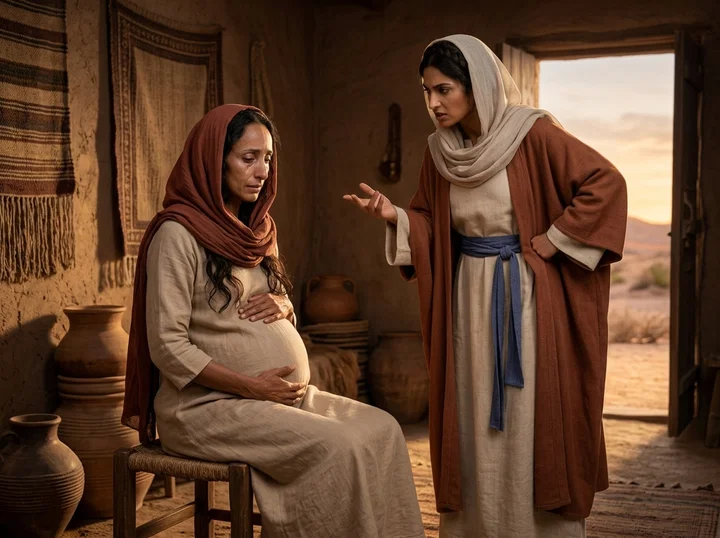
And Sarai said unto Abram, My wrong be upon thee: I have given my maid into thy bosom; and when she saw that she had conceived, I was despised in her eyes: the LORD judge between me and thee.
Translations
And Sarai said to Abram, My wrong be on you: I have given my maid into your bosom; and when she saw that she had conceived, I was despised in her eyes: the LORD judge between me and you.
And Sarai said unto Abram, My wrong be upon thee: I have given my maid into thy bosom; and when she saw that she had conceived, I was despised in her eyes: the LORD judge between me and thee.
And Sarai said unto Abram, My wrong be upon thee: I have given my maid into thy bosom; and when she saw that she had conceived, I was despised in her eyes: the Lord judge between me and thee.
And Sarai said to Abram, my wrong be upon thee: I have given my maid into thy bosom; and when she saw that she had conceived, I was despised in her eyes: the LORD judge between me and thee.
And Sarai said unto Abram, My wrong be upon thee: I gave my handmaid into thy bosom; and when she saw that she had conceived, I was despised in her eyes: the LORD judge between me and thee.
And Sarai said unto Abram, My wrong be upon thee: I gave my handmaid into thy bosom; and when she saw that she had conceived, I was despised in her eyes: Jehovah judge between me and thee.
And Sarai saith unto Abram, 'My violence [is] for thee; I — I have given mine handmaid into thy bosom, and she seeth that she hath conceived, and I am lightly esteemed in her eyes; Jehovah doth judge between me and thee.'
And Sarai said to Abram, My wrong be on thee! I have given my maidservant into thy bosom; and now she sees that she has conceived, I am lightly esteemed in her eyes. Jehovah judge between me and thee!
Then said Sarai unto Abram: My wrong, is, on thee! I, gave my handmaid into thy bosom, and when she seeth that she hath conceived, then am I lightly esteemed in her eyes Yahweh judge betwixt me and her.
Berean Standard Bible, Majority Standard Bible
Then Sarai said to Abram, “ May the wrong done to me be upon you! I delivered my servant into your arms, and ever since she saw that she was pregnant, she has treated me with contempt. May the LORD judge between you and me.”
Sarai said to Abram, “ This wrong is your fault. I gave my servant into your bosom, and when she saw that she had conceived, she despised me. May the LORD judge between me and you.”
And Sarai said to Abram, May my wrong be on you: I gave you my servant for your wife and when she saw that she was with child, she no longer had any respect for me: may the Lord be judge between you and me.
Then Sarai saide to Abram, Thou doest me wrong. I haue giuen my maide into thy bosome, and she seeth that she hath conceiued, and I am despised in her eyes: the Lord iudge betweene me and thee.
Douay-Rheims (Challoner revision)
And Sarai said to Abram: Thou dost unjustly with me: I gave my handmaid into thy bosom, and she perceiving herself to be with child, despiseth me. The Lord judge between me and thee.
Pictures
Cross-references
- Galatians 4:22-23
For it is written, that Abraham had two sons, the one by a bondmaid, the other by a freewoman.
Abraham’s sons by Hagar and Sarah represent birth after the flesh and by promise.
- Genesis 21:8-12
And the child grew, and was weaned: and Abraham made a great feast the same day that Isaac was weaned.
Ishmael mocks Isaac, leading Sarah to demand Hagar and her son be sent away.
- Genesis 15:2-6
And Abram said, Lord GOD, what wilt thou give me, seeing I go childless, and the steward of my house is this Eliezer of Damascus?
God promised Abram an heir, but Abram and Sarai tried to fulfill the promise themselves.
- Genesis 17:19-21
And God said, Sarah thy wife shall bear thee a son indeed; and thou shalt call his name Isaac: and I will establish my covenant with him for an everlasting covenant, and with his seed after him.
God establishes the covenant with Isaac, Sarah’s promised son, while distinguishing Ishmael.
- Genesis 30
And when Rachel saw that she bare Jacob no children, Rachel envied her sister; and said unto Jacob, Give me children, or else I die.
Cited alongside Genesis 16 in discussing patriarchal marriage.
- Hebrews 11:11
Through faith also Sara herself received strength to conceive seed, and was delivered of a child when she was past age, because she judged him faithful who had promised.
Sarah conceives through faith in God’s promise despite being past age.
- Galatians 4:24
Which things are an allegory: for these are the two covenants; the one from the mount Sinai, which gendereth to bondage, which is Agar.
Identifies Hagar’s story as an allegory of the two covenants.
- Genesis 21:1-7
And the LORD visited Sarah as he had said, and the LORD did unto Sarah as he had spoken.
Isaac’s birth contrasts with Ishmael’s humanly planned birth.
- 1 Peter 3:5-6
For after this manner in the old time the holy women also, who trusted in God, adorned themselves, being in subjection unto their own husbands:
Sarah is presented as an example of reverence and submission to her husband.
- Romans 9:7-8
Neither, because they are the seed of Abraham, are they all children: but, In Isaac shall thy seed be called.
Ishmael is not counted as the promised seed.
- Genesis 20:14
And Abimelech took sheep, and oxen, and menservants, and womenservants, and gave them unto Abraham, and restored him Sarah his wife.
Both texts concern the sacredness of marriage.
Commentary
Each commentary is drawn from primary sources: the writings of Ellen G. White and Adventist pioneers and periodicals. Each commentary is separate. Its own words are not a quotation; follow the references to read the source passages.
Ellen G. White
4 sources
The quarrel came because Abraham and Sarah did not wait in confiding faith for the fulfillment of the promise that they should have a son, since they could not believe that Sarah would bear in her old age.1SP 95.2–3 At Sarah's urging Abraham took Hagar as his wife, and by hearkening to her he failed to endure the test of his faith in God's unlimited power.1SP 95.2–3 That failure brought unhappiness upon himself and upon Sarah.1SP 95.2–3
After Hagar conceived she became proud and haughty, carrying herself boastfully and haughtily before Sarah and treating her with contempt.1SP 95.2–3SG3 101.1–2ST Mar 27, 1879PP 147.1 Sarah therefore felt despised in Hagar's eyes.1SP 95.2–3SG3 101.1–2 Hagar flattered herself that she was to be the mother of the great nation God had promised to make of Abraham.1SP 95.2–3
Sarah's words complained to Abraham and charged him with wrong, blaming him for the resulting unhappiness and contempt.1SP 95.2–3SG3 101.1–2ST Mar 27, 1879 Yet taking Hagar had been Sarah's own special proposal and request.1SP 95.2–3SG3 101.1–2ST Mar 27, 1879 Her protest asserted that Abraham's marriage to Hagar violated her rights as wife, for she alone was his true wife and no other person was entitled to share her place and rights as wife and mother.PP 147.1
Abraham was grieved, perplexed and distressed by Sarah's charge and by the conflicting complaints, including Hagar's complaints of abuse.1SP 95.2–3SG3 101.1–2ST Mar 27, 1879 He answered that Hagar was still Sarah's servant and left her under Sarah's control, reminding Sarah that he would not have taken Hagar except at her request.1SP 95.2–3SG3 101.1–2 He nevertheless refused to send Hagar away, because he thought her child was the one through whom the promise would be fulfilled.1SP 95.2–3SG3 101.1–2 He knew that if he redressed Hagar's wrongs he would increase the jealousy and unhappiness of Sarah, his first and much-loved wife.1SP 95.2–3 Sarah's unwillingness to share Abraham's affections and her demand that her rival be sent away were not reproved by God.PP 147.1
Sources
Pioneers and periodicals
33 sources
Sarai herself gave her Egyptian bondwoman Hagar to Abram to wife to obtain an heir, and Abram agreed, and when Hagar conceived she looked with pride and contempt upon her mistress.ST Apr 11, 1900RH Jul 3, 1900ST Jan 29, 1894ST Sep 28, 1915 Sarai then laid the blame and wrong upon Abram and called upon the LORD to judge between them, though the strife and distress came from her own plan and his acceptance of it.ST Nov 8, 1899RH Jul 3, 1900ST Mar 1, 1905 Abram was distressed by the conflict yet answered without anger for anger and yielded authority over Hagar to Sarai, which kept the quarrel from growing worse.ST Mar 27, 1879RH Apr 10, 1866 It was an unbelieving human scheme to help God fulfill the promise of an heir from his own body, and the flesh-plan that brought forth Ishmael could not fulfill the promise or glorify God but brought continuing trouble.ST Apr 11, 1900RH Jul 3, 1900ST Mar 1, 1905ST Sep 28, 1915ST Apr 29, 1908 Read with Genesis 15, Genesis 17, Genesis 21 and Galatians 4:21-30, Hagar the bondwoman bearing children to bondage stands for seeking the promise by human effort, Sarah the freewoman for the free child by God's power, and the whole account stands as a violation of marriage by polygamy that brought great unhappiness to the household.ST Sep 23, 1913RH Feb 3, 1852RH Jun 26, 1900RH Mar 1, 1870
Narrative Setting and Meaning
Sarai herself proposed giving Hagar, her Egyptian bondwoman and handmaid, to Abram to wife in order to obtain an heir, and Abram agreed to and adopted the arrangement.ST Apr 11, 1900RH Jul 3, 1900ST Sep 28, 1915ST Mar 22, 1899ST Jan 24, 1900 This was man's plan and not God's plan, a human scheming to help God out and to secure the promised heir, which did not fulfill God's promise.ST Sep 28, 1915ST Mar 22, 1899ST Jan 24, 1900 Hagar's status as a slave meant her child represented bondage, while the promised son to be born through Sarah as a freewoman would be free-born by God's power.ST Sep 28, 1915ST Mar 22, 1899
When Hagar conceived she despised her mistress with pride and vainglory and treated her with contempt, which is also described as Sarai feeling despised and becoming jealous toward her.ST Mar 27, 1879ST Apr 11, 1900RH Jul 3, 1900ST Jan 29, 1894 Sarai then laid the blame and the wrong on Abram and appealed to the LORD to judge between them, turning in reproach upon him after the success of her own plan.ST Nov 8, 1899RH Jul 3, 1900ST Mar 1, 1905RH Aug 3, 1905 The conflict came from her own plan and Abram's acceptance of it, producing complaints, strife, and family distress from this indiscreet and unholy scheme.ST Mar 27, 1879RH Jul 3, 1900ST Mar 1, 1905 Trying to supply human help for God's promise through unbelief led to trouble unsatisfactory to the whole company.RH Jul 3, 1900ST Mar 1, 1905
Abram was distressed by the resulting complaints and conflict, yet answered Sarai's accusation meekly without returning anger for anger.ST Mar 27, 1879RH Apr 10, 1866 He yielded authority over Hagar to Sarai, and his meek response kept the quarrel from escalating.RH Apr 10, 1866 The verse belongs to Abraham's sojourn and trials of faith under God's constant and remarkable overruling providence, within the 375 years from B.C. 2247 to B.C. 1872.ST Jan 2, 1912 It shows that Abraham did not come at once to fullness of faith but had to learn the lesson over and over, and it presses whether readers are children of Abraham.ST Jan 2, 1912
The verse belongs to God's dealings with Abram and with Abraham's family as the chosen family through whom the promised Seed would come, revealing Abram's character and including lessons in faith and providential care.ST Dec 20, 1910ST It stands after righteousness had been counted to Abram, to be read with Genesis 17 on the everlasting covenant of promise and the call to walk perfect before Almighty God, and it belongs with Genesis 15 and Genesis 22 as one experience.ST Sep 23, 1913 The transactions concerning Hagar in Genesis 16:1-9 stand with the swearing of Abraham's servant over a wife for Isaac as circumstances appealed to as proof that Abraham was a slaveholder, beyond the statements that he had servants, trained servants born in his house, servants bought with money, and servants given to him.RH Mar 10, 1863 Hagar is identified as an Egyptian slave girl, made to suffer for the sin of unbelief in another.RH Mar 10, 1863ST Sep 8, 1898ST Mar 22, 1899
Sarai dealt harshly with Hagar after her contempt, which became the setting for Hagar's flight.RH Aug 3, 1905RH Aug 3, 1905ST May 27, 1908 On the angel's advice Hagar returned to submit and suffer whatever fell to her lot and to smother her grief, for leaving her circumstances would not resolve her unhappiness.ST Sep 8, 1898RH Aug 3, 1905 The harsh treatment left its impress upon her unborn child who was born soon after and fulfilled the angel's prediction by becoming a wild man with his hand against everyone and everyone's hand against him.ST Sep 8, 1898 The later outcome was that Hagar and her son Ishmael, ancestor of the Arabs, were sent away, in keeping with concubines being treated as secondary wives whose children did not inherit as the first wife's children did, and Ishmael's line is excluded from being reckoned as Israel entitled to the promises.ST Jan 29, 1894ST May 27, 1908RH Jan 16, 1872
Unbelief and Covenant Lesson
Sarai was humanly barren, and she and Abram questioned the promise of an heir from his own body and through Sarah and concluded in unbelief that some other way besides the lawful way had to be devised for God to work.ST Apr 1, 1875ST Apr 11, 1900ST Sep 28, 1915 Sarai therefore gave her handmaid Hagar, a bondwoman, to Abram to wife, and Abram in unbelief adopted the arrangement, which was man's plan to help God out and not God's plan.ST Apr 11, 1900ST Sep 28, 1915ST Jan 24, 1900 When Hagar conceived she in vainglory despised her mistress, Sarai drove her out, and Sarai laid the blame and the wrong on Abram and called for the LORD to judge between them after the proxy plan broke down.ST Apr 11, 1900RH Jul 3, 1900ST Mar 1, 1905 If Abram had simply continued to believe God's promise and waited for God to fulfill it in His own time and way, the unholy arrangement would not have been made and he would have avoided this trouble and the later severe test.ST Apr 1, 1875ST Apr 11, 1900
The verse marks the first step proving that the flesh-plan that brought forth Ishmael, the natural son of the bondwoman born after the flesh through human planning, was unsatisfactory to the whole company and brought continuing strife and trouble.RH Jul 3, 1900ST Mar 1, 1905ST Apr 29, 1908 Sarai herself proposed and carried out the scheme of giving Hagar the Egyptian to Abram to produce a son and Abram agreed to it, but when Hagar conceived and despised her mistress Sarai turned in reproach upon Abram and held him responsible because he had accepted the arrangement.RH Jul 3, 1900ST Mar 1, 1905 This effort of human planning to secure the promised heir and to supply human help for God's promise could not glorify God or make Ishmael a child of promise and did not fulfill God's promise.ST Mar 1, 1905ST Apr 29, 1908ST Jan 24, 1900 The whole of Genesis 16, together with Genesis 15:18 and Genesis 17 and Genesis 21, is to be read with Galatians 4:21-30, especially the declaration for these are the two covenants, because the history provides the background and meaning of the old and new covenants.ST Sep 23, 1913RH Jun 26, 1900
With Genesis 15 and Genesis 22 the episode belongs as one experience illustrating the old covenant way of human effort and self-reliance in contrast with the new covenant way of faith.ST Sep 23, 1913 Abraham through human weakness and temporary lack of faith attempted to do for himself in his own way what God had promised to do for him, and seeking the promised heir through the handmaid represents seeking justification by one's own effort.ST Sep 23, 1913ST Mar 22, 1899 Hagar as an Egyptian slave bearing Ishmael bore children to bondage, while Sarah as a freewoman bore the free child of promise by God's power and promise through faith.ST Sep 28, 1915ST Mar 22, 1899 Salvation rests on God's promise through Jesus Christ, not on human plans or works, and obedience follows salvation rather than earning it.
The fact that Ishmael's line is excluded from being reckoned as Israel entitled to the promises, along with the lines of Keturah and Esau, proves that mere lineal descent from Abraham does not make anyone an Israelite and that some other principle besides fleshly descent decides who is Israel, though Ishmael was another son of Abraham and the Arabs came from him.RH Jan 16, 1872 The story of Hagar the Egyptian slave girl also shows that the results of unbelief cannot be confined to the unbeliever.ST Sep 8, 1898 Hagar was made to suffer for the sin of unbelief in another and became the innocent victim of distrust of the fulfillment of God's word, and that suffering is why her history was imperishably recorded.ST Sep 8, 1898
Marriage Doctrine and Application
Abram's taking of Hagar stands as concubinage and polygamy, a plain violation of the marriage institution on the part of the patriarchs and an example of disobedience and transgression among God's chosen people, with Sarai's strife with Abram after he took Hagar belonging to that breach.RH Feb 3, 1852ST Feb 28, 1906RH Nov 8, 1853ST Jun 10, 1875ST May 18, 1882 Such violation does not destroy or diminish the sacred character of marriage, just as any violation of the Sabbath institution in the patriarchal age would not destroy the sacred character of the Sabbath.RH Feb 3, 1852RH Nov 8, 1853ST Jun 10, 1875ST May 18, 1882RH Jan 21, 1875 Marriage was made for man before the fall, its sanctity is not derived from the Decalogue, and the seventh commandment guards its sacredness.RH Nov 8, 1853ST Jun 10, 1875RH Jan 21, 1875 The patriarchal breach therefore leaves the institution itself undiminished in sacredness.ST Jun 10, 1875ST May 18, 1882RH Jan 21, 1875
Abraham's household in this quarrel presents the great unhappiness, trouble, and harm caused by polygamy and plural marriage, including taking a concubine.RH Mar 1, 1870ST May 27, 1908RH Jul 4, 1865 The family conflict and distress followed from the indiscreet action of taking Hagar as wife.RH Mar 1, 1870ST May 27, 1908RH Jul 4, 1865 Concubines were treated as secondary wives, and their children did not inherit as the first wife's children did.ST May 27, 1908
Hagar's contempt for Sarai after she conceived was a fault connected with Sarai's harsh treatment of her, which God permitted for Hagar's sake.ST Mar 20, 1907RH Aug 3, 1905RH Aug 3, 1905 Her trouble was not solved by fleeing her circumstances, but she needed a change of heart and to return and submit.ST Mar 20, 1907RH Aug 3, 1905 Trials and offenses in the account can expose faults that need to be confessed and overcome.ST Mar 20, 1907 The harsh treatment Hagar then received left its impress upon her unborn child, who was born soon after and fulfilled the angel's prediction by becoming a wild man with his hand against everyone and everyone's hand against him, as she returned on the angel's advice to suffer whatever fell to her lot.ST Mar 20, 1907ST Sep 8, 1898
The surrounding story shows that God saw Hagar in her distress and provided for her, so being seen by God is a source of comfort and saving care.ST Nov 8, 1899 Abraham did not come at once to fullness of faith under God's constant overruling providence in his sojourn and trials, within the 375 years from B.C. 2247 to B.C. 1872, but had to learn the lesson over and over, and this presses whether readers are children of Abraham.ST Jan 2, 1912
Sources