Genesis 16:4
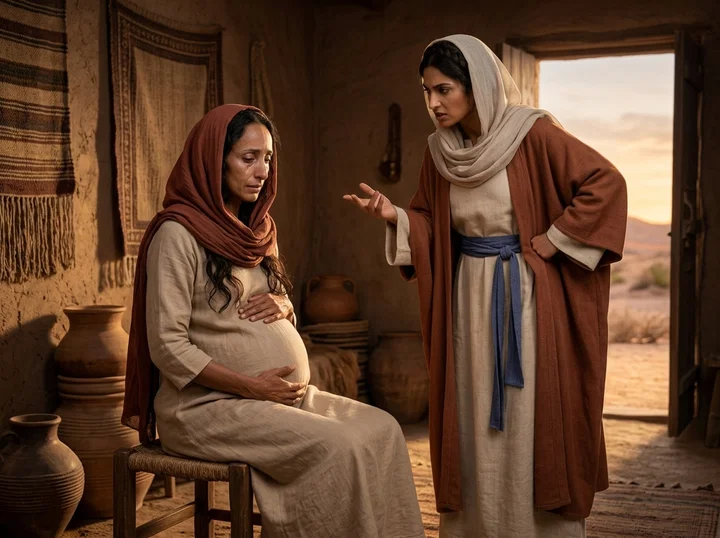
And he went in unto Hagar, and she conceived: and when she saw that she had conceived, her mistress was despised in her eyes.
Translations
American King James Version, Webster Bible
And he went in to Hagar, and she conceived: and when she saw that she had conceived, her mistress was despised in her eyes.
King James Version, KJV Cambridge Paragraph Bible, Revised Version, American Standard Version
And he went in unto Hagar, and she conceived: and when she saw that she had conceived, her mistress was despised in her eyes.
and he goeth in unto Hagar, and she conceiveth, and she seeth that she hath conceived, and her mistress is lightly esteemed in her eyes.
And he went in to Hagar, and she conceived. And when she saw that she had conceived, her mistress was lightly esteemed in her eyes.
And he went in unto Hagar and she conceived,—and when she saw that she had conceived, lightly esteemed, was her lady, in her eyes.
Berean Standard Bible, Majority Standard Bible
And he slept with Hagar, and she conceived. But when Hagar realized that she was pregnant, she began to despise her mistress.
He went in to Hagar, and she conceived. When she saw that she had conceived, her mistress was despised in her eyes.
And he went in to Hagar and she became with child, and when she saw that she was with child, she no longer had any respect for her master's wife.
And he went in vnto Hagar, and she conceiued. and when she sawe that she had conceiued, her dame was despised in her eyes.
Douay-Rheims (Challoner revision)
And he went in to her. But she, perceiving that she was with child, despised her mistress.
Pictures
Cross-references
- Galatians 4:22-24
For it is written, that Abraham had two sons, the one by a bondmaid, the other by a freewoman.
Hagar’s son born after the flesh represents the covenant that leads to bondage.
- Genesis 15:4-5
And, behold, the word of the LORD came unto him, saying, This shall not be thine heir; but he that shall come forth out of thine own bowels shall be thine heir.
God promises Abraham an heir of his own flesh, which he later tries to obtain through Hagar.
- Genesis 21:9-10
And Sarah saw the son of Hagar the Egyptian, which she had born unto Abraham, mocking.
Sarah demands that Hagar and Ishmael be sent away, continuing the household conflict.
- Genesis 21:1-3
And the LORD visited Sarah as he had said, and the LORD did unto Sarah as he had spoken.
Isaac’s promised birth contrasts with Ishmael’s natural conception and human contrivance.
- Genesis 17:15-21
And God said unto Abraham, As for Sarai thy wife, thou shalt not call her name Sarai, but Sarah shall her name be.
God promises Abraham that Sarah will bear Isaac.
- Galatians 4:23
But he who was of the bondwoman was born after the flesh; but he of the freewoman was by promise.
Ishmael was born of the bondwoman according to the flesh, not by promise.
- Hebrews 11:11
Through faith also Sara herself received strength to conceive seed, and was delivered of a child when she was past age, because she judged him faithful who had promised.
Isaac’s conception by faith contrasts with Ishmael’s conception through a fleshly scheme.
- Genesis 25:6
But unto the sons of the concubines, which Abraham had, Abraham gave gifts, and sent them away from Isaac his son, while he yet lived, eastward, unto the east country.
Both describe Abraham’s concubines and the status of their children.
- Genesis 21:12-13
And God said unto Abraham, Let it not be grievous in thy sight because of the lad, and because of thy bondwoman; in all that Sarah hath said unto thee, hearken unto her voice; for in Isaac shall thy seed be called.
God distinguishes Isaac as the promised line while promising a nation through Ishmael.
- Romans 9:8
That is, They which are the children of the flesh, these are not the children of God: but the children of the promise are counted for the seed.
Ishmael is a child of the flesh, not the promised son.
- Galatians 4:28
Now we, brethren, as Isaac was, are the children of promise.
Believers, like Isaac, are children of promise, contrasted with Ishmael’s birth according to the flesh.
- Genesis 30
And when Rachel saw that she bare Jacob no children, Rachel envied her sister; and said unto Jacob, Give me children, or else I die.
Both portray patriarchal violations of marriage.
- Genesis 15:5
And he brought him forth abroad, and said, Look now toward heaven, and tell the stars, if thou be able to number them: and he said unto him, So shall thy seed be.
Abraham tried to fulfill the promise of countless descendants through Hagar.
- Genesis 16:15
And Hagar bare Abram a son: and Abram called his son’s name, which Hagar bare, Ishmael.
Names Ishmael as the son born from Hagar’s conception.
- Genesis 16:9
And the angel of the LORD said unto her, Return to thy mistress, and submit thyself under her hands.
Commands Hagar to return and submit.
- Genesis 16:13
And she called the name of the LORD that spake unto her, Thou God seest me: for she said, Have I also here looked after him that seeth me?
Hagar finds comfort in the God who sees her.
- Galatians 4:29
But as then he that was born after the flesh persecuted him that was born after the Spirit, even so it is now.
Ishmael persecuting Isaac types bondage persecuting freedom
- Genesis 15:2-3
And Abram said, Lord GOD, what wilt thou give me, seeing I go childless, and the steward of my house is this Eliezer of Damascus?
Abraham first considered his servant Eliezer as heir.
- Isaiah 54:1
Sing, O barren, thou that didst not bear; break forth into singing, and cry aloud, thou that didst not travail with child: for more are the children of the desolate than the children of the married wife, saith the LORD.
The barren woman’s many children signify the children of the free mother of faith.
- Genesis 12:2
And I will make of thee a great nation, and I will bless thee, and make thy name great; and thou shalt be a blessing:
God promised Abraham a great nation and blessing.
Commentary
Each commentary is drawn from primary sources: the writings of Ellen G. White and Adventist pioneers and periodicals. Each commentary is separate. Its own words are not a quotation; follow the references to read the source passages.
Ellen G. White
12 sources
Abraham took Hagar at Sarah's suggestion because they distrusted God's power to fulfill the promise and would not wait for Him to fulfill it in His own time and way, and when he went in unto her she conceived by him.1SP 95.2–3PP 145.1PP 147.1Lt 47, 1891, par. 3–5SG3 103.2–104.2 When Hagar saw that she had conceived she despised Sarah her mistress, becoming proud, boastful and haughty toward her and flattering herself that she would be the mother of the great nation promised to Abraham, thus becoming her rival.1SP 95.2–3SG3 101.1–2ST Mar 27, 1879PP 147.1 Taking Hagar was polygamy and a departure from God's order of one wife for one man established with Adam, which God never sanctioned because it was contrary to His will and would destroy man's happiness, while Sarah remained Abraham's first and only true wife entitled to the rights of wife and mother that no other could share.PP 147.11SP 93.2–94.1SG3 103.2–104.2 The act brought evil into Abraham's household in jealousy, unhappiness, sorrow, anguish and lasting division, showing that restless efforts to secure God's promises by human devising bring misery and sin rather than the outcome God intends.1SP 95.2–3ST Mar 27, 1879PP 145.1Lt 47, 1891, par. 3–5Ms 8c, 1891, par. 13 The harm reached beyond the household to later generations through Ishmael's birth in descendants who opposed God and His purposes.PP 145.1Lt 47, 1891, par. 3–5PP 173.5
Background and Hagar's Contempt
Abraham took Hagar at Sarah's suggestion because he and Sarah distrusted God's power to fulfill the promise and failed to wait for God to fulfill it in His own time and way, devising their own plan to bring it about.1SP 95.2–3PP 147.1Lt 47, 1891, par. 3–5Ms 8c, 1891, par. 13SG3 103.2–104.2 That lack of perfect trust in taking Hagar was the background of what followed.SG3 108.2 After Abraham went in unto Hagar, she conceived by him.PP 145.1SG3 103.2–104.2
When Hagar saw that she had conceived, her mistress was despised in her eyes, and she looked with contempt on Sarah her mistress.1SP 95.2–3ST Mar 27, 1879PP 145.1Lt 47, 1891, par. 3–5Ms 8c, 1891, par. 13 Pride led her to look down on Sarah, and she became proud, boastful, and haughty toward her.1SP 95.2–3SG3 101.1–2ST Mar 27, 1879 She wrongly flattered herself that she would be the mother of the great nation promised to Abraham.1SP 95.2–3SG3 101.1–2
In conceiving, Hagar became Sarah's rival.PP 147.1 Abraham's lack of trust in taking Hagar was later redeemed by his faithfulness in the test involving Isaac.SG3 108.2
Household Harm and Marriage
The conception turned Abraham's household toward evil, filling it with jealousy and unhappiness and setting family relationships toward lasting division.1SP 95.2–3ST Mar 27, 1879PP 145.1PP 173.5 That breach came because the promise was sought by a human device instead of waiting for God to fulfill it in His own time and way, and the restless attempt brought sorrow and anguish and misery and sin.Lt 47, 1891, par. 3–5Ms 8c, 1891, par. 132MR 336.1 Restless efforts to secure what God has promised by human means lead to misery rather than to the outcome God intends.2MR 336.1 The harm did not stop with the household but reached later generations through the birth of Ishmael, producing descendants who opposed God and His purposes.PP 145.1Lt 47, 1891, par. 3–5PP 173.5
Taking Hagar as an additional wife was polygamy and a departure from God's order of one wife for one man established with Adam.1SP 93.2–94.1 God never sanctioned polygamy in a single instance, because it was contrary to His will and He knew it would destroy man's happiness.1SP 93.2–94.1 It was no less sin for having become common after the Flood or for being practiced even by righteous men, and in Abraham's case it greatly marred his peace through the unhappy union.1SP 93.2–94.1 Sarah was Abraham's first and only true wife, entitled to the rights of a wife and mother which no other person was entitled to share.PP 147.1SG3 103.2–104.2 The episode shows the harm when those rights are not carefully guarded, and that polygamy does not honor the rights and happiness of the marriage relation.PP 147.1SG3 103.2–104.2
Sources
Pioneers and periodicals
63 sources
After Abram had dwelt ten years in Canaan, Sarai gave Hagar her bondmaid to him as a second wife to hasten the promise, and he went in unto her and she conceived Ishmael, the son before Isaac through whom Abraham first set his heart on an heir.RH Jul 3, 1900RH Jun 5, 1900STST Feb 12, 1894GSAM 42.2 When Hagar saw that she had conceived, she regarded Sarah her mistress with contempt, changing from tractable respect to pride and haughtiness.ST Mar 20, 1907ST Nov 21, 1900ST Sep 8, 1898 The first result was immediate household strife with jealousy, rivalry and sorrow that cost years of trouble and ended in harsh dealing and flight.RH Jul 3, 1900ST Sep 8, 1898ST Mar 1, 1905 The scheme was unbelief and impatience, an attempt by human wisdom and strength to obtain by a shorter way what God had promised to give by His own power, and as a work altogether of the flesh it could gender only to bondage.ST Apr 11, 1900RH Jun 5, 1900ST Sep 28, 1915ST Oct 1, 1902ST Nov 21, 1900 With Sarah the freewoman, Hagar the bondwoman stands for the two covenants in Galatians 4:21-30, Ishmael the child after the flesh born of distrust set against Isaac the child of promise born through faith in Him who promised.RH Jul 3, 1900RH May 29, 1900ST Nov 21, 1900RH Jun 26, 1900RH Jul 24, 1900
Verse Setting and Background
The verse stands within history stretching from B.C. 2247 to B.C. 1872, belonging to the account of Abraham's sojourn and trials of faith with constant and remarkable evidences of God's overruling providence.ST Jan 2, 1912 It falls within God's progressive dealings with Abram as father of the faithful, through which he learned over and over to trust God while the promised Seed was kept in view.ST Dec 20, 1910 It also belongs to God's providential dealings with Abraham's family, whose chosen progenitor was to carry forward the promised Seed.ST
After Abram had dwelt ten years in the land of Canaan, Sarai gave Hagar the Egyptian, her bondmaid and slave, to Abram to be his wife.RH Jul 3, 1900RH Jun 5, 1900 She was taken as a second wife at Sarah's suggestion while Sarah his true wife still lived, in order to hasten the fulfillment of the promise.GSAM 42.2AUST Jun 14, 1920 Abram went in unto Hagar and she conceived Ishmael.RH Jul 3, 1900RH Jun 5, 1900 Before Isaac was born Abraham had first supposed his trusted servant would be heir, and God corrected him that the heir would come from his own body.ST Feb 12, 1894 He then set his heart on Ishmael as heir, but God corrected him again by declaring that Sarah his wife would bear the promised son Isaac.STST Feb 12, 1894
The human contrivance did not fulfil the promise nor meet the situation at all.ST Jan 24, 1900 Before Isaac appeared Hagar and Ishmael stood in a comparatively exalted position, since Ishmael would have succeeded to the titles and inheritance of his father Abraham.ST Jan 24, 1900 The true fulfilment came later when Abraham was a hundred years old and Sarah ninety, when God interposed and Isaac was born.ST Jan 24, 1900 Because Hagar was a bond-servant, Ishmael was not a free-born heir and Abraham gained nothing for inheritance by him.ST Nov 21, 1900 As children of a slave woman are slaves even when the father is a freeman, Hagar could bring forth only to bondage, in contrast to Isaac the free-born child of the freewoman who could inherit.ST Mar 22, 1899
In patriarchal tribal life the family is the real unit of protection and strength, with related families, clans, sub-tribes and tribes uniting against a common foe, so many sons are desired for safety and power.ST Jun 8, 1904 In Oriental polygamy in practice the esteem in which different wives are held depends on childbearing, with the wife who has conceived despising the childless mistress.ST Jun 8, 1904 The verse records the conception of Ishmael, another son of Abraham, from whom the Arabs came.RH Jan 16, 1872 Though the Arabs as lineal descendants of Abraham, like those by Keturah his last wife and the Edomites descended from Esau, are fleshly descendants, they are not reckoned as Israel entitled to the promises, showing that lineal descent does not decide who is Israel but character does.RH Jan 16, 1872
Human Scheme from Unbelief
Abram and Sarai doubted that God would fulfill His promise without their help, and if Abram had continued to believe the unholy arrangement with Hagar would not have been made.ST Apr 11, 1900RH Jun 5, 1900ST Sep 28, 1915 Sarai judged that the Lord had restrained her from bearing and refused to fulfill His promise, charging Him with unfaithfulness, and she invented a scheme of the natural mind, an invention of the flesh, to fulfill the promise by human means.RH Jun 5, 1900 Abram swerved from his trust and hearkened to the voice of Sarai, because he could not believe that God would bring the promised Seed through Sarah herself, and felt he must scheme to help God out.RH Jun 5, 1900ST Sep 28, 1915 The promised seed was still to be expected through Sarah herself, when through faith she received strength to conceive because she judged Him faithful who had promised.RH Jun 5, 1900
The act was impatience while waiting for the promised son, a failure to wait for God's time and way.ST Apr 1, 1875ST Oct 1, 1902ST Apr 28, 1914 Sarah tried to obtain the promised child by a shorter way through Hagar after waiting many years, and Abraham tried to bring about the promised outcome himself instead of waiting.ST Apr 1, 1875 It was an attempt to obtain by human means, wisdom and strength what God had promised to give by His power, acting by human effort rather than trusting God's promise.ST Mar 9, 1915AUST Jun 14, 1920ST Jul 9, 1894 This came not from intent to sin but from temporary lack of faith, from doubting and staggering, and his faith was not yet perfect even though he had believed that his seed would be as innumerable as the stars and it had been counted to him for righteousness.ST Apr 28, 1914AUST Jun 14, 1920 That choice showed distrust in God's promises and led to a more severe testing and to a severe later test.ST Apr 1, 1875ST Jul 9, 1894
Hagar's pride when she saw she had conceived and despised her mistress was the vainglory of unbelief.ST Apr 11, 1900 Her story at the same time illustrates that Sarah's distrust of God's promise made Hagar an innocent victim of another person's unbelief.ST Sep 8, 1898 The attempt to supplement the promise through Hagar and to make Ishmael the son of promise by human plans and efforts was Abraham's second failure of faith, in which faith was tested and failed.ST Apr 11, 1900RH Jul 8, 1915 It was permitting God to will while reserving doing to oneself, the act of a deceitful legal heart that trusts God for a promised child yet takes Hagar to get that child by its own doing, choosing without surrendering execution to God.
The work was altogether of the flesh, a natural birth resulting from human planning and effort rather than God's promise and creative power.ST Oct 1, 1902ST Apr 29, 1908ST Apr 11, 1900ST Mar 9, 1915ST Jul 29, 1913 It gendered only to bondage, met nothing and gained nothing, for because Hagar was a bond-servant Ishmael was not a free-born heir and Abraham gained nothing for inheritance by him.ST Oct 1, 1902ST Nov 21, 1900 It brought family trouble, heartache before Isaac was later born according to God's plan, and more severe testing, and it produced prolonged enmity between the descendants of Ishmael and the descendants of Isaac and hindered the cause of God in the earth.ST Oct 1, 1902ST Jul 9, 1894 Hagar was brought in altogether from distrust of God's covenant and unbelief of His promise confirmed by His oath.RH Jun 12, 1900RH Jun 12, 1900 In the same way Israel entered another covenant at Sinai because they did not trust the promises God had already made to them in Egypt, seeking by human doing and obedience to earn the inheritance and the righteousness that come only in Christ in the Abrahamic covenant.RH Jun 12, 1900RH Jun 12, 1900 They had sung with triumphant faith at the Red Sea, and if they had continued in that faith they would have continued in God's everlasting covenant given to them in Egypt and there would never have been any covenant at Sinai, but they murmured at Marah, in the Wilderness of Sin, and at Rephidim, which showed confirmed distrust and unbelief that hid from them the blessings and power given in the covenant with Abraham.RH Jun 12, 1900
Contempt and Household Trouble
When Hagar saw that she had conceived, she despised Sarah her mistress, regarding her with contempt and making light of her.ST Mar 27, 1879ST Mar 20, 1907ST Nov 21, 1900ST Sep 8, 1898 Before she had been tractable and respectful, but now in pride and boastfulness she acted haughtily toward her.ST Mar 27, 1879ST Sep 8, 1898 Her conception by Abraham marked the history of the two sons, the one born through the handmaid and the one through the freewoman, with the handmaid's son born into bondage in contrast to the son of the freewoman born through God's promise.ST Nov 21, 1900
The first result of the fleshly human attempt to secure the promised heir was immediate household strife.ST Mar 27, 1879RH Jul 3, 1900ST Sep 8, 1898ST Mar 1, 1905 That strife was friction and sorrow, jealousy and unhappiness, bickering, heartache and rivalry that cost years of trouble, with Sarah unable to endure the contempt and complaining of it.ST Mar 27, 1879RH Jul 3, 1900ST Sep 8, 1898ST Mar 27, 1907 In her vainglory of unbelief Hagar despised her mistress, showing the strife and bondage that followed when the promise was sought by human means and by a shorter way before Isaac was later born according to God's plan.ST Mar 1, 1905 The same household trial compares with tensions in families where later partners are treated as concubines and the first wife is given a special status.ST Mar 27, 1907
Though Sarai herself had proposed the plan, she turned reproach on Abram for the wrong when she was despised.RH Jul 3, 1900ST Apr 11, 1900 Abram left Hagar in Sarai's hand, and Sarai dealt harshly with her and oppressed her until Hagar fled.RH Jul 3, 1900ST Sep 8, 1898 If belief had continued the unholy arrangement would not have been made, for Abram and Sarai had doubted that God would fulfill His promise without their help, and Sarai later drove Hagar out and blamed Abram.ST Apr 11, 1900 The Lord commanded Hagar to return and submit to Sarai's authority, yet all was not peaceful afterward, with jealousy continuing to the sending away of Hagar and her son.RH Jul 3, 1900ST Jan 29, 1894RH Aug 3, 1905
Hagar's contempt helped bring about Sarah's harsh treatment of her, and her distress was not solved by fleeing.ST Mar 20, 1907RH Aug 3, 1905RH Aug 3, 1905 She needed a change of heart rather than a change of surroundings, having an experience to gain through submission rather than escape.ST Mar 20, 1907RH Aug 3, 1905 The trouble was permitted for Hagar's sake to expose a fault in her character.ST Mar 20, 1907RH Aug 3, 1905 Outward conflict reveals what is unchristlike within, and trials present an opportunity to recognize the fault and continue until such faults are recognized and overcome.ST Mar 20, 1907RH Aug 3, 1905
In Hagar's story the truth that God sees was given as a message of comfort, not as a deterrent to keep from sin.ST Nov 8, 1899 When she thought she was driven out to die in the wilderness, God saw her and supplied her need, which shows He had not forgotten her.ST Nov 8, 1899 This shows God sees a discouraged person not to condemn but to save.ST Nov 8, 1899
Allegory of Two Covenants
Genesis 16, with Genesis 15:18 and Genesis 17 and 21, is the history that teaches the old and new covenants explained in Galatians 4:21-30.RH May 29, 1900RH Jun 26, 1900 Hagar the bondwoman and Sarah the freewoman represent the two covenants, and their sons represent the children of the two covenants.RH May 29, 1900RH Jun 26, 1900 The conception by Abraham through the handmaid, followed by contempt for the mistress, belongs to the history of the two sons, one by the handmaid and one by the freewoman, which is used as an allegory of the two covenants.RH May 29, 1900ST Nov 21, 1900 The difference between the son of the bondwoman and the son of the freewoman is the basis for the allegory of the two covenants, testaments or dispensations, the typical and antitypical systems, and the two peoples, literal Israel and true Israel, Jews and Gentiles, as representatives of the work in two special periods of its development in the earth.ST Jan 24, 1900
The conception marks birth after the flesh, a child obtained not by trusting the promise but altogether by distrust and unbelief.RH Jun 5, 1900RH Jul 24, 1900RH Jul 3, 1900 Sarai judged that the Lord had restrained her from bearing and refused to fulfill His promise, charging Him with unfaithfulness, and invented a scheme of the natural mind, an invention of the flesh, to fulfill the promise by human means, while Abram swerved from trust and hearkened to her voice.RH Jun 5, 1900 After Abram had dwelt ten years in the land of Canaan Sarai gave Hagar the Egyptian to be his wife, he went in unto her and she conceived, and the conception led her to despise Sarai.RH Jul 3, 1900RH Jun 5, 1900 That fleshly scheme proved unsatisfactory from the first step, bringing immediate household strife, reproach turned upon Abram, harsh dealing until flight, and lack of peace even after the command to return and submit, so that it had to be repudiated and set aside for Isaac the child of promise with whom God would establish His everlasting covenant.RH Jul 3, 1900 The promised seed was still to be expected through Sarah herself, when through faith she received strength to conceive because she judged Him faithful who had promised.RH Jul 3, 1900RH Jun 5, 1900
Abraham's union with Hagar and her conception illustrates the old covenant experience in contrast with the new covenant, the attempt through human weakness and temporary lack of faith to do for himself in his own way what God had promised to do for him.ST Sep 23, 1913ST Sep 28, 1915 Because he could not believe the Seed would come through Sarah he felt he must scheme to help God out, trying by human means to obtain the son God had promised to give by His power.ST Sep 28, 1915ST Mar 9, 1915 That arrangement represents reliance on human, fleshly effort and stands as a failure leading to bondage rather than freedom and only to bondage and trouble.ST Sep 28, 1915ST Apr 11, 1900ST Mar 9, 1915 Hagar was Sarah's handmaid, a slave, so the child conceived was the child of a bondwoman born to bondage and not the heir, well representing those who trust in their own works and promises, whose own promises lead to bondage rather than liberty.ST Sep 28, 1915ST Mar 9, 1915 The effort to do God's will through human strength fails and brings bondage, illustrating reliance on human planning rather than on God's promise and righteousness by faith.ST Mar 9, 1915
Hagar as bondmaid bearing to bondage types those brought into the nominal fold through human scheming and all who endeavor to save themselves by any scheme of man, who are in sin-bondage they never can break and who convert only children of bondage to their system.ST Mar 19, 1912 She represents the earthly Jerusalem in bondage with her children who rejected God and followed her own way, and the mind of the flesh which is enmity against God and cannot be subject to His law.ST Mar 19, 1912 In contrast Sarah the freewoman, whose child came by the power and promise of God, represents the children of freedom under the new covenant, God's order, and the heavenly Jerusalem created and existing by the promise of God.ST Sep 28, 1915ST Mar 19, 1912 As Ishmael persecuted Isaac so the children of bondage persecute those free in Christ Jesus by using schemes of men to suppress what they think error, though God will save His children in the glorious outcome, and it is better to be children of freedom in Christ though in bondage here than children of sin-bondage though seeming in power for a while.ST Mar 19, 1912 The plan that brought Hagar in and brought forth Ishmael was fruit of the flesh, born of distrust and unbelief, the same in character as the covenant from Mount Sinai gendering to bondage, and just as the bondwoman and her son had to be cast out, the whole scheme had to be utterly renounced and abandoned in order to come back to God's original covenant with Abraham and depend wholly and alone upon that promise for all that it promises.RH Jul 3, 1900
Marriage Law and Polygamy
Genesis 16 records a plain breach of the marriage institution by the patriarchs in Abram's concubinage with Hagar, which issued in her conception and in her despising of Sarai her mistress.RH Feb 3, 1852ST Feb 28, 1906RH Nov 8, 1853 That breach does not destroy or lessen the sacred character of marriage.RH Feb 3, 1852RH Nov 8, 1853ST Jun 10, 1875ST May 18, 1882 Marriage was made for man before the fall, its sanctity is not derived from the Decalogue, and the seventh commandment guards its sacredness.RH Feb 3, 1852RH Nov 8, 1853ST Jun 10, 1875ST May 18, 1882 The episode stands as an example of disobedience and transgression even among God's chosen people.ST Feb 28, 1906
As a patriarch's violation does not make marriage any less sacred, so human wrongdoing does not cancel an institution's sanctity, as seen by comparing Abraham and Hagar with violations of the Sabbath.RH Jan 21, 1875
The verse shows the unhappiness caused by polygamy, for after Hagar conceived she despised her mistress Sarah.RH Mar 1, 1870RH Mar 16, 1869ST Oct 16, 1879 Abraham's taking of Hagar as a second wife and second-class wife was a departure from God's plan for one man and one woman, and that departure brought rivalry, trouble, and a curse into the family.RH Mar 16, 1869ST May 27, 1908ST Oct 16, 1879 Plural marriage did not work out for good.ST May 27, 1908 The strife in Abraham's household, where the later partner conceived and the first wife held a special status, is like the tensions in families where later partners are treated as concubines.ST Mar 27, 1907
Abraham's taking of Hagar was polygamy, sin, mistake, failure, and disobedience, never made right by his doing it, a faithless act wrong in God's sight.ST Sep 10, 1894ST May 17, 1899ST Feb 4, 1903 His decision to take Hagar instead of Sarah his lawful wife was a staggering in contrast with his later trust in God's promise, and an indiscreet action that brought direct family difficulties and trials.RH Jul 4, 1865ST May 17, 1899 Yet he remained one of the best of men with strong moral character, sincere heart, and inward true-heartedness toward God even in tests involving sacrifices dearer than life.ST Sep 10, 1894ST Feb 4, 1903 He was counted upright and accepted by God not because of his polygamy but in spite of it and notwithstanding it, because he was ignorant of its sin and right at heart toward God, and the blunder was not his life's purpose.ST Sep 10, 1894ST Apr 11, 1906ST Feb 4, 1903
Growth in Faith and Life
Genesis 16:4 stands within history stretching from B.C. 2247 to B.C. 1872, belonging to the account of Abraham's sojourn and trials of faith with constant and remarkable evidences of God's overruling providence.ST Jan 2, 1912 It shows that Abraham did not at once come to fullness of faith, but had to learn the lesson over and over.ST Jan 2, 1912 Genesis 16:1-4 records Abram taking Hagar the Egyptian bond-servant and bondmaid as a second wife at Sarah's suggestion while Sarah his true wife still lived, as an attempt by Abram and Sarai to help God fulfill His promise.AUST Jun 14, 1920ST Jun 15, 1904 That act proves his faith was not yet perfect, for he lacked faith that Sarah would be the mother of his promised innumerable posterity, even though he had believed God's promise that his seed would be as innumerable as the stars in the sky and it had been counted to him for righteousness.AUST Jun 14, 1920
At Sarah's foolish plea he fell through taking Hagar to wife in polygamy because he could not see how God's promise concerning the promised Seed could be fulfilled and lacked implicit confidence in God to fulfill it in His own way, being led astray in an astonishing weakness that marred the patriarch's life.ST Aug 30, 1877 His marriage to Hagar shows his weakness and unbelief.RH Apr 8, 1875 God afterward gave him the privilege of redeeming himself by commanding him to offer Isaac, the very son of promise over which he had stumbled, as a burnt sacrifice, a far more trying test in which obedience perfected his faith, with his errors later canceled through God's grace and that severe trial.ST Aug 30, 1877RH Apr 8, 1875
The human way devised because Abraham could not see how God could keep His promise to give him an heir from his own flesh and blood while Sarah was barren was a faithless mistake that cost Abraham and his family years of trouble and bickering and jealousy and heartache.ST Jun 15, 1904 Yet God bore with Abraham with patience as a generous teacher until he learned the lesson, believed the promise, separated from Lot, received the child of promise through Sarah, and rehearsed faith in the offering of Isaac.ST Jun 15, 1904 The verse presses the question whether its readers are children of Abraham.ST Jan 2, 1912 Genesis 16:4 shows Abraham trusting God for a promised child yet taking Hagar to get that child by his own doing, which means permitting God to will while reserving the right of doing to oneself, the act of a deceitful legal heart that chooses without surrendering execution to God, and it calls every sinner and Christian to surrender all, both willing and doing, to God, for then the delightful life begins.
Sources