Genesis 16:11
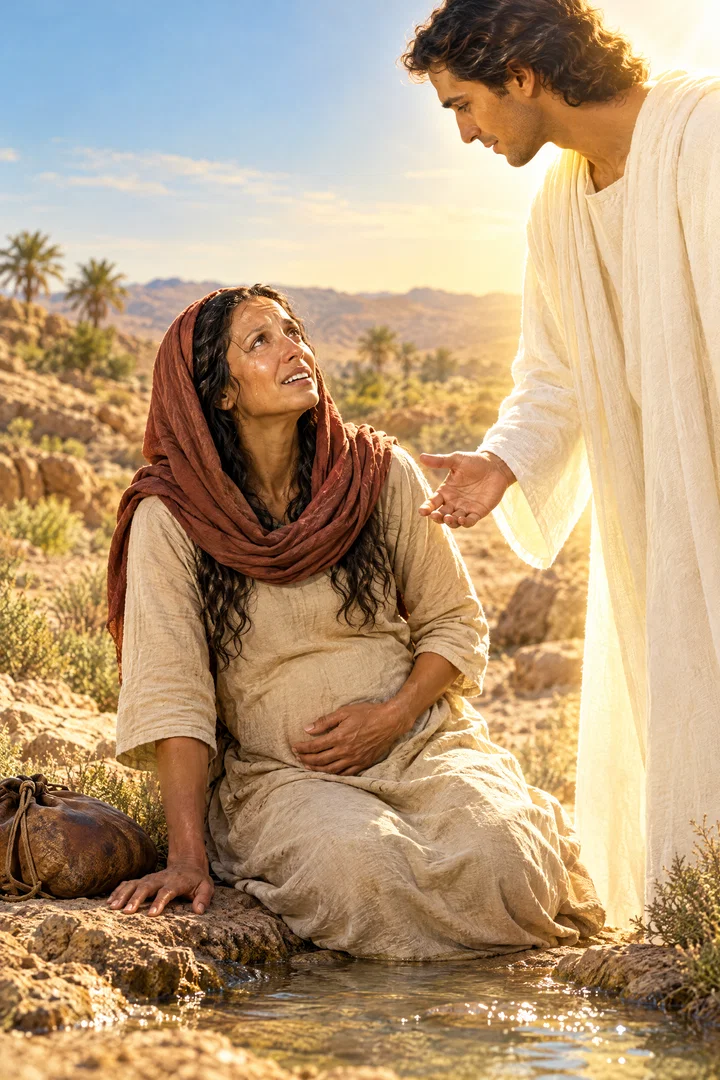
And the angel of the LORD said unto her, Behold, thou art with child, and shalt bear a son, and shalt call his name Ishmael; because the LORD hath heard thy affliction.
Translations
And the angel of the LORD said to her, Behold, you are with child and shall bear a son, and shall call his name Ishmael; because the LORD has heard your affliction.
And the angel of the LORD said unto her, Behold, thou art with child, and shalt bear a son, and shalt call his name Ishmael; because the LORD hath heard thy affliction.
And the angel of the Lord said unto her, Behold, thou art with child, and shalt bear a son, and shalt call his name Ishmael; because the Lord hath heard thy affliction.
And the angel of the LORD said to her, Behold, thou art with child, and shalt bear a son, and shalt call his name Ishmael; because the LORD hath heard thy affliction.
And the angel of the LORD said unto her, Behold, thou art with child, and shalt bear a son; and thou shalt call his name Ishmael, because the LORD hath heard thy affliction.
And the angel of Jehovah said unto her, Behold, thou art with child, and shalt bear a son; and thou shalt call his name Ishmael, because Jehovah hath heard thy affliction.
and the messenger of Jehovah saith to her, 'Behold thou [art] conceiving, and bearing a son, and hast called his name Ishmael, for Jehovah hath hearkened unto thine affliction;
And the Angel of Jehovah said to her, Behold, thou art with child, and shalt bear a son, and shalt call his name Ishmael, because Jehovah hath hearkened to thy affliction.
And the messenger of Yahweh said to her, Behold thee! with child, and about bearing a son—and thou shalt call his name Ishmael [="God hearkeneth"] for Yahweh hath hearkened unto thy humiliation.
Berean Standard Bible, Majority Standard Bible
The angel of the LORD proceeded:
“ Behold, you have conceived and will bear a son.
And you shall name him Ishmael,
for the LORD has heard your cry of affliction.The LORD’s angel said to her, “ Behold, you are with child, and will bear a son. You shall call his name Ishmael, because the LORD has heard your affliction.
And the angel of the Lord said, See, you are with child and will give birth to a son, to whom you will give the name Ishmael, because the ears of the Lord were open to your sorrow.
Also the Angel of the Lord said vnto her, See, thou art with childe, and shalt beare a sonne, and shalt call his name Ishmael: for the Lord hath heard thy tribulation.
Douay-Rheims (Challoner revision)
And again: Behold, said he, thou art with child, and thou shalt bring forth a son: and thou shalt call his name Ismael, because the Lord hath heard thy affliction.
Pictures
Cross-references
- Galatians 4:22-31
For it is written, that Abraham had two sons, the one by a bondmaid, the other by a freewoman.
Hagar and Ishmael represent the covenant of bondage, contrasted with the children of promise.
- Genesis 15:4
And, behold, the word of the LORD came unto him, saying, This shall not be thine heir; but he that shall come forth out of thine own bowels shall be thine heir.
God promises Abraham an heir from his own body, the promise Sarai tried to fulfill.
- Genesis 21:8-21
And the child grew, and was weaned: and Abraham made a great feast the same day that Isaac was weaned.
God hears Ishmael and provides for Hagar and him in the wilderness.
- Genesis 17:18-20
And Abraham said unto God, O that Ishmael might live before thee!
Abraham asks that Ishmael live before God, and God answers concerning Ishmael and Isaac.
- Genesis 25:6
But unto the sons of the concubines, which Abraham had, Abraham gave gifts, and sent them away from Isaac his son, while he yet lived, eastward, unto the east country.
Both texts describe patriarchal conduct involving Abraham’s concubines and family.
- Genesis 22:2
And he said, Take now thy son, thine only son Isaac, whom thou lovest, and get thee into the land of Moriah; and offer him there for a burnt offering upon one of the mountains which I will tell thee of.
Isaac is the promised son, distinguished from Ishmael, whom Abraham tried to provide himself.
- Romans 9:7-8
Neither, because they are the seed of Abraham, are they all children: but, In Isaac shall thy seed be called.
Abraham’s physical descendants were not all children of the promise.
- Genesis 25:12-18
Now these are the generations of Ishmael, Abraham’s son, whom Hagar the Egyptian, Sarah’s handmaid, bare unto Abraham:
Records Ishmael’s descendants and later life.
- Genesis 17:20
And as for Ishmael, I have heard thee: Behold, I have blessed him, and will make him fruitful, and will multiply him exceedingly; twelve princes shall he beget, and I will make him a great nation.
God hears Abraham and promises to bless Ishmael.
- Genesis 16:1-3
Now Sarai Abram’s wife bare him no children: and she had an handmaid, an Egyptian, whose name was Hagar.
human plan that produced Ishmael
- Genesis 16:4
And he went in unto Hagar, and she conceived: and when she saw that she had conceived, her mistress was despised in her eyes.
Sarah’s maid made light of her after conceiving, helping bring about Hagar’s oppression and flight.
- Genesis 21:1-7
And the LORD visited Sarah as he had said, and the LORD did unto Sarah as he had spoken.
Isaac’s miraculous birth contrasts with Ishmael’s natural birth.
- Genesis 17:4-7
As for me, behold, my covenant is with thee, and thou shalt be a father of many nations.
Renews the covenant promise that Abraham will become father of many nations.
- Genesis 12:1-3
Now the LORD had said unto Abram, Get thee out of thy country, and from thy kindred, and from thy father’s house, unto a land that I will shew thee:
Begins the promise later involved in the question of Abraham’s heir.
Commentary
Each commentary is drawn from primary sources: the writings of Ellen G. White and Adventist pioneers and periodicals. Each commentary is separate. Its own words are not a quotation; follow the references to read the source passages.
Ellen G. White
1 source
The angel's announcement told Hagar that she was with child and would bear a son, expressly because the Lord had heard her affliction.PP 145.2–3 The son was to be called Ishmael, a name meaning God shall hear.PP 145.2–3 That name was given as a lasting reminder of God's mercy shown to her in her suffering.PP 145.2–3
Sources
Pioneers and periodicals
32 sources
The angel of Jehovah found Hagar alone and distressed in the desert and announced that she was with child and would bear a son and call his name Ishmael, meaning God shall hear, because the Lord had heard her affliction.ST Feb 20, 1901STST Nov 8, 1899ST Jun 3, 1908RH Nov 19, 1861 She was Sarai's Egyptian handmaid, given to Abraham as wife through Sarai's scheming to secure the promised heir by human means rather than trusting God's promise.ST Apr 11, 1900ST Mar 1, 1905ST Dec 16, 1897 Read with Genesis 15:18 and Genesis 17 and Genesis 21 and Galatians 4:21-30, Hagar the bondwoman and Sarah the freewoman represent the two covenants, and Ishmael born after the flesh to a slave mother unto bondage stands in contrast to Isaac born by promise to the freewoman.RH May 29, 1900RH Jun 26, 1900ST Sep 23, 1913ST Mar 22, 1899ST Jan 24, 1900 He therefore pictures those who seek justification by law and human effort, teaching that salvation comes through God's promise in Christ and not by the flesh.ST Dec 16, 1897RH Jun 19, 1900 The announcement also begins the prophecy of his wild and hostile character and of descendants dwelling beside their brethren, fulfilled in the wandering tribes of the Arabian and Syrian deserts and proving the reliability of God's word.ST Feb 20, 1901ST Sep 8, 1898ST Jan 29, 1894STRH Jun 19, 1900
Context and Announcement
Genesis 16:11 stands in the history from B.C. 2247 to B.C. 1872, in the story of Abraham's sojourn and trials of faith after the covenant promise to Abram about his literal seed possessing the land.ST Jan 2, 1912ST Jan 29, 1894 It belongs to the birth of Ishmael together with the Hagar episode in which Abraham doubted God.ST Jan 29, 1894ST Aug 9, 1905 Abraham did not at once come to fullness of faith but had to learn the lesson over and over, and the history shows constant and remarkable evidences of God's overruling providence while pressing whether readers are children of Abraham.ST Jan 2, 1912
Hagar was Sarai's Egyptian handmaid, given to Abraham as wife through Sarai's plan to secure the promised heir by human arrangement and scheming rather than continuing to trust God's promise.ST Mar 1, 1905ST Dec 16, 1897ST Sep 28, 1915 After Abraham and Sarah tried in this way to secure the heir through their own means, Hagar conceived and bore a son.ST Apr 11, 1900ST Mar 1, 1905 That son, born to a handmaid and slave after the flesh rather than by God's promised plan, became a source of household conflict and trouble, and that course led to bondage.ST Apr 11, 1900ST Mar 1, 1905ST Sep 28, 1915
The Angel of Jehovah found Hagar alone and distressed in the desert when she thought she was driven out to die, and sent a messenger to comfort her with assurance about her child.ST Nov 8, 1899ST Jun 3, 1908ST Sep 8, 1898 He advised her to return to her mistress and foretold the son she would soon bear, bringing her a message of hope in her loneliness.ST Sep 8, 1898ST Mar 23, 1915 His seeing her affliction and naming her unborn son was comfort that He had not forgotten her but would supply her need, and God sees people in trouble so that when they yield to Him they are safe in His presence.ST Nov 8, 1899ST Mar 23, 1915 That seeing is not watching to condemn sin or to frighten from evil deeds, but seeing a discouraged soul to save.ST Nov 8, 1899 The promise reveals divine power to make and fulfill what only God can promise, for Hagar recognized Him as the God who sees.ST Jun 3, 1908
Before Ishmael's birth the angel announced that Hagar was with child and would bear a son and call his name Ishmael, because the Lord had heard her affliction.ST Apr 1, 1875ST Feb 20, 1901ST The name means God shall hear, and it was given to recall God's hearing.STRH Nov 19, 1861 God later answered the boy's need in the wilderness.ST
Prophecy and Descendants
The announcement that the afflicted fugitive would bear a son to be called Ishmael opens the prophecy concerning Ishmael and his descendants, whose character, relations with others, and continued existence are set forth in the verses that follow.ST Feb 20, 1901 His disposition was described before his birth as a wild man, a wild ass man, a wild ass among men, with his hand against every man and every man's hand against him.RH Jun 19, 1900
The related prophecy declares that his descendants would be hostile and would dwell in the presence of their brethren.ST Its fulfillment is seen in the wandering Ishmaelite tribes of the Arabian and Syrian deserts and in their continuing presence beside Israel.ST The later character of the child was shaped by the treatment his mother suffered.ST Sep 8, 1898
By descent Ishmael stands as a son of Abraham, giving another line from Abraham alongside the descendants of Isaac and Jacob.RH Jan 16, 1872 The Ishmaelites are thus the same race as the Bedouins and as the inhabitants of that country, identified here with the Arabs.RH Dec 25, 1856RH Jan 16, 1872 To this foretold birth is also connected the claim of the Bantu to descent from Ishmael.ST Jan 16, 1896
What God spoke concerning Ishmael was fulfilled, making it an example of the truth and reliability of what God has spoken.ST The history belongs with the covenant promise to Abram about his literal seed possessing the land, and with Sarai's jealousy and the sending away of Hagar and her son.ST Jan 29, 1894 Ishmael was afterward sent away to wander in the wilderness, and Abraham's separation from him brought grief and tested his faith.ST Apr 1, 1875
Covenant and Doctrine
Genesis 16 is to be read with Genesis 15:18 and Genesis 17 and Genesis 21 and Galatians 4:21-30 for the covenant question, because Galatians 4:24 shows these histories are the two covenants.RH Jun 26, 1900 Hagar the bondwoman was mother of one son and Sarah the freewoman mother of the other, the women represent the two covenants, and their sons represent the children of those covenants.RH May 29, 1900 This difference of birth supplies the illustration of the two covenants, testaments or dispensations, the typical and antitypical systems, and literal Israel and true Israel, Jews and Gentiles as representatives of the Lord and His work in two special periods of its development in the earth.ST Jan 24, 1900
Abraham's attempt through human weakness and temporary lack of faith to do for himself in his own way what God had promised shows the difference between the old covenant and the new covenant.ST Sep 23, 1913 Abram and Sarai relied on human means rather than continuing to trust God's promise when Hagar conceived and bore Ishmael, and attempts to help God fulfill His word through human effort lead to bondage.ST Mar 1, 1905 Hagar, Sarai's Egyptian handmaid given to Abraham as wife through Sarai's plan, bore a son named Ishmael after the flesh, in contrast to Isaac born by promise to Sarai.ST Dec 16, 1897 Hagar represents the old covenant entered at Mount Sinai and Sarai represents the new covenant, while Ishmael represents the children of the old covenant, the Jews after the flesh.ST Dec 16, 1897 Born to a handmaid and a slave through human scheming rather than God's promised plan, his birth led to trouble and represents bondage, and unlike Isaac he was not the child of promise or grace but the natural child born through a human plan to fulfill God's work.ST Sep 28, 1915ST Apr 29, 1908
Ishmael was Abraham's son by Hagar after the flesh and not by promise, and Hagar being an Egyptian slave meant her child was born to bondage and could bring forth only bondage, since children of a slave woman are always slaves even though their father is a freeman.ST Mar 22, 1899 Long before he was born God had told Abraham his heir would not be a bond-servant born in his house like Eliezer but a free-born son of a freewoman.ST Mar 22, 1899 To turn from whole-hearted faith in Christ to trust in fleshly descent from Abraham is to be a child after Ishmael, for the children of the flesh are not the children of God and not heirs of the promises.ST Mar 22, 1899
Ishmael was the fruit of Sarai's invention sprung from distrust of God and unbelief of His promise to give a son, and his disposition was described before birth as a wild man, a wild ass man, a wild ass among men, with his hand against every man and every man's hand against him.RH Jun 19, 1900 Sarai and even Abraham intended and expected that this child of the flesh should be accepted as the promised son and that God's covenant with Abraham should be fulfilled through him.RH Jun 19, 1900 Hagar his mother represents the covenant from Sinai, and Ishmael her son born after the flesh represents the children of that covenant from Sinai which gendereth to bondage, who like Ishmael expected to fulfill God's promise and bring God's covenant with Abraham to fullness through the flesh.RH Jun 19, 1900 Abraham kept the commandments of God, and the righteousness of God is essential to the covenant with Abraham without which no one can attain the inheritance, yet Ishmael born after the flesh knew only the birth of the flesh and only the minding of the flesh.RH Jun 19, 1900 The minding of the flesh is enmity against God and is not subject to the law of God neither indeed can be, so Ishmael could not keep the commandments, and a wild man with his hand against every man cannot keep Thou shalt love thy neighbor as thyself, though as Ishmael the children of the Sinai covenant covenanted to keep the law of God indeed.RH Jun 19, 1900
The son born of the handmaid through Abraham's plan represents those who seek justification by the law and try to earn it for themselves, in contrast to Isaac the child of promise whose birth depended on God's promise. The contrast teaches that justification and salvation come through God's promise in Christ, not human effort. The verse shows the Sabbath was in existence and binding at least a month before the covenant made at Horeb, so the obligation of the Sabbath did not originate with the covenant at Horeb.RH Apr 2, 1872
Genesis 16 is an example of violation of the marriage institution among the patriarchs through polygamy, but such violations did not make marriage any less sacred.RH Feb 3, 1852ST May 18, 1882 That violation does not destroy the sacred character of marriage, just as violation of the Sabbath would not destroy the Sabbath.RH Nov 8, 1853 Marriage was made for man before the fall and its sanctity is not derived from the Decalogue, the seventh commandment guards its sacredness, and the institution was established before the fall.RH Nov 8, 1853RH Jan 21, 1875
An angel saving Hagar and her child in the desert means the Bible teaches spirit communication as ministration of angels, not communication from the spirits of the dead. The angel to Hagar was not a dead person returned, for angels whether good or evil are a distinct order of beings who existed before man and the earth were created, before man sinned or any soul died.
Sources