Genesis 21:11
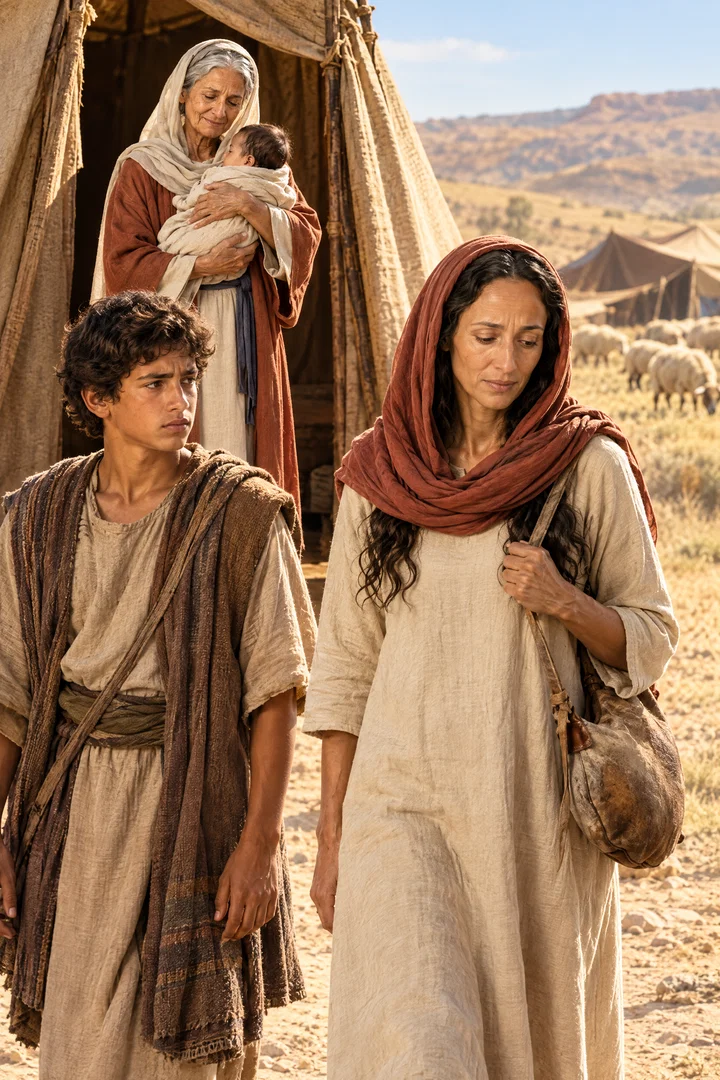
And the thing was very grievous in Abraham’s sight because of his son.
Translations
American King James Version, King James Version, KJV Cambridge Paragraph Bible
And the thing was very grievous in Abraham’s sight because of his son.
And the thing was very grievous in Abraham's sight, because of his son.
Revised Version, American Standard Version
And the thing was very grievous in Abraham’s sight on account of his son.
And the thing is very wrong in the eyes of Abraham, for his son's sake;
And the thing was very grievous in Abraham's sight because of his son.
And the word was very grievous in the eyes of Abraham,—on account of his son.
Berean Standard Bible, Majority Standard Bible
Now this matter distressed Abraham greatly because it concerned his son Ishmael.
The thing was very grievous in Abraham’s sight on account of his son.
And this was a great grief to Abraham because of his son.
And this thing was very grieuous in Abrahams sight, because of his sonne.
Douay-Rheims (Challoner revision)
Abraham took this grievously for his son.
Pictures
Cross-references
- Genesis 16:1-4
Now Sarai Abram’s wife bare him no children: and she had an handmaid, an Egyptian, whose name was Hagar.
Sarah’s plan involving Hagar led to Ishmael’s birth and the family trouble behind Abraham’s grief.
- Galatians 4:21-31
Tell me, ye that desire to be under the law, do ye not hear the law?
Abraham’s two sons and their mothers illustrate the covenants and their heirs.
- Genesis 17:18-21
And Abraham said unto God, O that Ishmael might live before thee!
Abraham pleads for Ishmael, but God names Isaac as the covenant heir and promises to bless Ishmael.
- Genesis 22:2
And he said, Take now thy son, thine only son Isaac, whom thou lovest, and get thee into the land of Moriah; and offer him there for a burnt offering upon one of the mountains which I will tell thee of.
The command to offer Isaac was a greater test after Abraham sent Ishmael away.
- Galatians 4:30
Nevertheless what saith the scripture? Cast out the bondwoman and her son: for the son of the bondwoman shall not be heir with the son of the freewoman.
Paul recalls the command to cast out Hagar and her son.
- Genesis 16:11-12
And the angel of the LORD said unto her, Behold, thou art with child, and shalt bear a son, and shalt call his name Ishmael; because the LORD hath heard thy affliction.
Gives the prophecy about Ishmael recalled in the surrounding account.
- Hebrews 11:17-19
By faith Abraham, when he was tried, offered up Isaac: and he that had received the promises offered up his only begotten son,
Abraham’s grievous trial is connected with his obedient act of faith.
- James 2:21-23
Was not Abraham our father justified by works, when he had offered Isaac his son upon the altar?
Abraham’s obedience in trial shows faith working through his actions.
- Genesis 15:2-4
And Abram said, Lord GOD, what wilt thou give me, seeing I go childless, and the steward of my house is this Eliezer of Damascus?
Abraham considers Eliezer as heir before God promises an heir from his own body.
- Matthew 1:1-2
The book of the generation of Jesus Christ, the son of David, the son of Abraham.
Jesus’ genealogy establishes his descent from Abraham.
Commentary
Each commentary is drawn from primary sources: the writings of Ellen G. White and Adventist pioneers and periodicals. Each commentary is separate. Its own words are not a quotation; follow the references to read the source passages.
Ellen G. White
3 sources
The grievous thing had its roots in earlier distrust of God that led to Abraham's marriage with Hagar.PP 147.1 It belongs to Sarah's demand that Hagar and Ishmael be sent away.PP 147.1 As wife and mother her rights were not to be shared with a rival, and God did not reprove her for requiring the banishment.PP 147.1
Abraham was deeply distressed at the thought of sending Ishmael away because Ishmael was his dearly loved son.PP 146.2PP 147.2–148.1 He obeyed the divine direction to send Hagar and Ishmael away so that peace could be restored to his household, but he did so with a heavy heart.PP 146.2 He had already obeyed God in sending Ishmael away before he faced the later test involving Isaac.PP 147.2–148.1
Sources
Pioneers and periodicals
22 sources
The verse shows Abraham was deeply grieved at having to send Hagar and Ishmael away because Ishmael was his own son whom he loved as a father.RH Dec 28, 1916ST Apr 11, 1900RH Jul 3, 1900 His grief came when Sarah required that separation after Isaac's birth and Ishmael's mocking of him.ST Apr 11, 1900RH Jul 3, 1900ST Mar 1, 1905ST Feb 12, 1894 God told him not to let grief hold him back but to heed Sarah's demand, because the promised heir and called line were to come through Isaac, the miraculous child of promise born to the free wife, and not through Ishmael.ST Apr 11, 1900RH Jul 3, 1900ST Mar 1, 1905 The two sons and their mothers stand for the two covenants, with Hagar and Ishmael standing for bondage brought by the human scheme to gain an heir and Sarah and Isaac standing for freedom and the children of the new covenant.RH May 29, 1900ST Sep 28, 1915RH Mar 1, 1870RH Jun 4, 1867 That choosing of Isaac concerned the line through which the promise and the Messiah would come, fulfilled in Jesus Christ sprung from Abraham, and not the eternal salvation of either son.ST Apr 11, 1900RH Nov 18, 1862ST Apr 10, 1907
Abraham's Grief and Context
The matter was very grievous in Abraham's sight because Ishmael was his son, and he was deeply distressed and grieved at the thought of sending him away.RH Dec 28, 1916ST Apr 11, 1900RH Jul 3, 1900ST Mar 1, 1905ST Mar 17, 1914 His attachment as a father and his love for Ishmael made the separation painful to him, for the conflict involved his own son to whom he clung.RH Dec 28, 1916ST Apr 11, 1900ST Mar 17, 1914RH Mar 1, 1870ST Sep 8, 1898 That distress came when Sarah demanded and advised that Hagar and Ishmael be sent away, so that her demand meant a painful separation of father and son.ST Apr 11, 1900RH Jul 3, 1900ST Mar 1, 1905ST Sep 8, 1898ST Sep 8, 1898 Sarah's demand to cast out the bondwoman and her son caused Abraham great grief because Ishmael was his son.ST Apr 11, 1900RH Jul 3, 1900ST Sep 8, 1898ST Sep 8, 1898ST Jan 24, 1900
The trouble grew out of the earlier course of taking Hagar as a wife and using her to obtain an heir by human arrangement.ST Apr 11, 1900RH Jun 4, 1867RH Mar 16, 1869ST Jan 20, 1898 That polygamous and scheming course brought great unhappiness into Abraham's family, and the grief over the son was its later sorrowful consequence ending in the painful separation of father and son.RH Mar 1, 1870RH Jun 4, 1867RH Mar 16, 1869ST Jan 20, 1898 His hesitation to send Hagar away followed Sarah's earlier advice that he take Hagar, which was wrong, yet her present advice to send her away was approved and to be followed.RH Jun 4, 1867RH Mar 16, 1869 The separation was part of Abraham's test of faith and obedience.ST Sep 8, 1898ST Jan 24, 1900 He eventually agreed and sent them away, breaking Ishmael's claim to heirship and inheritance, in the conflict over Abraham's sons and property in which Ishmaelites regarded Ishmael as unjustly deprived by Isaac of a share.ST Sep 8, 1898ST Jan 24, 1900
The setting is Isaac's birth, Ishmael's mocking of Isaac, and Hagar's departure, in which God showed mercy to Hagar in the wilderness.ST Apr 11, 1900RH Jul 3, 1900ST Feb 12, 1894
Promise, Covenant and Prophecy
The promised Seed, heir, blessing, and called line were to come through Isaac rather than through Ishmael.ST Apr 11, 1900RH Jul 3, 1900ST Mar 1, 1905RH Jul 5, 1915 Isaac was the miraculous child of promise born to Sarah the free wife by God's power and providence in the chosen family through whom the promised Seed would come.ST Apr 11, 1900STRH Jul 5, 1915 Abraham was still inclined to think that Ishmael, born through his own human arrangement, might share the inheritance, but God affirmed that the promised seed would be called through Isaac.ST Apr 11, 1900RH Jul 3, 1900ST Mar 1, 1905 God told Abraham not to be distressed and not to grieve over the boy and over Hagar, and not to let distress prevent him from acting.ST Apr 11, 1900RH Jul 3, 1900ST Mar 1, 1905 He was to heed Sarah and follow her present request, for God approved her present advice.ST Apr 11, 1900RH Jul 3, 1900ST Mar 1, 1905RH Jun 4, 1867
Abraham's two sons and their mothers represent the two covenants.RH May 29, 1900 Hagar the bondwoman represents one covenant and Sarah the freewoman the other, and the two sons represent their children.RH May 29, 1900 Isaac, born through God's promise, represents freedom and the children of the new covenant, while the human scheme led to bondage and trouble.ST Sep 28, 1915 Abraham had tried to secure the promised heir through Hagar contrary to the promise that the heir would come through Sarah.ST Sep 28, 1915 Ishmael's birth resulted from human efforts to bring about God's promise, and Abraham regarded him as his heir.ST Apr 11, 1900ST God corrected the mistake by declaring that Sarah would bear Isaac, and the two sons and their mothers could not remain together.ST Sep 28, 1915ST
Isaac was chosen to carry forward God's promise to Abraham, while Ishmael was passed over for that special role.ST Apr 10, 1907 This choosing concerned the line through which the promise would continue, not the brothers' eternal salvation.ST Apr 10, 1907 The account in Genesis 21:1-12 shows that Messiah was to be the son of Abraham, fulfilled by Jesus Christ sprung from Abraham in direct line.RH Nov 18, 1862 The weaning of Isaac and the mocking of Isaac by the bondwoman's son about that time marks the beginning of the 400-year period of affliction leading to the deliverance from Egypt.ST Aug 12, 1913ST Aug 7, 1901 That beginning is dated here to 1891 B.C.ST Aug 12, 1913
Sources