Genesis 23:3
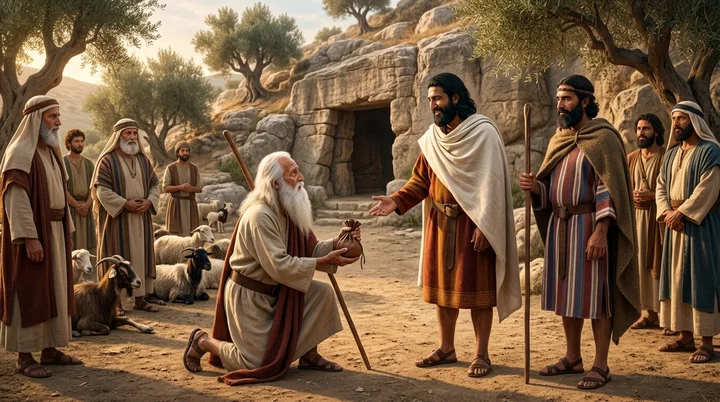
And Abraham stood up from before his dead, and spake unto the sons of Heth, saying,
Translations
American King James Version, Webster Bible
And Abraham stood up from before his dead, and spoke to the sons of Heth, saying,
King James Version, KJV Cambridge Paragraph Bible
And Abraham stood up from before his dead, and spake unto the sons of Heth, saying,
Revised Version, American Standard Version
And Abraham rose up from before his dead, and spake unto the children of Heth, saying,
And Abraham riseth up from the presence of his dead, and speaketh unto the sons of Heth, saying,
And Abraham rose up from before his dead, and spoke to the sons of Heth, saying,
And Abraham rose up from over the face of his dead,—and spake unto the sons of Heth, saying;
Berean Standard Bible, Majority Standard Bible
Then Abraham got up from beside his dead wife and said to the Hittites,
Abraham rose up from before his dead and spoke to the children of Heth, saying,
And Abraham came from his dead and said to the children of Heth,
Then Abraham rose vp from the sight of his corps, and talked with the Hittites, saying,
Douay-Rheims (Challoner revision)
And after he rose up from the funeral obsequies, he spoke to the children of Heth, saying:
Pictures
Cross-references
- Genesis 25:9-10
And his sons Isaac and Ishmael buried him in the cave of Machpelah, in the field of Ephron the son of Zohar the Hittite, which is before Mamre;
Abraham was buried in the field he bought for Sarah.
- Genesis 49:29-32
And he charged them, and said unto them, I am to be gathered unto my people: bury me with my fathers in the cave that is in the field of Ephron the Hittite,
Jacob identifies the family burial place bought by Abraham.
- Genesis 50:13
For his sons carried him into the land of Canaan, and buried him in the cave of the field of Machpelah, which Abraham bought with the field for a possession of a buryingplace of Ephron the Hittite, before Mamre.
Jacob is buried in the cave of Machpelah.
- Ezekiel 16:3
And say, Thus saith the Lord GOD unto Jerusalem; Thy birth and thy nativity is of the land of Canaan; thy father was an Amorite, and thy mother an Hittite.
Both texts name the Hittites in connection with Abraham and Jerusalem’s origins.
Commentary
Each commentary is drawn from primary sources: the writings of Ellen G. White and Adventist pioneers and periodicals. Each commentary is separate. Its own words are not a quotation; follow the references to read the source passages.
Ellen G. White
1 source
Abraham rose from mourning before Sarah after her death to speak with the sons of Heth, the Hittites, about arranging her burial.10MR 120.2 Although God had promised him the land of Canaan, he owned none of it at that time and had to purchase a burial place for Sarah.10MR 120.2 His hope was not fixed on present possessions but on the future immortal life and the earth made new.10MR 120.2
Sources
Pioneers and periodicals
11 sources
After Sarah's death at Hebron, Abraham stood up from beside her dead body and spoke to the sons of Heth, the Hittites, to seek a burial place for her.RH Jan 27, 1910RH Apr 25, 1854ST Jan 9, 1912ST Jun 23, 1909ST Feb 19, 1894 That address begins the account of his dealings with them over land and its purchase.RH Jan 27, 1910RH Apr 25, 1854ST Jan 9, 1912ST Feb 19, 1894 He approached them as a stranger and bought the field and cave of Machpelah from Ephron, where he buried Sarah.RH Jan 27, 1910ST Aug 21, 1884 He paid for what they offered rather than accepting it without payment, indeed at full price.RH Apr 25, 1854ST Aug 21, 1884 The sons of Heth offered land while expecting to be rewarded, and when asked to name a price they demanded more than it was worth, about 250 dollars.ST Jan 9, 1912
His purchase of land from a Hittite family did not surrender his broader claim to Canaan. The Hittites had established a settled presence in that district whose earlier settlement had been allowed to stand, making that particular area their property. The need to deal with the Hittites to buy a burial place shows that Abraham owned none of the land promised to him and his descendants, even though the promise included the whole earth.ST May 12, 1898ST Oct 12, 1904ST Apr 6, 1888 The burial place is the only permanent possession he acquires in Canaan, and otherwise he sojourns in the land of promise as in a strange country as a stranger.ST May 12, 1898ST Oct 12, 1904ST Apr 6, 1888ST Aug 21, 1884
His lack of possession proves the promise was not fulfilled to him in Canaan in his lifetime, and he dies without receiving it together with Isaac and Jacob as fellow heirs.ST May 12, 1898ST Oct 12, 1904 As a stranger and pilgrim he does not expect fulfillment in the present world but looks to a future immortal inheritance to be received together with all who die in faith at the coming of Christ and the resurrection of the righteous, when the meek shall inherit the earth.ST May 12, 1898ST Oct 12, 1904 The verse continues the Genesis account of the family through which the Seed was to come, in the line where the promises extend from Abraham to Isaac and from Isaac to Jacob.ST Jan 14, 1913 The verse belongs to the Bible's record of the Hittites reaching back to Abraham's time and places them at Hebron, providing evidence for the historical existence of the Hittite people later confirmed by archaeological discoveries.ST Jun 23, 1909ST Oct 1, 1885
Sources