Genesis 24:17
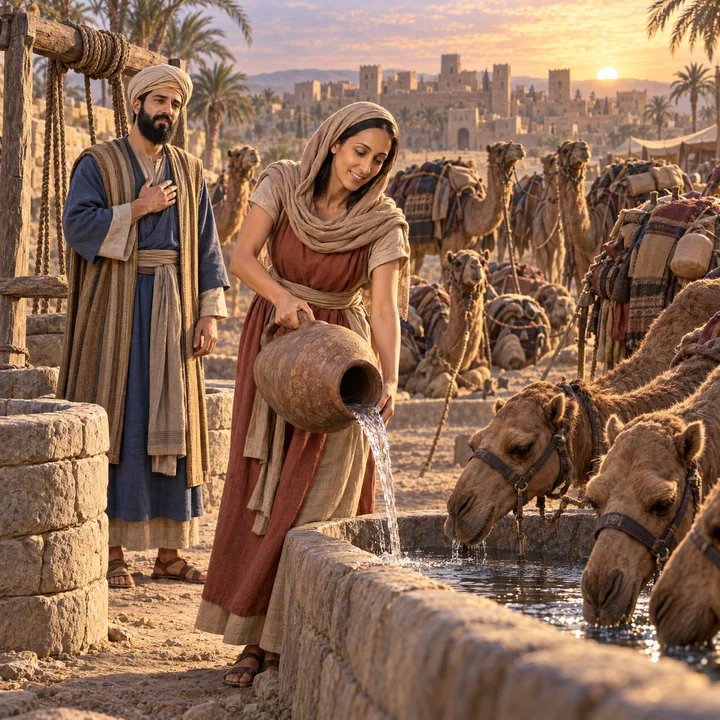
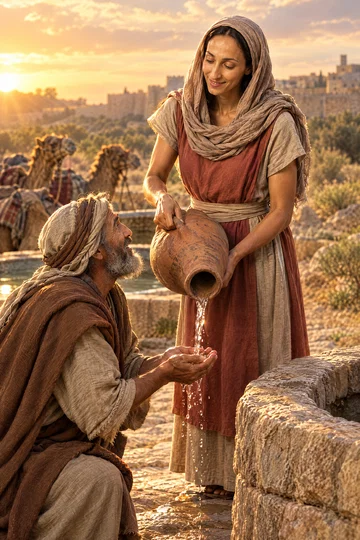
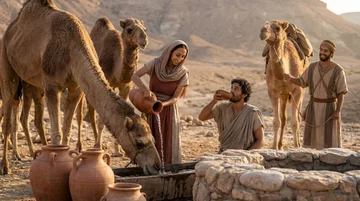
And the servant ran to meet her, and said, Let me, I pray thee, drink a little water of thy pitcher.
Translations
And the servant ran to meet her, and said, Let me, I pray you, drink a little water of your pitcher.
King James Version, KJV Cambridge Paragraph Bible
And the servant ran to meet her, and said, Let me, I pray thee, drink a little water of thy pitcher.
And the servant ran to meet her, and said, Let me, I pray thee, drink a little water from thy pitcher.
And the servant ran to meet her, and said, Give me to drink, I pray thee, a little water of thy pitcher.
And the servant ran to meet her, and said, Give me to drink, I pray thee, a little water from thy pitcher.
And the servant runneth to meet her, and saith, 'Let me swallow, I pray thee, a little water from thy pitcher;'
And the servant ran to meet her, and said, Let me, I pray thee, sip a little water out of thy pitcher.
And the servant ran to meet her,—and said, I pray thee let me drink a little water out of thy pitcher.
Berean Standard Bible, Majority Standard Bible
So the servant ran to meet her and said, “ Please let me have a little water from your jar.”
The servant ran to meet her, and said, “ Please give me a drink, a little water from your pitcher.”
And the servant came running to her and said, Give me a little water from your vessel.
Then the seruant ranne to meete her, and said, Let me drinke, I pray thee, a litle water of thy pitcher.
Douay-Rheims (Challoner revision)
And the servant ran to meet her, and said: Give me a little water to drink of thy pitcher.
Pictures
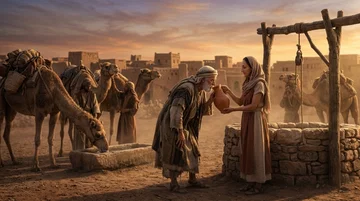
Cross-references
- Genesis 29:1-10
Then Jacob went on his journey, and came into the land of the people of the east.
Both scenes describe a meeting at a well in Padan-Aram.
- Exodus 2:15-17
Now when Pharaoh heard this thing, he sought to slay Moses. But Moses fled from the face of Pharaoh, and dwelt in the land of Midian: and he sat down by a well.
Moses meets Reuel’s daughters at a well.
- Genesis 24:12
And he said, O LORD God of my master Abraham, I pray thee, send me good speed this day, and shew kindness unto my master Abraham.
Eliezer asks God to guide his search.
- Genesis 24:67
And Isaac brought her into his mother Sarah’s tent, and took Rebekah, and she became his wife; and he loved her: and Isaac was comforted after his mother’s death.
Isaac takes Rebekah as his wife and loves her.
- Genesis 24:51
Behold, Rebekah is before thee, take her, and go, and let her be thy master’s son’s wife, as the LORD hath spoken.
Rebekah’s family recognizes God’s hand and gives her to Isaac as his wife.
- Genesis 24:40
And he said unto me, The LORD, before whom I walk, will send his angel with thee, and prosper thy way; and thou shalt take a wife for my son of my kindred, and of my father’s house:
Abraham recalls God’s promise to send an angel ahead.
- Genesis 24:63
And Isaac went out to meditate in the field at the eventide: and he lifted up his eyes, and saw, and, behold, the camels were coming.
Both depict pastoral scenes involving Isaac and Rebekah.
- Genesis 24:31
And he said, Come in, thou blessed of the LORD; wherefore standest thou without? for I have prepared the house, and room for the camels.
Laban welcomes the servant whom God guided to Rebekah.
- Genesis 24:7
The LORD God of heaven, which took me from my father’s house, and from the land of my kindred, and which spake unto me, and that sware unto me, saying, Unto thy seed will I give this land; he shall send his angel before thee, and thou shalt take a wife unto my son from thence.
Abraham assures the servant that God will send an angel ahead of him.
- Genesis 24:27
And he said, Blessed be the LORD God of my master Abraham, who hath not left destitute my master of his mercy and his truth: I being in the way, the LORD led me to the house of my master’s brethren.
quoted to sum up the servant's leading
Commentary
Each commentary is drawn from primary sources: the writings of Ellen G. White and Adventist pioneers and periodicals. Each commentary is separate. Its own words are not a quotation; follow the references to read the source passages.
Ellen G. White
7 sources
The verse belongs to the account of Abraham's servant seeking a wife for Isaac from Nahor's family in Mesopotamia.PP 171.3SG3 112.3SG3 112.1–2 In that account the servant meets Rebekah at the well and asks her for water.ST Apr 10, 1879CE 228.1–230.11SP 102.1 The servant undertook the journey trusting that God would guide the choice and send an angel before him.PP 171.3 The servant entrusted with the choice was experienced and God-fearing.SG3 112.1–2CE 228.1–230.1 Rebekah's courteous offer of water to the servant and her drawing water for his camels was the sign he had asked God for, confirming to him that she was the woman God had chosen for Isaac.1SP 102.1
The account shows Abraham taking responsibility to guide his son's choice of a suitable companion and his affections in marriage.SG3 112.3ST Apr 10, 1879 The account shows Isaac submitting to his father's experienced servant and trusting God to direct the choice of a wife.SG3 112.1–2 Isaac's deference to his father's judgment exemplifies obedience shaped by loving parental training.CE 228.1–230.1 The account serves as an example, especially for children who profess to fear God, that choosing a spouse should be done in the fear of God and prayer, with parents guiding their children's affections and teaching respect for parental authority, and with children respecting parental guidance rather than choosing independently.SG3 112.31SP 104.3
Sources
Pioneers and periodicals
19 sources
Abraham's trusted servant journeys to Mesopotamia, to Padan-Aram, to find a wife for Isaac, and at a well just outside Haran at sunset he runs to meet Rebekah as she comes with her pitcher and asks her for a little water.ST Jan 14, 1886ST Feb 19, 1894ST Feb 17, 1914RH Feb 22, 1912 The request is the first step of the sign he had prayed for, and she answers with gracious courtesy and prompt kindness, giving him drink and offering also to draw for his camels, which is the very token confirming God's guidance.ST Feb 17, 1914RH Jul 25, 1912RH Jan 30, 1872 Though the meeting looks like ordinary life, the Lord directs it providentially in answer to earnest prayer, through the servant's faithfulness in being in the way he is led.ST Jan 9, 1912ST Jan 14, 1886RH Jan 30, 1872ST Sep 15, 1898RH Aug 1, 1871 The search itself arises from urgent need to secure as nearly as possible a wife in the godly line, to prevent amalgamation of the godly seed with the ungodly and to preserve the channel for the promised Seed and the blessing of all families.ST Dec 20, 1910ST Aug 3, 1915ST The account also holds up Abraham guiding his son's affections and Isaac deferring to his father's judgment in obedience that honors parents as the fifth commandment requires.ST Apr 10, 1879ST Jul 9, 1874
Story and Historical Setting
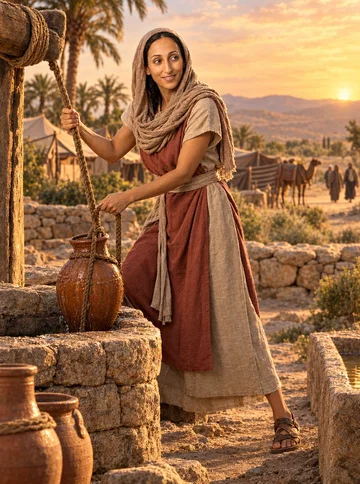
Genesis 24:17 belongs to the true account of ancient Oriental life in which Abraham's tested servant travels to Mesopotamia, to Padan-Aram, to a fountain and well, to find a wife for Isaac, Rebekah's cousin, and the journey succeeds and the servant returns with Rebekah.ST Jan 14, 1886ST Feb 19, 1894ST May 19, 1898 The meeting takes place at a well just outside Haran at sunset, where Rebekah comes with her pitcher and camels.ST Feb 17, 1914RH Feb 22, 1912 It unfolds amid the quiet pastoral life of Abraham, Ishmael and Isaac in a half-peopled world of flocks, green rest, and the bleating of sheep and tinkling of camel bells.RH Feb 22, 1912 The servant's arrival in Padan-Aram occurred about one hundred years before Jacob arrived there, inviting comparison between the two arrivals.ST Oct 6, 1898
The episode belongs to the continuing story of God's care for Abraham, who had come to trust God, and for the chosen family through whom the promised Seed would come.ST Dec 20, 1910ST The promises given to Abraham extend in it to Isaac and from Isaac to Jacob, as part of the family through which the Seed was to come.ST Dec 20, 1910STST Jan 14, 1913 The search for a wife arose from Abraham's great perplexity, after waiting a full twenty-five years in faith for the son of promise and after that son had come to manhood, to secure for Isaac a wife as nearly as possible in the godly line.ST Aug 3, 1915 This was necessary because the race was fast drifting into idolatry and Abraham and Lot were left as the only uncorrupted survivors, so separation from the ungodly line was urgent to prevent amalgamation of the godly seed with the ungodly and pollution of God's people.ST Aug 3, 1915 That separation would preserve God's name and truth in the earth, keep His people a factor in evangelizing the world, and provide a channel for the coming of the Deliverer, so that God's eternal purpose of filling the earth with a people all righteous would carry and all families of the earth be blessed in Abraham.ST Aug 3, 1915
Providence, Prayer and Lessons
The meeting at the well unfolds within a search guided by God and marked by prayer and faith rather than mere chance.ST Jan 14, 1886ST Sep 15, 1898 The servant had prayed earnestly over this temporal responsibility of finding a wife for Isaac, watching for divine leading, recognizing guidance when it came, and gratefully acknowledging mercy received.ST Jan 14, 1886ST Sep 15, 1898 His running to meet the maiden and asking for a little water from her pitcher shows the answer to that prayer for guidance beginning to unfold.ST Jan 14, 1886ST Sep 5, 1900
That request for water was the first step in the sign he had asked God to give for identifying Isaac's wife.ST Feb 17, 1914RH Jul 25, 1912RH Jan 30, 1872 She arrived while he was still speaking, and answered with gracious courtesy, deference, and prompt kindness.ST Feb 17, 1914RH Jul 25, 1912RH Jan 30, 1872 She not only gave him drink but also offered to draw for his camels, and this double kindness was the very token prayed for, confirming God's guidance.ST Feb 17, 1914RH Jul 25, 1912RH Jan 30, 1872 Its fulfillment filled him with joy and thanksgiving as revealing God's hand leading him to the daughter of Abraham's nephew.ST Feb 17, 1914RH Jul 25, 1912
Although the encounter appeared to happen in the ordinary course of events, the Lord directed it providentially.RH Jan 30, 1872 It displays God's special providence over the progenitors of the promised Seed through the piety, unselfishness, and faithfulness of the trusted servant in being in the way the Lord led him.ST Jan 9, 1912RH Jan 30, 1872 It likewise shows the power of prayer, in that the servant prays and Rebekah appears to meet him in answer.ST Jan 9, 1912RH Jan 30, 1872RH Aug 1, 1871
The whole account is connected with Abraham's example of guiding his son's marriage and affections.ST Apr 10, 1879 It shows Isaac accepting his father's judgment in choosing his wife, an obedience arising from training that taught him to value obedience. His deference to his father's wishes testifies that honor to parents as enforced in the fifth commandment was not new at Sinai but already controlled God's chosen servants among the patriarchs.ST Jul 9, 1874
Sources