Genesis 29:10
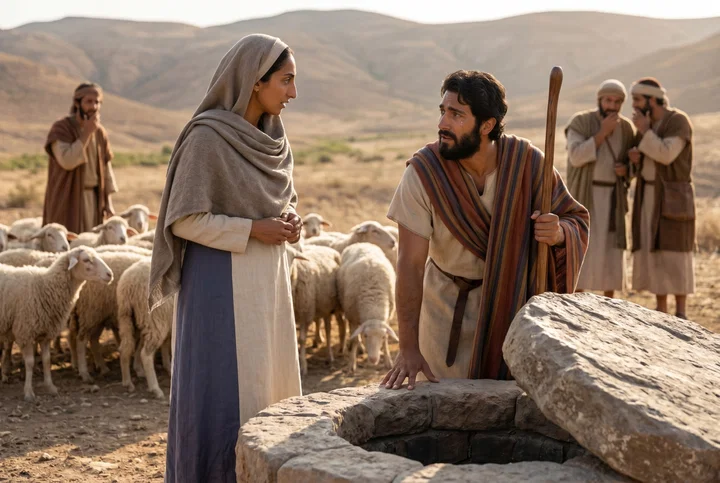
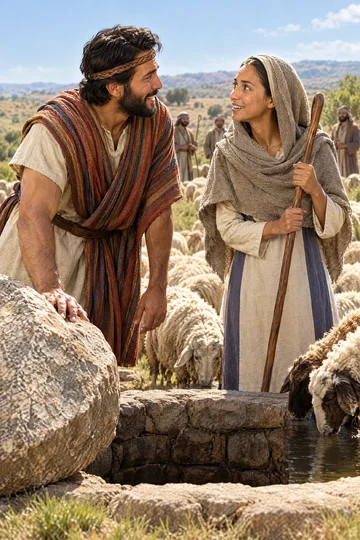
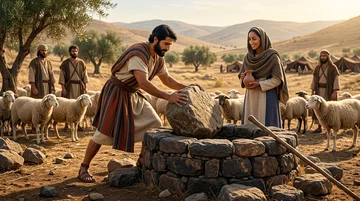
And it came to pass, when Jacob saw Rachel the daughter of Laban his mother’s brother, and the sheep of Laban his mother’s brother, that Jacob went near, and rolled the stone from the well’s mouth, and watered the flock of Laban his mother’s brother.
Translations
American King James Version, King James Version, KJV Cambridge Paragraph Bible, Revised Version, American Standard Version
And it came to pass, when Jacob saw Rachel the daughter of Laban his mother’s brother, and the sheep of Laban his mother’s brother, that Jacob went near, and rolled the stone from the well’s mouth, and watered the flock of Laban his mother’s brother.
And it came to pass, when Jacob saw Rachel, the daughter of Laban his mother's brother, and the sheep of Laban his mother's brother; that Jacob went near, and rolled the stone from the well's mouth, and watered the flock of Laban his mother's brother.
and it cometh to pass when Jacob hath seen Rachel, daughter of Laban his mother's brother, and the flock of Laban his mother's brother, that Jacob cometh nigh and rolleth the stone from off the mouth of the well, and watereth the flock of Laban his mother's brother.
And it came to pass when Jacob saw Rachel the daughter of Laban his mother's brother, and the sheep of Laban his mother's brother, that Jacob went near, and rolled the stone from the mouth of the well, and watered the sheep of Laban his mother's brother.
And it came to pass when Jacob saw Rachel daughter of Laban, his mother’s brother, and the sheep of Laban, his mother’s brother, that Jacob went near, and rolled away the stone from off the mouth of the well, and watered the sheep of Laban his mother’s brother,
Berean Standard Bible, Majority Standard Bible
As soon as Jacob saw Rachel, the daughter of his mother’s brother Laban, with Laban’s sheep, he went up and rolled the stone away from the mouth of the well and watered his uncle’s sheep.
When Jacob saw Rachel the daughter of Laban, his mother’s brother, and the sheep of Laban, his mother’s brother, Jacob went near, and rolled the stone from the well’s mouth, and watered the flock of Laban his mother’s brother.
Then when Jacob saw Rachel, the daughter of Laban, his mother's brother, coming with Laban's sheep, he came near, and rolling the stone away from the mouth of the hole, he got water for Laban's flock.
And assoone as Iaakob saw Rahel ye daughter of Laban his mothers brother, and the sheepe of Laban his mothers brother, then came Iaakob neere, and rolled the stone from the welles mouth, and watered ye flocke of Laban his mothers brother.
Douay-Rheims (Challoner revision)
And when Jacob saw her, and knew her to be his cousin-german, and that they were the sheep of Laban, his uncle: he removed the stone wherewith the well was closed.
Pictures
Cross-references
- Genesis 29:27-28
Fulfil her week, and we will give thee this also for the service which thou shalt serve with me yet seven other years.
Jacob completes Leah’s wedding week before receiving Rachel as his wife.
- Genesis 24:11-20
And he made his camels to kneel down without the city by a well of water at the time of the evening, even the time that women go out to draw water.
Both scenes place a family encounter at a well while a woman draws water.
- Genesis 30
And when Rachel saw that she bare Jacob no children, Rachel envied her sister; and said unto Jacob, Give me children, or else I die.
Continues the account of Jacob’s family and marriage.
- Genesis 31
And he heard the words of Laban’s sons, saying, Jacob hath taken away all that was our father’s; and of that which was our father’s hath he gotten all this glory.
Continues the account of Jacob’s family and his changing course.
- Genesis 28
And Isaac called Jacob, and blessed him, and charged him, and said unto him, Thou shalt not take a wife of the daughters of Canaan.
The chapter begins the account of Jacob’s trials and victories.
- Exodus 2:15
Now when Pharaoh heard this thing, he sought to slay Moses. But Moses fled from the face of Pharaoh, and dwelt in the land of Midian: and he sat down by a well.
both find contacts at well
- John 4:6-7
Now Jacob’s well was there. Jesus therefore, being wearied with his journey, sat thus on the well: and it was about the sixth hour.
The well and drawing water recall Jacob’s encounter at a well.
- Genesis 32:28
And he said, Thy name shall be called no more Jacob, but Israel: for as a prince hast thou power with God and with men, and hast prevailed.
Marks the completion of Jacob’s victory begun in Genesis 29.
Commentary
Each commentary is drawn from primary sources: the writings of Ellen G. White and Adventist pioneers and periodicals. Each commentary is separate. Its own words are not a quotation; follow the references to read the source passages.
Ellen G. White
1 source
Upon first meeting Rachel, Jacob drew near and performed an act of service for her household by removing the stone covering the mouth of the well and providing water for Laban's flocks.PP 188.2 That helpful labor marked his introduction to Rachel and to the family of Laban, his mother's brother.PP 188.2 He had come among them as a poor and solitary traveler with nothing to commend him but his own hands.PP 188.2 Yet his diligence and skill quickly proved his worth, causing him to be valued and prompting Laban to urge him to remain.PP 188.2
Sources
Pioneers and periodicals
15 sources
Jacob on his journey to the East reached a well near Haran where shepherds waited with their flocks, and when Rachel came with Laban's sheep he rolled the stone from the well's mouth himself and watered her flock for her, then made himself known to her and was warmly received by Laban.ST Oct 6, 1898ST Mar 19, 1894ST Mar 27, 1907ST Oct 6, 1898 The meeting stands in the midst of his checkered experience as a supplanter fleeing the result of his own plotting, through trials in Genesis 28-32 that brought a complete change of heart until he became Israel, a prevailer with God.STST Jan 9, 1912ST Jan 6, 1909ST Jan 14, 1913 The history that follows records his plain departure from the marriage institution in taking more than one wife.RH Feb 3, 1852ST Jun 10, 1875RH Nov 8, 1853 That violation does not destroy the sacred character of marriage, just as violation of the Sabbath in the patriarchal age would not destroy the sacred character of the Sabbath, for both were made for man before the fall and are guarded by the seventh and fourth commandments.RH Feb 3, 1852ST Jun 10, 1875RH Nov 8, 1853 Its setting keeps the reckoning of time by weeks and by Jacob's seven years of service twice for his two wives, a reckoning derived from nothing in nature but the six days of work and the rest of the seventh, showing the seven-day week and the Sabbath to be as old as creation.ST Jul 29, 1875ST Jun 10, 1875RH Nov 8, 1853RH Aug 12, 1875RH Feb 25, 1875
Meeting at the Well
Genesis 29:10 shows Jacob's introduction to Laban's home at a well in the land of the children of the East, on his journey to the land of the people of the East where he met Laban, after which he served Laban fourteen years for his two daughters.ST Oct 6, 1898ST Mar 19, 1894 Three shepherds with flocks of sheep were waiting at the well until all the flocks were gathered, when the well would be opened and the sheep watered.ST Oct 6, 1898 Jacob asked the shepherds where they lived and if they knew Laban the son of Nahor, and they answered that they were of Haran, that Laban was well, and that his daughter Rachel would soon come with her flock.ST Oct 6, 1898 When Rachel came with Laban's flock, Jacob went near, rolled the stone from the well's mouth himself and watered Laban's flock for her, then kissed her, told her who he was, met and greeted Laban, who received him warmly, and stayed with Laban a month.ST Oct 6, 1898
The verse recalls Jacob as a fugitive weary and thirsty at the spring near Haran, a scene like villagers gathering at public wells at watering time.ST Mar 27, 1907 Jacob went to the fountain or well when he desired to find his relatives, because the village fountain is a bureau of information where the news of the day is passed about and where people meet and can be found.ST May 19, 1898 The verse belongs to Jacob's arrival in Padan-Aram, which is compared with Abraham's servant arriving there about a century earlier.ST Oct 6, 1898
Jacob's Trials and Change
Genesis 29:10 belongs to the continuing story of Abraham and his family, showing Abraham's gradual development of faith and Isaac and his two sons in their defects.ST Jan 6, 1909 It belongs to the continuing line of the family through which the Seed was to come, with the promises extending from Abraham to Isaac and from Isaac to Jacob.ST Jan 14, 1913 It stands in the checkered and unsatisfactory experiences of Esau and Jacob, where Jacob's selfish plotting brought consequent suffering and where later trouble followed poor earlier experience.ST Jan 9, 1912ST Jan 14, 1913
Jacob who overreached and supplanted met overreaching in return, and God's providence, though seeming slow, brings retribution sooner or later.ST Jan 9, 1912 The division grew from a father's overfond affection for Esau and a mother's stronger sympathy for Jacob, and from a material-minded pressing after the promised Seed without full appreciation of the spiritual blessing, which showed the fitness of Jacob's name supplanter.ST Jan 14, 1913 The verse falls within Jacob's trials and victories through chapters 28-32, which lead to a complete change of heart, placing Jacob the supplanter among God's people, and in mercy God brings that change.STST Jan 14, 1913
Jacob's victory finally made him Israel, prevailer with God.ST Jan 6, 1909
Marriage, Sabbath and Time
Genesis 29 records a plain violation of and departure from the marriage institution by a patriarch in taking more than one wife.RH Feb 3, 1852ST Jun 10, 1875RH Nov 8, 1853 That violation does not destroy or lessen the sacred character of marriage, just as any violation of the Sabbath or Sabbatic institution in the patriarchal age would not destroy the sacred character of the Sabbath.RH Feb 3, 1852ST Jun 10, 1875RH Nov 8, 1853 Both marriage and the Sabbath were made for man before the fall, their sanctity is not derived from the Decalogue, and the fourth commandment guards the Sabbath while the seventh commandment guards the sacredness of marriage.RH Feb 3, 1852ST Jun 10, 1875
The patriarchal history in which the verse stands keeps the custom of reckoning time by weeks and by sevens of days, supporting the view that the seven-day week was known before the law was given at Sinai.ST Jun 10, 1875RH Nov 8, 1853RH Feb 25, 1875 That reckoning by weeks is not derived from anything in nature and is traceable only to the six days' work of creation and the rest of the seventh.ST Jun 10, 1875 It is unlikely the work of creation was remembered while the rest and sanctification of the Sabbath was forgotten, so the custom is a trace of the Sabbath set apart at creation and shows the Sabbath is as old as the creation.ST Jun 10, 1875RH Feb 25, 1875
Jacob served Laban for seven years twice, a total of fourteen years, namely fourteen years for his two daughters.ST Jul 29, 1875ST Mar 19, 1894RH Aug 12, 1875 The seven years are one example of a complete period of time.RH Aug 12, 1875
Sources