Genesis 29:9
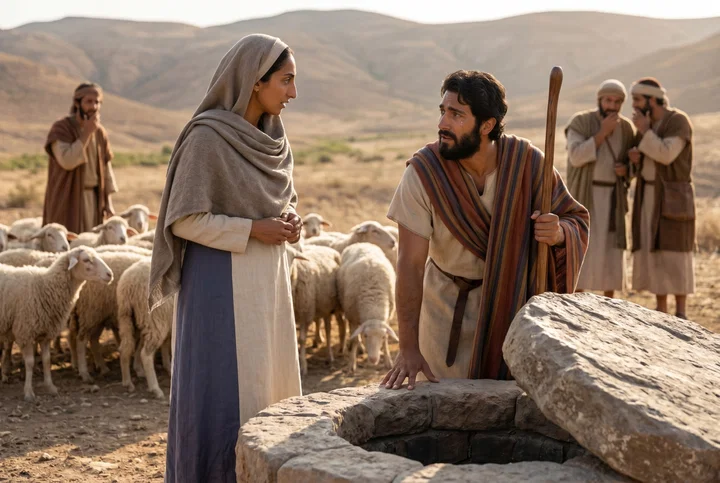
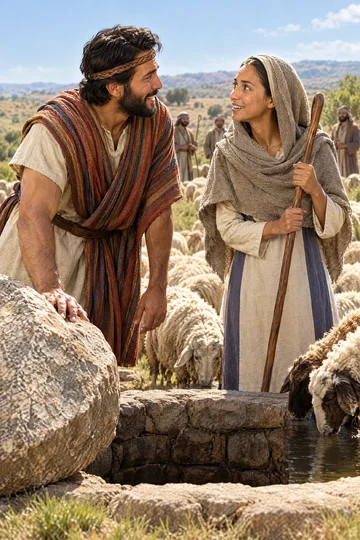
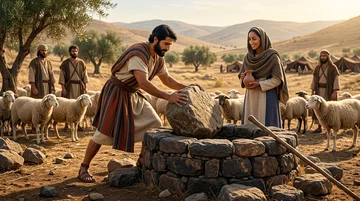
And while he yet spake with them, Rachel came with her father’s sheep: for she kept them.
Translations
And while he yet spoke with them, Rachel came with her father’s sheep; for she kept them.
King James Version, KJV Cambridge Paragraph Bible
And while he yet spake with them, Rachel came with her father’s sheep: for she kept them.
And while he was yet speaking with them, Rachel came with her father's sheep: for she kept them.
While he yet spake with them, Rachel came with her father’s sheep; for she kept them.
While he was yet speaking with them, Rachel came with her father’s sheep; for she kept them.
He is yet speaking with them, and Rachel hath come with the flock which her father hath, for she [is] shepherdess;
While he was still speaking to them, Rachel came with her father's sheep, for she was a shepherdess.
While yet he was speaking with them, Rachel, had come in with the sheep which belonged to her father, for a shepherdess, was she.
Berean Standard Bible, Majority Standard Bible
While he was still speaking with them, Rachel arrived with her father’s sheep, for she was a shepherdess.
While he was yet speaking with them, Rachel came with her father’s sheep, for she kept them.
While he was still talking with them, Rachel came with her father's sheep, for she took care of them.
While he talked with them, Rahel also came with her fathers sheepe, for she kept them.
Douay-Rheims (Challoner revision)
They were yet speaking, and behold Rachel came with her father’s sheep: for she fed the flock.
Pictures
Cross-references
- Genesis 30:1-24
And when Rachel saw that she bare Jacob no children, Rachel envied her sister; and said unto Jacob, Give me children, or else I die.
Rachel’s childlessness and the births of Jacob’s sons continue the family history.
- Genesis 29:27-28
Fulfil her week, and we will give thee this also for the service which thou shalt serve with me yet seven other years.
Jacob completes Leah’s week and receives Rachel after serving seven more years.
- Genesis 24:15-16
And it came to pass, before he had done speaking, that, behold, Rebekah came out, who was born to Bethuel, son of Milcah, the wife of Nahor, Abraham’s brother, with her pitcher upon her shoulder.
Abraham’s servant meets Isaac’s future bride at a well.
- Exodus 2:16-17
Now the priest of Midian had seven daughters: and they came and drew water, and filled the troughs to water their father’s flock.
Moses meets women tending their father’s flock at a well in Midian.
- Genesis 30:25-43
And it came to pass, when Rachel had born Joseph, that Jacob said unto Laban, Send me away, that I may go unto mine own place, and to my country.
God prospered flocks despite Laban
- Genesis 28:10-22
And Jacob went out from Beer-sheba, and went toward Haran.
Jacob’s journey begins a period of trials and victories.
- Genesis 29:1
Then Jacob went on his journey, and came into the land of the people of the east.
Introduces Jacob’s journey to the land of the East.
Commentary
Each commentary is drawn from primary sources: the writings of Ellen G. White and Adventist pioneers and periodicals. Each commentary is separate. Its own words are not a quotation; follow the references to read the source passages.
Ellen G. White
1 source
While Jacob was still speaking with the shepherds at the well, Rachel arrived with her father's sheep.PP 188.2 She herself kept her father's flock, coming to the well in the work of a shepherdess.PP 188.2 Her arrival at that moment brought about Jacob's meeting with Laban's younger daughter.PP 188.2
Sources
Pioneers and periodicals
13 sources
While Jacob was still speaking with the shepherds, Rachel arrived with her father's sheep because she was their keeper, upon his coming into Padan-Aram.ST Oct 6, 1898 He had journeyed on from Bethel to the land of the children of the East and come weary and thirsty to the spring near Haran where villagers gathered at the public well to draw water.ST Jan 3, 1911ST Jul 29, 1875ST Mar 19, 1894ST Mar 27, 1907ST May 19, 1898 The meeting stands in the record of God's care for Jacob despite his selfishness and unfaithfulness, showing the gradual development of faith through his trials and victories unto a complete change of heart that made him Israel.ST Jan 3, 1911STST Jan 6, 1909 His selfish plottings brought consequent suffering, for he who overreached others met overreaching himself, and Laban's deception over his daughters was just retribution for his deception of Esau, though his sin did not justify Laban's.ST Jan 9, 1912ST Mar 19, 1894 The history that follows plainly shows the patriarchs violated the marriage institution by polygamy, which was never anything but evil and the cause of very great unhappiness, yet the violation does not destroy the sacred character of marriage made for man before the fall.RH Feb 3, 1852RH Mar 1, 1870ST Jun 10, 1875
Narrative Setting and Context
While Jacob was still speaking with the shepherds, Rachel came up with her father's sheep, for she kept them, and this belongs to Jacob's arrival in Padan-Aram.ST Oct 6, 1898 The setting is Jacob, weary and thirsty, at the spring or fountain near Haran where he had gone to find his relatives.ST Mar 27, 1907ST May 19, 1898 It illustrates the familiar sight of villagers gathering at a public well or village fountain to draw water, in connection with family and daily life.ST Mar 27, 1907ST May 19, 1898
The verse stands in Jacob's journey onward from Bethel until he came to the land of the children of the East, where he met Laban.ST Mar 19, 1894 There he sojourned and served Laban seven years, which is an example of a complete period of time, indeed fourteen years in all for his two daughters.ST Jul 29, 1875ST Mar 19, 1894 There he married Leah and Rachel, was deceived by Laban, fathered sons, and prospered in flocks and herds despite Laban's efforts to deprive him of his right.ST Jan 3, 1911ST Mar 19, 1894 The same history continues with his departure from Haran, Laban's pursuit of him, the covenant they made, and his return to the land of Canaan guarded by angels.ST Mar 19, 1894
Jacob's Trials and Providence
Genesis 29 belongs to the account of Jacob's visit to Laban, including his marriages to Leah and Rachel, his deception by Laban, and his sojourn there, and it is part of the account of God's care for Jacob despite his selfishness and unfaithfulness.ST Jan 3, 1911 It is part of the continuing record of Abraham's family showing the gradual development of faith through Isaac and his two sons with their defects, through Jacob's trials and victories.STST Jan 6, 1909 That development culminates in a complete change of heart and in Jacob's victory that made him Israel, a prevailer with God among the Israel of God.STST Jan 6, 1909
The verse stands within the checkered and unsatisfactory experiences of Esau and Jacob in Genesis 27-31, where Jacob's selfish plottings brought consequent suffering.ST Jan 9, 1912 He who overreached and supplanted others himself met overreaching, showing God's providence bringing retribution sooner or later though seeming slow.ST Jan 9, 1912 The deception Laban practiced on Jacob in the matter of his daughters was just retribution for the deception Jacob had practiced on Esau, though Jacob's sin did not justify Laban's.ST Mar 19, 1894 The setting is Jacob journeying on from Bethel till he came to the land of the children of the East where he met Laban and served Laban fourteen years for his two daughters, with the following history recording the sons born to Jacob and how God prospered him in flocks and herds despite Laban's efforts to deprive him of his right, then his departure from Haran, Laban's pursuit and the covenant they made, and his return to the land of Canaan guarded by the angels of God.ST Mar 19, 1894
The verse belongs to Jacob's unsatisfactory experience in Haran and continues the line of the family through which the Seed was to come, with the promises extending from Abraham to Isaac and from Isaac to Jacob.ST Jan 14, 1913 It stands within Jacob's life as a supplanter, marked by material overreaching, whose later trouble grew out of earlier failure and family division.ST Jan 14, 1913 His aged father's overfond affection for Esau drew stronger sympathy from his mother for Jacob, while she knew the promise of God would be manifest through Jacob and kept before him the material importance of the Seed without the fullest appreciation of the spiritual blessings, until God in mercy brings a change.ST Jan 14, 1913
Marriage Institution and Polygamy
Genesis 29 belongs to the record in which the patriarchs plainly violated the institution of marriage by taking more than one wife through polygamy.RH Feb 3, 1852ST Jun 10, 1875 That violation does not destroy the sacred character of marriage, just as a violation of the Sabbath would not destroy the sacred character of the Sabbath.RH Feb 3, 1852ST Jun 10, 1875 Marriage was made for man before the fall, its holiness is not derived from the Decalogue, and the seventh commandment guards its sacredness as the fourth commandment guards the Sabbath.RH Feb 3, 1852ST Jun 10, 1875
The history of Jacob shows that polygamy was never anything but evil.RH Mar 1, 1870 It was never anything but wrong.RH Mar 1, 1870 It was the cause of very great unhappiness in every family where it entered.RH Mar 1, 1870
Sources