Genesis 31:35
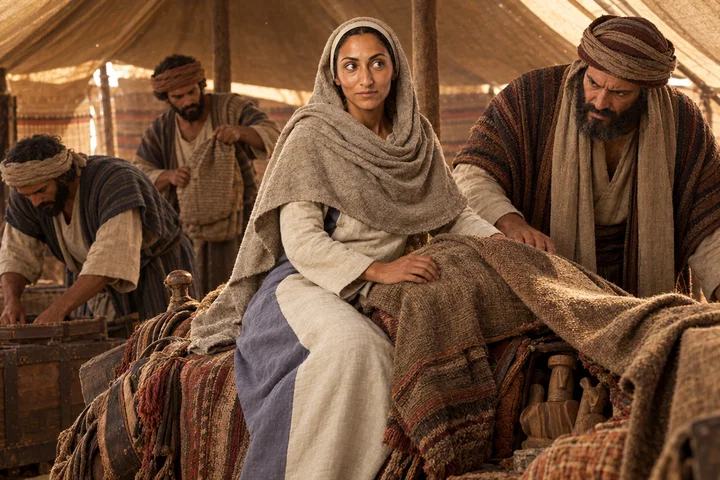
And she said to her father, Let it not displease my lord that I cannot rise up before thee; for the custom of women is upon me. And he searched, but found not the images.
Translations
And she said to her father, Let it not displease my lord that I cannot rise up before you; for the custom of women is on me. And he searched but found not the images.
King James Version, KJV Cambridge Paragraph Bible, Webster Bible
And she said to her father, Let it not displease my lord that I cannot rise up before thee; for the custom of women is upon me. And he searched, but found not the images.
Revised Version, American Standard Version
And she said to her father, Let not my lord be angry that I cannot rise up before thee; for the manner of women is upon me. And he searched, but found not the teraphim.
and she saith unto her father, 'Let it not be displeasing in the eyes of my lord that I am not able to rise at thy presence, for the way of women [is] on me;' and he searcheth, and hath not found the teraphim.
And she said to her father, Let it not be an occasion of anger in the eyes of my lord that I cannot rise up before thee, for it is with me after the manner of women. And he searched carefully, but did not find the teraphim.
And she said unto her father, Let it not be vexing in the eyes of my lord that I cannot rise up at thy presence, for, the way of women, is upon me. So he made search, but found not the household gods,
Rachel said to her father, “Sir, do not be angry that I cannot stand up before you; for I am having my period.” So Laban searched, but could not find the household idols.
Rachel said to her father, “Sir, do not be angry that I cannot stand up before you; for I am having my period.” So Laban searched but could not find the household idols.
She said to her father, “Don’t let my lord be angry that I can’t rise up before you; for I’m having my period.” He searched, but didn’t find the teraphim.
And she said to her father, Let not my lord be angry because I do not get up before you, for I am in the common condition of women. And with all his searching, he did not come across the images.
Then said she to her father, My Lord, be not angrie that I cannot rise vp before thee: for the custome of women is vpon me: so he searched, but found not the idoles.
Douay-Rheims (Challoner revision)
She said: Let not my lord be angry that I cannot rise up before thee, because it has now happened to me, according to the custom of women, So his careful search was in vain.
Pictures
Cross-references
- Genesis 31:19
And Laban went to shear his sheep: and Rachel had stolen the images that were her father’s.
Rachel steals Laban’s household images, setting up his search.
- Exodus 20:4-5
Thou shalt not make unto thee any graven image, or any likeness of any thing that is in heaven above, or that is in the earth beneath, or that is in the water under the earth:
The hidden household images are linked to the prohibition of making and worshiping images.
- Genesis 35:2-4
Then Jacob said unto his household, and to all that were with him, Put away the strange gods that are among you, and be clean, and change your garments:
Jacob later has his household put away and surrender their foreign gods.
- Isaiah 40:19-20
The workman melteth a graven image, and the goldsmith spreadeth it over with gold, and casteth silver chains.
Both texts describe images fashioned by human hands for worship.
- Genesis 35:4
And they gave unto Jacob all the strange gods which were in their hand, and all their earrings which were in their ears; and Jacob hid them under the oak which was by Shechem.
Jacob’s household gives him its foreign gods.
Commentary
Each commentary is drawn from primary sources: the writings of Ellen G. White and Adventist pioneers and periodicals. Each commentary is separate. Its own words are not a quotation; follow the references to read the source passages.
Ellen G. White
1 source
Rachel concealed the household gods she had stolen from her father by remaining seated upon them and pleading that the customary condition of women prevented her from rising in respect before him.ST Dec 4, 1879 Her excuse turned aside suspicion so that his careful search through the tents discovered no images.ST Dec 4, 1879 Because those hidden idols were retained rather than destroyed at once, idolatrous worship continued within the household.ST Dec 4, 1879 Jacob afterward understood that he should have dealt with them promptly, since keeping them endangered the faithfulness of his family to God.ST Dec 4, 1879
Sources
Pioneers and periodicals
15 sources
She excused herself from rising before her father by saying the monthly custom was upon her, while she sat upon the household idols she had stolen, and though he searched eagerly he did not find them.ST May 9, 1906ST Oct 6, 1898RH Oct 18, 1853 The objects she took were gods made for worship, graven images of the kind forbidden by the second commandment against making and worshiping images.ST Jun 3, 1875RH Oct 18, 1853ST May 4, 1882 Her stealing of them shows the principle of the eighth commandment, Thou shalt not steal, was known before the law was given at Sinai.RH Aug 17, 1876 Laban, Jacob and Rachel already knew that law long before Sinai, for Jacob counted stealing so sinful that the thief should not live, and Rachel took the idols because she knew her father's idolatry violated the first and second commandments.RH Aug 17, 1876RH Dec 25, 1860RH Mar 19, 1857 Jacob and his household knew this theft and idolatry made them unclean in God's sight and unfit to come to His altar in true worship while strange gods were among them, which Jacob later confronted by commanding them to put away the strange gods in their hands.ST Dec 4, 1879RH Aug 17, 1876RH Jan 15, 1875
Narrative Context and Meaning
The verse belongs to the account of Jacob's sojourn with Laban in Syria and his departure from Syria for Palestine.ST Jan 3, 1911ST Jan 3, 1911 It belongs with his marriages to Leah and Rachel and his leaving Syria for Palestine.ST Jan 3, 1911 It stands where the deceiver is deceived and Jacob sets his face homeward.
The verse stands in the record of Jacob through whom the promise given to Abraham and passed to Isaac comes down through the family line of the promised Seed.ST Jan 14, 1913 It stands in Jacob's unsatisfactory experience, rooted in earlier failure, in family division caused by aged Isaac's overfond affection for Esau and Rebekah's stronger sympathy for her neglected child Jacob, in her keeping the material importance of the Seed before Jacob without the fullest appreciation of the spiritual blessing, and in Jacob's material overreaching that fits his name supplanter, an experience God in mercy will change.ST Jan 14, 1913 Jacob's case, with Genesis 31 as part of it, shows that polygamy brought great unhappiness into the families where it was practiced.RH Mar 1, 1870
The custom of women upon her means she was menstruating, given as her excuse for not rising up before her father to greet him and for remaining seated while he searched.ST May 9, 1906ST Oct 6, 1898RH Oct 18, 1853RH Mar 19, 1857 She had hidden the household images she had taken, and he searched but did not find them.ST May 9, 1906ST Oct 6, 1898RH Oct 18, 1853RH Mar 19, 1857 His searching shows how strongly he wanted them.ST May 9, 1906
The verse falls within Jacob's troubled experiences in which his selfish plotting brings suffering and his own overreaching is met with overreaching.ST Jan 9, 1912
Commandments Known Before Sinai
Laban's stolen gods were images taken by Rachel and hidden from him while he searched, and the search that found nothing showed how strongly he wanted them.ST Jun 3, 1875RH Oct 18, 1853ST May 4, 1882RH Jan 15, 1875 They were gods made for worship, idols possessed even among the patriarchs, examples of graven images worshipped in violation of the second commandment against making and worshiping images.ST Jun 3, 1875RH Oct 18, 1853ST May 4, 1882 They were graven images of the kind forbidden by the words, Thou shalt not make unto thee any graven image, and their presence proves that idolatry by graven images existed before Sinai as transgression of God's law.RH Jan 15, 1875
Rachel had stolen the household images, and Laban searched for them but did not find them, showing that the principle of the eighth commandment, Thou shalt not steal, was known before the law was given at Sinai.RH Aug 17, 1876 Laban, Jacob and Rachel already knew that commandment long before Sinai, for Jacob regarded stealing as so sinful that the thief should not live.RH Aug 17, 1876 He invited Laban to search and to take what was his, because he did not know that Rachel had stolen the images.RH Aug 17, 1876 Rachel stole away Laban's idols because she definitely knew his idolatry violated the first and second commandments against having other gods and making and worshiping images, and alongside other early Genesis examples her concealment of the household gods by giving her father an excuse to remain seated while he searched is evidence that knowledge of the principles of the Ten Commandments existed before the law was proclaimed at Sinai.RH Aug 17, 1876RH Dec 25, 1860RH Mar 19, 1857
Jacob and his household knew this theft and idolatry violated God's commands and made them unclean in the sight of God and unfit to come to the altar of God in true worship while the strange gods were among them.RH Aug 17, 1876 It was the same idolatry Jacob later confronted when he commanded his household to put away the strange gods that were among them and in their hands.RH Aug 17, 1876RH Jan 15, 1875 Jacob later recognized that he should have promptly destroyed the idols she concealed, whose presence in his household allowed idolatrous worship and threatened his family's faithfulness to God.ST Dec 4, 1879
Warnings and Spiritual Lessons
The episode belongs to Jacob's long stay with Laban in Syria, his marriages to Leah and Rachel, and his departure from Syria toward Palestine, and it displays divine care for Jacob even amid his selfishness and unfaithfulness.ST Jan 3, 1911ST Jan 9, 1912 It is the story in which the deceiver is himself deceived and then turns his face homeward, and it teaches prompt readiness to follow divine leading.ST Jan 3, 1911 It stands among Jacob's troubled experiences where selfish scheming yields suffering and where his own overreaching is answered by overreaching from others, showing that providence may appear slow yet retribution arrives sooner or later.ST Jan 3, 1911ST Jan 9, 1912
Rachel remained seated before her father on the plea that the customary condition of women was upon her, so that Laban searched and failed to find the household images she had concealed.ST May 9, 1906ST Oct 6, 1898 Jacob's vow that whoever held the images should die sprang from overconfident trust in Rachel's goodness, and the outcome warns against rash speech.ST Oct 6, 1898 Rachel took the images because she knew the true God and desired that her father no longer worship idols, while Laban's eager search revealed how strongly he clung to them.ST May 9, 1906ST Oct 6, 1898
Sources