Genesis 31:34
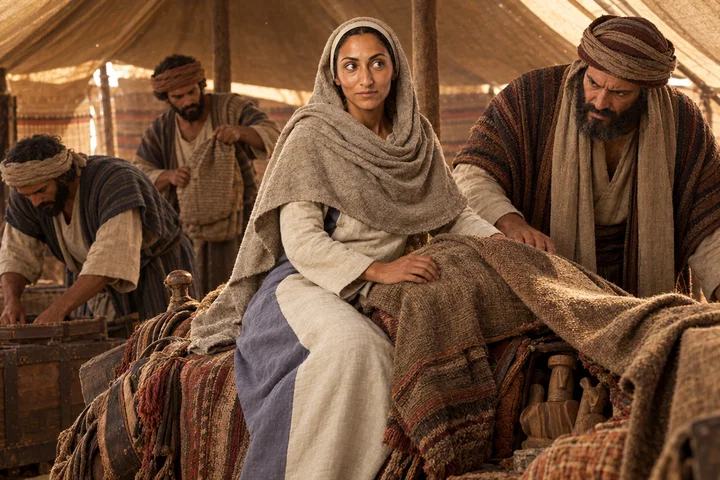
Now Rachel had taken the images, and put them in the camel’s furniture, and sat upon them. And Laban searched all the tent, but found them not.
Translations
Now Rachel had taken the images, and put them in the camel’s furniture, and sat on them. And Laban searched all the tent, but found them not.
King James Version, KJV Cambridge Paragraph Bible
Now Rachel had taken the images, and put them in the camel’s furniture, and sat upon them. And Laban searched all the tent, but found them not.
Now Rachel had taken the images, and put them in the camel's furniture, and sat upon them. And Laban searched all the tent, but found them not.
Now Rachel had taken the teraphim, and put them in the camel’s furniture, and sat upon them. And Laban felt about all the tent, but found them not.
Now Rachel had taken the teraphim, and put them in the camel’s saddle, and sat upon them. And Laban felt about all the tent, but found them not.
And Rachel hath taken the teraphim, and putteth them in the furniture of the camel, and sitteth upon them; and Laban feeleth all the tent, and hath not found;
Now Rachel had taken the teraphim and put them under the camel's saddle; and she sat upon them. And Laban explored all the tent, but found nothing.
Now Rachel, had taken the household gods and put them in the basket-saddle of the camel, and taken her seat upon them. And Laban felt about throughout all the tent, and found them not.
Berean Standard Bible, Majority Standard Bible
Now Rachel had taken Laban’s household idols, put them in the saddlebag of her camel, and was sitting on them. And Laban searched everything in the tent but found nothing.
Now Rachel had taken the teraphim, put them in the camel’s saddle, and sat on them. Laban felt around all the tent, but didn’t find them.
Now Rachel had taken the images, and had put them in the camels' basket, and was seated on them. And Laban, searching through all the tent, did not come across them.
(Nowe Rahel had taken the idoles, and put them in the camels litter and sate downe vpon them) and Laban searched al the tent, but found them not.
Douay-Rheims (Challoner revision)
She in haste hid the idols under the camel’s furniture, and sat upon them: and when he had searched all the tent, and found nothing,
Pictures
Cross-references
- Genesis 35:2-4
Then Jacob said unto his household, and to all that were with him, Put away the strange gods that are among you, and be clean, and change your garments:
Jacob’s household puts away the foreign gods and images Rachel had hidden.
- Genesis 31:19
And Laban went to shear his sheep: and Rachel had stolen the images that were her father’s.
Rachel steals Laban’s household images.
- Exodus 20:4-5
Thou shalt not make unto thee any graven image, or any likeness of any thing that is in heaven above, or that is in the earth beneath, or that is in the water under the earth:
The commandment forbids making and worshiping images.
- Isaiah 40:19-20
The workman melteth a graven image, and the goldsmith spreadeth it over with gold, and casteth silver chains.
Both describe graven images made for worship.
- Genesis 31:30
And now, though thou wouldest needs be gone, because thou sore longedst after thy father’s house, yet wherefore hast thou stolen my gods?
Rachel’s stolen household gods illustrate image worship.
- Genesis 35:4
And they gave unto Jacob all the strange gods which were in their hand, and all their earrings which were in their ears; and Jacob hid them under the oak which was by Shechem.
Jacob’s household gives him its foreign gods.
- Genesis 31:1-2
And he heard the words of Laban’s sons, saying, Jacob hath taken away all that was our father’s; and of that which was our father’s hath he gotten all this glory.
Laban’s sons’ jealousy and Laban’s changed attitude prompt Jacob’s concern.
Commentary
Each commentary is drawn from primary sources: the writings of Ellen G. White and Adventist pioneers and periodicals. Each commentary is separate. Its own words are not a quotation; follow the references to read the source passages.
Ellen G. White
1 source
Rachel had stolen her father's images and taken them with her from his house.ST Dec 4, 1879 She hid them in the camel's furniture and sat upon them to conceal them from discovery.ST Dec 4, 1879 When Laban searched through the whole tent for his gods, his search failed to find them where she had hidden them.ST Dec 4, 1879
Jacob afterward recognized that he had not destroyed these objects, and that through this neglect they remained as a snare that could lead his household into idolatry.ST Dec 4, 1879 False gods were thus still present in Israel's camp, and idolatrous worship was practiced within his own family.ST Dec 4, 1879 His household was thereby exposed to idolatry while these hidden images continued among them.ST Dec 4, 1879
Sources
Pioneers and periodicals
17 sources
Rachel had taken her father's household images, hidden them in the camel's saddle, and sat upon them, so that when Laban searched through the tent he could not find them.RH Aug 17, 1876ST May 9, 1906ST Oct 6, 1898 Those images were physical graven gods kept for idolatrous worship.RH Oct 18, 1853ST Jun 3, 1875ST May 4, 1882 Keeping them in Laban's house and in Jacob's household broke the commandments to have no other gods and to make no graven image, bow to it, or serve it.RH Aug 17, 1876ST Jun 3, 1875ST May 4, 1882ST Apr 18, 1911 Because this took place long before Sinai, it shows that God's law against image-worship and stealing was already known and binding in substance in the patriarchal age.ST Jun 3, 1875RH Mar 19, 1857RH Dec 25, 1860 Rachel took them because she knew the true God and did not want her father to worship idols, yet the incident remains evidence that false gods and idolatrous worship lingered among Abraham's kindred and in Jacob's family.ST Dec 4, 1879RH Aug 17, 1876ST May 9, 1906ST Oct 6, 1898
Narrative and Setting
Rachel had taken Laban's household images that she had stolen from him and put them in the camel's furniture or saddle, and she sat upon them and hid them beneath her while Laban searched all the tent but did not find them.RH Aug 17, 1876ST May 9, 1906ST Oct 6, 1898RH Oct 18, 1853ST May 4, 1882 She concealed them in the camel's furniture where she sat as Laban searched the tent without finding them.RH Aug 17, 1876ST May 9, 1906RH Oct 18, 1853ST May 4, 1882RH Mar 19, 1857
The images were Laban's household gods, physical graven images fashioned with a graving tool and objects of idolatrous worship.RH Oct 18, 1853ST Jun 3, 1875ST May 4, 1882
The verse belongs to the account of Jacob's sojourn with Laban, his mother's brother, including his marriages to Leah and Rachel and his troubled experiences there, and his leaving Syria for Palestine to go homeward.ST Jan 3, 1911ST Jan 9, 1912 It is part of the continuing story of Abraham and his family and of God's special providences over the progenitors of the promised Seed, with Jacob's checkered and unsatisfactory experiences in which his overreaching and supplanting met overreaching in return.ST Jan 3, 1911ST Jan 9, 1912ST Jan 6, 1909ST Jan 9, 1912 It belongs to the account of the deceiver deceived when Jacob set his face homeward.ST Jan 3, 1911ST Jan 9, 1912
Idolatry and Pre-Sinai Law
Laban's gods were household idols, physical graven images fashioned with a graving tool and objects of idolatrous worship, the very kind forbidden by the second commandment not to make graven images nor bow down to them nor serve them.ST Jun 3, 1875ST May 4, 1882RH Jan 15, 1875 Rachel had taken those images and concealed them in the camel's furniture or saddle, sitting upon them while Laban searched all the tent without finding them.ST May 4, 1882ST Apr 18, 1911RH Jan 15, 1875 Their existence in Laban's house and then in Jacob's household was transgression of that commandment against images.ST Jun 3, 1875ST Apr 18, 1911RH Jan 15, 1875 That transgression involved the first commandment to have no other gods as well as the second commandment concerning images.RH Aug 17, 1876ST Jun 3, 1875
The incident is evidence of idolatry among Abraham's kindred, showing that false gods remained in Jacob's family and camp and that idolatrous worship was practiced there.ST Dec 4, 1879ST Oct 6, 1898 Rachel took the images because she knew the true God and understood that Laban's idolatry violated the first and second commandments, not wanting her father to worship idols.RH Aug 17, 1876ST May 9, 1906 This therefore shows that some people knew Jehovah's law against image worship.ST May 9, 1906RH Mar 19, 1857
Because this happened long before Sinai, it proves that God's law against images and against stealing was already given, known, and binding in substance in the patriarchal age before Moses, with the principle of the second commandment concerning the worship of images known before the law was proclaimed at Sinai.ST Jun 3, 1875RH Dec 25, 1860ST Apr 18, 1911RH Jan 15, 1875 The hiding of the household images while Laban searched for them was idolatry in Jacob's household, breaking God's command against images.RH Mar 19, 1857ST Apr 18, 1911 People thus knew about idolatry before the law was given at Sinai.RH Mar 19, 1857RH Dec 25, 1860
Warnings and Applications
Rachel's hiding of her father's images in the camel's furniture and sitting upon them while Laban searched the tent without finding them exposes the danger of Jacob's rash declaration that whoever had the images should die, for he had too much confidence in Rachel's goodness.ST Oct 6, 1898 The whole history is that of the deceiver deceived: as Jacob had deceived his father to obtain the blessing and had practiced overreaching and supplanting, so he was deceived in his marriage to Leah and Rachel and met overreaching in return during his sojourn with Laban his mother's brother and his leaving Syria for Palestine.ST Jan 3, 1911ST Jan 9, 1912 God's providence, though seemingly slow, brings retribution sooner or later, so that Jacob's selfish plottings brought consequent suffering through troubled and checkered, unsatisfactory experiences.ST Jan 9, 1912ST Jan 9, 1912
At the same time the account shows God's care over His servant notwithstanding selfishness and unfaithfulness, in special providences over the progenitors of the promised Seed.ST Jan 3, 1911ST Jan 9, 1912 Belonging to the account of the deceiver deceived when Jacob set his face homeward, it teaches readiness always to obey God's leading. It belongs to the continuing story of Abraham and his family showing the gradual development of faith, the defects of Isaac and his two sons, and Jacob's victory that made him Israel, prevailer with God.ST Jan 6, 1909
As part of the account of Jacob's family it stands as an example of the unhappiness associated with polygamy.RH Mar 1, 1870 Jacob later recognized that he had failed to destroy these stolen and concealed objects that could lead his household into idolatry, while false gods remained in Israel's camp and idolatrous worship was practiced in his family.ST Dec 4, 1879
Sources