Genesis 31:19
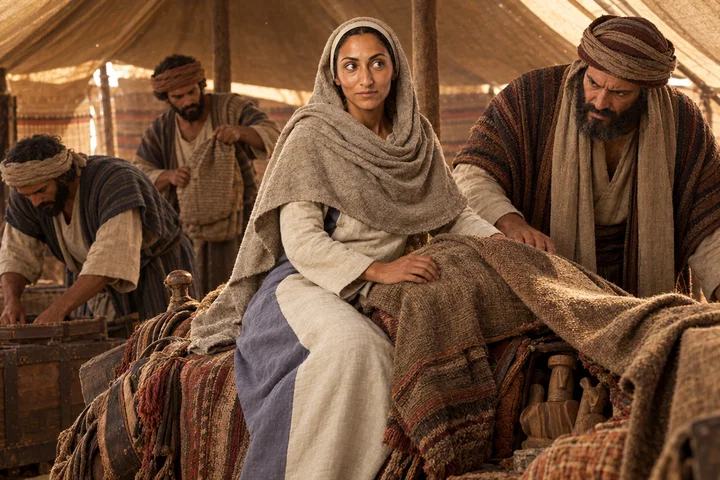
And Laban went to shear his sheep: and Rachel had stolen the images that were her father’s.
Translations
American King James Version, King James Version, KJV Cambridge Paragraph Bible
And Laban went to shear his sheep: and Rachel had stolen the images that were her father’s.
And Laban went to shear his sheep; and Rachel had stolen the images that were her father's.
Revised Version, American Standard Version
Now Laban was gone to shear his sheep: and Rachel stole the teraphim that were her father’s.
And Laban hath gone to shear his flock, and Rachel stealeth the teraphim which her father hath;
And Laban had gone to shear his sheep. And Rachel stole the teraphim that [belonged] to her father.
Now, Laban, had gone, to shear his sheep,—so Rachel stole the household gods that belonged to her father,
Berean Standard Bible, Majority Standard Bible
Now while Laban was out shearing his sheep, Rachel stole her father’s household idols.
Now Laban had gone to shear his sheep; and Rachel stole the teraphim that were her father’s.
Now Laban had gone to see to the cutting of the wool of his sheep; so Rachel secretly took the images of the gods of her father's house.
Whe Laban was gone to shere his sheepe, Then Rahel stole her fathers idoles.
Douay-Rheims (Challoner revision)
At that time Laban was gone to shear his sheep, and Rachel stole away her father’s idols.
Pictures
Cross-references
- Genesis 35:2-4
Then Jacob said unto his household, and to all that were with him, Put away the strange gods that are among you, and be clean, and change your garments:
Rachel’s stolen images are among the strange gods Jacob’s household puts away and buries.
- Genesis 31:30
And now, though thou wouldest needs be gone, because thou sore longedst after thy father’s house, yet wherefore hast thou stolen my gods?
Laban charges Jacob with stealing his gods
- Exodus 20:4-5
Thou shalt not make unto thee any graven image, or any likeness of any thing that is in heaven above, or that is in the earth beneath, or that is in the water under the earth:
Rachel’s stolen idols violate the prohibition against making and worshiping images.
- Genesis 31:34-35
Now Rachel had taken the images, and put them in the camel’s furniture, and sat upon them. And Laban searched all the tent, but found them not.
Rachel hides the stolen images and denies taking them.
- Genesis 31:32
With whomsoever thou findest thy gods, let him not live: before our brethren discern thou what is thine with me, and take it to thee. For Jacob knew not that Rachel had stolen them.
Jacob unknowingly pronounces death on Rachel for stealing Laban’s gods.
- Genesis 44:8-9
Behold, the money, which we found in our sacks’ mouths, we brought again unto thee out of the land of Canaan: how then should we steal out of thy lord’s house silver or gold?
Joseph’s brothers deny stealing, recalling Rachel’s theft and the death penalty Jacob imposed.
- Isaiah 40:19-20
The workman melteth a graven image, and the goldsmith spreadeth it over with gold, and casteth silver chains.
Both texts describe images fashioned by human hands for worship.
- Exodus 20:15
Thou shalt not steal.
Rachel’s theft shows the prohibition against stealing was known before Sinai.
- Genesis 30:33
So shall my righteousness answer for me in time to come, when it shall come for my hire before thy face: every one that is not speckled and spotted among the goats, and brown among the sheep, that shall be counted stolen with me.
Jacob and Laban recognized theft as wrong in their agreement.
- Genesis 35:4
And they gave unto Jacob all the strange gods which were in their hand, and all their earrings which were in their ears; and Jacob hid them under the oak which was by Shechem.
Jacob tells his household to put away foreign gods.
- Genesis 31:1-2
And he heard the words of Laban’s sons, saying, Jacob hath taken away all that was our father’s; and of that which was our father’s hath he gotten all this glory.
Laban’s sons resent Jacob’s wealth, and Laban’s attitude changes.
- Genesis 30:25-27
And it came to pass, when Rachel had born Joseph, that Jacob said unto Laban, Send me away, that I may go unto mine own place, and to my country.
Jacob asks to leave, and Laban acknowledges God’s blessing through him.
- Genesis 29:21-25
And Jacob said unto Laban, Give me my wife, for my days are fulfilled, that I may go in unto her.
Jacob is deceived when Laban gives him Leah instead of Rachel.
- Genesis 31:3
And the LORD said unto Jacob, Return unto the land of thy fathers, and to thy kindred; and I will be with thee.
God directs Jacob to return to his homeland.
Commentary
Each commentary is drawn from primary sources: the writings of Ellen G. White and Adventist pioneers and periodicals. Each commentary is separate. Its own words are not a quotation; follow the references to read the source passages.
Ellen G. White
1 source
The verse falls in the account of Jacob's departure from Laban, after Laban and his sons had become envious of Jacob's growing wealth.PP 192.3–193.1 Jacob left with his family and possessions because God had directed him to return to Canaan.PP 192.3–193.1 No explanation is given here for why Rachel stole her father's images.PP 192.3–193.1
Sources
Pioneers and periodicals
22 sources
While Laban was away shearing his sheep, Rachel stole her father's images, his household gods or teraphim, without Jacob knowing it.RH Aug 17, 1876ST May 9, 1906RH Oct 18, 1853 She took them because she knew the true God and would not have her father worship them in violation of His commandments.RH Aug 17, 1876ST May 9, 1906RH Oct 18, 1853 When Laban charged him with the theft, Jacob declared that the one with whom they were found should die, showing that stealing was already understood as grave wrongdoing.RH Aug 17, 1876RH Oct 18, 1853ST May 4, 1882 The images were graven idols forbidden by the second commandment, the same strange gods Jacob later commanded his household to put away, proving that law was already binding long before Sinai through what Abraham had obeyed and taught to his house.RH Aug 17, 1876ST May 9, 1906ST Jun 3, 1875RH Oct 18, 1853 Their lingering presence shows false worship had remained even in Jacob's household until surrendered and buried under the oak at Shechem, and pictures churches carrying Sunday out of Rome and hiding it in their teaching under the fourth commandment where it does not belong.ST Dec 4, 1879RH Mar 1, 1864RH Jan 15, 1875ST Nov 12, 1894
Story and Immediate Meaning
While Laban was away shearing his sheep, Rachel stole her father's images, also called his household gods and teraphim.RH Aug 17, 1876ST May 9, 1906RH Oct 18, 1853ST May 4, 1882ST May 4, 1882 Those images were graven, carved idols possessed and served as gods, objects of idolatrous worship forbidden by the second commandment, and they were also the strange and foreign gods later to be put away before approaching God.RH Aug 17, 1876ST May 4, 1882RH Oct 18, 1853 She took them because she knew the true God and did not want her father to worship them, recognizing his idolatry as a violation of the first and second commandments and of Jehovah's law against idolatry.RH Aug 17, 1876ST May 9, 1906
Jacob did not know Rachel had taken them.RH Aug 17, 1876RH Oct 18, 1853ST May 4, 1882ST Jun 3, 1875RH Jan 15, 1875 When Laban accused and reproved him for stealing the gods, Jacob declared that the one with whom they were found should die, or should not live.RH Aug 17, 1876RH Oct 18, 1853ST May 4, 1882ST Jun 3, 1875 That sentence shows theft was regarded as grave wrongdoing and grave sin worthy of death, and Laban's reproof proves both men understood stealing as wrong.RH Aug 17, 1876RH Oct 18, 1853ST May 4, 1882ST Jun 3, 1875RH Jan 15, 1875
The verse belongs to Jacob's visit to Laban his mother's brother, his marriages to Leah and Rachel, his sojourn there, and his leaving Syria for Palestine to go homeward with his face set homeward.ST Jan 3, 1911ST Jan 14, 1913 In it the deceiver who obtained his father's blessing by fraud is himself deceived and overreached, his selfish schemes and material overreaching fitting his name supplanter being followed by suffering and by others overreaching him.ST Jan 3, 1911ST Jan 9, 1912ST Jan 14, 1913 God's special providence and care remain over him notwithstanding his selfishness and unfaithfulness, as progenitor in the family through which the promised Seed was to come with the promises passing from Abraham to Isaac to Jacob, bringing retribution even when delayed.ST Jan 3, 1911ST Jan 9, 1912ST Jan 14, 1913 His troubled trials and unsatisfactory experience following poorer earlier experience lead by mercy to a complete change of heart and victory that made him Israel, prevailer with God and placed him among the Israel of God, calling for always being ready to obey God's leading.STST Jan 6, 1909ST Jan 14, 1913
Law Known Before Sinai
While Laban was away shearing his sheep Rachel stole her father's household gods, and Jacob did not know she had taken them.RH Oct 18, 1853ST May 4, 1882ST Jun 3, 1875RH Mar 19, 1857RH Jan 15, 1875 When Laban accused Jacob of the theft, Laban reproved him for stealing his gods, and Jacob declared that with whomsoever the gods were found he should die or should not live.RH Oct 18, 1853ST May 4, 1882ST Jun 3, 1875RH Jan 15, 1875 That reproof and that sentence prove both men understood stealing as wrong and as wrongdoing worthy of death, so the commandment Thou shalt not steal was known, understood, and binding long before Moses and before the law was proclaimed at Sinai.RH Oct 18, 1853ST Jun 3, 1875RH Dec 25, 1860RH Mar 19, 1857RH Jan 15, 1875 The principle against theft was therefore already in force in the patriarchal age.RH Dec 25, 1860RH Mar 19, 1857
Laban's images were carved household images kept and used as gods, graven images of the kind that are made and then bowed down to and served as idols.RH Aug 17, 1876ST Jun 3, 1875ST May 4, 1882RH Oct 18, 1853 Their existence and worship among the patriarchs, and Rachel's act in taking them, show that the practice forbidden by the second commandment was already present and already recognized as forbidden before Sinai.ST May 9, 1906ST Jun 3, 1875ST May 4, 1882RH Dec 25, 1860 Rachel knew the true God and took the images because she did not want her father to worship them, recognizing his idolatry as a violation of the first and second commandments and of Jehovah's law against idolatry.RH Aug 17, 1876ST May 9, 1906
These images were the strange and foreign gods that Jacob's household possessed and that Jacob later commanded his household to put away before approaching God, hiding them from his people because keeping images broke God's law against images.RH Oct 18, 1853 That command to put them away proves the second commandment was already in force and known before Sinai. Jacob knew it because he had been taught the law of God handed down from Abraham, who obeyed God's law and taught it to his household.
Household Idols and Application
The teraphim Rachel took were heathen idols and household gods, graven images made to be bowed down to and served.ST Jun 3, 1875RH Jan 15, 1875 They were understood to be gods, and their keeping broke the law against making images and worshiping them.ST Jun 3, 1875RH Mar 1, 1864RH Jan 15, 1875 Their presence in Laban's house shows that Abraham's kindred worshiped false gods, and that such idols were present even in Jacob's family and household.RH May 5, 1859ST Oct 6, 1898
Jacob failed to act promptly to destroy these idols, and so allowed idolatry to remain for a time in his household.ST Dec 4, 1879 They were the strange gods he later commanded his household to put away and hid from his people, because keeping images broke God's law against images. Then they were surrendered together with earrings and armlets used as idolatrous charms and were buried under the oak at Shechem.
Rachel's stealing of her father's gods and sitting on them pictures the Protestant churches carrying Sunday out of Rome when they left her.ST Nov 12, 1894 Sunday had long been venerated by Mother Rome and is like teraphim hidden away among belongings, sat upon and concealed.ST Nov 12, 1894 It was then placed in doctrinal church books under the fourth commandment, though it belongs to Rome and not to God's commandment.ST Nov 12, 1894
Sources