Genesis 39:1
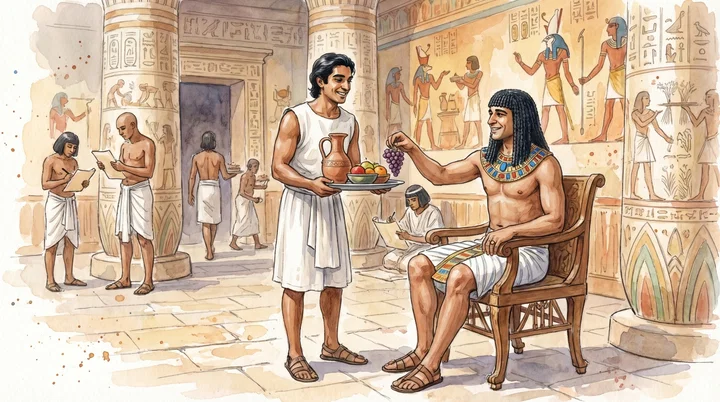
And Joseph was brought down to Egypt; and Potiphar, an officer of Pharaoh, captain of the guard, an Egyptian, bought him of the hands of the Ishmeelites, which had brought him down thither.
Translations
American King James Version, King James Version
And Joseph was brought down to Egypt; and Potiphar, an officer of Pharaoh, captain of the guard, an Egyptian, bought him of the hands of the Ishmeelites, which had brought him down thither.
And Joseph was brought down to Egypt; and Potiphar, an officer of Pharaoh, captain of the guard, an Egyptian, bought him of the hand of the Ishmeelites, which had brought him down thither.
And Joseph was brought down to Egypt: and Potiphar, an officer of Pharaoh, captain of the guard, an Egyptian, bought him of the hands of the Ishmaelites, who had brought him down thither.
And Joseph was brought down to Egypt; and Potiphar, an officer of Pharaoh’s, the captain of the guard, an Egyptian, bought him of the hand of the Ishmaelites, which had brought him down thither.
And Joseph was brought down to Egypt; and Potiphar, an officer of Pharaoh’s, the captain of the guard, an Egyptian, bought him of the hand of the Ishmaelites, that had brought him down thither.
And Joseph hath been brought down to Egypt, and Potiphar, a eunuch of Pharaoh, head of the executioners, an Egyptian man, buyeth him out of the hands of the Ishmaelites who have brought him thither.
And Joseph was brought down to Egypt; and Potiphar, a chamberlain of Pharaoh, the captain of the life-guard, an Egyptian, bought him of the hand of the Ishmaelites who had brought him down thither.
Now, Joseph, was taken down to Egypt,—and Potiphar, courtier of Pharaoh, chief of the royal executioners, an Egyptian bought him, at the hand of the Ishmaelites, who had brought him down thither.
Berean Standard Bible, Majority Standard Bible
Meanwhile, Joseph had been taken down to Egypt, where an Egyptian named Potiphar, an officer of Pharaoh and captain of the guard, bought him from the Ishmaelites who had taken him there.
Joseph was brought down to Egypt. Potiphar, an officer of Pharaoh’s, the captain of the guard, an Egyptian, bought him from the hand of the Ishmaelites that had brought him down there.
Now Joseph was taken down to Egypt; and Potiphar the Egyptian, a captain of high position in Pharaoh's house, got him for a price from the Ishmaelites who had taken him there.
Now Ioseph was brought downe into Egypt: and Potiphar an Eunuche of Pharaohs (and his chiefe stewarde an Egyptian) bought him at the hande of the Ishmeelites, which had brought him thither.
Douay-Rheims (Challoner revision)
And Joseph was brought into Egypt, and Putiphar an eunuch of Pharao, chief captain of the army, an Egyptian, bought him of the Ismaelites, by whom he was brought.
Pictures
Cross-references
- Genesis 39:6
And he left all that he had in Joseph’s hand; and he knew not ought he had, save the bread which he did eat. And Joseph was a goodly person, and well favoured.
Potiphar entrusted all he had to Joseph except his food.
- Genesis 37:28
Then there passed by Midianites merchantmen; and they drew and lifted up Joseph out of the pit, and sold Joseph to the Ishmeelites for twenty pieces of silver: and they brought Joseph into Egypt.
Joseph is sold and brought down to Egypt.
- Genesis 41:40
Thou shalt be over my house, and according unto thy word shall all my people be ruled: only in the throne will I be greater than thou.
Joseph is raised from prison to authority in Egypt.
- Genesis 40
And it came to pass after these things, that the butler of the king of Egypt and his baker had offended their lord the king of Egypt.
Joseph’s imprisonment follows his service in Potiphar’s house.
- Genesis 50:20
But as for you, ye thought evil against me; but God meant it unto good, to bring to pass, as it is this day, to save much people alive.
God uses the wrongdoing that brought Joseph to Egypt to accomplish good.
- Genesis 42:6
And Joseph was the governor over the land, and he it was that sold to all the people of the land: and Joseph’s brethren came, and bowed down themselves before him with their faces to the earth.
His brothers bow before him, fulfilling his dreams.
- Genesis 41:1-37
And it came to pass at the end of two full years, that Pharaoh dreamed: and, behold, he stood by the river.
God brought Joseph before Pharaoh to save Israel.
- Genesis 39:21
But the LORD was with Joseph, and shewed him mercy, and gave him favour in the sight of the keeper of the prison.
The LORD’s presence with Joseph continues into prison.
- Genesis 43:32
And they set on for him by himself, and for them by themselves, and for the Egyptians, which did eat with him, by themselves: because the Egyptians might not eat bread with the Hebrews; for that is an abomination unto the Egyptians.
explains bread exception as abomination
Commentary
Each commentary is drawn from primary sources: the writings of Ellen G. White and Adventist pioneers and periodicals. Each commentary is separate. Its own words are not a quotation; follow the references to read the source passages.
Ellen G. White
11 sources
Joseph was brought down from his childhood home in Canaan to slavery in Egypt, bought from the Ishmaelites who had brought him down by Potiphar, an officer of Pharaoh and captain of the guard, in whose service he remained ten years.PP 214.2–4ED 52.3–4SG3 143.21SP 131.1 He was greatly afflicted by separation from his father, with bitterest sorrow over his father's grief.SG3 143.21SP 131.1 Yet God did not leave him to go to Egypt alone, and angels prepared the way for his reception.SG3 143.21SP 131.1
As a stranger and slave he was surrounded by idolatry and heathen worship, vice and corruption, and the pomp of royalty and royal splendor supported by the wealth and culture of the most highly civilized nation then in existence.PP 214.2–4ED 52.3–4Lt 65, 1896, par. 1–34SP 445.2–446.1 It was a place of sights and sounds of vice all about him, of increased temptation and temptations of no ordinary character.PP 214.2–4Lt 65, 1896, par. 1–3 In that crisis he remembered his father's God and the lessons of his childhood and resolved to remain faithful as a subject of the King of heaven.PP 214.2–4ED 52.3–4
He preserved simplicity and fidelity to God as one who saw and heard not, not permitting his thoughts to linger on forbidden subjects.PP 214.2–4 He refused to conceal his principles to gain favor, and was openly unashamed as a worshiper of Jehovah.PP 214.2–4 His being brought down and sold as a captive was God's providence in placing him in a heathen court so he could carry to a heathen nation the blessings that come through knowing God and represent Jehovah there.6T 219.1–2CH 205.1–2Lt 65, 1896, par. 1–3
When God places people in such circumstances, he gives them grace to stand, not in their own strength but in his.Lt 65, 1896, par. 1–3 The Lord was with Joseph and prospered him and gave him favor with his master.SG3 143.21SP 131.1 Potiphar entrusted all that he possessed to Joseph's care and kept knowledge only of the bread he ate, because it was considered an abomination for a Hebrew to prepare food for an Egyptian.SG3 143.21SP 131.1
God did not forget him among idolaters, and this proves the Lord will not forget his people in the trying hour when they endure privation, cruel bondage, prison chains, and want of food, but will remember them and provide for them.4SP 445.2–446.1 He was virtuous, genuinely good, and strong in purpose, yet maligned, persecuted, and treated as a criminal while doing what was right.Lt 10, 1879, par. 4–9 But God gave him signal victories despite appearances to the contrary.Lt 10, 1879, par. 4–9
As a youth he was tried and proved, and because he stood firm to principle under test he became a representative man and a pattern of integrity.ED 52.3–4SCE 23.1FE 245.1 His obedience to duty and faithfulness in every station, lowly or exalted, prepare a person for higher service.ED 52.3–4 He is therefore a pattern to be imitated, showing institutions and youth how to honor God without compromising with idolaters, to bear faith and the name of worshipers of the living God as a special honor in prosperity and adversity, and to be honored by God in return.6T 219.1–2SCE 23.1CH 205.1–2FE 245.1
His example shows each person in probationary time is responsible for the kind of character built and is deciding eternal destiny and forming a character to stand the test of the judgment.SCE 23.1FE 245.1 No teacher can make character for another.SCE 23.1FE 245.1 No second probation will come.SCE 23.1FE 245.1
Sources
Pioneers and periodicals
19 sources
Joseph was carried as a slave down into Egypt by the traders who had bought him, and there sold again to Pharaoh's Egyptian officer in command of the guard.ST Jan 3, 1911ST Apr 9, 1894 Though God did not stop the sale, He went with the lonely captive, caring for the bond-slave in a foreign land no less than for the favored son.ST Oct 9, 1901RH Aug 21, 1856 By that hard and indirect road God was overruling human jealousy and wrath for good, testing and training him through slavery and prison to make him a preserver of His people and to bring his early dreams to pass.ST Jan 3, 1911ST Jan 16, 1912ST Jan 21, 1913ST Jan 16, 1912RH Jan 19, 1860 His early home training in integrity held firm, so that when assailed by temptation he fled rather than yield and suffered for righteousness, showing that God's children can live out the truth even in lonely places and under difficult conditions.ST Jan 3, 1911ST Apr 9, 1894ST Jan 16, 1912ST Jan 16, 1912 His life thus gives principles for meeting the trials of life that should be known familiarly for personal good and for counseling others in like difficulties.ST Mar 17, 1914ST Nov 29, 1905
Arrival in Egypt
Genesis 39:1 records the next link after Joseph was sold as a slave, when the Ishmaelites who had bought him brought him down to Egypt and Potiphar, an Egyptian officer of Pharaoh and captain of the guard, bought him from their hands.ST Jan 3, 1911ST Apr 9, 1894RH Nov 24, 1874RH Dec 20, 1906 It begins the account of Joseph bought by Potiphar, after which Satan tried to destroy him through Potiphar's wife, but he resisted with integrity and for that resistance was cast into prison.ST Jan 3, 1911ST Apr 9, 1894 That imprisonment began the thirteen-year path that led to his being brought out to interpret Pharaoh's dreams, so that God could bring him to the king's notice to save Israel, fulfill the dreams for which his brothers had hated him, and raise the innocent prisoner who had needed two years of prison discipline to share Egypt's throne.ST Jan 3, 1911ST Apr 9, 1894 God dealt wondrously well with him in his sojourn in Egypt, His regard for the bond-slave in a foreign country being no less than for the favored son, and He guided and saved Joseph in his youth while leading him individually as He leads each of His workers in the world's closing act.ST Oct 9, 1901RH Nov 24, 1874RH Dec 20, 1906
The arrival was affliction, marked by grief over separation from his father and over his father's grief.ST Mar 24, 1887 At first Joseph gave himself up for a time to uncontrollable weeping and despair at being taken away into slavery to serve a heathen people with no hope for the future.ST Jul 7, 1909 Then he remembered the God he had been taught, recovered faith and cheerfulness, and resolved to do everything faithfully in his service while trusting Him who controls all to untangle the mesh of life.ST Jul 7, 1909
God went with Joseph to Egypt and continued with him, and angels prepared the way for his reception when he was bought from the traders who brought him there, so that he was not left alone.ST Oct 9, 1901ST Mar 24, 1887 The details placing him in Potiphar's house are accurate to Egyptian custom and history.RH Nov 9, 1916 Archaeological records have illustrated and confirmed points in his story, including a striking parallel to the story of Joseph in Potiphar's house.RH Nov 9, 1916
Genesis 39:1 belongs to Genesis 12-50, which concerns God's dealings with the chosen race as distinct from Genesis 1-11 concerning the human race.ST Mar 17, 1914 It belongs to the beloved patriarchal stories of Creation, the Flood, the Tower of Babel, Abraham, Isaac, Jacob and Joseph.ST Mar 17, 1914RH Oct 1, 1901 Children's minds turn to the story of Joseph naturally as a lily to the sun, never tiring of hearing it but asking to hear it again and again, and when the mind is expanding and most open to impressions from hearing these stories over and over, love for Bible teaching is planted.RH Oct 1, 1901 Studying such stories by books, with outlines and a title for each chapter, makes Bible study interesting and fruitful and retains a knowledge of its contents.ST Mar 17, 1914
Providence and Outcome
God did not loose Joseph from the Ishmaelites nor step in to stop the sale in Egypt, yet His care for Jacob's son was no less when he had become traders' property and a bond-slave in a foreign land than when he had been the petted son of a rich father.ST Oct 9, 1901 God went down with him to Egypt and stayed with him there, so that the fall from favored son to slave did not mean abandonment but abiding presence.ST Oct 9, 1901 That presence turns what looks like a chance string of events into guided providence, for light is made to rise in darkness for the upright.ST Oct 9, 1901RH Aug 21, 1856 The later testings of courage and uprightness through slavery and prison, and the rise from them to share Egypt's throne, belong to that providence and not to fortune.RH Aug 21, 1856
The history shows human wrath, ambition and jealousy overruled for good.ST Jan 16, 1912ST Jan 16, 1912 God guides a man to his appointed end by a difficult and indirect path rather than by a straight and easy one.ST Jan 16, 1912RH Jan 19, 1860RH Aug 21, 1856 Going into Egypt as a slave was darkness, and being set over Potiphar's house was light.RH Aug 21, 1856 Being cast afterward into chains and prison was further darkness, yet by good providence he was brought out of it to rule next to the king.RH Aug 21, 1856
From this beginning in Potiphar's purchase God was fitting Joseph to be a preserver of the holy Seed.ST Apr 9, 1894ST Jan 21, 1913RH Aug 21, 1856 Though petted by his father he had already learned integrity and purity, which soon showed themselves in Egypt in faithfulness, conscientiousness and integrity.ST Jan 3, 1911ST Satan tried to destroy him through Potiphar's wife, but he resisted with integrity and for that resistance was cast into prison.ST Apr 9, 1894 Though innocent of crime he spent two years in prison as needed discipline within a thirteen-year path from slavery to exaltation.ST Jan 3, 1911ST Apr 9, 1894 God then raised him to share Egypt's throne and brought him to the king's notice by the interpreting of Pharaoh's dreams, in order to preserve Egypt and his own family and to save Israel.ST Jan 3, 1911ST Apr 9, 1894RH Aug 21, 1856 In that exaltation the dreams for which his brothers had hated him were fulfilled in their bowing before him.ST Jan 3, 1911ST
Faithful Example for Believers
Though petted by his father, Joseph had learned integrity and purity in his early home, and those principles soon became evident after he was sold as a slave and brought to Egypt.ST Jan 3, 1911RH Jan 20, 1916 His faithfulness, conscientiousness and integrity were shown in the part of his life in Egypt that begins here, and his courage and uprightness were tested through slavery and innocent imprisonment.ST His righteousness in Egypt was not outward only but a living part of his character.ST Jan 16, 1912ST Jan 16, 1912 That early home training shaped his later character and conduct, and after two years in prison as needed discipline God raised him to share Egypt's throne, so that his brothers' bowing fulfilled the dreams for which they had hated him.ST Jan 3, 1911STRH Jan 20, 1916
After this beginning of being bought by Potiphar, an officer of Pharaoh, Satan tried to destroy him through Potiphar's wife.ST Apr 9, 1894 He resisted the temptation with integrity, and because of that resistance he was cast into prison, beginning the thirteen-year path that led to his being brought out to interpret Pharaoh's dreams.ST Apr 9, 1894 He is an admirable example of the true soldier who stands his ground when he should stand and flees when he should flee, proving that even he who fights the good fight of faith must sometimes flee. That flight is obedience to the commands to flee fornication, idolatry and youthful lusts, refusing to remain in an unequal contest when Satan has prepared his ambush with consummate skill, but fleeing without delay rather than being disarmed and taken in his snare before fighting at all.
His life in Egypt was lived as a faithful witness to God among people and circumstances unlike his own.RH May 30, 1912 It shows that God's children can obey Him and live out the truth even in lonely places and under difficult conditions.RH May 30, 1912 God's abiding presence with him in this great fall from favored son to bond-slave in a foreign country teaches every child of God contentment in whatsoever state he is.ST Oct 9, 1901 His righteousness offers young men an example, and his placement in Egypt is an example of how God wants His workers to serve in the world's closing act, with God leading each worker individually.ST Jan 16, 1912ST Jan 16, 1912RH Dec 20, 1906
His life contains underlying principles to guide dealing with the contingencies of life.ST Nov 29, 1905 It provides a counterpart to human experiences people still go through.ST Nov 29, 1905 It should therefore be known familiarly for personal good and for giving counsel to others in similar difficulties, with the Bible trusted as a guidebook to the very end.ST Nov 29, 1905 Studying it by books, by outlining chapters and making a title for each chapter, makes Bible study interesting and fruitful and retains a knowledge of its contents.ST Mar 17, 1914
Sources