Genesis 37:28
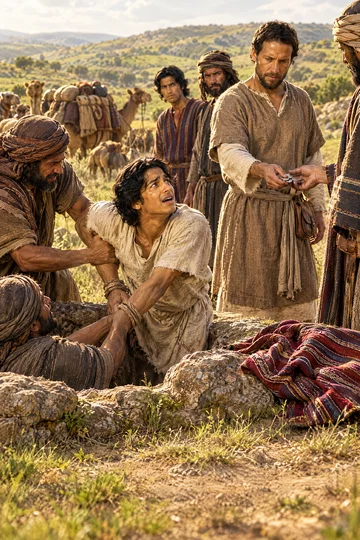
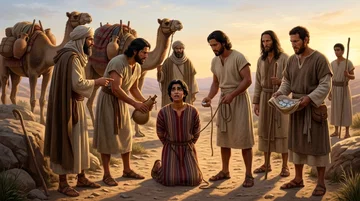
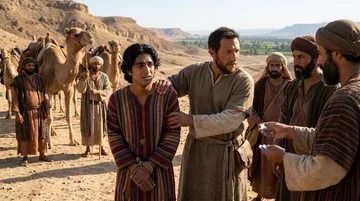
Then there passed by Midianites merchantmen; and they drew and lifted up Joseph out of the pit, and sold Joseph to the Ishmeelites for twenty pieces of silver: and they brought Joseph into Egypt.
Translations
Then there passed by Midianites merchants; and they drew and lifted up Joseph out of the pit, and sold Joseph to the Ishmeelites for twenty pieces of silver: and they brought Joseph into Egypt.
Then there passed by Midianites merchantmen; and they drew and lifted up Joseph out of the pit, and sold Joseph to the Ishmeelites for twenty pieces of silver: and they brought Joseph into Egypt.
Then there passed by Midianites merchantmen; and they drew and lift up Joseph out of the pit, and sold Joseph to the Ishmeelites for twenty pieces of silver: and they brought Joseph into Egypt.
Then there passed by Midianites, merchants; and they drew and lifted Joseph out of the pit, and sold Joseph to the Ishmaelites for twenty pieces of silver: and they brought Joseph into Egypt.
Revised Version, American Standard Version
And there passed by Midianites, merchantmen; and they drew and lifted up Joseph out of the pit, and sold Joseph to the Ishmaelites for twenty pieces of silver. And they brought Joseph into Egypt.
And Midianite merchantmen pass by and they draw out and bring up Joseph out of the pit, and sell Joseph to the Ishmaelites for twenty silverlings, and they bring Joseph into Egypt.
And Midianitish men, merchants, passed by; and they drew and lifted up Joseph out of the pit, and sold Joseph to the Ishmaelites for twenty silver-pieces; and they brought Joseph to Egypt.
And there passed by certain Midianites travelling merchants, so they drew forth and uplifted Joseph out of the pit, and sold Joseph to the Ishmaelites, for twenty pieces of silver,—and they brought Joseph into Egypt.
Berean Standard Bible, Majority Standard Bible
So when the Midianite traders passed by, his brothers pulled Joseph out of the pit and sold him for twenty shekels of silver to the Ishmaelites, who took him to Egypt.
Midianites who were merchants passed by, and they drew and lifted up Joseph out of the pit, and sold Joseph to the Ishmaelites for twenty pieces of silver. The merchants brought Joseph into Egypt.
And some traders from Midian went by; so pulling Joseph up out of the hole, they gave him to the Ishmaelites for twenty bits of silver, and they took him to Egypt.
Then the Midianites marchant men passed by, and they drewe foorth, and lift Ioseph out of the pit, and solde Ioseph vnto the Ishmeelites for twentie pieces of siluer: who brought Ioseph into Egypt.
Douay-Rheims (Challoner revision)
And when the Madianite merchants passed by, they drew him out of the pit, and sold him to the Ismaelites, for twenty pieces of silver: and they led him into Egypt.
Pictures
Cross-references 20 of 35
- Genesis 50:20
But as for you, ye thought evil against me; but God meant it unto good, to bring to pass, as it is this day, to save much people alive.
God overruled the evil sale of Joseph for good, preserving many lives.
- Matthew 26:15
And said unto them, What will ye give me, and I will deliver him unto you? And they covenanted with him for thirty pieces of silver.
Joseph’s sale for twenty pieces of silver parallels Christ’s betrayal for thirty.
- Acts 7:9
And the patriarchs, moved with envy, sold Joseph into Egypt: but God was with him,
Both describe Joseph’s brothers selling him from envy, while God was with him.
- Genesis 37:5-11
And Joseph dreamed a dream, and he told it his brethren: and they hated him yet the more.
Joseph’s brothers’ later bowing fulfills his dreams.
- Genesis 45:5-7
Now therefore be not grieved, nor angry with yourselves, that ye sold me hither: for God did send me before you to preserve life.
Joseph says God sent him ahead to preserve life.
- Genesis 42:6
And Joseph was the governor over the land, and he it was that sold to all the people of the land: and Joseph’s brethren came, and bowed down themselves before him with their faces to the earth.
Joseph’s brothers bow before him as his dreams are fulfilled.
- Genesis 41:40-41
Thou shalt be over my house, and according unto thy word shall all my people be ruled: only in the throne will I be greater than thou.
Joseph later becomes ruler over Egypt.
- Genesis 37:23-24
And it came to pass, when Joseph was come unto his brethren, that they stript Joseph out of his coat, his coat of many colours that was on him;
Joseph’s brothers strip him and put him in the pit before selling him.
- Genesis 37:36
And the Midianites sold him into Egypt unto Potiphar, an officer of Pharaoh’s, and captain of the guard.
Shows resale to Potiphar after arrival in Egypt.
- Genesis 42:21-22
And they said one to another, We are verily guilty concerning our brother, in that we saw the anguish of his soul, when he besought us, and we would not hear; therefore is this distress come upon us.
Joseph’s brothers recall his anguish and confess guilt for selling him.
- Genesis 41:54
And the seven years of dearth began to come, according as Joseph had said: and the dearth was in all lands; but in all the land of Egypt there was bread.
Joseph’s sale leads, in God’s providence, to his role preserving people during famine.
- Psalms 105:17-22
He sent a man before them, even Joseph, who was sold for a servant:
Recounts Joseph’s enslavement and imprisonment before his rise to rule in Egypt.
- Genesis 46:6
And they took their cattle, and their goods, which they had gotten in the land of Canaan, and came into Egypt, Jacob, and all his seed with him:
Jacob’s family went to Egypt, where Joseph had already arrived.
- Genesis 37:35
And all his sons and all his daughters rose up to comfort him; but he refused to be comforted; and he said, For I will go down into the grave unto my son mourning. Thus his father wept for him.
Jacob mourns Joseph, believing him dead.
- Genesis 39:2
And the LORD was with Joseph, and he was a prosperous man; and he was in the house of his master the Egyptian.
Lord with Joseph after sale into Egypt
- Genesis 39:20-22
And Joseph’s master took him, and put him into the prison, a place where the king’s prisoners were bound: and he was there in the prison.
Joseph’s imprisonment leads to responsibility and favor under God’s providence.
- Amos 6:6
That drink wine in bowls, and anoint themselves with the chief ointments: but they are not grieved for the affliction of Joseph.
Amos uses Joseph’s affliction to describe a heartless generation.
- Genesis 37:24
And they took him, and cast him into a pit: and the pit was empty, there was no water in it.
Joseph’s brothers cast him into the pit.
- Genesis 37:21-22
And Reuben heard it, and he delivered him out of their hands; and said, Let us not kill him.
Reuben intervenes to keep his brothers from killing Joseph.
- Genesis 42:1-3
Now when Jacob saw that there was corn in Egypt, Jacob said unto his sons, Why do ye look one upon another?
Joseph’s brothers later go down to Egypt.
Commentary
Each commentary is drawn from primary sources: the writings of Ellen G. White and Adventist pioneers and periodicals. Each commentary is separate. Its own words are not a quotation; follow the references to read the source passages.
Ellen G. White
19 sources
The verse records Joseph being drawn and lifted out of the pit and sold to passing Midianite merchantmen called Ishmaelites for twenty pieces of silver, then carried south into Egypt as a slave.SG3 141.1–2ST Dec 18, 1879PP 211.3–4 At Judah's proposal his brothers agreed to sell him for gain rather than kill him with their own hands or leave him to die, to keep him from gaining authority over them and to place him where his dreams could no longer trouble them or be fulfilled.ST Dec 18, 1879ST Feb 5, 1880PP 211.3–41SP 157.2–158.2SG3 174.2–176.1 Though he pleaded for mercy and compassion and dreaded slavery as worse than death, they hardened their hearts and delivered him to the traders.SG3 141.1–2PP 211.3–41SP 129.2 God overruled the very course they pursued to bring about what they designed should never take place, giving Joseph dominion over them and making him by his sale a saviour to his father's family, yet his providential control for good does not lessen the heinous guilt of the deed.ST Feb 5, 18801SP 157.2–158.2SG3 174.2–176.1 As Joseph was sold by his own brothers to foreigners, Christ was sold to his bitterest enemies by one of his own disciples, and as Joseph's sale led to his rise and saving work, so Christ's murder made him the Redeemer of the fallen race and ruler over the whole world.ST Feb 5, 18801SP 157.2–158.2SG3 174.2–176.1
The Brothers' Cruel Sale
Joseph was drawn and lifted out of the pit and sold to passing Midianite merchantmen, called Ishmaelites, for twenty pieces of silver, a small sum, and was taken south into Egypt as a slave.SG3 141.1–2ST Dec 18, 1879PP 211.3–41SP 157.2–158.2SG3 174.2–176.1 Judah proposed the sale to gain money and to remove Joseph from their way without leaving him to die or killing him with their own hands, and the brothers agreed to the plan.ST Dec 18, 1879PP 211.3–4 They acted heartlessly toward their own brother in handing him over to traveling traders bound for Egypt.ST Dec 18, 1879PP 211.3–4
The brothers first purposed to kill Joseph but settled on selling him to keep him from becoming greater than they and gaining authority over them.ST Feb 5, 18801SP 157.2–158.2SG3 174.2–176.1 They thought they had placed him where his dreams could no longer trouble them and could never be fulfilled.1SP 157.2–158.2SG3 174.2–176.1 Joseph saw that slavery awaited him and pleaded for mercy and compassion, even for his father's sake, but they hardened their hearts and delivered him to the traders.SG3 141.1–2PP 211.3–41SP 129.2 To him slavery was more dreadful than death and filled him with deeper anguish than the thought of death, and though some felt pity, fear of ridicule kept them silent.PP 211.3–41SP 129.2
The act was a cruel and wrong deed, an act of unfilial conduct and cruelty and wickedness that God would by no means sanction.SG3 155.2SG3 170.2 Reuben had no hand in the selling, though previous to that transaction he had grievously sinned by a corrupt course transgressing the law of God.SG3 170.2 Simeon and Levi were especially guilty in the selling of Joseph, and their later scattering in Israel is presented as a consequence of their cruelty and this act.PP 235.5–6
The sale began Joseph's exile from his childhood home in Canaan to bondage in Egypt as a helpless stranger, leaving father and home behind.PP 213.1–2ED 52.3–4ST Jan 8, 1880 On the terrible journey he looked for the last time on the hills that hid the tents of his kindred.ED 52.3–4 His brothers' cruelty had been provoked by their father's partiality and indulgence, which had also encouraged faults in Joseph such as self-sufficiency and demandingness that his new hardships would correct.PP 213.1–2 The wicked treatment caused Jacob many years of grief as he reflected upon Joseph's supposed dreadful death, yet Jacob forgave his children when they gathered about him to receive his blessing and hear his last words.SG3 170.2
Providence Foreshadowing Christ
God turned the very plan the brothers followed to bring about what they were determined should never happen, giving Joseph dominion over them and making him by his sale into Egypt a saviour to his father's family.ST Feb 5, 18801SP 157.2–158.2SG3 174.2–176.1PP 239.2–4 They had meant to keep him from becoming greater than they and to put him where his dreams could no longer trouble them or ever be fulfilled, but their course was overruled to establish the exaltation they sought to prevent.ST Feb 5, 18801SP 157.2–158.2SG3 174.2–176.1 That providential control of events for His own glory and the good of man does not lessen guilt, and the crime of the brothers remains just as heinous.ST Feb 5, 18801SP 157.2–158.2SG3 174.2–176.1PP 239.2–4 The fact that good was brought out of evil does not excuse the evildoers.ST Feb 5, 18801SP 157.2–158.2SG3 174.2–176.1
Though the injustice came through no wrongdoing of his own, Joseph did not give way to gloom or resentment.ED 52.3–4ST Jan 8, 1880 In the crisis of the terrible journey from his childhood home in Canaan to the bondage awaiting him in Egypt, looking for the last time on the hills that hid the tents of his kindred, he remembered his father's God and the lessons of his childhood, and his soul thrilled with resolve to prove himself true, ever to act as became a subject of the King of heaven.ED 52.3–4 He remained steadfast amid the sights and sounds of vice and the allurements of heathen worship, surrounded with all the attractions of wealth and culture and the pomp of royalty, faithful in every station from the most lowly to the most exalted, with gentleness, fidelity, truthfulness, virtue and firm purpose training every power for highest service.PP 209.1ED 52.3–4Lt 10, 1879, par. 4–9 His faith stayed fixed on God through slavery and imprisonment when hope seemed gone, until God brought him out of the dungeon to be a light to the world, giving him signal victories even while he was maligned, persecuted and treated as a criminal for doing right.RH Jan 27, 1916Lt 10, 1879, par. 4–9
The brothers later remembered their cruelty when they were confined three days in Egypt as suspected spies, facing death or slavery if they could not clear themselves.SG3 155.21SP 141.1–142.2 With bitter sorrow they reflected on their past wrong course and especially on their cruelty to Joseph, fearing God designed to punish them for selling him by letting them become slaves themselves.SG3 155.21SP 141.1–142.2 Their sorrow and fear showed repentance that gave confidence they would in no case treat Benjamin as they had treated Joseph, even while their father and their families might be suffering for food.SG3 155.2
As Joseph was sold by his own brothers to foreigners and enemies for a small sum of money, Christ was sold to His bitterest enemies by one of His own disciples.ST Feb 5, 18801SP 157.2–158.2SG3 174.2–176.1PP 239.2–4 As the brothers sought to prevent Joseph from gaining authority, Christ's enemies sought to prevent Him from gaining authority, but as Joseph's sale led to his rise and saving work, Christ's murder and crucifixion made Him the Redeemer of mankind, the Saviour of the fallen race, and ruler over the whole world.ST Feb 5, 18801SP 157.2–158.2SG3 174.2–176.1PP 239.2–4 As God's use of Joseph's sale for good did not lessen his brothers' guilt, God's use of Christ's death for good did not lessen the heinous crime of His enemies.ST Feb 5, 18801SP 157.2–158.2SG3 174.2–176.1PP 239.2–4 The sale for twenty pieces of silver thus supplies the image of selling one's Lord and warns against betraying Christ for gain.Ms 38, 1904, par. 79
Sources
Pioneers and periodicals
85 sources
Midianite merchantmen passed by while Joseph was in the pit, and he was drawn and lifted up out of it and sold to the Ishmaelites for twenty pieces of silver, who carried him down into Egypt as a slave.ST Apr 2, 1894ST Oct 2, 1901ST Oct 27, 1898 The sale was moved by the brothers' envy and hatred against the just, arising from Jacob's special love, the special coat, and the dreams of pre-eminence, and it carried out Judah's proposal to spare his life for gain rather than kill him or leave him to die.ST Mar 17, 1887ST Mar 17, 1887ST Dec 18, 1879ST Jan 3, 1911ST Oct 27, 1898 What the brothers meant for evil God meant and overruled for good, for it was not chance but God's deliberate plan and special providence guiding Joseph, going with him, and setting a bound around danger to deliver him.ST Apr 2, 1894ST Jan 16, 1912ST Jun 11, 1894 What was done from hatred became the stepping-stone to the very authority they sought to prevent, sending him beforehand to Egypt to become a saviour of life to his family and to Egypt during the famine and to preserve the Hebrew people.ST Nov 29, 1905ST Jul 28, 1881ST Mar 30, 1904ST Dec 12, 1916 Joseph is in some respects a type of Christ, for as the brothers through envy delivered Joseph for twenty pieces of silver, so the Jews through envy delivered Christ to death for thirty pieces of silver, yet each suffered not for his own wrongdoing but that others might be delivered.ST Dec 25, 1901ST Apr 2, 1894ST Apr 20, 1888ST Apr 20, 1888
Sale Narrative Details
Midianite merchantmen passed by while Joseph was in the pit, and he was drawn and lifted up out of the pit and sold to the Ishmaelites for twenty pieces of silver, who brought him down into Egypt as a slave.ST Mar 17, 1887ST Apr 2, 1894ST Oct 2, 1901ST Oct 27, 1898ST Apr 20, 1888 The sale carried out the brothers' settled plan to sell rather than kill him, fulfilling Judah's suggestion, and it belongs to the account of Joseph as beloved by Jacob and hated by his brothers.ST Oct 2, 1901ST Oct 27, 1898 The evil men intended against Joseph in this sale God intended for good.ST Apr 2, 1894 The sale was moved by envy and is an instance of the wicked plotting against the just, illustrating the fruit and outcome of envy.ST Apr 20, 1888
The caravan traders are called Midianites, Medanites, and Ishmaelites, related peoples descended from Abraham's sons.ST Apr 2, 1894ST Apr 2, 1894 The traders who bought Joseph were his own relatives and kin through Abraham.ST Apr 2, 1894ST Apr 2, 1894 The account distinguishes the Midianite merchants who lifted him from the pit from the Ishmaelite buyers to whom he was sold.ST Oct 2, 1901ST Apr 2, 1894 The buyers treated their purchase as justified because the brothers had offered him for sale, yet as merchants trafficking in slaves who bought a kinsman and sold him into Egypt they exposed a grasping character that spares no one.ST Apr 2, 1894ST Feb 20, 1901
The sale carried out Judah's proposal to spare Joseph's life and gain money rather than kill him or leave him to die in the pit.ST Mar 17, 1887ST Dec 18, 1879ST Oct 27, 1898 The suggestion to sell him was discussed while the brothers ate, and they agreed to it and acted heartlessly toward their own brother.ST Dec 18, 1879ST Oct 2, 1901 They accepted it because they shrank from either killing him outright or letting him starve in the pit.ST Oct 2, 1901 They believed selling him would accomplish the purpose of removing him while letting them claim they were innocent of his blood, yet the sale was murder already in the heart.ST Oct 2, 1901
The price was twenty pieces of silver, about eleven dollars, a small payment for betraying him showing how little his envious brothers valued him.ST Oct 9, 1901 It was two-thirds of the thirty pieces of silver for which Christ was sold, as the sale of Joseph is compared with Judas's betrayal of Jesus.ST Apr 2, 1894ST Apr 2, 1894 Carried toward Egypt by the merchant caravan as a slave, he was taken where he would later provide food for his brothers and save them from starvation. Joseph was sold as a slave despite his anguished pleas for compassion, his fear of slavery being greater than his fear of death.ST Mar 17, 1887 As he was taken away he looked back tearfully at the brothers who had betrayed him, frightened, heartbroken, and far from home.ST Feb 18, 1913
Setting and Chronology
The sale took place in the valley of Dothan, on the caravan route from Gilead to Egypt.ST Aug 25, 1898ST Oct 19, 1904 Its broad grazing land explains how the brothers could see Joseph from far off, and its position explains how merchandise-laden camel caravans readily passed by.ST Aug 25, 1898 The place was still called Joseph's Pit.ST Aug 25, 1898 The visit to Dothan and the sale to Midianite traders who carried him to Egypt happened more than nine hundred years before Elisha's time there, with the sale occurring near Dothan to Ishmaelite traders.ST Oct 19, 1904
Joseph was seventeen, about eighteen, when his brothers sold him.ST Mar 31, 1881RH Apr 26, 1870 Jacob was deceived into believing a wild beast had killed him, and mourned him as dead and as destroyed in slavery.ST Jan 22, 1880ST Jan 31, 1906RH Apr 26, 1870 That separation and long grief lasted about twenty-two years, following from the deception and family wrongs set in motion by Jacob's own earlier conduct.ST Mar 31, 1881RH Apr 26, 1870 Jacob thought he must go down to the grave in sorrow for his son, counting the taking of Joseph as a great and incomprehensible calamity.ST Jan 31, 1906 After years of faithfulness to God, about twenty-two years after the sale Joseph had become Egypt's governor and prime minister, and his brothers bowed humbly before him in fulfillment of the dreams that had provoked their envy.ST Jan 3, 1911ST Dec 14, 1915
Joseph was carried into Egypt eight years before the death of his grandfather Isaac. Isaac could therefore converse with his grandson Joseph. Joseph then lived long afterward to converse with Amram the father of Aaron and Moses.
The sale belongs to the family setting of Jacob's having more than one wife.ST Jan 3, 1911ST Unequal affection for Joseph and jealousies between Jacob's wives and their families produced hatred among the brothers.ST Jan 3, 1911 That polygamous setting displays its harm in partiality, jealousy, envy, low moral standards, and crime, as the sad fruits of Jacob's mistakes.ST Jan 3, 1911ST
The Genesis account of Joseph and its portrayal of Egypt is accurate and circumstantial history.ST Jul 30, 1885 It agrees with evidence from Egyptian monuments and records, being fully corroborated by deciphered inscriptions on Egyptian monuments and tombs.ST Nov 20, 1884ST Jul 30, 1885 The Pentateuch is therefore of prime historical importance and a most valuable auxiliary to the full understanding of Egyptian history.ST Jul 30, 1885
The verse marks the beginning of Joseph's journey as a boy and lad sold by his older brothers.ST May 13, 1908ST Mar 11, 1908 He was lifted from the pit and sold for twenty pieces of silver to passing merchants, then taken to Egypt as a slave.ST After many years, prison, and severe trial he became governor of all Egypt, its prime minister and leading statesman.ST May 13, 1908STST Mar 11, 1908
Causes and Human Motives
The sale was moved by envy, hatred, jealousy and wickedness plotting against the just, stirred by Jacob's special love for Joseph, by his special coat, by his reports of his brothers' wrongdoing, by his faithful obedience and rebuke of their wrong, and by his dreams of pre-eminence.ST Mar 17, 1887ST Jan 3, 1911ST Apr 20, 1888ST Jun 11, 1894ST Oct 2, 1901 That hatred grew until it sought murder and then sold him as a slave into Egypt, illustrating the fruit and outcome of envy and the attempt to thwart God's providence, which God overruled for good as Genesis 50:20 shows.ST Mar 17, 1887ST Jan 3, 1911ST Apr 20, 1888ST Jun 11, 1894 The long years of sorrow thus brought upon their father, who mourned for days and weeks and months and years, were only part of the fruits of that hatred, and the later bowing of the brothers before Joseph in Egypt fulfilled the very dreams that had provoked their envy.ST Jan 3, 1911 Envy is pain felt at the sight of superior excellence or happiness, hatred is the offspring of envy, and malice is the offspring of hatred.RH Jan 9, 1855 The brothers went downward step by step from envy to hatred to a murderous scheme to deceit to a fearful expectation of wrath to be visited upon them, with one brother as chief instigator in the crime, and the same progression appeared in still greater measure in the Jews' delivery of Jesus Christ, in whom all excellence met, to crucifixion.ST Oct 27, 1898RH Jan 9, 1855
They chose to sell him into slavery rather than kill him because they believed selling would remove him while letting them claim they were innocent of his blood, but the sale was murder already in the heart.ST Oct 2, 1901 The example warns to suppress every rising of these malignant dispositions lest they grow by imperceptible degrees until escape is impossible, and to seek righteousness and seek meekness in order to be hid in the day of the Lord's anger.RH Jan 9, 1855 Reuben's failure to stand firm in protesting his brothers' cruel treatment shows the weakness of those who do not take their stand for right when opportunity offers.ST Nov 29, 1905 If he had stood firm he might have shared Joseph's suffering and also shared in the later glorious vindication of right and principle seen in Joseph's life, who could not see the purpose while it was happening yet kept faith that all would come out right in God's own good time.ST Nov 29, 1905
Joseph had done no wrong to provoke the act, for he feared God and was righteous, and despite his brothers' ill will he went without complaint when his father sent him on his errand, showing a helpful character that later led to positions of trust in Egypt.ST Jan 8, 1880ST Apr 29, 1908ST Apr 20, 1888 His pride, encouraged by his father's favoritism and displayed in his special coat and dreams, brought him into trouble, but in the pit God humbled him and lifted him out of himself.RH Sep 24, 1908 God then arranged for the same men who had put him in the pit to lift him out, and kept lifting him until he stood next to the king, the Bible's first use of lifted and an example of God lifting those who submit to His dealings, and despite this undeserved hardship Joseph did not give way to gloom or resentment.ST Jan 8, 1880RH Sep 24, 1908 Like Christ sold to His enemies, he suffered not for his own wrongdoing but so that others might be delivered.ST Apr 20, 1888
The men who once sold a brother later showed they had changed, for they would not abandon Benjamin.ST Feb 28, 1884 Many years passed before they met Joseph again, when ten of them stood before him as buyers of corn without recognizing him though he knew them.ST Jan 21, 1886 After he charged them with being spies and kept them in prison three days, their quickened conscience over selling him broke out in the confession, We are verily guilty concerning our brother.ST Jan 21, 1886
Providence and Preservation
What the brothers meant for evil God meant for good, as Genesis 50:20 declares, and the drawing of Joseph from the pit and his sale for twenty pieces of silver and his bringing down into Egypt was not chance or good fortune but deliberate plan and special providence.ST Apr 2, 1894ST Jun 11, 1894RH Jan 19, 1860RH Feb 12, 1857RH Jan 30, 1872 Human wrath, ambition, jealousy and envy sought to thwart providence, yet God overruled them to accomplish His purposes and to guide Joseph round to exactly what He had intended for him.ST Jan 16, 1912ST Jun 11, 1894RH Jan 19, 1860ST Apr 2, 1894 He went with Joseph to Egypt, did not forsake him or lose sight of him, and set a bound around danger to deliver those who fear and trust Him.RH Jan 19, 1860ST Dec 2, 1897RH Jan 30, 1872 What was unwittingly done by evil men to serve their own ends was turned to blessing far beyond expectation, even to the saving of the soul of the man who sold him.ST Apr 2, 1894RH Feb 12, 1857
What was done from hatred became a stepping-stone to the very authority the brothers desired to prevent.ST Nov 29, 1905ST Nov 29, 1905ST Nov 29, 1905 In casting him into the pit and selling him they laid the first stone of steps that led him up and up until he became ruler in Egypt.ST Nov 29, 1905ST Nov 29, 1905 Being sold into servitude was the first step in humiliation, suffering and imprisonment that came before exaltation and prepared him for the work given him.ST Jul 28, 1881RH Mar 2, 1916ST Dec 16, 1880 Though the event seemed to destroy the future shown in his dreams, grief and fear were turned into the means of fulfilling them, and the journey to Egypt was free transportation to the field of his future greatness where he would serve as mighty statesman.RH Mar 2, 1916ST Nov 29, 1905ST Nov 29, 1905
Through anguish unknown to Joseph, God was sending him beforehand to Egypt for a wise and beneficent purpose.ST Jan 31, 1906 From that sale he became a prisoner who became a ruler, and became a saviour of life to his family and to Egypt and to other countries during the seven-year famine.ST Mar 30, 1904ST Oct 28, 1897RH Nov 19, 1908RH Nov 28, 1912 By that chain of afflictions God preserved Israel's family and brought the Hebrew people into being, and through His people's lives and deliverance Egypt would learn of the true God.ST Mar 30, 1904ST Dec 12, 1916 The same leading went ahead of Jacob's family into Egypt, where famine afterward brought them to dependence and eventual enslavement, and it humbled Israel and prepared them to receive the law and build the sanctuary.ST Nov 23, 1904RH Nov 17, 1904
The sale belongs to the persecution of Abraham's descendants and to the four hundred years of affliction ending in deliverance.RH Jan 2, 1913 The jealousy that turned violent when Ishmael rose against Isaac's line continued through Ishmael's descendants who sold Joseph.RH Jan 2, 1913 That sale of one brother brought the whole chosen family into Egyptian bondage for many generations until they numbered 600,000 men besides women and children.RH Aug 23, 1864 Their sin had blinded their judgment, and their treatment of Joseph led to the descent into Egypt where Israel encountered Egyptian worship and became influenced by its principles.RH Nov 17, 1904
The sale was part of Satan's scheme and attempt to destroy Israel and cut off the promised Seed.ST Mar 30, 1904ST Dec 12, 1916RH Nov 28, 1912 Joseph stands in the channels through which the Promised Seed should come, and the Lord was preparing him to preserve the holy Seed.STST Jan 21, 1913 God used the brothers' sin together with the famine in Canaan to bring His purpose to pass and to bring the Hebrew people into being, so what was intended for harm became part of His purpose.ST Mar 30, 1904ST Dec 12, 1916
God's providential use of the deed for good did not lessen the brothers' guilt or justify their wrong.ST Feb 5, 1880RH Jan 30, 1872 Betrayal by brothers does not mean abandonment, for God goes with the one who is sold into Egypt.ST Dec 2, 1897 Jacob's taking of Joseph and his long mourning of him as destroyed by a wild beast was a great calamity he could not understand, yet it was a blessing in disguise, for the Lord had sent Joseph beforehand to prepare the way for the safety of His people, and when that purpose was made known sorrow turned to joy.ST Jan 31, 1906 God in kind fatherly care permits calamity and works it together for good to them that love Him, with the blessing revealed hereafter to those who wait patiently and press on without fear.ST Jan 31, 1906ST Dec 2, 1897
Type of Christ
Joseph is in some respects a type of Christ, though not on the same plane with Christ.ST Dec 25, 1901ST Apr 20, 1888 As his brothers through envy delivered him to be drawn from the pit and sold into Egypt, so the Jews through envy delivered Christ to death.ST Dec 25, 1901RH Jan 9, 1855 Envy is pain felt at the sight of superior excellence or happiness, hatred is the offspring of envy, and malice is the offspring of hatred, and this downward progression seen in Joseph's brethren casting him out and selling him appeared in still greater measure in the Jews' delivery of Jesus, in whom all excellence met, to crucifixion.RH Jan 9, 1855 The warning is therefore to suppress every rising of these malignant dispositions lest they grow by imperceptible degrees until escape is impossible, and to seek righteousness and seek meekness in order to be hid in the day of the Lord's anger.RH Jan 9, 1855
His sale for twenty pieces of silver is set beside Judas's betrayal of Jesus for thirty pieces of silver, Joseph being sold for two-thirds of the price received for Christ.ST Apr 2, 1894 Joseph was the tender and most-beloved son of his father, through whom he desired communication with his children, as Jesus was the only-begotten Son of God, through whom He emptied His heart of infinite love upon fallen sons of earth, yet each was sold.ST Oct 27, 1898 The beginning of the history of the children of Israel was thus marked with envious hatred against their younger brother, just as the end of their history was marked with bitter hatred even unto death against their Elder Brother.ST Oct 27, 1898 Envy in this sense means malice, ill-will, spite, and discontent at another's excellence or good fortune that no one can stand before.ST Oct 27, 1898
Both suffered not for their own wrongdoing but that others might be delivered, for Joseph feared God and was righteous and had done no wrong to cause his sale into slavery.ST Apr 20, 1888ST Apr 20, 1888 His brothers sold him to keep him from gaining authority over them, yet the act instead led to his rise in Egypt and his becoming a saviour to his family.ST Feb 5, 1880ST Jul 21, 1909 In like manner Christ's enemies sought to prevent Him from gaining authority, but His death made Him the Redeemer of mankind.ST Feb 5, 1880 The unpopular man rejected and put out of the way by his own was afterward entrusted with a divine mission to save, bless and benefit humanity, proving that the rejected man is the saviour, like Christ who came to His own and His own received Him not, with God bringing salvation and making Joseph a ruler and a saviour of life through one whom men had rejected.ST Nov 22, 1899ST Jul 21, 1909
Doctrine and Daily Application
The wayward and envious sons of Jacob persecuted Joseph, who feared God, by casting him out and selling him into Egypt.RH Jun 8, 1916 This is an instance of the rule that he that was born after the flesh persecutes him that was born after the Spirit.RH Jun 8, 1916 It proves that the wicked persecute the righteous because their own works are evil and their brother's are righteous, and they cannot endure goodness.RH Jun 8, 1916
The selling of a human being recorded here is the only sale of a human being mentioned in the patriarchal records, for Joseph's brothers sold him.RH Oct 1, 1861 The act was later bitterly regretted by them, showing that selling a person was condemned rather than treated as an accepted patriarchal custom.RH Oct 1, 1861 God did not sanction slavery but permitted Joseph to be sold into slavery in Egypt to bring forth great blessing somewhere, sometime, to someone in darkness and need, and through that permitted enslavement Joseph saved his father's house.RH Sep 27, 1906 That sale of one brother for twenty pieces of silver caused God to bring his whole family of chosen people into Egyptian bondage for many generations until they numbered 600,000 men besides women and children, so wholesale traffic in human flesh and blood of black and white deserves far greater punishment, whether southern slavery with its cruelties or the buying and selling of white brothers and sons for the slaughter and hardships of war at prices far above that paid for Joseph and for Christ.RH Aug 23, 1864
The human experiences in Joseph's life hold underlying principles for dealing with the contingencies of life, giving an example to help and guide any person called to pass through a similar experience, with practical lessons to be as familiar as our own names for personal good and for giving counsel to others in similar difficulties, as the Bible becomes more and more the guidebook to be trusted with confidence to the very end.ST Nov 29, 1905 His sale and being brought into Egypt was God leading him round in order to guide him right to what God had intended for him, so whatever God has intended a person for He can be safely trusted to bring them to.RH Jan 19, 1860 The selling of Joseph by his brothers was not good fortune but part of God's deliberate plan for Joseph's life.ST Nov 29, 1905 Joseph could not see the purpose while it was happening, yet he kept faith in God that all would come out right in God's own good time.ST Nov 29, 1905 After being sold into Egypt he was imprisoned and faced a time when hope seemed gone, yet his faith remained fixed on God, who brought him out of the dungeon and made him a light to the world.RH Jan 27, 1916 God goes with the one who is sold to Egypt, so betrayal by brothers does not mean abandonment, and when evils surround there is reason to press on without fear because even this works together for good.ST Dec 2, 1897 His being taken from the pit and brought into Egypt was not chance but divine providence, the work of the unchanging God of Israel who sets a bound around danger and delivers those who fear and trust him, proving he is a friend to youth who guards by angels in time of trouble, and urging every child and youth to seek him early in order to find him.RH Nov 24, 1874
As a boy far from home, taken from the pit and sold into slavery on the way to Egypt, Joseph faced the apparent ruin of his plans and ambitions, but his adversity became a blessing because he remained true to God amid temptation and later rose from prison to become Egypt's leading statesman.RH May 25, 1916 His early, pure and simple training helped him stand firm through severe trial and insult, remain faithful in every duty, and let duty rather than inclination guide him, for God gives opportunities to develop character, and their effect depends on how they are used.RH Mar 5, 1914 That early hardship after his relatives abandoned him preceded his rise to become a great financier who used his wisdom to provide food and prevent widespread starvation.ST Dec 12, 1916 His going to Egypt under the divine plan in submission without complaining developed character and trustworthiness in him so that his fellowmen trusted him implicitly, which is why he occupied positions of great trust and was placed in charge of the prisoners confined with him.ST Nov 29, 1905ST Nov 29, 1905 Like the captive maid, he faced a future that seemed hopeless and wept in despair when sold into slavery and taken from home to serve a foreign people, yet later he remembered the God he had been taught about, resolved to serve faithfully, and trusted God.ST Jul 7, 1909
At about eighteen, after the dreams of the sheaves and the sun, moon, and stars with their plain meaning that his father, mother, and brothers would bow to him, Joseph reasoned he must first be exalted since homage belongs to kings and governors, and with an ambitious character he laid plans to exalt himself, encouraged by his father giving him the seamless garment to mark desire for his exaltation to the sacred calling of the priesthood.RH Jan 27, 1916 Being sold to Ishmaelite merchantmen was the point where his own plans for himself had to change, for being sold broke those self-exalting plans, and his later casting into prison brought them fully to pieces.RH Jan 27, 1916
The life of Joseph sets before children a high ideal worthy of imitation and helps form strong character, as the story of a mighty man of old who accomplished wonderful things for God through faith in him.RH Dec 14, 1911 The boy Joseph envied by his brothers and sold into Egypt became from that sale a prisoner who became a ruler and preserved the lives of God's people, which is an example of God using children to do his work.RH Nov 19, 1908 His story warns that withholding love and cherishing envy toward family members can cause deep harm, for he had come to visit them and bring a message from home, but their perfidy left him a homesick boy facing years of bondage and imprisonment after cruel betrayal by those who should have loved and protected him. Jealousy among children makes sons unhappy and, once allowed to cross the threshold of the home, is sure to become a disturber of the peace, as seen in the sad experience that came upon the sons of Jacob because the older brothers were jealous of Joseph.ST Aug 1, 1916 Children must not be permitted to cultivate the habit of being jealous of one another, and parents must treat their children with such impartiality that slumbering jealousy is not awakened early.ST Aug 1, 1916 The brothers first hating Joseph and then persecuting him caused their father to mourn for days, weeks, months and years, with those long years of sorrow being only part of the fruits of their hatred. Envy is pain felt at the sight of superior excellence or happiness, hatred is the offspring of envy, and malice is the offspring of hatred, as displayed in Joseph's brethren ending in his being cast out and sold and in still greater measure in the Jews' delivery of Jesus Christ, in whom all excellence met, to crucifixion, warning to suppress every rising of these malignant dispositions lest they grow by imperceptible degrees until escape is impossible, and to seek righteousness and seek meekness in order to be hid in the day of the Lord's anger.RH Jan 9, 1855
A messenger of God may be sold, carried away, and jailed by those who do not know what they do, yet his message holds their own life and the life of all the people around them, as Joseph sold by his brothers and taken to Egypt was in prison for years, but Pharaoh saw in him a wisdom that was the life of all the land of Egypt and brought him to his own throne, where Joseph taught his elders wisdom.RH Nov 30, 1905 Those who suffer so must not speak harsh words against the officers but be kind, patient, and enduring and bless them, praying God to forgive them.RH Nov 30, 1905 If rulers knew their own life was in the message, they would seat the prisoner on their own throne as Pharaoh did Joseph and urge him to go quickly to deliver his message to every town and village, and by jailing him and stopping the message they cut off their own life and doom the people to death.RH Nov 30, 1905 Joseph's sale by his brothers became part of what happened to Israel during the seven lean years, just as exile became consequential for new settlements.RH Jul 30, 1908
Sources