Genesis 41:17
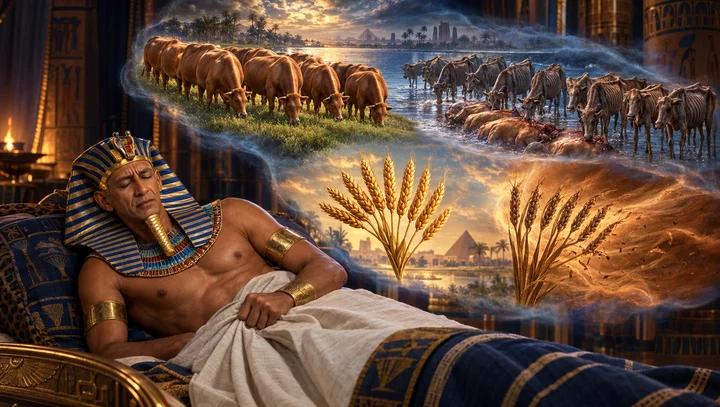
And Pharaoh said unto Joseph, In my dream, behold, I stood upon the bank of the river:
Translations
And Pharaoh said to Joseph, In my dream, behold, I stood on the bank of the river:
King James Version, KJV Cambridge Paragraph Bible
And Pharaoh said unto Joseph, In my dream, behold, I stood upon the bank of the river:
And Pharaoh said to Joseph, In my dream, behold, I stood upon the bank of the river:
Revised Version, American Standard Version
And Pharaoh spake unto Joseph, In my dream, behold, I stood upon the brink of the river:
And Pharaoh speaketh unto Joseph: 'In my dream, lo, I am standing by the edge of the River,
And Pharaoh said to Joseph, In my dream, behold, I stood on the bank of the river.
Then spake Pharaoh unto Joseph,—In my dream, there was I, standing on the lip of the river;
Berean Standard Bible, Majority Standard Bible
Then Pharaoh said to Joseph: “ In my dream I was standing on the bank of the Nile,
Pharaoh spoke to Joseph, “ In my dream, behold, I stood on the brink of the river;
Then Pharaoh said, In my dream I was by the side of the Nile:
And Pharaoh sayde vnto Ioseph, In my dreame, beholde, I stoode by the banke of the riuer:
Douay-Rheims (Challoner revision)
So Pharao told what he had dreamed: Methought I stood upon the bank of the river,
Pictures

Cross-references
- Genesis 41:25-32
And Joseph said unto Pharaoh, The dream of Pharaoh is one: God hath shewed Pharaoh what he is about to do.
Joseph interprets Pharaoh’s dream as seven years of plenty followed by famine.
- Daniel 2:1-28
And in the second year of the reign of Nebuchadnezzar Nebuchadnezzar dreamed dreams, wherewith his spirit was troubled, and his sleep brake from him.
A king’s dream brings a captive before him, where God reveals its meaning.
- Genesis 41:1-7
And it came to pass at the end of two full years, that Pharaoh dreamed: and, behold, he stood by the river.
Gives the riverbank setting and the dreams’ images.
- Genesis 41:29-30
Behold, there come seven years of great plenty throughout all the land of Egypt:
The riverbank dream leads to the prediction of plenty followed by famine.
- Genesis 41:33-36
Now therefore let Pharaoh look out a man discreet and wise, and set him over the land of Egypt.
Joseph advises storing food before the famine.
- Genesis 41:38-41
And Pharaoh said unto his servants, Can we find such a one as this is, a man in whom the Spirit of God is?
Pharaoh recognizes God’s Spirit in Joseph and appoints him ruler.
- Daniel 2:31
Thou, O king, sawest, and behold a great image. This great image, whose brightness was excellent, stood before thee; and the form thereof was terrible.
Both are God-given dreams revealing the future.
- Genesis 40:11
And Pharaoh’s cup was in my hand: and I took the grapes, and pressed them into Pharaoh’s cup, and I gave the cup into Pharaoh’s hand.
both show Egyptian dress of story
- Genesis 41:42
And Pharaoh took off his ring from his hand, and put it upon Joseph’s hand, and arrayed him in vestures of fine linen, and put a gold chain about his neck;
both show Egyptian dress of story
- Genesis 41:45
And Pharaoh called Joseph’s name Zaphnath-paaneah; and he gave him to wife Asenath the daughter of Poti-pherah priest of On. And Joseph went out over all the land of Egypt.
Joseph receives an Egyptian name meaning “the bread of life.”
Commentary
Each commentary is drawn from primary sources: the writings of Ellen G. White and Adventist pioneers and periodicals. Each commentary is separate. Its own words are not a quotation; follow the references to read the source passages.
Ellen G. White
3 sources
Pharaoh himself retells his dream to Joseph, and the retelling opens with Pharaoh standing upon the bank of the river.SG3 150.1–151.2ST Jan 15, 1880PP 220.3 That riverside position is the setting from which the rest of the dream unfolds.ST Jan 15, 1880PP 220.3 Out of the river come the cattle and then the ears of grain that form the two visions he describes.ST Jan 15, 1880PP 220.3 He lays those visions before Joseph for interpretation because the magicians had been unable to explain them.PP 220.3
The two parts are one message from God revealing what is to come in Egypt.SG3 150.1–151.2ST Jan 15, 1880 It foretells seven years of plenty to be followed by seven years of severe famine.SG3 150.1–151.2ST Jan 15, 1880
Sources
Pioneers and periodicals
31 sources
Pharaoh is retelling his dream to Joseph, beginning with standing on the bank of the river and opening the renewed account of the kine and the ears that Joseph then interprets.ST Nov 10, 1898ST Nov 10, 1898ST Apr 9, 1894 The dream is a divine revelation of seven years of plenty to be followed by seven years of famine in Egypt.ST Nov 10, 1898ST Jul 29, 1875RH Jul 25, 1854 Through it God gave warning of what was coming beforehand, so that grain could be stored in great quantity during the plentiful years and multitudes in Egypt and other lands preserved from starvation.ST Oct 11, 1905ST Apr 16, 1894ST Oct 16, 1901ST Mar 23, 1882ST Nov 28, 1900 That famine brought Jacob and his family to Egypt to buy corn and be saved, while God used the dream to lift His captive servant Joseph from prison to palace and power where he could store grain and help others.RH Jan 20, 1916ST Apr 9, 1894ST May 9, 1878ST Jan 21, 1889ST Mar 11, 1913
Dream's Setting and Meaning
Pharaoh is retelling his dream to Joseph, beginning with standing upon the bank of the river, the Nile, and opening the renewed account in verses 17-24 of the kine and the ears that Joseph then interprets.ST Nov 10, 1898ST Nov 10, 1898ST Apr 9, 1894ST Jul 29, 1875 It is the opening detail of the dream reiterated in those verses, where the river produces the cows and ears of grain that signify what is to come in Egypt.ST Jan 15, 1880ST Nov 10, 1898ST Oct 16, 1901 The dream was given by God and brought Joseph to Pharaoh's attention so that Joseph could interpret it.ST Apr 9, 1894
The dream with its river, kine, grain and sacred seven is thoroughly Egyptian in form and dress, even down to Egyptian words, showing the Egyptian origin of the story and that Joseph was a real person and not a sun deity or fiction.ST Dec 14, 1915 God reveals things to come by visions in figures and parables, and the same things are often revealed again and again by different visions or in different figures, so to understand them all the repeated visions must be combined into one.RH Mar 31, 1868RH Feb 18, 1873 Pharaoh's account is one of those repeated visions to be considered together with the others to understand what God reveals through them.RH Mar 31, 1868RH Feb 18, 1873
The dream came in natural sleep with the external senses closed, when the Holy Spirit moved upon the mental faculties and stamped the figures upon perception and memory.RH Feb 28, 1856 As a dream given by God it bears the impress of divine wisdom and is as truly a communication from God as a vision, although dreams as a class are less certain than visions because dreams can also come from Satan or from multiplicity of business.RH Feb 28, 1856 Its meaning and purpose was to communicate from God the knowledge of the approaching famine.RH Feb 28, 1856
The dream is a divine revelation, interpreted by Joseph, of seven years of plenty followed by seven years of famine in Egypt, and Joseph's prediction identifies him as a prophet.ST Jan 15, 1880ST Nov 10, 1898ST Jul 29, 1875RH Jun 23, 1903ST Oct 16, 1901 God gave warning of this event before it took place.RH Jul 25, 1854 The allotted periods of prosperity and famine in the land of Egypt were seven years each, and those seven-year periods show early respect for the number seven and indicate a general regard for the weekly cycle, pointing to knowledge of the weekly period and of a stated rest day continuing from its institution at creation.RH Jun 6, 1912
Divine Warning and Preservation
Through the retold dream God foretold the coming famine, and in doing so showed that He foretells in prophecy all the great disasters and important events in human history.ST Oct 11, 1905 What was shown to Joseph was the coming seven years of plenty and seven years of famine, given as a warning of the event before it took place.RH Jul 25, 1854 The dream showed Pharaoh what lay ahead, standing as a divine warning about the future to him and, through his experience, to rulers who came after him.ST Nov 28, 1900
The dream was given by God and brought Joseph to Pharaoh's attention so that Joseph could interpret it and help save Israel from the coming famine.ST Apr 9, 1894 Although it came to a heathen ruler standing on the bank of the river, Joseph was needed to explain it, showing that God can use rulers outside His people to convey instruction and advance His purposes.RH Mar 14, 1865
Foreknowledge that Egypt would have seven years of great plenty followed by seven years of severe scarcity allowed provisions to be stored in great quantities during the plentiful years.ST Apr 16, 1894ST Mar 23, 1882 The vision of cattle and grain interpreted as seven years of plenty followed by seven years of famine revealed what was coming so Egypt could store food and preserve lives.ST Oct 16, 1901 By that storing multitudes in Egypt, Canaan, and other lands were saved from starvation.ST Mar 23, 1882 That famine brought Jacob and his family to Egypt, where his sons came to buy corn from Joseph after his removal from prison to the palace.RH Jan 20, 1916ST May 9, 1878 In this way Israel was saved from the coming famine.ST Apr 9, 1894
The same revelation that let Egypt store food brought Pharaoh and his people a knowledge of the true God who directs the destinies of nations.ST Oct 16, 1901 Joseph's God-given interpretation brought him to the king's notice and showed Egypt that Israel's God was superior to its gods and could overrule events to accomplish His will.RH Jun 10, 1902 During the famine people from many lands came to Egypt to buy grain, and they could learn why grain was available and carry knowledge of Israel's God back to their own lands.RH Jun 10, 1902
Joseph's Exaltation and Example
Joseph himself declares that the power to interpret dreams is not in him, yet God uses the king's retelling of his dream beginning on the river bank to lift His captive servant from prison to palace and to power.RH Jan 20, 1916ST Jan 21, 1889ST Mar 11, 1913 That exaltation advances him to the place where he can store grain and help others in the famine, where Jacob's sons come to buy corn from him, and where he can help his companions in tribulation and rescue Jacob's whole house.RH Jan 20, 1916ST Jan 21, 1889ST Mar 11, 1913 What seemed to be against God's people is thus God's special providence for their deliverance, showing that out of the most insignificant thing God can bring blessing and deliverance.ST Jan 21, 1889
In that exalted place Joseph afterward provides food during the famine and saves the people, receiving the Egyptian name Zaphnath-paaneah, meaning the bread of life.ST Jan 1, 1885 The dreams retold and interpreted before Pharaoh ultimately lead Joseph's brothers to bow before him, fulfilling his earlier dreams that had stirred their envy and caused them to hate him.ST Jan 3, 1911ST The beautiful story in Egypt displays faithfulness, conscientiousness, and integrity.ST
His life shows that God can guide a person through a winding path to the purpose intended for them, turning what seemed against God's people into special providence for their deliverance.RH Jan 19, 1860ST Jan 21, 1889 God brings deliverance through Joseph after deep affliction and does not forsake him, proving that the God of Israel does not change but delivers those who fear and trust Him.ST Feb 18, 1913RH Nov 24, 1874 Out of the most insignificant thing God can bring blessing and deliverance and advance His servant to help companions in tribulation and rescue Jacob's whole house.ST Jan 21, 1889 His example calls every child and youth to take the God of Israel for friend and to seek Him early, with the promise that those who seek Him early shall find Him and that angels will guard them in time of trouble.RH Nov 24, 1874
Joseph brought before the king of Egypt brings God's name and truth to the attention of a ruler, which is part of God's plan of missionary work to set the truth before those of great influence.ST Oct 12, 1904 If they accept it their endorsement goes far toward making a favorable impression on the lower classes, so God will have His name and truth brought to kings and others in authority, even forcing His children through oppression or chastisement into position to bear the message.ST Oct 12, 1904 Joseph in Egypt standing before Pharaoh is an example of what God wants His workers to be in the world in its closing act.RH Dec 20, 1906 His standing there illustrates God's new covenant promise to lead each worker individually, applied to those in the medical missionary cause who hold the light higher in their own work and fit their little part into the grand whole to reach thousands perishing spiritually and physically who cannot be reached by an institution.RH Dec 20, 1906
Sources