Genesis 41:45
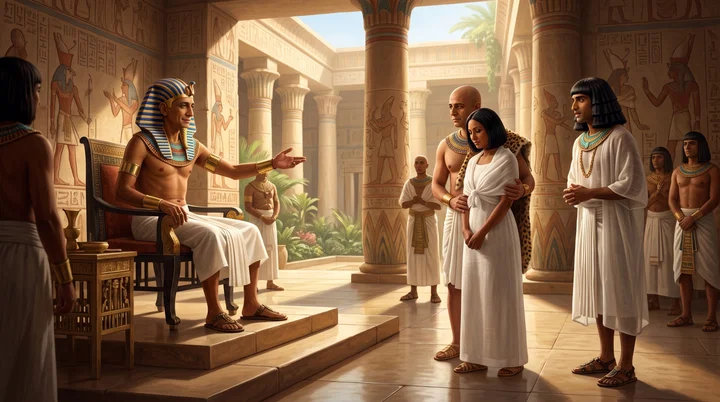
And Pharaoh called Joseph’s name Zaphnath-paaneah; and he gave him to wife Asenath the daughter of Poti-pherah priest of On. And Joseph went out over all the land of Egypt.
Translations
And Pharaoh called Joseph’s name Zaphnathpaaneah; and he gave him to wife Asenath the daughter of Potipherah priest of On. And Joseph went out over all the land of Egypt.
King James Version, KJV Cambridge Paragraph Bible
And Pharaoh called Joseph’s name Zaphnath-paaneah; and he gave him to wife Asenath the daughter of Poti-pherah priest of On. And Joseph went out over all the land of Egypt.
And Pharaoh called Joseph's name Zaphnath-paaneah; and he gave him for a wife Asenath the daughter of Poti-pherah priest of On: and Joseph went over all the land of Egypt.
And Pharaoh called Joseph’s name Zaphenath-paneah; and he gave him to wife Asenath the daughter of Poti-phera priest of On. And Joseph went out over the land of Egypt.
And Pharaoh called Joseph’s name Zaphenath-paneah; and he gave him to wife Asenath, the daughter of Poti-phera priest of On. And Joseph went out over the land of Egypt.
and Pharaoh calleth Joseph's name Zaphnath-Paaneah, and he giveth to him Asenath daughter of Poti-Pherah, priest of On, for a wife, and Joseph goeth out over the land of Egypt.
And Pharaoh called Joseph's name Zaphnath-paaneah, and gave him as wife Asnath the daughter of Potipherah the priest in On. And Joseph went out over the land of Egypt.
And Pharaoh called Joseph’s name Zaphenath-paneah, and gave him Asenath daughter of Poti-phera priest of On, to wife,—and Joseph went forth over the land of Egypt.
Berean Standard Bible, Majority Standard Bible
Pharaoh gave Joseph the name Zaphenath-paneah, and he gave him Asenath daughter of Potiphera, priest of On, to be his wife. And Joseph took charge of all the land of Egypt.
Pharaoh called Joseph’s name Zaphenath-Paneah. He gave him Asenath, the daughter of Potiphera priest of On as a wife. Joseph went out over the land of Egypt.
And Pharaoh gave Joseph the name of Zaphnath-paaneah; and he gave him Asenath, the daughter of Poti-phera, the priest of On, to be his wife. So Joseph went through all the land of Egypt.
And Pharaoh called Iosephs name Zaphnath-paaneah: and he gaue him to wife Asenath the daughter of Poti-pherah prince of On. then went Ioseph abrode in the land of Egypt.
Douay-Rheims (Challoner revision)
And he turned his name, and called him in the Egyptian tongue, The saviour of the world. And he gave him to wife Aseneth the daughter of Putiphare priest of Heliopolis. Then Joseph went out to the land of Egypt:
Pictures
Cross-references
- Genesis 41:29-30
Behold, there come seven years of great plenty throughout all the land of Egypt:
Joseph explains the coming years of plenty and famine to Pharaoh.
- Genesis 46:20
And unto Joseph in the land of Egypt were born Manasseh and Ephraim, which Asenath the daughter of Poti-pherah priest of On bare unto him.
Names On in the account of Joseph’s family in Egypt.
- Genesis 41:50
And unto Joseph were born two sons before the years of famine came, which Asenath the daughter of Poti-pherah priest of On bare unto him.
Both identify On in connection with Joseph’s family.
- Acts 7:9-10
And the patriarchs, moved with envy, sold Joseph into Egypt: but God was with him,
Joseph rises to authority in Egypt through Pharaoh’s favor.
- Psalms 105:21-22
He made him lord of his house, and ruler of all his substance:
Describes Joseph’s authority in Egypt.
- Genesis 37:5-11
And Joseph dreamed a dream, and he told it his brethren: and they hated him yet the more.
exaltation fulfills his envied dreams
- Psalms 105:17-19
He sent a man before them, even Joseph, who was sold for a servant:
Joseph’s trials preceded his rise to authority in Egypt.
- Genesis 37:28
Then there passed by Midianites merchantmen; and they drew and lifted up Joseph out of the pit, and sold Joseph to the Ishmeelites for twenty pieces of silver: and they brought Joseph into Egypt.
sold as slave before ruling Egypt
- Genesis 41:54
And the seven years of dearth began to come, according as Joseph had said: and the dearth was in all lands; but in all the land of Egypt there was bread.
The predicted years pass, and famine begins as foretold.
- Genesis 39:6
And he left all that he had in Joseph’s hand; and he knew not ought he had, save the bread which he did eat. And Joseph was a goodly person, and well favoured.
Both show God prospering Joseph and giving him favor in Egypt.
- Genesis 39:20
And Joseph’s master took him, and put him into the prison, a place where the king’s prisoners were bound: and he was there in the prison.
Imprisonment humbled Joseph before his rise to Pharaoh’s throne.
- Genesis 50:20
But as for you, ye thought evil against me; but God meant it unto good, to bring to pass, as it is this day, to save much people alive.
God turned the evil done to Joseph toward preserving many lives.
- Genesis 45:5-7
Now therefore be not grieved, nor angry with yourselves, that ye sold me hither: for God did send me before you to preserve life.
Joseph says God sent him ahead to preserve his family during the famine.
- Genesis 40:12-20
And Joseph said unto him, This is the interpretation of it: The three branches are three days:
listed together as fulfilled time periods
- Jeremiah 43:13
He shall break also the images of Beth-shemesh, that is in the land of Egypt; and the houses of the gods of the Egyptians shall he burn with fire.
On is identified with Beth-shemesh, meaning “house of the sun.”
Commentary
Each commentary is drawn from primary sources: the writings of Ellen G. White and Adventist pioneers and periodicals. Each commentary is separate. Its own words are not a quotation; follow the references to read the source passages.
Ellen G. White
4 sources
The naming and marriage and going out over all the land of Egypt marks the Lord's placing of Joseph, through much affliction, to carry a heavy burden and responsibility under Pharaoh in the idolatrous nation of Egypt as the line God had chosen for him.Ms 18, 1897, par. 10 There he served as God's representative in a foreign society, set where the knowledge of God might shine forth in the kingdom of Egypt, and he did not betray that sacred trust.HPMMW 6.2–3Ms 18, 1897, par. 10 His life and character bore precious fruits that made it fragrant and beautiful, qualities that were absent from the Jewish nation in Christ's day.
The surrounding account of the seven years of plenty and the seven years of famine made known through Pharaoh shows events limited by a given time that were once only a matter of prophecy and were afterward fulfilled in accordance with the prediction, proving that God foretells events to occur within definite chronological periods.GC88 323.2GC 323.2–324.2 Because such predicted events often occur within a given time, the chronological periods in Scripture extending to the second coming of Christ are appointed times revealed by God that will likewise be fulfilled.GC 323.2–324.2 Joseph in Egypt in this service to the world stands as the example for institutions bearing the Seventh-day Adventist name.HPMMW 6.2–3
Sources
Pioneers and periodicals
38 sources
Pharaoh, a royal title rather than a personal name, gave Joseph an Egyptian name meaning revealer of secrets and saviour of the world, gave him Asenath daughter of the priest of On, the city of the sun, as wife, and sent him out as ruler over all Egypt at thirty years old to gather food in the years of plenty before the famine.ST Jan 1, 1885ST Nov 10, 1898ST Nov 10, 1898ST Sep 5, 1895RH Nov 12, 1861 His exaltation came after separation, slavery and two years of unjust imprisonment, where God was with him, proved his integrity and brought deliverance out of suffering.ST Jan 3, 1911ST Mar 24, 1887ST Feb 18, 1913 Because he did duty faithfully in prison, gave God the credit and gave wise counsel by the Spirit of prophecy, God honored him and he was chosen as the wise man to set over the kingdom.ST Jun 11, 1894ST Dec 25, 1901 His rule fulfilled the prophecy made known beforehand in Pharaoh's dreams that seven years of great plenty would be followed by seven years of scarcity, and the provision he gathered saved multitudes in Egypt, Canaan and all lands from starvation.RH Apr 18, 1854RH Mar 31, 1868RH Jun 23, 1903 Though sold by his brothers, God overruled their act to preserve Israel and his family through famine and to give Egypt an asylum under a son of Abraham, and in storing bread that saved from death he points to Jesus the true Bread of Life come down from heaven to give life to the world.ST Jan 1, 1885ST May 9, 1878RH Nov 28, 1912ST Sep 30, 1889ST Dec 22, 1898
Names and Egyptian Setting
The Egyptian ruler in the verse is called Pharaoh, which is a title shared by successive kings of Egypt rather than a personal name.RH Nov 12, 1861 Pharaoh gave Joseph the Egyptian name Zaphnath-paaneah, also rendered Zaphenath-paneah and Zophnatpaneakh.ST Jan 1, 1885ST Apr 9, 1894ST May 20, 1880ST Oct 16, 1901 It was explained as an Egyptian dignity meaning the bread of life, governor of the place of life, the man to whom secrets are revealed, governor of the living one, saviour of the world, and governor of the Sethroitic nome.ST Jan 1, 1885ST Apr 9, 1894ST May 20, 1880ST Oct 16, 1901
Pharaoh gave Joseph as wife Asenath, daughter of Poti-pherah priest of On.ST Nov 10, 1898ST Nov 10, 1898ST Sep 5, 1895ST Nov 14, 1878ST Sep 3, 1902 Asenath means the favorite of Neith, and Poti-pherah means belonging to the sun.ST Apr 9, 1894 On is Heliopolis, meaning the city of the sun, named after and dedicated to the sun.ST Sep 5, 1895ST Apr 9, 1894 It is the Bible name of an Egyptian city from which came the two sun-image obelisks called Cleopatra's needles, now on the shore of the Thames in London and in Central Park in New York City.ST Apr 9, 1894 It is identified as a city of Egypt and as the city where Joseph's father-in-law lived.ST Sep 3, 1902ST Feb 14, 1906 Egypt had priests, showing the Egyptians had their own gods and religious worship, and the priests were a power in Egypt, so marriage into the priestly family gave the greatest possible power and influence.ST Nov 14, 1878ST Apr 9, 1894
The verse therefore shows Joseph married an Egyptian woman from a prominent priestly or princely family.ST May 20, 1880ST May 5, 1909 That does not establish that she was an idolater, since she may have accepted Joseph's faith and her father may also have come to worship the true God.ST May 5, 1909 After the naming and marriage, Joseph went out over all the land of Egypt as ruler throughout Egypt to carry out his charge, gathering food during the years of plenty in service on Pharaoh's throne before the famine.ST Nov 10, 1898ST Nov 10, 1898ST Apr 16, 1894ST Nov 29, 1905 He was thirty years old when he stood before Pharaoh.ST Nov 10, 1898
Exaltation and Preserving Providence
Joseph was lifted up only after affliction and separation from his father and after two years in prison.ST Jan 3, 1911ST Mar 24, 1887 Though innocent of crime, he needed discipline to humble the pride fostered by his father's unwise favoritism toward him as the petted child of old age and son of the favorite wife, amid the jealousies and hatred bred by plurality of wives.ST Jan 3, 1911 The integrity and purity instilled in him by his father were proved there, and God did not leave him alone or forsake him but was with him, prepared his way, prospered him, gave him favor, guided and saved him, and brought deliverance out of his suffering.ST Jan 3, 1911ST Mar 24, 1887ST Feb 18, 1913RH Nov 24, 1874
Faithfulness comes before honor, for Joseph did his duty faithfully while in jail and was then taken from jail and made ruler over all Egypt.ST Jun 11, 1894 He gave the God of heaven credit for the wisdom he showed, interpreting through the Spirit of prophecy and then giving wise counsel for managing the kingdom in the coming crisis.ST Dec 25, 1901 Because Joseph honored God, God honored him, and when Pharaoh saw the need to place a discreet and wise man over the affairs of the kingdom, Joseph was chosen as the best qualified.ST Jun 11, 1894ST Dec 25, 1901
The exaltation belongs to the seven-year prophecy made known beforehand through Pharaoh's dreams interpreted by Joseph, that seven years of great plenty in Egypt would be followed by seven years of great scarcity.RH Jun 23, 1903ST Mar 23, 1882 The years announced came to pass within the predicted time, showing that God foretells events to occur within a given time, including chronological periods extending to the coming of the Saviour.RH Apr 18, 1854RH Mar 31, 1868 Provision made in the years of plenty saved multitudes in Egypt, Canaan, and all lands from starvation.ST Mar 23, 1882
That rise from prison to palace to authority over all the land sets the fulfillment of the dreams that had aroused his brothers' envy and led them to hate him.ST Jan 3, 1911ST After attempting to slay him and selling him as a slave into Egypt, his brethren came unknowingly to buy corn of Joseph and bowed humbly before him.ST Jan 3, 1911RH Jan 20, 1916 It is part of a narrative marked by faithfulness, conscientiousness, and integrity, and by Joseph's declaration it is not in me.RH Jan 20, 1916ST
Though his brothers had sold him into slavery, God overruled their act and brought Joseph into authority, so that Egypt came under the control of a member of Abraham's family.RH Nov 28, 1912ST Dec 22, 1898 That position provided an asylum for Abraham's descendants during famine, the famine that brought Jacob and his whole family to Egypt.ST May 9, 1878ST Dec 22, 1898 Through it Joseph became the means of sustaining Israel, his family and people in Egypt and other countries through the seven-year famine, for Satan intended the famine to destroy Israel and his family and cut off the promised Seed, but God preserved them through Joseph.RH Nov 28, 1912
Placed over all the land, his wise counsel and vigorous action saved the Egyptians from perishing by famine, so that under God they owed their very existence to the Hebrews.ST Feb 4, 1889 That debt, added to many years of unpaid labor that enriched Egypt, made Israel's later demand for silver, gold, and clothing on leaving Egypt a demand for just compensation owed to them.ST Feb 4, 1889
Type and Present Lessons
The Egyptian name given to Joseph means the bread of life, and it fits because he stored food that saved people from famine and death.ST Jan 1, 1885 It points beyond him to Jesus, the true Bread of Life who came down from heaven to save from spiritual famine and death and to give life to the world.ST Jan 1, 1885 His wise management in the famine led Pharaoh to call him Saviour of the world, and as patriarch he is a type of Joseph, Mary's husband, as guardian and protector of the church.ST Sep 30, 1889
God is not confined to His own people in His workings on earth and does not impart instruction through them alone.RH Mar 14, 1865 He rules in the kingdoms of men and uses whomever His purposes require, giving a dream to Pharaoh, a heathen king, while keeping His own people directly connected and concerned by requiring Joseph to explain it.RH Mar 14, 1865 This casting down and setting up by the Lord opens a way for His people, for God goes before His church to pilot them through history.RH Mar 14, 1865 Joseph's being brought before Pharaoh and set over Egypt belongs to God's plan of missionary work to set truth before those of great influence.ST Oct 12, 1904 If such persons accept it, their endorsement goes far toward a favorable impression upon the lower classes, and through them the power of God is manifested to the whole nation, so God will have His name and truth brought before kings and authorities even if His children must be forced through oppression or chastisement to bear the message.ST Oct 12, 1904
Joseph's history shows that God can lead a person by a roundabout path and still guide him to the place God intends.RH Jan 19, 1860 His going out over all the land of Egypt after imprisonment proves the path of the just is radiant.RH Jul 24, 1856RH Mar 27, 1856 That glory is from within, light given by God in himself and not borrowed, so wherever he is put he shines and cannot but shine.RH Jul 24, 1856RH Mar 27, 1856 Even from prison he shines out cloudless as the rainless Egyptian sky over the whole land.RH Jul 24, 1856RH Mar 27, 1856
Joseph's life bore precious fruits that made his character fragrant and beautiful, qualities absent from the Jewish nation in Christ's day. Joseph in Egypt is an example of what God wants His workers to be in the world in its closing act, with God individually leading each worker as promised in the new covenant.RH Dec 20, 1906 His service to Egypt is a model of a savior for medical missionary work that brings help to people living amid sin and suffering by relieving pain and teaching healthier ways to live.RH Jan 28, 1902
Sources