Daniel 2:1
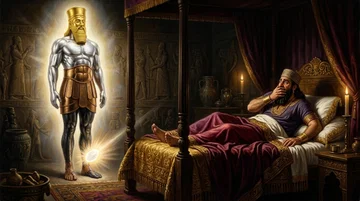
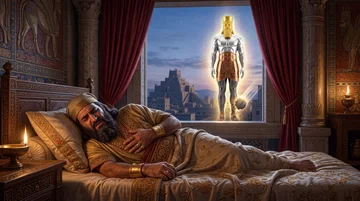
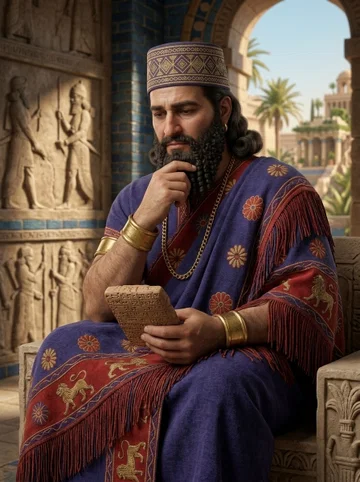
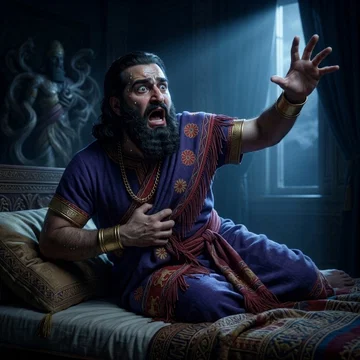
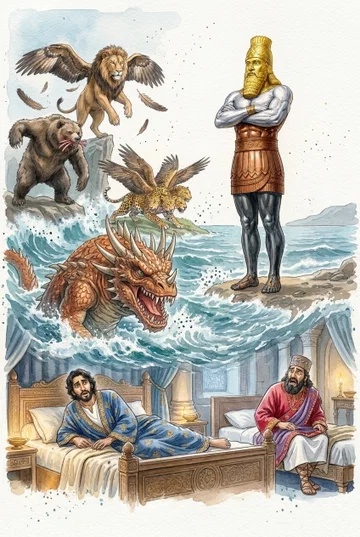
And in the second year of the reign of Nebuchadnezzar Nebuchadnezzar dreamed dreams, wherewith his spirit was troubled, and his sleep brake from him.
Translations
And in the second year of the reign of Nebuchadnezzar Nebuchadnezzar dreamed dreams, with which his spirit was troubled, and his sleep broke from him.
And in the second year of the reign of Nebuchadnezzar Nebuchadnezzar dreamed dreams, wherewith his spirit was troubled, and his sleep brake from him.
And in the second year of the reign of Nebuchadnezzar, Nebuchadnezzar dreamed dreams, wherewith his spirit was troubled, and his sleep brake from him.
And in the second year of the reign of Nebuchadnezzar, Nebuchadnezzar dreamed dreams, with which his spirit was troubled, and his sleep broke from him.
And in the second year of the reign of Nebuchadnezzar Nebuchadnezzar dreamed dreams; and his spirit was troubled, and his sleep brake from him.
And in the second year of the reign of Nebuchadnezzar, Nebuchadnezzar dreamed dreams; and his spirit was troubled, and his sleep went from him.
And in the second year of the reign of Nebuchadnezzar, dreamed hath Nebuchadnezzar dreams, and his spirit doth move itself, and his sleep hath been against him;
And in the second year of the reign of Nebuchadnezzar, Nebuchadnezzar dreamed dreams, and his spirit was troubled, and his sleep went from him.
And, in the second year of the reign of Nebuchadnezzar, Nebuchadnezzar dreamed dreams,—and his spirit, was troubled, and, his sleep, had gone from him.
Berean Standard Bible, Majority Standard Bible
In the second year of his reign, Nebuchadnezzar had dreams that troubled his spirit, and sleep escaped him.
In the second year of the reign of Nebuchadnezzar, Nebuchadnezzar dreamed dreams; and his spirit was troubled, and his sleep went from him.
In the second year of the rule of Nebuchadnezzar, Nebuchadnezzar had dreams; and his spirit was troubled and his sleep went from him.
And in the seconde yeere of the raygne of Nebuchad-nezzar, Nebuchad-nezzar dreamed dreames wherewith his spirite was troubled, and his sleepe was vpon him.
Douay-Rheims (Challoner revision)
In the second year of the reign of Nabuchodonosor, Nabuchodonosor had a dream, and his spirit was terrified, and his dream went out of his mind.
Pictures
Cross-references 20 of 43
- Daniel 2:31-45
Thou, O king, sawest, and behold a great image. This great image, whose brightness was excellent, stood before thee; and the form thereof was terrible.
Daniel interprets the dream as outlining successive kingdoms and God’s enduring kingdom.
- Daniel 7
In the first year of Belshazzar king of Babylon Daniel had a dream and visions of his head upon his bed: then he wrote the dream, and told the sum of the matters.
Both visions portray successive world empires and the everlasting kingdom of God.
- Daniel 2:44-45
And in the days of these kings shall the God of heaven set up a kingdom, which shall never be destroyed: and the kingdom shall not be left to other people, but it shall break in pieces and consume all these kingdoms, and it shall stand for ever.
The dream’s stone represents God’s future, literal kingdom.
- Daniel 2:28
But there is a God in heaven that revealeth secrets, and maketh known to the king Nebuchadnezzar what shall be in the latter days. Thy dream, and the visions of thy head upon thy bed, are these;
Explains that the dream reveals what will happen in the latter days.
- Daniel 2:38
And wheresoever the children of men dwell, the beasts of the field and the fowls of the heaven hath he given into thine hand, and hath made thee ruler over them all. Thou art this head of gold.
Identifies Nebuchadnezzar and Babylon as the image’s head of gold.
- Daniel 4:10-17
Thus were the visions of mine head in my bed; I saw, and behold a tree in the midst of the earth, and the height thereof was great.
Another royal dream receives an interpretation, and its judgment humbles Nebuchadnezzar before God.
- Daniel 2:19
Then was the secret revealed unto Daniel in a night vision. Then Daniel blessed the God of heaven.
Daniel receives the dream’s contents in a night vision.
- Daniel 2:29
As for thee, O king, thy thoughts came into thy mind upon thy bed, what should come to pass hereafter: and he that revealeth secrets maketh known to thee what shall come to pass.
God reveals what will happen in the future, answering the king’s thoughts.
- Daniel 2:47
The king answered unto Daniel, and said, Of a truth it is, that your God is a God of gods, and a Lord of kings, and a revealer of secrets, seeing thou couldest reveal this secret.
The dream’s interpretation leads the king to acknowledge God as revealer of secrets.
- Daniel 3:1-7
Nebuchadnezzar the king made an image of gold, whose height was threescore cubits, and the breadth thereof six cubits: he set it up in the plain of Dura, in the province of Babylon.
Nebuchadnezzar’s all-gold image defies the mixed-metal kingdom foretold in his dream.
- Daniel 2:10-11
The Chaldeans answered before the king, and said, There is not a man upon the earth that can shew the king’s matter: therefore there is no king, lord, nor ruler, that asked such things at any magician, or astrologer, or Chaldean.
The Chaldeans admit that no human can reveal the dream’s meaning; only the gods can.
- Daniel 1:17
As for these four children, God gave them knowledge and skill in all learning and wisdom: and Daniel had understanding in all visions and dreams.
God gives Daniel understanding of visions and dreams before Nebuchadnezzar’s dream.
- Daniel 7:1
In the first year of Belshazzar king of Babylon Daniel had a dream and visions of his head upon his bed: then he wrote the dream, and told the sum of the matters.
Daniel’s vision parallels the dream in Daniel 2 as prophecy about successive empires.
- Daniel 2:39-43
And after thee shall arise another kingdom inferior to thee, and another third kingdom of brass, which shall bear rule over all the earth.
The dream’s image foretells successive kingdoms and the divided fourth kingdom.
- Daniel 2:31-33
Thou, O king, sawest, and behold a great image. This great image, whose brightness was excellent, stood before thee; and the form thereof was terrible.
Describes the great image seen in the king’s dream.
- Genesis 41:1-32
And it came to pass at the end of two full years, that Pharaoh dreamed: and, behold, he stood by the river.
Pharaoh’s dream is another example of revelation through a dream and figures.
- Daniel 1:1-2
In the third year of the reign of Jehoiakim king of Judah came Nebuchadnezzar king of Babylon unto Jerusalem, and besieged it.
Dates Jerusalem’s capture three years before the dream and records the taking of captives and temple vessels.
- Daniel 7:17-18
These great beasts, which are four, are four kings, which shall arise out of the earth.
The four beasts represent Daniel 2’s kingdoms, and the saints receive the everlasting kingdom.
- Daniel 2:16-18
Then Daniel went in, and desired of the king that he would give him time, and that he would shew the king the interpretation.
Daniel receives time to seek the interpretation and prays with his companions.
- Daniel 2:34
Thou sawest till that a stone was cut out without hands, which smote the image upon his feet that were of iron and clay, and brake them to pieces.
The stone smites the image’s feet in Daniel’s prophecy.
Commentary part 1 of 2
Each commentary is drawn from primary sources: the writings of Ellen G. White and Adventist pioneers and periodicals. Each commentary is separate. Its own words are not a quotation; follow the references to read the source passages.
Ellen G. White
19 sources
In the second year of his reign as king of Babylon, soon after Daniel and his companions entered his service, Nebuchadnezzar dreamed dreams that troubled his spirit and broke his sleep, leaving a fearful impression while he could not recall the details or the meaning when he awoke.FE 410.1–411.1STE 13.2Ms 85, 1910, par. 41–44PK 491.1Ms 110, 1904, par. 48–49 From his throne he demanded that his counselors and wise men both relate the forgotten dream and give its meaning, and when they declared it unreasonable and failed, he in fury decreed that all the wise men of Babylon should be put to death.STE 13.2Ms 85, 1910, par. 41–44PK 491PK 491.2–3Ms 110, 1904, par. 48–49 Daniel sought time from the king and with his three companions pleaded on bended knees for wisdom from heaven, and God gave His servants the secret in a night vision, so Daniel could rehearse the dream with its interpretation and the lives of the wise men were spared.Ms 85, 1910, par. 41–44Ms 110, 1904, par. 48–49RH Nov 10, 1904 God deliberately caused the details to be forgotten while leaving the impression, so the wise men could not place a false interpretation upon it and their failure exposed the limits of human wisdom and false claims to understand mysteries.Ms 110, 1904, par. 48–49BS 29.2–3FE 412.1 The dream revealed important historic events and the succession of kingdoms in the latter days, beginning a prophecy that foretells history with remarkable exactness and proves the inspiration of the Scriptures, and contrary to popular belief it can be understood even by children.FE 410.1–411.1GC88 364.2GC 364.2–3Ms 110, 1904, par. 48–49FE 412.1
Dream's Setting and Sequence
In the second year of his reign as king of Babylon, and in the same year and soon after Daniel and his companions entered the king's service, Nebuchadnezzar dreamed dreams.STE 13.2PK 491.1Ms 110, 1904, par. 48–49 The dream was remarkable.PK 491.1Ms 110, 1904, par. 48–49 It troubled his spirit and broke his sleep.STE 13.2Ms 85, 1910, par. 41–44PK 491.1PK 491PK 491.2–3
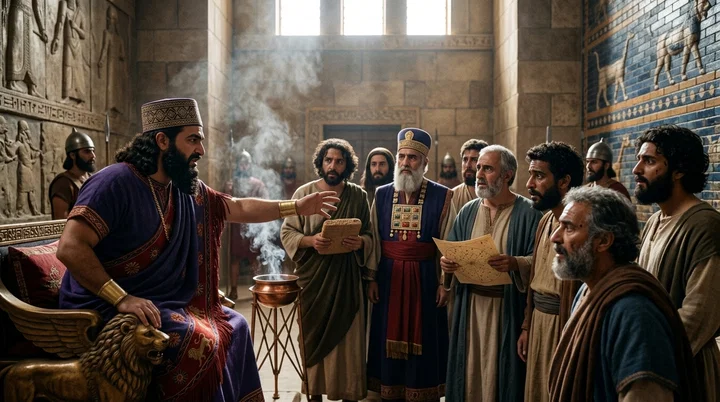
When he awoke he could not bring it to remembrance or recall its details or its meaning, though his mind remained deeply impressed by its fearful impression.FE 410.1–411.1STE 13.2PK 491.1Ms 110, 1904, par. 48–49 From his elevated ornate throne in his grand Babylonian palace, with his robed counselors and wise men gathered and listening before him, he declared the trouble to them.PK 491 In his perplexity he sought relief by asking them to reveal the dream and its meaning.PK 491PK 491.2–3
He demanded not only the interpretation but the relation of the forgotten dream itself, to be accepted as proof of the claims of the magicians and astrologers.STE 13.2Lt 90, 1894, par. 2–4 They declared the request unreasonable and beyond anything ever required of any man, and failed to tell both the dream and its interpretation.STE 13.2Ms 110, 1904, par. 48–49Lt 90, 1894, par. 2–4 In fury at their failure he decreed and threatened that all the wise men of Babylon should be put to death.Ms 85, 1910, par. 41–44Ms 110, 1904, par. 48–49RH Nov 10, 1904Lt 151, 1904, par. 3–5Lt 90, 1894, par. 2–4
Daniel and his fellows shared that fate, as being numbered with the wise men.Lt 90, 1894, par. 2–4 Daniel, gifted with understanding in visions and dreams, sought an interview with the king and pleaded for time to bring the matter before God.Ms 110, 1904, par. 48–49Lt 90, 1894, par. 2–4 When it was granted he laid the whole matter before his three companions who worshipped the true God.Ms 110, 1904, par. 48–49Lt 90, 1894, par. 2–4
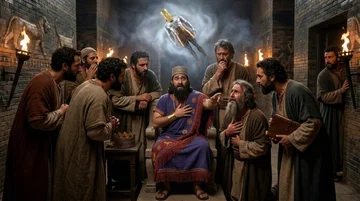
Together on bended knees with contrition of heart they pleaded for light and power and wisdom from heaven, that God would give them the power and wisdom that alone would avail them and so arrange matters that they need not perish with the rest of the wise men of Babylon.Ms 110, 1904, par. 48–49RH Nov 10, 1904Lt 90, 1894, par. 2–4 God gave His servants the secret in a night vision through an angel in answer to prayer.Ms 85, 1910, par. 41–44Ms 110, 1904, par. 48–49RH Nov 10, 1904Ms 71, 1910, par. 5–6 Thus enabled, Daniel made the dream known to the king and rehearsed it with its interpretation and explained its meaning.Ms 110, 1904, par. 48–49RH Nov 10, 1904CTBH 20.1–21.2 So the edict was revoked, the wise men's lives were spared, and the God of heaven was revealed to Nebuchadnezzar as all-powerful.Ms 85, 1910, par. 41–44Ms 110, 1904, par. 48–49
Divine Purpose and Prophecy
God deliberately caused the details of the dream to be forgotten and withheld them while leaving its fearful impression upon the king, so that the wise men of Babylon with their claimed understanding of mysteries could not place a false interpretation upon it.BS 29.2–3FE 412.1STE 15.2ST Oct 19, 1882 Their complete failure to tell both the forgotten dream and its meaning exposed their hypocrisy and false claims.Ms 110, 1904, par. 48–49BS 29.2–3ST Oct 19, 1882 That exposure showed the limits of human and scientific wisdom.Ms 110, 1904, par. 48–49Lt 151, 1904, par. 3–5
The dream concerned important historic events of consequence to the king, given to reveal what would happen in the latter days.FE 412.1STE 15.2ST Oct 19, 1882 It concerned the succession of kingdoms and their declining value as the end approached, and the lessons taught in it were given by God for those who live in the present day.FE 412.1Ms 163, 1898, par. 5–11 Its interpretation revealed heavenly glory to the Hebrew captives who depended on God rather than to those captivated by Babylon's splendor, showing the superior wisdom of those who worship Him.Lt 151, 1904, par. 3–5 The king's perplexity led him to need help from people connected with God, whom God's providence brought before him.Ms 110, 1904, par. 48–49Ms 163, 1898, par. 5–11
This verse begins a most interesting and important history and introduces the prophecy of the second chapter of Daniel.FE 410.1–411.1GC88 364.2GC 364.2–3 That prophecy foretells history with remarkable and wonderful exactness as confirmed and recorded by historians and history.GC88 364.2GC 364.2–3 That exact fulfillment gives evidence of and proves the inspiration of the Scriptures.GC88 364.2GC 364.2–3 It anchors faith amid rationalism, skepticism, and peril, and shows that the coming of the Lord is at hand.GC 364.2–3
Contrary to the popular belief that the prophecies of Daniel are mysteries that cannot be understood, this prophecy can be understood and explained even by children and thereby bring its solemn importance before parents and others.GC 364.2–3 The inability of the wise men to tell the dream represents learned people of the present day who have no discernment and learning and wisdom and knowledge from the Most High and therefore cannot understand prophecy.FE 412.1STE 15.2 Even great and learned men of the earth, kings and nobles, though the truth unto eternal life is brought to them, will not be the ones to receive it.FE 412.1 Learning worldly knowledge without watching to hear what God says in His word and opening hearts to receive that word and give it to others does not make them His representatives.FE 412.1STE 15.2
Sources
Pioneers and periodicals
238 sources
In his second year Nebuchadnezzar dreamed dreams that troubled his spirit and broke his sleep so that he could not sleep and called for his wise men.RH Jun 25, 1908 The second year is by Chaldean reckoning, the fourth by Jewish reckoning, because he reigned two years jointly with his father and the Jews counted from the joint reign while the Chaldeans counted only from his sole reign.RH Jan 19, 1869ST Feb 1, 1877ST Dec 2, 1897 He had gone to bed wondering whether Babylon would endure after him and what should come afterward, and God used that desire to give an outline of leading nations to the close of time.RH May 21, 1901ST Oct 11, 1905 The dream held a great image of gold, silver, brass, and iron with divided iron-and-clay feet, portraying four universal kingdoms in succession — Babylon, Medo-Persia, Greece, and Rome with divided Rome — followed by God's everlasting kingdom.ST Sep 12, 1916ST Jun 22, 1915 Its purpose was to reveal through Daniel what would happen in the latter days, a fundamental prophecy whose exact fulfillment proves inspiration and certainty of the still-unfulfilled stone cut without hands destroying all earthly kingdoms and filling the whole earth forever.RH Jan 20, 1853ST Jul 14, 1887ST Feb 15, 1883
Time and Historical Setting
The second year in the verse is counted by Chaldean reckoning, which is the fourth year by Jewish reckoning, because Nebuchadnezzar reigned two years jointly with his father Nabopolassar, the Jews counting from the beginning of the joint reign while the Chaldeans counted only from his sole reign after his father's death.RH Jan 19, 1869ST Feb 1, 1877ST Dec 2, 1897ST Jul 28, 1881 The events fall in the second year of his sole reign after those two years of joint rule with his father.ST Jan 11, 1916 He was an empire-builder who thought of posterity and believed in Babylon's gods, and because he believed in the supernatural God gave him a dream that deeply troubled him and broke his sleep as he pondered its meaning. Daniel had been carried captive in the first year of Nebuchadnezzar and was placed for three years under instructors, during which he was not reckoned among the wise men of the kingdom nor took part in public affairs, so the dream came in the very next year after his preparation was completed, when providence brought him into sudden and wonderful notoriety throughout all the kingdom.RH Jan 19, 1869ST Feb 1, 1877ST Jul 28, 1881 He interpreted it after completing three years of training in the palace school.ST Jan 11, 1916
Daniel was taken with Hananiah, Mishael and Azariah when Nebuchadnezzar attacked Jerusalem in the first year of the joint reign and carried temple vessels and captives to Babylon, they being still young men when the dream occurred, and only after they had completed three years of schooling did they become counted among Babylon's wise men.ST Dec 2, 1897RH Jun 25, 1908 That conquest and beginning of the seventy years of Babylonian captivity is dated to 606 B.C., so because Daniel and his companions underwent three years of training after Jerusalem's conquest the dream falls at least three years after that conquest.RH May 28, 1908 During his reign Jerusalem was taken, the temple vessels were carried to Babylon, and the predicted seventy-year captivity began, with Nebuchadnezzar as head of gold used to carry out God's purpose.RH May 18, 1876 The opening chapters belong to the account of Judah's captivity and the experiences of Daniel and his companions in Babylon.RH Aug 5, 1902 Consulting specialists to tell and interpret the troubling dream that broke sleep was in keeping with the importance Babylonians attached to dreams and their reliance on interpreters, even when interpretations seemed contrary to reason or law.RH Jun 25, 1908
The dream was given in B.C. 603, placed by another reckoning at about 604 B.C., when the kingdom of Babylon stood at the summit of its greatness and glory and at the height of its power.ST May 29, 1884ST Apr 30, 1894ST Apr 2, 1894 It came after Babylon had completed the conquest of the known world by the sack of Jerusalem as the mightiest empire since Nineveh, and the vision was given in 603 B.C. for the immediate benefit of Nebuchadnezzar king of Babylon.ST Jun 30, 1914ST Jul 6, 1915 Nebuchadnezzar had been anxiously looking into the future and pondering on his royal bed what should come to pass thereafter, whether Babylon would endure or be conquered and what kingdom would follow, and God did not rebuke that inquiry but granted to the king, and through him to the world, the information sought. Under the symbol of a great image God presented world history from that time on, beginning the prophetic period of the image that runs 1086 years from B.C. 603 to A.D. 483 when Rome was divided into ten kingdoms, the image having to be complete including the feet before the stone smites all parts together.ST May 29, 1884
In prophetic reckoning Babylon is dated from 677 B.C. when it became connected with God's people and the Jews became tributary to it, although it existed as a distinct empire from 747 B.C. and earlier as part of the Assyrian empire.RH Apr 22, 1862RH Apr 22, 1862 The verse marks the time when Babylon is first noticed in prophecy, more than fifteen hundred years after Nimrod founded Assyria, when Nebuchadnezzar held universal empire and God was using him to punish rebellious Judah as they entered seventy years of captivity.RH Mar 12, 1857 Nations are noted in prophecy only when connected with God's people, and the announcement that Babylon is the head of gold begins four successive universal kingdoms each holding jurisdiction over God's people, with three kingdoms to succeed Babylon.RH Mar 12, 1857 Babylon is also called the Chaldean empire after its country and the Babylonish empire after its capital, brought to prosperity under Nebuchadnezzar as the first universal empire and head of gold.RH Jul 28, 1874 The passage traces its extent and fall to the Medes and Persians, then Greece's conquest under Alexander and division among his generals, with brass as Grecia succeeding Persia in world dominion in B.C. 331, the same as the goat of Daniel 8 and leopard of Daniel 7, then Rome succeeding Greece after conquering it in 168 B.C. and devouring the whole earth before division into lesser European kingdoms, whose later divisions have no reference to the United States.RH Jul 28, 1874ST Jul 15, 1913RH Dec 17, 1857RH Jun 6, 1912
The verse belongs to the Hebrew introduction before the change to Aramaic at Daniel 2:4, Hebrew being natural for beginning the narrative in the native language for the common people in captivity, while court speeches and proceedings from Daniel 2:4 through Daniel 7 are in Chaldee as the language of the court understood generally.RH Nov 25, 1873 The Chaldee is continued through Daniel 7 because its subject is greatly similar to Daniel 2, before Hebrew is resumed with Daniel's personal introduction in Daniel 8 concerning restoration and God's future dealings.RH Nov 25, 1873 Unlike Daniel 8 which begins with Media and Persia, the visions of Daniel 2 and Daniel 7 begin with Babylon before their rise.RH Apr 30, 1857RH Nov 21, 1854RH Dec 23, 1852 The verse places the dream in the second year of the reign during the captivity and supplies the historical setting for the succession of Gentile kingdoms from Babylon onward to the end of time, beginning the account of the great image and its interpretation in which God showed the course of empire until the scepter passes to Christ.RH Dec 18, 1855RH May 30, 1854RH Nov 6, 1860RH Sep 10, 1901 It marks the first of Daniel's great prophetic lines, given nearly seventy years before his final vision, associated with Nebuchadnezzar's reign and the time of the great monarchies that existed during Daniel's life.ST Apr 9, 1912
Dream and Troubled King
In the second year of his reign Nebuchadnezzar dreamed dreams that troubled his spirit and broke his sleep so that he could not sleep, and in that distress he commanded the magicians, astrologers, sorcerers and Chaldeans to be called.RH Jun 25, 1908RH Nov 3, 1910ST Jan 8, 1880 The dream was given by God and divinely interpreted, worthy of careful study, beginning a prophecy represented by a great image whose head of gold is explained through the history of that time.RH Nov 3, 1910ST Jan 8, 1880 It was repeated and left him so deeply troubled that he could no longer sleep or dream, a startling dream that kept him from sleeping.RH Mar 13, 1900ST Dec 23, 1903 The king demanded that his wise men reveal both the dream and its interpretation, but they could do neither, and God revealed them to Daniel, who credited the God in heaven with revealing secrets and possessing wisdom and might.RH Nov 3, 1910
The plural dreams alongside the later demand to explain one dream indicates that the same dream recurred several times.ST Jan 6, 1909 It was given such force in the king's mind that he could not forget having dreamed it, deeply impressing him until sleep left him so he could dream no more.RH Mar 13, 1900ST Dec 23, 1903RH Mar 13, 1900 It was repeated and left him sorrowful and unable to dream again, leaving a strong impression while its meaning was hidden from him.RH Mar 13, 1900RH Mar 13, 1900RH Mar 13, 1900 The same dream was also hidden from his wise men, exposing their inability to reveal secret things and showing that genuine wisdom comes from God, with the king's distress also presented as God turning his heart in response to the prayers of His people.ST Jan 6, 1909RH Mar 13, 1900
Going to bed he had been thinking whether Babylon would endure or be conquered in turn after reflecting on the rise and fall of earlier empires, whether a new kingdom would rise after his own, what should come afterward, and whether his empire would endure after his death.RH May 21, 1901 God used that desire to know the future to permit an outline of leading nations to the close of time, giving the dream in answer to his desire to know what would happen afterward.ST Oct 11, 1905ST Oct 13, 1909 When Babylon stood at the summit of its greatness and glory in B.C. 603, Nebuchadnezzar had been anxiously looking into the future and pondering what should come to pass thereafter, and God did not rebuke that inquiry but granted to the king, and through him to the world, the information he sought. Under the symbol of a great image God presented the history of the world from that time on, with Babylon as the head of gold, followed by Media and Persia, Grecia, Rome, the division of Rome, and finally the everlasting kingdom of God that destroys all earthly kingdoms. The dream answered his desire to know what would follow his reign and revealed the future course of earthly empires.ST Apr 9, 1896
In the morning he had forgotten all about what he had seen, utterly unable to recall thoughts, images or a single feature, though its importance remained impressed on his mind and made a deep impression.RH May 21, 1901ST Apr 9, 1896RH Jun 25, 1908 This troubled him because he wanted to know it, and what troubled his spirit was that he could not recall what he had dreamed.RH Jun 25, 1908ST Aug 20, 1885 Its loss served God's purpose of turning him from idolatry to Jehovah and bringing the matter to Daniel, and the dream was given to reveal what would happen in the latter days.ST Oct 19, 1882ST Apr 9, 1896 None of Babylon's wise men could bring the dream back to his mind, and only Daniel could because it was shown to him in a night vision, so that when Daniel related it the description was so accurate that Nebuchadnezzar immediately recognized it fully.ST Aug 20, 1885 His demand that the wise men recover the dream as well as interpret it tested their claims to reveal hidden things and exposed their false claims, since human reasoning depends on information supplied to it while the dream's meaning required revelation beyond mortal knowledge.ST Oct 19, 1882RH Jun 25, 1908
His sleep broken by a dream given by the Lord contrasts with Jeremiah's consolatory dream after which sleep was sweet and refreshing.RH Mar 10, 1868 The verse is used as the comparison for a forgotten dream gone from memory while its vivid impression remained.RH Jun 11, 1901
The verse introduces a troubling dream breaking sleep and given as prophetic revelation outlining world governments from Babylon to the establishment of Christ's kingdom, representing the course of empires from his time to the end of the world.ST Jan 20, 1898ST Jan 28, 1886ST Nov 24, 1909 It opens a view of future world history and forms the setting for the prophecy of the image and its later symbols, including Rome and the divided kingdoms represented by the feet and toes, treated as an exposition of the four kingdoms and the sanctuary and the 2300 days.RH Feb 26, 1867ST Feb 26, 1880RH Jul 2, 1867 It begins the account providentially given to the king who so urgently wanted its meaning that he summoned the Babylonian wise men to tell him what he had dreamed, and when they failed God revealed the dream and its meaning to Daniel in a night vision and Daniel made it known to the king.ST Jan 28, 1886ST Nov 24, 1909 Inability to remember made Daniel's disclosure a convincing basis for trusting the interpretation, since God revealed both the dream and its true interpretation through Daniel, who gave God the glory as the Revealer of the future.ST Oct 11, 1905ST Oct 13, 1909
The king required the wise men of Babylon not only to interpret the dream but first to tell what the dream was, and they confessed their inability to do this.ST Sep 21, 1904 Their humiliating failure left them resentful and eager to accuse the Jews.RH Apr 13, 1869 At the first time they learned to fear the king and became chary of his decrees, and the seeking was in the same manner as in Daniel 4.RH Jan 2, 1900ST Jan 16, 1912 The dream of the great image came some time before his dream of the tree in Daniel 4, and God spoke to him in a dream before the tree dream and speaks to him in a dream again.ST Sep 21, 1904ST Jan 16, 1912 When the second dream comes he tells them the dream, yet none of the magicians, enchanters, Chaldeans, or soothsayers can tell the interpretation, and after they are tried and tested Daniel, whom Nebuchadnezzar had named Belteshazzar, is brought before him.ST Jan 16, 1912 Nebuchadnezzar remembers Daniel's wisdom, calls him master of the magicians, declares that the spirit of the holy gods is in him and that no secret troubles him, and his confidence is revived as he calls him.ST Jan 16, 1912 Through a vision from God Daniel was enabled both to tell the dream and to interpret it.ST Sep 21, 1904
The verse shows Nebuchadnezzar had a most striking dream soon after Daniel's captivity began, Daniel having been taken to Babylon in the first overthrow of Jerusalem and placed with his companions under special training to become one of the wise men in the nation's council.ST Aug 22, 1900 The dream made a deep impression on the king's mind, yet in the morning he was unable to recall a single feature of it.ST Aug 22, 1900 He turned to counselors who pretended to possess power to forecast future events and give the meaning of mysterious signs and omens, reasoning that if they could tell the meaning of hard problems they could likewise tell what the problems were.ST Aug 22, 1900 To his chagrin and surprise not one dared presume to tell the subject matter of the dream, and because of this failure and the deception they had played upon him in the past he decreed that the wise men should be destroyed.ST Aug 22, 1900
Divine Purpose in Giving Dream
The circumstances draw attention because the purpose was to reveal through Daniel what would happen in the latter days, as Daniel 2:28-29 explains that God makes known secrets and what shall be in the latter days.ST Jul 14, 1887ST Feb 15, 1883ST May 21, 1902 The message is therefore relevant to later generations and not to the king alone, though Nebuchadnezzar himself is included in the image so that not all represented need occur in the latter days.ST Jul 14, 1887ST Oct 11, 1883RH Jun 8, 1911 It forms a fundamental prophecy whose authoritative interpretation confirms God's word, tracing in outline the history of nations as they successively rise and fall until the final change when God establishes the kingdom of Christ.ST May 21, 1902 Step by step the centuries have chronicled its fulfilment, with Babylon, Medo-Persia, Grecia and Rome arising and being overthrown, and the whole prophecy is focused upon that last enduring kingdom lost in the splendor of its introduction by the coming of its King with His Father's glory attended by the shining host.ST May 21, 1902RH Jun 8, 1911
The dream contained a great image and a stone that struck it, destroyed it, and grew to fill the earth.ST Jun 29, 1882ST May 21, 1902 It was given to the king for his instruction and for the benefit of God's people and all rulers and subjects, a world-prophecy extending through the kingdoms of men to God's everlasting kingdom, divinely interpreted and worthy of careful study.RH Nov 3, 1910ST May 8, 1907 It is the most condensed and comprehensive outline of the world's history ever written, tracing the succession of the four perishable world kingdoms from Babylon to God's eternal kingdom.ST Apr 9, 1912ST May 27, 1913 It is remarkably clear in answering what the world, nations and individuals are coming to, briefly outlining history from Nebuchadnezzar whose exact fulfilment proves inspiration and the certainty of the unfulfilled portion, adapted even to the Oriental mind for Mohammedans and Christians in Turkish with Arabic characters and in Arabic.RH Nov 3, 1910ST May 27, 1913
The dreams were sent by the Lord to turn Nebuchadnezzar's attention to God, who had given him power over the nations.ST Aug 3, 1904 He had been made guardian of Judah's people after their apostasy left them unfit to govern independently, and even while chastening His people the Lord remained active on their behalf.ST Aug 3, 1904 The dream was given to teach that the Most High rules in the kingdom of men and gives it to whomever He will, but that lesson was not fully learned.ST Sep 21, 1904 God can send a dream to a heathen king, and indeed the first prophetic dream was given to Nebuchadnezzar, a heathen idolatrous king, not to a Jewish believer, in a form suited to impress him, dealing with metals introductory to Daniel's later vision.ST Nov 28, 1895RH Jan 16, 1900 The record correctly recounts his experience and is inspired, though Nebuchadnezzar himself was not inspired.ST Jul 16, 1912
The chapter gives a remarkable and graphic illustration that God reveals future events of this world's history, and this revealing seals the prophecy with divinity and infallibility.ST May 27, 1913 Jesus Christ gave this prophecy through His Spirit in the prophets, not by the will of man but as holy men spoke moved by the Holy Ghost, and all are commanded to read and understand it.ST May 27, 1913 He is the Revealer able to reveal what is hidden, interested in all the affairs of men as well as nations, with a message for the last days as truly as for that time, and He is still the Revealer today.ST Aug 9, 1910ST Oct 2, 1901ST Aug 9, 1910 He is close to humanity and knows people's thoughts from afar, the dream being given by God and then withheld from the king to create opportunity for that revelation.RH Aug 5, 1902 Human wisdom cannot provide true knowledge or reveal the future, but true knowledge comes from God, whose Spirit takes the mind in sleep to show unknown things for personal benefit or for instruction to others.ST Oct 21, 1908
The account is symbolic prophecy contained in symbols rather than verbal prediction expressed directly in words, the great image being given through a dream.RH Jun 12, 1855RH Apr 23, 1867 This proves that God sometimes teaches His servants in dreams.RH Apr 21, 1851 God revealed things to come by vision in figures and parables, oftentimes revealed again and again by different visions or in different figures and parables, as in Daniel 7 and Daniel 8, after the pattern of Pharaoh's doubled dream in Genesis 41 and Peter's repeated vision in Acts 10, so that to understand them all the visions must be combined into one.RH Feb 18, 1873RH Mar 31, 1868 Unlike Daniel 11, which is presented mostly in plain literal language, this is symbolic prophecy, yet its symbols represent a literal future kingdom to be set up.RH Dec 28, 1911
The dream is one of three lessons exposing false claims, revealing the true God, and teaching heaven's kingdom superior to earthly governments, the first of three experiences Daniel and his companions met through faithfulness and wisdom.RH Nov 3, 1910ST Oct 11, 1905 God used the king's desire to know what would happen afterward, troubling him so he demanded both dream and interpretation from his wise men who could do neither, and then revealed both to Daniel who credited the God in heaven with wisdom and might and gave God the glory.RH Nov 3, 1910ST May 8, 1907ST Oct 11, 1905ST Oct 13, 1909 God revealed the dream and its meaning to Daniel and his companions through fasting and earnest prayer, bringing joy, sparing the wise men, and making them unwilling afterward to bow to the golden image.ST Jan 8, 1880 It first began working on Nebuchadnezzar's heart by confounding his wise men so that he acknowledged God as revealer of secrets, but pride kept him from submitting and he gave idolatrous honor to Daniel, a difficulty God permitted to honor His name through human instrument overcoming the impossible.RH Nov 3, 1910ST Oct 11, 1905
God gave Nebuchadnezzar the dream and gave Daniel its interpretation to preach the gospel of the kingdom in Babylon in a way that would make an impression on that idolatrous nation.RH Aug 26, 1902 Nebuchadnezzar and his subjects did not believe the inspired writings of the law and the prophets and the psalms, so it would have been useless to read to them from the sacred rolls even if the captives had brought them from Jerusalem.RH Aug 26, 1902 The truth of the gospel had to be revealed as fact and not merely talked about, by a living epistle and a living sermon, Christ revealed as proof of His existence by actual revelation of His presence and actual experience in seeing and dealing with the invisible, establishing real fellowship and real union between God and man.RH Aug 26, 1902 Nebuchadnezzar longing to know truth received it through the revelation, and the truth given to him was to reach all nations, illustrating how rulers outside Israel could receive God's truth and become His servants spreading it among the peoples they ruled, made known through Gentile kings when Israel failed to carry the gospel to the nations.RH Nov 11, 1902RH Feb 13, 1900 God used the dream as a means to raise Daniel, a captive servant by providence, to a position where he could help others sharing his troubles, and this vision also served as a warning for rulers who came after him, so that ignoring divine warnings is folly.ST Jan 21, 1889ST Nov 28, 1900 It opens the revelation of the world's history showing the unity of the divine plan and the continuity of God's purpose through all ages toward one end, the setting up of the everlasting kingdom which is the restoration of the dominion lost in Adam and the restoration of the first dominion, given not for that king alone but for later kingdoms, states and individuals, whose faithfulness is an example for workers in the closing days.RH Nov 11, 1902ST Nov 7, 1892
Four Kingdoms in Succession
The dream opens the prophecy of successive universal earthly rule, beginning with Babylon as head of gold, followed by Medo-Persia as breast and arms of silver, Greece as belly and sides or thighs of brass, and Rome as legs of iron, then divided Rome as feet and toes of iron mixed with clay, and finally God's everlasting kingdom.ST Sep 12, 1916ST Jun 22, 1915RH Jan 20, 1853RH Nov 19, 1857 The image represents empires and kingdoms of the world through the end of time, the leading nations from Nebuchadnezzar onward, with four perishable kingdoms and one immortal, five universal kingdoms counting the divided phase.ST Sep 12, 1916RH Jan 20, 1853RH Nov 19, 1857ST Jun 23, 1914 Rome was the last world-wide kingdom, broken into numerous smaller kingdoms continuing divided until Christ comes in person to overthrow all and establish everlasting reign, with no later nation to rule the whole world.ST Sep 12, 1916ST Jun 22, 1915RH Jan 20, 1853ST Jun 23, 1914 Babylon has long passed away, Medo-Persia is past, Grecia is past, undivided Rome is past, and the ten toes have continued almost fourteen hundred years to the present, so the next event is the stone smiting the feet and setting up God's kingdom.ST Jun 22, 1915RH Jan 20, 1853ST Jun 23, 1914
The head of gold is Nebuchadnezzar and his kingdom as the first kingdom beginning world history and the revelation of world history.ST Jan 8, 1880RH Nov 19, 1857ST Jan 8, 1880 The great image represented successive earthly governments beginning with Babylon, its materials of gold, silver, brass, iron and iron mixed with clay symbolizing the kingdoms rather than its anatomical parts.ST Jan 8, 1880ST Jan 8, 1880ST Dec 29, 1909 The breast and arms of silver are Medo-Persia, inferior to Babylon in wealth, magnificence and brilliancy of career as the bear is inferior to the lion, showing marked decline and deterioration descending from one kingdom to the next.ST Sep 29, 1881 The same outline covers the same ground as the four beasts, with Babylon, Medo-Persia, Greece and Rome corresponding to lion, bear, leopard and ten-horned beast and to ram, goat and great horn, the chief metals symbolizing the autocratic Babylonian empire as the lion with eagles' wings is chief among beasts and birds.
The brass of the image is Grecia, the same power as the goat of Daniel 8 and the leopard of Daniel 7.RH Apr 30, 1857RH Nov 21, 1854 Grecia succeeded Persia in dominion of the world in B.C. 331.RH Apr 30, 1857RH Nov 21, 1854 Rome is the succeeding kingdom that follows Grecia in the parallel visions of Daniel 7 and Daniel 8.RH Apr 30, 1857RH Nov 21, 1854ST May 10, 1877
There were to be only four universal kingdoms covering world history from about 625 B.C., beginning with Babylon in Nebuchadnezzar's time, with Medo-Persia second and Grecia third, so the one universal empire found after Grecia, Rome, must be the fourth.STST Nov 19, 1885 If Rome is the fourth kingdom of Babylonian, Medo-Persian, Grecian and Roman succession, Daniel was supernaturally given insight into the future.STST Nov 19, 1885 The prophecy of the four universal monarchies has been fulfilled in history, and its outline is linked with Daniel 7 and 8 where Rome succeeds Greece as the fourth great power.ST Jul 24, 1884ST Nov 24, 1881 Its field is substantially the same as Daniel 7 and the vision where the little horn succeeds Grecia as an exceeding great power, with the fourth great power after Grecia as Rome, identified exactly as Daniel 8 is by common commentators with seventy weeks cut from the 2300 days to A.D. 33 leaving 1810 years to about 1843 corrected to autumn 1844.RH Jun 28, 1870RH Feb 25, 1873
The metals decrease in value from gold through silver, brass and iron to mingled iron and clay, illustrating humanity's gradual apostasy and decline since Eden rather than progress toward a golden age.ST Dec 3, 1912RH Aug 11, 1853ST Sep 16, 1886 Five universal kingdoms are represented, four earthly and mortal and one immortal, Babylon as gold, Persia as silver, Grecia as brass, Rome as iron, and the final divided condition before the immortal kingdom as iron mixed with miry clay, each succeeding generation degenerating physically, mentally and morally till ripe for final doom, proving conversion of the world impossible and its complete overthrow and utter destruction rather than conversion.ST Sep 16, 1886RH Nov 23, 1869RH Jan 1, 1875 Human rule apart from God passes from gold through silver, brass and iron to brittle clay, showing deterioration, changes of government and failure of earthly empires not by arbitrary decree but through weakness and corruption, destructive and unable to endure, while God's kingdom endures by righteousness.ST Dec 3, 1912ST Apr 11, 1911 Babylon's universal dominion came because God gave supremacy, not because it occupied all the earth, with the same distinction for later empires.ST Dec 3, 1912
The dream and interpretation reveal the Gospel of Christ, the power of God unto salvation, the mystery of godliness, Christ in you the hope of glory, and the working of the divine principle to establish heaven's kingdom on earth. World-kingdoms one after another and finally all together perish through rejection of that divine principle, which is God's gift of life to make men right in His sight that by sharing His righteousness they may share eternal existence, which is justification by faith set forth not abstractly but in concrete world history.RH Dec 1, 1910 The secret sought is mystery, the wonderful union of God and man, with fuller meaning in the union of divinity with humanity revealed in Jesus, and the prophecy sets out rise and fall of world kingdoms and God's eternal kingdom established in hearts through indwelling presence. Advancing world history is conflict between two opposing principles calling for choice, Babylonian principles of putting humanity in God's place, altering His ways, claiming authority and rebelling continuing through later kingdoms until destroyed, against God's secret made known, while a human kingdom not founded on righteousness comes to nothing.ST Aug 13, 1902ST Dec 1, 1914
Nebuchadnezzar, a type of all worldly patriotic rulers, believed his empire should stand forever and imaged forth his idea in a figure all of gold.ST Dec 3, 1912ST Oct 11, 1905 The image of gold in Daniel 3 shows his attempt through patriotism and human power to resist prophecy and make Babylon everlasting.ST Dec 3, 1912ST Oct 11, 1905 Earthly empires perish through weakness and corruption but God's kingdom endures by righteousness, and in its final phase earthly empire shares Babylon's spirit and methods.ST Dec 3, 1912
The outline includes Rome divided into ten parts followed by the Papacy and its period of great authority from 538 to 1798.RH Nov 24, 1910RH Sep 8, 1874 God's kingdom is the same as the kingdom of the Most High in Daniel 7, not taking the place of Rome at once but only after Rome is divided into ten horns and after the papal power has risen, ruled and been ruined.RH Sep 8, 1874RH Sep 8, 1874 The dashing by the stone cut without hands was not done by the gospel at the first advent, for the gospel does not subvert earthly governments, but when God's kingdom takes their place under the seventh trumpet, covering the same ground as Daniel 7 where the fourth beast Rome is followed by ten kingdoms and the papal little horn thinking to change law and wearing saints before destruction by Christ's coming and the kingdom given to saints.RH Sep 8, 1874RH Sep 8, 1874 The consecutive line describes Babylon, Persia, Grecia and Rome including the papacy, its rise, work, duration, deadly wound and decay of civil power, with only the dashing of nations and destruction of papal power by Christ's brightness yet unfulfilled, showing the last days reached.RH Nov 4, 1873 Rome is shown as one single power with no distinction between pagan and papal, both periods included together unlike other prophecies where the distinction is marked, paganism prevailing under Medo-Persian, Grecian and early Roman rule. The breakup of the Western empire into the same ten horns of Daniel 7 was the barbarian kingdoms formed before the sixth century, Huns, Ostrogoths, Visigoths, Franks, Vandals, Sueves and Alans, Burgundians, Heruli and Turingi, Saxons and Angles, and Lombards, which adopted Rome's faith in the sixth century and came under papal influence as paganism revived in papal form, while the image itself leaves papal history and saints' suffering to later prophecy.RH Sep 22, 1874
The symbols portray characteristics of Medo-Persia among the four monarchies of Babylon, Medo-Persia, Greece and Rome.ST Jul 15, 1913 The Chaldean empire brought to prosperity under Nebuchadnezzar was succeeded by Persia, then the Grecian or Macedonian empire erected by Alexander and continued in four divisions under successors, then Rome succeeding Greece.ST Jul 15, 1913 Rome became dominant after conquering the Grecian empire in 168 B.C., first devouring the whole earth as none before and then to be divided into lesser kingdoms, with later European nations as divisions of Rome and legs of iron traced to the Christian era with further specifications after that time.ST Jul 15, 1913RH Dec 17, 1857RH Jun 6, 1912 The iron legs symbolize pagan Rome ruling at the gospel opening when through Herod it tried to destroy the child Jesus.RH Dec 17, 1857
The verse begins the account of the troubling dream and demand upon Babylon's wise men to interpret it.ST Mar 15, 1877 The dream revealed the great image of Babylon, Medo-Persia, Greece and Rome followed by division into ten kingdoms, and the stone cut without hands destroying it as God's kingdom overthrowing earthly rule to reign in righteousness.ST Mar 15, 1877 God revealed the dream in answer to prayer, and the secret and interpretation belong to God, not to Daniel.ST Mar 15, 1877
Sources