Genesis 47:7
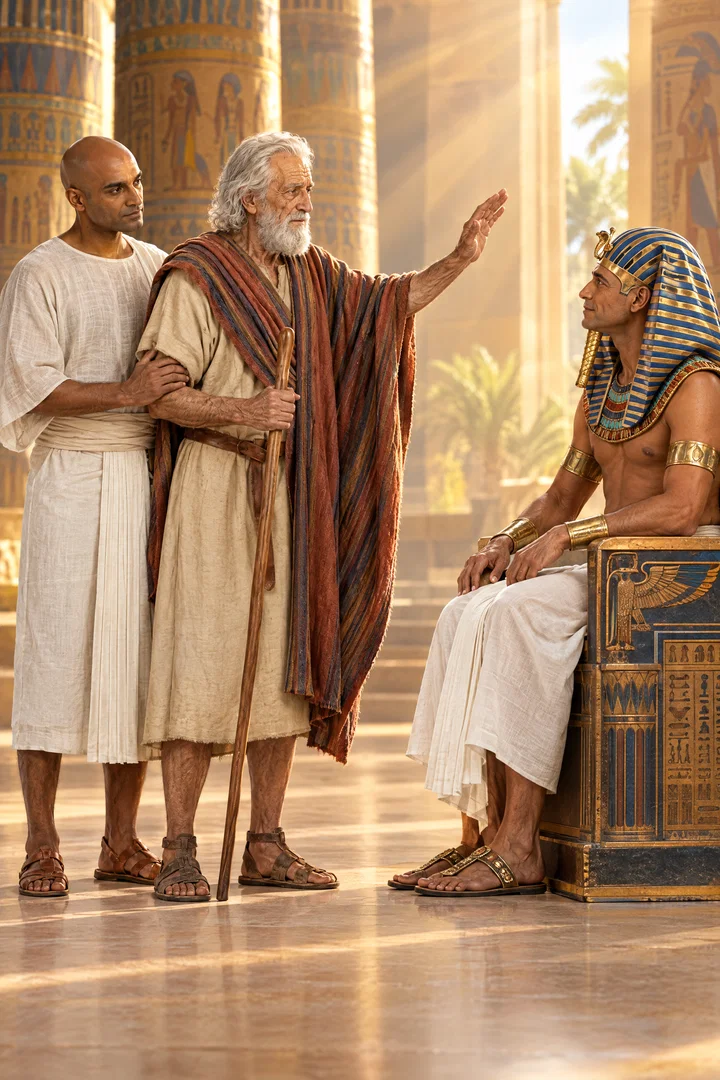
And Joseph brought in Jacob his father, and set him before Pharaoh: and Jacob blessed Pharaoh.
Translations
American King James Version, King James Version, KJV Cambridge Paragraph Bible, Webster Bible, Revised Version, American Standard Version
And Joseph brought in Jacob his father, and set him before Pharaoh: and Jacob blessed Pharaoh.
And Joseph bringeth in Jacob his father, and causeth him to stand before Pharaoh; and Jacob blesseth Pharaoh.
And Joseph brought Jacob his father, and set him before Pharaoh. And Jacob blessed Pharaoh.
So Joseph brought in Jacob his father, and caused him to stand before Pharaoh,—and Jacob blessed Pharaoh.
Berean Standard Bible, Majority Standard Bible
Then Joseph brought in his father Jacob and presented him before Pharaoh, and Jacob blessed Pharaoh.
Joseph brought in Jacob, his father, and set him before Pharaoh; and Jacob blessed Pharaoh.
Then Joseph made his father Jacob come before Pharaoh, and Jacob gave him his blessing.
Ioseph also brought Iaakob his father, and set him before Pharaoh. And Iaakob saluted Pharaoh.
Douay-Rheims (Challoner revision)
After this Joseph brought in his father to the king, and presented him before him: and he blessed him.
Pictures
Cross-references
- Hebrews 7:7
And without all contradiction the less is blessed of the better.
Jacob blesses Pharaoh, illustrating that the greater blesses the lesser.
- Genesis 41:54-56
And the seven years of dearth began to come, according as Joseph had said: and the dearth was in all lands; but in all the land of Egypt there was bread.
The famine and Egypt’s food supply bring Jacob’s family to Egypt.
- Genesis 47:2-3
And he took some of his brethren, even five men, and presented them unto Pharaoh.
same presentation of five brothers as shepherds
- Genesis 49:33
And when Jacob had made an end of commanding his sons, he gathered up his feet into the bed, and yielded up the ghost, and was gathered unto his people.
Dates Jacob’s death seventeen years after entering Egypt.
- Exodus 1:8-22
Now there arose up a new king over Egypt, which knew not Joseph.
Later Egyptian affliction contrasts with Jacob’s earlier welcome.
- Genesis 50:26
So Joseph died, being an hundred and ten years old: and they embalmed him, and he was put in a coffin in Egypt.
Dates Joseph’s death 71 years after Jacob’s entry into Egypt, before the slavery.
Commentary
Each commentary is drawn from primary sources: the writings of Ellen G. White and Adventist pioneers and periodicals. Each commentary is separate. Its own words are not a quotation; follow the references to read the source passages.
Ellen G. White
3 sources
Not long after Israel arrived in Egypt, Joseph brought his father Jacob in and presented him before Pharaoh at court.ST Feb 5, 1880PP 233.1–31SP 153.2–154.1 At that meeting Pharaoh stood as a king surrounded by royal pomp and magnificence, the proud heir of a kingly line, while Jacob stood before him as a stranger.ST Feb 5, 1880PP 233.1–3 Jacob was unawed by the display, for amid the sublime scenes of nature he had communed with a mightier Monarch.ST Feb 5, 1880PP 233.1–3
In conscious spiritual superiority he raised his hands and blessed Pharaoh, and the blessing was an expression of that standing.ST Feb 5, 1880PP 233.1–3 He came to that act after having been crippled in his struggle with the covenant Angel, where his weakness and surrender had brought him the victory of conquering faith. So it was that Pharaoh stooped to seek his blessing. The blessing was also an expression of kindness in return for Pharaoh's kindness to Joseph.1SP 153.2–154.1
In speaking with Pharaoh, Jacob called his 130 years a pilgrimage and described them as few and evil.1SP 153.2–154.1 By evil he meant that he had known much trouble and perplexity, and by few that he had not reached the years of his forefathers.1SP 153.2–154.1 His life had been troubled by jealousy in his household and grief over his children, though its final years were more peaceful.1SP 153.2–154.1
Sources
Pioneers and periodicals
8 sources
Joseph brought in Jacob his father and set him before Pharaoh for Jacob's own meeting with Pharaoh, distinct from the meeting of Joseph's brethren and following the settlement in Goshen, not long after Israel's arrival in Egypt.ST Feb 5, 1880ST Dec 1, 1898 In that meeting Jacob blessed Pharaoh, raising his hands, unawed by the pomp of royalty and the magnificence surrounding Pharaoh because amid the sublime scenes of nature he had communed with a mightier monarch.ST Feb 5, 1880 Jacob and his family came into Egypt in 1706 B.C., 215 years after Abram left his father's house, not as slaves but as welcomed guests.RH May 14, 1901RH May 14, 1901
Pharaoh set the land of Egypt before them and commanded that his father and brethren dwell in the best of the land, and Joseph placed them and gave them a possession in the best of the land in Goshen.RH May 14, 1901RH May 14, 1901 Joseph nourished his father and his brethren and all his father's household with bread as a little child is nourished through the famine, understood as the seven years of famine.RH May 14, 1901RH May 14, 1901 He did not so nourish the Egyptians, who were compelled to give money and sell cattle and stock and land and themselves to Pharaoh, were bought with their land for Pharaoh and left in slavery to him, and were made to give a fifth part of the increase.RH May 14, 1901RH May 14, 1901
Israel dwelt in Goshen, had possessions therein, and grew and multiplied exceedingly, with Jacob living in Egypt seventeen years till his death in 1689 B.C. and Joseph dying in 1635 B.C., seventy-one years after the entry, and in all that time there are no signs of slavery.RH May 14, 1901 That favored condition stands in dreadful contrast to the later time when a new king arose who knew not Joseph and set taskmasters over them with hard bondage.RH May 14, 1901 The verse belongs to the account of Jacob's journey to Egypt with his descendants and their presentation to Pharaoh and of Israel's reception there, as part of the history of God's care for the promised family through whom the promised Seed would come and of its preservation.ST Jan 10, 1911
God's blessing on his children makes them a blessing to others.ST Jan 10, 1911 Because Jacob blessed Pharaoh, the shepherd patriarch is superior to the Egyptian king though Pharaoh held earthly rank and power, for without contradiction the less is blessed of the better, which means true greatness is goodness and not earthly rank or power.ST Dec 1, 1898ST Dec 1, 1898 As part of the life of Joseph, the verse gives principles for dealing with the contingencies of life, showing underlying principles by which those called to pass through similar experiences may be helped and guided by his example, with practical lessons for the soul's good and for counseling others in similar difficulties, as part of the Bible as a trustworthy guidebook to the very end.ST Nov 29, 1905 It illustrates that God can guide a person by a winding path and still bring him safely to the place intended for him.RH Jan 19, 1860
Sources