Genesis 48:15
And he blessed Joseph, and said, God, before whom my fathers Abraham and Isaac did walk, the God which fed me all my life long unto this day,
Translations
And he blessed Joseph, and said, God, before whom my fathers Abraham and Isaac did walk, the God which fed me all my life long to this day,
King James Version, KJV Cambridge Paragraph Bible
And he blessed Joseph, and said, God, before whom my fathers Abraham and Isaac did walk, the God which fed me all my life long unto this day,
And he blessed Joseph, and said, God, before whom my fathers Abraham and Isaac did walk, the God who hath fed me all my life long to this day,
And he blessed Joseph, and said, The God before whom my fathers Abraham and Isaac did walk, the God which hath fed me all my life long unto this day,
And he blessed Joseph, and said, The God before whom my fathers Abraham and Isaac did walk, the God who hath fed me all my life long unto this day,
And he blesseth Joseph, and saith, 'God, before whom my fathers Abraham and Isaac walked habitually: God who is feeding me from my being unto this day:
And he blessed Joseph, and said, The God before whom my fathers Abraham and Isaac walked, the God that shepherded me all my life long to this day,
Thus blessed he Joseph, and said,—God himself—before whom walked my fathers. Abraham and Isaac, God himself—who hath been my shepherd, since I came into being until this day;—
Berean Standard Bible, Majority Standard Bible
Then he blessed Joseph and said:
“ May the God before whom my fathers Abraham and Isaac walked,
the God who has been my shepherd all my life to this day,He blessed Joseph, and said,
“ The God before whom my fathers Abraham and Isaac walked,
the God who has fed me all my life long to this day,And he gave Joseph a blessing, saying, May the God to whom my fathers, Abraham and Isaac, gave worship, the God who has taken care of me all my life till this day,
Also he blessed Ioseph and sayde, The God, before whom my fathers Abraham and Izhak did walke, the God, which hath fed me al my life long vnto this day, blesse thee.
Douay-Rheims (Challoner revision)
And Jacob blessed the sons of Joseph, and said: God, in whose sight my fathers Abraham and Isaac walked, God that feedeth me from my youth until this day;
Pictures
Cross-references
- Genesis 48:20
And he blessed them that day, saying, In thee shall Israel bless, saying, God make thee as Ephraim and as Manasseh: and he set Ephraim before Manasseh.
Jacob’s blessing of Ephraim and Manasseh affirms their future prominence.
- Genesis 48:5
And now thy two sons, Ephraim and Manasseh, which were born unto thee in the land of Egypt before I came unto thee into Egypt, are mine; as Reuben and Simeon, they shall be mine.
Jacob adopts Joseph’s sons as his own before blessing them.
- Genesis 48:21
And Israel said unto Joseph, Behold, I die: but God shall be with you, and bring you again unto the land of your fathers.
Assurance of God’s presence follows the blessing.
- Genesis 47:27-31
And Israel dwelt in the land of Egypt, in the country of Goshen; and they had possessions therein, and grew, and multiplied exceedingly.
grouped as same lesson scripture
- Genesis 42:36
And Jacob their father said unto them, Me have ye bereaved of my children: Joseph is not, and Simeon is not, and ye will take Benjamin away: all these things are against me.
Jacob’s earlier complaint that all things were against him is reversed in his later blessing.
- Hosea 12:4
Yea, he had power over the angel, and prevailed: he wept, and made supplication unto him: he found him in Beth-el, and there he spake with us;
Jacob wept and made supplication while seeking God’s blessing.
- Psalms 23:1
The LORD is my shepherd; I shall not want.
Jacob’s description of God’s lifelong care anticipates David’s Shepherd.
- Genesis 46:1-7
And Israel took his journey with all that he had, and came to Beer-sheba, and offered sacrifices unto the God of his father Isaac.
grouped as same lesson scripture
- 1 Chronicles 5:1
Now the sons of Reuben the firstborn of Israel, (for he was the firstborn; but, forasmuch as he defiled his father’s bed, his birthright was given unto the sons of Joseph the son of Israel: and the genealogy is not to be reckoned after the birthright.
Joseph receives Reuben’s birthright, granting him a double portion.
- Galatians 3:29
And if ye be Christ’s, then are ye Abraham’s seed, and heirs according to the promise.
Those who belong to Christ are Abraham’s seed and heirs according to the promise.
- Genesis 27:27-29
And he came near, and kissed him: and he smelled the smell of his raiment, and blessed him, and said, See, the smell of my son is as the smell of a field which the LORD hath blessed:
Isaac blesses Jacob with abundance, authority, and protection.
- Genesis 32:29
And Jacob asked him, and said, Tell me, I pray thee, thy name. And he said, Wherefore is it that thou dost ask after my name? And he blessed him there.
Jacob’s encounter with God brought a blessing that made the supplanter a prince.
- Genesis 37:35
And all his sons and all his daughters rose up to comfort him; but he refused to be comforted; and he said, For I will go down into the grave unto my son mourning. Thus his father wept for him.
Jacob’s mourning over Joseph contrasts with his later recognition of God’s care.
- Genesis 41:54-56
And the seven years of dearth began to come, according as Joseph had said: and the dearth was in all lands; but in all the land of Egypt there was bread.
Famine forces Jacob's household to seek bread in Egypt.
Commentary
Each commentary is drawn from primary sources: the writings of Ellen G. White and Adventist pioneers and periodicals. Each commentary is separate. Its own words are not a quotation; follow the references to read the source passages.
Ellen G. White
7 sources
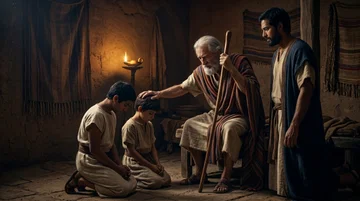
Jacob blessed Joseph by reverently laying hands on heads to ask God to bless them, in the customary way a Jewish father blessed his children, and specifically laid his hands on Ephraim and Manasseh to bless the lads.PP 234.2–235.13SP 349.1–2SLP 44.1RH May 11, 1911 The same laying on of hands later asked God to bless Paul and Barnabas as they devoted themselves to their appointed work, recognizing their calling rather than imparting a new qualification.RH May 11, 1911 The blessing belongs to Jacob's old age when he dwelt in Canaan while famine was severely felt there, so that his family lacked food and ten of his sons had to journey to Egypt to buy grain from the abundant provision made there.PP 224.3–225.1
In the blessing Jacob addresses God as the God before whom his fathers Abraham and Isaac walked, and as the God who fed, provided for, preserved, supported and cared for Jacob himself every day all his life long unto that day.ED 147.4PP 234.2–235.1 Spoken near the end of his life, at death and at life's evening, the blessing looks back over his life history to recognize God's sustaining power, bringing light after darkness.ED 147.4ST Nov 17, 1909PP 234.2–235.1 There is no complaint about past evil days, no longer counting trials and sorrows as against him, but remembering only mercy and loving-kindness with him throughout his pilgrimage.ST Nov 17, 1909PP 234.2–235.1
That review follows fraud to gain the birthright, reaping his brother's hatred, twenty years of exile being wronged and defrauded, flight for safety, and seeing the evils of his own character reproduced in his sons.ST Nov 17, 1909 It also follows repentance, endeavor to atone to his brother, seeking God when threatened with death, weeping supplication and prevailing over the Angel, blessing, deliverance from his brother and deliverance from himself, the breaking of evil in his nature, and transformation from supplanter to prince with God.ST Nov 17, 1909 The blessing expresses utter dependence on God, with no spirit of self-dependence and no reliance on human power or cunning, meaning that while reaping the fruit of his own thoughts and deeds Jacob was not overwhelmed because God sustained, healed, led, and restored comfort to him.ST Nov 17, 1909PP 234.2–235.1 It proves that God does not annul law or undo sin's work but transforms through grace, so that the curse works out a blessing and retribution gives way to righteousness unto life.ST Nov 17, 1909
Sources
Pioneers and periodicals
19 sources
On his deathbed Jacob blesses Joseph and his sons Ephraim and Manasseh, naming the God in whose name the blessing is given while laying his hands upon their heads.ST Jan 28, 1913ST Dec 1, 1898 To call Him the God who fed him all his life long is to say He shepherded, guided and provided for him to old age, and to say Abraham and Isaac walked before Him is to say they lived and served in His presence.RH Nov 13, 1900ST Jan 10, 1911RH Jan 23, 1913 Spoken at life's evening, it is Jacob's review of his whole history, confessing that God had been faithful to him as to his fathers and had sustained, healed and transformed him from supplanter to prince with God through fraud, exile, wrestling and repentance.ST Nov 17, 1909ST Dec 14, 1915RH Jan 19, 1860 He knowingly crosses his hands to set his right hand on the younger Ephraim over the elder Manasseh, showing that God directs events without mistake despite human plans.ST Dec 1, 1898ST Nov 10, 1914RH Oct 3, 1907 That giving of the birthright and firstborn place to the younger proves firstborn means pre-eminence by appointment rather than priority in time, as when Jacob received it over Esau and Joseph over Reuben, so Jesus Christ remains the First-born from the dead though others rose before Him because all rise by His offering and work.ST Nov 15, 1910ST Apr 9, 1902ST Oct 29, 1902
Context and Language
Genesis 48:15 stands in the last chapters of Genesis, the Book of Beginnings, in the rest and close of the story of Joseph and his brethren, a portion full of lessons on the surface as well as deeper ones. It belongs to the account of Israel in Egypt, connected with Israel taking his journey with all that he had and going down into Egypt with all his seed.ST Dec 1, 1898 There it is set within their reception by Joseph and Pharaoh, and Jacob's death and burial, and finally Joseph's death, showing God's care for the preservation of the progenitors of the Seed.ST Jan 28, 1913
Its immediate occasion is Jacob's prophetic blessing on his deathbed upon Joseph and upon Joseph's sons Ephraim and Manasseh.ST Jan 28, 1913RH Jan 23, 1913 That blessing is joined to his prophecy concerning them and to his adoption of Joseph's sons among the twelve tribes.ST Jan 28, 1913 Verse 15 is the introduction to that blessing identifying whose name it invokes.ST Dec 1, 1898
It was spoken with laying of hands reverently on the head, as fathers blessed children, an act that asked God to bless those devoted to their appointed work by recognizing their calling rather than imparting a new qualification.RH May 11, 1911 Jacob deliberately crossed his hands to put his right hand on the younger Ephraim rather than the elder Manasseh, and his dim sight did not cause the choice.ST Nov 10, 1914 In so doing he delivered the message given him that the younger son was to excel the older, showing that God directs events without mistake even when human plans and schemes interfere.ST Nov 10, 1914RH Oct 3, 1907
To say God fed Jacob all his life long means God continually cared for, guided, and provided for him like a shepherd feeds his flock.RH Nov 13, 1900ST Jan 10, 1911RH Jan 23, 1913 That shepherd image for God was used long before David.RH Nov 13, 1900 To say Abraham and Isaac walked before Him means they lived and served in His presence, while unto this day stresses that the same sustaining care had continued to Jacob's old age and shows God's providential care across generations.ST Jan 10, 1911RH Jan 23, 1913ST Apr 23, 1894
God's Lifelong Care
Jacob speaks in old age as one reviewing his whole history to acknowledge the sustaining power that had carried him through it all.ST Nov 17, 1909ST Dec 14, 1915RH Jan 19, 1860 He confesses at last that God had been faithful to him as to his fathers Abraham and Isaac, guiding and caring for him continually, at work even in painful events he had once counted as against him.ST Nov 17, 1909ST Dec 14, 1915 And on that ground he commits Joseph to the same watchful care, trusting the God who had sustained him to guide and keep his son also.ST Dec 14, 1915RH Jan 19, 1860 That review reaches back to fraud to gain the birthright, to reaping his brother's hatred, to twenty years of exile in being wronged and defrauded, to flight for safety, and to seeing the evils of his own character reproduced in his sons.ST Nov 17, 1909 It reaches forward through repentance, through endeavor to atone to his brother, through seeking God when threatened with death, through weeping supplication and prevailing over the Angel, through blessing and deliverance from his brother and deliverance from himself, through the breaking of evil in his nature, to transformation from supplanter to prince with God.ST Nov 17, 1909 Spoken at life's evening, his word is light after darkness, for while reaping the fruit of his own thoughts and deeds he was not overwhelmed, because God sustained and healed and led him and restored comfort to him.ST Nov 17, 1909 This proves that God does not annul law or undo sin's work, but transforms through grace, so that the curse is made to work out blessing and retribution gives way to righteousness unto life.ST Nov 17, 1909
The blessing belongs to God's providential care for Jacob's family in Egypt after Israel's journey down with all that he had and all his seed, their reception by Joseph and Pharaoh, and onward to Jacob's death and burial and Joseph's death. It stands in the rest and close of the story of Joseph and his brethren in the last chapters of Genesis, joined to prophecy concerning the sons and to adoption of Joseph's sons among the tribes. There it shows God's care for the preservation of the progenitors of the Seed, turning what the family meant for harm to their good and preservation.ST Jan 23, 1912
The blessing came through Jehovah's angel and included redeeming Jacob, one instance among many in which God's angels execute His will and minister to His people.ST Apr 14, 1898 In it the old patriarch prays for the younger members of his family after Abraham's example, laying hands reverently on the head as fathers blessed children.RH May 11, 1911ST Sep 4, 1907 God is pleased with such old and tried servants who, while themselves looking for a better country, pray for younger believers and for the work of God.ST Sep 4, 1907 The same laying on of hands afterward asked God to bless Paul and Barnabas as they devoted themselves to their appointed work, recognizing their calling rather than imparting a new qualification.RH May 11, 1911
Birthright and Christ
The blessing introduced by this verse gives the birthright and firstborn place to the younger Ephraim over the elder Manasseh.ST Nov 15, 1910ST Apr 9, 1902ST Oct 29, 1902ST Nov 10, 1914 Manasseh was the older son and Joseph's firstborn in point of time, yet Ephraim was made the firstborn and was to excel him.ST Nov 15, 1910ST Apr 9, 1902ST Oct 29, 1902 The blessing invokes the God before whom Abraham and Isaac lived and who had sustained Jacob throughout his life, and with laying on of hands Jacob deliberately crossed his hands to place his right hand on the younger rather than the elder, not from dim sight but to deliver the message given him.ST Nov 10, 1914
This proves that firstborn and first do not necessarily mean priority of time or first in date.ST Apr 9, 1902 They denote pre-eminence in character or station, coming by appointment rather than by order of birth.ST Apr 9, 1902ST Oct 29, 1902 The same appointment is seen when Jacob received the birthright over Esau and when Joseph received it over Reuben.ST Oct 29, 1902
First birth in time therefore does not decide who holds the firstborn place, for the birthright can be appointed to another.ST Nov 15, 1910ST Oct 29, 1902 So Jesus Christ is still the First-born from the dead even though others were raised before Him.ST Nov 15, 1910ST Oct 29, 1902 He holds the firstborn place by pre-eminence as the One by whose offering and work all others are brought from the dead.ST Nov 15, 1910ST Oct 29, 1902
Sources