Genesis 37:35
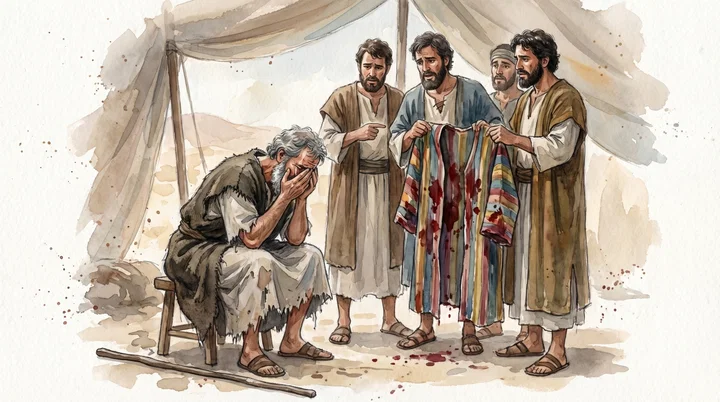
And all his sons and all his daughters rose up to comfort him; but he refused to be comforted; and he said, For I will go down into the grave unto my son mourning. Thus his father wept for him.
Translations
And all his sons and all his daughters rose up to comfort him; but he refused to be comforted; and he said, For I will go down into the grave to my son mourning. Thus his father wept for him.
King James Version, KJV Cambridge Paragraph Bible
And all his sons and all his daughters rose up to comfort him; but he refused to be comforted; and he said, For I will go down into the grave unto my son mourning. Thus his father wept for him.
And all his sons and all his daughters rose up to comfort him; but he refused to be comforted; and he said, For I will go down into the grave to my son mourning: Thus his father wept for him.
And all his sons and all his daughters rose up to comfort him; but he refused to be comforted; and he said, For I will go down to the grave to my son mourning. And his father wept for him.
And all his sons and all his daughters rose up to comfort him; but he refused to be comforted; and he said, For I will go down to Sheol to my son mourning. And his father wept for him.
and all his sons and all his daughters rise to comfort him, and he refuseth to comfort himself, and saith, 'For — I go down mourning unto my son, to Sheol,' and his father weepeth for him.
And all his sons and all his daughters rose up to comfort him, but he refused to be comforted, and said, For I will go down to my son into Sheol mourning. Thus his father wept for him.
And all his sons and all his daughters rose up to console him but he refused to be consoled, and said—Surely I will go down unto my son mourning to hades! And his father wept for him.
Berean Standard Bible, Majority Standard Bible
All his sons and daughters tried to comfort him, but he refused to be comforted. “ No,” he said. “ I will go down to Sheol mourning for my son.” So his father wept for him.
All his sons and all his daughters rose up to comfort him, but he refused to be comforted. He said, “ For I will go down to Sheol to my son, mourning.” His father wept for him.
And all his sons and all his daughters came to give him comfort, but he would not be comforted, saying with weeping, I will go down to the underworld to my son. So great was his father's sorrow for him.
Then all his sonnes and all his daughters rose vp to comfort him, but he woulde not be comforted, but said, Surely I will go downe into the graue vnto my sonne mourning: so his father wept for him.
Douay-Rheims (Challoner revision)
And all his children being gathered together to comfort their father in his sorrow, he would not receive comfort, but said: I will go down to my son into hell, mourning. And whilst he continued weeping,
Pictures
Cross-references 20 of 30
- Genesis 42:38
And he said, My son shall not go down with you; for his brother is dead, and he is left alone: if mischief befall him by the way in the which ye go, then shall ye bring down my gray hairs with sorrow to the grave.
Jacob again speaks of going down to Sheol in grief.
- Job 17:13
If I wait, the grave is mine house: I have made my bed in the darkness.
Both describe the grave as the mourner’s destination and dwelling.
- Genesis 15:15
And thou shalt go to thy fathers in peace; thou shalt be buried in a good old age.
Going to one’s fathers is expressed as going to the grave.
- Genesis 44:29-31
And if ye take this also from me, and mischief befall him, ye shall bring down my gray hairs with sorrow to the grave.
Jacob fears sorrow will bring him to the grave over Benjamin, as he mourned Joseph.
- Genesis 42:36
And Jacob their father said unto them, Me have ye bereaved of my children: Joseph is not, and Simeon is not, and ye will take Benjamin away: all these things are against me.
Jacob laments that Joseph is gone and that all these things are against him.
- Psalms 89:48
What man is he that liveth, and shall not see death? shall he deliver his soul from the hand of the grave? Selah.
All people must die, and none can escape Sheol.
- Job 14:13
O that thou wouldest hide me in the grave, that thou wouldest keep me secret, until thy wrath be past, that thou wouldest appoint me a set time, and remember me!
Both speak of the grave as the place of the dead.
- Job 10:21
Before I go whence I shall not return, even to the land of darkness and the shadow of death;
Both describe going down to the dark land of the dead.
- Genesis 37:28
Then there passed by Midianites merchantmen; and they drew and lifted up Joseph out of the pit, and sold Joseph to the Ishmeelites for twenty pieces of silver: and they brought Joseph into Egypt.
Joseph’s sale lies behind the brothers’ report that he is dead.
- Job 17:16
They shall go down to the bars of the pit, when our rest together is in the dust.
Both describe the dead as going down to the grave.
- Genesis 37:5-11
And Joseph dreamed a dream, and he told it his brethren: and they hated him yet the more.
Later events fulfilled Joseph’s dreams despite his brothers’ efforts to thwart them.
- 2 Chronicles 34:28
Behold, I will gather thee to thy fathers, and thou shalt be gathered to thy grave in peace, neither shall thine eyes see all the evil that I will bring upon this place, and upon the inhabitants of the same. So they brought the king word again.
gathered to fathers explained as gathered to the grave
- Genesis 45:26-28
And told him, saying, Joseph is yet alive, and he is governor over all the land of Egypt. And Jacob’s heart fainted, for he believed them not.
Jacob’s grief turns to joy when he learns Joseph is alive.
- Genesis 46:29-30
And Joseph made ready his chariot, and went up to meet Israel his father, to Goshen, and presented himself unto him; and he fell on his neck, and wept on his neck a good while.
mourning ends when they meet again
- Genesis 45:9-11
Haste ye, and go up to my father, and say unto him, Thus saith thy son Joseph, God hath made me lord of all Egypt: come down unto me, tarry not:
Joseph urges Jacob to come to Egypt and promises to provide for him.
- Job 21:13
They spend their days in wealth, and in a moment go down to the grave.
both show going down to sheol
- Acts 7:9
And the patriarchs, moved with envy, sold Joseph into Egypt: but God was with him,
Both describe Joseph’s persecution by his brothers.
- 1 Samuel 2:6
The LORD killeth, and maketh alive: he bringeth down to the grave, and bringeth up.
Sheol is named in connection with death.
- Psalms 30:3
O LORD, thou hast brought up my soul from the grave: thou hast kept me alive, that I should not go down to the pit.
Both speak of going down to the grave.
- Genesis 45:5-7
Now therefore be not grieved, nor angry with yourselves, that ye sold me hither: for God did send me before you to preserve life.
Joseph sent to Egypt beforehand to preserve life
Commentary
Each commentary is drawn from primary sources: the writings of Ellen G. White and Adventist pioneers and periodicals. Each commentary is separate. Its own words are not a quotation; follow the references to read the source passages.
Ellen G. White
7 sources
Jacob loved Joseph more than his other children, and his heart was bound up in him.PP 209.1 His sons showed him Joseph's bloodied coat.1SP 130.1–2 Through them he was led to believe that wild beasts had killed Joseph.1SP 130.1–2SG3 142.1–2 Though all his sons and daughters rose up to comfort him, his grief was so deep that he refused to be comforted and expected to go down to the grave still mourning for his son.PP 212.11SP 130.1–2SG3 142.1–2Lt 33, 1870, par. 5–7
Jacob mourned Joseph as dead until he saw him alive again, and then expressed his willingness to die.SG3 168.2 When they met again Joseph left his chariot, ran to meet his father on foot, embraced him, and they wept over each other.SG3 168.2 This mourning belongs to the account of Joseph's unjust suffering as one maligned, persecuted and treated as a criminal, yet God gave him signal victories even while he appeared to suffer for doing right.Lt 10, 1879, par. 4–9
Mourning like Jacob's should not be nourished until health is harmed.Lt 33, 1870, par. 5–7 The mind should turn from dwelling on the affliction to gratitude for God's mercy in preparing the loved one for heaven.Lt 33, 1870, par. 5–7
Sources
Pioneers and periodicals
54 sources
Jacob was deceived by his sons with the blood-stained coat into believing Joseph had been torn by an evil beast, so he rent his garments, put on sackcloth, mourned many days, refused to be comforted, and expected to mourn for his son until he died.ST Oct 27, 1898ST Oct 27, 1898RH Feb 10, 1859ST Apr 20, 1888 The grave to which he expected to go down is sheol, here used for the first time, meaning not the outward burial pit but the invisible state and resting-place of death, down below in contrast with Paradise above.RH Apr 28, 1863RH Aug 18, 1863RH Aug 27, 1872RH Nov 7, 1854ST Aug 18, 1881 It is the common receptacle of all the dead without distinction, where righteous as well as wicked rest together in the dust, and it is a state of complete unconsciousness and inactivity with no work, knowledge, remembrance, or praise until the resurrection.RH Jun 26, 1900RH Apr 28, 1863RH Aug 18, 1863ST Mar 6, 1879RH Nov 18, 1858 Jacob did not place Joseph as a conscious soul in heaven and did not hope to join him there, for though he believed Joseph was devoured and had no grave, he still expected to enter the same state of death, which proves sheol holds even the unburied.RH Feb 10, 1859RH Oct 2, 1855RH Nov 18, 1858RH Nov 7, 1854ST Mar 6, 1879 Those who held otherwise read it to mean that at death he expected to go down to the underworld to meet Joseph where all souls immediately enter upon a conscious existence.RH Feb 11, 1873 His inconsolable grief rested on supposed loss, for Joseph was alive and prospering, and it was the bitter fruit of partiality from having more than one wife and of envy growing into hatred and deceit, yet God overruled the brothers' evil to send Joseph beforehand into Egypt to preserve the family in famine, so that what seemed against Jacob was a blessing in disguise.STST Dec 14, 1915RH Mar 30, 1869RH Jan 11, 1906ST Oct 27, 1898
Story Setting and Grief
Genesis 37 holds the story of Joseph and his brothers, in which envy moves the brothers to sell Joseph as a slave into Egypt, beginning the train of events that later brings them to bow before him, and the verse marks the father's grief within that early account.ST Jan 3, 1911 The grief followed the sons' conspiracy against Joseph and their concealment of guilt, for after being shown the bloodied coat Jacob concluded that an evil beast had torn Joseph in pieces.ST Oct 27, 1898ST Apr 20, 1888 Upon that conclusion he rent his garments, put sackcloth upon his loins, and mourned many days.ST Oct 27, 1898ST Apr 20, 1888
When all his sons and all his daughters rose up to comfort him, he refused to be comforted and said he would go down into the grave unto his son mourning.ST Oct 27, 1898ST Oct 27, 1898ST Oct 2, 1901 He expected to mourn until he died, and he continued weeping for him, showing the depth and lasting force of his sorrow.ST Oct 27, 1898ST Oct 2, 1901ST Aug 24, 1915 The distress the sons had already seen in him over Joseph explains their later fear that losing Benjamin would cause their father to die.ST Jan 22, 1880
His grief rested on deception, for his sons had dipped Joseph's coat of many colors in the blood of a kid or goat and brought it home with the insinuating question whether it was his son's coat.RH Feb 10, 1859RH Aug 14, 1860 Believing their lie, Jacob imagined that wild beasts had torn Joseph apart and was overwhelmed with grief that longed to descend to the grave in sorrow.ST Mar 17, 1887ST Oct 22, 1912RH Aug 14, 1860 Yet Joseph was not dead but alive and prospering, taken away for a time, so that Jacob's loss was only supposed, unlike the real loss of children as in Job's case.RH Mar 30, 1869ST Aug 24, 1915
The Pentateuch record concerning Joseph to which the verse belongs is accurate and circumstantial history, fully corroborated by inscriptions on Egyptian monuments and tombs.ST Jul 30, 1885 That corroboration makes the Pentateuch a valuable auxiliary for understanding Egyptian history and of prime historical importance.ST Jul 30, 1885
Meaning of Grave Sheol
The word rendered grave is the Hebrew sheol, here occurring for the first time in the Old Testament.ST Aug 18, 1881ST Jun 5, 1879 Sheol occurs sixty-five times, rendered grave thirty-one times, pit three times, and hell thirty-one times, and answers to the Greek hades in the New Testament, which is used eleven times, rendered hell ten times and grave once.RH Apr 28, 1863ST Mar 15, 1877 The teaching of Moses and the prophets concerning sheol, or hades, is in harmony with the teachings of Christ and the apostles.ST Mar 15, 1877
Sheol is not keber.RH Apr 28, 1863 Keber occurs seventy times, rendered burying-place, sepulchre, and grave, and means the outward and visible burial place, never describing the state of man in death, while sheol means both place and condition, the invisible world or habitation of the departed.RH Apr 28, 1863
Sheol is down and not up, below in contrast with Paradise which is above.RH Aug 18, 1863ST Jul 29, 1875 It means the grave, the state of death and the resting place of the dead, not a burial pit only and not a place of torment.RH Aug 27, 1872RH Nov 7, 1854RH Jun 12, 1860 Jacob as a good man going there proves that both the good and the bad go to sheol.RH Aug 18, 1863 Rendering sheol uniformly as hell would make his words read as going down mourning into hell to his son, which sounds strange only because of popular misuse of hell, since the grave is properly its meaning as the usual receptacle of the silent sleepers who return to dust.
Sheol or hades is the common destination and receptacle of all the dead without distinction of places or separate apartments of comfort and misery.RH Jun 26, 1900ST Mar 6, 1879 Righteous as well as wicked go there, the good as Jacob shows and the bad, the whole man bodily and in death going down with gray hairs to the bars of the pit where rest together is in the dust.RH Aug 27, 1872ST Aug 13, 1874ST Mar 20, 1879 It is a place down in the earth where all go at death, in Hebrew sheol and in Greek hades, translated hell, pit, or grave.ST Mar 20, 1879
Sheol is a state of complete unconsciousness and inactivity until the resurrection, with no knowledge, wisdom, device, work, activity, consciousness, remembrance of God, thanksgiving, praise, good or evil.RH Jun 26, 1900RH Apr 28, 1863 The patriarchs without exception held that the whole man dies and remains in the grave in privation of life, understanding death as the loss of life of the whole man rather than continued conscious existence.RH Nov 18, 1858RH Aug 5, 1862 The dead do not immediately live through conscious events after death, but the whole man lies unconscious till the resurrection.ST Mar 20, 1879ST Mar 30, 1882
Jacob did not place his son in heaven and did not expect a conscious soul to join departed souls.RH Oct 2, 1855RH Nov 18, 1858 Going down to the dead and being gathered to one's people or fathers means burial of the body and joining them in the grave, the common receptacle of all the dead, not conscious intercourse, with no conscious existence in heaven.RH Feb 10, 1859RH Sep 8, 1859RH Oct 24, 1871 When he thought Joseph was dead he expected to join his son in the grave mourning, not that his soul or Joseph's soul survived apart to praise God in heaven.RH Nov 18, 1858
Although Jacob believed Joseph was rent in pieces and devoured by beasts and had no grave, and could expect no body to join, he still said he would go down mourning into sheol unto his son.RH Feb 10, 1859RH Nov 7, 1854 This proves sheol holds all the dead in unconscious death whether they are buried or not, counting among those in hades even those torn by beasts rather than buried in a grave.RH Nov 7, 1854ST Mar 6, 1879 It means entering the state of death in which his son was held, not going to the same burial locality or same grave as Joseph, and this going into death he calls going unto his son.ST Apr 17, 1884RH Jul 23, 1872
By contrast, those who held it taught that at death Jacob expected to go down to sheol to meet Joseph, whom he supposed to be dead and already gone there, sheol being not the grave or sepulcher for the body but the underworld, the place of departed spirits where all souls immediately enter upon a conscious existence.RH Feb 11, 1873
Sin Causes and Consequences
Jacob's strong and inconsolable love for Joseph was drawn by Joseph's character and conduct toward God and his father.ST Mar 17, 1887 He listened to his father's instructions and feared the Lord, obeying his father's righteous teachings more than any of his brethren, treasuring instruction and loving to obey God with integrity of heart.ST Mar 17, 1887 He hated sin and grieved over the wrong conduct of his brethren, meekly entreating them to pursue righteousness and leave off their wicked acts, and laying the matter before his father in hope his father's authority would reform them.ST Mar 17, 1887 The brethren observed that strong love, envied Joseph for it, and their envy grew into hatred and finally to murder.ST Mar 17, 1887
That mourning and refusal to be comforted were sad fruits of Jacob's mistake in having more than one wife, which brought partiality, jealousy, envy, low standards of morality, and crime into his family.ST It shows the inevitable result of partiality in the family and illustrates the misery jealousy causes in the home.ST Oct 27, 1898ST Sep 28, 1904 Envy led Joseph's brothers to plot against him and to persecute him who feared God, making his life miserable, yet their evil deeds moved him toward the throne of Egypt while God overruled their evil for good.ST Jun 11, 1894RH Mar 20, 1900 This proves that he that is born after the flesh persecutes him that is born after the Spirit, because the wicked persecute the righteous whose works are righteous while their own are evil.RH Jun 8, 1916
The brothers first hated Joseph and then persecuted him, and by that caused their father to mourn for days and weeks and months and years. Those long years of sorrow they brought upon him were part of the bitter fruits of their hatred. Their course marked downward steps from envy to hatred to a scheme of murder to deceit to a fearful expectation of wrath to be visited upon them, while the divine plan concerning the children of Israel was still being developed through these events.ST Oct 27, 1898 Jacob suffered after trusting his sons and believing their lie when they presented Joseph's bloodied coat, and that belief caused his deep grief and mourning for the loss of Joseph.RH Aug 6, 1861RH Aug 14, 1860
His suffering was the return of his own earlier deception of his father upon himself, now through deception practiced by those near and dear to him.ST Apr 20, 1888ST Jul 10, 1893 Although Joseph was alive and prospering, Jacob believed his sons' deception that a wild animal had devoured him, rent his clothes, put sackcloth upon his loins, mourned many days, refused to be comforted by his sons and daughters, resolved to go down into the grave mourning unto his son, and wept for him.ST Apr 20, 1888RH Mar 30, 1869 This proves that although a sin may be forgiven the results of it may remain, that sincere repentance and forgiveness do not always remove the consequences of sin in this life, and that God abhors deception.ST Apr 20, 1888RH Mar 30, 1869ST Jul 10, 1893
Providence Comfort and Application
God overruled the brothers' evil for good, turning their plot against Joseph into the path that moved him toward the throne of Egypt.ST Jun 11, 1894RH Mar 20, 1900 Whatever God has intended a person for, He can be safely trusted to bring them to it, leading them round but guiding them right.RH Jan 19, 1860 God guided and saved Joseph in his youth, and with Samuel, who was called by God in childhood, he shows that the God of Israel befriends and keeps children and youth.RH Nov 24, 1874 Those who seek Jesus early shall find Him when little children are called to Him, and angels guard them in time of trouble.RH Nov 24, 1874
Jacob was robbed of his son Joseph and passed several years in grief and deep sorrow without knowing why so great a calamity should befall him.RH Jan 11, 1906 He refused comfort and resolved to mourn Joseph until his own death because he believed Joseph was dead, seeing only the visible circumstances and mistaking what God was working through for evidence that all things were against him.ST Dec 14, 1915RH Jan 11, 1906ST Jan 9, 1912 The reason was hidden at the time but was afterward made plain when Joseph was found to have been sent beforehand to Egypt to prepare the way for support during the seven years of famine in all Palestine and Egypt, leading to Joseph's return and the saving of many lives.RH Jan 11, 1906ST Jan 9, 1912 What seemed too good to be true was true, and when Jacob realized he would really see Joseph he was almost overwhelmed with joy and thankfulness.RH Jan 11, 1906 A calamity can be a blessing in disguise whose good is recognized only by waiting for the Lord to reveal it.RH Jan 11, 1906
The father's grief over his supposed lost son pictures the grief of longing souls who are told that the Bible is not the Word of God.ST Feb 7, 1911 The very evil the brothers meant brought salvation to the weeping father and his family, for the son sold into slavery became their only hope in time of trouble, so the Old Book under attack remains the hope of every longing soul in days of trouble.ST Feb 7, 1911 Joseph's life experience holds an underlying practical principle to guide the contingencies of life, to be known as familiarly as one's own name for personal good and for counseling others called to pass through similar grief and mourning and similar difficulty.ST Nov 29, 1905 It applies in mourning the death of a loved one, as when those who miss a native teacher mourn his death as Jacob refused comfort and grieved for his son.RH Sep 3, 1903 It is imagined in poetry where Jacob refuses his family's comfort and expects to mourn until he dies because he believes his son is dead, while Joseph, now a ruler in Egypt, sends wheat down the Nile as a sign that bread is available and as a way to draw his grieving father toward him.ST Feb 10, 1881
Sources