Genesis 48:19
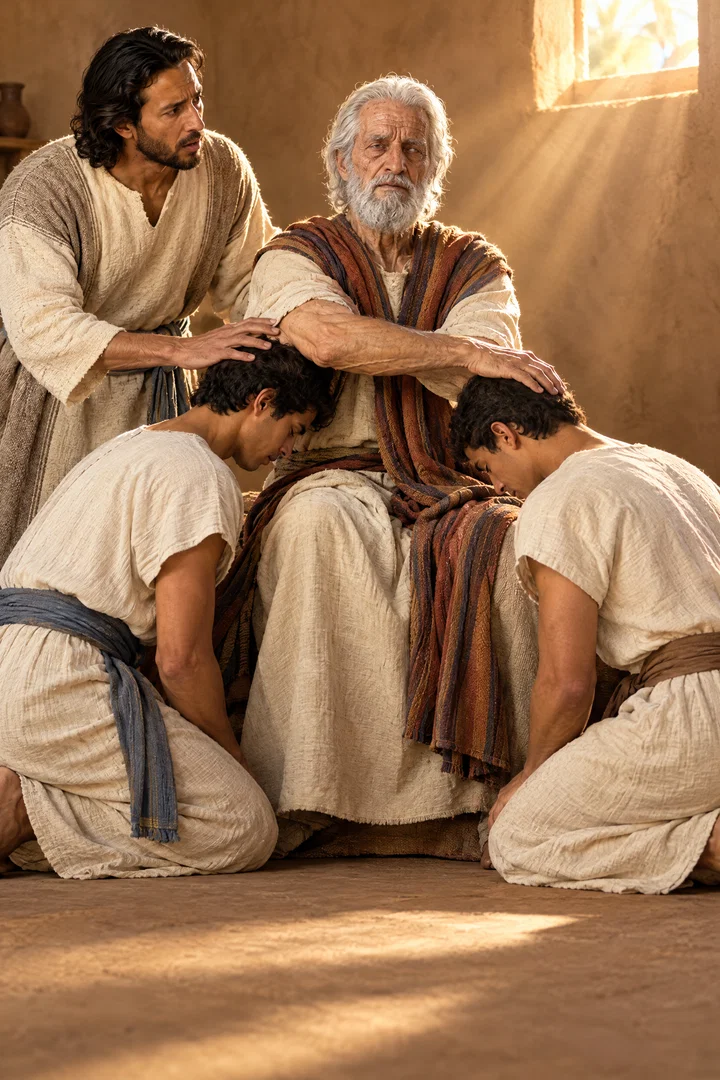
And his father refused, and said, I know it, my son, I know it: he also shall become a people, and he also shall be great: but truly his younger brother shall be greater than he, and his seed shall become a multitude of nations.
Translations
American King James Version, King James Version, KJV Cambridge Paragraph Bible
And his father refused, and said, I know it, my son, I know it: he also shall become a people, and he also shall be great: but truly his younger brother shall be greater than he, and his seed shall become a multitude of nations.
And his father refused, and said, I know it, my son, I know it; he also shall become a people, and he also shall be great; but truly his younger brother shall be greater than he, and his seed shall become a multitude of nations.
And his father refused, and said, I know it, my son, I know it: he also shall become a people, and he also shall be great: howbeit his younger brother shall be greater than he, and his seed shall become a multitude of nations.
And his father refused, and said, I know it, my son, I know it; he also shall become a people, and he also shall be great: howbeit his younger brother shall be greater than he, and his seed shall become a multitude of nations.
And his father refuseth, and saith, 'I have known, my son, I have known; he also becometh a people, and he also is great, and yet, his young brother is greater than he, and his seed is the fulness of the nations;'
But his father refused and said, I know, my son, I know: he also will become a people, and he also will be great; but truly his younger brother will be greater than he; and his seed will become the fulness of nations.
And his father refused, and said—I know—my son, I know! He also, shall become a people, and he also, shall become great,—but nevertheless, his younger brother, shall become greater than he, and his seed, shall become a filling up of the nations.
Berean Standard Bible, Majority Standard Bible
But his father refused. “ I know, my son, I know!” he said. “ He too shall become a people, and he too shall be great; nevertheless, his younger brother shall be greater than he, and his offspring shall become a multitude of nations.”
His father refused, and said, “ I know, my son, I know. He also will become a people, and he also will be great. However, his younger brother will be greater than he, and his offspring will become a multitude of nations.”
But his father would not, saying, I am doing it on purpose, my son; he will certainly become a nation and a great one; but his younger brother will be greater than he, and his seed will become a great family of nations.
But his father refused, and sayd, I know well, my sonne, I know well: he shalbe also a people, and he shalbe great likewise: but his yonger brother shalbe greater then he, and his seede shall be full of nations.
Douay-Rheims (Challoner revision)
But he refusing, said: I know, my son, I know: and this also shall become peoples, and shall be multiplied: but this younger brother shall be greater than he: and his seed shall grow into nations.
Pictures
Cross-references
- Jeremiah 31:9
They shall come with weeping, and with supplications will I lead them: I will cause them to walk by the rivers of waters in a straight way, wherein they shall not stumble: for I am a father to Israel, and Ephraim is my firstborn.
Ephraim is called firstborn by appointment despite being the younger son.
- 1 Chronicles 5:1-2
Now the sons of Reuben the firstborn of Israel, (for he was the firstborn; but, forasmuch as he defiled his father’s bed, his birthright was given unto the sons of Joseph the son of Israel: and the genealogy is not to be reckoned after the birthright.
Joseph receives the birthright, while Judah gains preeminence among the tribes.
- Hebrews 11:21
By faith Jacob, when he was a dying, blessed both the sons of Joseph; and worshipped, leaning upon the top of his staff.
Jacob’s blessing of Joseph’s sons was an act of faith.
- Genesis 37:5-11
And Joseph dreamed a dream, and he told it his brethren: and they hated him yet the more.
Joseph’s dreams foretold his brothers bowing to him.
- Genesis 27:28-29
Therefore God give thee of the dew of heaven, and the fatness of the earth, and plenty of corn and wine:
Jacob receives the blessing over his older brother, though Rebekah secures it through deception.
- Genesis 42:6
And Joseph was the governor over the land, and he it was that sold to all the people of the land: and Joseph’s brethren came, and bowed down themselves before him with their faces to the earth.
Joseph’s brothers bow before him, fulfilling Jacob’s words about their future.
Commentary
Each commentary is drawn from primary sources: the writings of Ellen G. White and Adventist pioneers and periodicals. Each commentary is separate. Its own words are not a quotation; follow the references to read the source passages.
Ellen G. White
3 sources
Genesis 48:19 belongs to the history of Joseph as ruler in Egypt during the seven years of dearth, when ten of Jacob's sons came from Canaan to buy grain and bowed down before him with their faces to the earth without recognizing him, fulfilling his earlier dreams.PP 224.3–225.1 It belongs also to the account of the customary Jewish way for a father to bless his children by reverently laying his hands upon their heads.SLP 44.1RH May 11, 1911 That laying on of hands in blessing meant asking God to bestow His blessing upon them.SLP 44.1
The laying on of hands upon Paul and Barnabas by the ministers at Antioch carried that same meaning, as an appeal for God to bless them in devotion and dedication to the particular work He had chosen for them to do.SLP 44.1
Sources
Pioneers and periodicals
21 sources
On his deathbed in Egypt Jacob adopted Joseph's two sons as his own and, laying his hands upon their heads in faith in God's promise, knowingly crossed his hands to set his right hand upon the younger. RH May 11, 1911ST May 12, 1890ST Dec 1, 1898 His refusal to move his hand when Joseph objected was no mistake of dim sight, and his blessing foretold that both sons would become great peoples but Ephraim the younger would become greater than Manasseh the elder, with his seed becoming a multitude of nations. ST Mar 17, 1914ST Dec 1, 1898ST Nov 10, 1914ST Apr 23, 1894 By this adoption Joseph received a double portion, Ephraim became the leading tribe, and the prediction was fulfilled in later history when Ephraim excelled Manasseh. ST Jul 15, 1913ST Mar 17, 1914ST Dec 1, 1898ST Nov 10, 1914 Birth order does not secure precedence with God, for firstborn standing comes by God's appointment and preeminence rather than by time of birth, which proves Jesus Christ the Firstborn from the dead and first-fruits though others were raised before Him. ST Jan 10, 1911ST Nov 15, 1910ST Oct 29, 1902ST Jun 26, 1907 Jacob's tribal prophecies find their fulfillment in Christ, in whom all Israel centers so that those who belong to Him are Abraham's seed and the true tribes, showing that God directs events and shapes destinies without error even by a winding route. ST Jan 23, 1912ST Nov 29, 1905RH Jan 19, 1860RH Oct 3, 1907
Context and Plain Meaning
Genesis 48:19 belongs to the Genesis 37-50 section whose leading thought is Joseph and whose central figure is Joseph and his wonderful experiences and work.ST Aug 9, 1905 It stands in the closing part of that story, with the meeting with his brethren, the fulfillment of his dreams, the bringing of his father down into Egypt, the adoption of Joseph's sons among the twelve tribes, the blessing upon the sons, and the deaths of the old patriarch and finally of Joseph himself.ST Jan 28, 1913
It is Jacob's prophetic blessing upon Joseph's sons, given after Israel's journey to Egypt and his reception by Joseph and Pharaoh. There in Egypt Jacob adopted Joseph's sons as his own and gave his prophetic blessing before his death. It was done as a Jewish father blesses his children, by laying hands reverently upon their heads.RH May 11, 1911 It was Jacob's deathbed blessing and an expression of faith in God's promise, though he had no possession of the promised inheritance, and it shows God's care for preserving the progenitors of the Seed and for the promised Seed.ST May 12, 1890
Jacob acted knowingly and deliberately, crossing his hands to place his right hand upon the younger, Ephraim.ST Nov 10, 1914 When Joseph tried to correct him he refused to move his right hand from Ephraim to Manasseh, saying he knew what he was doing.ST Dec 1, 1898 This was not a mistake caused by dim sight but the delivery of the message given to him.ST Nov 10, 1914
The blessing foretells greatness for both sons: Manasseh the elder also shall become a people and shall be great.ST Mar 17, 1914ST Dec 1, 1898 Yet truly the younger brother Ephraim shall be greater than he, and his seed shall become a multitude of nations, with descendants forming many nations.ST Mar 17, 1914ST Dec 1, 1898ST Apr 23, 1894RH Jan 23, 1913 In this the blessing knowingly gives Ephraim preference over Manasseh.ST Dec 1, 1898ST Apr 23, 1894RH Jan 23, 1913 By adopting Joseph's two sons as his own Jacob gave Joseph a double portion, and this prophecy determined the inheritance, with Ephraim becoming the leading tribe among the ten northern tribes.ST Jul 15, 1913
Prophecy Doctrine and Application
The prediction was fulfilled in later history, for Ephraim excelled Manasseh and became greater than his brother.ST Jul 15, 1913ST Nov 10, 1914 Both sons did become great, yet the younger was made the greater, and this determination of the inheritance gave Joseph a double portion through the adoption of his two sons, with Ephraim becoming the leading tribe among the ten northern tribes.ST Jul 15, 1913ST Nov 10, 1914 Jacob's prophecies concerning his descendants and their tribes find their fulfillment in Christ, in whom all Israel centers as the true stock of Israel.ST Jan 23, 1912 Those who belong to Christ are therefore Abraham's seed, heirs according to the promise, and members of the true tribes.ST Jan 23, 1912
Birth order does not guarantee favor or precedence with God, for Manasseh would become a people and be great, but his younger brother Ephraim would become greater, with descendants forming many nations.ST Jan 10, 1911ST Jun 26, 1907ST Jan 11, 1905 Firstborn and being counted first can mean preeminence in character or station rather than being first in time, as Ephraim could be called firstborn though Manasseh was born first.ST Jun 26, 1907ST Jan 11, 1905 So also Jacob was counted firstborn although Esau was older, and Ephraim although Manasseh was older. A younger son may likewise be named before an older one because he is more notable, so the order of names does not prove birth order.
The giving of the birthright and firstborn place to Ephraim the younger rather than Manasseh the elder shows that firstborn standing comes by God's appointment and preeminence, not by order of birth.ST Nov 15, 1910ST Oct 29, 1902 This illustrates and proves that Jesus Christ is the Firstborn from the dead and the first-fruits, though others were raised before Him.ST Nov 15, 1910ST Oct 29, 1902 His standing rests on His offering and work by which all others are brought from the dead.ST Oct 29, 1902 The distinction that Ephraim the younger would become greater with seed becoming a multitude of nations has been invoked to claim the English are Ephraim and the Americans Manasseh, but that assignment conflicts with the claim that many Americans descended from English colonists.ST Oct 13, 1881
As part of Joseph's history and Jacob's crossed arms giving the greater blessing to the younger, the verse illustrates that God directs events and shapes destinies without error even when human plans interfere.RH Jan 19, 1860RH Oct 3, 1907 God can guide a person to His intended purpose even by a winding route.RH Jan 19, 1860RH Oct 3, 1907 The survey of Joseph's life holds striking lessons and underlying principles designed to guide the various contingencies of life, to help those passing through similar experiences.ST Nov 29, 1905 Its practical lessons should be kept as familiar as one's own name for the good of the soul and for counseling others in similar difficulties, with the Bible trusted with confidence as the guidebook to the very end.ST Nov 29, 1905
Sources