Genesis 27:28
Therefore God give thee of the dew of heaven, and the fatness of the earth, and plenty of corn and wine:
Translations
Therefore God give you of the dew of heaven, and the fatness of the earth, and plenty of corn and wine:
King James Version, Webster Bible
Therefore God give thee of the dew of heaven, and the fatness of the earth, and plenty of corn and wine:
Therefore God give thee of the dew of heaven,
And the fatness of the earth,
And plenty of corn and wine:And God give thee of the dew of heaven, And of the fatness of the earth, And plenty of corn and wine:
And God give thee of the dew of heaven,
And of the fatness of the earth,
And plenty of grain and new wine:and God doth give to thee of the dew of heaven, and of the fatness of the earth, and abundance of corn and wine;
And God give thee of the dew of heaven, And of the fatness of the earth, And plenty of corn and new wine.
Then, may God give thee of the dew of the heavens, And of the fatness of the earth,—And abundance of corn and new wine:
Berean Standard Bible, Majority Standard Bible
May God give to you the dew of heaven
and the richness of the earth—
an abundance of grain and new wine.God give you of the dew of the sky,
of the fatness of the earth,
and plenty of grain and new wine.May God give you the dew of heaven, and the good things of the earth, and grain and wine in full measure:
God giue thee therefore of the dewe of heauen, and the fatnesse of the earth, and plentie of wheate and wine.
Douay-Rheims (Challoner revision)
God give thee the dew of heaven, and of the fatness of the earth, abundance of corn and wine.
Pictures
Cross-references
- Genesis 25:29-34
And Jacob sod pottage: and Esau came from the field, and he was faint:
Esau sells his birthright for food, which is tied to the blessing Jacob later receives.
- Genesis 25:23
And the LORD said unto her, Two nations are in thy womb, and two manner of people shall be separated from thy bowels; and the one people shall be stronger than the other people; and the elder shall serve the younger.
The promise that the elder would serve the younger frames Jacob’s blessing.
- Genesis 28:13-14
And, behold, the LORD stood above it, and said, I am the LORD God of Abraham thy father, and the God of Isaac: the land whereon thou liest, to thee will I give it, and to thy seed;
God reaffirms to Jacob the land and blessing promised through his father.
- Hebrews 12:16-17
Lest there be any fornicator, or profane person, as Esau, who for one morsel of meat sold his birthright.
Esau sold his birthright and was later rejected when he sought the blessing.
- Malachi 1:2-3
I have loved you, saith the LORD. Yet ye say, Wherein hast thou loved us? Was not Esau Jacob’s brother? saith the LORD: yet I loved Jacob,
Contrasts God’s love for Jacob with his rejection of Esau.
- Genesis 27:35-36
And he said, Thy brother came with subtilty, and hath taken away thy blessing.
Jacob’s deceit in obtaining Isaac’s blessing is recalled.
- Hebrews 11:20
By faith Isaac blessed Jacob and Esau concerning things to come.
Isaac’s blessings on Jacob and Esau concern things to come.
- Genesis 12:2-3
And I will make of thee a great nation, and I will bless thee, and make thy name great; and thou shalt be a blessing:
Jacob receives the blessing promised to Abraham.
- Genesis 48:14-20
And Israel stretched out his right hand, and laid it upon Ephraim’s head, who was the younger, and his left hand upon Manasseh’s head, guiding his hands wittingly; for Manasseh was the firstborn.
Jacob blesses the younger son over the firstborn, showing God’s direction beyond human expectations.
- Genesis 28:14
And thy seed shall be as the dust of the earth, and thou shalt spread abroad to the west, and to the east, and to the north, and to the south: and in thee and in thy seed shall all the families of the earth be blessed.
The promised seed brings blessing to all families after the stolen blessing.
- Genesis 27:38
And Esau said unto his father, Hast thou but one blessing, my father? bless me, even me also, O my father. And Esau lifted up his voice, and wept.
plea for a reserved blessing
- Genesis 27:34
And when Esau heard the words of his father, he cried with a great and exceeding bitter cry, and said unto his father, Bless me, even me also, O my father.
records bitter cry over losing it
- Matthew 1:2
Abraham begat Isaac; and Isaac begat Jacob; and Jacob begat Judas and his brethren;
Jacob’s descendants include Jesus in the genealogy.
- Genesis 32:26-29
And he said, Let me go, for the day breaketh. And he said, I will not let thee go, except thou bless me.
Jacob clung to God for a blessing and received a new name and blessing.
- Romans 9:13
As it is written, Jacob have I loved, but Esau have I hated.
Quotes the statement about God loving Jacob and hating Esau.
Commentary
Each commentary is drawn from primary sources: the writings of Ellen G. White and Adventist pioneers and periodicals. Each commentary is separate. Its own words are not a quotation; follow the references to read the source passages.
Ellen G. White
18 sources
God was asked to grant rich material prosperity from sky and soil, abundant grain and wine.1SP 107.1SG3 115.1ST Apr 17, 1879 The blessing was meant for Esau as the favored firstborn son, but Jacob received it, to whom it already belonged by God's promise and purpose.1SP 107.1SG3 115.1ST Apr 17, 1879ED 147.1–2PP 197.2–198.1 Jacob secured it by deceiving his father with Rebekah's help, from lack of trust that God would fulfill His own word in His own time and way, which God did not prompt and did not excuse.ST Apr 17, 1879ED 147.1–2SG3 133.2Ms 139, 1899, par. 17–21PP 197.2–198.1 The fraud brought Esau's murderous hatred and forced Jacob into long fugitive exile where he was himself wronged, and later returned upon him in terror before Esau's warriors and in the evils of his sons.ED 147.1–24SP 432.3GC 616.2–3 The wrong had to be sincerely repented of and confessed before God heard his prayer for deliverance and pardoned him, changing Jacob to Israel in peace.SG3 133.2GC 619.2–620.14SP 437.2PP 197.2–198.1 That pardon shows God's people must have sins confessed beforehand to prevail in the final trouble, and warns that all conniving and underhand dealing for advantage over others must be cleansed away.Ms 139, 1899, par. 17–21Lt 7, 1896, par. 1–417MR 196.2–197.1PP 201.3–202.2
Blessing's Content and Recipient
The prayer asks God to give material prosperity from both heaven and earth, in the form of heaven's dew, the earth's richness, and plenty of grain and wine.1SP 107.1SG3 115.1SG3 114.1GC88 616.1–2ST Jan 29, 1880 It opens Isaac's blessing and pronounces abundance from above and below upon the one who receives it.ST Apr 17, 1879SG3 114.1GC88 616.1–2 That blessing was intended for Esau as the firstborn and favored son, yet Jacob is the one who received it.1SP 107.1SG3 115.1ST Apr 17, 18794SP 432.3GC 616.2–3 Although spoken over Jacob, it had been meant for Esau, and Jacob obtained by deception what Isaac designed for his elder son.ST Apr 17, 18794SP 432.3GC 616.2–3GC88 616.1–2
At the same time the birthright blessing already belonged to Jacob by God's promise and purpose to fulfill His word through him.ST Apr 17, 1879ED 147.1–2PP 197.2–198.1ST Jan 29, 1880 He knew God had promised it to him, and God's purpose was to bring about His own word through Jacob in His own time and way.ST Apr 17, 1879PP 197.2–198.1ST Jan 29, 1880 The promised prosperity itself could come only from God, who gives prosperity or brings adversity according to the recipient's conduct.1SP 107.1SG3 115.1ST Apr 17, 1879SG3 114.1 Receiving the firstborn's blessing therefore did not guarantee God's favor to an unrighteous person, nor did its fulfillment and continuance follow the mere words apart from God and the recipient's course.1SP 107.1SG3 115.1ST Apr 17, 1879SG3 114.1
One who loves, fears, and reveres God in a righteous course would be accepted and blessed even without the privileges usually given to the firstborn.1SP 107.1SG3 115.1 Jacob could have been so blessed by God for loving and fearing Him and for holding a righteous course, apart from those customary privileges.1SP 107.1SG3 115.1 By contrast, one who rejects God and His commandments would not receive His blessing.1SP 107.1SG3 115.1
Fraud and Its Consequences
Jacob secured the blessing that opens with the gift of dew from heaven and richness from earth through fraud and deception practiced upon his father Isaac, with Rebekah's help, acting as supplanter and deceiver.ST Apr 17, 1879SG3 133.24SP 432.3Ms 139, 1899, par. 17–21PP 197.2–198.1 The blessing so obtained had been intended for Esau.ST Apr 17, 18794SP 432.3GC 616.2–3 The fraud came because he did not trust God's promises and ability to fulfill His purpose in His own time and way, but sought by his own effort to bring about what God Himself would have accomplished.PP 197.2–198.1ST Jan 29, 1880 God did not prompt the deceit, does not connive at selfishness to carry out His plans, and was fully able to provide for Jacob by His own methods, so the divine purpose neither made the fraud right nor required the family to force it by deceit.ST Apr 17, 1879Ms 139, 1899, par. 17–21
That deception at once brought Esau's hatred and deadly threats of revenge with danger to Jacob, forcing him to flee for his life into long exile.ED 147.1–24SP 432.3GC 616.2–3 He entered exile as a fugitive, and the direct result was twenty years away from his native land, during which he was himself wronged and defrauded until forced to flee for safety.ED 147.1–2PP 195.1 He returned from Padan-aram in obedience to divine direction with an accusing conscience, his sin ever before him, with remorse and fear that he had forfeited divine protection, making his journey sad even as he also remembered God's favor and the promises of divine help and guidance.PP 195.1ST Jan 29, 1880
The fraud later returned upon him as self-reproach and terror when Esau approached with warriors while Jacob's company was unarmed and defenseless, leaving prayer for God's mercy as his only hope.GC 616.2–3 It yielded also a second harvest when the evils of his own character cropped out in his sons, showing that every deed reacts upon the doer.ED 147.1–2
Repentance and Present Warning
Taking the blessing by fraud was sin and wrong, a secret working for selfish advantage carried out as supplanter and deceiver.SG3 133.2GC 619.2–620.1PP 197.2–198.1PP 195.1PP 201.3–202.2 It was an act of partiality and hypocrisy, open to the eye of God, which He will not tolerate, justify, or excuse.Lt 7, 1896, par. 1–4 That sin gave Satan ground to accuse Jacob before God and to claim the right to destroy him.PP 201.3–202.2
The wrong had to be sincerely repented of and confessed before God heard Jacob's prayer and mercifully saved and preserved his life from Esau.SG3 133.24SP 437.2PP 201.3–202.2 Without that prior repentance he could not have confidently pleaded with God in his later crisis, and unconfessed sin would have left him without confidence to plead for deliverance.GC 619.2–620.14SP 437.2PP 201.3–202.2 The sin in obtaining the blessing was set before him and then pardoned, with the change of his name from Jacob to Israel as evidence that he was forgiven.PP 197.2–198.1 With that pardon the crisis of his life was past, doubt and remorse were replaced by the peace of reconciliation with God, fear of meeting Esau was removed, and God could move Esau's heart to accept Jacob's humiliation and repentance.PP 197.2–198.1
Jacob's holding fast for deliverance in the night of wrestling prevailed only because he had already repented and cast himself on God's mercy.PP 201.3–202.2 It shows that in the final time of trouble God's people must have all sins confessed and blotted out by the blood of Christ beforehand, or despair will cut off faith and prayer for deliverance will fail.PP 201.3–202.2 The episode stands as a warning against the same deceptive dealing that turns men from their rights and wrongs others for gain, which is still practiced and must be exposed.Lt 7, 1896, par. 1–417MR 196.2–197.1 God did not prompt the deceit, does not connive at selfishness to carry out His plans, and will not work with any devising or planning after that example.Ms 139, 1899, par. 17–21
The spirit of rivalry and all conniving and underhand dealing to obtain advantage over brethren must be cleansed from mind and heart, for this unholy work hurts and finally ruins every soul who engages in it.Ms 139, 1899, par. 17–21 Even so God will not contend forever nor be always wroth, but sees, heals, leads, restores comforts to mourners, and gives peace to him that is far off and to him that is near.ED 147.1–2
Sources
Pioneers and periodicals
57 sources
The prayer asks God to grant heaven's dew and the earth's richness in abundant grain and wine, a blessing of agricultural prosperity and full provision.ST Sep 22, 1898ST Jan 3, 1911ST Jan 14, 1913 Isaac arranged it for Esau his favored firstborn after bringing venison from the hunt, but Jacob aided and urged by his mother Rebekah took it by disguise and deception of his blind aged father.ST Jul 31, 1901STST Jan 3, 1911ST The blessing fixed and conveyed the birthright with its priesthood, dignity, headship, double portion, dominion and riches, and with it the hopes of Abraham's line through whom all families of earth would be blessed and Christ would come.RH Apr 14, 1859RH Nov 18, 1862ST May 17, 1910 God meant and designed both birthright and blessing for Jacob because he loved and honored God, and Jacob obtained it in spite of the deception not because of it, for the blessing given in God's name is prophetic and carries Heaven's decree.ST Jul 31, 1901ST Jan 14, 1913ST Mar 31, 1881ST Feb 26, 1894 Gaining it by human scheming roused Esau's murderous hatred, forced Jacob to flee to Padan-aram in lifelong separation from his mother, and brought long years of hardship, guilt and retribution in kind, yet the chastisement worked deep repentance and trust that placed him among the heroes of faith.ST Jul 31, 1901STST Jan 9, 1912RH Apr 26, 1870
Blessing's Words and Imagery
The verse is part of the opening of Isaac's blessing over Jacob, asking God to give him the dew of heaven and the richness and fertility of the earth with plenty of corn or grain and wine, a blessing of agricultural prosperity and abundant provision from heaven and earth.ST Apr 17, 1879ST Sep 22, 1898ST Jan 3, 1911ST Jan 14, 1913 It was arranged and intended for Esau, the firstborn and favored elder son, but was obtained by Jacob through fraud and disguise in deceiving his aged blind father.ST Apr 17, 1879ST Jan 3, 1911ST Nov 21, 1906 It stands in the line of promises passing from Abraham through Isaac to Jacob, which the family took in material and temporal terms without fully appreciating its spiritual blessings, and while its words pronounce prosperity, prosperity itself depends on God and on the recipient's conduct and course of action.ST Apr 17, 1879ST Jan 14, 1913
The wine named in the blessing is wine in its natural bottle, the unfermented juice still contained in the grape itself, showing that wine exists as grape juice before fermentation.ST May 17, 1899
The dew of heaven images prayer that, after the soul becomes calm and turns its thoughts to God, returns bearing a blessing.RH Jul 25, 1871
Historical Setting and Deception
Isaac arranged and intended this blessing for Esau, his firstborn and favored elder son, to be given after Esau brought venison from the fields and made savory food for his aged father's appetite, while Esau was out hunting.ST Apr 17, 1879ST Feb 24, 1887ST Jul 31, 1901ST Esau had already sold his birthright without valuing it, yet as the favored firstborn and his father's favorite he hoped by feeding his father to secure the blessing.ST Apr 17, 1879ST Isaac's words nevertheless pronounced prosperity, while prosperity itself was understood to depend on God and on the recipient's conduct.ST Apr 17, 1879
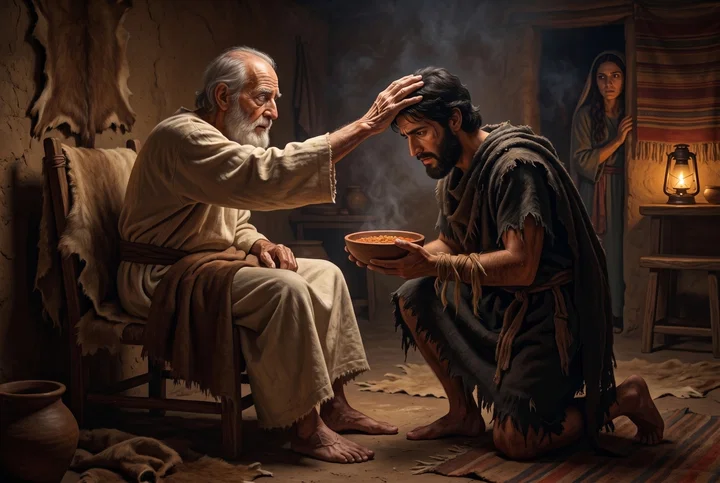
Jacob, aided and urged by his mother Rebekah, obtained the blessing intended for his brother by fraud, disguise, and deception of his aged blind father.ST Jul 31, 1901STST Jan 3, 1911ST Feb 28, 1906ST Jun 9, 1881 Rebekah overheard Isaac's promise to Esau and schemed so her own favorite, the younger son constantly by her side, would receive it instead through deceit and double-dealing.STST Feb 11, 1913ST Oct 1, 1902 The blessing was obtained by Jacob disguising himself as Esau, taking selfish advantage of Esau's need to obtain the birthright and then taking the father's blessing by wrong means.ST Apr 1, 1897ST Nov 18, 1897ST Nov 21, 1906 Isaac's dim sight allowed the substitution, and although Isaac had intended to bless Esau the blessing was spoken to Jacob.ST Feb 24, 1887ST Oct 1, 1902
The deception used Rebekah having Jacob kill kids while Esau hunted, preparing the meal, putting the skins on Jacob's neck and hands to imitate Esau's hairy skin, and sending him to personate Esau with the savory meal and Esau's garments.STST Dec 13, 1883ST Oct 1, 1902 Jacob's kiss served as a false sign of affection while he pursued his own ends, and the blessing was sealed in connection with the elder brother's garments.RH Sep 27, 1870ST Dec 13, 1883 The name Jacob means supplanter and describes his overreaching, mercenary, covetous character, shown when he took advantage of Esau's appetite to purchase the birthright and then took the father's blessing intended for Esau.ST Apr 1, 1897ST Nov 18, 1897ST Oct 1, 1902
Before the blessing Esau had already sold and despised his birthright without valuing it, trading it for temporary gratification and food that perishes with the using.ST Mar 30, 1888ST May 17, 1910STST Nov 18, 1897 Jacob had purchased the claim, taking advantage of Esau's hunger and reckless appetite for a mess of pottage.ST Apr 1, 1897ST Mar 31, 1881ST Nov 18, 1897ST Oct 1, 1902 Jacob valued these privileges, while Esau traded them for temporary gratification, and an honest presentation of Jacob's rightful claim would have been enough.ST May 17, 1910ST Mar 31, 1881 Esau afterward sought to inherit the blessing with tears and a great bitter cry, but was rejected and could not recover it or undo his deliberate sale.ST Mar 30, 1888ST Feb 23, 1915
Birthright Contents and Heir
The blessing recognizes, fixes and conveys the birthright, including the family priesthood, the inheritance of the father's dignity and position, patriarchal headship and precedence in all things, and a double share of the estate.RH Apr 14, 1859ST May 17, 1910 Uttered by holy and inspired lips and sealed by the father's kiss, it carries abundant riches and unconquerable might and wide dominion, going down like a rich heirloom to the future generations descended from its possessor.RH Apr 14, 1859 Its value as a great and magnificent possession is proved by Esau's great and exceeding bitter cry when it is gone from him and his line forever through his own folly and wickedness in despising his birthright.RH Apr 14, 1859
In this case the birthright also involved rulership in the family and lordship over brethren.RH Nov 18, 1862ST May 17, 1910 Together with these went the vast hopes of the glorious lineal descendant of Abraham in whom all the families of the earth would be blessed.RH Apr 14, 1859 It involved the line through whom Christ would come and, in a measure, the salvation of the human race, meaning Messiah was to be the Son of Jacob and not of Esau, fulfilled because Jesus descended from Jacob and not from Esau.RH Nov 18, 1862ST May 17, 1910 Jacob valued these privileges and believed God and remembered the promises made to Abraham and Isaac concerning their descendants, while Esau traded them for temporary gratification and was willing to trade the birthright and its promised blessing for a meal.ST May 17, 1910ST Oct 4, 1905
The blessing conveyed both spiritual blessings and abundant earthly provision to Jacob.RH Dec 30, 1915 Its material abundance is reflected in the promise of heaven's dew, fertile land, and plenty of food and wine, and Jacob's later life showed God blessing his work with family and possessions.RH Dec 30, 1915 The spiritual blessing involved the birthright and a place in God's kingdom, which Jacob ultimately received through faith, prayer, confession, and seeking forgiveness.RH Dec 30, 1915
The blessing was Isaac's priestly blessing consecrating the heir of the sacred covenant, the ancestral blessing associated with the firstborn.RH Apr 14, 1859ST Mar 31, 1881 God approved and sanctified Jacob's consecration because Jacob had already purchased the claim, though the deceitful scheme to obtain it was abhorred, since an honest presentation of his rightful claim would have been enough.ST Mar 31, 1881 Though God's design was for Jacob to receive it, Jacob obtains it through deception, and his selfish way of securing it brings painful consequences.
Divine Purpose and Providence
The blessing was Heaven's decree already laid upon Abraham and Isaac, promised to Jacob who would be a prince in Israel, passing in the line from Abraham through Isaac to Jacob and carrying the promised Seed.ST Jul 31, 1901ST Jan 14, 1913ST Oct 6, 1914 It meant Messiah was to be Son of Jacob and not of Esau, and this was fulfilled because Jesus descended from Jacob and not from Esau.RH Nov 18, 1862ST Oct 6, 1914 Jacob received it because he loved and honored God and was accepted by Him, while Esau belonged to another realm and was possessed by another spirit like Cain's.ST Dec 8, 1914 The family at the time focused on the promise in material and temporal terms without fully appreciating its spiritual blessings.ST Jan 14, 1913
God meant and designed both birthright and blessing for Jacob because of superior character, and God approved and sanctified Jacob's consecration because he had already purchased the claim.ST Mar 31, 1881ST Feb 26, 1894ST Feb 26, 1894 An honest presentation of his rightful claim would have been enough, for he obtained the blessing in spite of the deception and not because of it, though God abhorred the deceitful scheme devised with his mother.ST Mar 31, 1881ST Feb 26, 1894 In his unregenerate state he used his own wisdom to deceive, and his selfish way of securing what God designed to bestow in His own way brought painful consequences.ST Feb 26, 1894 Though greatly superior to Esau in morality, integrity and faith in God, he was still forced by the deception to separate from his mother whom he never saw again and to flee to Padan-aram to obtain a wife from his own relatives, after which Esau married one of the daughters of Ishmael.ST Feb 26, 1894ST Feb 26, 1894
The blessing spoken over Jacob in God's name with abundance from heaven and earth was prophetic and spiritual, in contrast with the blessing given to Esau in Isaac's own name.ST Sep 22, 1898 Jacob valued it above all else because he believed God and remembered the promises made to Abraham and Isaac concerning their descendants, and his desire for God's promise was right though his fraudulent method was not approved.ST Sep 1, 1909ST Oct 4, 1905 Those who held otherwise taught that he coveted it for temporal rather than spiritual ends, and that his effort to obtain it by fraud represents religionists who pursue worldly position and material gain while sacrificing principle and relying on human schemes, only to be utterly disappointed.ST Sep 1, 1909ST Oct 4, 1905
The words pronounced prosperity, yet prosperity itself depends on God and on the recipient's conduct and course of action, for God may bless or bring adversity.ST Apr 17, 1879ST Feb 24, 1887 One who loves and reverences God like Abel is accepted and blessed, while one who disregards God and follows a corrupt course like Cain is rejected, and Jacob could have received God's blessing through righteous living even without the privileges of the firstborn.ST Feb 24, 1887 The promise of God's purpose being fulfilled through Jacob did not make the fraud right or require the family to force that purpose by deceit.ST Apr 17, 1879 When God promises a blessing He will perform it at the proper time, and God makes no mistakes in shaping destinies when human plans cross His providence, so Rebekah's interference to secure the coveted blessing for her favorite son did not prevent Him from shaping her sons' destinies.ST Jul 31, 1901RH Oct 3, 1907 That Isaac blessed Jacob while passing Esau because his sight was dim proves love and knowledge in the creature can be estranged by ignorance and forgetfulness, while God is never subject to ignorance or forgetfulness but knows all things and knows who are His.RH Nov 4, 1858
Consequences and Discipline
Securing the blessing by human ingenuity and treachery roused Esau's hatred and vengeance with threats to kill Jacob, forcing Jacob to flee for his life from Canaan to distant Padan-aram in Mesopotamia.ST Jul 31, 1901RH Apr 26, 1870ST Feb 26, 1894ST Oct 1, 1902 That flight was a return to the land God had called Abraham out of, which Abraham would not re-enter nor allow Isaac to re-enter, and so was apostasy. It brought lifelong separation of mother and son, so Rebekah never saw her darling son again on earth, and even formal reconciliation with Esau waited over twenty years.ST Jul 31, 1901STST Feb 26, 1894ST Oct 1, 1902ST Jul 27, 1904
The selfish way of gaining the blessing brought many long years of hardship, difficulty, distress, guilt, danger, remorse, and fear that divine protection was forfeited.ST Jul 31, 1901STST Jan 9, 1912ST Jan 9, 1912ST Jul 27, 1904 Jacob had been his mother's best-loved son, humored and petted until home-loving and deeply attached to home and mother, yet at her urging he joined her mistaken deed of selfishness and fraud and as the logical outcome lost that home.ST Feb 11, 1913 He became a tenderly reared, home-loving youth turned lonely, weary, homesick wanderer in a strange and barren land, lying at night on bare ground under strange skies with staff by his side and a cold rock for bolster instead of a soft pillow, with aching heart full of thoughts of home and mother and feeling utterly forsaken of God and man as if his sins had separated him from heaven like a great gulf.ST Feb 11, 1913ST Jul 27, 1904 Yet a pitying God watched him and had not left him, but revealed love and care in the night vision of the ladder with angels sent to him in his dream.ST Feb 11, 1913ST Jul 27, 1904
God's providence brings retribution even when it seems slow, and Jacob's selfish plotting was followed by suffering that showed evil brings its own recompense.ST Jan 9, 1912ST Jan 9, 1912 The wrong he did toward his brother and his deceit toward his father returned upon him, so that a person reaps the harm he has done and his sin followed him.ST Jun 9, 1881RH Apr 26, 1870ST Mar 31, 1881 He was deceived and treated with deceit and cruelty by Laban, and was deceived by his own sons and children through long family sorrows including the false report about Joseph.ST Jun 9, 1881RH Mar 30, 1869RH Apr 26, 1870ST Mar 31, 1881RH Mar 30, 1869
Deception is peculiarly abhorrent to God, and Jacob's duplicity in securing the blessing was wicked and not approved.RH Mar 30, 1869ST Mar 31, 1881ST Mar 30, 1888RH Mar 30, 1869 Even where repentance is accepted and eternal life assured, and even though the sinner is forgiven, the guilty are still left to suffer bitter consequences and grievous chastisement in this life.ST Jun 9, 1881RH Mar 30, 1869RH Mar 30, 1869 Yet his crude, uninstructed faith enabled God to work toward his complete moral reformation.ST Mar 30, 1888
That chastisement through perplexing trials was sent to develop thorough repentance, deep and thorough change of heart, and perfect trust, and to remit the shameful error.STRH Apr 8, 1875ST Jul 21, 1881 The greatest of the trials was wrestling with the angel for deliverance, which placed him among heroes of faith and among the Israel of God.STRH Apr 8, 1875 His plea was heard and his life was mercifully preserved, and his anguish and prayer with no concealed wrongs became a pattern for God's people in the coming time of trouble when pleading with God.RH Nov 14, 1912 His remembered prosperity was acknowledged as God's favor, his long-continued afflictions were closed forever and the rod withdrawn when he went down into Egypt, where the sojourn assigned by Providence ripened him for the kingdom of God and his life ended in heavenly brightness.ST Jul 21, 1881
The deception had a direful effect upon posterity to the latest generation, which Jacob was favored to foresee with clearer discovery than ever of the heinousness of his sin, seeing how as centuries passed his posterity would become more and more deceitful and covetous and wicked until the end.RH Oct 4, 1864 The return to Mesopotamia foreshadowed later apostasy, when his posterity after deliverance from Egyptian bondage and planting in Canaan would be carried captive back to that country. Esau's animosity likewise affected his descendants for hundreds of years, so they refused Israel passage from Egypt to Canaan and Israel afterward could only subdue Edom by warfare with no moral influence upon them.ST Oct 1, 1902
Moral and Typological Application
Believers should not grow impatient or try to help God out by human wisdom, works and schemes to force His purpose, but quietly wait until ready to receive it, for when God promises a blessing He will perform it at the proper time in due time.ST Jul 31, 1884ST Jul 31, 1901STRH Nov 16, 1916ST Feb 17, 1914 Rebekah and Jacob acted as if God could not fulfill His promises without their help, failing to trust Him and wait for His timing and taking matters into their own hands to bring about His word through human effort and deception of the father while Esau was in the fields hunting.ST Jul 31, 1884STRH Nov 16, 1916ST Feb 17, 1914RH Jul 8, 1915 That lack of faith was first seen in Abraham and is found at the basis of all union of church and state, and the human ingenuity and scheming behind gaining the blessing brought self-reproach, lasting loss, lifelong separation of mother and son, and many long years of hardship, difficulty and distress in a distant country.ST Jul 31, 1901STRH Nov 16, 1916 The blessing Heaven had decreed upon Abraham and Isaac had been promised to Jacob who would be a prince in Israel, and God would have fulfilled the promise in due time if Jacob had waited, yet Rebekah urged him into deception because she wanted him to receive the blessing and divine favor.ST Jul 31, 1884ST Jul 31, 1901RH Nov 16, 1916 Jacob's desire for God's promise and blessing was right, for he valued it above all else, believed God and remembered the promises made to Abraham and Isaac concerning their descendants, while Esau was willing to trade the birthright and its promised blessing for a meal.RH Aug 17, 1869ST Oct 4, 1905 His method of selfish plotting, treachery, unrighteous coveting and guile and dissimulation to obtain his father's inheritance was not approved, and his coveting of Esau's blessing is covetousness which is idolatry violating the first and second commandments.RH Aug 17, 1869ST Oct 4, 1905 His conduct is a good man's sin set as example and not permission for others to imitate it, though God regarded his repentance.RH Aug 17, 1869ST Oct 4, 1905
The fruit of favoritism in the home is bitter and unpleasant, for Isaac favored Esau and Rebekah favored Jacob.STST Feb 11, 1913 Isaac intended the blessing for Esau as the favored firstborn after Esau brought venison from the fields and made savory food for his aged father's appetite, and Esau had already sold his birthright without valuing it yet hoped by feeding his father to secure the blessing.ST Rebekah overheard Isaac's promise to Esau and schemed with deceit and double-dealing so her own favorite, the handsome younger son constantly by her side, humored and petted until home-loving and loving home and especially his fond mother deeply, would receive it instead.STST Feb 11, 1913 At her suggestion and urging he joined her mistaken selfish fraud to gain the blessing, and as the logical outcome at sad cost he lost that home and became a tenderly reared and home-loving young man turned lonely, weary and homesick wanderer in a strange and barren land, lying down at night under strange skies with staff by his side and a cold rock for a bolster instead of a soft pillow, with aching heart full of thoughts of home and mother, watched by a pitying God who sent angels to him that night in his dream, leaving Rebekah separated from her darling son whom she never saw again on earth.STST Feb 11, 1913 One person's influence can lead another into error and exile, as Jacob was led into wrongdoing through his mother's influence when he sided with his mother in deceiving his father.ST Apr 12, 1883RH Jan 7, 1873 Siding in sympathy with the wrong party is a wrong act whose influence has no end but lives on destroying precious souls for whom Christ died until the Judgment, and even when the wrongdoer is saved through pardoning love there is loss where there might have been eternal gain, for this deception forced Jacob to flee for his life to a stranger's land and in after years nearly proved the ruin of himself and his family and his substance.ST Apr 12, 1883RH Jan 7, 1873
Jacob the supplanter types religionists who treat the Lord's blessing as largely temporal place and position and material gain instead of spiritual, in contrast to the spiritual blessing Jacob sought.ST Nov 18, 1897ST Sep 1, 1909 He shows desire for the Lord's blessing even by wrong means after taking selfish advantage of Esau's need to obtain the birthright, while Esau in selling his birthright for food that perishes with the using represents those who have no faith, children of unbelief and disobedience.ST Nov 18, 1897ST Sep 1, 1909 As supplanter he represents a religious class seeking the blessing by might or right, by any means, by principle or policy, by right or expediency, sacrificing principle, taking the suggestions of the faithless, and uniting with the world and the State, only to be utterly disappointed at last.STST Nov 18, 1897ST Sep 1, 1909 Believers receive the Heavenly Father's blessing clothed in Christ's righteousness through the elder brother's garments, for Christ is the firstborn among many brethren.ST Dec 13, 1883
Jacob's anguish and prevailing prayer for deliverance, with his plea heard and his life mercifully preserved, is presented as a pattern for God's people in the coming time of trouble when pleading with God, when they must have confessed their sins and have no concealed wrongs to hinder their confidence.RH Nov 14, 1912 The story stands among the outgoings and incomings of Abraham and Ishmael, Isaac in the fields at eventide, Rebekah at the well, Jacob's guile toward Esau whose face was reddened by desert sun-heat, and Joseph's splendid funeral procession.RH Feb 22, 1912 It shows indubitable human existence in a half-peopled world of bleating flocks, tinkling camel bells, and green pastoral rest.RH Feb 22, 1912
Sources