Genesis 48:20
And he blessed them that day, saying, In thee shall Israel bless, saying, God make thee as Ephraim and as Manasseh: and he set Ephraim before Manasseh.
Translations
And he blessed them that day, saying, In you shall Israel bless, saying, God make you as Ephraim and as Manasseh: and he set Ephraim before Manasseh.
King James Version, KJV Cambridge Paragraph Bible, Webster Bible, Revised Version
And he blessed them that day, saying, In thee shall Israel bless, saying, God make thee as Ephraim and as Manasseh: and he set Ephraim before Manasseh.
And he blessed them that day, saying, In thee will Israel bless, saying, God make thee as Ephraim and as Manasseh: and he set Ephraim before Manasseh.
and he blesseth them in that day, saying, 'By thee doth Israel bless, saying, God set thee as Ephraim and as Manasseh;' and he setteth Ephraim before Manasseh.
And he blessed them that day, saying, In thee will Israel bless, saying, God make thee as Ephraim and Manasseh! And he set Ephraim before Manasseh.
And he blessed them on that day, saying—In thee, let Israel bless himself saying, God set thee as Ephraim, and as Manasseh! So he set Ephraim before Manasseh.
Berean Standard Bible, Majority Standard Bible
So that day Jacob blessed them and said:
“ By you shall Israel pronounce this blessing:
‘ May God make you like Ephraim and Manasseh.’”So he put Ephraim before Manasseh.He blessed them that day, saying, “ Israel will bless in your name, saying, ‘God make you as Ephraim and as Manasseh’” He set Ephraim before Manasseh.
So he gave them his blessing that day, saying, You will be the sign of blessing in Israel, for they will say, May God make you like Ephraim and Manasseh; and he put Ephraim before Manasseh.
So he blessed them that day, and sayde, In thee Israel shall blesse, and say, God make thee as Ephraim and as Manasseh. and he set Ephraim before Manasseh.
Douay-Rheims (Challoner revision)
And he blessed them at that time, saying: In thee shall Israel be blessed, and it shall be said: God do to thee as to Ephraim, and as to Manasses. And he set Ephraim before Manasses.
Pictures
Cross-references
- Genesis 48:16
The Angel which redeemed me from all evil, bless the lads; and let my name be named on them, and the name of my fathers Abraham and Isaac; and let them grow into a multitude in the midst of the earth.
Jacob invokes God to bless Joseph’s sons and multiply them.
- Jeremiah 31:9
They shall come with weeping, and with supplications will I lead them: I will cause them to walk by the rivers of waters in a straight way, wherein they shall not stumble: for I am a father to Israel, and Ephraim is my firstborn.
Both texts call younger Ephraim the firstborn.
- 1 Chronicles 5:1
Now the sons of Reuben the firstborn of Israel, (for he was the firstborn; but, forasmuch as he defiled his father’s bed, his birthright was given unto the sons of Joseph the son of Israel: and the genealogy is not to be reckoned after the birthright.
Joseph receives Reuben’s birthright, fulfilled as Ephraim and Manasseh are blessed separately.
- Exodus 4:22
And thou shalt say unto Pharaoh, Thus saith the LORD, Israel is my son, even my firstborn:
Israel receives firstborn status by God's choice, not by age.
- Hebrews 11:21
By faith Jacob, when he was a dying, blessed both the sons of Joseph; and worshipped, leaning upon the top of his staff.
Jacob blessed Joseph’s sons by faith.
- Genesis 25:23
And the LORD said unto her, Two nations are in thy womb, and two manner of people shall be separated from thy bowels; and the one people shall be stronger than the other people; and the elder shall serve the younger.
The elder serves the younger, as Ephraim is placed before Manasseh.
- 1 Chronicles 5:2
For Judah prevailed above his brethren, and of him came the chief ruler; but the birthright was Joseph’s:)
Contrasts Judah’s rulership with Joseph’s birthright.
- Jeremiah 7:15
And I will cast you out of my sight, as I have cast out all your brethren, even the whole seed of Ephraim.
Ephraim is named among Israel’s people cast out of God’s sight.
- Genesis 27:28-29
Therefore God give thee of the dew of heaven, and the fatness of the earth, and plenty of corn and wine:
Isaac blesses Jacob with prosperity and rule over his brother.
- Psalms 78:67
Moreover he refused the tabernacle of Joseph, and chose not the tribe of Ephraim:
God rejects the tribe of Ephraim after Jacob placed Ephraim before Manasseh.
- Revelation 21:12
And had a wall great and high, and had twelve gates, and at the gates twelve angels, and names written thereon, which are the names of the twelve tribes of the children of Israel:
Israel's tribes remain in God's spiritual numbering.
Commentary
Each commentary is drawn from primary sources: the writings of Ellen G. White and Adventist pioneers and periodicals. Each commentary is separate. Its own words are not a quotation; follow the references to read the source passages.
Ellen G. White
3 sources
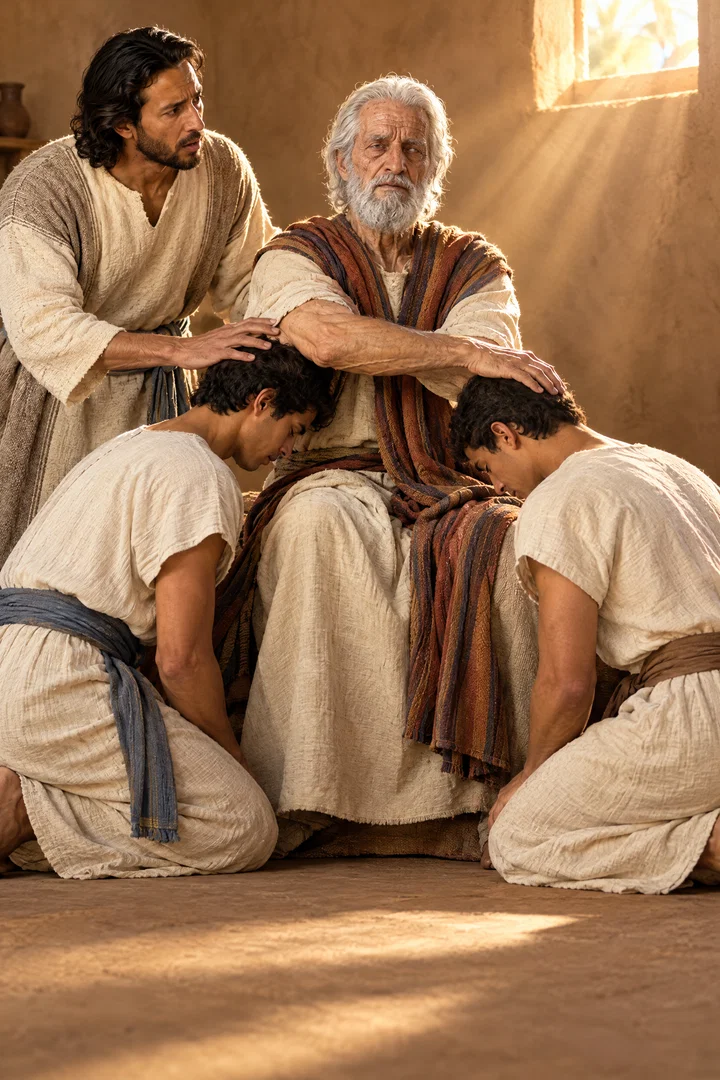
In the verse a father blesses his children by laying his hands reverently upon their heads.3SP 349.1–2SLP 44.1RH May 11, 1911 This was the act of a Jewish father when blessing his children.SLP 44.1 The laying on of hands means asking God to bestow His blessing upon those who receive it.SLP 44.1RH May 11, 1911
There is no power inherent in the act itself to impart the blessing.RH May 11, 1911 The laying on of hands by the ministers at Antioch upon the apostles meant the same thing.SLP 44.1 It was asking God to bestow His blessing upon them in their devotion to the specific work God had chosen them to do.SLP 44.1
Sources
Pioneers and periodicals
17 sources
Jacob in his final days in Egypt adopted Joseph's two sons as his own among the tribes and blessed them by laying his hands on their heads to ask God to bless them.RH May 11, 1911ST Jul 15, 1913ST Jan 28, 1913ST Apr 23, 1894 He knowingly crossed his hands to set the younger Ephraim before the elder Manasseh, and gave the form by which Israel would bless in time to come by asking God to make others like Ephraim and Manasseh.ST May 12, 1890ST Jan 10, 1911ST Nov 10, 1914ST Dec 1, 1898ST Apr 23, 1894 In that act he prophesied that Ephraim would become greater than Manasseh, carrying Joseph's share of Reuben's forfeited birthright as a double portion through two sons united under the name Ephraim.ST Jul 15, 1913ST Dec 1, 1898 Firstborn standing rests on preeminence and bestowed right rather than order of birth, so Christ remains the First-born from the dead even though others were raised before Him, as the One by whose work all others are brought from the dead.ST Nov 15, 1910ST Oct 29, 1902ST Jun 26, 1907 God by deliberate blessing fixes an order that must be kept, so as Ephraim was set before Manasseh faith was set before baptism in He that believeth and is baptized, and to reverse it is unlawful.RH Mar 28, 1871
Wording and Historical Setting
Jacob's blessing of Joseph's sons belongs to his final days after Israel's journey down into Egypt.ST Jan 28, 1913 It stands at the completion of the story of Joseph after his meeting with his brethren, the fulfilment of his dreams, and the taking of his father down into Egypt.ST Jan 28, 1913 It comes before the death of the old patriarch Jacob and finally the death of Joseph.ST Jan 28, 1913 It is part of the account of God's care for preserving the forebears of the promised Seed.
In the blessing Jacob adopts Joseph's sons, taking Ephraim and Manasseh among the twelve tribes as his own sons.ST Jul 15, 1913ST Jan 28, 1913ST Apr 23, 1894 He blessed them by laying his hands on their heads.RH May 11, 1911 That laying on of hands was a gesture asking God to bless them, distinct from any power inherent in the act itself.RH May 11, 1911
The blessing gives the form for Israel's future blessing, that people would ask God to make others like Ephraim and Manasseh.ST May 12, 1890ST Dec 1, 1898 The word for bless can also carry the sense of bidding farewell when someone departs, as in this farewell blessing to Joseph's sons.RH Jan 23, 1913 The younger son Ephraim is named before the elder Manasseh because he is more notable, so order of names alone does not establish birth order.ST May 12, 1890ST Dec 1, 1898
Birthright Prophecy and Fulfillment
Jacob knowingly set Ephraim before Manasseh even though Manasseh was the elder by birth, crossing his hands to give the younger son preeminence in the blessing.ST Jan 10, 1911ST Nov 10, 1914ST Apr 23, 1894 His dimness of sight caused no mistake, for he deliberately delivered the message entrusted to him by God.ST Nov 10, 1914 In that act he also adopted Joseph's sons as his own sons.ST Apr 23, 1894 The later prominence of Ephraim confirmed that no error had been made, and birth order by itself does not secure favor with God.ST Jan 10, 1911ST Nov 10, 1914
In setting the younger before the elder he prophesied that Ephraim would become greater than Manasseh.ST Jul 15, 1913ST Dec 1, 1898 The order of the names preserves that prophecy, placing Ephraim before Manasseh in keeping with the blessing that the younger brother would become greater.ST Dec 1, 1898 The blessing also established Ephraim and Manasseh as the pattern for Israel's future blessing, so that Israel would ask God to make others like them.ST Dec 1, 1898
That setting of Ephraim before Manasseh carried Joseph's share of Reuben's forfeited birthright.ST Jul 15, 1913 The double portion of the inheritance came through the adoption of Joseph's two sons as sons of Jacob, and that double portion was united under the name Ephraim.ST Jul 15, 1913 This preeminence continued after Solomon, when the ten tribes were ranged under Ephraim, so that Ephraim is spoken of as having the birthright.ST Jul 15, 1913 That standing lasted until God cast off Ephraim when the ten tribes turned away.ST Jul 15, 1913
The passage names Ephraim and Manasseh as distinct tribes.ST Oct 13, 1881 That distinct naming stands against the claim that English people are Ephraim and Americans are Manasseh, since ancestry cannot change merely by crossing the Atlantic.ST Oct 13, 1881
Doctrine and Life Application
Firstborn standing rests on preeminence and bestowed right rather than order of birth, for Manasseh was older than Ephraim by birth yet Ephraim received the birthright and was set before Manasseh.ST Nov 15, 1910ST Oct 29, 1902 Firstborn therefore means pre-eminence and right, not merely being born first, and can express preeminence rather than priority in time, since Ephraim was given precedence over Manasseh and called firstborn in rank although Manasseh was born first.ST Oct 29, 1902ST Jun 26, 1907 So Christ remains the First-born from the dead even though others were raised before Him, because He is first by preeminence as the One by virtue of whose offering and work all others are brought from the dead.ST Nov 15, 1910ST Oct 29, 1902
God set Ephraim before Manasseh by deliberate blessing, fixing an order that must be kept.RH Mar 28, 1871 Divine order matters and is not left to human choice, so it is unlawful to treat mode or order as unimportant or to do the opposite of what God appointed.RH Mar 28, 1871 Applied to baptism, as Ephraim was set before Manasseh so faith was set before baptism in He that believeth and is baptized, and to baptize before faith reverses God's order.RH Mar 28, 1871 Birth order does not guarantee favor with God, as seen when Jacob blessed Joseph's sons and placed Ephraim before Manasseh though Manasseh was older.ST Jan 10, 1911
The history of Joseph to which this blessing belongs shows that God guides people to the purpose He has for them even when the way there is indirect.RH Jan 19, 1860 God's providence can direct events rightly even when human plans interfere, as illustrated when Jacob blessed Joseph's sons and placed Ephraim before Manasseh.RH Oct 3, 1907 The life of Joseph contains principles designed to guide dealing with the various contingencies of life, and its underlying principles are to be discovered so that those called to pass through similar experiences may be helped and guided by the example.ST Nov 29, 1905 The variety of human experiences recorded in Scripture means this blessing has its counterpart in experiences people may go through, and its practical lesson is to be as familiar as one's own name for the soul's good and for giving counsel to others in similar difficulties, as part of the Word of God to be trusted as a guidebook till the very end.ST Nov 29, 1905
Sources