Isaiah 13:20
It shall never be inhabited, neither shall it be dwelt in from generation to generation: neither shall the Arabian pitch tent there; neither shall the shepherds make their fold there.
Translations
It shall never be inhabited, neither shall it be dwelled in from generation to generation: neither shall the Arabian pitch tent there; neither shall the shepherds make their fold there.
King James Version, Webster Bible
It shall never be inhabited, neither shall it be dwelt in from generation to generation: neither shall the Arabian pitch tent there; neither shall the shepherds make their fold there.
It shall never be inhabited,
Neither shall it be dwelt in from generation to generation:
Neither shall the Arabian pitch tent there;
Neither shall the shepherds make their fold there.Revised Version, American Standard Version
It shall never be inhabited, neither shall it be dwelt in from generation to generation: neither shall the Arabian pitch tent there; neither shall shepherds make their flocks to lie down there.
She doth not sit for ever, Nor continueth unto many generations, Nor doth Arab pitch tent there, And shepherds lie not down there.
It shall never be inhabited, neither shall it be dwelt in, even to generation and generation; nor shall Arabian pitch tent there, nor shepherds make fold there.
It shall not be dwelt in for ever, Neither shall it be inhabited from generation to generation,—Neither shall encamp there, an Arab, Nor, shepherds, fold their flocks there.
Berean Standard Bible, Majority Standard Bible
She will never be inhabited
or settled from generation to generation;
no nomad will pitch his tent there,
no shepherd will rest his flock there.It will never be inhabited, neither will it be lived in from generation to generation. The Arabian will not pitch a tent there, neither will shepherds make their flocks lie down there.
People will never be living in it again, and it will have no more men from generation to generation: the Arab will not put up his tent there; and those who keep sheep will not make it a resting-place for their flocks.
It shall not bee inhabited for euer, neither shall it be dwelled in from generation to generation: neither shall the Arabian pitch his tents there, neither shall the shepheardes make their foldes there.
Douay-Rheims (Challoner revision)
It shall no more be inhabited for ever, and it shall not be founded unto generation and generation: neither shall the Arabian pitch his tents there, nor shall shepherds rest there.
Pictures
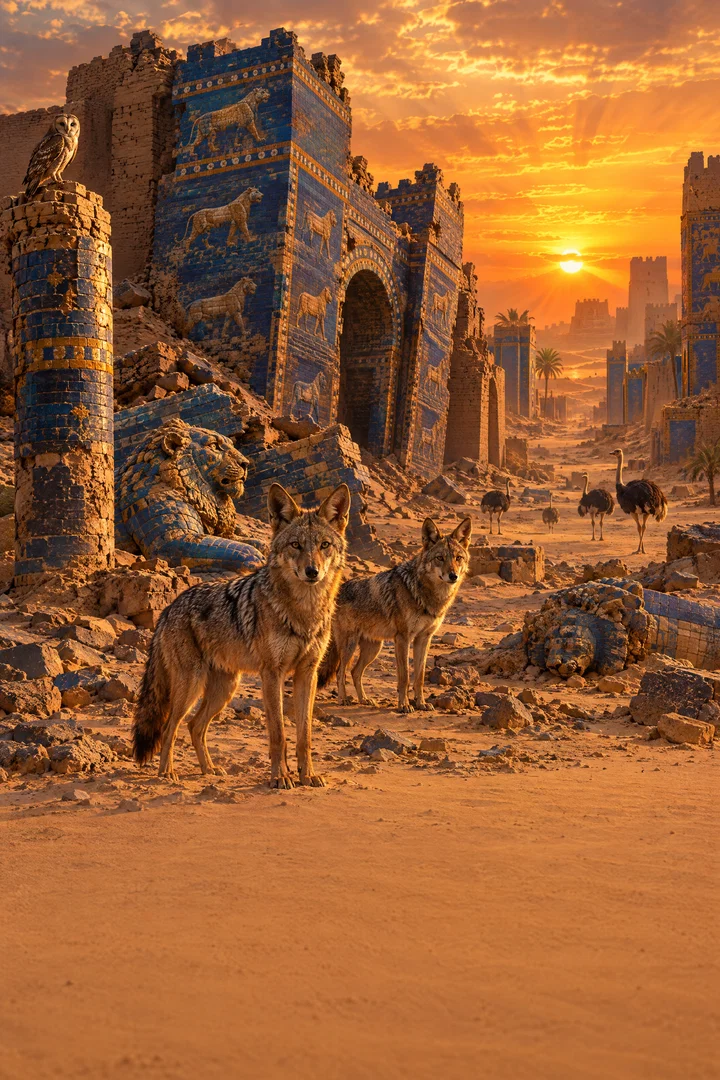
Cross-references 20 of 23
- Jeremiah 51:37
And Babylon shall become heaps, a dwellingplace for dragons, an astonishment, and an hissing, without an inhabitant.
Both describe Babylon as ruins, desolate and without inhabitants.
- Isaiah 14:23
I will also make it a possession for the bittern, and pools of water: and I will sweep it with the besom of destruction, saith the LORD of hosts.
Both foretell Babylon’s destruction and desolate condition.
- Jeremiah 50:39
Therefore the wild beasts of the desert with the wild beasts of the islands shall dwell there, and the owls shall dwell therein: and it shall be no more inhabited for ever; neither shall it be dwelt in from generation to generation.
Both foretell Babylon’s lasting desolation and its remaining uninhabited.
- Revelation 18:2
And he cried mightily with a strong voice, saying, Babylon the great is fallen, is fallen, and is become the habitation of devils, and the hold of every foul spirit, and a cage of every unclean and hateful bird.
Babylon’s fall brings desolation, echoing Isaiah’s prophecy of Babylon’s ruin.
- Isaiah 47:11
Therefore shall evil come upon thee; thou shalt not know from whence it riseth: and mischief shall fall upon thee; thou shalt not be able to put it off: and desolation shall come upon thee suddenly, which thou shalt not know.
Babylon’s boastful confidence is followed by sudden destruction.
- Jeremiah 50:13
Because of the wrath of the LORD it shall not be inhabited, but it shall be wholly desolate: every one that goeth by Babylon shall be astonished, and hiss at all her plagues.
Both foretell Babylon becoming desolate and uninhabited.
- Isaiah 44:26-28
That confirmeth the word of his servant, and performeth the counsel of his messengers; that saith to Jerusalem, Thou shalt be inhabited; and to the cities of Judah, Ye shall be built, and I will raise up the decayed places thereof:
Foretells Babylon’s fall and names Cyrus as its conqueror.
- Jeremiah 51:25-26
Behold, I am against thee, O destroying mountain, saith the LORD, which destroyest all the earth: and I will stretch out mine hand upon thee, and roll thee down from the rocks, and will make thee a burnt mountain.
Both describe Babylon’s destruction and lasting desolation.
- Jeremiah 51:58
Thus saith the LORD of hosts; The broad walls of Babylon shall be utterly broken, and her high gates shall be burned with fire; and the people shall labour in vain, and the folk in the fire, and they shall be weary.
Babylon’s walls and gates are destroyed as part of its downfall.
- Genesis 19:24-25
Then the LORD rained upon Sodom and upon Gomorrah brimstone and fire from the LORD out of heaven;
Babylon’s overthrow is compared with Sodom and Gomorrah.
- Daniel 5
Belshazzar the king made a great feast to a thousand of his lords, and drank wine before the thousand.
Belshazzar’s feast accompanies Babylon’s fall.
- Daniel 4:29-30
At the end of twelve months he walked in the palace of the kingdom of Babylon.
proud building that precedes prophesied fall
- Isaiah 45:1
Thus saith the LORD to his anointed, to Cyrus, whose right hand I have holden, to subdue nations before him; and I will loose the loins of kings, to open before him the two leaved gates; and the gates shall not be shut;
Cyrus is identified in advance as the conqueror who would open Babylon’s gates.
- Jeremiah 51:62
Then shalt thou say, O LORD, thou hast spoken against this place, to cut it off, that none shall remain in it, neither man nor beast, but that it shall be desolate for ever.
Speaks of Babylon becoming desolate and uninhabited.
- Jeremiah 25:12
And it shall come to pass, when seventy years are accomplished, that I will punish the king of Babylon, and that nation, saith the LORD, for their iniquity, and the land of the Chaldeans, and will make it perpetual desolations.
Both foretell Babylon’s punishment and lasting desolation.
- Jeremiah 51:43
Her cities are a desolation, a dry land, and a wilderness, a land wherein no man dwelleth, neither doth any son of man pass thereby.
Babylon’s cities are described as desolate and uninhabited.
- Jeremiah 50:3
For out of the north there cometh up a nation against her, which shall make her land desolate, and none shall dwell therein: they shall remove, they shall depart, both man and beast.
Also foretells Babylon’s desolation.
- Jeremiah 51:29
And the land shall tremble and sorrow: for every purpose of the LORD shall be performed against Babylon, to make the land of Babylon a desolation without an inhabitant.
Foretells the land becoming desolate.
- Isaiah 34:11
But the cormorant and the bittern shall possess it; the owl also and the raven shall dwell in it: and he shall stretch out upon it the line of confusion, and the stones of emptiness.
Both describe beasts dwelling in ruined earth.
- Daniel 5:30-31
In that night was Belshazzar the king of the Chaldeans slain.
Persian takes city at midnight feast
Commentary
Each commentary is drawn from primary sources: the writings of Ellen G. White and Adventist pioneers and periodicals. Each commentary is separate. Its own words are not a quotation; follow the references to read the source passages.
Ellen G. White
2 sources
Babylon after judgment is left in lasting desolation, never to be inhabited nor dwelt in from generation to generation.PK 533.1PK 532.4 The desolation is total and continuing, with no return to dwelling across successive generations.PK 533.1PK 532.4 Once the glory of kingdoms, it is brought down to the condition of Sodom and Gomorrah.PK 532.4 In that overthrow it is permanently laid waste, a place made desolate rather than restored.PK 532.4
Not even Arabian nomads pitch tent there, refusing it as a camping place.PK 533.1PK 532.4 Neither do shepherds make their fold there nor use it as a home for themselves and their flocks.PK 533.1PK 532.4 Both the wandering tent-dweller and the shepherd seeking pasture leave it alone, so that neither temporary shelter nor pastoral use remains.PK 533.1PK 532.4
Sources
Pioneers and periodicals
63 sources
The verse foretells the utter and permanent desolation of literal Babylon, the glory of kingdoms, so that it would never again be settled nor even used for a night by wandering Arabs pitching tents or by shepherds folding flocks.ST Oct 7, 1930ST Feb 13, 1912RH May 13, 1915ST Apr 28, 1914 Its overthrow is likened to Sodom and Gomorrah when God overthrew them, leaving it wholly empty and given over to desert creatures and marshes.ST May 31, 1910ST Sep 10, 1885ST Aug 25, 1898 That word has been fulfilled literally and exactly to the letter, for the mighty city decayed step by step into shapeless mounds where no one dwells and where Arabs will not camp and shepherds make no fold.RH May 13, 1915ST Apr 28, 1914ST Jul 23, 1912ST May 23, 1911ST Aug 8, 1900 It stands as an imposing monument to God's power to read the future, so that even Alexander's attempt to restore Babylon failed and his early death left the word unbroken forever.ST Jul 23, 1912ST Feb 13, 1912ST Aug 25, 1898ST Oct 27, 1909ST Feb 13, 1912 From the near judgment on literal Babylon the prophecy passes to the greater destruction of mystical Babylon at the great day of the Lord, making the ancient ruin a type and warning of the final overthrow of an apostate, arrogant world.ST Mar 6, 1901ST May 27, 1875RH Jun 19, 1900RH Feb 18, 1875
Wording and Setting
The verse stands in the series of burdens upon Babylon, Philistia, Moab and other nations in Isaiah 13-23, which is the third section of the first part of the book in Isaiah 1-39, spoken between 760 and 698 B.C. in the reigns of Uzziah, Jotham, Ahaz and Hezekiah.ST May 28, 1912 It foretells the destruction and doom of literal Babylon, the glory of kingdoms, including its capture, conquest and eventual desolation.ST Oct 7, 1930RH Aug 4, 1859ST Dec 24, 1896ST Jan 15, 1880 It is part of the predictions concerning the proud city that joined religion with state power, whose existence would end under God's judgment.RH Aug 4, 1859ST Dec 24, 1896RH Nov 26, 1857
It means Babylon would never be inhabited nor dwelt in from generation to generation, becoming permanently empty and unoccupied in every future age, with no settled dwellers and no temporary use by Arabian nomads pitching tents or by shepherds making folds for flocks.ST Feb 13, 1912RH May 13, 1915ST Apr 28, 1914RH Nov 11, 1862ST May 23, 1911 It declares the city would remain uninhabited from one generation to another, so completely desolate that neither Arabs would camp there nor shepherds keep their flocks there.RH May 13, 1915ST Apr 28, 1914RH Nov 11, 1862ST May 23, 1911RH May 13, 1915 Its overthrow is likened to Sodom and Gomorrah when God overthrew them, leaving it wholly and permanently desolate, given over to desert animals and swept into marshes.ST May 31, 1910ST Sep 10, 1885ST Aug 25, 1898RH Jun 19, 1900ST Jun 10, 1913
It was spoken while Babylon was still the mightiest city of the world with its period of greatest glory and height under Nebuchadnezzar yet before it, when its defenses, provisions, mighty walls, brazen gates, temples, palaces and hanging gardens made its fall seem unlikely and human sagacity could not have foreseen it.RH May 13, 1915RH Nov 11, 1862ST Jun 10, 1913ST Jan 27, 1881ST Aug 25, 1898 Though so substantially built that men thought it must stand forever, God decreed its complete end, to remain empty and unused even for temporary shelter by travelers or shepherds, and to become a home for wild creatures.ST Jun 10, 1913ST Sep 10, 1885ST Jan 27, 1881ST Oct 27, 1909ST Jul 13, 1904 The word was spoken about 2,600 years ago, nearly 150 years before Cyrus the Great overthrew the city.ST Jul 23, 1912ST Jul 23, 1912 It was spoken about 200 years before Alexander the Great.ST Feb 13, 1912
The political fall of Babylon's rule to the Medes and Persians came about 175 years after the prophecy, yet did not at once fulfill the desolation, for the city itself remained populous and prosperous and beautiful under Medo-Persia and later under the Greeks, and as late as the first century of the Christian era its palaces on the Euphrates were still roofed with bronze and adorned with silver and gold.RH May 13, 1915 The verse was given about 700 years before Christ, and Babylon fell in 538 before the conquering armies of Cyrus king of Persia.ST Jun 10, 1913
Literal Fulfilment in Ruins
The desolation foretold has come to pass literally and markedly to the letter, not in a spiritual or general sense, as any eastern traveler can see today, with the city remaining uninhabited from generation to generation, no settled dwellers and no temporary use by desert nomads pitching tents or shepherds making folds for flocks.ST Jul 23, 1912ST May 23, 1911ST Jan 27, 1881ST Aug 25, 1898ST Oct 11, 1905 The word declares with minute particularity that Babylon, the glory of kingdoms, would be overthrown like Sodom and Gomorrah and never inhabited again, left to wild beasts, though it possessed mighty walls, brazen gates, magnificent temples and palaces and hanging gardens as one of the wonders of the world, and its ruins today hold not one living human being.ST Aug 8, 1900ST Jan 27, 1881ST Aug 25, 1898 The complete destruction did not occur when the Persians overthrew it, for after reaching its height and after Alexander died there the city gradually fell into decay, diminished under Persian rule, and remained desolate for many centuries.ST Aug 8, 1900ST Jun 10, 1913ST Apr 23, 1896
The political fall of its rule to the Medes and Persians about one hundred seventy-five years after the prophecy did not at once fulfill the desolation, for the city itself remained populous and prosperous and beautiful under Medo-Persia and later under the Greeks, and as late as the first century of the Christian era its palaces on the Euphrates were still roofed with bronze and adorned with silver and gold.RH May 13, 1915 It fell in 538 before the conquering armies of Cyrus king of Persia, and from that time its decay was rapid until its sun-dried brick and other buildings had utterly crumbled and desert sands swept over the ruined city until its very place was disputed.ST Jun 10, 1913 The abandonment was already underway while the word remained certain, with its walls long used as a quarry for Seleucia on the Tigris until the city could be described as in great part deserted, a great city become a great desert, its inhabitants moved elsewhere and its walls dismantled for building materials.RH May 13, 1915ST Apr 23, 1896
The ruin came step by step to make the deserted heap a habitation for beasts of the desert, with houses full of doleful creatures, wild beasts crying in desolate houses and dragons in pleasant palaces.ST Cyrus removed the imperial seat to Susa, and after the Babylonian rebellion Darius took away the brazen gates and lowered the walls from two hundred cubits to fifty, leaving it exposed to every hostile band.ST Xerxes plundered the temple of Belus and laid it in ruins, Alexander's attempt to rebuild failed, Seleucus built a new city nearby drawing away inhabitants and material, Parthian violence hastened ruin, it was used as an enclosure for wild beasts, and the ruins of Nebuchadnezzar's palace became so full of serpents and venomous reptiles they could not be closely inspected, until scarcely enough ruins are left to mark the spot where stood the largest, richest and proudest city the earth has seen.ST
No living soul abides on the site of ancient Babylon, for there are no ruins in the common sense, no arches, no pillars, scarcely masonry, but vast shapeless unsightly heaps or mounds scattered over the region, with soil between the heaps of pottery and brick fragments deeply impregnated with nitre.RH May 13, 1915ST Apr 28, 1914 The site stretches for miles in mounds and ruins through desert that was once the most fertile country in the world, including a portion of a tower identified as the Tower of Babel and the vast ruined palace of Nebuchadnezzar with its decorations, pillars and great halls, now waste and deserted along the Euphrates.ST Nov 29, 1910ST Feb 20, 1912 Arabs avoid even temporary pitching of tents on the site as a place under a curse, and the only Arabs who stop there are temporary helpers in excavation work.RH May 13, 1915 Arab laborers employed in excavating Nebuchadnezzar's palace built their mud huts off the site in the bed of the ancient Euphrates, whose course has now shifted half a mile farther west.RH May 13, 1915ST Apr 28, 1914
Arab guides will not remain at the ruins after sunset and say no Arab has ever seen the sun set there.ST Jul 15, 1908ST Mar 6, 1907 Travelers reported Arabs avoided camping because they feared evil spirits and believed the ruins haunted, and shepherds did not make folds there at night.ST Feb 13, 1912RH Nov 11, 1862RH Apr 18, 1912 A sheik refused to stay even when offered a large payment, illustrating that local people would not camp there.ST Feb 13, 1912ST Mar 6, 1907 The empty city became a barren waste rather than pastureland, a haunt of wolves and jackals with countless jackals and now and then a desert lion prowling, houses full of doleful creatures, and wild beasts occupying its dry parts while wild animals made their home among the ruins.ST Feb 20, 1912RH Oct 24, 1885ST Jun 10, 1913RH Nov 18, 1862 The native Arab name for the ruins, Mudjelibe, meaning the Overturned, reflects the doom.RH May 13, 1915 Recent opening of the great mound where the city stood revealed even the names of streets, among them one named after Daniel who was for a time prime minister of the empire, and its long-lost site later yielded its secrets through excavation.ST Jun 10, 1913RH Sep 7, 1905
Proof of Divine Foresight
The verse stands as an imposing monument to the ability to read the future accurately and definitely, proving omniscience and miraculous foresight and divine inspiration, showing a great God who reads the future as though past and to whom eternity is as present, and ruling out mere hap-hazard coincidence.ST Jul 23, 1912ST Aug 25, 1898ST Oct 27, 1909ST Jul 13, 1904ST Sep 2, 1880 It was spoken while Babylon was still the wonder of the world and the glory of kingdoms, with mighty walls and brazen gates and magnificent temples and palaces and hanging gardens, before she reached the summit of her glory under Nebuchadnezzar, when no human sagacity could have foreseen her fall.ST Aug 25, 1898ST Oct 27, 1909ST Jul 13, 1904RH Feb 26, 1857ST Sep 2, 1880 The doom was declared definitely and with particularity hundreds of years before fulfillment, that Babylon would become like Sodom and Gomorrah when God overthrew them, never inhabited nor dwelt in from generation to generation, with no Arab pitching tent there and no shepherd making his fold there, and it has been definitely and literally fulfilled until now with not a living human being inhabiting the ruins.ST Aug 25, 1898ST Oct 27, 1909ST Jul 13, 1904RH Feb 26, 1857ST Sep 2, 1880 The fulfillment was so exact in subsequent history that the history can be read from the prediction by changing verbs from future to past.ST Sep 2, 1880
The same word forbids restoring the old city on its old site to its original splendor and fertility.ST Jul 23, 1912ST Feb 13, 1912ST Jul 23, 1912ST Feb 13, 1912 Alexander at thirty-three, after conquering the world, determined to restore ruined Babylon to part of its ancient splendor, setting his power against the word, but within a few short months after the work began he died from yielding to appetite for strong drink, the restoration ceased, and Babylon remains heaps of ruins without a single inhabitant.ST Jul 23, 1912ST Feb 13, 1912ST Feb 13, 1912 The word was spoken about 2,600 years ago, nearly 150 years before Cyrus the Great overthrew the city and about 200 years before Alexander, and it has met with a most marked and literal fulfillment thus far, so the present Turkish plan under the Young Turks employing British engineer Sir William Willcocks to irrigate the Babylonian territory cannot succeed.ST Jul 23, 1912ST Feb 13, 1912ST Jul 23, 1912
Alexander conquered the world in cooperation with what was spoken by the spirit of prophecy in Daniel 8, but when he began to restore Babylon he fought against this verse.ST Feb 13, 1912 His signal failure after miraculous world conquest proves the verse is a testimony that cannot be broken and will stand fast forever and ever though earth and hell combine to break it.ST Feb 13, 1912ST Feb 13, 1912 Fighting in harmony with it brings easy victory and conquering the world, while fighting against it brings certain defeat so that not even a single city can be built, and mighty leaders who strive to thwart prophecy bring themselves to shame, ignominy and utter ruin.ST Feb 13, 1912ST Feb 13, 1912 Those who both believe the Bible and actually know what it contains will not invest in the enterprise of restoring Babylon.ST Jul 23, 1912ST Jul 23, 1912
Wider Prophecy and Types
The burden passes from the ruin of literal Babylon to the greater and more fearful ruin of mystical Babylon at the last day, so that the same fervid language covers both destructions.ST May 27, 1875RH Feb 18, 1875 A near local judgment is made to figure and illustrate the future judgments that usher in the great day of the Lord.RH Feb 18, 1875 The desolation foretold therefore concerns ancient Babylon and also introduces the final punishment of modern Babylon and of all sinners at that day.RH Feb 18, 1875RH Sep 17, 1872
It belongs to the prophecy of the great day of the Lord, emphatically called the great day of His wrath.ST Feb 19, 1880 The evils to come in that day will exceed all evils ever before brought upon men.ST Feb 19, 1880 It does not describe only the old Babylonish kingdom with its sun-worship and idolatry as mother of evils, but points to the close of time and the day of the Lord.ST Mar 6, 1901 The incorrigible wickedness and arrogance that overthrew Babylon will again make the world almost wholly evil, so that Babylon's desolation stands as a type of the everlasting overthrow of the whole world because of its evils.ST Mar 6, 1901RH Jun 19, 1900 It pictures also the coming desolation of modern Babylon and of the whole earth when destruction upon destruction spoils all the land.RH Jun 19, 1900
The fall of Babylon is a type of the end of the world, and the chapter shows the final overthrow of all nations at the second coming.ST Sep 3, 1902ST Apr 23, 1896 The earth is then left in ruins desolate of human dwelling for generations.ST Sep 3, 1902ST Apr 23, 1896 Not all beasts and birds are destroyed, but they live on as at present, propagating their kind amid the ruins through the thousand years between the second coming and the resurrection of the wicked, increasing enormously in number and providing sustenance for the wicked hosts when they are raised.ST Sep 3, 1902 In end-time application the rich men's castles and pleasure palaces of present Babylon will likewise lie ruined and overgrown and filled with wild creatures, as Sodom and Gomorrah were left wholly and permanently desolate.RH Sep 14, 1916RH Jun 19, 1900
The ancient city professed a religion that exalts man and perverts truth and was antagonistic to God, built in exaltation and pride and fallen in God's everlasting way of right to be never inhabited.ST Mar 23, 1915 Its desolation therefore makes it a type of apostasy and of apostate churches, organizations, associations and federations that profess to save men while perverting God's plan, just as Jerusalem stands for the true church and people of God.ST Mar 23, 1915 The same condition continues in modern Babylon, which mighty efforts to heal could not heal because she would not be healed.ST Mar 23, 1915 Unlike Tyre, whose ruins became a place for fishermen to dry their nets, Babylon was to become a haunt for wild animals rather than a place for people or livestock.RH Nov 18, 1862
Her end came at midnight while given to revelry, with life and mirth and prophet voices warning even in her festal halls and a hand writing doom upon the palace wall amid palaces and shrines of fretted gold and the house of Bel and Merodach and streets full of countless nations.ST May 20, 1880 The Persian came mingling among the crowd, and because her river proved false and her gods of stone were heedless, he entered at her open gates and she passed away.ST May 20, 1880 Total desolation with no dwelling, gladness or song was left by Cyrus son of Mandane, whose soldiers climbed tower and citadel and came like the death-angel while the city was given to mirth, dance and song, banquets and joyous throngs carefree of danger.ST May 20, 1880 Where she stood there remains only darkness and ruin, a lone waste wilderness with the moaning breeze for reply and the sighing lone willow for music over endless silent marsh and shapeless ruined heaps strewn on broken ground.ST May 20, 1880ST May 20, 1880
Warning and Obedience
Isaiah 13 belongs to the prophecy of Babylon's judgment and stands as a warning that cities that forget and defy God face judgment and ruin.ST May 2, 1906ST May 23, 1906ST Jun 27, 1906 The doom announced is permanent desolation, never to be inhabited from generation to generation, with neither Arabian nomads pitching tents there nor shepherds making folds for flocks.ST May 23, 1906ST Jun 27, 1906ST May 2, 1906 That fate is a lasting lesson for later cities and peoples, including modern cities in the writer's own day.ST May 2, 1906ST Jun 27, 1906ST May 2, 1906 Judgments come after warnings have been laughed at or ignored.ST May 23, 1906
San Francisco's disaster is such a fate invited by open wickedness, like the judgments that came upon Babylon and Tyre.ST May 23, 1906 The overthrow of Babylon was made known beforehand to the people of God for a practical purpose.ST Mar 3, 1881 Those who believed and obeyed fled from the city before it was destroyed and were favored of God, while those who neglected the warning perished.ST Mar 3, 1881 Prophecy is thus given to be understood, so that people may know their duty in the time in which they live.ST Mar 3, 1881
Babylon's destruction stands among the judgments brought upon peoples amid injustice and wrongdoing.RH Mar 1, 1860 The proud city that joined religion with state power would come to ruin.ST Dec 24, 1896
Sources