Isaiah 37:1
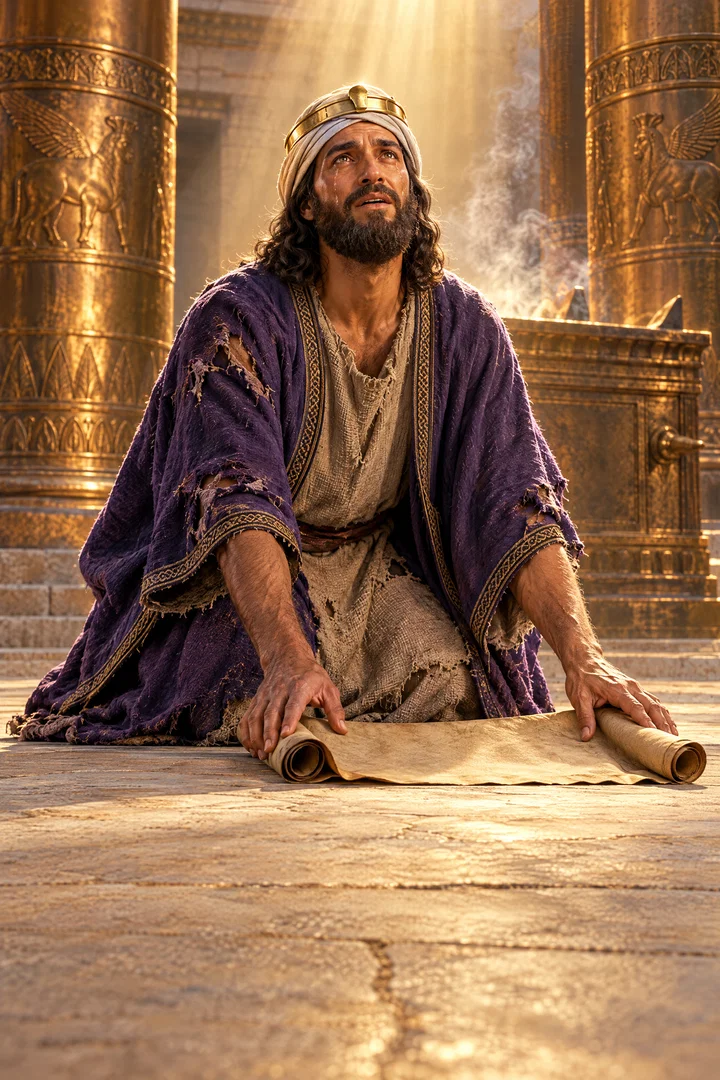
And it came to pass, when king Hezekiah heard it, that he rent his clothes, and covered himself with sackcloth, and went into the house of the LORD.
Translations
American King James Version, King James Version, Webster Bible, Revised Version
And it came to pass, when king Hezekiah heard it, that he rent his clothes, and covered himself with sackcloth, and went into the house of the LORD.
And it came to pass, when king Hezekiah heard it, that he rent his clothes, and covered himself with sackcloth, and went into the house of the Lord.
And it came to pass, when king Hezekiah heard it, that he rent his clothes, and covered himself with sackcloth, and went into the house of Jehovah.
And it cometh to pass, at the king Hezekiah's hearing, that he rendeth his garments, and covereth himself with sackcloth, and entereth the house of Jehovah,
And it came to pass when king Hezekiah heard [ it], that he rent his garments, and covered himself with sackcloth, and went into the house of Jehovah.
And it came to pass, when King Hezekiah heard it, that he rent his clothes,—and covered himself with sackcloth, and entered the house of Yahweh;
Berean Standard Bible, Majority Standard Bible
On hearing this report, King Hezekiah tore his clothes, put on sackcloth, and entered the house of the LORD.
When King Hezekiah heard it, he tore his clothes, covered himself with sackcloth, and went into the LORD’s house.
And on hearing it Hezekiah took off his robe and put on haircloth and went into the house of the Lord.
And when the King Hezekiah heard it, he rent his clothes, and put on sackcloth and came into the House of the Lord.
Douay-Rheims (Challoner revision)
And it came to pass, when king Ezechias had heard it, that he rent his garments and covered himself with sackcloth, and went into the house of the Lord.
Pictures
Cross-references
- 2 Kings 19:1
And it came to pass, when king Hezekiah heard it, that he rent his clothes, and covered himself with sackcloth, and went into the house of the LORD.
Records Hezekiah’s same response to the Assyrian threat.
- 2 Chronicles 32:20-21
And for this cause Hezekiah the king, and the prophet Isaiah the son of Amoz, prayed and cried to heaven.
Hezekiah and Isaiah prayed during the Assyrian threat, and God defeated the enemy.
- Isaiah 37:14-20
And Hezekiah received the letter from the hand of the messengers, and read it: and Hezekiah went up unto the house of the LORD, and spread it before the LORD.
Hezekiah brings the threat before God and prays for deliverance.
- Isaiah 37:36
Then the angel of the LORD went forth, and smote in the camp of the Assyrians a hundred and fourscore and five thousand: and when they arose early in the morning, behold, they were all dead corpses.
The Lord’s angel destroys the Assyrian army, answering Hezekiah’s prayer.
- Isaiah 36:1-2
Now it came to pass in the fourteenth year of king Hezekiah, that Sennacherib king of Assyria came up against all the defenced cities of Judah, and took them.
gives the army threat that drove Hezekiah to pray
- 2 Kings 18:13-19
Now in the fourteenth year of king Hezekiah did Sennacherib king of Assyria come up against all the fenced cities of Judah, and took them.
Hezekiah faces the Assyrian threat at Jerusalem.
- Isaiah 10:5-14
O Assyrian, the rod of mine anger, and the staff in their hand is mine indignation.
Distinguishes the Assyrian campaign from the events in Isaiah 37.
Commentary
Each commentary is drawn from primary sources: the writings of Ellen G. White and Adventist pioneers and periodicals. Each commentary is separate. Its own words are not a quotation; follow the references to read the source passages.
Pioneers and periodicals
16 sources
When Hezekiah heard the blasphemy, taunts and insults of a great and mighty army come up against the land and Jerusalem, he did not meet his enemies in his own strength though outnumbered, but rent his clothes and covered himself with sackcloth and went into the house of the LORD in grief and humility to seek the Lord for counsel, help, protection and deliverance.ST Jun 1, 1876ST Oct 6, 1887ST Jun 21, 1905 His humble seeking opened the way for God's message to him through the prophet and for the Lord's wonderful deliverance from the power of Assyria by His angel, and when he laid the insulting message before God and prayed to be delivered from the mighty host his prayer was answered in the loss of 185,000 men of the invading army in one night, showing he was not helpless while God was with him.ST Oct 6, 1909ST Jun 7, 1883 That overthrow stands as God's most notable witness to Assyria that He is God above all, borne after that nation arose to world power and influence and then grew corrupt and went far from God, following His gracious call to repentance through the Hebrew prophet Jonah and other repeated witnesses.ST Dec 29, 1887 Isaiah and Hezekiah together are examples of subduing enemies through faith for Christians who retain that faith and the church's spiritual gifts to follow, while Hezekiah as a great and good king also illustrates human frailty and the lesson against trusting in men.RH Dec 16, 1862ST Jun 7, 1910
Setting and Meaning
Isaiah 37:1 belongs to the first part of Isaiah, chapters 1 to 39, which contains prophecies and historical accounts from Isaiah's time of active work among rulers and people as God's messenger to the nation.RH Jul 6, 1916 That first part is made up of separate prophecies given at different times and on different occasions and afterward gathered into one collection.RH Jul 6, 1916 Chapters 40 to 66 are distinct from it, being occupied wholly with the future.RH Jul 6, 1916
The verse opens the account in Isaiah 37:1-38 of Sennacherib's campaign against Judah, which came from the southwest.ST Jan 4, 1916 That account helps distinguish this campaign from the earlier campaign described in Isaiah 10, which came from the northeast and was made by Sargon.ST Jan 4, 1916
The thirty-seventh chapter of Isaiah is alike to the nineteenth chapter of 2 Kings, so the two chapters give the same account of Hezekiah's reign.RH Sep 16, 1909RH Sep 15, 1868ST Sep 12, 1895 The parallel holds with considerable verbal difference between the two tellings.RH Mar 11, 1875
When Hezekiah heard it, a great and mighty army had come up against the land and Jerusalem, with threat, blasphemy, taunts and insults against the Lord and His people.ST Jun 1, 1876ST Oct 6, 1887ST Jun 21, 1905 Though outnumbered he did not oppose his enemies in his own strength, but cried to the Lord for protection and deliverance.ST Jun 1, 1876ST Oct 6, 1887 Rending his clothes, covering himself with sackcloth, and going into the house of the LORD was his response of grief and humility.ST Jun 1, 1876ST Jun 21, 1905ST Oct 6, 1909 By going into the Lord's house he sought the Lord for counsel, help, protection and deliverance from the mighty host, and his prayer was answered with deliverance.ST Oct 6, 1887ST Jun 21, 1905
Deliverance Through Faith
Hezekiah's rending of his clothes and covering himself with sackcloth and going into the house of the Lord was humility under threat from the king of Assyria come up against the land, and that humble seeking opened the way for God's message to him through the prophet and for the Lord's wonderful deliverance from the power of Assyria by His angel.ST Oct 6, 1909 His grief at the enemy's taunts and threats turned him to the house of the Lord, where he brought the insulting message before God and prayed to be delivered from the mighty host.ST Jun 7, 1883 That prayer was answered when the invading army suffered the loss of 185,000 men in one night, showing that he was not helpless while God was with him.ST Jun 7, 1883
The slaughter of Sennacherib's host recorded in this chapter is God's most notable witness to Assyria that He is God above all.ST Dec 29, 1887 It came after that nation had arisen to world power and influence and then had grown corrupt and gone far from God.ST Dec 29, 1887 It followed His gracious call to repentance through the Hebrew prophet Jonah and other repeated witnesses that He is God above all.ST Dec 29, 1887
The striking down of the 185,000 men by the angel took place when the Assyrian army was not near Jerusalem but was with the king at Libnah, and that destruction is not identified as the fulfillment of Isaiah 30:33 concerning Tophet prepared for the Assyrian king.RH Jun 15, 1869 Isaiah and Hezekiah together are examples of subduing enemies through faith, whom Christians who retain that faith and the church's spiritual gifts may follow.RH Dec 16, 1862 Hezekiah in this account is also a great and good king whose life illustrates human frailty and the lesson against trusting in men.ST Jun 7, 1910
Sources