John 13:3
Jesus knowing that the Father had given all things into his hands, and that he was come from God, and went to God;
Translations
American King James Version, King James Version, KJV Cambridge Paragraph Bible
Jesus knowing that the Father had given all things into his hands, and that he was come from God, and went to God;
Jesus knowing that the Father had given all things into his hands, and that he had come from God, and was going to God;
Revised Version, American Standard Version
Jesus, knowing that the Father had given all things into his hands, and that he came forth from God, and goeth unto God,
Jesus knowing that all things the Father hath given to him — into [his] hands, and that from God he came forth, and unto God he goeth,
[ Jesus,] knowing that the Father had given him all things into his hands, and that he came out from God and was going to God,
[Jesus] knowing that, all things, the Father had given unto him, into his hands, and that, from God, he had come, and, unto God, he was going,
Berean Standard Bible, Majority Standard Bible
Jesus knew that the Father had delivered all things into His hands, and that He had come from God and was returning to God.
Jesus, knowing that the Father had given all things into his hands, and that he came from God and was going to God,
Jesus, being conscious that the Father had put everything into his hands, and that he came from God and was going to God,
Iesus knowing that the Father had giuen all things into his hands, and that he was come forth from God, and went to God,
Douay-Rheims (Challoner revision)
Knowing that the Father had given him all things into his hands, and that he came from God, and goeth to God;
Pictures
Cross-references 20 of 32
- John 13:14-15
If I then, your Lord and Master, have washed your feet; ye also ought to wash one another’s feet.
Jesus gives the example and commands his disciples to follow it.
- Philippians 2:6-8
Who, being in the form of God, thought it not robbery to be equal with God:
Christ’s divine status is joined to his self-humbling and taking a servant’s place.
- John 17:5
And now, O Father, glorify thou me with thine own self with the glory which I had with thee before the world was.
Jesus speaks of the glory he shared with the Father before the world existed.
- John 14:2-3
In my Father’s house are many mansions: if it were not so, I would have told you. I go to prepare a place for you.
Jesus goes to the Father and promises to return and receive his own.
- John 13:10-11
Jesus saith to him, He that is washed needeth not save to wash his feet, but is clean every whit: and ye are clean, but not all.
Jesus says the disciples are clean, but not all, knowing Judas would betray him.
- Matthew 20:28
Even as the Son of man came not to be ministered unto, but to minister, and to give his life a ransom for many.
Jesus came not to be served but to serve.
- John 17:11
And now I am no more in the world, but these are in the world, and I come to thee. Holy Father, keep through thine own name those whom thou hast given me, that they may be one, as we are.
Jesus says he is leaving the world and coming to the Father.
- John 13:7
Jesus answered and said unto him, What I do thou knowest not now; but thou shalt know hereafter.
Jesus says Peter will understand the footwashing later.
- Luke 22:24-27
And there was also a strife among them, which of them should be accounted the greatest.
Jesus’ divine authority contrasts with his humble service among the disciples.
- John 13:30
He then having received the sop went immediately out: and it was night.
Judas receives the sop and immediately leaves to carry out the betrayal.
- John 7:33
Then said Jesus unto them, Yet a little while am I with you, and then I go unto him that sent me.
Jesus says he will go to the one who sent him.
- John 3:31
He that cometh from above is above all: he that is of the earth is earthly, and speaketh of the earth: he that cometh from heaven is above all.
The one who comes from above is above all.
- John 17:8
For I have given unto them the words which thou gavest me; and they have received them, and have known surely that I came out from thee, and they have believed that thou didst send me.
Jesus says he came from the Father and was sent by him.
- Matthew 28:18
And Jesus came and spake unto them, saying, All power is given unto me in heaven and in earth.
Both affirm that all authority was given to Jesus.
- John 14:28
Ye have heard how I said unto you, I go away, and come again unto you. If ye loved me, ye would rejoice, because I said, I go unto the Father: for my Father is greater than I.
Jesus says he is going to the Father.
- John 3:13
And no man hath ascended up to heaven, but he that came down from heaven, even the Son of man which is in heaven.
Jesus speaks of his heavenly origin.
- John 14:12
Verily, verily, I say unto you, He that believeth on me, the works that I do shall he do also; and greater works than these shall he do; because I go unto my Father.
Connects Jesus’ going to the Father with his followers’ works.
- John 16:5
But now I go my way to him that sent me; and none of you asketh me, Whither goest thou?
Jesus says he is going to the one who sent him.
- John 6:62
What and if ye shall see the Son of man ascend up where he was before?
Speaks of the Son of Man ascending to where he was before.
- John 8:29
And he that sent me is with me: the Father hath not left me alone; for I do always those things that please him.
The Father is with Jesus, whom He sent.
Commentary
Each commentary is drawn from primary sources: the writings of Ellen G. White and Adventist pioneers and periodicals. Each commentary is separate. Its own words are not a quotation; follow the references to read the source passages.
Ellen G. White
34 sources
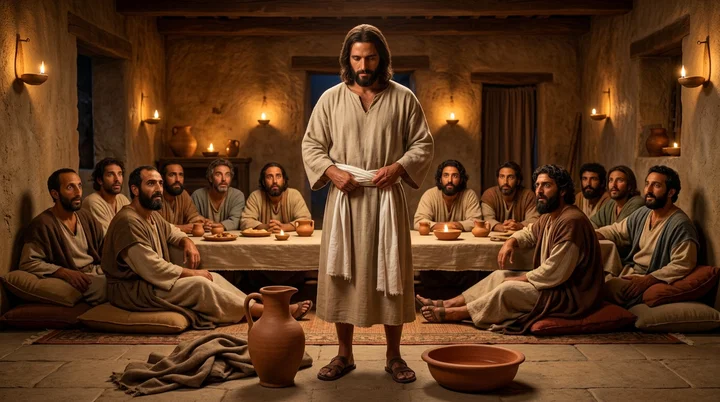
Fully conscious that all authority had been placed in His hands and that He had come from God and was returning to God, Jesus knew His divine origin, mission and destiny in that hour.Lt 210, 1899, par. 3–5Lt 232, 1903, par. 48–50Ms 54, 1897, par. 10 It was the last sacred gathering before His sacrifice, with supper ended and betrayal already in the heart of Judas, when He prepared the disciples for their separation from Him and the suffering they would see Him endure.Ms 19, 1897, par. 3–5Lt 336, 1906, par. 5–9 With that full knowledge He rose from supper, laid aside His garments, girded Himself as a servant, and began to wash the disciples' feet, letting supreme authority lead to humble, loving service.Ms 19, 1897, par. 3–5Ms 35, 1897, par. 9–10Ms 102, 1904, par. 1–3 His humility was His exaltation, rebuking selfish contention for greatness and giving His followers an example and ordinance of humility to follow, to be remembered and obeyed in uniting hearts and cleansing from self-seeking.Ms 19, 1897, par. 3–5Ms 14, 1895, par. 1–2Lt 210, 1899, par. 3–5Ms 43, 1897, par. 24 Though knowing Judas would betray Him, He washed his feet first, kept him at the table and gave him no rebuke, holding out a last tender appeal to repent and be cleansed.DA 655.4DA 720.2Ms 35, 1897, par. 11–12
Setting and Divine Knowledge
The setting is the last sacred gathering before the crucifixion, in the last week together and the last hours before His sacrifice for the world.Lt 336, 1906, par. 5–96MR 24.2–3 It was before the feast of the Passover, with supper ended and the devil having put betrayal into the heart of Judas Iscariot Simon's son, and knowing His hour had come to depart out of this world to the Father, having loved His own in the world and loving them to the end.Ms 19, 1897, par. 3–56MR 24.2–3 His words then were to prepare the disciples for the coming trial, for their separation from Him, and for the suffering they would see Him endure.Lt 336, 1906, par. 5–9
The verse declares His full, conscious knowledge that the Father had given all things into His hands and that He had come from God and was going to God.Ms 19, 1897, par. 3–5Lt 210, 1899, par. 3–5Lt 232, 1903, par. 48–50 That knowledge means supreme divine authority entrusted to Him by the Father, together with divine origin and destiny and return to God.Lt 210, 1899, par. 3–5Lt 232, 1903, par. 48–50Lt 189, 1897, par. 15Ms 27, 1885, par. 2 It is full consciousness of His exalted position, His divine standing, His divinity and mission, even while facing the cross.Lt 210, 1899, par. 3–5DA 644.5Ms 54, 1897, par. 10
With that full knowledge He rose from supper, laid aside His garments, His royal crown and kingly robes and royal status, girded Himself with a towel as a servant, poured water into a basin, and began to wash the disciples' feet and wipe them.Ms 19, 1897, par. 3–5DA 644.5Ms 54, 1897, par. 11–12 Supreme authority and divine origin and destiny led Him to humble, loving service, and with full knowledge of His divine authority and mission He performed that humble service.Ms 35, 1897, par. 9–10Ms 102, 1904, par. 1–3 His humility was His exaltation, making foot-washing an occasion when God is sacredly near.Ms 35, 1897, par. 9–10Lt 210, 1899, par. 3–5
The nearer He came to the hour of ascending to the Father, the more conspicuous His humility became. Fully conscious of His divine standing and facing the cross, He put the disciples' needs before His own in this final act that evening.Ms 54, 1897, par. 11–12Ms 54, 1897, par. 10 He laid aside His royal status and took the form of a servant to wash their feet.Ms 54, 1897, par. 11–12Ms 54, 1897, par. 10
His knowledge also included foreknowledge of the betrayer's purpose, while the other disciples knew nothing of it.Ms 19, 1897, par. 56–57Ms 120, 1897, par. 9 He alone knew that Judas had allowed himself to become a channel of darkness, knew better yet was bracing his soul against light, had given up hope of temporal preferment, was fighting away from Jesus, and was becoming a traitor and betrayer, though the disciples still looked on him as a man of great capabilities.Ms 19, 1897, par. 56–57 He knew Judas had sold Him for thirty pieces of silver and would leave to carry out his plan to betray Him.COS 110.7–9Ms 8, 1897, par. 14 That knowledge of the betrayer's purpose demonstrated His divinity, and it frames His long patience with perverse human nature.Ms 120, 1897, par. 9ST Feb 9, 1915
Humble Example and Ordinance
The washing of feet rebuked the dispute over who should be greatest, for the hearts of the twelve were filled with selfishness and their tempers heated by contention stirred up by Satan.6MR 24.2–3 He heard their whisperings and saw their flushed faces at a time when a right frame of mind would have brought them great blessing, yet without a word He laid aside His outer garment, girded Himself with a towel as a servant, and washed their feet.6MR 24.2–3 With full knowledge of divine authority and mission He rose from supper to perform this humble service, rebuking their strife for the highest place in the promised kingdom.Ms 102, 1904, par. 1–3 At the last sacred gathering before the crucifixion the nearer He came to the hour of ascending to the Father the more conspicuous His humility became, in striking contrast to the twelve disputing which should be accounted greatest. Done as He ate the Passover with His disciples, the act most forcibly illustrates the necessity of true humility and that true service calls for unselfish ministry.Ms 43, 1897, par. 24
His humility was His exaltation, showing humility to be fitting even for those in the highest positions.Lt 210, 1899, par. 3–5 Though fully aware of His exalted position with all things placed in His hands, He served His disciples by washing their feet.Lt 210, 1899, par. 3–5 The menial service stands as a lesson of humility and loving ministration, and His meekness and humility will be seen in His followers. The more closely they resemble Him and the richer and more perfect their Christian character, the less disposition they will have to honor or exalt self, giving glory to God's name for mercy and truth. With His purity as the spotless Lamb presenting Himself as a sin-offering, He girded Himself and performed the office of a servant for those who called Him Lord.Ms 43, 1897, par. 24
His humble service is an example His followers are to follow, and through remembrance of what He did for them no exaltation of one above another would find place.Ms 19, 1897, par. 3–5Ms 14, 1895, par. 1–2 Before the feast of the Passover, knowing His hour had come to depart out of this world to the Father, having loved His own and loving them to the end, with supper ended and betrayal put into the heart of Judas Iscariot Simon's son, He rose, laid aside His garments, girded Himself with a towel, poured water into a basin, and began to wash the disciples' feet and wipe them.Ms 19, 1897, par. 3–5 Supreme authority and divine origin and destiny led Him to this humble service, and foot-washing is an occasion when God is sacredly near, where His words and example are to be remembered and obeyed.Ms 35, 1897, par. 9–10 The ordinance of humility brings brother to an understanding of his brother's feelings.Ms 19, 1897, par. 3–5 It was given to teach humility and to bring believers together in unity, joining their hearts in oneness with Him.Ms 75, 1898, par. 30–32 The practice of washing one another's feet is followed as His example.Ms 6, 1859, par. 34
Done as He ate the Passover with His disciples, the act put an end to the sacrifices offered for four thousand years.Ms 43, 1897, par. 24 In place of the national festival the Jewish people had observed He instituted feet washing and the sacramental supper as a memorial service to be observed by His followers through all time and in every country in continual repetition of His act.Ms 43, 1897, par. 24 As His last established ordinance, type was meeting antitype in Himself, with all things given into His hands as the authority and foundation of all the Jewish ordinances that pointed to Him as the great and only efficacious offering for the sins of the world.Ms 19, 1897, par. 18–19 He discharged His disciples from the cares and burdens of the ancient Jewish obligations in rites and ceremonies, which no longer possessed virtue or force after the reception of the Gospel, so that to continue them would be an insult to Jehovah.Ms 19, 1897, par. 18–19 He gave this simple ordinance to disentangle them from those rites, to be a special season when He Himself will always be present to lead each participant to feel the pulse of conscience, awaken understanding of the lessons symbolized, revive memory, convict of sin, and receive penitential offerings.Ms 19, 1897, par. 18–19 It speaks not so largely to intellectual capacity as to the heart, because the moral and spiritual nature needs it, teaching that brother is not to exalt himself above brother and showing the dangers of disunion and strife, for the health and holy activity of the soul are involved.Ms 19, 1897, par. 18–19
Footwashing and communion are to be observed among believers apart from unbelievers, for He took His disciples away alone separate from unbelievers and the wicked, first washed their feet and then gave broken bread to represent His broken body and juice of the vine to represent His spilled blood.12MR 247.1–2 Holding them among unbelievers brings reproach on God's cause, and even when kept private a Judas may appear with believers and eat and drink to his own damnation, but God will quickly make him manifest and purge him out.12MR 247.1–2 The example of breaking bread and washing the saints' feet is to be practiced together even where it has never been practiced before, with leaders setting the example first and then all joining heartily.7MR 218.1 The observance is solemn, profitable, and long to be remembered, bringing humbling before God with weeping and rejoicing, accompanied by speaking when breaking the bread that moves hearers to sobs and groans.7MR 218.1 It was observed together with the Lord's Supper.Lt 164, 1897, par. 4–5 Women are to wash the feet of women and men the feet of men, not men and women together.5MR 192.1–3
This humility calls man out of esteeming himself above his brother, out of selfishness, self-seeking, seeking the highest place and self-exaltation, to the humility of washing his brother's feet, clearing away misunderstandings, evil surmisings and bitterness of spirit over trifles before the Lord's supper.Ms 35, 1897, par. 11–12 The ordinance must not be deferred because some are considered unworthy, for human beings cannot tell who is worthy and who is not and cannot read the secrets of the soul.Ms 35, 1897, par. 11–12 Though knowing Judas was the betrayer, He washed his feet and allowed him to share in the sacrament, showing longsuffering mercy and holding out opportunity to receive Him, repent, and be cleansed from sin.DA 655.4 His knowledge and divine authority did not keep Him from humbly washing the disciples' feet, including Judas's, and He tenderly gave Judas this last appeal of love, revealing that He knew the traitor's purpose.DA 720.2 With full knowledge He humbled Himself to wash the feet of His disciples, and divine power, origin and destiny did not prevent lowly service, nor did foreknowledge of betrayal prevent love, for He washed the feet of Judas and kept him a place at the table knowing Judas would leave to betray Him.Ms 35, 1897, par. 11–12
He alone knew Judas had allowed himself to become a channel of darkness, knew better yet was bracing his soul against light, had given up hope of temporal preferment, was fighting away from Him, and was becoming traitor and betrayer, while the disciples knew nothing of his purposes and still looked on him as a man of great capabilities.Ms 19, 1897, par. 56–57 Though knowing this secret, He gave Judas no word of rebuke and did not expose him, but with goodness, humility and love bathed his soiled feet and wiped them with the towel, making Judas the first one washed, and this treatment of poor deluded Judas was a sample of His treatment of them all through His association with them.Ms 19, 1897, par. 56–57 Knowing the betrayer's heart from the beginning did not keep Him from washing his feet or offering him a place at the sacrament.20MR 149.2–4Ms 106, 1903, par. 54–55 With goodness, humility and love He tenderly gave this last appeal, showing longsuffering mercy and long patience with perverse human nature.Ms 19, 1897, par. 56–57ST Feb 9, 1915 He knew Judas had sold Him for thirty pieces of silver, yet He washed Judas's feet the same as the others, meaning no one is to be singled out for special favor, service, or honor, because all are His purchased possession and He died just as truly for the poor and uneducated as for the most learned and those who think themselves greatest.Ms 8, 1897, par. 14
His patience with Judas shows how His followers should patiently bear with those who are at fault.MH 493.3–4 His example teaches not to abandon someone believed to be in error or sin, but to seek to help rather than leave that person exposed to temptation.Ms 106, 1903, par. 54–55 Judas wrongly took His humility as evidence that He could not be Israel's King and abandoned hopes of worldly honor.Ms 54, 1897, par. 13 Washing Judas's feet did not make him love Jesus, and when Judas left to carry out his plan the others were relieved and the shadow lifted from them.COS 110.7–9 The chapter belongs to careful and prayerful study in rejecting desire for position and learning humility, repentance, and dependence on God, with warning not to act like Judas.Lt 117, 1897, par. 8–10 His action opened their eyes, left them too astonished and ashamed to speak, filled their hearts with bitter shame and humiliation, showed them themselves in a new light, and gave them an experience they would remember as long as life lasted.6MR 24.2–3 The act is a lesson to be taken in in all its bearings, giving insight into the workings of God, whose ways and thoughts are not human ways and thoughts.Ms 8, 1897, par. 14
Sources
Pioneers and periodicals
96 sources
Jesus fully knew that the Father had placed all things in His hands, and that He had come from God and was returning to God, in conscious possession of His divine origin, authority, mission and destiny.ST Apr 19, 1905ST Oct 24, 1878ST Aug 5, 1886 With that full knowledge He rose from the Passover supper and Himself took the lowest servant's place to wash His disciples' feet, joining perfect authority with perfect humility without lessening His standing as Lord and Master.ST Jul 26, 1883ST Aug 28, 1879ST Mar 30, 1904RH Apr 22, 1862ST Mar 29, 1883 By doing as He did He gave His followers both example and command to wash one another's feet, instituting a plain, literal ordinance of humility to be kept like baptism and the Lord's Supper until His return.ST Feb 7, 1884RH Jul 24, 1856ST Jan 3, 1884RH Mar 1, 1860 The washing is more than hospitality or outward cleansing; it is a lasting sign of the cleansing from sin He came from God to accomplish, renewing from post-baptismal defilement those who would partake of communion in unity with His holy life.RH Apr 2, 1908RH Apr 2, 1908RH Jun 27, 1878RH Jun 23, 1910 In that act the Ruler of the universe stooped from glory to human form and a servant's form to bear sin and die, teaching that true greatness in His kingdom is loving service and not rank or rule over others.ST Oct 24, 1900RH Aug 19, 1902ST Jun 7, 1899RH Jun 27, 1878ST Oct 31, 1878
Words and Historical Setting
Jesus knew that the Father had given all things into His hands, that He had come from God, and that He was going back to God, acting in conscious knowledge of His divine mission, position, authority, origin and destiny.ST Apr 19, 1905ST Oct 24, 1878ST Aug 5, 1886ST Jul 30, 1885RH May 3, 1864 That knowledge explains His rising to wash the disciples' feet, for He did so knowing the Father had placed all things in His hands and that He had come from God and was returning to God.ST Oct 24, 1878RH Jan 8, 1867ST Feb 11, 1897RH Aug 24, 1869 Despite that authority and divine origin He gave an example of humility to be imitated, washing their feet as Lord and Master taking a servant's place.ST Aug 5, 1886ST Jul 30, 1885RH May 3, 1864RH Jan 8, 1867
The verse belongs to the account of the last supper, when Jesus girded Himself with a towel and washed His disciples' feet as an intentional example and not merely hospitality.RH Apr 22, 1862ST Mar 9, 1888ST Nov 19, 1912 It stands within the upper-room discourse of John 13-17, the instruction given at the Passover supper in the upper chamber on His final evening with the disciples.ST Mar 9, 1888ST Mar 18, 1897ST Nov 15, 1883 That supper was the last Passover He shared with them, spent for their benefit in the few quiet hours before Gethsemane, when His meetings with them were usually seasons of calm joy but on this night He was troubled in spirit and they sympathized without knowing its cause.ST Nov 15, 1883ST Aug 12, 1886 It was virtually the last Passover ever to be celebrated, for type was to meet antitype in the slaying of the Lamb of God for the sins of the world, and the sequence is closely connected with His death and central to Christian hope as He was soon to receive His full baptism of suffering.ST Nov 15, 1883ST Aug 12, 1886 The chapter presents both the Passover supper and the institution of the Lord's Supper as occurring at that supper.ST Nov 19, 1912
The rising to wash feet took place during the supper, after they had sat down at the Passover table, and on the evening of His betrayal.ST Oct 24, 1878ST Oct 24, 1878 That timing distinguishes it from the customary washing of guests' feet upon entering a house before a meal, for it came later than the usual time for that hospitality.ST Oct 24, 1878ST Oct 24, 1878 Those who hold it stood first in the celebration of the ordinances teach that He washed feet before eating the supper, before breaking the bread and blessing the cup to institute the Lord's Supper, with the breaking of the bread and the blessing of the cup belonging immediately together after the foot washing.ST Feb 4, 1903RH Dec 23, 1858
That knowledge was with Him before the feast of the Passover when He knew His hour had come to depart out of this world to the Father, having loved His own in the world and loving them to the end.ST Feb 11, 1897RH Aug 24, 1869 Even while the devil had already put betrayal into the heart of Judas Iscariot, He acted with that understanding of His position and work, with Judas present and with the knowledge that not all were clean.ST Feb 11, 1897RH Dec 23, 1858 The immediate occasion was strife among the disciples over which should be accounted greatest and who should be greatest, after they disputed places of honor and which of them should be greatest.RH Feb 10, 1916ST Oct 24, 1900ST Nov 15, 1883 Though they had spent much time with Him and witnessed His meek humility, they needed the lesson at that solemn critical moment to purge pride, expose selfishness and discord continuing even on the last day of His ministry, and to teach that humility rather than rank or position is the ground of preferment in His kingdom.RH Feb 10, 1916ST Oct 24, 1900ST Nov 15, 1883 In that setting He washed their feet despite their faults, and the act led all but Judas to repentance and prepared them to receive the Last Supper with meekness, teachability and love for one another.RH Nov 20, 1913
With that understanding He rose from supper, laid aside His garments, girded Himself with a towel, took a basin, and began the humble work of washing their feet as the example of the humility of true greatness.ST Feb 11, 1897ST Mar 29, 1883 He did Himself what only a slave was accustomed to do, with full consciousness of His divine authority, origin and destiny.ST Mar 29, 1883 Guests were ordinarily provided water to wash their own feet, whereas this washing was not ordinary hospitality because Jesus washed His disciples' feet Himself in the upper chamber on the night of His betrayal.RH Apr 22, 1862
Humility in Full Authority
Knowing that the Father had given all things into His hands and that He had come from God and was going to God, Jesus as Lord and Master took the lowliest servant's place and washed the disciples' feet, exercising divine authority in humble service and giving an example for followers to copy.ST Jul 26, 1883ST Mar 30, 1904RH Aug 19, 1858ST Dec 16, 1886RH Jul 30, 1867 Fully aware of His divine origin and destiny, that knowledge did not keep Him from serving, and as He faced betrayal and suffering He remained calm, loving and self-possessed, showing regal authority and humility together without lessening His status.ST Jul 26, 1883ST Aug 28, 1879ST Mar 30, 1904RH Aug 19, 1858 His service teaches that greatness in Christ's kingdom means serving others, and that His followers stand as equals as children of one Father and servants of one Master.ST Jul 26, 1883ST Mar 30, 1904
His humility did not come from forgetting who He was, for fully conscious of His divine origin, dignity and authority He used His own hands to wash the disciples' feet.ST Feb 11, 1897 The nearer He came to the hour of ascending to the Father the more conspicuous His humility became, performing at the last sacred gathering before the crucifixion the menial service of washing feet as a lesson of humility and loving ministration, in striking contrast to the twelve disputing which should be accounted greatest.ST Feb 11, 1897 His meekness and humility will be seen in His followers, and the more closely they resemble Him and the richer and more perfect their Christian character, the less disposition they will have to honor or exalt self, giving glory to God's name for His mercy and truth.
With full awareness of divine authority and mission He washed their feet to establish humility and service as a lasting example and to rebuke ambition to be greatest, showing that true greatness and kingship are expressed through loving service and not through rank, position or lording over others.RH Aug 19, 1902ST Jun 7, 1899RH Nov 6, 1900 Greater than the disciples and by right Lord of all, whom all creatures should serve and obey, He yet served them, emptied Himself of His rights and power, did not long for high estate, and took the form of a servant, therein giving the great lesson and example of humility and Christianity opposite to seeking chief places as benefactors.RH Aug 19, 1902ST May 21, 1896 That mind in His followers overcomes the world, humility rather than status is the ground of preferment, and for those who continue with Him in that serving way a kingdom and a table therein are prepared.ST May 21, 1896RH Nov 6, 1900 His humility answered their pride and ambition, and He humbly served even to washing the traitor's feet.RH Nov 6, 1900
The foot-washing displays the condescension of the Lord of glory whose glory filled heaven, who laid it aside and took human form and the form of a servant.ST Oct 24, 1900RH Jun 27, 1878ST Oct 31, 1878 Knowing His authority came from the Father, He stooped from His exalted place as Ruler of the universe to take human nature, bear the world's sins and suffer death on the cross, expressing in the washing the humility of the whole life He chose.ST Oct 24, 1900RH Jun 27, 1878ST Oct 31, 1878 The ordinance is not for physical cleansing but is an emblem that directs disciples to what the Saviour did and cultivates humility and contrition in them.RH Jun 27, 1878
His act was inward humility, not an imposed humiliation, and Judas experienced it as humiliation because he clung to pride, while true humility can lead even the One who holds the highest position as Greatest of the brethren to take a servant's place and do menial work.RH May 30, 1912RH May 30, 1912 True humility is shown in ordinary duties done willingly from love, not merely in performing a church rite, and serving others as He did expresses the spirit of the ordinance of humility.RH May 30, 1912RH May 30, 1912
That consciousness of all things in His hands and of coming from God and going to God makes the act a beautiful episode of humility and unselfishness, presenting Him as the divine Saviour, Substitute and Surety and as the perfect model for daily conduct to be closely copied for symmetrical and holy living, rising from the table, laying off His upper garment, girding Himself with a towel and with a basin doing what only a slave was accustomed to do.ST Mar 29, 1883 Belonging to the institution of the ordinance of humility to be kept together with the communion service, it is to be taught to new believers and newly organized churches even when they have never witnessed it before, and all who join heartily in the service are blessed accordingly.ST Mar 29, 1883ST Aug 21, 1907
Ordinance for the Church
John 13 institutes foot-washing as a divinely appointed, plain and literal ordinance of humility, explicitly defined and enforced in Scripture like baptism and the Lord's Supper.ST Apr 20, 1915ST May 13, 1903ST Sep 10, 1885 It is minutely described as a very literal transaction, a literal emblem of a literal event, and Christ's own example in observing it proves it is to be literally obeyed.ST Jan 3, 1884 His command to do as He did can only be fulfilled in a literal manner, and some have practiced it as a duty essential to fellowship while others have regarded it only as hospitality.ST Jan 3, 1884RH Mar 1, 1860 Memorializing humility literally is hard for the natural man, so this ordinance is rejected most of all, but refusal of literal obedience is not of the Holy Spirit.ST Jan 3, 1884
The washing was done from love for the disciples at the time Jesus was about to depart out of this world.RH Jan 20, 1853 Taken in its plain sense it is the most explicitly and strictly enjoined ordinance in the New Testament, an institution and precept to be observed and not dismissed as unimportant or merely figurative.RH Jan 20, 1853RH Mar 12, 1901 Its binding force is shown by the warning that without the washing there is no part with Christ and by the injunction that as Lord and Master washed the disciples' feet so they ought to wash one another's feet.RH Jan 20, 1853
The act was an example for followers to follow in washing one another's feet, not an act of hospitality, and it stands as both example and positive command.ST Feb 7, 1884RH Jul 24, 1856ST Dec 30, 1889 Because Jesus as Lord and Master did it, His followers should do the same to one another, and ought carries the force of a command that obedient children fulfill without arguing over words or excusing themselves because they were not told they must.ST Jul 8, 1880 Doing what Jesus did brings Christians to a common level in humility with more union, communion and manifest love to each other, for Jesus knew what was best and human opinions are worth nothing unless backed by the word.ST Jul 8, 1880
The example was intended for disciples to follow in all future times and was set apart to be observed as an impressive object lesson in humility.ST Oct 24, 1900RH Feb 24, 1859 The rite was to continue until Jesus' return, to commemorate His humility of life till He comes just as the Lord's Supper shows His death till He comes.ST May 21, 1896ST Oct 24, 1900 Those coming into the church afterward need it as well, especially when the falling away comes, because professed Christians are more willing to follow His example in dying for religion than to imitate His humility in living it.ST Oct 24, 1900 It is one of the ordinances of the Lord's house to be kept together with the communion service, to be taught even to new believers and newly organized churches that have never witnessed it before, and happiness comes to those who know these things and do them.ST Aug 20, 1902ST Aug 21, 1907
Foot-washing is practiced in connection with communion, immediately before the Lord's Supper, for Jesus did it first in the celebration of the ordinances before breaking the bread and blessing the cup to institute the Lord's Supper, and the breaking of the bread and the blessing of the cup belong immediately together after the foot-washing.ST Feb 4, 1903 It is a divinely appointed ordinance of humility and a preparatory service to be observed before the sacrament, placed in His knowledge that the Father had given all things into His hands and that He had come from God and was returning to God.CO 43.4–5CO 43.8–44.3 In His example His followers prepare their hearts through self-examination before sharing the emblems of His broken body and shed blood, putting away differences, confessing fully and freely forgiving one another.RH Jan 14, 1858RH Apr 1, 1858CO 43.8–44.3 The humbling ordinance of washing feet is thus practiced for the church followed by the Lord's Supper, and knowing and doing these things brings refreshment and happiness.RH May 19, 1859
Its benefits come not from knowing about the act but from doing it, for participating in it renews the memory of Christ's condescension and brings a blessing.ST Oct 31, 1878 His example and command as Lord and Master provide authority for the practice, and those who do what He taught are blessed and happy.ST Oct 20, 1898RH Aug 4, 1868 Actually carrying out the Saviour's instructions about humility in action together with commemorating His death brings His rich blessing and the happiness promised to those who know these things and do them.RH Jan 9, 1872
Foot-washing was instituted at the same occasion as the Lord's Supper to commemorate Christ's humility of life, reminding followers of His taking human nature, His humble service in salvation, and His freely given body and blood.ST Mar 27, 1901ST May 21, 1896 The command to observe it is as plain and positive as the command to observe the Supper.ST Mar 27, 1901 The immediate occasion was strife among the disciples over which should be accounted greatest, and though they had spent much time with Him and witnessed His meek humility they needed the lesson at that solemn critical moment.ST Oct 24, 1900
Meaning of the Washing
The washing does not teach ordinary hospitality, for the disciples were not inhospitable and were not in need of hospitality, so there was no occasion for such a lesson and to view it as hospitality makes it a strange digression from what was then transpiring.RH Feb 24, 1859 Even a hospitable host did not wash a guest's feet himself, but provided water for guests to wash their own feet, whereas Jesus in the upper chamber on the night of betrayal washed His disciples' feet Himself.ST Mar 9, 1888RH Apr 22, 1862 It was not prompted by physical uncleanness or by the customs of the time, but enforced a great moral lesson that the surrounding circumstances called for.RH Feb 24, 1859RH Feb 24, 1859 It showed the service that Christian fellowship requires people to give one another, and was an example intended to be followed in all future times.ST Mar 9, 1888RH Feb 24, 1859
The knowledge that He had come from God and was returning to God, with all things entrusted to Him by the Father, is what prompted Him to rise and wash feet.RH Apr 2, 1908RH Apr 2, 1908 His coming from God was to seek and save the lost from their sins, and the foot-washing is a lasting sign and ordinance of that cleansing from sin He came to accomplish.RH Apr 2, 1908RH Apr 2, 1908 It is not merely an example of humility or service but an act with an inner meaning beyond humility, to be continued by His followers as evidence that they understand and value His purpose to cleanse people from sin.RH Apr 2, 1908RH Apr 2, 1908
Coming before the communion service, the washing gives cleansing from sins committed after the baptismal cleansing on accepting Jesus, sins which defile many times yet do not entirely separate from God nor cast off His children forever.RH Jun 23, 1910 This renewed cleansing of everything from heart and life that would unfit for holy service prepares to take the emblems that typify perfect unity with His holy, sinless life, and when rightly used brings great blessing with melted hearts and united lives and interests.RH Jun 23, 1910 The ordinance is not for physical cleansing but is an emblem that directs disciples to what the Saviour did, displaying His condescension and self-abnegation who though His glory filled heaven laid it aside, took human form and did a servant's work, and it cultivates humility and contrition in them as an example to imitate.RH Jun 27, 1878 He rose to do this during the supper after they had sat down at the Passover table when the dispute over who should be greatest had arisen and Judas was present, and having a part with Him depended on more than taking part in a formal ceremony.
Doctrine and Christian Life
The verse proves that Jesus lived before His earthly life, for He came out from God and went back to God with all things placed in His hands.ST Sep 26, 1895 That placing of all things in His hands shows His authority came from the Father, not from human governments.ST Sep 4, 1893 In connection with His future throne, it points to His return to the Father before receiving His own throne after His mediatorial work is finished.ST Jun 14, 1905
The certainty that He had come from God and was going back to God shaped His mission and gave Him confidence that the Father was with Him.RH May 7, 1901 In the same way those sent by God should understand themselves as sent by God rather than defined by their country, and should trust in God's presence with them.RH May 7, 1901 Though divine and immortal, He lived human life and served His people, being one with them and their Brother, and though the gulf was vast between His divine greatness and the humble fishermen He chose, love bridged that gulf.STST Jun 3, 1913
Since God is love, love is what moved Him to come to earth knowing all the consequences, so that His mission stood or fell with His love continuing.ST Mar 29, 1899 Therefore even at that critical hour, knowing that before morning one would betray Him and another deny Him and all would forsake Him, nothing could quench His love, and He loved them to the end.ST Mar 29, 1899 His knowledge of His divine mission and return did not lessen His love for His disciples nor keep Him from humbly serving them, and it did not lead Him to count Himself above them, and He remains the pattern His followers are to imitate.RH Dec 25, 1856ST Apr 19, 1905
The chapter enforces humble service by example, so that no one in His church is to claim supremacy over others or enslave them, but all are to honor the dignity of labor and the laborer.ST Sep 9, 1886RH Oct 8, 1861 His followers are to serve one another, including the weak and lowly, rather than seek status or advantage at others' expense.ST Sep 9, 1886RH Oct 8, 1861 Following Christ's example of humble service obliges disciples to serve one another and creates holy, equal fellowship among members of the same body, without ranks or barriers of separation.ST Jul 8, 1880ST Feb 20, 1901 Doing what Jesus did brings Christians to a common level in humility with more union, communion, and manifest love to one another, as children of one Father and servants of one Master.ST Jul 8, 1880ST Feb 20, 1901
The lesson rebuked ambition to be greatest and exposed the selfishness and discord that continued even on the last day of His ministry.ST May 13, 1875RH Aug 3, 1916 Though the disciples needed their pride purged and their hearts cleansed, He gave them a humble example, and after three and one-half years of teaching they began to see the sinfulness of unholy ambition, jealousy, and criticism of one another.ST May 13, 1875RH Aug 3, 1916 In that setting Jesus washed the disciples' feet despite their faults, and the act led all but Judas to repentance and prepared them to receive the Last Supper with meekness, teachability, and love for one another.RH Nov 20, 1913RH Sep 10, 1901 His humble service included washing the traitor's feet though Judas had betrayed Him, showing long patience with perverse human nature.ST Feb 9, 1915RH Nov 20, 1913RH Sep 10, 1901
The glorious Son of God clothed with humanity stooped to serve Judas in a humble, menial act, but Judas wrongly took this humility to mean Jesus would not become a king and that following Him would bring no honor or personal gain.RH Jan 4, 1906 Humility is not fulfilled merely by feeling humble inwardly but is to be expressed in obedience to the actions Jesus commanded.RH May 7, 1872ST Jul 17, 1879 The church is to humble itself by obeying His instructions, and obedience to those instructions brings a shared blessing.RH May 7, 1872ST Jul 17, 1879
The account gives proof of His willingness to humble Himself for humanity and provides an example for His followers to follow.ST Oct 18, 1877ST May 21, 1896 The ordinance points to His broken body and shed blood and is observed in expectation of His return.ST Oct 18, 1877 He was greater than the disciples and by right Lord of all, whom all creatures should serve and obey, yet He emptied Himself of His rights and power, did not long for high estate, and took the form of a servant, and for those who continue with Him in that serving way a kingdom and a table therein are prepared.ST Oct 18, 1877ST May 21, 1896
His meekness and humility will be seen in His followers in striking contrast to disputing which should be accounted greatest. The nearer He came to the hour of ascending to the Father the more conspicuous His humility became, and the more closely they resemble Jesus and the richer and more perfect their Christian character, the less disposition they will have to honor or exalt self, giving glory to God's name for His mercy and truth. The chapter teaches the ordinance of humility by Jesus' example and instruction, as an ordinance of humility and as an example of His whole humble life and of the humility of true greatness.ST Sep 24, 1912ST Jun 14, 1905ST Dec 16, 1886ST Sep 9, 1886RH Nov 20, 1866 It teaches a marvelous lesson of humility and service through Jesus' example, fitting to humble the proud heart, and was given as an act of love they should imitate through washing one another's feet.ST Sep 24, 1912ST Jun 14, 1905ST Dec 16, 1886RH Nov 20, 1866RH Jan 19, 1869 With full awareness of His divine authority and greatness He chose to serve His disciples by washing their feet, illustrating that the one who leads must serve, answering pride and ambition and showing that loving service and humility are true greatness.ST Apr 11, 1906
Sources