John 13:30
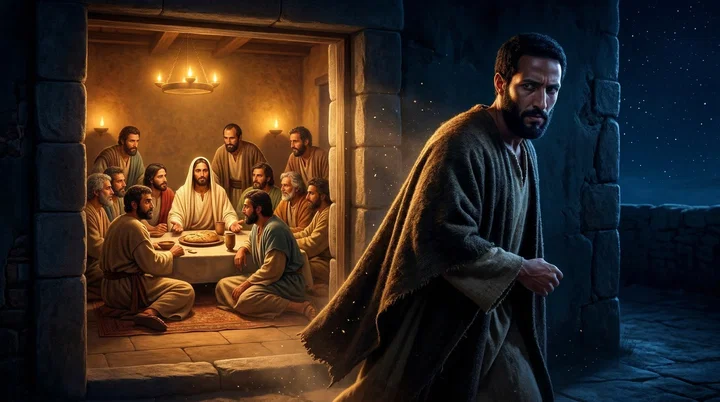
He then having received the sop went immediately out: and it was night.
Translations
American King James Version, King James Version, KJV Cambridge Paragraph Bible
He then having received the sop went immediately out: and it was night.
He then having received the sop, went immediately out: and it was night.
Revised Version, American Standard Version
He then having received the sop went out straightway: and it was night.
having received, therefore, the morsel, that one immediately went forth, and it was night.
Having therefore received the morsel, he went out immediately; and it was night.
So, he, taking the morsel, went out straightway;—and it was night.
Berean Standard Bible, Majority Standard Bible
As soon as he had received the morsel, Judas went out into the night.
Therefore having received that morsel, he went out immediately. It was night.
So Judas, having taken the bit of bread, straight away went out: and it was night.
Assoone then as he had receiued the soppe, he went immediately out, and it was night.
Douay-Rheims (Challoner revision)
He therefore having received the morsel, went out immediately. And it was night.
Pictures
Cross-references 20 of 25
- Matthew 26:20-25
Now when the even was come, he sat down with the twelve.
Jesus identifies Judas as the betrayer during the supper.
- Luke 22:21
But, behold, the hand of him that betrayeth me is with me on the table.
Jesus announces that the betrayer is present at the table during the meal.
- Mark 14:17-21
And in the evening he cometh with the twelve.
The betrayal is announced during the supper, matching the timing of Judas’s departure.
- John 13:10-11
Jesus saith to him, He that is washed needeth not save to wash his feet, but is clean every whit: and ye are clean, but not all.
Jesus says not all are clean, referring to Judas, whose feet he had washed before he left.
- 1 Corinthians 11:23
For I have received of the Lord that which also I delivered unto you, That the Lord Jesus the same night in which he was betrayed took bread:
Jesus instituted the supper on the night he was betrayed.
- Psalms 41:9
Yea, mine own familiar friend, in whom I trusted, which did eat of my bread, hath lifted up his heel against me.
A close companion who shared Jesus’ bread betrayed him, fulfilling the prophecy.
- John 13:18-19
I speak not of you all: I know whom I have chosen: but that the scripture may be fulfilled, He that eateth bread with me hath lifted up his heel against me.
Jesus identifies the betrayer and foretells the betrayal so the disciples will believe.
- John 13:2
And supper being ended, the devil having now put into the heart of Judas Iscariot, Simon’s son, to betray him;
Judas’s betrayal follows Satan’s influence and unfolds during the supper.
- John 13:12-17
So after he had washed their feet, and had taken his garments, and was set down again, he said unto them, Know ye what I have done to you?
Jesus explains the foot washing and commands the disciples to serve one another.
- John 13:21
When Jesus had thus said, he was troubled in spirit, and testified, and said, Verily, verily, I say unto you, that one of you shall betray me.
Jesus announces that one of the disciples will betray him, which Judas fulfills.
- Matthew 26:47-50
And while he yet spake, lo, Judas, one of the twelve, came, and with him a great multitude with swords and staves, from the chief priests and elders of the people.
Judas came with a crowd and delivered Jesus to his enemies.
- Matthew 26:26-29
And as they were eating, Jesus took bread, and blessed it, and brake it, and gave it to the disciples, and said, Take, eat; this is my body.
Jesus institutes the meal with bread and the cup as emblems of his death.
- John 13:23-26
Now there was leaning on Jesus’ bosom one of his disciples, whom Jesus loved.
Jesus indicated the betrayer and gave Judas the sop before he went out.
- Matthew 26:14-16
Then one of the twelve, called Judas Iscariot, went unto the chief priests,
Judas’s silver-driven plot to betray Jesus
- John 6:70
Jesus answered them, Have not I chosen you twelve, and one of you is a devil?
Jesus had earlier identified one of the twelve as a devil.
- Matthew 26:25
Then Judas, which betrayed him, answered and said, Master, is it I? He said unto him, Thou hast said.
Judas asks whether he is the betrayer, and Jesus answers him.
- Luke 22:3
Then entered Satan into Judas surnamed Iscariot, being of the number of the twelve.
Satan enters Judas before he acts against Jesus.
- John 13:11
For he knew who should betray him; therefore said he, Ye are not all clean.
words Jesus spoke under restraint while Judas remained
- Mark 14:22-25
And as they did eat, Jesus took bread, and blessed, and brake it, and gave to them, and said, Take, eat: this is my body.
Records Jesus’ actions at the meal before his arrest.
- Matthew 26:36-46
Then cometh Jesus with them unto a place called Gethsemane, and saith unto the disciples, Sit ye here, while I go and pray yonder.
Jesus prayed in Gethsemane that night before his arrest.
Commentary
Each commentary is drawn from primary sources: the writings of Ellen G. White and Adventist pioneers and periodicals. Each commentary is separate. Its own words are not a quotation; follow the references to read the source passages.
Ellen G. White
15 sources
After Jesus gave the sop to Judas as the sign of the betrayer, Judas took it and left the supper table and room at once to carry out his betrayal with Christ's enemies.ST Dec 23, 1908DA 654.3–655.1RH Nov 4, 19023SP 86.1
It was literal night outside, and also the spiritual and outer darkness into which he turned away from Christ.Ms 106, 1903, par. 37–38ST Dec 23, 1908DA 654.3–655.1
Jesus knew his secret purpose yet washed his feet, kept him at the table, and gave him every opportunity and a final appeal of love to repent, but he was not convicted to cast out Satan and only grew more determined in his plan.ST Dec 23, 19083SP 86.1ED 92.1–2COS 110.7–9Ms 35, 1897, par. 11–12
By going out from Christ's presence he made his final decision and crossed the boundary beyond repentance, giving himself fully to Satan's control and to the loss of hope and immortal life.Ms 106, 1903, par. 37–38DA 654.3–655.1ED 92.1–2Ms 120, 1897, par. 9
His departure lifted the painful restraint of his presence so Christ could speak freely with the rest, and it warns believers to keep their faith in Christ as a personal Saviour genuine and unwavering lest they betray Him as Judas did.Lt 117, 1897, par. 8–10COS 110.7–9RH Nov 4, 1902Ms 102, 1904, par. 39
Leaving Supper for Betrayal
After Jesus dipped the sop and gave it to Judas Iscariot the son of Simon as the sign pointing out the betrayer, and after Satan entered Judas and Jesus told him to do quickly what he was going to do, Judas received the sop and went out at once into the night.RH Nov 4, 1902 He left the Passover supper table and chamber immediately to carry out his betrayal.DA 654.3–655.13SP 86.1ED 92.1–2COS 110.7–9Ms 35, 1897, par. 11–12 He went out into the streets of Jerusalem to find the council of Christ's enemies and complete the betrayal he had begun.ST Dec 23, 1908DA 654.3–655.1RH Nov 4, 1902 The night was both literal night and a picture of outer and spiritual darkness into which he turned away from Christ.Ms 106, 1903, par. 37–38ST Dec 23, 1908DA 654.3–655.1
Jesus knew Judas's thoughts and purpose and secret purpose and made that knowledge clear, giving convincing proof of divinity.3SP 86.1Ms 19, 1897, par. 56–57 Yet He washed Judas's soiled feet first and wiped them with the towel and did not refuse him a place at the table nor expose him.COS 110.7–9Ms 35, 1897, par. 11–12Ms 19, 1897, par. 56–57 The disciples knew nothing of his purpose and esteemed Judas as a man of great capabilities, breadth of knowledge and valuable qualifications.Ms 19, 1897, par. 56–57
He left in anger after realizing Jesus knew his purpose.COS 110.7–9 Washing his feet had not made him love Jesus, and learning that Jesus would not be made king only strengthened his resolve to betray Him.COS 110.7–9 He chose to become a traitor after being met only with goodness, humility and love and no word of rebuke.Ms 19, 1897, par. 56–57 He allowed himself to become a channel of darkness by bracing his soul against light he knew better than to deny, fighting away deep impressions of the Holy Spirit, giving up hope of temporal preferment, seeking to obliterate all he had heard, and listening to the enemy's presentation that Christ was not the Son of God but a pretence.Ms 19, 1897, par. 56–57
His departure lifted a painful restraint caused by the traitor's presence and relieved the others.COS 110.7–9RH Nov 4, 1902 The shadow lifted from the disciples and Jesus' face brightened, becoming cheerful and radiant with divinity.COS 110.7–9RH Nov 4, 1902 So He could freely express His feelings in the sacred last interview with His disciples.RH Nov 4, 1902
Rejected Mercy, Final Choice
At that moment Judas was given a final call to turn back, every opening to be saved, a last opportunity and last appeal of love.ST Dec 23, 19083SP 86.1Ms 120, 1897, par. 9 He was surprised and alarmed when his secret purpose was laid bare, and when his soiled feet were washed first his heart thrilled with an impulse to confess on the spot.3SP 86.1Ms 19, 1897, par. 56–57 He did not repent or become ashamed and convicted and cast out Satan, but rejected mercy and became more determined and firmly set on his plan.ST Dec 23, 19083SP 86.1Ms 19, 1897, par. 56–57
Even though he had twice agreed to betray Jesus, repentance remained possible until he left.Ms 106, 1903, par. 37–38DA 654.3–655.1Ms 120, 1897, par. 9 By leaving Christ and the disciples he made his final decision, his case was decided, and he crossed the boundary beyond which he would not repent.Ms 106, 1903, par. 37–38DA 654.3–655.1Ms 120, 1897, par. 9
By going out he went from Christ's presence and the hope of immortal life into the darkness of his evil purpose where hope was gone.Ms 106, 1903, par. 37–38DA 654.3–655.1ED 92.1–2 He went no longer favored by God but abandoned to do Satan's mission, giving himself fully to Satan's control of his heart and mind and to the consequences of his choice.Ms 106, 1903, par. 37–38Ms 120, 1897, par. 9RH Nov 4, 1902
Warning and Instruction Today
The departure into the night stands as a warning against acting like Judas and betraying the Lord and Master.Lt 117, 1897, par. 8–10Ms 102, 1904, par. 39 Believers must work out their own salvation with fear and trembling, and youth especially must live by this principle.Ms 102, 1904, par. 39 Their religious influence must be kept genuine and their faith in Christ as a personal Saviour unwavering, so that they will never betray Christ as Judas did.Ms 102, 1904, par. 39 This is an experience that all need to gain.Ms 102, 1904, par. 39
Even though Jesus knew what Judas would do and had washed his feet, He did not refuse him a place at the table when Judas left to carry out his part in the betrayal.Ms 35, 1897, par. 11–12 Judas was included when Jesus washed the disciples' feet and shared the sacrament, and that inclusion teaches that people cannot judge who is worthy to take part in the ordinance.Ms 35, 1897, par. 11–1220MR 149.2–4 No one can read another person's heart or distinguish the tares from the wheat.Ms 35, 1897, par. 11–1220MR 149.2–4 The account therefore supports not excluding anyone from these services.20MR 149.2–4
The placing of Judas among the disciples as he leaves shows Jesus' long patience with a perverse person.ST Feb 9, 1915 His example in bearing with Judas teaches His followers to bear patiently with false brethren.ST Feb 9, 1915
Sources
Pioneers and periodicals
40 sources
At the last Passover meal in the upper room on his final evening, Jesus exposed the betrayer by giving the dipped sop to Judas, who received it and went out at once while still at the table.RH Nov 4, 1902ST Aug 12, 1886ST Oct 5, 1882ST Nov 22, 1883ST May 21, 1896 It was literal night in the streets of Jerusalem, and that outer darkness marked both the dark hour of the betrayal and the spiritual night and outer darkness into which Judas departed when he shut himself off from grace.RH Jul 14, 1863RH May 27, 1873RH Dec 7, 1916ST Jan 10, 1911 Jesus had given him every opportunity to be saved in a final call to repent, but though surprised and alarmed at the exposure he rejected mercy, refused to yield, and left at once to do Satan's mission and complete his bargain with Christ's enemies.ST Dec 23, 1908RH Dec 7, 1916RH Mar 6, 1866ST He left during the Passover after receiving its sop and before Jesus instituted the memorial supper, so he did not partake of it, though others hold that the verse alone does not settle whether he took part.ST Nov 22, 1883RH Jul 14, 1863ST Nov 22, 1883RH Jul 29, 1873 With the traitor gone the oppressive restraint was lifted and peace returned, and Jesus then spoke freely to the eleven the sacred truths of John 13:31 through chapter 17 that he would not utter before one who could not understand them.RH Nov 4, 1902ST May 19, 1898ST Mar 18, 1897ST Aug 12, 1886
Setting and Sequence
The verse belongs to Jesus' final Passover meal with his disciples in the upper room on his last evening, when he foresaw his coming suffering and the events soon to follow, and when he instituted the Lord's Supper and foot washing as lasting reminders of his humility and sacrifice for the world.ST Aug 12, 1886ST May 21, 1896 That supper was the last Passover ever to be celebrated, where type met antitype in the slaying of the Lamb of God for the sins of the world.ST Aug 12, 1886 Though meetings of Jesus with his disciples were usually seasons of calm joy highly prized by all, at this supper he was troubled in spirit and they sympathized with his grief without knowing its cause.ST Aug 12, 1886 The few quiet hours between him and Gethsemane were to be spent for the benefit of his disciples, for he was soon to receive his full baptism of suffering.ST Aug 12, 1886
The Gospel accounts agree in placing the last supper and betrayal on the same night, and their agreement supports the truth of the events recorded.RH Jan 28, 1862 Jesus identified the betrayer by giving the dipped sop to Judas Iscariot the son of Simon as the sign pointing him out, showing Judas that his treachery was known.RH Nov 4, 1902ST Oct 5, 1882ST Nov 22, 1883 Surprised and alarmed at the exposure, Judas received the sop and went out at once, horror-stricken but without repentance, while the other disciples remained with Jesus and while they were still eating the Passover meal.RH Nov 4, 1902ST Oct 5, 1882ST Nov 22, 1883RH Mar 6, 1866ST Jan 10, 1911 After Satan entered Judas and Jesus told him to do quickly what he was going to do, Judas left immediately into the night at the dark hour of the betrayal.RH Nov 4, 1902ST Jan 10, 1911
Judas left immediately while still at the table, closing the meal scene before Jesus and the disciples went out.ST May 12, 1898RH Dec 23, 1858 He could remain for the Passover meal but did not stay to join the solemn hymn sung by the others before they sang a hymn and went out.STRH Dec 23, 1858 The foot washing occurred during or at or near the beginning of the supper rather than after it had ended, before the supper was eaten and before Judas went out, after which Judas received the sop and went out.ST Nov 15, 1883ST Jul 30, 1885RH Dec 23, 1858 On another reckoning the order was that the disciples first bathed before the Passover, then ate the Passover supper, then washed one another's feet and celebrated the Lord's Supper, with Judas remaining through the washing of feet, the dispute over who was greatest, and the Lord's Supper before he left.ST Jul 12, 1905 The foot washing happened because the apostles, alienated and in dissension and disputing over who should have the highest place, refused their duty, so Jesus washed them, washing Judas first before the Passover supper.RH Jun 23, 1910
The verse falls within the opening chapter of the upper-room discourse extending through John 13-17, concerned with Christ's divine glories and with life.ST Mar 9, 1888 Jesus' instruction recorded from John 13:31 through chapter 17, including John 15 and 16 and the prayer of John 17, was given after Judas left, on the same night on the way toward Gethsemane after Jesus and his disciples left the upper room.ST May 19, 1898ST Mar 18, 1897 That night continued with Jesus praying in Gethsemane and being handed over to his enemies, with the darkness marking the setting for the betrayal.ST Nov 4, 1897 When Judas left, the other disciples mistakenly thought he was going to buy something for the feast.
Literal and Spiritual Night
He went out at once after taking the dipped morsel, and it was night, the literal hour of his going forth into the streets of Jerusalem.RH Jul 14, 1863RH May 27, 1873ST Jan 10, 1911ST Jun 8, 1915 That morsel belonged to the Passover meal, so his immediate departure came before the memorial supper was instituted and he did not partake of it.RH Jul 14, 1863RH May 27, 1873 He left the Passover table after being pointed out as the betrayer, while the other disciples remained behind with Jesus.RH Jul 14, 1863RH May 27, 1873ST Jan 10, 1911 He went from the company of Jesus with murder in his heart.ST Jun 8, 1915
That night was the night of the Passover meal, of instruction to the disciples, and of betrayal, and its darkness formed the setting in which the betrayal was carried out.ST Nov 4, 1897ST Jan 10, 1911 It was the dark hour of the deed, continuing onward to prayer in Gethsemane and to the handing over to enemies.ST Nov 4, 1897ST Jan 10, 1911
The night without also pictured the night within, for the outward darkness signified the darkness in his heart.RH Dec 7, 1916ST Jun 8, 1915 He had shut himself off from grace, had clung to sin and turned from the prompting of the Spirit despite the desire for his salvation and the offered opportunity to confess and yield himself.RH Dec 7, 1916 The power of darkness soon overtook him, and the night became a picture of the spiritual night in his soul.ST Jun 8, 1915 He stepped at once from the room into the night while the rest supposed he had gone to buy something for the feast, stepping from light into darkness and separating himself from the company of the godly as one wholly ruled by the adversary.
In that going out he departed from Christ into outer darkness, turning away from Christ into spiritual darkness.ST Dec 23, 1908RH Nov 20, 1913 He left the supper immediately after receiving the morsel to carry out the betrayal, though every opportunity to be saved and a final call to repent had been given him.ST Dec 23, 1908RH Nov 20, 1913 He rejected mercy and grew more determined in his purpose after his intent was exposed and he was bidden to act quickly.ST Dec 23, 1908RH Nov 20, 1913 The night therefore marks both the literal darkness and the spiritual turning.RH Nov 20, 1913
His passing into the night signifies his doom as a ruined, lost soul.RH Aug 2, 1906RH Jan 4, 1906 He shut himself away from pardoning love because he refused it, leaving with sins unconfessed and with final decision made.RH Aug 2, 1906RH Jan 4, 1906 Having completed his choice to betray at the Passover table upon receiving the morsel, even after the foot washing, his departure stands as the eternal night of one lost.RH Aug 2, 1906RH Jan 4, 1906
Judas Choice and Betrayal
Judas's conduct that night showed he was not clean within, despite outward association with Christ and the disciples.ST Jul 26, 1883 When the disciples refused the duty of washing feet because alienation and dispute over who should be greatest had come between them, Jesus Himself washed them, washing Judas first before the Passover supper.RH Jun 23, 1910 That humility and love nearly melted Judas's heart, yet seeing his Lord and Master humble Himself so low caused his feelings to rebel, and he resolved to own Jesus no longer, giving himself over at once to Satan in his immediate going out.RH Jun 23, 1910
In giving the sop and exposing the treachery, Jesus gave Judas a final convincing proof of divinity, a final call to repentance, and every opportunity to be saved.ST Dec 23, 1908ST Aug 12, 1886 He desired Judas's salvation and set before him opportunity to confess and yield himself to the Saviour.RH Dec 7, 1916 Though surprised and alarmed when he saw his guilt was known, Judas did not repent but rejected mercy, clinging to sin and turning away from the prompting of the Spirit.ST Dec 23, 1908RH Dec 7, 1916RH Mar 6, 1866ST Aug 12, 1886 Horror-stricken yet unrepentant, he became more determined and more firmly and settledly set in his purpose.ST Dec 23, 1908RH Mar 6, 1866ST Aug 12, 1886
He left the supper room at once to carry out his betrayal and complete what he had begun.ST Dec 23, 1908STST Aug 12, 1886 His errand was Satan's mission, going out into the streets to find the council of Christ's enemies, no longer favored by God but abandoned.RH Nov 4, 1902 He went with murder in his heart, afterward betraying Jesus with a kiss.RH Mar 6, 1866ST Jun 8, 1915 Yet his treachery casts no discredit upon the faithful eleven nor upon their Master.
Ordinances and Doctrine
The washing of feet in John 13 was meant to teach a moral lesson rather than a lesson in hospitality.RH Feb 24, 1859 It stands in plain instruction to be kept and obeyed rather than treated as unimportant or nonessential.RH Jun 16, 1868RH Mar 12, 1901 It is a memorial of the humility of the Lord and Master, the Prince of glory, just as bread and wine are a memorial of death and baptism is a memorial of resurrection.RH Jun 16, 1868 It was practiced in the earlier and purer ages of this dispensation until Rome laid polluting hands on the ordinances of the church and either abolished or perverted them in establishing its mixture of Christianity and heathenism, and it must be restored to its appropriate place as a link in the golden chain so the age closes with as pure a gospel as that with which it began.RH Jun 16, 1868
The going out at night is evidence that the Lord's Supper was eaten at night, since the inspired accounts place it in the evening or at night.RH Aug 19, 1858 The Passover meal came before the Lord's Supper, and the dipped sop belonged to that Passover meal, so in receiving it and going out immediately while they were still eating, Judas left during the Passover before Jesus instituted the memorial supper and did not partake of it, with the mention that it was night marking the time of his departure.ST Nov 22, 1883RH Jul 14, 1863ST Nov 22, 1883RH May 27, 1873
By the weight of testimony Judas was therefore no longer present when the memorial was instituted.ST Nov 22, 1883RH Jul 14, 1863RH May 27, 1873 Those who held the timing to be disputed taught that the verse alone does not establish whether the supper was instituted before or after he went out immediately after receiving a portion, so it does not settle whether he took part in it.RH Jul 29, 1873
Teaching and Warning Afterward
After he had received the sop Judas went out, and then Jesus told the disciples that he would be with them only a little longer and spoke to Peter about following him later and denying him.RH May 18, 1869
His withdrawal was a relief to Jesus and to all present, lifting the painful restraint caused by the traitor's presence, for while Judas was there Jesus could not freely express his feelings in the sacred last interview with his disciples.RH Nov 4, 1902 At his going out the oppressive shadow was lifted from the disciples, peace returned, the Saviour's face lighted immediately and the peace of heaven returned to his pale, worn countenance, and once Judas was gone Jesus became cheerful and radiant with divinity seen.RH Nov 4, 1902ST Aug 12, 1886 He went out into the streets of Jerusalem to do Satan's mission, no longer favored by God but abandoned, to find the council of Christ's enemies and complete the betrayal he had begun.RH Nov 4, 1902
Judas had to go because Jesus had much to say to his beloved disciples in sacred truths he did not wish to say in the presence of those who could not understand them.ST Aug 12, 1886 With Judas and the multitude absent he could share those sacred truths with his disciples, though even they themselves could not fully understand them until after the resurrection had taken place.ST Aug 12, 1886 His being placed among Jesus' disciples and then leaving shows Jesus' long patience with a perverse person, and the example teaches his followers to bear patiently with false brethren.ST Feb 9, 1915
He left the room immediately after receiving the sop, while the other disciples mistakenly thought he was going to buy something for the feast. It was night outside, and the darkness also pictured the state of Judas's heart, for he had shut himself off from Jesus' grace and the power of darkness soon overtook him. His departure illustrates how those who persist in sin can become wholly ruled by Satan and separate themselves from the company of the godly, stepping from the light into darkness.
Sources