Mark 14:65
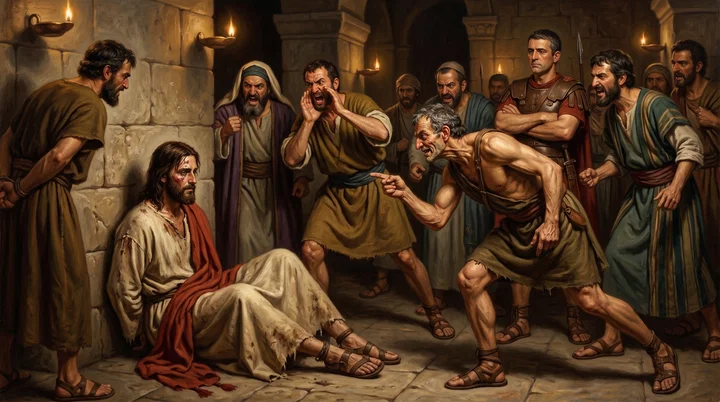
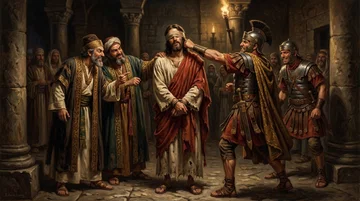
And some began to spit on him, and to cover his face, and to buffet him, and to say unto him, Prophesy: and the servants did strike him with the palms of their hands.
Translations
And some began to spit on him, and to cover his face, and to buffet him, and to say to him, Prophesy: and the servants did strike him with the palms of their hands.
King James Version, KJV Cambridge Paragraph Bible
And some began to spit on him, and to cover his face, and to buffet him, and to say unto him, Prophesy: and the servants did strike him with the palms of their hands.
And some began to spit on him, and to cover his face, and to buffet him, and to say to him, Prophesy: and the servants struck him with the palms of their hands.
Revised Version, American Standard Version
And some began to spit on him, and to cover his face, and to buffet him, and to say unto him, Prophesy: and the officers received him with blows of their hands.
and certain began to spit on him, and to cover his face, and to buffet him, and to say to him, 'Prophesy;' and the officers were striking him with their palms.
And some began to spit upon him, and cover up his face, and buffet him, and say to him, Prophesy; and the officers struck him with the palms of their hands.
And some began to be spitting at him, and, covering up his face, and to be buffeting him, and saying to him—Prophesy! And, the attendants, with smart blows, took him.
Then some of them began to spit on Him. They blindfolded Him, struck Him with their fists, and said to Him, “ Prophesy!” And the officers received Him with slaps in His face.
Then some of them began to spit on Him. They blindfolded Him, struck Him with their fists, and said to Him, “ Prophesy!” And the officers kept striking Him with the palms of their hands.
Some began to spit on him, and to cover his face, and to beat him with fists, and to tell him, “ Prophesy!” The officers struck him with the palms of their hands.
And some put shame on him and, covering his face, gave him blows and said to him, Now say what is to come: and the captains took him and gave him blows with their hands.
And some began to spit at him, and to couer his face, and to beate him with fists, and to say vnto him, Prophesie. And the sergeants smote him with their roddes.
Douay-Rheims (Challoner revision)
And some began to spit on him, and to cover his face, and to buffet him, and to say unto him: Prophesy: and the servants struck him with the palms of their hands.
Pictures
Cross-references
- Matthew 26:67-68
Then did they spit in his face, and buffeted him; and others smote him with the palms of their hands,
Jesus is spat upon, struck, and taunted to prophesy.
- Luke 22:63-65
And the men that held Jesus mocked him, and smote him.
Jesus is blindfolded, struck, mocked, and challenged to prophesy.
- John 18:22-23
And when he had thus spoken, one of the officers which stood by struck Jesus with the palm of his hand, saying, Answerest thou the high priest so?
An officer strikes Jesus, who calmly answers him.
- Isaiah 50:6
I gave my back to the smiters, and my cheeks to them that plucked off the hair: I hid not my face from shame and spitting.
Foretells the servant’s humiliation, spitting, and being struck.
- Luke 22:54-62
Then took they him, and led him, and brought him into the high priest’s house. And Peter followed afar off.
A parallel account of Jesus’ arrest and Peter’s denial.
- Mark 15:1
And straightway in the morning the chief priests held a consultation with the elders and scribes and the whole council, and bound Jesus, and carried him away, and delivered him to Pilate.
Continues the account with the authorities’ next action.
Commentary
Each commentary is drawn from primary sources: the writings of Ellen G. White and Adventist pioneers and periodicals. Each commentary is separate. Its own words are not a quotation; follow the references to read the source passages.
Ellen G. White
8 sources
Mark 14:65 belongs to the account of Jesus before Annas and the court of Caiaphas.DA 698 It places Him in the judgment hall before the fully assembled council, the judges and others specially interested, with the multitude watching Him and Roman soldiers ranged on the platform below the throne amid wild excitement.3SP 115.3–116.2 In that hall Caiaphas presides in gorgeous robe with glittering tiara and costly breastplate, in strong contrast to Jesus in coarse, homely garb.3SP 115.3–116.2 Yet Jesus had reigned crowned in the courts of heaven in garments of brightness attended by holy angels and now stands at an earthly throne to be tried for His life.3SP 115.3–116.2 There He stands calm, serene, dignified, majestic and God-like, revealing His true heavenly kingship.5RED 35.3–36.23SP 115.3–116.2
A holy influence emanates from Jesus and pervades the atmosphere, moving even the hardened multitude to question sentencing such a presence as a common criminal.3SP 115.3–116.2 Caiaphas himself is struck with sudden admiration and conviction that Jesus is akin to God, then banishes the thought and scorns his own mind.3SP 115.3–116.2 Perceiving the influence gaining ground, he hastens the trial and mockingly demands that Jesus work before him one of His famed mighty miracles, which Jesus hears as though He heard not.3SP 115.3–116.2 Earlier in the examination, after Annas was silenced by Jesus' answer, an officer struck Jesus in the face and challenged His reply.DA 698.1–700.5
After His condemnation, while bound, Jesus is mocked and physically abused during His trial: His persecutors spit on Him, cover His face and head and blindfold Him, strike and buffet Him, and taunt Him to prophesy by identifying who struck Him.5RED 35.3–36.2DA 714.5–715.2SG1 51.1EW 139.25RED 41.3–43.1 That abuse takes place with the priests and rulers present and approving, while Roman soldiers restrain the violent crowd from killing Him before He can be crucified.DA 714.5–715.2 Jesus bears the insults and violence without retaliation: He remains meek, calm and dignified, does not answer with anger or force, calmly asks the officer to identify any wrong He has spoken, and answers the abuse without retaliation.DA 698.1–700.55RED 35.3–36.2SG1 51.1EW 139.25RED 41.3–43.1 Though He could have used His divine power to stop His tormentors, and though angels were ready to rescue Him but were restrained by their commanders, He bore the suffering as part of His mission to become humanity's Sin-bearer and as part of the plan of redemption.DA 698.1–700.5EW 139.25RED 41.3–43.1 Those who scorned and spat on Him will one day see His face in glory, for the abused face will give light to the city of God and shine brighter than the sun.DA 714.5–715.2SG1 51.15RED 41.3–43.1
Sources
Pioneers and periodicals
9 sources
Mark 14:65 belongs to the account of Jesus' arrest and trial when, after the disciples fled, he was left alone with his enemies, bound, and taken to Annas.ST Mar 14, 1906 The abuse it records happened during his unjust hearing before the council.ST May 27, 1889 It happened after the council condemned him, in the interval between his condemnation and the morning when he was taken to Pilate, when he was insulted and mocked before being brought to Pilate.ST May 27, 1889ST Mar 6, 1901ST May 25, 1904
The verse records that he was spat on, his face covered, struck with the hands and buffeted, and taunted with the command to prophesy, done openly while he was in custody.ST May 27, 1889ST Mar 6, 1901ST Jun 18, 1912RH Dec 29, 1863 The taunt to prophesy was a mocking demand that he identify who had struck him.ST May 27, 1889ST Mar 6, 1901ST Jan 17, 1911 The abuse was carried out by a violent crowd, with his captors allowing the servants to spit on him and strike him.ST May 27, 1889ST Jun 18, 1912 A temple scribe covers his bleeding face and challenges him to name his attacker, while Roman soldiers restrained the crowd from killing him before the crucifixion.ST May 27, 1889ST Jan 17, 1911
He did not retaliate against those who abused him.ST May 27, 1889 Occurring after Peter followed him at a distance, the mocking and striking warns against standing apart from Christ when he suffers.ST Mar 14, 1906 His open mockery and abuse shows how hollow homage to Christ can stand close to outright rejection and outrage.RH Dec 29, 1863
Sources