Matthew 26:67
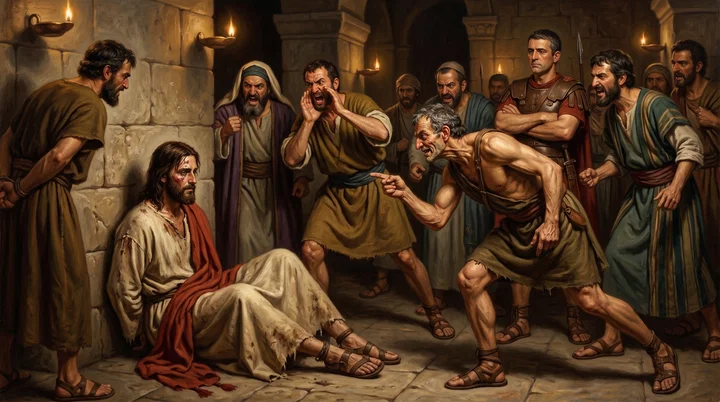
Then did they spit in his face, and buffeted him; and others smote him with the palms of their hands,
Translations
American King James Version, King James Version, KJV Cambridge Paragraph Bible
Then did they spit in his face, and buffeted him; and others smote him with the palms of their hands,
Then they spit in his face, and buffetted him; and others smote him with the palms of their hands,
Revised Version, American Standard Version
Then did they spit in his face and buffet him: and some smote him with the palms of their hands,
Then did they spit in his face and buffet him, and others did slap,
Then they spit in his face, and buffeted him, and some struck him with the palms of their hand,
Then, spat they into his face, and buffeted him; and, others, struck him smartly,
Berean Standard Bible, Majority Standard Bible
Then they spit in His face and struck Him. Others slapped Him
Then they spat in his face and beat him with their fists, and some slapped him,
Then they put shame on him, and were cruel to him: and some gave him blows, saying,
Then spet they in his face, and buffeted him, and other smote him with roddes,
Douay-Rheims (Challoner revision)
Then did they spit in his face, and buffeted him: and others struck his face with the palms of their hands,
Pictures
Cross-references
- Luke 22:63-65
And the men that held Jesus mocked him, and smote him.
A parallel account recounts Jesus being mocked, struck, and insulted.
- Isaiah 50:6
I gave my back to the smiters, and my cheeks to them that plucked off the hair: I hid not my face from shame and spitting.
Foretells the Messiah being struck and spat upon.
- Mark 14:65
And some began to spit on him, and to cover his face, and to buffet him, and to say unto him, Prophesy: and the servants did strike him with the palms of their hands.
Describes people spitting on, striking, and taunting Jesus.
- Matthew 27:27-30
Then the soldiers of the governor took Jesus into the common hall, and gathered unto him the whole band of soldiers.
Continues Jesus’ humiliation and abuse, including mockery, spitting, and striking.
- Isaiah 53:7
He was oppressed, and he was afflicted, yet he opened not his mouth: he is brought as a lamb to the slaughter, and as a sheep before her shearers is dumb, so he openeth not his mouth.
Jesus endured abuse without opening his mouth, fulfilling the prophecy.
- John 18:22
And when he had thus spoken, one of the officers which stood by struck Jesus with the palm of his hand, saying, Answerest thou the high priest so?
An officer strikes Jesus during questioning before the high priest.
- Isaiah 53:3-5
He is despised and rejected of men; a man of sorrows, and acquainted with grief: and we hid as it were our faces from him; he was despised, and we esteemed him not.
The Messiah is rejected and suffers for humanity’s sins, bringing healing.
- Matthew 27:30
And they spit upon him, and took the reed, and smote him on the head.
Both describe Jesus being spat upon and struck before the crucifixion.
- 1 Peter 2:23
Who, when he was reviled, reviled not again; when he suffered, he threatened not; but committed himself to him that judgeth righteously:
Jesus suffered abuse without retaliating.
- Luke 23:11
And Herod with his men of war set him at nought, and mocked him, and arrayed him in a gorgeous robe, and sent him again to Pilate.
Herod’s men mocked Christ during his trial.
- Hebrews 12:3
For consider him that endured such contradiction of sinners against himself, lest ye be wearied and faint in your minds.
Jesus endured sinners’ hostility without growing weary.
- Isaiah 53:12
Therefore will I divide him a portion with the great, and he shall divide the spoil with the strong; because he hath poured out his soul unto death: and he was numbered with the transgressors; and he bare the sin of many, and made intercession for the transgressors.
The servant pours out his life unto death.
- Matthew 27:39
And they that passed by reviled him, wagging their heads,
Both show Christ patient under abuse.
- 1 Peter 2:21
For even hereunto were ye called: because Christ also suffered for us, leaving us an example, that ye should follow his steps:
suffering endured as pattern to follow
- Matthew 27:2
And when they had bound him, they led him away, and delivered him to Pontius Pilate the governor.
The trial before Caiaphas leads to Christ being taken to Pilate.
- John 15:20
Remember the word that I said unto you, The servant is not greater than his lord. If they have persecuted me, they will also persecute you; if they have kept my saying, they will keep yours also.
Christ’s suffering is the pattern for the persecution His followers face.
- 1 Peter 4:13
But rejoice, inasmuch as ye are partakers of Christ’s sufferings; that, when his glory shall be revealed, ye may be glad also with exceeding joy.
Believers share Christ’s sufferings and rejoice in his coming glory.
Commentary
Each commentary is drawn from primary sources: the writings of Ellen G. White and Adventist pioneers and periodicals. Each commentary is separate. Its own words are not a quotation; follow the references to read the source passages.
Ellen G. White
17 sources
In the dark early morning at the palace of Caiaphas, after a secret mock examination meant to condemn Him for His life, those present spat in His face, struck Him with fists and with the palms of their hands, threw a garment over His head, reviled Him with foul names and taunts about His birth and His claim to be Messiah, and challenged Him to prophesy who struck Him.Ms 29, 1909, par. 5–9DA 698.1–700.53SP 122.1–3 He stood bound at the foot of the judgment seat while Caiaphas sat enthroned in gorgeous robes, surrounded by judges, interested partisans and Roman soldiers holding back the excited multitude, with false accusations heaped upon Him to turn the people against Him.5RED 35.3–36.23SP 122.1–3DA 714.5–715.23SP 115.3–116.25RED 27.1 Through it all He remained calm, serene, dignified and meek, without word or look of retaliation, a holy influence going out from Him in sharp contrast to the malignant excitement around Him.DA 698.1–700.55RED 35.3–36.23SP 122.1–33SP 115.3–116.2ST Jun 13, 1878 Though the blows came from beings He had created, whom He could have laid in the dust by a word or look while heaven's hosts longed to intervene, He restrained His divine power and submitted uncomplainingly out of love for His Father and His pledge from the foundation of the world to become the Sin-bearer.DA 698.1–700.53SP 122.1–3Lt 98, 1906, par. 15 Every insult was recorded by angels, and the face then treated with contempt will one day shine brighter than the sun in the city of God, when those who struck and spat upon Him will remember with terror and pray to be hidden from it.3SP 122.1–3EW 139.2GC 643.1–2
Trial Setting and Abuse
It was very dark early morning at the palace of Caiaphas the officiating high priest when Jesus was hurried there amid insult and mockery.5RED 27.1 He stood at the foot of the throne of judgment to be tried for His life, with Caiaphas seated on the throne, the judges and those specially interested on either side, and Roman soldiers ranged on the platform below the throne.5RED 35.3–36.23SP 115.3–116.2 The eyes of the multitude were upon Him while the wildest excitement prevailed around.5RED 35.3–36.23SP 115.3–116.2
The proceedings were a mockery of an examination and a mock trial kept secret under pretense of a legal trial so the people could not testify in His defense.5RED 27.15RED 33.1 Their testimony of His mighty works would have turned anger against the Sanhedrin, undone its actions, and led to His release and renewed honor.5RED 33.1 His persecutors coarsely accused Him with false statements and accusations to portray Him in the worst light, the priest sneeringly questioned Him, and the whole assembly reviled Him.5RED 27.1Lt 50, 1889, par. 6–9 Priests and rulers sanctioned the violence while Roman soldiers by force held back the mob from tearing Him to pieces.3SP 122.1–3DA 714.5–715.2
After His testimony and condemnation came a third scene of abuse, which those who held it to be before He was even accused or condemned described as by a midnight mob.Ms 29, 1909, par. 5–9DA 698.1–700.5DA 714.5–715.2 Those present spat in His face, struck Him with fists, and hit Him with the palms of their hands.Ms 29, 1909, par. 5–9 An old garment was thrown over His head and they struck Him in the face, and when it was removed one spat in His face.3SP 122.1–3 The judges forgot the dignity of their office and abused Him with foul names, railing on His parentage and low birth and declaring His claim to be Messiah worthy of the most shameful death.3SP 122.1–3 They taunted Him about that claim, challenged Him to prophesy and identify who struck Him, and sneeringly demanded a mighty miracle, with the most dissolute men joining in deliberate humiliation without pity or shame.3SP 122.1–3DA 714.5–715.2Lt 98, 1906, par. 15COS 131.2–5
Peter and John witnessed the mock trial.5RED 33.1 Peter saw a hand raised to strike Jesus in the face and realized his denial had added dishonor and grief to his Master's suffering.ST Oct 19, 1882 While enduring the abuse Jesus felt a keener pang than His enemies could inflict when He heard His beloved disciple deny Him with cursing and swearing.5RED 27.1
Christ's Patient Endurance
Amid the spitting and blows He stood calm, serene, dignified, majestic and meek, with a holy influence emanating from Him that pervaded the atmosphere.5RED 35.3–36.23SP 115.3–116.2ST Jun 13, 1878EW 139.2 That calm bearing stood in strong contrast to the excited, malignant, sneering bearing of Annas and Caiaphas.5RED 35.3–36.23SP 115.3–116.2ST Jun 13, 1878 For a moment it convicted even Caiaphas that He was akin to God, and it led even the hardened multitude to question whether a man of God-like presence should be sentenced as a common criminal.5RED 35.3–36.23SP 115.3–116.2 Caiaphas presided in gorgeous robe, glittering tiara and costly breastplate while Jesus wore coarse, homely clothing, yet He had reigned in the courts of heaven crowned and clothed in brightness and attended by holy angels.5RED 35.3–36.23SP 115.3–116.2
He endured bound and closely guarded, without word or look or angry look of retaliation, with a sinless, patient, gentle heart, keeping to His chosen position as one with humanity.DA 698.1–700.53SP 122.1–3EW 139.2 The blows came from beings He had created and came to save, men controlled by Satan acting as fiends.DA 698.1–700.5 He suffered keenly under them in proportion to the perfection of His holiness and hatred of sin.DA 698.1–700.5
He knew the hosts of heaven witnessed His humiliation, and He had supreme power to stop His strikers.DA 698.1–700.53SP 122.1–3Lt 98, 1906, par. 15 By one flash of divine will, by a word or look, He could have laid His tormentors in the dust as dead men, driven them away, and compelled confession that He is Lord above kings, rulers, priests and temple.DA 698.1–700.53SP 122.1–3 The angels witnessing every movement longed to consume His adversaries, and the least angel could have dispersed the crowd and freed Him, but they were not commanded to strike.DA 698.1–700.53SP 122.1–3
He restrained His divine power and submitted uncomplainingly because of His love for His Father and His pledge from the foundation of the world to become the Sin-bearer.DA 698.1–700.5 It was part of His mission to bear in His humanity all taunts and abuse men could heap upon Him.DA 698.1–700.5 The plan of redemption to which He had consented in becoming man's Redeemer required Him to suffer the scorn and abuse of wicked men, and the only hope of humanity was in this submission to all He could endure from the hands and hearts of men.DA 698.1–700.53SP 122.1–3
This abuse was part of the bitter cup of agony that threatened to separate Him for a time from His Father.Ms 9, 1910, par. 11–13 He endured it in behalf of sinners when He could have refused to drink it.Ms 9, 1910, par. 11–13 God knew best and strengthened His only begotten Son to endure the agony and shame to become a propitiation for the sins of a lost world.Ms 9, 1910, par. 11–13
Future Glory and Appeal
Every insulting look and word and act in that hour was recorded by angels.3SP 122.1–3 The calm, pale face then treated with contempt and spat upon will one day be seen in glory shining brighter than the sun.3SP 122.1–3EW 139.2 In that glory it will give light to the city of God.EW 139.2 Those who scorned and spat upon it and those who struck Him will then remember what they did with terror and remorse.3SP 122.1–3GC 643.1–2 They will pray to rocks and mountains to hide them from it.3SP 122.1–3
The striking and spitting in the judgment hall, like the taunting on the cross, was a rejection of the Lord of life and glory that needed pardon.Ms 29, 1898, par. 14–15 Pardon for that rejection was brought to the Jewish nation in the gospel preached in the power of the Holy Spirit after He was crucified.Ms 29, 1898, par. 14–15 Even those who did this abuse would have been forgiven if they had repented as Saul did.Ms 29, 1898, par. 14–15
He suffered that shame at the hands of cruel men who struck Him in the face and spat upon Him while mockingly commanding Him to give a sign that He was the Saviour.Ms 9, 1910, par. 11–13 It was part of the bitter cup of agony that threatened to separate Him for a time from His Father, which He endured in behalf of sinners when He could have refused to drink it.Ms 9, 1910, par. 11–13 God knew best and strengthened His only begotten Son to endure the agony and shame to become a propitiation for the sins of a lost world.Ms 9, 1910, par. 11–13 That endurance rebukes self-pity in service and calls for Christlikeness and suffering for His sake.Ms 9, 1910, par. 11–13
Sources
Pioneers and periodicals
55 sources
After declaring under oath that he is the Son of God, he was condemned by Caiaphas and the council as a blasphemer worthy of death, and in the high priest's house they spit in his face, struck him with fists and with the palms of their hands, and blindfolded him mocking his Messiahship by demanding he tell who hit him.ST Mar 6, 1901ST Mar 6, 1901RH Dec 9, 1858RH Nov 5, 1872
Though innocent and without sin, the Lord of glory laying down his life for a ruined world, he stood calm amid their excitement with dignified bearing, bearing it without anger, reviling in return, or retaliation, and answering with patient silence.ST May 27, 1889ST Jun 13, 1878RH Nov 5, 1872ST Jul 14, 1881ST Mar 19, 1896
This shame and smiting fulfills Isaiah 50:6 concerning the suffering servant, proving him the promised Messiah despised and rejected who did not open his mouth.RH Nov 18, 1862RH Jun 24, 1858ST Oct 21, 1930RH Jan 12, 1869
His buffeting, shame and reviling were part of the sacrifice in which he bore the curse of the law for sinners, paid humanity's debt, made pardon possible, and gave his life in humiliation and pain so others might live.ST Feb 3, 1909RH Feb 13, 1872RH Oct 28, 1858
His meek endurance without sinning or standing on his rights is the perfect rule and example for his followers to keep close to him in reproach as well as glory, to persevere under scoffing, and to love and bless even those who wrong and persecute them rather than retaliate.ST Mar 14, 1906RH Jan 12, 1869RH May 26, 1868RH Aug 3, 1916ST Aug 17, 1915
Trial Setting and Sequence
The blows came after Jesus declared under oath before Caiaphas that He is the Son of God, and after the council answered that He was worthy of death for blasphemy.ST Mar 6, 1901ST Mar 6, 1901ST Mar 28, 1906 Caiaphas sat as judge and head of the highest court of His own nation, pronouncing Him guilty as an accused culprit, and the events around Jesus and Caiaphas hold lessons of world-wide and ages-long import concerning His name, character, mission, and end.ST Mar 6, 1901 What the rabble then did was to spit in His face, strike and buffet Him, beat Him with the hands, blindfold Him, and mock Him by demanding that He prophesy who had hit Him.ST Mar 6, 1901ST Mar 6, 1901RH Nov 5, 1872 The beating came from brutal servants who abused the One their masters hated in order to win favor with them, and the reviling and smiting went on until cruelty itself grew tired.ST Mar 28, 1906 The charge leading to condemnation at that arraignment before the high priest was blasphemy, not Sabbath-breaking, and His silence did not make the accusation true.ST Dec 6, 1883 He bore all this without anger or resentment in order to save sinners, including those who abused Him.RH Nov 5, 1872
It took place in the house of Caiaphas, in the high priest's palace and hall, before a vindictive council of chief priests, elders, scribes, Sadducees, and Pharisees.ST Mar 27, 1901RH Dec 9, 1858 These were leaders whose greed, hypocrisy, ignorance, or doctrines Jesus had reproved or condemned.ST Mar 27, 1901 There the Son of God was treated with bitter hate, malicious scorn, and bitter insult, with peculiar and extraordinary inhumanity beyond common custom, in a work of shame and awful guilt in which Jews and Gentiles joined.ST Jul 14, 1881 They insulted Him by spitting in His face, buffeted Him, covered His eyes and then struck Him with the palms of their hands, joining the blows to mockery of His claim to be the heavenly Messiah.RH Dec 9, 1858ST Jul 14, 1881 Amid surrounding hostility and excitement He stood calmly, and His dignified bearing contrasted with their sneering conduct.ST Jun 13, 1878 This humiliation and abuse before Caiaphas belongs to the path of suffering Christians follow when they take up the cross and follow Christ, and to the opposition He endured from open enemies and professed religious leaders.RH Jul 30, 1867RH Mar 17, 1853
It belongs to His arrest and trials before the Sanhedrin and chief priests, as part of the day of betrayal, agony in the garden, arrest, trial, condemnation, mocking, scourging, and crucifixion.ST Feb 3, 1909RH Feb 13, 1872 That day of His death was the day He showed His love for humanity above all others and bore the curse of the law for sinners, presenting Him as the Saviour of the world and an example.ST Feb 3, 1909RH Feb 13, 1872 He was first brought before Annas, who condemned Him despite lacking authority to judge Him and despite the unlawfulness of a nighttime condemnation; in the morning Caiaphas condemned Him for blasphemy but could not enforce a death sentence; Pilate later passed that sentence although he declared Jesus innocent of any crime.ST Dec 24, 1912 He was thus unjustly condemned and hurried from tribunal to tribunal by night, with Herod mocking Him for calling Himself a King and daring Him to save Himself.ST Jan 13, 1898 The spitting in His face belongs with putting on Him an old purple robe of scorn and crowning Him with thorns, and He who was spat upon is the Lord of glory whom angels delight to honor.ST Jan 13, 1898 The same suffering leads on to laying the heavy cross on Him till He fainted beneath the burden, driving nails into His hands and feet, lifting the cross till it fell with a thud into its place, and hanging the Saviour of men between earth and heaven, showing that evil did come upon Him in His arrest unto crucifixion.ST May 8, 1879ST Jan 13, 1898
He was left alone with His enemies after all the disciples forsook Him and fled in the Garden, bound with utterly needless precaution and taken to Annas the former high priest and father-in-law of Caiaphas while the leaders united all possible against Him.ST Mar 14, 1906 Peter still smarted under rebuke for using the sword and followed hoping for opportunity to fight, expecting Jesus to assert authority as in the cleansing of the temple.ST Mar 14, 1906 He had not learned the spirit of the Master and the principles of the kingdom.ST Mar 14, 1906 All who seek to promote His kingdom by carnal means profit nothing, for all they that take the sword shall perish with the sword.ST Mar 14, 1906
The religious court condemned Him although He was the promised Messiah, spoke the truth, and was blameless, without fairly examining His claims.RH Oct 27, 1874RH Oct 27, 1874 The law was not at fault; the court's misinterpretation of it and its expectations about how the Messiah would come led to His rejection.RH Oct 27, 1874 They might have been convinced of His Messiahship had they consented to examine anew the Scriptures to which He appealed.RH Oct 27, 1874 Their error and guilt warns everyone who would know the mind of Jesus to come to the Bible with a simple desire to learn its teachings.RH Oct 27, 1874
Nature of the Abuse
Matthew 26:67 describes contempt poured out in the high priest's hall, where he was mocked and abused with spitting in his face and striking of every kind.ST Feb 3, 1909ST Oct 31, 1916RH Oct 17, 1854 Some spat and struck while others slapped, so that buffeting with fists and beating with the palms of the hands and open slaps fell on him together.ST Feb 3, 1909ST Oct 31, 1916 This humiliation came as he was led among the rulers toward Pilate's final sentence and on toward Calvary, part of the suffering by which he gave his life so that others might live.ST Oct 31, 1916RH Oct 17, 1854RH Aug 29, 1865RH Mar 25, 1873 It was not convenient pain, but he accepted it to save humanity while carrying out his mission to save sinners, giving weary endurance under scoffing and hostility its pattern.RH Oct 17, 1854RH Aug 29, 1865
His eyes were covered or blindfolded and then he was struck, with the blows joined to mockery of his claim to be the Messiah from heaven.ST Mar 6, 1901RH Dec 9, 1858ST Jul 14, 1881ST Mar 28, 1906 They demanded that he prophesy and identify who had hit him, daring him to tell who struck him.ST Mar 6, 1901RH Dec 9, 1858RH Nov 5, 1872ST Jul 14, 1881ST Mar 28, 1906 This followed his condemnation, after he was declared guilty of death, in the high priest's palace.ST Mar 6, 1901RH Dec 9, 1858RH Nov 5, 1872 The blows came from brutal servants who abused the one their masters hated in order to win favor with them, and he bore it without anger or resentment in order to save sinners, even those who abused him.RH Nov 5, 1872ST Mar 28, 1906
The reviling and smiting went on until cruelty itself grew tired.ST Mar 28, 1906 It was a work of shame and awful guilt in which Jews and Gentiles joined, marked by peculiar and extraordinary inhumanity beyond common custom, with bitter hate and malicious scorn.ST Jul 14, 1881 The soldiers followed the chief priests' example and, as their excitement grew, repeatedly struck him on the head after taking the mock scepter from his hand.ST Nov 16, 1882 Such open outrage in smiting and buffeting him stands only a single step beyond mocking him with hollow homage, with Hail, Master, and lip-confession with life-denial, showing how quickly merely outward traditional profession passes into outright rejection.RH Dec 29, 1863
The spitting in his face belongs with the rest of his passion: scourging and binding to a pillar, putting on him an old purple robe of scorn, crowning him with thorns, laying the heavy cross on him till he fainted beneath the burden, driving nails into his hands and feet, lifting the cross till it fell with a thud into its place, and hanging the Saviour of men between earth and heaven.ST Jan 17, 1911ST Jan 13, 1898 After he was scourged and bound to a pillar his face was covered and a rabbi spat on his cheek while he was taunted to identify who had struck him.ST Jan 17, 1911 He who was thus spat upon, unjustly condemned and hurried from tribunal to tribunal by night with Herod mocking him for calling himself a King and daring him to save himself, is the Lord of glory whom angels delight to honor.ST Jan 13, 1898
Christ's Character Under Suffering
Though innocent and without sin, he was the Lord of glory laying down his life for a sinful and ruined world, and Matthew 26:67 marks the beginning of the shame and cruelty he humbled himself to endure in the high priest's palace where Jews and Gentiles joined in awful guilt with peculiar and extraordinary inhumanity beyond common custom and with bitter hate and malicious scorn.ST Jul 14, 1881ST Nov 14, 1900 Though able to summon angels, he submitted without resistance to the civil authorities in custody before the high priest and endured spitting and striking while remaining faithful to his mission and to God, a submission that did not mean denying that mission when authority demanded it.ST Jul 14, 1881ST Mar 19, 1896 His humiliation and pain were not convenient, yet he accepted them in giving his life so that others might live.RH Aug 29, 1865
He stood calmly before his accusers with dignified bearing amid surrounding hostility and excitement, in contrast to their sneering conduct after the high priest declared him guilty of death.ST Jun 13, 1878RH Nov 5, 1872 Amid the mob's violence, which Roman soldiers restrained, he bore spitting in the face, buffeting, blows with fists and palms, covering of his eyes, and the mocking demand to identify who had hit him, without anger or resentment and without retaliation, in order to save sinners including those who abused him.ST May 27, 1889RH Nov 5, 1872ST Jul 14, 1881 During his mock trial before the Jewish Sanhedrin he did not answer or resist, but kept patient silence without opening his mouth, fulfilling Isaiah's prophecy of the afflicted servant.RH Jan 12, 1869ST Nov 14, 1900
He was patient when despitefully used by Caiaphas, being spit in the face, buffeted, and smitten with the palms of hands, giving reason to pray to him for patience to bear God's holy will in all things.RH May 26, 1868 Though misunderstood by his best-loved friends and maligned and spit upon under the very shadow of the cross by those for whom he was willing to die, he never spoke a word of discontent but remained sweet and gentle, beautifying common toil by example.RH Jun 8, 1911 He loved those who hated him even while spat upon and struck, and prayed for his tormentors.ST Aug 17, 1915
His sorrows and wounds were caused by sin, so that lightheartedness about sin insults him in the high priest's hall where he was treated with contempt, mocked, abused, spat upon and struck. His spit and blows belong to the cruel humiliation and bitter death he endured for sinners, calling those he purchased to turn from sin and leave sinful habits behind.RH Jan 9, 1866 Even those who took part in spitting in his face and striking him before his accusers committed wicked deeds for which they could still repent and receive forgiveness through him.RH Jun 12, 1855
Prophecy and Typology Fulfilled
The spitting in his face and the striking with fists and open hands are the shame and smiting foretold for the suffering servant in Isaiah 50:6.RH Jun 24, 1858ST Oct 21, 1930 That foretold smiting and spitting identifies him as the promised Messiah and suffering servant.RH Jun 24, 1858ST Oct 21, 1930 Comparing such Old Testament prophecy with its New Testament fulfillment in this abuse guides understanding of prophecy still unfulfilled.RH Jun 24, 1858
He is the Messiah despised and rejected, enduring foretold humiliation and grief at the hands of his persecutors.RH Nov 18, 1862 During his mock trial before the Jewish Sanhedrin he was spat upon, struck and buffeted, yet he did not answer or resist.RH Jan 12, 1869 That patient silence fulfills Isaiah's prophecy of the afflicted servant who did not open his mouth.RH Jan 12, 1869
In the peace-offering type the two cheeks given to the priest correspond to the Saviour's face being spat upon in his humiliation.RH Jun 13, 1912
Salvation and Coming Glory
The verse belongs to the arrest and trials before the Sanhedrin and chief priests, on the day of betrayal, agony in the garden, arrest, trial, condemnation, mocking, scourging and crucifixion.ST Feb 3, 1909RH Feb 13, 1872 That day of death showed love for humanity above all others, when the curse of the law was borne for sinners.RH Feb 13, 1872 The buffeting, shame and reviling were part of the sacrifice that paid humanity's debt, made pardon possible, and saved humanity from despair.RH Oct 28, 1858 The spitting and striking in the judgment hall were humiliation and pain accepted before Calvary so that others might live, presenting him as the Saviour of the world and an example.ST Feb 3, 1909RH Aug 29, 1865RH Mar 25, 1873
The suffering and mock trial are past and will never be repeated.ST Dec 7, 1904 The same men who judged, mocked and struck him must rise to see him return in royal glory.RH Nov 17, 1868 He is coming again in glory to judge the world and reign forever, no longer in humiliation or anguish.RH Nov 17, 1868ST Dec 7, 1904
The contemptuous and violent treatment was spitting and striking by the Sanhedrin as a religious power.RH Dec 13, 1906 That same treatment by a religious power is what would be received if he returned to earth.RH Dec 13, 1906 The Vatican would give him what the Sanhedrin gave him.RH Dec 13, 1906
Example and Call to Follow
The judgment hall where he was spit upon and struck is a place of reproach and suffering where his followers must keep close to him and go with him just as much as on the Mount of Transfiguration and in the triumphal entry, and just as on the toiling way up Calvary.ST Mar 14, 1906 It is better to be with him in suffering and shame than to be without him in safety and glory, for following afar off ends in denying the Master.ST Mar 14, 1906 Christian perfection is not chiefly a matter of extraordinary spiritual experiences, but of resolutely taking up the cross and following him through suffering, injustice, and humiliation before Caiaphas and Pilate and on the way to Calvary.RH Aug 14, 1860RH Jul 30, 1867
He meekly endured being spit upon, struck, and abused while carrying out his mission to save sinners, and his endurance gives weary Christians strength to persevere when they face scoffing or hostility.RH Oct 17, 1854 His suffering in mockery and physical abuse gave Paul an example as he endured shame and reproach for serving him.RH Jan 7, 1873 The contempt and violence of spitting in his face and striking him illustrates the world's hostility toward him, so that standing with him means accepting that his followers may be treated with the same hostility.RH Oct 17, 1854
He left a perfect rule of life and example to follow in all things by being without sin, without reviling in return, without standing up for his rights, and without opening his mouth.ST Nov 14, 1900 When lied about he did not waste time running from place to place to straighten it out but lived the lie down, so that his life itself completely refuted all vilification, and he endured this to magnify the precepts of the law.ST Nov 14, 1900 During his mock trial before the Jewish Sanhedrin he was spit upon, struck, and buffeted, yet did not answer or resist, and his patient silence was that of the afflicted servant who did not open his mouth.RH Jan 12, 1869 He was patient when despitefully used, being spit in the face, buffeted, and smitten with the palms of hands, and his sorrows suffered with patience are an example for praying to him for patience to bear God's holy will in all things.RH May 26, 1868
He was struck and spit upon by people he had blessed and sought to save, yet his mistreatment did not stop him from helping others, for he responded with forgiveness and continued concern for them.RH Mar 27, 1900 He nevertheless loved even the ungodly and those who treated him evilly and hated him, and prayed for them.ST Aug 17, 1915RH Sep 10, 1901 Though crowned with thorns, blindfolded, hanged on a tree, and reproached as he died after being spit in the face, struck, and beaten, he prayed with love for his tormentors.RH Aug 3, 1916 His example therefore calls his followers to love all, including those who wrong them, to show the same spirit under rebuff and persecution, and, though repaid with persecution, to keep helping and blessing rather than retaliating.RH Aug 3, 1916RH Mar 27, 1900RH Sep 10, 1901
His enduring far worse treatment without complaint stands against a pastor's grievances and teaches patience and humility.ST Dec 25, 1901 Even under the very shadow of the cross, misunderstood by his best-loved friends and maligned and spit upon by those for whom he was willing to die, yet never speaking a word of discontent, he remained sweet and gentle, beautifying common toil by his example, teaching giving thanks in everything and taking hold of sufficient grace to bear petty trials of everyday life with cheerfulness and even temper.RH Jun 8, 1911 Merely outward, traditional profession with hollow homage of Hail, Master and lip-confession with life-denial easily and quickly passes to open outrage in smiting and buffeting him, standing only a single step beyond that mockery and revealing the sure connection between outward profession and outright rejection.RH Dec 29, 1863 His cruel humiliation with spit and blows belongs to the bitter death he endured for sinners, and it calls those he purchased to turn from sin and leave sinful habits behind.RH Jan 9, 1866 After he answered the high priest men spit on him and struck him, and Peter witnessed this humiliation but, overcome by fear, did not defend his Master, seeing the hand raised to strike his Master's face and realizing that his denial had added dishonor and grief to the suffering already being endured.ST Oct 19, 1882ST Jan 10, 1911
Sources