Translations
American King James Version, King James Version, KJV Cambridge Paragraph Bible, Webster Bible, Revised Version, American Standard Version
Then Pilate therefore took Jesus, and scourged him.
Then, therefore, did Pilate take Jesus and scourge [him],
Then Pilate therefore took Jesus and scourged [ him].
Then Pilate, therefore, took Jesus, and scourged him.
Berean Standard Bible, Majority Standard Bible
Then Pilate took Jesus and had Him flogged.
So Pilate then took Jesus and flogged him.
Then Pilate took Jesus and had him whipped with cords.
Then Pilate tooke Iesus and scourged him.
Douay-Rheims (Challoner revision)
Then therefore, Pilate took Jesus, and scourged him.
Pictures
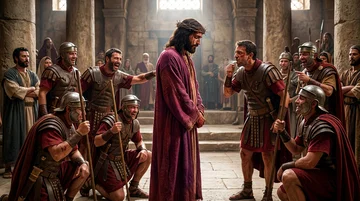
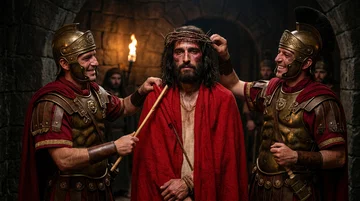
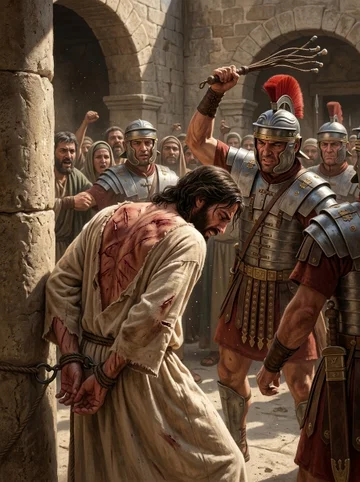
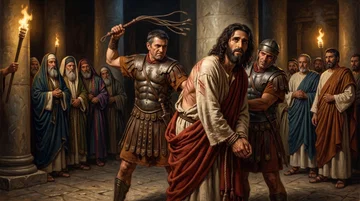
Cross-references 20 of 25
- Matthew 27:26
Then released he Barabbas unto them: and when he had scourged Jesus, he delivered him to be crucified.
Records Pilate having Jesus scourged before handing him over.
- Mark 15:15
And so Pilate, willing to content the people, released Barabbas unto them, and delivered Jesus, when he had scourged him, to be crucified.
Pilate has Jesus scourged before delivering him to be crucified.
- John 18:38
Pilate saith unto him, What is truth? And when he had said this, he went out again unto the Jews, and saith unto them, I find in him no fault at all.
Pilate declares that he finds no fault in Jesus.
- Luke 23:16
I will therefore chastise him, and release him.
Pilate proposes chastising Jesus, corresponding to his scourging.
- Matthew 27:29
And when they had platted a crown of thorns, they put it upon his head, and a reed in his right hand: and they bowed the knee before him, and mocked him, saying, Hail, King of the Jews!
Jesus is crowned with thorns and mocked as King of the Jews.
- Isaiah 53:5
But he was wounded for our transgressions, he was bruised for our iniquities: the chastisement of our peace was upon him; and with his stripes we are healed.
Christ’s wounds bear others’ sins and bring redemption.
- John 19:16-18
Then delivered he him therefore unto them to be crucified. And they took Jesus, and led him away.
Scourging led to Jesus being handed over and crucified.
- Mark 15:16-20
And the soldiers led him away into the hall, called Prætorium; and they call together the whole band.
Records the crown of thorns, purple robe, blows, and mockery.
- Matthew 27:2
And when they had bound him, they led him away, and delivered him to Pontius Pilate the governor.
Jesus is brought before Pilate on the way to crucifixion.
- Luke 23:22
And he said unto them the third time, Why, what evil hath he done? I have found no cause of death in him: I will therefore chastise him, and let him go.
Pilate finds no fault in Jesus yet says he will chastise him and release him.
- John 19:5-6
Then came Jesus forth, wearing the crown of thorns, and the purple robe. And Pilate saith unto them, Behold the man!
Jesus is displayed to the crowd, which demands his crucifixion.
- John 19:17-18
And he bearing his cross went forth into a place called the place of a skull, which is called in the Hebrew Golgotha:
Jesus bears the cross and is crucified.
- Matthew 27:22
Pilate saith unto them, What shall I do then with Jesus which is called Christ? They all say unto him, Let him be crucified.
The crowd demanded that Jesus be crucified.
- Isaiah 53:3
He is despised and rejected of men; a man of sorrows, and acquainted with grief: and we hid as it were our faces from him; he was despised, and we esteemed him not.
Both texts describe Jesus’ suffering and sorrow.
- John 19:34
But one of the soldiers with a spear pierced his side, and forthwith came there out blood and water.
Records the spear wound following Christ’s scourging.
- Isaiah 53:7
He was oppressed, and he was afflicted, yet he opened not his mouth: he is brought as a lamb to the slaughter, and as a sheep before her shearers is dumb, so he openeth not his mouth.
The afflicted servant remains silent while suffering, as Jesus did.
- 1 Peter 2:24
Who his own self bare our sins in his own body on the tree, that we, being dead to sins, should live unto righteousness: by whose stripes ye were healed.
Christ’s stripes are connected with bearing sins and living unto righteousness.
- Matthew 27:19
When he was set down on the judgment seat, his wife sent unto him, saying, Have thou nothing to do with that just man: for I have suffered many things this day in a dream because of him.
Pilate’s wife warns him in a dream not to harm Jesus.
- Matthew 26:67-68
Then did they spit in his face, and buffeted him; and others smote him with the palms of their hands,
Both describe Jesus being abused during his trial.
- Matthew 27:24
When Pilate saw that he could prevail nothing, but that rather a tumult was made, he took water, and washed his hands before the multitude, saying, I am innocent of the blood of this just person: see ye to it.
Pilate washes his hands to disclaim responsibility before the crowd.
Commentary
Each commentary is drawn from primary sources: the writings of Ellen G. White and Adventist pioneers and periodicals. Each commentary is separate. Its own words are not a quotation; follow the references to read the source passages.
Ellen G. White
23 sources
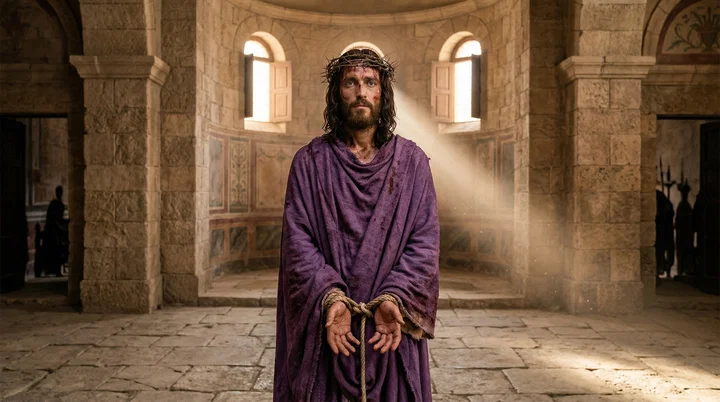
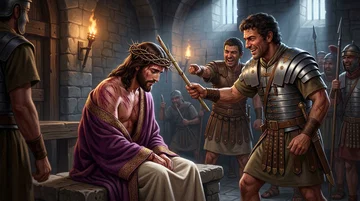
Pilate in his judgment hall before the march to Calvary had Jesus, whom he had three times declared to be without fault, scourged before condemning him.DA 723.1–724.1DA 722.5Ms 51, 1897, par. 31–32ST Jul 12, 1899DA 735.1–5 He ordered it as a cruel and unjust expedient to satisfy the priests and hostile crowd, to stir their pity, and to avoid sentencing him to crucifixion.ST Jul 11, 18785RED 63.13SP 143.1–2 Under his authority a Roman soldier lacerated Jesus until his back was wounded with long, deep, bleeding stripes, while around the scourging he was mocked as king in a purple robe, crowned with thorns pressed into his temples, struck on the head with a reed until blood ran down his face, spit upon and struck with blows.Ms 137, 1897, par. 6–85RED 63.1SG1 50.1EW 138.3COS 147 Wounded and bleeding and crowned with thorns he was displayed beside Barabbas in hope the sight would move the people, and even then his uncomplaining patience and dignity stood in sharp contrast to the hardened robber, yet the priests and crowd were not moved to pity but still demanded his crucifixion.ST Jul 11, 1878Ms 51, 1897, par. 31–325RED 63.1 The scourging was part of the suffering at the hands of wicked men necessary to carry out the plan of salvation, in which the Just suffered for the unjust and bore the sins of the whole world to ransom humanity, and though the abuse was meant to provoke him to complain or use his divine power to escape, he bore it as a voluntary sacrifice.SG1 50.1EW 138.3EW 138.116MR 31.1Ms 95, 1897, par. 14
Context and Scourging
The scourging took place in Pilate's judgment hall before Jesus was led out to Calvary for crucifixion.DA 723.1–724.1DA 722.5 There He stood bound as a prisoner with soldiers around Him, while outside the hall the Sanhedrin with Jewish officials and a crowd pressed Pilate during the Passover feast to confirm and carry out their sentence.DA 723.1–724.1 The scourging itself came before His condemnation.Ms 137, 1897, par. 6–8DA 722.5
Pilate had Him scourged even though he had found no fault in Him, declaring Him innocent three times.Ms 51, 1897, par. 31–32ST Jul 12, 1899DA 735.1–5 The scourging was followed by the soldiers' mockery and blows.Ms 51, 1897, par. 31–32 Afterward Pilate presented Him wearing the crown of thorns and the purple robe as One in whom he found no fault, before He was handed over to suffer a cruel death.Ms 51, 1897, par. 31–32ST Jul 12, 1899
Pilate ordered the scourging as an expedient to satisfy the priests and the hostile crowd, hoping the punishment would stir their pity and let him release Jesus and avoid condemning Him to crucifixion.ST Jul 11, 18785RED 63.13SP 143.1–2DA 735.1–5Ms 112, 1897, par. 26–30 It was a cruel and unjust act, done against the evidence and against his own conviction of Jesus' innocence, causing Him great bodily pain.Ms 112, 1897, par. 26–30 By yielding to the priests and rulers he sacrificed innocence to religious hatred.Ms 112, 1897, par. 26–30
The scourging was inflicted under Pilate's authority by a Roman soldier.COS 147 It left His back wounded with long, cruel, deep, bleeding stripes, His body lacerated, exhausted, and humiliated.Ms 137, 1897, par. 6–85RED 63.1COS 147DA 735.1–5Ms 75, 1886, par. 19 After a second scourging, with the crown of thorns upon Him and the cross laid on Him, He bore Himself as one making a voluntary sacrifice yet fell fainting, too weak to continue standing.Ms 95, 1897, par. 14
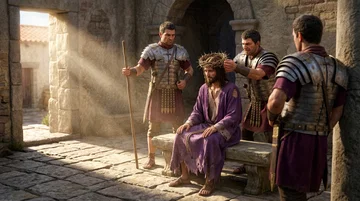
Around the scourging He was further degraded after betrayal and arrest.Ms 78, 1910, par. 29 He was dressed in a purple robe and mocked as king, spit upon, and struck with blows.Ms 137, 1897, par. 6–8SG1 50.1EW 138.3Lt 1a, 1861, par. 2–5 A crown of thorns was put upon His head and pressed into His temples, and He was struck on the head with a reed so that the thorns pierced Him and blood ran down His face, brow, and beard, giving Him all the suffering possible before His hands and feet were nailed to the cross.SG1 50.1EW 138.3Lt 1a, 1861, par. 2–5Ms 78, 1910, par. 29
Wounded and bleeding and crowned with thorns, He was displayed beside Barabbas in hope the sight would stir pity.ST Jul 11, 18785RED 63.13SP 143.1–2 Even in suffering His uncomplaining patience, gentleness, nobility, and dignity stood in sharp contrast to the hardened robber beside Him.ST Jul 11, 18785RED 63.13SP 143.1–2 The priests and people were not moved to pity but still demanded His crucifixion and accused Him of claiming to be the Son of God.ST Jul 11, 1878Ms 51, 1897, par. 31–323SP 143.1–2
Purpose in Salvation
The scourging was part of the suffering at the hands of wicked men necessary to carry out the plan of salvation and ransom humanity.SG1 50.1EW 138.3 He was dressed in a purple robe and mocked as king, crowned with thorns, and struck on the head with a reed so that the thorns pierced His temples and blood ran down His face and beard.SG1 50.1EW 138.3 His suffering and death were the sacrifice of the Just for the unjust, for He bore the sins of the whole world so that His precious blood could redeem people to God.16MR 31.1
The abuse and mockery, including the crown of thorns, were meant to provoke Him to complain or to use His divine power to escape, and His doing so would have frustrated the plan of salvation.EW 138.1 Yet He bore Himself as one making a voluntary sacrifice.Ms 95, 1897, par. 14 After a second scourging, with the crown of thorns and the cross laid upon Him, the burden left Him too weak to continue standing, and He fell fainting beneath the cross.Ms 95, 1897, par. 14
The verse shows the Son of God, though Creator and Redeemer, suffering cruel scourging as part of the affliction and sorrow He endured before His death.Ms 75, 1886, par. 19 His body was lacerated, and the violence against Him was driven by Satan through his human agents, yet through that affliction Satan's own rule was ultimately brought down.Ms 75, 1886, par. 19 Because He was lacerated with stripes, spit upon, degraded, and crowned with thorns, He has close understanding of those who suffer for truth and virtue, and He is beside them when they are tortured, imprisoned, or bound.Ms 137, 1897, par. 6–8
Responses and Lessons
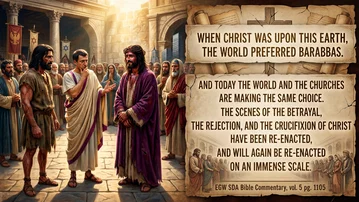
The scourging came as Jesus approached the cross and descended into the depths of humiliation, treated as the worst of criminals while in the hands of wicked men.ST Jul 7, 1898Ms 3, 1898, par. 20–21 His own nation clamored for His blood, and the murderous Barabbas was chosen in place of their beloved Teacher, who was crowned with thorns, clad in the purple robe, bowed before in mockery and struck with the reed placed in His hand, then lifted up on the cross to die as a malefactor.ST Jul 7, 1898 The disciples had thought He was to take His place on David's throne and had centered their hopes of eternal life in Him, so to see Him so treated shook them deeply.ST Jul 7, 1898Ms 3, 1898, par. 20–21 This was the taking away of the Bridegroom, bringing days of trial and temptation when their faith would be tried and their hope and courage would fail, giving them cause to mourn and fast.ST Jul 7, 1898Ms 3, 1898, par. 20–21
They had been prepared for this trial by having seen how fickle the crowd was.4RED 102.2–103.1 The same multitude that had hailed Him as king turned against Him in His condemnation and humiliation before crucifixion and cried for His death, and people had turned from Him before.4RED 102.2–103.1 They therefore need not let the changing opinions of others destroy their faith.4RED 102.2–103.1
Pilate ordered the scourging even though he had found no fault in Jesus, using it as an attempt to satisfy the hostile crowd and avoid condemning Him to crucifixion.Ms 112, 1897, par. 26–30Ms 72, 1898, par. 11 It was a cruel and unjust expedient, done against the evidence and against his own conviction of Jesus' innocence, causing great bodily pain to an innocent man.Ms 112, 1897, par. 26–30Ms 72, 1898, par. 11 By yielding to the priests and rulers and to the crowd instead of defending Jesus, he sacrificed innocence to religious hatred.Ms 112, 1897, par. 26–30Ms 72, 1898, par. 11 His unjust act brought guilt of conscience and lasting remorse and lasting infamy, and his conduct became an example repeated by judges.Ms 112, 1897, par. 26–30Ms 72, 1898, par. 11
Sources
Pioneers and periodicals
48 sources
Pilate took Jesus and had him scourged though convinced of his innocence and having declared he found no fault in him.ST Jul 14, 1881RH Dec 9, 1858 He ordered it as a chastisement and compromise to appease the crowd's wrath, hoping the sight of Jesus bloody and helpless would stir their pity and let him release him.ST Jul 11, 1878RH Dec 9, 1858ST Oct 7, 1886ST Mar 13, 1901ST Mar 13, 1901 The scourging was cruel, leaving him torn, bloodied and exhausted, and was joined by the soldiers to mock royal honors with a purple robe, crown of thorns, reed scepter, blows and spitting.ST Jul 14, 1881RH Dec 9, 1858ST Oct 7, 1886ST Sep 23, 1889ST Dec 17, 1912 He endured it meekly and patiently for fallen humanity as one step in giving his life for sinners.ST Jan 27, 1904RH Apr 8, 1902ST Oct 31, 1916ST Jul 18, 1878ST Feb 13, 1907 In that abasement his patient dignity reveals his true kingship and glory, sanctifying suffering and setting an example of endurance for his followers.ST Jul 11, 1878ST Sep 23, 1889ST Dec 17, 1912RH Jun 24, 1902
Pilate's Decision and Motive
Pilate ordered Jesus to be scourged though he was convinced Jesus was innocent, having declared three times that he found no fault in him, and his conscience was troubled by the act.ST Jul 12, 1899ST Jul 14, 1881RH Dec 9, 1858ST Oct 7, 1886 He knew the prisoner before him was innocent truth itself, yet he spoke the sentence to take, scourge and crucify him, and did not repent of that choice.RH Dec 9, 1858 The scourging left Jesus exhausted and torn with stripes, and it was unmerited punishment added to the torture and mockery he had already received from the soldiers.ST Jul 14, 1881RH Dec 9, 1858ST Mar 13, 1901
Pilate offered the scourging as chastisement and as a compromise to appease the anger and unreasoning wrath of the crowd.ST Oct 7, 1886ST Mar 13, 1901ST Mar 13, 1901 To chastise means to discipline, correct, chasten and teach a lesson, but here the chastening took the form of cruel scourging.ST Mar 13, 1901 It was a cruel infliction, yet one that would still spare the victim's life, and Pilate proposed it as a way to chastise and then release him.ST Mar 13, 1901ST Mar 13, 1901
He hoped this punishment would satisfy the crowd, stir their pity, persuade them that it was enough, and allow him to release Jesus.ST Jul 11, 1878ST Oct 7, 1886ST Oct 7, 1886 He had Jesus scourged in front of the crowd and then displayed him bloodied, exhausted, helpless and marked with long stripes, stressing that the priests and elders had not substantiated their accusations.RH Dec 9, 1858ST Oct 7, 1886ST Oct 7, 1886 He expected the sight of Jesus beside Barabbas to move them to pity and consent to his release, and seeing Jesus in the purple robe and crown of thorns in that bloody, helpless condition moved Pilate himself to compassion and prompted one last effort to save him.ST Jul 11, 1878RH Dec 9, 1858ST Nov 9, 1882 He thought this measure might save Jesus from the demand for his death, but washing his hands afterward to signal disapproval did not undo his part in the unjust treatment.RH Jul 16, 1861
The compromise did not relieve him but weakened his position and encouraged the demand for death.ST Oct 7, 1886 Each evasion of his duty to release an innocent man made the situation more difficult rather than relieving him of responsibility.ST Mar 13, 1901 When the crowd renewed the demand for crucifixion and raised the threat that releasing Jesus would make him no friend of Caesar, Pilate's resolve was overcome.RH Dec 9, 1858 For fear of losing his position he set aside conscience and ordered the execution.RH Dec 9, 1858
He had the power and duty in justice to deny the mad mob crying for death and to save Jesus, but after yielding to the priests and rulers he ordered him scourged before crucifixion.ST Nov 9, 1882 His inconsistency in appealing to the people for consent to do his plain duty, instead of releasing an innocent man, exposes him.ST Mar 13, 1901 The same test comes to every reader, who must pass sentence and decide whether to take Jesus as leader or condemn him to die.
The scourging was ordered before the crucifixion and after Pilate's sentence, as a preparatory step to execution.ST Jul 14, 1881ST Apr 4, 1906 It followed the Roman practice of whipping a criminal before putting him to death by crucifixion.RH Oct 10, 1854 It still ended with Jesus handed over to his persecutors to be crucified, his life cruelly sacrificed so that our lives might be saved.ST Mar 13, 1901 In the hours around it he was also struck, beaten and mocked, dressed in royal-looking garments, and led away too weak to carry the heavy cross.ST Apr 4, 1906
It took place in Jerusalem, where Christ lived and died, at the hands of Roman authorities under civil power.RH Dec 25, 1856ST Apr 3, 1928ST Jan 29, 1885 There he was bound to a pillar identified as being at an altar on Calvary and scourged.ST Mar 12, 1885 Paul's later scourging nearby would be a new form of agony like the torture his Lord had endured.ST Jan 29, 1885
Scourging and Mockery Suffered
The scourging was cruel, leaving Jesus exhausted and torn with stripes, bloodied with long stripes upon him.ST Jul 14, 1881RH Dec 9, 1858ST Oct 7, 1886 He was cruelly scourged until his back smarted and blood flowed.RH Jan 9, 1866 The suffering left him too weak to carry the heavy cross.ST Apr 4, 1906
That cruel scourging began his suffering at the hands of the soldiers, carried out by them in their customary cruel manner.ST Nov 9, 1882 It was unmerited punishment added to the torture and mockery he had already received from the soldiers of Herod and Pilate.ST Mar 13, 1901 In the hours around his arrest and trial he was also struck and beaten, then mocked by the crowd and soldiers.ST Apr 4, 1906
The scourging was joined to a cruel parody of a royal coronation, with royal-looking garments put upon him.ST Sep 23, 1889ST Dec 17, 1912ST Apr 4, 1906 The soldiers mocked his claim to be king with a royal-colored and scarlet and purple robe, a crown of thorns, and a reed for a scepter.RH Dec 9, 1858ST Sep 23, 1889ST Dec 17, 1912 With bent knees, blows and jeers, striking and spitting, they struck him and spat upon him.RH Dec 9, 1858ST Sep 23, 1889ST Dec 17, 1912RH Jul 7, 1910
He was then displayed in the purple robe and crown of thorns, and the sight of his bloody, helpless condition moved Pilate to compassion and prompted one last effort to save him.ST Nov 9, 1882 These acts of striking, spitting, and crowning with thorns around the scourging are represented in a mock reenactment of his trial and crucifixion.RH Jul 7, 1910
Passover Sacrifice Fulfilled
The scourging stands within the account of the death of Jesus as the Lamb of God and Passover sacrifice.RH Oct 30, 1855ST Aug 13, 1874RH Mar 31, 1874RH Dec 15, 1868 It belongs to the record of his suffering before that death. That sacrifice was made on the fourteenth day of the first month.RH Oct 30, 1855ST Aug 13, 1874RH Mar 31, 1874RH Dec 15, 1868 That was the day appointed for the Passover sacrifice.RH Dec 15, 1868
Together with John 18 it forms part of the Gospel account establishing the timing of that fulfillment.RH Oct 30, 1855 The account connected with the paschal lamb shows Christ's death fulfilled its type.ST Aug 13, 1874 His death as the Lamb of God on that day met the antitype of the slaying of the paschal lamb on that day.RH Mar 31, 1874
Kingship Revealed in Humiliation
Pilate ordered the scourging in hope that this punishment would satisfy the crowd and allow him to release Jesus.ST Jul 11, 1878 Already exhausted, Jesus was wounded and humiliated, yet bore the abuse with patient dignity.ST Jul 11, 1878 Pilate expected the sight of Jesus beside Barabbas to stir pity, but the crowd still demanded crucifixion.ST Jul 11, 1878
In Pilate's hall the scourging was joined to mockery that turned the scene into a cruel parody of a royal coronation, with scarlet robe, reed for a scepter, bent knees, blows and jeers.ST Sep 23, 1889ST Dec 17, 1912 His suffering and meek endurance in that mockery reveal his kingship and royal lineage and glory.ST Sep 23, 1889ST Dec 17, 1912 His lowliness is more glorious than worldly triumph.ST Sep 23, 1889 The crown of thorns becomes a sign of his kingship and royal dignity.ST Sep 23, 1889ST Dec 17, 1912
Taken in Zion and scourged while Pilate and Rome in pride compelled the world by arms, Jesus in abasement — crownless, poor, disrobed and bleeding — is sublime and awful in weakness and more than kingly in meekness as the Son of God.RH Jun 24, 1902 He is the true King who leaves the dividing of glory and honor and the crowning and uncrowning of monarchs to the world but will reign himself.RH Jun 24, 1902 He is the same King now interceding in glory.RH Jun 24, 1902
Suffering Borne for Humanity
The divine Son of God was scourged and humiliated for every person and for fallen humanity.ST Jan 27, 1904 He endured the mob's rough treatment and the shame of the scene for us, going forth to die for me.ST Jan 27, 1904RH Apr 8, 1902 His blood-stained steps and burdened journey to the cross express the cost of that death, and his bloodied suffering under Pilate was personally undertaken for the speaker on his way to die for humanity.RH Apr 8, 1902RH May 12, 1904
The scourging and its wounds were one step and one of the pains in his sacrifice, part of the suffering that preceded his death and of his giving his life for the sinful race.ST Oct 31, 1916ST Feb 13, 1907 That step stands alongside his mocking, crowning with thorns, condemnation, and journey to the cross. He bore cruel scourging and mocking as an act of love for humanity that moves believers to serve him and endure reproach for his sake.RH Jun 4, 1908 His sacrifice also fills the speaker with grief and lays the cross within his heart, while the contrast between his wounds and the speaker's own lack of suffering raises whether he shares fully in Christ's suffering.RH Jan 17, 1865 His suffering borne for humanity is reason for gratitude and for following his example of self-denial while preparing for his coming.RH Jun 14, 1867
He was cruelly scourged until his back smarted and blood flowed as part of what he endured for sinners.RH Jan 9, 1866 That suffering calls people to turn from sinful passions and habits and no longer serve sin.RH Jan 9, 1866 He was scourged as the worst of criminals as he approached the cross and descended into the depths of humiliation, though the disciples thought he was to take his place on David's throne and their hopes of eternal life were centered in him.ST Jul 7, 1898 At that time he was in the hands of wicked men, with his own nation clamoring for his blood, crowned with thorns, clad in the purple robe, bowed before and struck with the reed placed in his hand, with the murderous Barabbas chosen in place of their Teacher, leading to his being lifted up to die as a malefactor.ST Jul 7, 1898 This was the taking away of the Bridegroom, bringing days of trial and temptation when the disciples' faith would be tried and their hope and courage would fail, giving them cause to mourn and fast.ST Jul 7, 1898
Earthly Power Wounds Christianity
John 19:1 shows Jesus scourged under Pilate's authority and civil power, and his suffering belongs to the humiliation inflicted on him by those in power.ST Jan 24, 1906ST May 21, 1912ST Apr 3, 1928 The scourging came before the mock honors that followed, and the surrounding scene joins it to the rulers mocking and humiliating him.ST May 21, 1912ST Apr 3, 1928
In that scene he was treated as a temporal king with mock royal honors.ST Nov 13, 1893ST May 21, 1912ST Jul 4, 1900ST Feb 22, 1910 Men bowed the knee and bowed before him, cried Hail, spat upon him, smote him on the cheek and struck him.ST Nov 13, 1893ST May 21, 1912ST Jul 4, 1900ST Feb 22, 1910 They put a fragile reed in his hand for a scepter, crowned him with thorns, and dressed his wounded body in purple that covered the wounds their own hands had inflicted.ST Nov 13, 1893ST May 21, 1912ST Jul 4, 1900ST Feb 22, 1910 They bent the knee with a reed scepter and insults and taunts, and then set magnificent titles over the cross on which they fixed him to perish in ignominy and pain.ST Nov 13, 1893ST May 21, 1912ST Jul 4, 1900ST Feb 22, 1910
This treatment is a picture of how earthly and temporal power can appear to honor Christianity while wounding, humiliating, corrupting it and bringing it harm and disgrace.ST Jan 24, 1906ST May 21, 1912ST Jul 4, 1900ST Feb 22, 1910ST Apr 3, 1928 Alliance with temporal power wounds and corrupts Christianity, and imposing worldly sovereignty on Christ and the church repeats this treatment because his kingdom is not of this world.ST Jan 24, 1906ST Nov 13, 1893 Imposed temporal sovereignty comes as outward dignity that conceals harm, and thrusting temporal sovereignty upon her with the offer of earthly honor and alliance repeats the mockery done to her Author, crowning while wounding and crucifying her.ST Nov 13, 1893ST May 21, 1912ST Jul 4, 1900ST Feb 22, 1910 The scourge together with the thorny crown and the Roman cross was the last argument brought by the chief priests and Pharisees against his teachings.RH Oct 11, 1870 Unable to maintain their position yet determined to hold it right or wrong, they resorted to anger and abuse, which proves a person is on the wrong side, while one who contends for what he regards as truth with love of truth in the heart never needs them.RH Oct 11, 1870
Example Calling to Endurance
Scourging, mockery and shame were endured without answering with anger, and without resistance, in meekness and patience as the Savior in wondrous love for guilty sinners.ST Jul 18, 1878RH May 26, 1868RH Jan 12, 1869 He bore them in peace, with no malice in heart though buffeted and scorned, spit upon, crowned with thorns and clothed in a purple robe.ST Mar 11, 1908 That patient endurance under Pilate's scourging is the example for followers to imitate when they suffer abuse.RH May 26, 1868RH Jan 12, 1869
Men's abuse and torture did not disturb His gentleness.ST Oct 14, 1913 As the lash caused pain He meekly prayed for His tormentors and loved them.ST Oct 14, 1913 His gentle spirit won victory over every foe of righteousness.ST Oct 14, 1913 This sets the way His followers must walk in peace and union with God no matter what comes to vex their souls.ST Mar 11, 1908
The scourging belongs to the record of His sorrow along the road through mocking and jeers, the crown of thorns, falling tears, the cross, the nails, the spear, anguish, blood-sweat and the lone grave.RH Apr 27, 1905 He bore the cross, wore the crown of thorns, and endured the nails and spear. In benign love His scourging sanctified suffering and made it divine, proving that trials lead upward to God.RH Apr 27, 1905
Reading the account subdues pride and casts out discontent, and is commended as spiritually healing to fretful, gloomy or discontented Christians.ST Apr 17, 1879 His suffering shows the depth of His sorrow and calls people to bear their own pain without complaint, to live in sympathy with Him, and to put self-pleasing aside. Sorrow is therefore to be counted as gain and gives no ground for murmuring or complaining.RH Apr 27, 1905 Though sick, despondent, weary of life and longing for rest or death as release, the soul is to remember His pain, cease complaining, accept its lot, rejoice over sorrows, press onward and upward to the end, bend its energies to present duty, and be honest, upright, noble and brave rather than hide in the grave.RH Apr 27, 1905 For the crown is worn only through suffering, sorrow and care, and life is transcended only through the cross, and sweetest peace comes after strife as sunshine and flowers after storm, bright hours after darkness, and gladness and joy after tears.RH Apr 27, 1905
Sources